As high schools around the country look for ways to help students meet the two-year foreign language requirement, Fort Scott and Uniontown have come up with an innovative way to offer a new exciting option by pooling their resources to hire a new teacher for “pirate talk” classes at both highschools.
“It was really hard to find a teacher qualified to teach pirate speak,” said a school administrator who was hard to identify on this particular date. “Especially because most people who are good at speaking pirate, are usually looking for watery waves and less amber grain. But we are proud to announce that we’ve managed to procure the services of Captain Barnaby Blackwater as a teacher for the 2025 to 2026 school year.”
When asked about the compensation package offered Mr. Blackwater, the administrator seemed a big hesitant and mumbled something that sounded like “rum, doubloons, and more rum…” but it wasn’t clear exactly what they were trying to say.
Mr. Blackwater agreed to a short interview to answer some questions.
Captian Barnaby Blackwater, what convinced you to give up the high seas to come teach our high school students how to speak like a pirate?
Arrr, that be a fine question, matey! Truth be told, sailin’ the high seas be grand, but when the good folk o’ Bourbon County waved doubloons and barrels o’ their finest rum under me nose, ol’ Barnaby couldn’t resist!
Mind ye, I’m still scratchin’ me beard ’bout the notable absence o’ oceans ’round Kansas—makes sailin’ me ship, the Salty Grammar, mighty tricky—but the thought o’ teachin’ landlocked lads and lasses the sweet tongue o’ piracy warmed me black heart. And between you an’ me, I’ve a notion to recruit a few sturdy seniors to crew me ship once their diplomas be in hand! Harrr-harr-harr!
Some people say that learning pirate speak isn’t comparable to learning a foreign language and students should be required to learn more traditional languages. What do you think of those claims?
Arrrr, poppycock and bilgewater, says I! Pirate speak be as foreign as any tongue sailed across the seven seas. Why, me hearties, Pirate speak is brimmin’ with culture, tradition, and adventure—enough to put French or Spanish to shame!
Besides, when was the last time ye heard o’ French helpin’ ye find buried treasure, or Spanish teachin’ ye how to properly swing a cutlass and shout fearsome insults at yer foes, eh?
Will Pirate Speak help students get positions in the job market?
Arrr! A wise query indeed, matey! O’ course Pirate speak be useful in the job market—more useful than a parrot that can recite poetry, I’ll wager!
Think o’ the skills these young buccaneers’ll master: assertive communication (“Hand over the doubloons, ye scallywag!”), leadership (“Hoist the mainsail and ready the cannons!”), negotiation (“Five barrels o’ rum or I be walkin’ away!”), an’ teamwork (“All hands on deck, ye salty seadogs!”).
Plus, should traditional jobs fail ’em, there’s always plenty o’ room aboard me ship, the Salty Grammar. Ol’ Captain Blackwater always be lookin’ for hearty new recruits with a flair fer proper Pirate speak! Harrr-harr!
Painting of Captain Blackwater’s ship, the Salty Grammar
CFSEK Launches 2025 Elm Acres Foundation Grant Cycle
Since 2017, the Elm Acres Foundation has hosted an annual grant cycle through the Community Foundation of Southeast Kansas (CFSEK) to help fund projects and services supporting at-risk youth in Southeast Kansas. Since inception, the Elm Acres grant cycle has awarded over $160,000 to vital service projects benefiting area children.
“CFSEK is proud to continue the legacy of the Elm Acres Foundation, ensuring that at-risk youth in Southeast Kansas have access to essential services and programs that foster their growth and development,” said CFSEK Executive Director Devin Gorman.
Applications for the Elm Acres Foundation grant cycle are available online via CFSEK’s portal until midnight on April 30th. Questions regarding the grant applications should be directed to CFSEK Program Coordinator Kara Mishmash at SoutheastKansas.org/Contact/Kara.
Applications are available at SoutheastKansas.org/Grant-App, and more information about the fund is available at SoutheastKansas.org/EA.
In response to local concern that the Pike Creek Reservoir couldn’t be properly paid for by the proposed funding mechanism, state leaders have come up with a contingency plan that should alleviate all concerns.
Artist conception of what the Pike Creek Reservoir will look like with the integrated wind turbines.
As an additional source of income to fund the project, large wind turbines will be built in the lake which will produce power that can be sold to the local power companies in order to fund development at the lake. If there are extra funds, the state has some exciting ideas for additional amenities for the area.
“We’d really like to build an alligator petting zoo to help promote tourism,” said an official who asked not to be named because he only exists one day each year. “Neighboring states are seeing a massive increase in tourism with these petting zoos, and there is no reason Bourbon County couldn’t do the same.” The official also noted that most of the places that have built these tourist attractions have also seen a massive increase in the sustainability of their local emergency rooms. “In some places, they have gone from a five-bed facility to 50 beds to meet the increased demand. The growth in scale has made a lot of them able to operate profitably in areas where they have been losing money for years.”
Architectural drawing of proposed alligator petting zoo. (Alligators not to scale.)
Asked about what might might be the link between alligator petting zoos and an increase in the ER visits the official said he wasn’t sure. “I think it might have something to do with people spending more time in the area, so instead of going back home to deal with an emergency, they choose to do it near the place where their family can enjoy petting their reptile friends.”
The official said that the idea for the petting zoo came to him when reading about the snake pit in Gunn Park that was announced exactly one year ago on April 1st. “It just made me realize how important it is to people to be up close and personal with reptiles.”
He also said other potential ideas include a cannon that will launch tourists across the lake into a net on the other side, a “build-a-sub” attraction where you can try your hand at making a functioning sub to test on the deepest part of the lake, and adventure hang-gliding where you can try your skills at flying through the blades of the wind turbines.
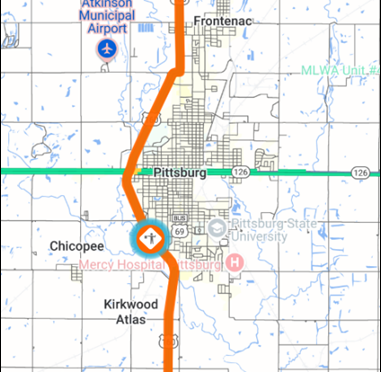
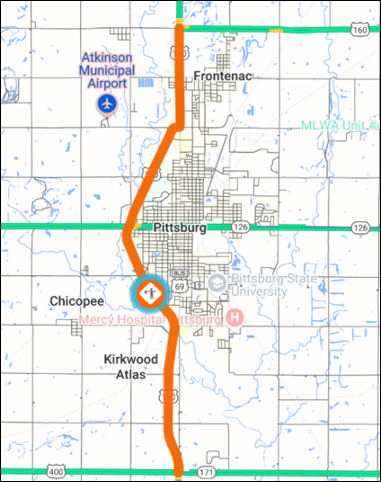
The Kansas Department of Transportation has started a pavement marking project on U.S. 69 at Pittsburg. The project area begins south of U.S. 400/K-171 and continues north for 9.8 miles to U.S. 160.
A mobile operation is placing the pavement markings on the highway, with no significant effects expected to traffic. Flaggers will guide traffic through the work zone at intersections and the railroad crossing. Weather permitting, the work should be completed by the end of May.
KDOT awarded the $495,614 construction contract to Cillessen and Sons Inc., of Kechi. Check KDOT’s updated traveler information website, www.kandrive.gov, for more highway conditions and construction details. Persons with questions may contact Bukola Oni at KDOT-Pittsburg, (620) 308-7617, or Priscilla Petersen at (620) 902-6433.
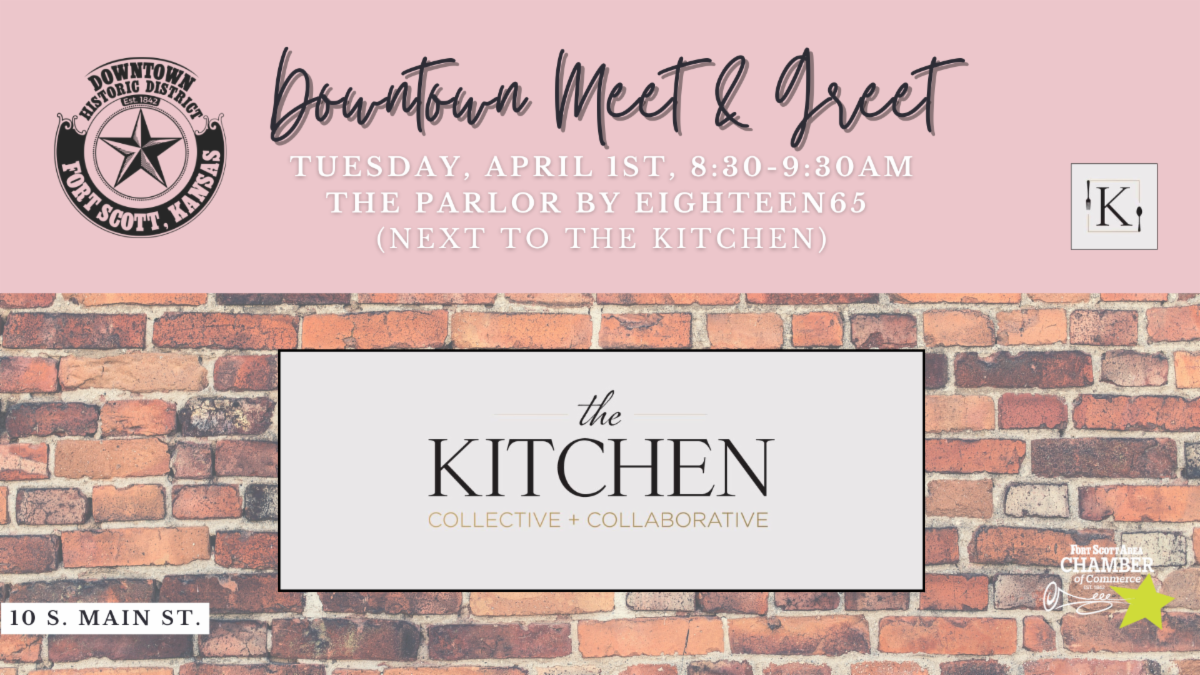
Quarterly Downtown Meet & Greet scheduled for April 1st!
The Fort Scott Area Chamber of Commerce announces a Downtown Meet & Greet will be held Tuesday, April 1st at The Parlor by Eighteen65, adjacent to The Kitchen Collective + Collaborative,
10 S. Main St., from 8:30 to 9:30am.
These informal, quarterly meetings are hosted by the Chamber for downtown business owners, representatives, and community members to network and share ideas on events, promotions, and anything related to downtown. Coffee, juice, and light refreshments will be served.
Contact the Chamber at 620-223-3566 with any questions.
The 2025 regular session ended. Veto session starts April 10th and is scheduled to last two days. Below are a few of the items we worked on last week. All legislation can be found at www.KSLegislature.gov.
Property Taxes the statewide 1.5 mill levy used for building maintenance will be eliminated if CCR 35 becomes law. The Senate passed the tax cut in January. In March, the House gutted the bill and put language in that would repeal transparency (often referred to as Revenue Neutral that requires local governments to vote on property tax increases) and created an option to petition counties and cities to restrict property tax increases over inflation plus new development plus some bonding, but the Senate saw too many issues so asked for a conference committee. The House agreed in conference to put the Senate version back, eliminating the statewide 1.5 mill levy tax cut. Some legislators complained because it is a minimal cut, but a cut is a step in the right direction. Keep in mind, it is a cut that will save you more each year, because you will no longer pay 1.5 mill on your increased valuations. All property taxes will now be to fund local governments, including schools, not state government.
The Senate also passed constitutional amendments that would have gone on a ballot for voters to decide if they want to limit property taxable valuation increases. The county valuation of your property could still increase but the taxable value of your property would be limited in growth each year. The Senate passed it three times by 2/3 majority (in SCR 1603 and HCR 5011, with a 3% limit on a bipartisan vote; and CCR 5011 with a 4% limit). It doesn’t make sense the Senate passed each one with 2/3 majority, and the House rejected the opportunity for voters to decide. The House passed a more clunky version to limit taxable value increases using an average of several years that could still result in double digit increases and would have taken longer to implement because the number of years would have to be defined in statute. The House could still move on SCR 1603 in veto session, but the odds are slim because lobbyists for the Kansas Realtors and others are putting out inaccurate information. SCR 1603 would allow voters to decide if they want a taxable valuation limit of 3%. I say, let the voters decide.
Foreign Adversaries would not be able to own property within 100 miles of a military facility in Kansas and drones or parts for drones made by foreign adversaries could no longer be purchased by government entities, including law enforcement, if CCR 9 becomes law. This would restrict foreign governments from spying. The Senate sent it to the Governor’s desk on a vote of 39 to 1. I voted Yes.
Right To Try experimental drugs if you are out of health options passed the Senate unanimously and was sent to the Governor.
Contingent Fee Contracts by political subdivisions would have a higher level of scrutiny if HB 2228 becomes law. That sounds good, but the bill had some suspicious dates like back dating to July 1, 2024, and sunsetting in 2029. Only 9 other Senators had concerns, so the bill passed with 28 yes votes. I voted No.
Campaign Contribution Limits to candidates would double if the Governor signs CCR 2054 into law. It would also increase contribution limits to political parties. We do not need increased contribution limits. It passed 26 to 14. I voted No.
Kansas Court of Appeals appointment of Lori Bolton Fleming from southeast Kansas, passed the Senate unanimously, which finalized her appointment.
Kansas Supreme Court Justices could be elected if voters decide to amend the Kansas Constitution on the August 2026 ballot. SCR 1611 passed both chambers with 2/3 majority. I voted Yes.
It is an honor and a privilege to serve as your 12th District State Senator.
TOPEKA – Governor Laura Kelly has vetoed Senate Bill 5 and Senate Bill 14. Governor Kelly also allowed House Bill 2106, House Bill 2027, and Senate Bill 105 to become law without her signature.
The following veto message is from Governor Kelly regarding her veto of Senate Bill 5:
“Restricting federal funds for elections and election-related activities without legislative approval is not just unnecessary micromanagement; it undermines our ability to conduct secure and efficient elections.
“Some legislators have voiced concerns about voter fraud and foreign interference, but state and local election officials would be much more capable of addressing these threats if they received necessary funding from Congress. It doesn’t make sense to turn down these resources that make our local elections in Kansas safe, secure, and accurate.
“Given that the Legislature only convenes for three months each year, how can we expect them to approve funding when they are not available year-round? Instead of obstructing our electoral process, lawmakers should concentrate on the real issues impacting Kansans, rather than complicating the management of election funds.
“Therefore, under Article 2, Section 14(a) of the Constitution, I hereby veto Senate Bill 5.”
The following veto message is from Governor Kelly regarding her veto of Senate Bill 14:
“Kansas entered statehood on January 29, 1861. Since that time, every single Legislature has managed to pass a budget that became law. In fact, technically speaking, it’s the Legislature’s only constitutionally required job.
“If this Legislature cannot do what every previous legislature has been able to do since our founding—through periods of war, famine, pandemic, recession, the Dust Bowl, and even the Great Depression—then they will have to do it over my veto because I will not sanction it, nor will the people of Kansas.
“This bill is the latest attempt at legislative overreach into the executive branch and is really nothing more than an invitation to government dysfunction—just like we see in Washington, D.C. Is that what we want for Kansas?
“I am confident that this Legislature will be able to continue the tradition of completing their constitutionally mandated duties, within the constitutionally mandated timeframe just as every one of their predecessors has been able to do.
“Therefore, under Article 2, Section 14(a) of the Constitution, I hereby veto Senate Bill 14.”
The following statement is from Governor Kelly regarding allowing House Bill 2106 to become law without her signature:
“I support stopping foreign influence in our elections so that Kansans can decide what’s best for Kansas. Federal law already prohibits foreign nationals from contributing to federal, state, or local elections. If the Legislature had crafted something similar for Kansas, I would have signed it. But this bill goes too far. I cannot sign a bill that takes away the ability of Kansans and Kansas businesses to support elections if they accept money from overseas for any purpose, not just those related to elections.
“Forcing Kansans to choose between accepting financial support for any reason or surrendering their voice in the political process is wrong. This bill potentially exposes our state to litigation for its limitations on speech and association, possibly violating First Amendment protections in the U.S. Constitution as well as possible equal protection violations of the 14th Amendment of the U.S. Constitution on account of disparate treatment of the people and businesses in Kansas based on whether they have international operations or support.”
The following statement is from Governor Kelly regarding allowing House Bill 2027 to become law without her signature:
“The Legislature passed the so-called HOPE Act in 2015, severely restricting Kansans’ ability to access social service programs like SNAP food assistance, TANF cash assistance, and childcare assistance.
“The HOPE Act was wrong then, and it remains wrong now. Legislators are only trying to put lipstick on a pig, and I refuse to associate myself with the HOPE Act. Now, more than ever, the Legislature should look for ways to support working Kansas families rather than further shredding the safety net that gives Kansans a bridge back to self-sufficiency.”
The following statement is from Governor Kelly regarding allowing Senate Bill 105 to become law without her signature:
“While I understand the Legislature’s desire to have a say in the appointment process for filling vacancies for United States senator, state treasurer and insurance commissioner, this bill puts forth a partisan power grab by the Legislature and includes an overly bureaucratic process ripe for undue influence by special interests.
“Had the Legislature passed a simpler method for modifying the appointment process for these offices, I would’ve signed it into law. However, given my concerns about the messy process this bill creates, the bill will become law without my signature.”
TOPEKA – Governor Laura Kelly has signed Senate Bill 36, which increases the cap on the amount of money conservation districts can receive from the division of conservation and increases the amount of matching dollars the state can provide conservation districts.
“Addressing our state’s diverse water quality and quantity challenges will require on-the-ground action from local partners who know their communities the best,” Governor Laura Kelly said. “This bill strengthens local capacity by providing our state’s conservation districts the resources they need to effectively implement state and federal natural resource programs.”
Under Senate Bill 36, the matching basis for state moneys disbursed to conservation districts will be based on amounts allocated by the board of county commissioners for such districts.
“Kansas Conservation Districts have been a vital part of responsibly maintaining our water supply and protecting against erosion for over eight decades,” said Representative for House District 116 Kyle Hoffman. “By ensuring these districts have the resources necessary to continue their important work, we are taking critical steps toward the future of agriculture in Kansas.”
This bill doubles the amount of money conservation districts can receive from $25,000 to $50,000 and makes matching dollars a $2 division contribution for every $1 from counties to match the funds allocated by county commissioners.
“Doubling the matching funds available could allow the district to hire a second staff member to focus on education and outreach,” said Senator for District 2 Marci Francisco. “Helping our farmers understand the advantages of conservation practices such as cover crops could in turn have a significant impact on both soil health and crop quality.”
In addition to Senate Bill 36, Governor Kelly also signed the following bipartisan bills:
Senate Bill 6: Reaffirms current law prohibiting the use of ranked-choice voting methods for conducting elections.
Senate Bill 58: Modifies the requirements and allocations for multi-year flex accounts, providing for additional flexibilities to maximize the efficiency of water usage and conservation.
House Bill 2254: Ensures Kansas milk producers are financially protected by requiring milk processors to hold payments in trust for producers until full payment is received.
House Bill 2085: Extends the expiration of permits issued under the water pollution control permit system from five to 10 years.
House Bill 2166: Continues existing exceptions to the disclosure of public records under the open records act pertaining to sensitive personal medical information.
House Bill 2182: Clarifies that victims shall not be charged a fee for service of process by a sheriff’s office under the Kansas protection order acts; with the goal of ensuring that said fee does not deter victims from pursuing a protection order for their safety.
House Bill 2238: Directs legislative administrative services to prepare all committee minutes.
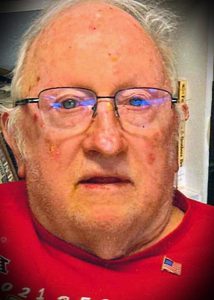
Warren Edward Knight, a quiet kind man, passed away Wednesday, March 26, 2025 in Fort Scott, KS. Warren was 88 years old.
He was born in Centerville Kansas on April 27, 1936 to hard working and loving parents Harry Austin and Minnie Belle (Kline) Knight. He graduated from Parker High School in 1954 while he helped on the family farm near Centerville, KS.
He went on various adventures after High School, then served as a Private First Class in the United States Army in the 47th Field Hospital, 67th Medical Group at Fort Sam Houston Texas and continued his service to others as a member of the American Legion Post 25 in Fort Scott, KS.
He was an excellent Carpenter for Capital Federal as a member of the International Painters and Allied Trades Union in the Kansas City area until his retirement in 2000. His passion and work ethic were inspirational to anyone who was privileged enough to witness it.
Warren was a confirmed bachelor until he met Erma Rose (Sluder). They married on October 17, 1975 and then spent many enjoyable years together. Family was important to Warren and he could always be found at family reunions smiling at the camera, pitching horseshoes that spun like a Frisbie, and making everyone laugh with his unexpected wit.
Watching the Kansas City Chiefs, Kansas City Royals, collecting old car license plates, coins, and other memorabilia were things Warren enjoyed doing. He loved old cars and could talk about every one he owned and what it meant to him.
Warren was preceded in death by his wife Erma, his parents, and 10 siblings: Willard, Francis, Wendell, Enid, Thelma, Kenneth, Maurine, Harold, Carolyn and H. Roger.
Warren is survived by many loving nieces and nephews, a step-daughter, step-granddaughter, and step-great granddaughter.
Memorial Service will be held at the Fort Scott National Cemetery on April 8, 2025 at 11:00am. In lieu of flowers, donations can be made to American Legion Charities or Medical Lodge of Fort Scott.
Graveside services will be held at 11:00 A.M. Tuesday, April 8th at the U. S. National Cemetery.
Military honors will be provided by the American Legion.
Services are under the direction of the Cheney Witt Chapel. Memorials are suggested to the Medicalodge Activity Fund or the American Legion and may be left in care of the Cheney Witt Chapel, 201 S. Main, P.O. Box 347, Ft. Scott, KS 66701. Words of remembrance may be submitted to the online guestbook at cheneywitt.com.
Students at Fort Scott High School joined the national grassroots effort called Theatre in Our Schools Month (TIOS) to advocate for the benefits of theatre education in schools in the month of March. Members of International Thespian Society (ITS) Troupe #7365 drew attention to the need for increased access to quality theatre programs for all students.
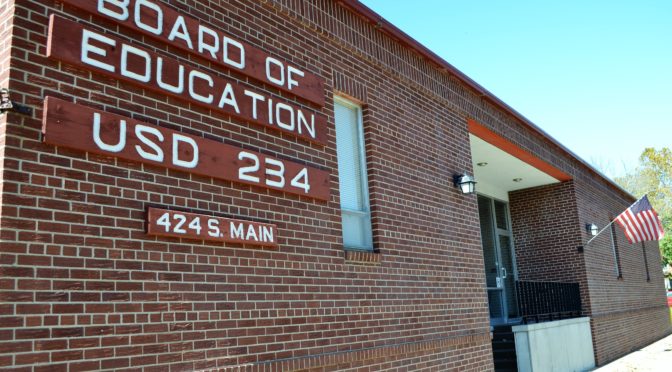
To get the word out, students participated in a number of theatre related activities. On Feb. 26 and 28 the troupe participated in community service activities at the Senior Center in downtown Fort Scott. They had a Theatre in Our Schools Month Kick-Off Party on March 4 at the Museum of Creativity. On March 6, the troupe traveled to Topeka to meet with Thespians from across the state and Senator Tim Shallenburger and Representative Rick James to celebrate and discuss Theatre Advocacy Day in KS. Troupe President Cooper George and Secretary Emi King presented to the USD 234 Board of Education on March 10.
Throughout the month, the troupe dressed to represent various musicals on Musical Mondays and wore theatre-related shirts on Theatre Shirt Tuesdays. They also had Improv Acting Troupe practice on Tuesdays after school and FSMS Drama Club on Fridays after school. All Drama class students learned about mask use in theatre and created their own masks using plaster strips molded to their own faces. Masks were on display in the Art Gallery throughout the month. Drama classes also held a Creative Costuming contest using a tote full of miscellaneous items to create a unique costume. Technical Theatre classes designed costumes for a specific character based on costuming the school has on hand in our wardrobe. To finish out the month, the troupe saw the FSCC production of “No Exit” on March 26 and held the annual FSHS Talent Show & Minute to Win It on March 28.
The ITS is the theatre honor society for middle and high school students. These Thespians plan and implement TIOS activities in their schools, in their communities, and with elected officials. The presentations and activities explain how theatre education positively shapes students’ lives by instilling necessary life skills. TIOS Month is an opportunity for students, parents, communities, school boards, and elected officials to come together to make theatre education more available to all students. One of the key messages is that theatre skills help students develop vital 21st-century skills like communication, collaboration, creativity, and critical thinking, as well as social/emotional skills critical to students’ growth as young adults.