Shane Walker, who worked for the county for 21 years, claims he was fired while on medical leave in retaliation for his wife’s discrimination complaints — and that a commissioner later told someone as much.
Case number: 26-CV-01057-DDC-ADM
Court: U.S. District Court, District of Kansas
Trial location: Kansas City, Kansas
Plaintiff’s attorney: Gaye B. Tibbets, Hite, Fanning & Honeyman L.L.P., Wichita, KS
Jury trial: Requested
Shane Walker, who served as Bourbon County’s Chief Information Officer for several years before his July 2025 layoff, has filed a federal lawsuit against the county, three county commissioners, and an HR contractor. Walker alleges he was let go while on approved medical leave in retaliation for discrimination complaints he and his wife, County Clerk Susan Walker, had filed against the county. The suit was filed March 9, 2026 in the U.S. District Court for the District of Kansas and raises ten separate legal claims including breach of contract, retaliation under federal civil rights law, First and Fourteenth Amendment violations, and violations of the Family and Medical Leave Act.
Everything described in this article comes from Walker’s complaint and the documents attached to it. These are allegations — none have been proven in court. The county and the individual defendants named in the suit have not yet filed their responses.
Timeline of Court Filings
- March 9, 2026
Original Complaint filed — Walker files his initial 21-page complaint in U.S. District Court for the District of Kansas.
Document 1, p.1 - March 9, 2026
Civil Cover Sheet filed — Standardized JS 44 form establishes the case docket. Lists primary cause of action as 42 U.S.C. § 1983 with a brief description of “Breach of contract.” Checks boxes for Family and Medical Leave Act (§751) and Civil Rights (§440).
Document 2, p.1 - March 9, 2026
Designation of Place of Trial — Walker initially designates Wichita, Kansas as the trial location.
Document 3, p.1 - March 9, 2026
Amended Designation of Place of Trial — Walker amends the trial location to Kansas City, Kansas.
Document 4, p.1 - March 9, 2026
Request for Jury Trial — Walker requests a trial by jury on all claims triable to a jury.
Document 5, p.1 - March 10, 2026
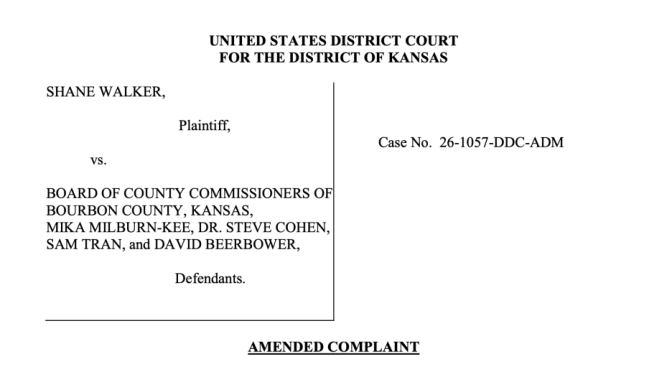
Amended Complaint and Employment Agreement Exhibit filed — Walker files a 21-page Amended Complaint (Document 6) with an attached Exhibit A, his June 7, 2022 employment contract (Document 6-1).
Document 6, p.1 | Document 6-1, p.1
Background: Walker’s Employment History
Shane Walker, 56, started working for Bourbon County on December 15, 2005 and, according to the complaint, spent 21 years there without a single disciplinary or performance issue. (Amended Complaint [AC], ¶¶1, 9) None of the positions he held were policymaking roles. (AC ¶10) In late 2024 he was also appointed Deputy Register of Deeds — without any additional pay — to fill in for the elected Register of Deeds when she was unavailable. (AC ¶11)
Walker was laid off on July 9, 2025, when his salary was $88,616.84. (AC ¶12) He was re-hired by the elected Register of Deeds on November 17, 2025 at $16 per hour for archiving work — a position of at least 30 hours per week. (AC ¶64)
The Employment Contract
In 2022, Walker served as the county’s Chief Information Officer (CIO) at an annual salary of $82,617.60. (AC ¶14) On June 7, 2022, he and the county entered into a formal written employment contract. (AC ¶15; Employment Agreement, p.1) The contract included several key provisions:
- Vacation: 28 days of paid vacation per year (carry-over permitted) plus 20 days at the beginning of each year to be used by December of that year. (AC ¶15a; Employment Agreement ¶7)
- Term and auto-renewal: The agreement ran from May 1, 2022 through December 1, 2025, and renewed automatically for one-year periods unless either party gave the other 45 days written notice of termination prior to expiration. (AC ¶15b; Employment Agreement ¶8)
- Severance: If Walker were terminated before expiration for reasons other than “any unethical or improper act involving personal gain,” the county agreed to pay 60 days aggregate salary plus accumulated vacation and sick leave. The complaint identifies this amount as $20,448. (AC ¶15c; Employment Agreement ¶9A)
The complaint alleges that in January 2023, the county passed a resolution claiming to “negate” or “cancel” all employee contracts — but that it never gave Walker the required 45-day written notice of termination. (AC ¶17) The complaint includes an excerpt from the minutes of the county’s January 24, 2023 meeting in which a county official explains the resolution. (AC ¶18)
The complaint states the county did pay some vacation through January 2023, but that the rest of the contract promises — including the 60-day severance — were never paid. (AC ¶19) On August 22, 2025, Walker’s attorney sent a written demand for the contractual damages and unpaid vacation and sick leave. The county declined to respond. (AC ¶24)
Protected Activity: Discrimination Complaints and Advocacy
Susan Walker and her complaints
Shane Walker has been married to Susan Walker since May 19, 2023. Susan Walker currently serves as the elected Bourbon County Clerk and previously served as the county’s Chief Financial Officer. The complaint notes all defendants were aware of the marriage. (AC ¶25)
In September 2024, Susan Walker filed an administrative complaint with the KHRC alleging gender and age discrimination and retaliation in the terms and conditions of her employment. She specifically complained that then-commissioners Harris and Beth were rude and dismissive to her and other female employees, that the county would not let her transfer to another position, that her work was being scrutinized more closely than male employees, and that she was being excluded from work-related conversations while having her employment threatened. (AC ¶37)
In February 2025, Susan Walker sued the county in state court for breach of her written employment contract, which was similar to her husband’s. (AC ¶39) When the county failed to respond to the properly served summons, a judge entered a default judgment of $199,527.04 against the county on May 5, 2025. (AC ¶40) The default judgment was later set aside by agreement, with the county paying $8,000 in legal fees to Susan Walker’s attorney; the order setting it aside was not entered until September 2025. (AC ¶41) Susan Walker’s discrimination, retaliation, and breach of contract claims ultimately settled in 2026, before this federal lawsuit was filed. (AC ¶43)
The complaint also alleges that Commissioner Tran, during a public meeting in which Susan Walker was explaining a report, derisively said to her: “Oh, are we going to talk about your feelings again?” The complaint states no commissioner had ever made such a statement to a male county employee. (AC ¶38)
Shane Walker’s own advocacy
In the summer of 2024, Shane Walker wrote a letter to county commissioners “in support of my wife and all the other women in our organization,” complaining of Commissioners Beth’s and Harris’s “lack of respect for woman (sic) in positions of authority and even with taxpayers who come to our meetings who are not men.” He concluded that “the other very professional women of our organization deserve to be treated with the same respect as anyone else.” (AC ¶26) The complaint notes Walker wrote the letter as a private citizen, not as part of his job duties. (AC ¶28)
Walker says he also made his views known to each of the three commissioners named in the suit: he spoke with Beerbower when Beerbower joined the commission on January 13, 2025 (AC ¶31); with Milburn-Kee when she joined in April 2025 (AC ¶32); and with Tran before Tran took office. (AC ¶33)
Walker’s 2024 age discrimination complaint
On September 30, 2024, Walker filed a complaint with the Kansas Human Rights Commission (KHRC) alleging age discrimination and retaliation. The filing was prompted by what Walker says was different treatment compared to younger employees, and by statements commissioners Beth and Harris allegedly made during a 2024 executive session about wanting to fire Walker and replace him with a younger trainee. (AC ¶¶34–35) (Beth and Harris were commissioners at that time but are no longer on the commission and are not named as defendants in this lawsuit — the current defendants are Commissioners Milburn-Kee, Tran, and Beerbower, along with HR contractor Dr. Cohen.) Walker was not terminated in the ten months that followed that filing. (AC ¶36)
The Layoff
IT outsourcing and the lead-up to termination
Walker’s primary job duty was responsibility for the county’s IT services. (AC ¶44) During the week of June 13, 2025 — while Susan Walker’s default judgment was still pending — Commissioner Milburn-Kee suggested that the county’s network infrastructure have a “health check.” The commission hired an organization called Stronghold to perform the check. The complaint states no commissioner had previously mentioned hiring an outside agency for IT services. (AC ¶45)
Commissioner Milburn-Kee then insisted she be given server passwords in her role as commissioner. Walker and his coworker, Jimmy Kemmerer, refused to disclose the confidential information. (AC ¶46) A confrontation ensued and Kemmerer called police. The county fired Kemmerer for cause on July 2, 2025. (AC ¶47)
FMLA leave and termination
The complaint alleges that because of the discrimination and retaliation suffered by himself and his wife, Walker’s blood pressure rose to a dangerous level in June 2025. (AC ¶49) On June 24, 2025, Walker wrote to the commissioners complaining that he was being retaliated against because of his association with his wife and their discrimination complaints. (AC ¶48)
Walker applied for and was granted intermittent FMLA leave on June 26, 2025 and began working reduced hours. He remained on FMLA leave until he was terminated. (AC ¶50) The complaint alleges that all commissioners and Dr. Cohen were aware Walker was on FMLA leave when the termination decision was made. (AC ¶55)
Walker was given one week’s notice prior to his July 9, 2025 layoff — less than two weeks after his FMLA leave began. The complaint notes this layoff came ten months after his KHRC age discrimination filing; two months after his wife’s default judgment against the county; two weeks after his June 24 retaliation letter; less than six months after his statements to Beerbower and Milburn about gender discrimination; and two weeks after he began FMLA leave. (AC ¶56)
The complaint states the vote to terminate Walker was unanimous — all defendants voted in favor and Dr. Cohen did not counsel against it. (AC ¶58) The commission publicly claimed it outsourced the IT department to save money. (AC ¶59)
The complaint includes an allegation that goes to the core of the retaliation claim. After the layoff, the complaint states:
“Commissioner Beerbower told a county employee that the County commissioners ‘got rid of Shane’ because they ‘could not get rid of Susan.'”
Because Susan Walker is an elected official, the complaint notes, the commissioners cannot terminate her. (AC ¶¶58–60; AC ¶¶87–88)
The complaint disputes the county’s cost-savings rationale, alleging the outsourcing decision was more expensive, less effective, and more time-consuming than retaining Walker. The complaint states current estimates put costs at double, that performance has been less efficient, that security issues have occurred, and that three different elected officials have circumvented the new IT system because of difficulties getting assistance. (AC ¶61)
Walker’s second KHRC complaint
On September 9, 2025, Walker filed a second KHRC complaint alleging his layoff was motivated by his association with his wife, retaliation for his gender discrimination advocacy, age discrimination, and retaliation for his 2024 age discrimination complaint. His original 2024 complaint was still pending at that time. (AC ¶62)
Post-Layoff: Alleged Continued Retaliation
When Walker was re-hired by the Register of Deeds in November 2025, the complaint alleges the commissioners and Dr. Cohen continued to interfere:
- Health insurance: County policy provides health insurance to employees working 30 or more hours per week. Walker worked at least 30 hours. Despite this, Commissioner Milburn-Kee called the HR department and told them Walker should not be on the county’s health insurance. The complaint states no other 30-hour employee who had not filed administrative complaints had a commissioner attempt to interfere with their health insurance. (AC ¶¶65–67)
- Seniority and benefits — “bridging”: County policy (called “bridging”) was to restore seniority, vacation, and sick leave for employees re-hired by elected officials. The complaint states the sheriff had done this several times without commissioner interference. In Walker’s case, defendants changed his employment records to set his seniority date to 2025, preventing bridging. The complaint states he was the only laid-off employee ever prevented from bridging by the County Commissioners. (AC ¶¶69–72)
- Cohen’s statement to the Register of Deeds: The complaint alleges Dr. Cohen called the elected Register of Deeds and told her the commissioners were upset that she had re-hired Walker “because of his lawsuits.” The complaint clarifies that Walker had no active lawsuits against the county — only pending administrative complaints — and argues this statement is direct evidence of retaliatory motive. (AC ¶¶74–75)
- HR administrator’s statement: The county’s HR administrator also pushed back on the hiring, telling the Register of Deeds that the commissioners did not “understand why you would hire someone who is suing the county.” (AC ¶97)
- Beerbower’s FMLA comment: After Walker was re-hired, Commissioner Beerbower referred to his earlier use of FMLA medical leave as “Shane’s antics.” (AC ¶54)
The Ten Legal Claims
- Count I — Breach of Contract against Bourbon County: County failed to provide required 45-day written notice of contract termination and failed to pay the 60-day severance ($20,448) and enhanced vacation pay for 2023–2024 and 2024–2025. (AC ¶¶77–81)
- Count II — Kansas Wage Payment Act (KWPA) against Bourbon County, Cohen, Beerbower, Milburn-Kee, and Tran: The severance and vacation pay constitute “wages” under Kansas law (K.S.A. 44-323); defendants willfully withheld them, exposing defendants to wages plus a 100% penalty under K.S.A. 44-315(b). (AC ¶¶82–85)
- Count III — Title VII Retaliation against Bourbon County: Termination and post-termination benefit interference in retaliation for Walker’s association with his wife, who engaged in protected Title VII activity. (AC ¶¶86–89)
- Count IV — Title VII Retaliation against Bourbon County: Retaliation for Walker’s own advocacy against gender discrimination, which constitutes protected activity under Title VII. (AC ¶¶90–93)
- Count V — Title VII Retaliation against Bourbon County: Retaliation for Walker’s September 2024 KHRC complaint alleging age discrimination. (AC ¶¶94–98)
- Count VI — 42 U.S.C. § 1983 / First Amendment (Free Speech) against Beerbower, Cohen, Tran, and Bourbon County: Walker’s complaints about gender discrimination were protected speech on a matter of public concern, made as a private citizen. Defendants retaliated against him for that speech. (AC ¶¶99–103)
- Count VII — 42 U.S.C. § 1983 / First Amendment (Right of Association) against Bourbon County: Terminating Walker and denying his benefits because his wife engaged in protected litigation and complaints violates his First Amendment right to associate with his spouse. (AC ¶¶104–108)
- Count VIII — 42 U.S.C. § 1983 / Fourteenth Amendment (Due Process) against all defendants: Defendants deprived Walker of contractual property rights — including the 60-day severance, 48 days vacation per year, and health insurance — without due process. (AC ¶¶109–113)
- Count IX — Title VII Retaliation against Bourbon County: Retaliation for Walker’s September 2025 KHRC complaint (filed after the layoff). (AC ¶¶114–119)
- Count X — FMLA Retaliation and Interference against Bourbon County and Dr. Cohen: Walker was terminated less than two weeks after being approved for FMLA leave, while still on that leave. The complaint alleges this both constitutes retaliation and deprived Walker of his right to reinstatement at the end of the FMLA period. (AC ¶¶120–125)
Understanding the EEOC Process and the Right to Sue
Under Title VII of the Civil Rights Act and the Age Discrimination in Employment Act (ADEA), an employee generally cannot file a federal lawsuit until they have first filed a charge with the Equal Employment Opportunity Commission (EEOC) and received a “Right to Sue” letter.
According to the EEOC:
“If we are unable to conciliate the charge, we will then decide whether to file a lawsuit to protect individuals or the public interest. If we decide not to file a lawsuit, we will close the charge and issue a Notice of Right to Sue, which gives the charging party 90 days to file a lawsuit.”
A Right to Sue letter does not mean the EEOC found that discrimination occurred — it is authorization to proceed to federal court.
Walker filed his first KHRC/EEOC complaint on September 30, 2024 (AC ¶34) and his second on September 9, 2025. (AC ¶62) He received a Right to Sue letter covering both his 2024 and 2025 EEOC complaints on December 10, 2025. (AC ¶76) This lawsuit was filed on March 9, 2026 — within the required 90-day window. (AC ¶76)
In Kansas, employees may also file complaints with the Kansas Human Rights Commission (KHRC), which operates in a worksharing agreement with the EEOC, meaning a complaint filed with one agency is automatically cross-filed with the other.
Understanding FMLA: Why It Matters Here
The Family and Medical Leave Act (FMLA), enforced by the U.S. Department of Labor, provides eligible employees of covered employers with up to 12 weeks of unpaid, job-protected leave per year for qualifying medical reasons, including a serious health condition.
The Department of Labor states:
“The FMLA prohibits interference with an employee’s rights under the law, and prohibits an employer from retaliating against an employee for opposing any practice, or because of involvement in any proceeding, related to FMLA.”
The law also entitles an eligible employee to be restored to the same or an equivalent position upon return from FMLA leave.
Source: U.S. Department of Labor: FMLA Frequently Asked Questions
The complaint alleges Walker was approved for intermittent FMLA leave on June 26, 2025 (AC ¶50) and was terminated less than two weeks later, on July 9, 2025, while still on that leave. (AC ¶122) The complaint further alleges that had he been allowed to continue his FMLA leave, he would have recovered and returned to the same position. (AC ¶125)
Relief Sought
The complaint seeks the following relief across the ten counts:
- 60-day severance pay ($20,448) plus prejudgment interest (AC, Count I prayer)
- 48 days per year vacation pay for 2023–2024 and 2024–2025 (AC, Count I prayer)
- Wages due plus a 100% penalty under the Kansas Wage Payment Act (AC, Count II prayer)
- Back pay and front pay or reinstatement (AC, Count III prayer)
- Compensatory damages for mental distress (AC, Count VI prayer)
- Medical costs related to increased blood pressure attributed to defendants’ actions (AC, Count VI prayer)
- Punitive damages against individual defendants Tran, Beerbower, Milburn-Kee, and Cohen (AC ¶103)
- Liquidated damages under FMLA (AC, Count X prayer)
- Attorneys’ fees and costs
Court Documents
All documents are from Case No. 26-CV-01057-DDC-ADM, U.S. District Court for the District of Kansas.
- Document 1: Original Complaint — Filed March 9, 2026 (21 pages)
- Document 2: Civil Cover Sheet — Filed March 9, 2026
- Document 3: Designation of Place of Trial (Wichita) — Filed March 9, 2026
- Document 4: Amended Designation of Place of Trial (Kansas City) — Filed March 9, 2026
- Document 5: Request for Jury Trial — Filed March 9, 2026
- Document 6: Amended Complaint — Filed March 10, 2026 (21 pages)
- Document 6-1: Exhibit A — Employment Agreement — Filed March 10, 2026 (3 pages)
This article is based solely on court documents filed by Shane Walker. All descriptions of events are allegations and have not been proven in court. Bourbon County and the named defendants have not yet responded to the complaint and their side of the story is not reflected here.