FORT SCOTT — Lab tests commissioned by Bourbon County found asbestos in damaged pipe insulation and fittings in the courthouse, according to reports in the commission’s Oct. 19 agenda packet under “Asbestos Report – Beerbower.”
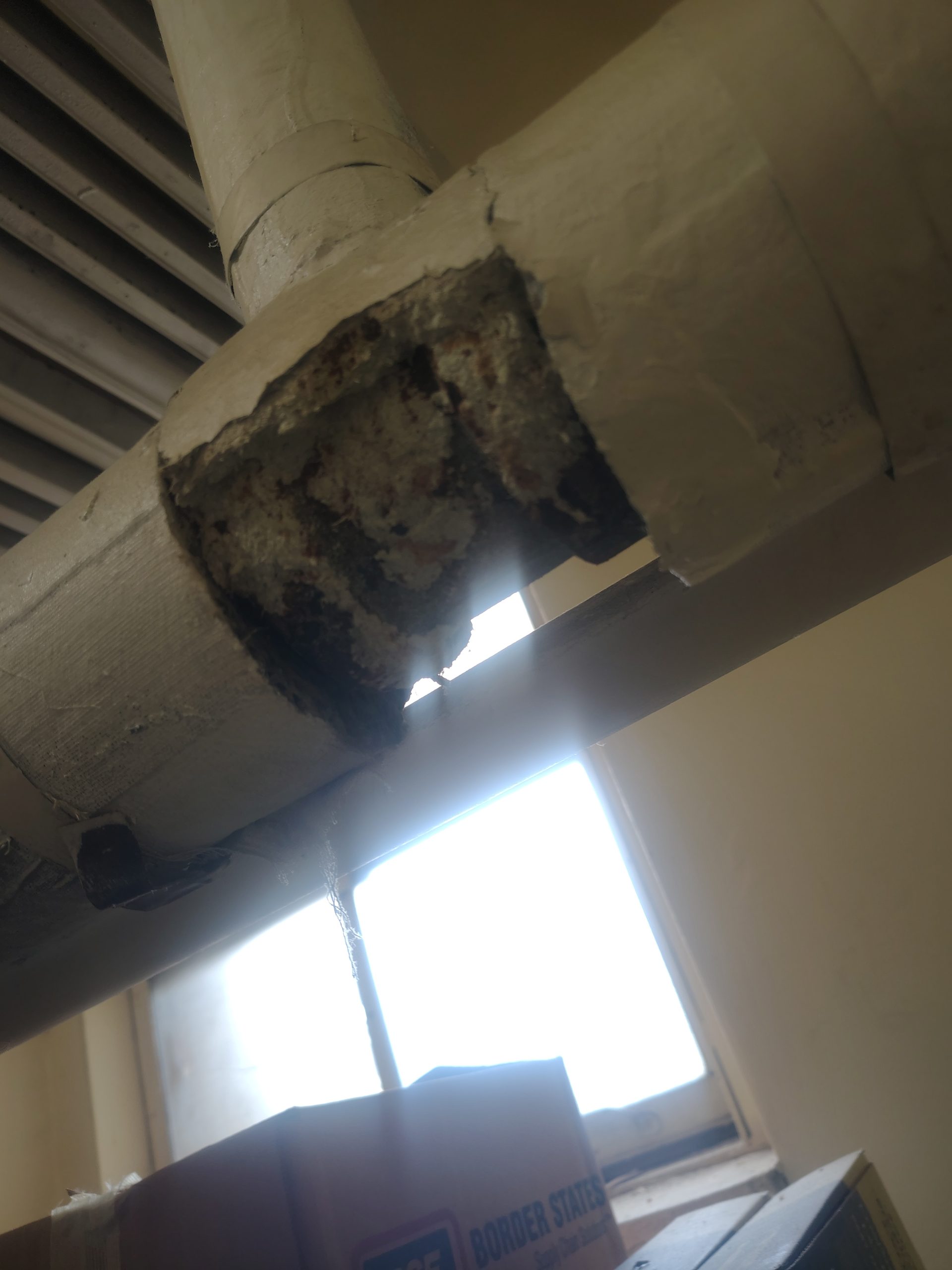
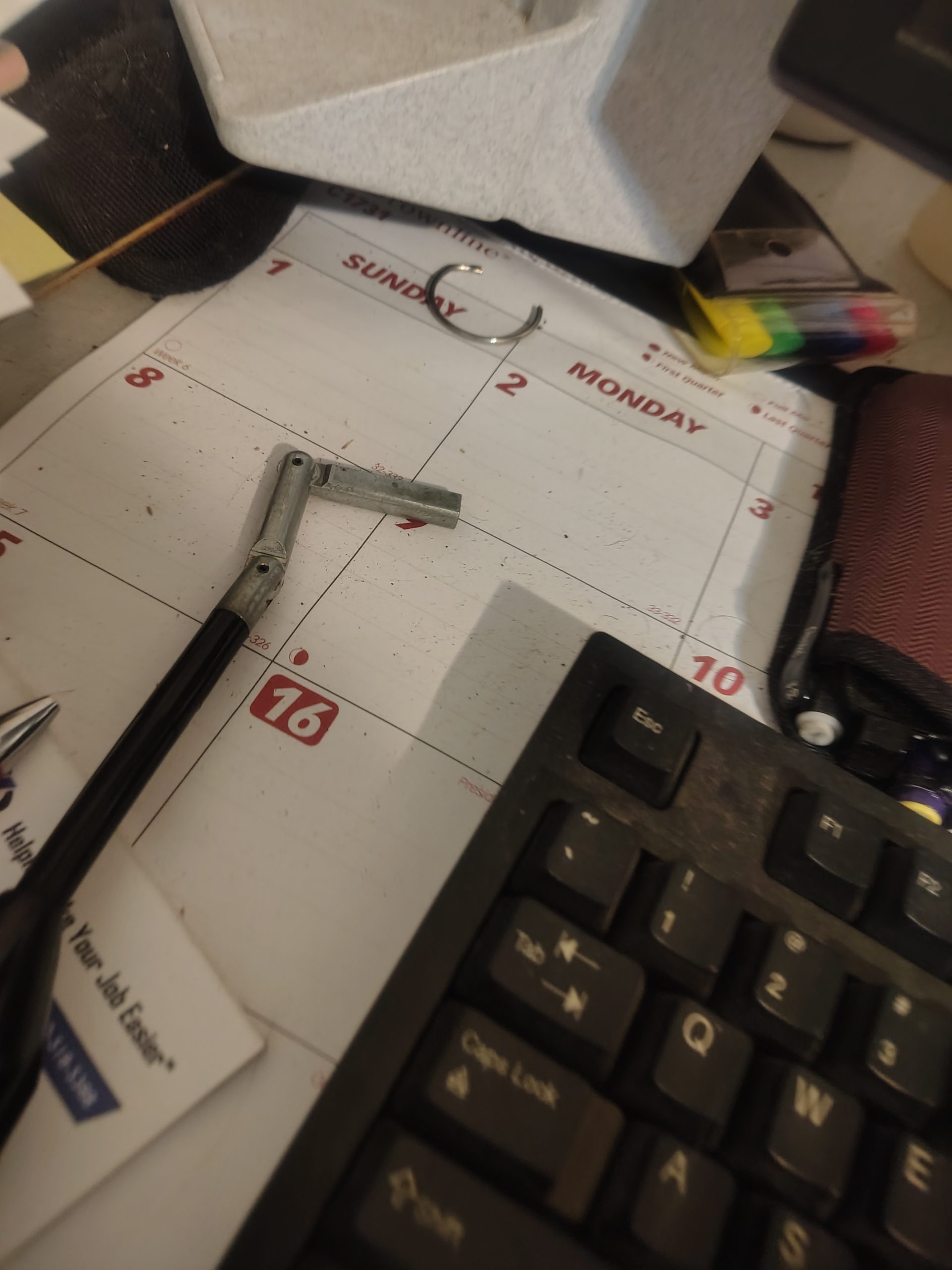
An environmental firm, APEX Environmental Consultants, took the samples Sept. 29. Schneider Laboratories reported results Oct. 5. All three samples of mudded pipe fittings were 55% chrysotile asbestos. All three samples of pipe insulation were 45%. EPA treats anything over 1% as asbestos-containing. The samples came from the North Custodial Room, the Custodial Restroom and the South Custodial Room in the courthouse basement. APEX rated the material “friable/damaged.” In its recommendations, it said the insulation “is on the verge of a fiber release incident.” Previous photos show the insulation from the pipe insulation accumulating on the desk below the damaged area.
APEX recommends removal by a KDHE-licensed contractor, with advance notice to KDHE. It said more suspect material may be present in the boiler room and elevator room and has not been quantified. Flooring samples from the district court jury room and judge’s chambers showed no asbestos. APEX called the survey limited and “not intended to be a full asbestos inspection.”
Insulation at a pipe joint in the courthouse basement, from one of the photos William Jackson sent his supervisor May 29. (Photo by William Jackson)
Air samples
APEX also took five air samples in the building. Measured fiber concentrations were all below APEX’s clearance level of 0.010 fibers per cubic centimeter, ranging from 0.0032 to 0.0075. The method counts fibers of a certain size but does not identify what they are.
Separately, APEX took two bulk samples of foyer drywall at 108 W. 2nd St., the building the district court is to use during the elevator shutdown. The lab detected no asbestos in either.
The report text raises several questions
How much damage. The recommendations say “nearly 3 linear feet of the subject pipe insulation fittings” were damaged and asbestos-containing. The results table lists about 600 linear feet of the insulation, “friable/damaged,” and 13 fittings.
“Abatement.” The air-monitoring letter calls its work “post-abatement clearance sampling… following the abatement project.” FortScott.biz has found no record of an abatement.
“Residence.” Both inspection letters say the survey covered “the subject residence.” The building is the courthouse.
FORT SCOTT — Bourbon County has finally had its courthouse inspected for asbestos, and a report is on the commission’s agenda for Monday night.
An environmental firm did the inspection Sept. 29, under a contract the commission capped at $5,000. The Oct. 19 agenda lists “Asbestos Report – Beerbower,” two days before the courthouse elevator goes out of service for renovation.
Long before anyone took a sample, the public was told the building was fine. In July, then-Chairman Samuel Tran said the state had given the courthouse “a clean bill of health” and that “for the general public, we’re fine.” In September, he said the asbestos issue only became a controversy because “somebody took it and broadcast it all over the news prior to coming to the board.”
Monday’s report should show whether the building is safe for the public and for county employees. Tran’s claim that there would have been no controversy if “somebody” had brought the issue to the board instead of to news outlets can be checked against the record now.
What Jackson reported, and what happened next
On Friday afternoon, May 29, courthouse maintenance employee William Jackson sent his supervisor, Laura Krom, executive assistant to the county commission, a text message with photos of crumbling pipe insulation in the courthouse basement and asked for permission to have it tested for asbestos, FortScott.biz reported in June. He also photographed dust he said was collecting on desks in the basement work area.
Insulation at a pipe joint in the courthouse basement, one of the photos Jackson sent his supervisor on May 29. (Photo by William Jackson)Dust on a desk in the basement work area, photographed by Jackson on May 29. (Photo by William Jackson)
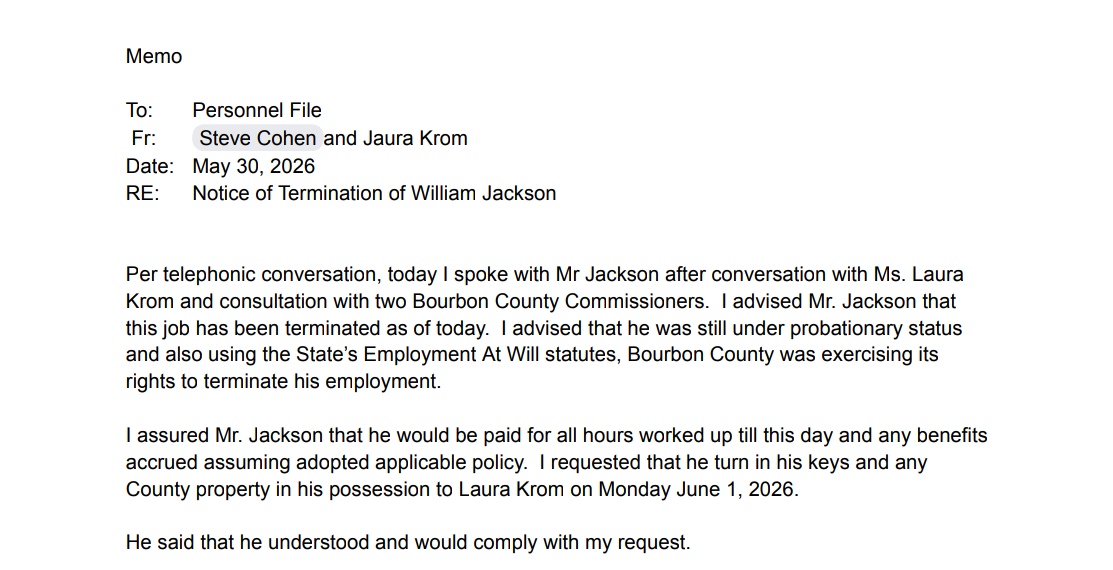
The next morning, the county’s contracted human resources consultant, Dr. Steven Cohen, told Jackson by phone that he was terminated. The termination memo, from Cohen and Krom to Jackson’s personnel file, says Cohen spoke with Jackson “after conversation with Ms. Laura Krom and consultation with two Bourbon County Commissioners.” It cites his probationary status and Kansas at-will employment. May 30 was his 90th day.
The May 30 termination memo. (Provided by William Jackson)
The memo does not name the two commissioners, but commissioners Gregg Motley, Joe Allen and David Beerbower all say they were not consulted about the firing. That leaves Commissioners Mika Milburn-Kee and Samuel Tran, who was chairman at the time.
“A clean bill of health”
In mid-June, a Kansas Department of Health and Environment representative walked the basement with county Emergency Manager Lou Howard. It was a visual look; no samples were taken. Howard told FortScott.biz the representative “did not see anything that was concerning,” but added: “He did say that if there was active construction going on at the time, then it would be a concern.”
FortScott.biz asked county officials about it the same day. Milburn-Kee said someone had given “a verbal” account and that “it wasn’t a negative report — like it wasn’t bad,” though she had nothing in writing and had not spoken with KDHE herself. Krom said she had not seen it but had “heard that the report is complete.”
Jackson came to the July 6 commission meeting to raise the same concerns he had communicated to his supervisor the day before being fired. “If there is no hazard, prove it,” he said. “Release the inspection records, show the testing, let the facts speak.” (video, 15:57)
Near the end of that meeting, Tran took up “the issue of health and wellness of the people within the building itself” (video, 1:55:38):
“KDHE did come through the building. They did tour the building. They did inspect the building. They gave us a clean bill of health.”
He said that did not mean the building was free of asbestos or lead, but that KDHE “did see it, they did annotate it, they gave us a clean bill of health. … So for the general public, we’re fine. As long as you don’t go eating it, licking it, crumbling it, and breathing it, you’ll be fine.”
Milburn-Kee replied: “Actually, I heard you could eat it, you just shouldn’t breathe it.” (video, 1:57:08)
There was no report, and no “clean bill of health” that could be verified. When the Bourbon County Monitor requested the documentation the county produced a single memo Krom wrote on July 8, two days after Tran spoke. Not only was there no KDHE “bill of health” attached, the memo specifically said KDHE would not issue anything in writing. Further it said that KDHE “only regulates asbestos in connection with construction or demolition, not deterioration alone.” This apparently put the deteriorating pipe insulation falling onto an employee’s desk outside KDHE’s purview.
“Asbestos is a federal EPA issue. KDHE cannot give us a clean bill of health. The only time the state’s involved is when there’s construction surrounding asbestos.”
“Some people are afraid to come in the courthouse, whether their fears are justified or not,” Motley said. Allen said some county employees “refuse to go down there now” (video, 2:20:46). When the board asked for a volunteer to take on the issue, Tran said, “I’m not volunteering” (video, 2:21:25). Motley took it.
On Aug. 31, Motley reported that asbestos expert Dr. Arthur Frank told him “we definitely need to have it tested” (video, 58:06). That night Milburn-Kee moved to have the entire courthouse tested; the motion failed. Two days later, she brought a testing firm to the board, and commissioners voted to hire it.
“Broadcast it all over the news”
On Sept. 21, Beerbower wanted to bring resident Michael Hoyt to the inspection. Milburn-Kee moved that the inspection be limited to “the employees, the elected official, the contractors,” and Tran seconded (video, 52:58). In the discussion that followed, Tran said (video, 54:04):
“This has been known in this building for a while, way before you became commissioner, way before I became commissioner, and it became a controversy because somebody took it and broadcast it all over the news prior to coming to the board with the results.”
“Yes, we have an issue, we’re trying to fix it,” he added. “But it didn’t need to be blown out of proportion.” The motion passed 3-1, with Beerbower opposed.
William Jackson was the one who raised the issue. According to his account, he had been fired for doing exactly what Tran said he had not done: raising the issue with the board first. He sent a written request with photos to the commission’s own executive assistant on Friday, May 29. Tran, Milburn-Kee, Krom and Cohen then decided to fire him, and he was told Saturday morning, less than a day after he sent the request.
Tran’s complaint points to a proper path: bring the concern to the board before going public. Jackson took that path, and within hours Tran was part of the decision to fire him. Tran did not say what Jackson should have done differently. Jackson’s photos reached the news only after he had raised the issue through his supervisor and been fired.
What Monday should answer
On Oct. 5, Beerbower told the board the inspection “did happen” but he had not received results (video, 1:16:11).
The report should say whether the material Jackson photographed contains asbestos and whether air samples in the building found fibers. If the insulation is asbestos, the crumbling pipes over the basement work area, and the dust on the desks below them, become a far more serious matter for the people in that area.
If the results are clean, they will support Tran’s July assurance that “we’re fine.” If they are not, residents will have the July 6 recording, the July 8 memo and the May 30 termination memo to set beside them.
The commission meets at 5:30 p.m. Monday, Oct. 19, at the courthouse, 210 S. National Ave.
The company that sold the former Mercy Hospital building at 401 Woodland Hills Blvd. shares an owner with Kansas Renewal Institute, and Kansas Renewal Institute shares a manager and an address with the building’s new owner, according to public filings in five states and New York City.
FortScott.biz reported that a deed recorded Oct. 13 conveys the building from Kansas RE Investment Group LLC to 401 Woodland Hills KS Realty LLC, and that the new owner and Kansas Renewal Institute LLC (KRI) took out a $17.5 million mortgage on it the same day. This story maps the relationships between the various entities and the people who had ownership, management, or business transactions related to the old Mercy building.
The interactive map below shows each connection. Click a name to see its links and the record that shows each one.
CompanyPersonGovernmentShown in a recordLikely or name match, unconfirmed
Click any name
Click a person or company in the map, or pick one from the list, to see how it connects to the others and which record shows each link.
Interactive map. If it does not load (for example in an email), the main connections are also described in the story above.
The seller and KRI share an owner
The seller, Kansas RE Investment Group, is a Georgia company based in Sandy Springs, Ga. The 2026 deed was signed for it by Erik Engebretson, as authorized signatory of Guild Dream Homes LLC, which the deed calls a managing member of the seller.
Guild Dream Homes is also one of the five companies that each own 5% or more of KRI, according to KRI’s 2026 report to the Kansas Secretary of State, which Engebretson signed. Georgia records list Engebretson as the registered agent for Guild Dream Homes, Kansas RE Investment Group and a third company, EME Consulting Inc., all at the Sandy Springs address. In 2024, FortScott.biz identified Engebretson as KRI’s chief financial officer.
Timothy Denning is the seller’s registered agent in Kansas, at the hospital building’s address. The 2024 story identified T.J. Denning as KRI’s chief operating officer.
Kansas Secretary of State records show the seller’s Kansas registration was forfeited July 15, 2026, for failing to file its annual information report, about six weeks before it signed the deed. Its Georgia registration is active.
KRI’s owners
KRI’s 2026 Kansas report lists five companies that each own 5% or more of it:
JG Healthcare Solutions LLC, Golden, Colo. Colorado records show it was formed in 2023 and is in good standing. The 2024 FortScott.biz story called it KRI’s parent company and identified Jonathan Gross as KRI’s chief executive.
Guild Dream Homes LLC, Sandy Springs, Ga. (Engebretson; see above).
Dennings LLC, Seneca, Mo. Missouri has a DENNING’S LLC, formed in December 2023 with Bounds Law LLC of Kansas City as organizer, the same firm that organized KRI in Kansas two weeks later. The Missouri filing names no owners or principal business address, so it is not clear it is the same company. The name is similar to that of KRI’s chief operating officer, but no record we found confirms a link.
KRI Otto HoldCo LLC, Lexington, Ky. Kentucky lists it as formed in April 2024 and now inactive and in bad standing, with Matthew Otto as registered agent. Its Kansas registration was also forfeited in July.
Tinervin Consulting LLC, Novato, Calif. California records show it was formed in December 2023 and is managed by its members. Its 2025 statements of information list Joseph Robert Tinervin as its manager or member and give its type of business as behavioral health care. The 2024 FortScott.biz story identified Joe Tinervin as KRI’s president of operations.
The new owner
401 Woodland Hills KS Realty LLC was formed in Kansas on July 1, 2026. Its formation filing was signed by Elliott Teitelbaum and does not name its owners.
David E. Marx signed the $17.5 million mortgage as manager of the new owner and, separately, as manager of Kansas Renewal Institute LLC. Both companies give the same address in Flushing, N.Y., on the loan papers. New York City housing records list 7MDR of Queens, Inc. as the owner of that building and a David E. Marx as its president. The website of Marx Development Group, a New York City developer, lists a David E. Marx as its owner and chief executive. KRI’s own Kansas filings still give the hospital building as its address.
Legacy and the BR companies
Bourbon County donated the building and $2 million to Legacy Healthcare Foundation in November 2022. Legacy’s 2024 IRS Form 990 lists Troy Schell as chairman, Jose Banos as chief financial officer, Juan Banos as president and Vanessa Banos as a director, with an address in Glendora, Calif. Schell signed the 2022 donation agreement and the 2024 deed for Legacy, and signed the 2024 mortgage assignment as manager of Legacy Health LLC, which gives the same Glendora address.
The donation agreement required Legacy to provide at closing proof of a purchase, or a signed agreement to purchase, of other Bourbon County property worth more than $300,000, or of a line of credit or loan of $2 million or more. Its opening section describes the line of credit as one “secured by a lending institution in the amount of no less than Two Million Dollars ($2,000,000.00) which has already been verified by Donor.” County records released under the Kansas Open Records Act include a Sept. 27, 2022, letter headed “Re: Legacy Health Bourbon County Hospital” on letterhead listing Legacy’s Glendora address and www.brco.com. It says, “I am authorizing the use of $2,000,000.00 (TWO MILLION DOLLARS AND 00/100) as an additional operating line of credit from the B.R. General Fund I,” and describes the fund as “a private investment fund.” The letter is in the name of Camron Cubak, managing principal. Cubak emailed it on Sept. 29, 2022, from a brco.com address to Rob Harrington, then executive director of Bourbon County REDI, the county-funded economic development organization, with copies to Jose Banos and Juan Banos at brco.com addresses. Harrington forwarded it to commissioners and county officials. In a June 2022 email in the same records, Jennifer Massey, whom FortScott.biz identified in November 2022 as Legacy’s chief clinical operations officer, is addressed at a brco.com address. FortScott.biz’s review of the county’s records found no other proof of a line of credit, from a lending institution or otherwise.
California Secretary of State records show the same names as Legacy’s chairman and president, and as Cubak, on three corporations with B.R. names that list Legacy’s address. The records do not say who owns them or whether they are connected to Legacy:
B.R. Capital and Finance Corporation was incorporated April 16, 2021, at Legacy’s Glendora address. Troy Schell signed its articles as incorporator and was its registered agent. Juan J. Banos signed its election to wind up and dissolve on July 15, 2021, and the state lists it as terminated as of Aug. 12, 2021.
BR Capital & Finance, a separate corporation formed in January 2019 and still active, gives a principal address in Newport Beach and uses Legacy’s Glendora address as its mailing address. Its registered agent is Camron G. Cubak of Glendora.
BR Capital Inc., formed in August 2023 and active, gives Legacy’s Glendora address as both its principal and mailing address. Its registered agent, Mohamad Khattab, is listed at the same address.
Business listings also place The BR Companies and BR Real Estate at that Glendora address. None of the California records we reviewed mention B.R. General Fund I, the fund named in the 2022 letter.
We found no shared people or addresses between the Legacy companies and the new owner.
Where the companies are
These are the addresses the records give. Each links to Google Street View of the street address, which shows the building but cannot show which business is inside.
Kansas RE Investment Group, Guild Dream Homes and EME Consulting: 110 Ridgemont Trace, Sandy Springs, Ga. Aerial imagery shows a house on a wooded residential street.
Legacy Healthcare Foundation, Legacy Health LLC, BR Capital Inc., the former B.R. Capital and Finance Corporation and B.R. General Fund I (letterhead): 2250 Lindsay Way, Glendora, Calif. Aerial imagery shows a one-story commercial building in an office park.
FortScott.biz called Marx Development and KRI on Thursday. Marx Development’s line reached an automated attendant and no one answered. A KRI receptionist returned the call to ask whether we could meet at the facility Monday morning, but declined to provide the telephone number of the person who could answer our questions.
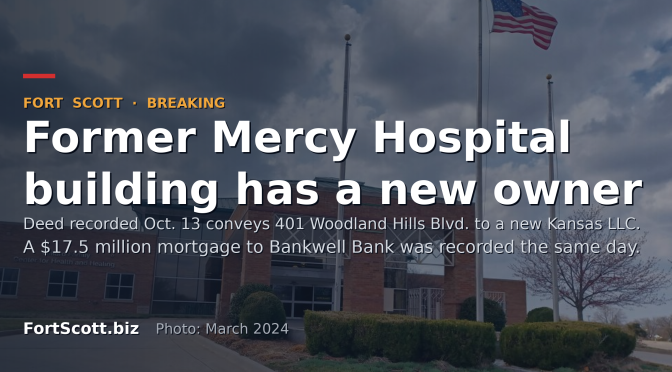
The former Mercy Hospital building at 401 Woodland Hills Blvd. has a new owner, according to documents recorded Tuesday, Oct. 13, at the Bourbon County Register of Deeds office.
A special warranty deed conveys the property from Kansas RE Investment Group LLC to 401 Woodland Hills KS Realty LLC, a Kansas company that gives its mailing address as 158-13 72nd Avenue, Suite 2D, Flushing, New York 11365. The deed is dated Aug. 26, 2026.
The same afternoon, the new owner and Kansas Renewal Institute LLC recorded a $17.5 million mortgage on the property in favor of Bankwell Bank, a Connecticut bank acting as agent for the lenders.
What the building has changed hands for
The building was given away twice before Legacy reported a $7.5 million value when it transferred the building in 2024. This table shows each transfer we can document, using the best information available.
The county also gave Legacy $2 million. (2022 story)
Dec. 20, 2024
Legacy Healthcare Foundation → Kansas RE Investment Group LLLP
$7,500,000 (reported fair market value)
Value Legacy reported to the IRS, citing the escrow closing statement. The buyer borrowed $2.5 million from Legacy Health LLC under a mortgage recorded the same day. (2024 Form 990)
Aug. 26, 2026 (recorded Oct. 13)
Kansas RE Investment Group LLC → 401 Woodland Hills KS Realty LLC
Not stated
The deed lists “$10.00 and other good and valuable consideration.” The new owner and Kansas Renewal Institute LLC, with “certain affiliates,” borrowed $17,500,000 secured by the property.
The $17.5 million is a loan amount, not a sale price, and the mortgage says it was borrowed by the two companies “and certain affiliates.” For comparison, the Bourbon County appraiser values the two lots at $3,877,950 for 2025: $3,601,940 for the hospital lot and $276,010 for the lot at 0 S. Horton.
Two figures have been reported for the 2024 transfer. Legacy’s 2024 Form 990 lists the building, land and equipment at a fair market value of $7.5 million and shows $7.5 million in notes and loans receivable. A higher figure comes secondhand: in June 2026, the Bourbon County Monitor reported that Commissioner Gregg Motley said KRI’s T.J. Denning told him KRI had paid Legacy $8.5 million in total for the building. No record we have reviewed shows the $8.5 million figure.
What the deed shows
The seller is Kansas RE Investment Group LLC, a Georgia company. The deed says it was formerly Kansas RE Investment Group LLLP. Erik Engebretson signed for the seller as authorized signatory of Guild Dream Homes LLC, which the deed describes as a managing member of the seller.
The deed covers Lots 1 and 2 of the Mercy Health Systems of Kansas addition, which it lists as 401 Woodland Hills Blvd. and 0 S. Horton. It does not disclose an actual purchase price; it recites only “Ten and 00/100 Dollars ($10.00) and other good and valuable consideration.”
The new owner
According to the Kansas Secretary of State, 401 Woodland Hills KS Realty LLC was formed July 1, 2026. Its resident agent is NUCO Filings Corp. of Topeka, and the formation filing was signed by Elliott Teitelbaum as an authorized person. The filing does not list the company’s owners.
The $17.5 million mortgage
The mortgage names two borrowers, jointly and severally: 401 Woodland Hills KS Realty LLC as “Owner” and Kansas Renewal Institute LLC, a Kansas company, as “Operator.” Both list the same Flushing, New York, address. The documents say the owner leases the property to Kansas Renewal Institute under a lease agreement dated the same day as the mortgage.
The mortgage says the borrowers “and certain affiliates of Borrower have borrowed the sum of $17,500,000.00” from the lenders, with Bankwell Bank acting as agent. The loan matures Aug. 26, 2029, “subject to extension.” A separate assignment of leases and rents, also recorded Tuesday, assigns the borrowers’ leases and rents to Bankwell Bank, as agent for itself and the other lenders, as additional security for the loan.
One passage in the mortgage describes the promissory note as being in “the principal amount of Six Million Four Hundred Eighty-Seven Thousand Five Hundred and No/100 Dollars ($17,500,000.00).” The recording stamp, the mortgage’s opening recital and the assignment of rents all give the amount as $17.5 million.
The written-out amount and the figure in parentheses do not match on page 2 of the mortgage recorded Oct. 13, 2026 (Book 534, Page 140). Highlighting added by FortScott.biz. Source: Bourbon County Register of Deeds.
David E. Marx signed the mortgage and the assignment as manager of both 401 Woodland Hills KS Realty LLC and Kansas Renewal Institute LLC. The website of Marx Development Group, a New York City developer, lists a David E. Marx as its owner and chief executive officer and describes him as an attorney and real estate developer whose projects include skilled nursing homes and assisted living facilities. New York City housing registration records list a David E. Marx as president of the company that owns the Flushing building where both Kansas companies give their address.
An earlier mortgage is released
In December 2024, Kansas RE Investment Group LLLP gave Legacy Health LLC, a California company, a $2.5 million mortgage on the building. On Dec. 21, Legacy Health LLC assigned that mortgage to Pasadena Private Lending Inc., a Delaware corporation with an address in Pasadena, California.
A release recorded Tuesday, dated Aug. 26, 2026, says Pasadena Private Lending “certifies that the Mortgage has been fully paid and satisfied and is of no further force or effect.”
Property taxes
Bourbon County Treasurer records show the 2025 property taxes on both lots were paid Sept. 1, 2026. As of Oct. 15, those records still listed Kansas RE Investment Group as owner and taxpayer of both lots. The payments covered $180,999.54 in 2025 taxes, plus $13,574.97 in interest and $34 in fees, for a total of $194,608.51. The tax histories show a $0 balance due on both lots for every year listed.
Most of the bill was for Lot 2, the hospital building at 401 Woodland Hills Blvd., which was assessed at $900,485 for 2025 and taxed $168,116.96. That lot carried no assessed value and no tax for 2023 and 2024, the years the tax records list Legacy Healthcare Foundation as its owner. Lot 1, listed at 0 S. Horton, was taxed $12,882.58 for 2025.
Kansas Renewal Institute runs a behavioral health treatment center in the building, and Freeman opened its hospital and emergency department there on Sept. 4, 2025. In September 2026, Freeman and KRI signed a non-binding letter of intent to explore the future ownership and operation of Freeman Fort Scott Hospital. It is unclear how the change in ownership will affect current hospital operations. None of the four documents recorded Tuesday mentions Freeman or the county’s 2022 donation agreement.
FortScott.biz called Marx Development and reached an automated attendant; no one answered. A KRI receptionist returned our call to ask whether we could meet at the facility Monday morning, but could not comment on our questions. We will update this story if KRI responds with a statement.
FORT SCOTT — Bourbon County commissioners spent part of their Sept. 21 meeting trying to work out when they had agreed to shift money between funds in the 2027 budget. They never voted on it, and they did not agree about what their earlier discussions had settled. Meeting video and the county’s own minutes show how the idea moved forward over four meetings without a vote.
Aug. 24: a stated goal, no vote
Commissioner Mika Milburn-Kee described what she wanted from the budget: “keep everybody exactly where they’re at, revenue neutral, but us take the assessed valuation increase of that two mil and put it in the reserves in the general fund” (video, 52:45). She put that growth at “approximately $300,000, a little bit less.” The only vote on the 2027 budget that night authorized publishing the hearing notice. The minutes, approved Sept. 9, record the idea as “the Commission’s overall objective.”
Aug. 31: a new recommendation, with Tran absent
A week later, budget consultant Matt Lawn of Baker Tilly recommended “lowering that mill levy” for Road and Bridge “by about four mills and then essentially pushing those mills back into general fund and the employee benefit fund,” using one-time FEMA reimbursement money in the road fund (video, 23:20). He said the plan was based on “some requests that I’ve got from you guys.”
Commissioner Samuel Tran was absent. The commission took no vote on the recommendation. County Treasurer Jennifer Hawkins cautioned that part of the road fund’s balance predates the FEMA reimbursements and that some is needed to match bridge grants. The minutes say the commission directed that her reconciliation of those funds “be completed before any mill reallocation is finalized.”
Sept. 14: the shift shows up in the numbers
After the revenue-neutral rate hearing, Lawn walked through how mills had been moved between funds while the total levy stayed flat: up 2.313 mills in the employee benefit fund and down 1.134 mills in Road and Bridge, among other changes. He said the Road and Bridge cut was smaller than first proposed because some of the FEMA money was “already spoken for” and some had to stay in its special project fund, and that the changes were made “based on council priorities.” The commission voted 5-0 to exceed the revenue-neutral rate but did not adopt the budget. Later that night, all five commissioners, Tran among them, voted to approve the Aug. 31 minutes describing Lawn’s recommendation.
Sept. 21: “When and where do we change our mind?”
When Lawn described moving Road and Bridge money into the employee benefit fund, Tran objected. “That’s the last thing I remember the five of us talking about,” he said of the general fund plan. “We agreed to that, all of us, unanimously” (video, 12:26). “I just want to know when and where do we change our mind on this.”
Milburn-Kee said she was “fine with general.” Lawn said he was “merely saying what Commissioner [Milburn-Kee] asked me to consider” and was open to whatever the board wanted. Tran asked who had directed the change. “Projections. Nobody directed,” Milburn-Kee said, explaining that Lawn had projected what Road and Bridge would overspend in 2026 and carried that forward (video, 13:20).
About 25 minutes later, Commissioner David Beerbower said he did not remember that discussion at the table. “Did we vote?” he asked. “No,” Tran said. “We never voted because we weren’t voting at the time. It was just a consensus like, hey, that’s a good idea” (video, 37:42). He said two commissioners had liked the idea, “so I kept it in the back of my head.”
“To be fair for Matt, we’re throwing him all over the place because we haven’t voted on a single thing,” Milburn-Kee said.
Tran then told Lawn that direction should come only from the full board. “Any marching orders that you get should come from the table,” he said. “It should always come from the table where there’s a consensus. … We rule as a body, not as a single person” (video, 38:35).
“To be fair to him again, we haven’t made any motion here,” Milburn-Kee said of Lawn. “He’s just listened to all the conversations and tried to build something.”
What’s next
The allocation also bears on raises: the draft includes a 5% wage increase across departments, and Milburn-Kee pressed Lawn on whether it rests on one-time money. Lawn agreed to bring about four versions of the budget. The budget must be adopted by Sept. 30, and the commission’s next regular meeting is Sept. 28. Full coverage of the Sept. 21 meeting is also available.
Freeman Health System and Kansas Renewal Institute (KRI) issued a joint statement Monday announcing the signing of a non-binding Letter of Intent to explore the future ownership and operation of Freeman Fort Scott Hospital.
“The Letter of Intent provides Freeman Health System and Kansas Renewal Institute (KRI) the opportunity to evaluate whether a transition of ownership and operations could further support the long-term access to healthcare,” according to the press release.
“The Letter of Intent is non-binding, and no final agreement has been reached. Any potential transaction remains subject to due diligence, negotiation of definitive agreements, regulatory review and other necessary approvals,” according to the press release. “Throughout this process, patient care, hospital operations and services will continue as normal.”
“Freeman Health is trying to sell its hospital to KRI,” said Gregg Motley, who is the Bourbon County Commission Chairman. “They (Freeman Health System) don’t have a building to sell; they have its operations to sell.”
“KRI would have to acquire expertise to run the hospital, and all the Freeman staff would have to be willing to reassign their contract with KRI,” he said. “KRI has to be willing to buy the operations of Freeman Fort Scott. The fly in the ointment is that the State of Kansas will have to give licensing to KRI.”
“I tried to trigger the ‘Claw Back Provision’ with the Bourbon County Commission (who previously owned the building), to give the building to Freeman, and the commission would not support that,” Motley said.
“Now KRI has to be willing to buy the operations of Freeman Fort Scott Hospital,” he said.
Part of what keeps the emergency department running is a tax county voters approved themselves. On May 14, 2024, Bourbon County voters approved a quarter-cent countywide retail sales tax, 1,611 to 496. It took effect Oct. 1, 2024 and runs five years. The ballot language limits the money to the “establishment and operation of an emergency department in Bourbon County,” and says that when the tax ends, whatever is left goes to emergency medical services or to reducing property taxes.
A citizens committee appointed by the commission checks that the money is spent that way. Charles Gentry and Dr. Randy Nichols reported to commissioners on Aug. 31 that the tax collected $336,741.49 in the first half of 2026 and that $280,602.05 of it was disbursed to Freeman to operate the emergency department.
The county is not a party to the Letter of Intent. Commissioners declined in July to put $300,000 in the 2027 budget to pursue the clawback against KRI and Legacy, a push Motley had led and said he would stop; he laid out his reasoning in a June interview with FortScott.biz. Separately, a federal rural hospital bill introduced in July could change what a hospital like Fort Scott’s can bill for.
The press release, as sent
Joint Statement Freeman Health System and KRI Sign Letter of Intent Regarding the Future of Fort Scott Healthcare Services
Freeman Health System and KRI today announced the signing of a non-binding Letter of Intent (LOI) to explore the future ownership and operation of Freeman Fort Scott Hospital.
Since opening Freeman Fort Scott Hospital on September 4, 2025, Freeman has remained committed to providing the residents of Fort Scott and Bourbon County with access to high-quality local healthcare. During that time, healthcare organizations across the country, particularly those serving rural communities, have continued to face significant workforce, reimbursement, operational and financial pressures.
As part of its ongoing commitment to the community, Freeman has worked closely with local leaders, providers and stakeholders to evaluate opportunities that could support the long-term sustainability of healthcare services in Fort Scott. Those efforts have included operational improvements and evaluation of potential care delivery models, including opportunities associated with the Rural Emergency Hospital model.
The Letter of Intent provides Freeman Health System and KRI the opportunity to evaluate whether a transition of ownership and operations could further support the long-term access to healthcare.
The LOI is non-binding, and no final agreement has been reached. Any potential transaction remains subject to due diligence, negotiation of definitive agreements, regulatory review and other necessary approvals.
Throughout this process, patient care, hospital operations and services will continue as normal.
Both organizations remain committed to supporting employees, providers, patients and community stakeholders while exploring opportunities to preserve and strengthen local healthcare access.
Additional information will be shared as appropriate as discussions progress.
###
About Freeman Health System
Locally owned and nationally recognized, Freeman Health System is a not-for-profit health system serving communities across Missouri, Arkansas, Oklahoma and Kansas through a network of hospitals, physician clinics, outpatient locations, and specialty services. The system includes Freeman Hospital West, Freeman Hospital East, Freeman Neosho Hospital, Freeman Fort Scott Hospital, Inc. and the Freeman Health System facilities in Bentonville, Springdale, Johnson and Siloam Springs. Freeman Health System also operates Ozark Center—the region’s largest provider of behavioral health services, and offers comprehensive cancer, cardiology, neurology and neurosurgery, orthopedics, and women’s and children’s services. The system is supported by more than 7,000 employees and is the only Children’s Miracle Network Hospital in a 70-mile radius. For more information, visit Freeman Health System.
The Bourbon County Commission voted 5-0 Monday night to keep the county’s property tax rate exactly where it is: 56.678 mills. Before it could do that, state law made it hold a public hearing and vote, on the record, to exceed what the law calls the revenue-neutral rate, the rate that would bring in the same dollars as last year.
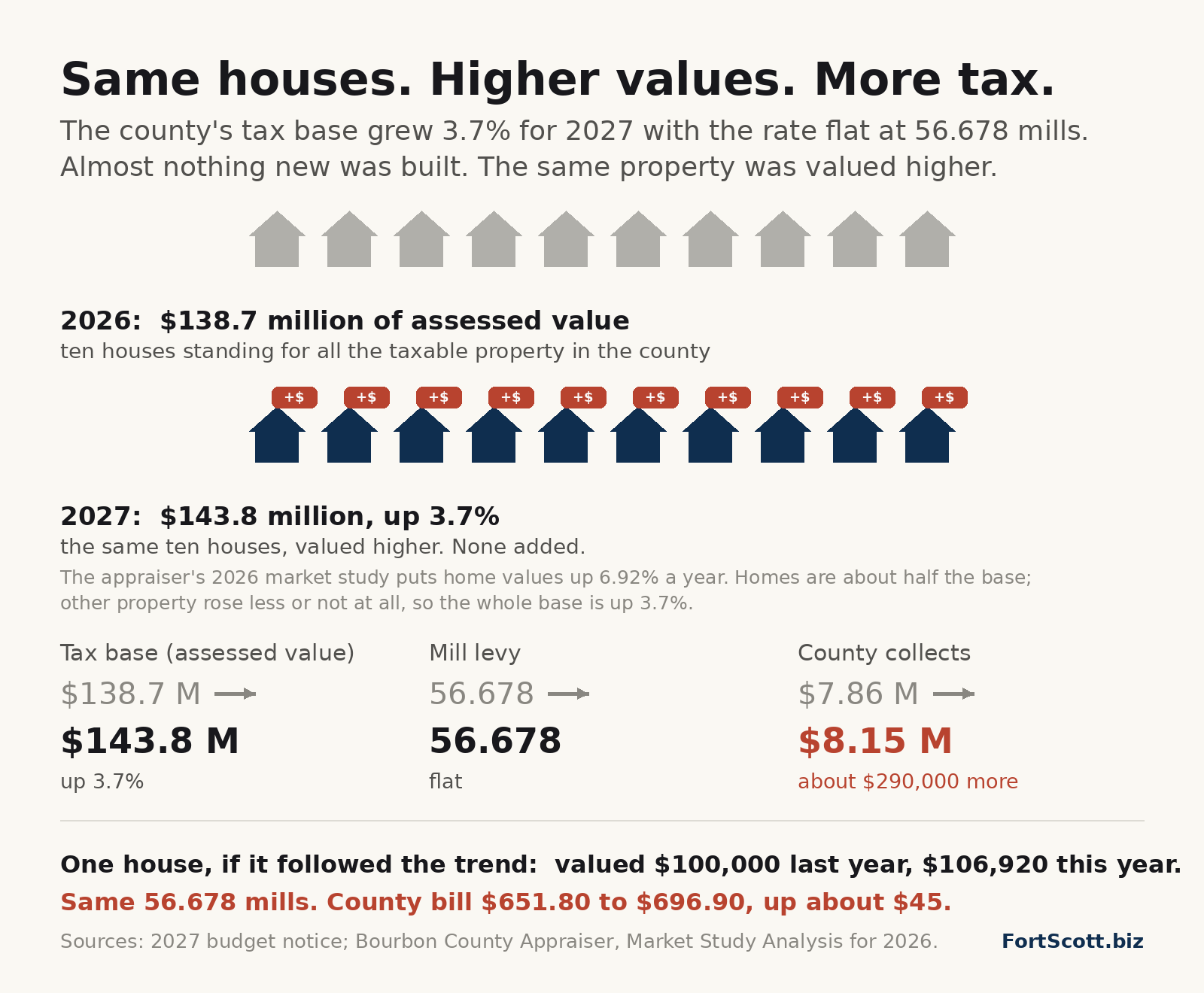
Why would keeping a rate flat need a hearing about exceeding a rate? Because property values in the county went up, and a flat rate on higher values means the county will be raising the amount of taxes collected.
Start with the mill
Property tax is figured in mills. One mill is $1 of tax for every $1,000 of assessed value.
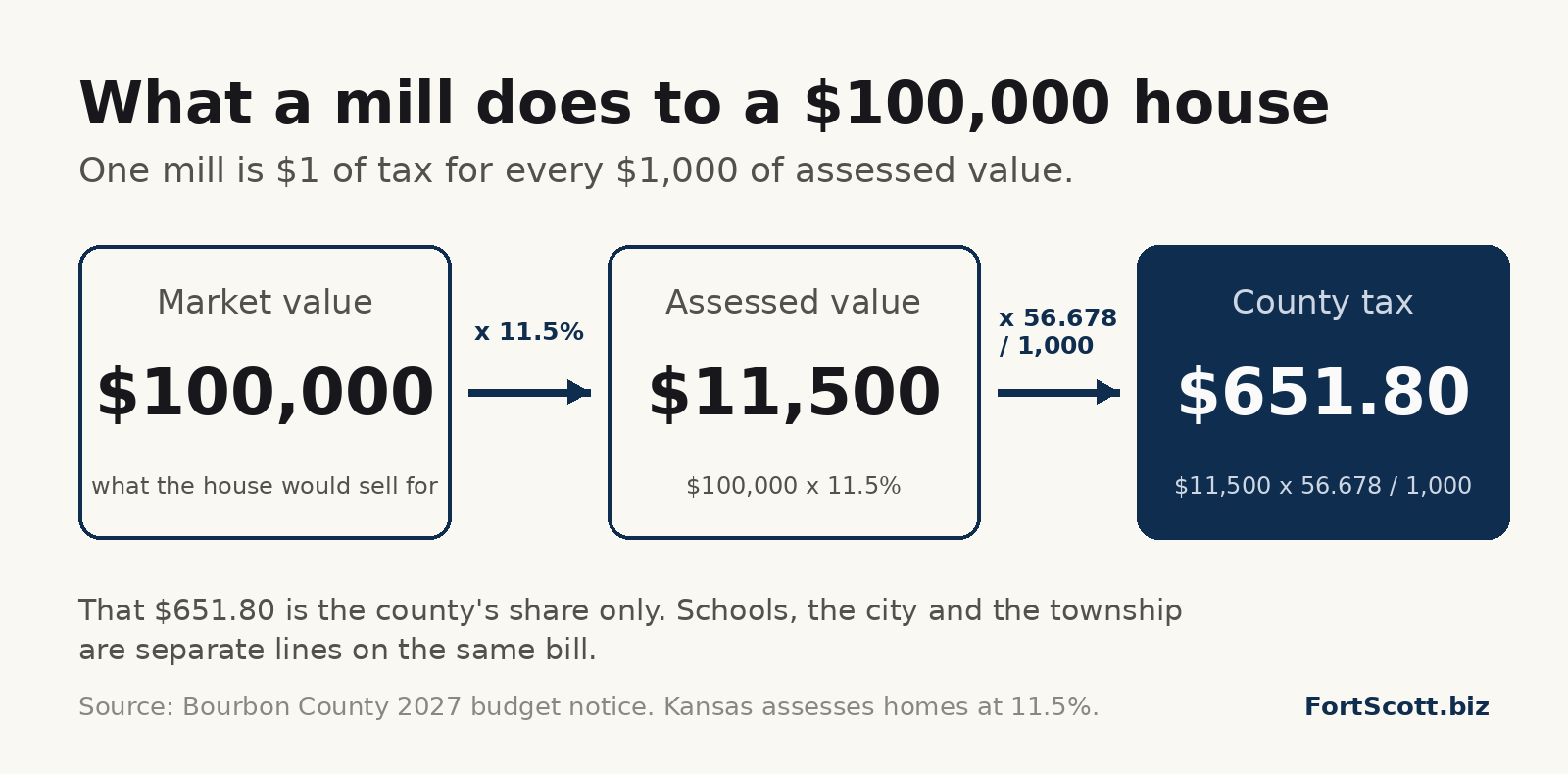
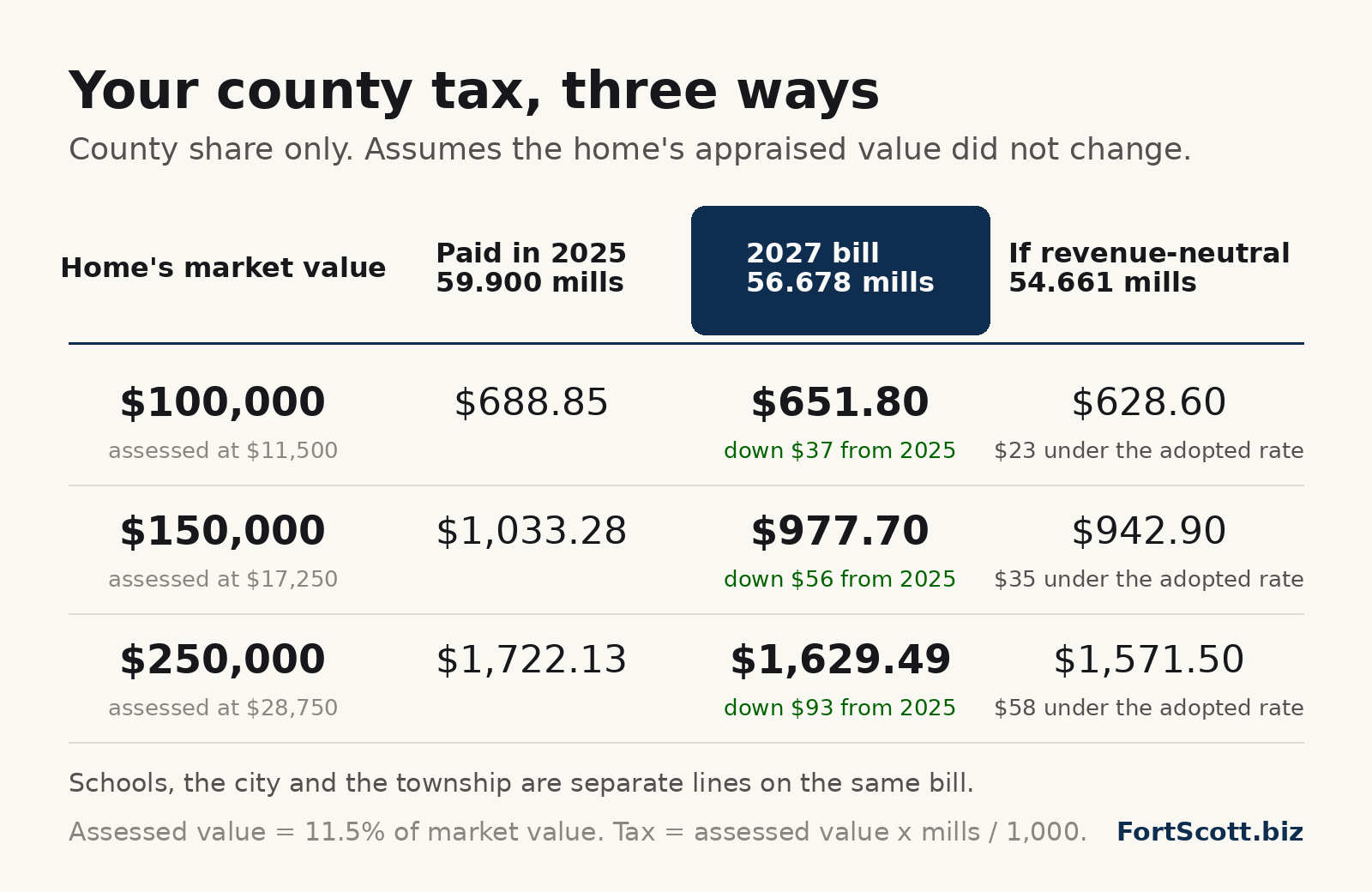
Kansas does not tax a home on what it would sell for. It taxes a home on 11.5% of that figure, which is called the assessed value. A $100,000 house has $11,500 of assessed value. To get the tax, multiply the assessed value by the mill rate and divide by 1,000. At the county’s rate of 56.678 mills, that is $11,500 times 56.678, divided by 1,000, or $651.80 a year going to the county.
How a $100,000 house turns into $651.80 of county tax. This is the county’s share only.
That $651.80 is only the county’s line. The school district, the city and the township each set their own mill levy, and they are separate lines on the same bill.
The revenue-neutral rate is a calculation, not a decision
Every year the county clerk takes the property tax dollars the county collected last year and asks one question: with this year’s property values, what rate would bring in exactly the same dollars? That rate is the revenue-neutral rate. It is based on simple mathematics, and it moves every year because property values move.
For 2027 it came out to 54.661 mills. Last year the county’s property tax levy, the total it charged, was $7,858,151. For the 2027 levy, the county’s total assessed value (the sum total of the assessed value of all the property in the county) is $143,767,695. Multiply that by 54.661 and divide by 1,000 and you get $7,858,486, last year’s money within a few hundred dollars. The small gap is only rounding.
“Flat” does not mean taxes don’t go up
The commission adopted 56.678 mills, the same rate the county is levying this year. Budget consultant Matt Lawn of Baker Tilly called it “a flat mill levy”.
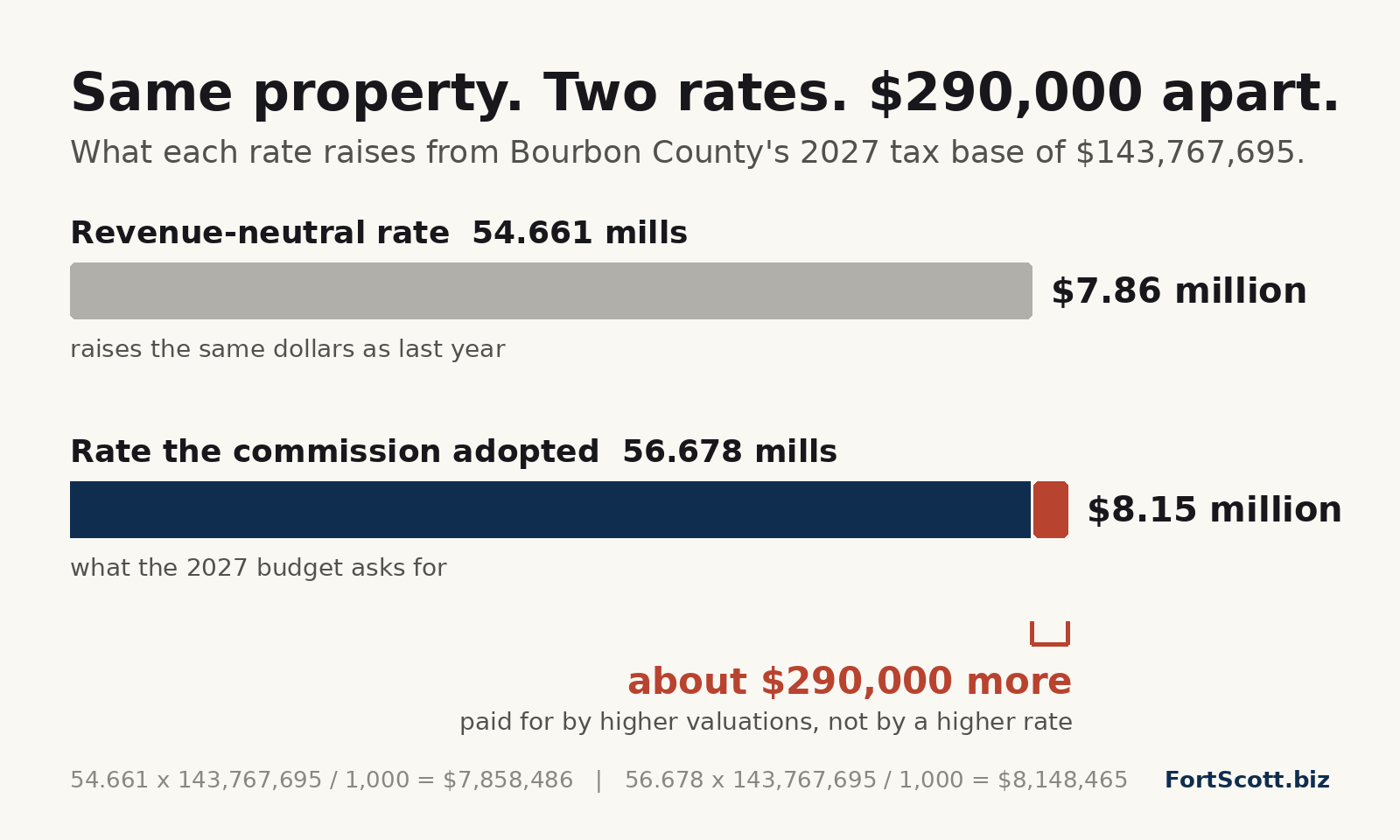
But the same rate on higher valuations raises taxes. Put 56.678 mills on the same $143,767,695 and you get $8,148,465, within a couple of hundred dollars of the $8,148,297 the 2027 budget asks for in property tax. The revenue-neutral rate is 54.661 mills. The commission kept 56.678. That 2.017-mill gap is worth about $290,000 more in county tax.
Same property, two rates. The red sliver is the difference: about $290,000.
Where did the extra come from? The tax base grew. One mill is $1 per $1,000 of assessed value, so last year one mill in Bourbon County raised about $138,700. This year since valuations have gone up, it raises about $143,800. Higher values on property that was already there, with only a little new construction, added about $5.1 million of assessed value to the county’s tax base (the total assessed value of everything in the county). At the flat rate, that growth raises about $290,000 a year, roughly the gap between the two rates.
Your bill can go down while the county takes in more
Back in 2025 the county’s rate was 59.900 mills, and the county share on that $100,000 house was $688.85. At the 2027 rate of 56.678 mills the county will charge $651.80. The hypothetical $100,000 home that didn’t increase in value would have seen its county tax bill fall about $37 from 2025 to 2027.
At the same time, the county will collect about $290,000 more in 2027 than it would at the revenue-neutral rate. Both things are true, because the county is now taxing a higher total valuation of property. If that were because more homes and businesses had been built, more people would be sharing the load. In Bourbon County that is mostly not what happened. The county’s population has been flat to slightly down since 2020. The county appraiser’s market study for 2026 found home values rising 6.92% a year and commercial property 4.97% a year. Homes are nearly half the county’s tax base and businesses about a fifth, so those two trends together add about $5.8 million of assessed value, more than the whole $5.1 million increase, before counting anything newly built. The growth is mostly the same houses and businesses valued higher, not more of them. When that is what is happening, a flat rate means most county tax bills go up, because most valuations did.
If your home’s value followed the market. The same property valued higher is what grew the tax base, and at a flat rate that means a bigger bill.
While the rate is down 3.2 mills since 2025, property tax dollars the county levies are up about $170,000, from $7,977,466 to $8,148,297.
If your home’s value stood still. County share only; the revenue-neutral rate would have saved the $100,000 homeowner $23.20.
To be clear, your bill only falls if your own valuation did not go up. If your house followed the appraiser’s residential trend, a $100,000 house last year is valued at about $106,920 this year. Its assessed value is $12,296, and at the same 56.678 mills its county share goes from $651.80 to $696.90, up about $45 with no change in the rate. That is also $8 more than the $688.85 it paid in 2025, even though the rate is lower. Whether your own bill went up or down depends on the valuation notice you got this spring, not on the rate alone.
Why the law makes them hold a hearing
Since 2021, Kansas law (K.S.A. 79-2988) has required any city, county or school district to hold a public hearing and take a recorded roll-call vote if they intend to increase the total amount they are taking in taxes. It doesn’t matter whether the rate goes up or down. The hearing is triggered whenever the rate is above the revenue-neutral rate, the rate that would collect the same dollars as the year before. That applies even when the rate itself has not changed, which is Bourbon County’s situation this year.
The reason is the arithmetic above. Before that law, a county could adopt the same rate year after year while rising valuations raised the dollars it collected, with no separate vote on the increase. The rate was voted on. The extra money was not. The hearing and roll call require that extra money to be approved in public, with each commissioner’s vote recorded.
What happened Monday night
Commission Chairman Gregg Motley opened the hearing a few minutes into the Sept. 14 meeting, Lawn laid out the two rates, and Motley asked for public comment.
FORT SCOTT — The Fort Scott City Commission split 3-2 Tuesday night on whether to levy a property tax rate above the revenue-neutral rate, then turned around and adopted the 2027 budget unanimously.
Resolution 40-2026 says the county clerk calculated the city’s revenue-neutral rate (the rate that would raise the same money from existing property as last year) at 41.472 mills, and that the commission, “having heard testimony, still finds it necessary to exceed” it (video, 1:38:11). The rate the city adopted is 41.886 mills, 0.414 above revenue-neutral, worth about $24,000 on an assessed valuation of $58,608,895, according to the budget summary the city published Sept. 5.
On the roll call, Mayor Kathryn Salsbury, Julie Buchta and Tim Van Hoecke voted yes. Matthew Wells and Tracy Dancer voted no (video, 1:39:43).
Minutes later the same five voted yes on the budget itself. Wells said so explicitly: “I approve of this budget, yes.”
The vote to exceed does not mean the city is raising its rate. Ben Hart, the city’s financial adviser, told the commission that since 2020 Fort Scott has cut its levy every year but one, “going down by almost six full mills,” and that this year it found a way to cut taxes “by almost a half a mill” even with revenues falling and costs rising.
Hart also commended the commission for having the conversations necessary to enable them to keep the budget as low as they have.
Kansas still requires the hearing and a recorded vote whenever a city intends to levy above the revenue-neutral rate, because rising property values raise more money at an unchanged rate (video, 1:36:10).
Michael Hoyt, who serves on the city land bank board, questioned the budget from the floor, asking about a $3,179,736 lease-purchase principal line and whether the debt service above it covered only the general obligation bonds (video, 1:16:52). He asked why the principal hasn’t been going down. Hart answered that the city adds leases every year; Wells mentioned new police cars, and Hart cited fire apparatus and a rescue truck, “not cheap pieces of equipment.”
What the budget fight was actually about
The argument that dominated the hearing was over $38,976 cut from the general fund demolition budget.
The cut itself had already been made. At the commission’s previous meeting, Wells moved to eliminate the line for one year, which by the published figures took about two-thirds of a mill off the levy (the minutes and Hart both round it to half). Wells, Dancer and Salsbury voted yes; Van Hoecke and Buchta voted no, and it carried 3-2, a different split from Tuesday’s; the mayor was the only commissioner in the majority both times. The budget options in front of the commission before that cut carried a levy of 42.551 mills; the budget adopted Tuesday levies 41.886.
Van Hoecke read aloud an email from a business owner of 20 years. “I watch as you remove demolition from the 2027 budget,” it said. “I would encourage you to reconsider before you adopt a budget” (video, 1:21:40).
Wells responded saying, “I’ve also been reached out to by many citizens who say we demo too many good houses… houses that very easily could have been restored, put back on the market, and sold to somebody at a discounted rate.”
Salsbury said cutting the line does not end demolitions. “Removing the strict code demolition line does not completely remove the ability to demolish houses,” she said. “That is a function that can also be done through the land bank.” Wells said the solution he presented with his motion was to funnel blighted houses into the land bank, which has money to demolish them, or to have a contractor restore them and sell them, as he said Parsons has done.
Dancer argued the money would do more as an incentive than as a demolition line. “Maybe we need to pull back some of the money that we are giving up so freely,” he said, and instead tell developers the city will pay them $5,000 once a rehabilitated house is sold (video, 1:28:14).
Dancer framed the test narrowly: the standard the commission has to apply is whether a structure is dangerous and unsafe, not whether the community dislikes looking at it. Van Hoecke said unsafe was not the whole of it. “If you’re a longtime resident here and you’re paying your taxes, it does come down to quality of life as well,” he said (video, 1:29:56). Salsbury agreed aesthetics matter to people but are not part of the ordinance’s mechanism.
Hart put numbers to it: $40,000 budgeted for the land bank, plus about $82,000 already sitting in cash. Van Hoecke started to move $15,000 back into the demolition fund, then dropped it after being told the land bank would spend that much on blight regardless, having already identified the area it wants to work on (video, 1:33:09).
$15,000 in grants, seven applicants, three winners
The longest stretch of the meeting was the third-quarter small-business grants. Seven applicants came to the table and presented in person for a $15,000 pool: Salon Social, Better and Bourbon, Travis Sawyer, the Fort Cinema, Bourbon County Clay, Midwest Runway Boutique and the Super 8.
Van Hoecke moved first, for a three-way $5,000 split to Bourbon County Clay, Salon Social and the Fort Cinema, saying he was reluctant to see the theater go the way of neighboring towns’ (video, 1:10:45). That motion died for want of a second.
Wells then proposed an even three-way split, $5,000 each to Midwest Runway Boutique, Salon Social and Bourbon County Clay, and asked the others to reapply next quarter. His test, he said, was “return on investment. What are we going to get back as a city?”, noting one applicant expected to create three new jobs (video, 1:06:58). It passed unanimously (video, 1:14:48).
Maria Morris told the commission she had just relocated Midwest Runway Boutique to downtown Fort Scott. Brooklyn Holder is opening Salon Social, which she said would hire three people. The Freemans’ Bourbon County Clay and their Artificers gallery are downtown. Buchta noted, echoing Wells, that applicants who missed out can apply again next quarter.
Also before the commission
Emergency pump. The commission unanimously approved $43,772.30 for an emergency replacement pump at the College Booster Station, upgrading to an impeller that stands up better to chlorine.
Alcohol ordinance. Ordinance 3801, amending the city code on alcoholic liquor, cereal malt beverages and beer gardens, came back for a first reading after being tabled Sept. 1. City attorney Bob Farmer said the fee schedules are unchanged and the draft’s one change is to repeal the former $125 beer garden license; Wells said the beer garden rules were the only place the old code fell out of line with state statute. Commissioners asked for a single revision: language making clear that the common consumption area applies every day of the year, not only during special events, which Van Hoecke said is how the draft read. Salsbury and Dancer also asked whether license fees should distinguish a restaurant that serves drinks from a bar; Farmer said the line is hard to draw. “It is a bar. They just happen to sell food there,” he said (video, 1:53:12). Van Hoecke moved to approve the ordinance with that one change and Wells seconded; the clerk and Farmer said the vote approved only the changes, with the final ordinance to come back at the next meeting. Salsbury first voted no, saying she had made “a personal commitment never to vote in the affirmative on an ordinance that I don’t have the final version of in front of me,” then said “okay, yes” after Farmer clarified that the vote approved only the changes, not the final ordinance (video, 1:56:50).
FortScott.biz file photo of 118 Wall in September 2024
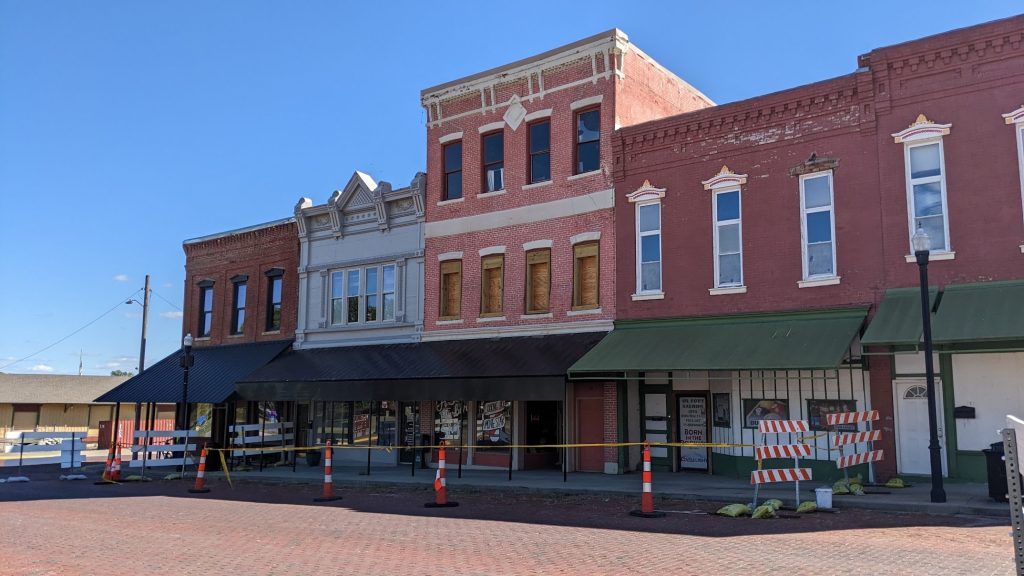
118 E. Wall. Farmer said he told the owner of the blighted building that the city will not pay for it and has been authorized to sue to bring it into compliance, but that the owner should first look at giving the building away. The owner had asked for tax credits, which Farmer said the city cannot grant. City Manager Brad Matkin said two men from a church-funded Kansas City medical business, with locations in Wyandotte and Johnson counties, visited City Hall and said the owner may donate the building to them; the city plans to look at their operations before anything is settled. “It’s not a done deal,” Matkin said. Farmer added that if a use is allowed under zoning, the city cannot pick and choose who occupies a building. At Wells’s request, Matkin said the city will send the notice that starts the 30-day clock for demolition-by-neglect citations and fines (video, 2:03:12).
Moody Building. Farmer said the owner’s corporate status has been revived, so the proper party can now act on the building, and that he is still trying to get an answer from the IRS: an agent who had been responsive no longer returns calls, and the office number rings to a national line that, after 20 minutes on hold, tells him to call back another day. Matkin said the party interested in the building has been cleared to bring in architects and engineers and has started cleaning out the basement, which is why a dumpster is parked outside. Van Hoecke said that when he was downtown Saturday they were pumping out water that “has been in that basement for a long time” (video, 2:07:05).
Lake lots. Matkin was asked to gather survey costs, covenants and deed-restriction information on eight lake lots on the east side and to look at leasing rather than selling, including very long-term leases and RV sites; he said he would come back in about a month. Van Hoecke said selling the lots would help pay down debt on the fire trucks; Wells said he would lease all eight on 199-year leases, as some Colorado resort towns do. Salsbury cautioned about protecting the water supply. “I don’t want to compromise our water supply at all, and I think we just have to be incredibly careful about it,” she said (video, 2:09:56).
Naturalization ceremony. Matkin reminded the mayor that a naturalization ceremony was scheduled for the following day and asked who else planned to attend, saying he would be running sound and would post about it (video, 2:21:52). Twenty-five people are to be sworn in as citizens; Salsbury said she is to speak at the ceremony.
Street repairs. Answering Streeter, Matkin said the city plans to run the striping machine over several streets at once when the cape-seal top coat is finished. He said the dip in the brick street by Streeter’s shop was left by a contractor rather than the street department and will be repaired, and that Wall Street should be finished the next day after the asphalt plant the city buys from broke down twice.
Memorial Hall. Mary Wyatt, the city’s business development director, reported that the Kansas Department of Commerce that morning released the Memorial Hall window and exterior restoration project, approving the single-bidder award to Mid-Continental Restoration so construction can begin. Asked by Van Hoecke whether the city’s Certified Local Government status helped win the grant, Wyatt said it did not; the city was not yet a CLG when it applied (video, 2:16:53).
Public comment. Cory Bryars of Care to Share thanked the city golf course, promoted Fort Fest at Riverfront Park and said the group is now averaging about $12,000 a month to local cancer patients. Ray Streeter urged the city to stripe recently cape-sealed streets, said he is “sick and tired of the brick streets,” and argued against spending grant money on another walking path when streets, sewers and water need it.
Consent agenda. The agenda was approved as amended, adding a late Olson invoice of about $5,381.74 for airport grading and runway-lighting work. The consent agenda also carried a $505,024.42 appropriation ordinance, $114,300 to Jeff Asbell Excavating for the Davis Lift Station and $139,218.75 to Strukel Electric for airport runway lighting repair.
Executive session. The commission closed for seven minutes to discuss information technology under the financial-affairs and trade-secrets exception, then returned and directed the city manager to negotiate an information technology support agreement on behalf of the city (video, 2:43:29).
The commission opened and closed the budget public hearing formally, and adjourned at about 8:45 p.m.
FORT SCOTT — Commissioner David Beerbower laid out his plan to raise Bourbon County Transfer Station rates and public works wages at a work session Wednesday night, and said he will bring motions on it to the commission’s next meeting Monday. The session, held after the commission’s regular meeting that evening, opened with a dispute over its format, turned into a running argument between Beerbower and Commissioner Mika Milburn-Kee over what the county can afford, and ran about an hour and a quarter.
Beerbower had asked for the session. He said the public would get three minutes each at the start and the discussion after that would stay among the commissioners. “It’s not the chairman’s work session. It’s my work session,” he said when Milburn-Kee said she understood it would be an open dialogue (video, 3:16). Kevin “Skitch” Allen, who owns Skitch’s Hauling & Excavation and hauls to the transfer station, said Chairman Gregg Motley had told him he did not need to be on the agenda. Motley was absent due to dental work. Commissioners David Beerbower, Joe Allen, Milburn-Kee and Samuel Tran took part.
Commissioner Joe Allen proposed going through the presentation first and then letting people respond, “so we keep the meeting going civilly,” and the session went on. Beerbower said the format was a response to the Aug. 31 meeting, where Skitch Allen had questioned him during public comment: “We have smartasses that make personal comments rather than talk about the subject and the details of the plan” (video, 4:11). Before leaving for another engagement, Allen offered Beerbower “an opportunity to apologize for calling somebody a proud smartass.” Beerbower declined: “I think apologies come both directions there, buddy. I’m not going to be apologizing to you” (video, 26:09).
No rate increase since 2016
Beerbower said the transfer station has not raised its tipping fees since it opened in 2016, apart from a three-cent-a-pound increase on tires in 2021, and that fees tracking inflation would be about 30% higher today (video, 12:13).
He offered three scenarios. The first raises transfer station wages about $3 to $4 an hour and fees about $7 a ton; the second, $4 to $11 an hour and $10.49 a ton; the third, $13 to $14 an hour and $14.38 a ton (video, 16:53). Out-of-county customers currently pay $40 a ton for construction and demolition debris against $35 for county residents, and Beerbower said the difference can be set however the commission chooses. Landfill supervisor Diane Ballou handed out rate sheets of her own (video, 28:54).
Deputy County Clerk Michael Hoyt asked whether higher rates would mean more trash dumped along county roads; Beerbower said the county held rates flat from 2016 to 2021 over the same worry and that “every county has it” (video, 32:57).
Skitch Allen said haulers have argued for years that out-of-county loads should pay $10 a ton more than local ones, not $5, and that county residents will feel any gate increase in their trash bills. “They come over here because it is cheap,” he said (video, 21:14).
Wages, taxes and the poverty line
The sharpest exchanges were over what county workers should be paid. Milburn-Kee interrupted Beerbower’s wage benchmarks with a point of order to ask whether they came from other counties or private industry, and whether he would compare against counties alone. “I could leave that up to you if you want to. I mean, it’s your question,” he said. “But this is your thing,” she answered (video, 14:57).
She returned to it after the public works numbers, asking whether he had checked employers in town. “McDonald’s, 15,” Beerbower said. “Mr. Beerbower, that’s enough,” Milburn-Kee said. The new company coming to Fort Scott, she said she was told, will start between $17 and $20 an hour. “We have to be realistic about the people that are paying into the taxes here in Bourbon County,” she said. “We’re not going to kick the taxpayers in the teeth” (video, 40:06).
Beerbower said he compared equipment operators with equipment operators and CDL drivers with CDL drivers, not factory work: “If you want to compare it apples to oranges, then go ahead.” County employees pay the same taxes as everyone else, he said, and the federal poverty level works out to about $15 an hour: “We got guys that are making 93 cents more than that.” When Milburn-Kee said private businesses cannot set their own rates the way the county can, Beerbower said he did not understand her point. “Okay, you’ll figure it out. I’m sure you will,” she said (video, 43:25), and listed what county jobs carry beyond the wage: insurance, 14 holidays, 14 vacation days and 12 sick days.
Beerbower said the number of public works employees has fallen since January because the county trains people and loses them. “I want guys that graduate high school that can’t afford to go to college but can come to Bourbon County, look at Bourbon County and say, where am I going to get a job here?” he said, and find the answer at public works (video, 45:06). “That’s not what’s happened over the last 10 years.”
“Bring the counter to the table”
The plan leans on the county’s FEMA storm reimbursement, roughly $605,000. Milburn-Kee said raises of $5 to $10 an hour are not realistic with the mills the county has, and that $5 an hour for the 38 public works employees alone comes to about $410,000 a year. “I want you to have the opportunity to earn my vote, but I have to understand what you’re saying,” she said (video, 51:24). Beerbower said the transfer station is fee-funded, and that on the public works side the money comes from lower turnover, less retraining, an equipment reserve that cuts repair bills and doing fewer miles of road better.
The two went around it several times. “This happens just about every time,” Beerbower said. “If you got a counter to it, bring the counter to the table” (video, 51:58). “So you don’t want me to talk about your plan and ask questions about your plan?” Milburn-Kee asked. “You haven’t successfully laid out a plan that doesn’t lead to the raising of taxes.” “Look at what I put in this paperwork and show me where I raise taxes,” Beerbower said (video, 53:51). “Are your numbers correct, sir?” she asked. “Yeah,” he said.
When Beerbower said the sheriff had given his staff raises last year from within his own budget, Milburn-Kee cut in: “Sir, that is not correct. He was down a person. He gave raises with that person’s salary through the rest of that year.” The budget had to go up the next year, she said (video, 61:00). Beerbower’s answer to the criticism came a few minutes later: “If you don’t believe that my plan shows merit, then get your own plan and show where it doesn’t work” (video, 65:57). His FEMA option would put $175,000 into a workforce fund and $125,000 into an equipment reserve.
Tran asked about the money itself. The commission was told last week that about $300,000 of the reimbursement has to go back to a fund it was borrowed from; Tran said he had heard much of the storm repair was paid from the general fund and had never been shown records. “If that is true, please bring the receipts,” he said (video, 66:28). Beerbower said the treasurer told the commission Aug. 31 that about $300,000 came out of the bridge fund, and that he had since heard it was a reserve fund that need not be repaid.
A step schedule, and the ditches
Commissioner Joe Allen, who also serves as USD 234’s transportation director, brought the district’s step salary schedule and suggested the county adopt something like it: columns for qualifications, rows for years of service, a 25-cent step each year that rises to 35 cents after 10 years. The district hires a bus driver with a Class B license and no experience at $15.60 an hour, he said (video, 70:08). Tran said the county still needs written job descriptions and a Kansas-only salary survey before it sets any. “Without those two documents, we’re winging it,” he said (video, 74:40).
Milburn-Kee closed with current problems: ditches filling in, water running down roads, bridge signs hidden in the grass. She said a resident who called public works was told to call a county commissioner instead. “If you guys find that acceptable, fine. I don’t,” she said, and offered to support hiring outside help, even local residents on 1099s, to catch up on mowing (video, 75:57). Beerbower asked why the mowing was not being done and answered that the county is down to one or two mowers kept running with parts from each other because no commission has funded an equipment reserve. “The grass grows the same height every year,” Milburn-Kee said. “Right, and it’s been taken care of every year until you don’t have mowers,” Beerbower said. “The answer lies in giving them the tools they need, not the criticism because the job’s not getting done” (video, 78:16).
The commission’s next meeting is Monday, Sept. 14. Under the county’s published notice, that is also its public hearing on exceeding the revenue-neutral rate for the 2027 budget, at 5:30 p.m. at 210 S. National Ave.
Kevin Wagner is the new chair of the Bourbon County Republican Party. The party selected its officers for the coming year Thursday night, Sept. 10, at its annual leadership reorganization meeting.
Katie Casper was elected vice-chair, Jennifer Hawkins secretary and Doug Niemeir treasurer.
Wagner succeeds Kaety Bowers, who had chaired the party since September 2024 and who signed its public statements as chair. The outgoing officers, elected Sept. 19, 2024, at the Fort Scott Livestock Market, were Bowers as chair, Tim Emerson as vice-chairman, Gayle Sackett as secretary and Donna Banwart as treasurer.
Wagner has served as the party’s precinct committeeman for Pawnee Township. Niemeir has served as precinct committeeman for Fort Scott’s 6th Ward. Casper was a member of the county’s Budget Advisory Committee. Hawkins is the elected Bourbon County treasurer, a county office that is separate from the party treasurer’s post Niemeir now holds.
Officers are nominated and voted on each year at the reorganization meeting, and the results are reported to the state. Under the party’s rules, its leadership must include both a man and a woman, Emerson said after the 2024 election. The officers represent the county at state Republican meetings and at the party’s local meetings.
FORT SCOTT — The Homeless Alliance, the citizens’ coalition on homelessness that City Commissioner Matthew Wells has been organizing since July, held its first meeting Wednesday evening at City Hall, and by the end of about 80 minutes had a plan on the table, a volunteer to lead a nonprofit, a point of contact for the people camping at Second Street Park, and a second meeting set for Sept. 23.
Wells presided. Commissioner Tracy Dancer sat beside him, and about a dozen people who had signed up with City Manager Brad Matkin took seats at the table: church representatives, social workers, nonprofit operators and residents who had been homeless. Two people now living at the Second Street Park encampment came with one of them, and one of the two spoke.
“I am of the firm belief that simple finances don’t fix a problem like this. Simple mental health doesn’t fix a problem like this,” Wells said. It has to be a combination of spiritual, mental and financial healing, he said, and the alliance needs the city, churches, nonprofits, schools and health care providers all in. “If we don’t have a buy-in from all three areas, then I personally don’t believe there will be any success moving forward” (video, 23:32).
A seven-step plan, “not the plan”
The packet Wells handed out was the plan he wrote after the city commission’s work session on homelessness, held May 5, drawn from what he said had worked in other Kansas and Missouri towns. “My plan is not the plan. It is not the only way to get this accomplished,” he said. “But I felt like we needed something as a guideline” (video, 28:26).
Its steps, in his order: form the coalition; adopt “clear and compassionate public space policies” modeled on Salina; establish a navigation hub with a case manager, modeled on Wichita; coordinate behavioral health and law enforcement with a co-responder model like Johnson County’s; consider a very small low-barrier shelter for winter; a work-for-housing program of the kind used in Kansas City and Tulsa; and transitional housing in existing buildings, as the Path of EASE Association already does in Fort Scott (video, 30:36). He said a county commissioner had contacted him that day about joining the alliance.
Wells said the city cannot apply for most of the grants in the plan, so the alliance needs a nonprofit to take the lead. Honey Bidwell offered to head it (video, 46:52). Jenni Simhiser, whose Path of EASE Association runs a recovery house for women and children, cautioned that some larger grants require a nonprofit to have existed for some time, so a new one needs a fiscal agent “that will umbrella you when you’re new” (video, 47:57). Wells said Compassionate Ministries had offered to help and the alliance may organize under it for now.
“Are they willing?”
The first question from the floor came from a woman in the audience who said she had helped one homeless person in town, “and it took great lengths to do that.” She asked whether the people the plan is meant for are willing to go through it, and what happens with those who are not (video, 50:12). Wells said he had not yet spoken with any of them personally. She also said Kansas Works once had case managers in Fort Scott helping people get Social Security cards, birth certificates, benefits and mental health care, and urged the alliance to avoid duplicating what already exists.
Lisa Robertson, a social worker, said those services were part of the COVID-era COPE program run through HBCAT, which ended when its grant did, and that she could bring what that program learned to the alliance. “You don’t just take someone off the streets and, oh, put them in housing and it’s going to work,” she said (video, 52:19).
Michael Barnard said any program has to be merit-based. “I was one of these people,” he said. “I went through 20 years of addiction and homelessness. Got in trouble a handful of times. Jails, prisons, rehabs. Lived in shelters, worked in shelters.” He spent five years in the Oxford House recovery program, he said, and warned that an emergency shelter “will triple instantly” in winter (video, 56:06). John Brown said his son went through Watered Gardens, a merit-based program in Joplin with steps from a night shelter to supervised living. “It took my son 18 months,” he said (video, 57:47).
What the camp says it needs
Bidwell, who said she grew up homeless and has been homeless in Fort Scott, told the group she had spent the last couple of days with the people camping at Second Street Park and had brought two of them to the meeting. Not everyone there wants housing, she said, and much of the discussion was coming from a point of view that is not that of the people it is about. “Food is not the issue,” she said. “They’re just people” (video, 59:12).
Wells asked Bidwell to be the alliance’s point of contact for the camp; she said she had had coffee with the campers that morning. Too many people are trying to help without a system, she said, and much of what is being dropped off is not what the camp needs: more fruit than anyone can eat in the heat, when what helps is ice (video, 62:41). Wells proposed one place where people who want to donate know to drop things off, with Bidwell and others taking what is needed down to the camp. Near the end of the meeting he said the alliance would set up a system so supplies get to Bidwell, stored at Compassionate Ministries or another location (video, 89:34).
A woman who said she is living at the encampment temporarily, until she can get out of town, asked for one thing: somewhere in Fort Scott to buy block ice or dry ice, which would let the camp keep food without daily deliveries of bagged ice. “There’s no place around that has that,” she said (video, 64:33).
“Not the city”
Peggy Stark, who said she works as a mental health social worker in Missouri, asked who would employ the case manager in the plan. “What we’re putting together today is not the city. This is a citizens’ alliance of hopefully like-minded people who want to help address this issue,” Wells said, adding that liability keeps the city from doing much of the work itself (video, 69:39). Stark asked whether police and first responders would get crisis-intervention training; Wells said that was step four of the plan and asked her to help with it.
Simhiser said she is opening the former Keyhole building as a mental health recovery resource center with peer support groups. Commissioner Julie Buchta said the town needs a thrift store, both for people in need and as a place to do community service.
Next steps
Wells listed his: contact the Southeast Kansas Regional Planning Commission; reach the Community Health Center of Southeast Kansas outreach worker in Pittsburg who helps with IDs and birth certificates; set up the donation drop-off; form the nonprofit; look into law enforcement training and a possible case manager space at the Keyhole building; and explore a thrift store location (video, 89:01). Bidwell will set up a Facebook page, Homeless Alliance of Fort Scott. Barnard offered to organize food fundraisers and was asked to bring ideas to the next meeting.
The alliance will meet again Wednesday, Sept. 23, at 5:30 p.m. Wells said the group would check whether the middle school or another location is available and otherwise meet at City Hall again, with everyone who signed up to be notified (video, 95:26).
FORT SCOTT — With Chairman Gregg Motley absent following a dental procedure, Vice Chairman Joe Allen presided over his first Bourbon County Commission meeting Wednesday, a session that began at 5 p.m. instead of the usual 5:30, with a work session on public works to follow. Four executive sessions took up about 45 minutes of the 78-minute meeting.
“You guys will have to bear with me. This is the first time I’ve done this,” Allen said as he opened the meeting (video, 3:32). Allen was elected vice chairman Aug. 17, the night the commission removed Samuel Tran as chairman and elected Motley. Commissioners David Beerbower, Mika Milburn-Kee and Samuel Tran took part.
Milburn-Kee amended the agenda to add two executive sessions, one of them, she said, for “Ms. Harper,” and to remove an election-deadline update from Hoyt. She also asked that the minutes of the Aug. 31 and Sept. 2 meetings be pulled and brought back Monday “pending some changes” (video, 5:34). The Aug. 24 minutes were approved. There were no accounts payable to approve; Allen said the item could have come off the agenda as well, “but maybe people want to know there’s nothing” (video, 6:30).
Four closed sessions
The commission went into executive session four times, each under the exception in K.S.A. 75-4319(b)(1) for personnel matters of non-elected employees, and each time returned to open session with no action.
The first, moved by Milburn-Kee, was for 10 minutes (video, 7:18). Allen moved the second for 15 minutes, saying “specifically, the subject will be job duties,” with the four commissioners and Janet Harper from the appraiser’s office(video, 18:51). The third and fourth, near the end of the meeting, were listed as wages and performance, 10 minutes each, with the four commissioners only (video, 52:52)(video, 64:49). After the fourth motion, Hoyt objected to its wording: “Citing the KSA does not explain what you’re doing,” he said (video, 65:34).
Training invoice paid
The commission voted to release a check for a training invoice of about $8,000 that Milburn-Kee said she had questioned. “I reached out to Murphy just because I wanted that this invoice was really vague for $8,000 in training. And from what I had heard from our director that he didn’t even know that we were going to have to pay for training, I thought it must be something real special. It didn’t sound exceptionally special, but it is what it is,” she said (video, 35:29).
“They provided a service, and if we want them to ever provide us a service again, we need to pay our bills,” she said. The motion passed on a voice vote with no opposition heard.
No public comment cards were turned in. Beerbower noted the meeting had started half an hour earlier than usual and asked whether anyone in the room wanted to speak (video, 36:50). Nobody did.
Landfill covenant signed, water tests ordered
Milburn-Kee brought the restrictive covenant for the county’s closed landfill, the property the commission decided in August to put up for sale. In an email read into the record Aug. 3, the Kansas Department of Health and Environment told the county its files showed no covenant had been filed, that the county “has been notified several times that this is required,” and set a Sept. 30 deadline.
Milburn-Kee said the document had grown from a general sample into more than a page of legal description covering several deeds. It will be notarized, filed with the Register of Deeds at $21 a page, paid from the general fund, and a copy sent to KDHE. “That should have been done years and years ago, but we’re doing it now,” she said (video, 38:04). Because the chairman was absent, the commission voted to have Allen sign it for the board.
The commission then approved a $12,990 contract with Triad Environmental for groundwater testing at the site, paid from the Public Works budget. Milburn-Kee said KDHE’s engineer for the site, Mr. Mack, had set out which samples the county needs based on its earlier results, “which we are in default on, because they were due in 2020” (video, 41:47). Asked when the testing was last done, she said 2018. A memo included with the county’s Aug. 31 agenda says KDHE’s most recent monitoring report for the site was completed in November 2017 and that the county’s consent agreement with the state required another round in 2020. The commission authorized Allen to sign the contract, and Milburn-Kee said the work should start immediately.
Asbestos inspection about $3,500
Beerbower reported that Apex Environmental had made an offer for the courthouse asbestos inspection within the $5,000 cap the commission set at its Sept. 2 special meeting, and that he was waiting to hear back from the elevator company so the inspection can be scheduled with an elevator mechanic on site (video, 45:51). Milburn-Kee said the cost “looks like about $3,500 total. And that’s with 30 samples loaded,” including air testing on every floor. She said the courts had asked her to thank everyone for accommodating their move off the third floor.
Appraiser vacancy
The commission signed the state’s notification of county appraiser change for Matt Quick, who resigned Aug. 3 with a last day of Aug. 18. Milburn-Kee said the county is required to report when an appraiser leaves and why, and that she filled in the form using Quick’s resignation letter as the reason because she could not reach the state to ask how it should be worded. “I just did the best I could because I didn’t have any guidance,” she said (video, 46:58).
Milburn-Kee then asked to schedule interviews with the four candidates as soon as they can attend, and said she would rather the county’s human resources contractor handle it. Beerbower said the candidates’ emails had been forwarded to HR. Milburn-Kee encouraged the other commissioners to call the candidates with questions of their own, which drew an objection from Tran. “Because generally, to be fair and impartial in the hiring process, everybody asks the same question of the four individuals,” he said (video, 50:32). Tran said he wanted to take part in the interviews, and the commissioners agreed all five should. Milburn-Kee said only one of the four, Allen County, had been approached by the county rather than applying on its own. On Beerbower’s motion, the commission authorized Milburn-Kee to have HR set up the interviews.
Monday’s hearing
Building the next agenda, Beerbower asked for the policy manual to be added “for the 14th,” and Tran asked to bring back the comprehensive plan and the Confluence contract, a planning and zoning agreement of about $116,500 that the commission tabled 3-2 in July(video, 76:07). Monday’s meeting is also the county’s public hearing on exceeding the revenue-neutral rate, which the county’s published notice sets for 5:30 p.m. Sept. 14 at 210 S. National Ave. “It’s going to be a long agenda,” Allen said.
Milburn-Kee asked what time the newspaper notice said the hearing would begin, and nobody at the table was certain; Beerbower said he thought it was 5:30. The commission adjourned and took a short recess before its work session on public works.