We live in a world that loves labels. In the education field we hear words like advanced, average, behind and dropout frequently. Sometimes the label says more about the system than the student, though.
Todd Rose is often cited as a powerful example of this truth. In high school, he struggled academically and eventually dropped out with a 0.9 GPA. By most traditional measures, it was apparent, he was not college material. He did not appear to be promising in obtaining college degrees. By all means, he did not appear to be likely to succeed.
Life compounded the narrative. He was married at a young age and was working low-wage jobs. He was on welfare, and at one point was even homeless. His future did not look like it included higher education, much less elite academia, but necessity has a way of clarifying purpose.
Todd was determined to provide for his family. He earned his GED and enrolled at a local community college. He did not have a master plan. He had a simple goal: just to do better. Then something unexpected happened. After receiving his GED, he realized he wasn’t incapable. He had simply not thrived in a one-size-fits-all, factory-style education model. He was given flexibility, encouragement, and space to learn differently, and his abilities surfaced. Community college became the proving ground where his confidence replaced doubt. From there, his path accelerated.
After receiving his Associates Degree, he transferred to a four-year college. He earned a bachelor’s degree and eventually a masters. What followed was amazing, he then received a Ph.D. from Harvard University.
Where did this lead Todd? Not only did he receive a Ph.D. from Harvard, he became a Harvard professor. At Harvard he launched a think tank focused on personalized education and rethinking how we measure human potential.
Let that sink in. Todd was a high school dropout with a 0.9 GPA and became a Harvard professor. The lesson isn’t that everyone will follow that exact path. The lesson is that potential is often mismeasured.
Education systems can identify performance. They cannot always identify capacity. That’s why second chances matter. That’s why alternative pathways matter. That’s why community colleges matter. Some students don’t fit the mold. That doesn’t mean they lack ability. It may simply mean they need a different road map.
We would be wise to remember: the “dropout” in one chapter may be the doctoral candidate in the next.
Thought for the Week, “Never confuse someone’s current performance with their ultimate potential.” Jack Welch
Dr. Jack Welch serves as President of Fort Scott Community College. With a career spanning professional sports, public education, and rural community development, he brings a servant-leader mindset and a passion for building trust-driven cultures that empower people to thrive in the classroom, on the field, and in life. He is also the author of Foundations of Coaching: The Total Coaching Manual.
The Bourbon County Arts Council will present its 34th Annual Fine Arts Exhibit from March 5th through March 14th, at the Danny and Willa Ellis Family Fine Arts Center, on the Campus of Fort Scott Community College.
The Arts Council will host the Chamber Coffee at 8:00am on Thursday March 5th, at the Ellis Center. The Exhibit will be open to the public beginning Thursday March 5th through Saturday March 14th: weekdays from 12:00pm to 7:00pm, and on Saturdays, from 9:00am to 1:00pm. The Opening Reception to honor this year’s Juror and artists will be held on Thursday the 5th from 6:00pm to 8:00pm; the public are invited to attend and enjoy the opportunity to meet and visit with them about the art.
Artists will have their work on display and for sale in this multi-media exhibit, in categories including Ceramics, Drawing & Graphics, Fiber Arts, Glasswork, Jewelry, Mixed Media, Painting, Pastel, Photography, Printmaking, Sculpture, and Watercolor. A “themed” category was added to the Exhibit, with this year’s theme being “Life Inspiring”. An artist may create a piece in any of the above categories, in relation to the theme. This year, artists from Kansas and Missouri, will participate in the Fine Art Exhibit, including local artists Kathy Allen, John Batrelsmeyer, Sally Brandon, Steve Floyd, Kate Freeman, Oriah Freeman, Lucy Gladbach, Leslie Godden, Sara Hannigan, Katie Hueston, Jodi Johnson, Bobbi Kemna, Andrea Latham, Katelynn McCoy, Jill Moler, Connie Neil, Kadra Nevitt, Eric Popp, Elisabeth Ross, Kaitlyn Walker, and Karen Wilterding.
Cash prizes awarded for category winners are given by the Bourbon County Arts Council in memory of E.C. Gordon, and by the generous sponsorship from these local businesses: Buerge Art Studio, Citizens Bank, City State Bank, Edward Jones-Jamie Armstrong , T.E. Freeman Studios, Front Door Realty-Crystal Mason and Diane Striler, H&H Realty, Landmark Bank, Lyons Realty, Mid-Continental Restoration, State Farm Insurance, Union State Bank, and Ward Kraft.
Al Letner will serve as Juror for this year’s exhibit. Mr. Letner is a 1976 graduate of Pittsburg State University with degrees in Art and History in Education. He has been an artist and educator both in Missouri and Kansas for more than 40 years. He has exhibited and won awards for his work for decades and has judged art competitions on both educational and professional levels. Mr. Letner continues to work in 2-D and 3-D at his studio near Pittsburg, Kansas.
The Bourbon County Arts Council encourages everyone to come and enjoy an exciting collection of original artwork! The Danny and Willa Ellis Family Fine Arts Center is located at 1208 Horton St., in Fort Scott, Kansas. There is no admission charge for this event.
This week, I was honored to join my colleagues in both chambers of Congress to attend President Trump’s State of the Union address and reflect on the accomplishments his administration and the 119th Congress have completed. While we’ve done great work, there is still much to accomplish and issues that we must tackle in order to provide further stability and assurance to the American people.
On Tuesday, the House Committee on Small Business held a hearing on the importance of career and technical education (CTE) for the small business workforce. Mike Gibson from Associated General Contractors–Kansas testified before the committee at my invitation about the Build UP Kansas initiative and prioritizing great CTE jobs for the next generation. Thank you, Mike, for your testimony and expertise.
Rep. Derek Schmidt (KS-2) questions witnesses during House Committee on Small Business hearing.
Also earlier this week, I introduced a bill called the State Partnerships to Enhance Removal of Criminal AliensAct, which focuses on what most Kansans agree should be the top priority for immigration enforcement – swift deportation of illegal aliens who also commit crimes while present in the United States. The bill would authorize the Department of Homeland Security (DHS) to enter into voluntary agreements with state and local prosecutors to represent DHS in removal proceedings before immigration courts, streamlining the process to obtain removal orders for aliens convicted in state courts.
We are roughly two weeks into a partial government shutdown due to a lapse of funding for DHS. In my view, and as I often shared previously, government shutdowns are preventable and unnecessary. It is my hope that congressional Democrats come to the table to fully open DHS and work with congressional leadership to ensure every department in the federal government is fully funded.
Around the District
Enjoyed visiting with Kansans this past week! Thank you to the following for the hospitality and productive discussions:
Dwight D. Eisenhower VA Medical Center in Leavenworth
Western Farm Show in Kansas City
KCK Fire Department in Kansas City
Colmery-O’Neil VA Medical Center in Topeka
FritoLay in Topeka
Brown County Conservation District Annual Dinner in Hiawatha
Kansans in Washington
I also enjoyed meeting with many Kansans during their visits to Washington:
Mike Gibson, Associated General Contactors-Kansas
John Ford, Riley County Commission
Kansas State University
Kansas Municipal Utilities
Kansas Medical Society
National Industries for the Blind
Liberty Utilities
Thank you all for stopping by!
Constituent Services
My team stands ready to help Kansans in the Second Congressional District who are dealing with unresolved federal issues. This includes assistance with the VA, Social Security, the IRS, and other federal agencies.
As always, my office is here to serve you. Please do not hesitate to contact me with any questions or concerns you may have. Be sure to also follow me on social media at the links below for timely updates from my office.
It’s a tremendous honor to represent our Second Congressional District in Congress!
It is impossible to watch last week’s county commissioner meeting without recognizing that there are major problems in our local government. It can be difficult to follow the video because it isn’t immediately apparent what reports are being discussed, some of the payroll terms can be a bit obscure, and it isn’t clear that Commissioner Tran knows what data he says didn’t copy over. After talking to several people at the county, below is my best understanding of what happened, along with my conclusion about the necessary next step.
In 2025, the county commissioners decided to stop having the county clerk’s office do payroll and instead outsource it to PayEntry through the reseller, Emerson & Co. The commissioners also hired Laura Krom to be responsible for administering the PayEntry payroll system as well as providing administrative support for the commissioners in other ways.
As part of the setup process, existing payrolls in 2025 were copied from the existing CIC system to the PayEntry system. That way PayEntry would have all the data to run reports for the full year of 2025. Without this import, PayEntry would not be able to produce the reports, including the W2 tax forms, at the end of 2025 because it wouldn’t have the data from the period when the other system was being used for payroll.
Each year, part of the payroll responsibility is to provide reports to the workers’ compensation insurance company. These reports are used to audit the workers’ compensation information from the previous year, and the process is used to set the rate that the county pays for workers’ compensation in the coming year.
Before the recording started at last Monday’s meeting, there was evidently some type of conversation (or disagreement) between the commissioners and the clerk over a report. According to the clerk, she then went into PayEntry (the system administered by the commissioner’s assistant, Laura Krom), printed out the report in question, and gave it to the commissioners. This is the report that Tran mentions having received in the video.
I’d encourage you to watch the full video of the meeting, but here are the two minutes most relevant for our discussion.
Here is my walk-through of what seems to be happening. However, my final conclusion is based on a wider range of possible facts.
Commissioner Tran claimed that a report that the county clerk had given the commissioners 5 minutes before the meeting had been requested by the commissioner’s assistant and new payroll administrator, Laura Krom, weeks earlier. Clerk Susan Walker says that wasn’t the case and that Krom had asked her to do the Worker Compensation audit, which Walker declined to do since it is the role of the new payroll administrator.
Tran goes on to ask that Laura Krom be given access to PayEntry (which she administers), then corrects himself and says CIC (which Clerk Walker administers). Walker tells Tran that if Krom uses the old data in CIC, it will not give Krom the correct information she needs for the Worker’s Compensation report. She then explains how to run the correct report in PayEntry to accomplish the goal. Tran then says the Karma (from the workers’ compensation insurance company) had said that the “information that Laura is getting from [the clerk’s] office is not the information [Karma] needs.” Walker says that there was no information provided to Krom from her office other than the 941 reports (a quarterly IRS payroll report), and that what Krom provided Karma was a report that Krom had created in PayEntry on her own. Walker goes on to say there is another report in PayEntry that was built to do what Karma is asking for—it just has to be run with the correct parameters.
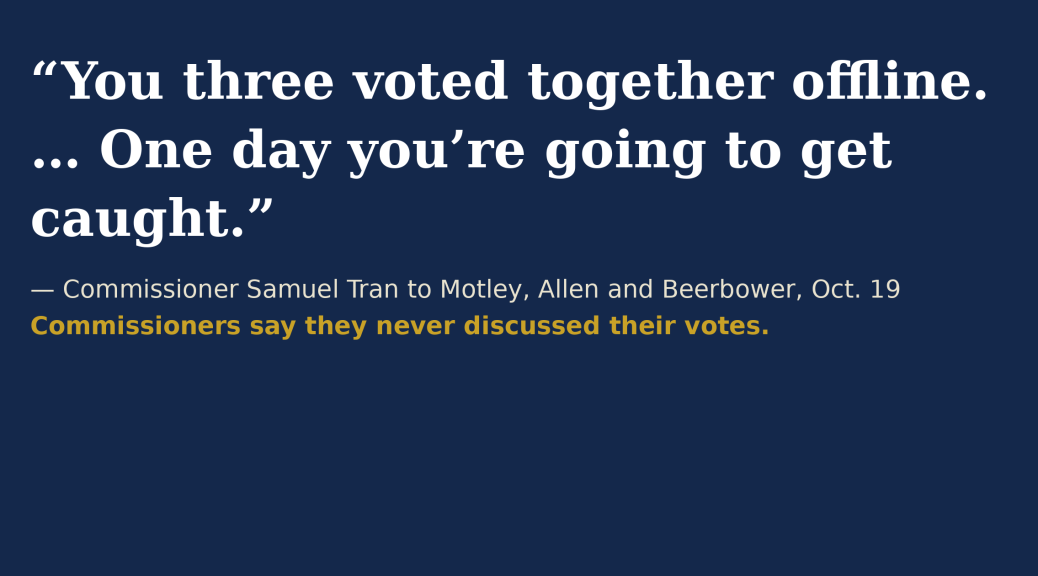
At this point, Tran starts laughing. He says whatever he is laughing at is the opposite of laughing at Walker. Walker expresses her frustration with the situation, says she’d be happy to help show Krom how to run the report if Krom would just come in and ask for help with it, but that, instead of asking for help, there are a bunch of “backdoor conversations accusing me of things that I’m not doing.” At this point, Tran utters his infamous, “Are we talking about your feelings again? ‘Cause I’m not here to talk about your feelings, I’m here to talk about facts.”
Words are being said, but communication is not happening. How could it have played out differently? Tran clearly has no idea what Walker is saying when it comes to the reports he is asking for. And that’s okay. He may not have any experience with running payroll, but that means that no matter what Walker says, he doesn’t have any way to know if it will solve the issue or not. However, the commissioners hired someone whom they believe is the best person to run the payroll system for Bourbon County, Laura Krom. Tran indicates that Laura Krom had just been out there before the recording started when he said, “Laura came out here, and I asked her point-blank what she needed.” Unless she left the meeting, she is apparently sitting right in the next room, but not participating in the conversation at this point.
Walker says that Krom just needs to log in to the PayEntry system and run the workers’ compensation report with the correct settings, which she describes for them. Now, maybe that would resolve the entire issue. Maybe it wouldn’t. Tran doesn’t know enough about the payroll system to know either way. So what options did Tran have at this point? He could:
Start laughing in a way that seems strange and inappropriate.
Ignore the easy-to-validate information Walker has just presented him with while claiming he is just there for the “facts.”
Ask Krom to run the report and see if it provides what she needs.
Inexplicably, he chooses to do both 1 & 2, but not 3. Apparently, using the information he has just been provided to try to solve the stated problem is neither in his skill set nor part of his desired course of action. So how could it have played out if Bourbon County had a different chair of the county commission? What if we had someone with the leadership skills or problem-solving experience to say, “Let’s try running that report then”?
If Walker is right, Krom runs the report, and 60 seconds later, the confusion is solved, and the meeting moves on. Karma at the insurance company gets what she needs, and everything runs smoothly. On the other hand, if the report doesn’t give Krom what she needs, the county has still made progress. In that scenario, it should be very easy to see the source of the confusion, rectify it, and move on with what is needed.
Regardless of which way you think things would have gone had they tried to run the report, Tran’s behavior in this situation is 100% the opposite of what our county needs. The fact that he clearly doesn’t understand payroll enough to know what he is asking for can be excused. Commissioners can’t be experts on every single detail of the county. What is not excusable is the fact that there is a very simple path forward to achieve the goal and resolve the situation that might take only a minute or two. He completely ignores this path and instead plows ahead, using his position as chair of the county commission to create an entirely avoidable self-inflicted debacle.
It is hard to overstate the magnitude of the core issue here. This doesn’t fall into a trivial “misunderstanding”. Monday’s meeting was a catastrophic failure of foundational leadership by the chair.
Imagine Tran sitting in the driver’s seat of a car that is accelerating toward a cliff. He tells the passenger the vehicle needs to be slowed. The passenger, who has way more experience in motor vehicles, says, “all you need to do is take your foot off the gas pedal.” The first thing Tran should do is take his foot off the gas pedal to see if the suggested solution works. If the passenger is wrong and it doesn’t help, they can immediately move on to try something else. If the passenger is right and it does help, then he now has a solution to the problem.
What if Tran applied the same course of action as what we saw in the Commission meeting? Well, he’d keep his foot firmly pinning the pedal to the floor and laugh. Then he’d say, “Are we talking about your feelings again? Because I’m not here to talk about your feelings, I’m here to talk about facts.” All the time, he’d have the gas pedal floored, completely ignoring the information he was just given that might actually help resolve the situation. Bourbon County needs leadership that can use the information presented to ask for the next reasonable step forward. This appears to be a skill that Tran either lacks or chooses not to use.
I’ve seen many calls on Facebook for Tran to resign over this incident. The optimist in me wants to think may still be a role Tran can play that serves Bourbon County, perhaps even continuing as a County Commissioner. However, my optimism does not extend to his position as chair of the commission. The last meeting made that clear. That chair position minimizes his ability to draw on his strengths while magnifying his weaknesses. Based on what we saw in the last commission meeting, I personally feel that any continuation of his role as the Chair of the Bourbon County Commission will cause greater harm in the future. He should resign from the chair immediately.
Is my reasoning sound, or did I make a mistake in my logic? I’d love to hear your concurrence or disagreement.
Mark Shead
Note: FortScott.biz publishes opinion pieces with a variety of perspectives. If you would like to share your opinion, please send a letter to [email protected].
Some things I forget and some things I remember — it just depends. When I attended Draughon Business College in Springfield, Missouri in 1976, I didn’t know any of the students when I arrived. However, I quickly made several new friends. One was a Chinese kid and, I don’t remember his name now, one day he and I were talking. In the middle of our conversation he said, “You have teeth like rabbit.” His out-of-the-blue statement made me laugh; I’ve told this funny incident many times throughout my life. (I got braces in 1979, and I’ve never had anyone tell me that my teeth looked like a bunny rabbit’s again.) Even though I can’t recall the guy’s name, I remember what he said. I’m sure he has forgotten all about me and my two front teeth.
This is a fact: The words we speak outlive us. I could author a small book using quotes from my parents. Their words influenced my life at the time and they’re still echoing in my day-to-day life even though their hearts ceased to beat in 2012 and 2015. Believers should consider the fact that what we say is being recorded in heaven and on earth. God keeps a record and so do the people with whom we have interaction.
James, the half brother of Jesus, wrote spiritual instruction on crucial topics regarding relationships. Christ followers are to choose our words with great care because words are powerful. “Indeed, we all make mistakes. For if we could control our tongues, we would be perfect and could also control ourselves in every other way. But a tiny spark can set a great forest on fire. And the tongue is a flame of fire” (James 3:2,5-6 NLT). Right words can help and wrong words can hurt.
I think we all know how powerful words are. They cause wars, end marriages, start fights; bless family and friends, encourage the downcast, and vocalize prayers. “…the tongue is a fickle unrestrained evil that spews out words full of toxic poison! We use our tongue to praise God our Father and then turn around and curse a person who was made in His very image! Out of the same mouth we pour out words of praise one minute and curses the next. My brothers and sisters, this should never be! (James 3:8-10 TPT).
James uses the endearing terms of “brothers and sisters” in his wisdom sermon. He is writing to Christ followers who evidently needed a whippin’ behind the woodshed! Welp, what’s good for the goose is good for the gander! Christ followers today are no different from those in the New Testament. If we want to shine the light and love of Jesus on others and represent Him well, we need to control the words that topple out of our mouth.
It would be to my benefit if I seriously considered this truth every day: “O Lord, You have examined my heart and know everything about me. You know what I am going to say even before I say it, Lord. Such knowledge is too wonderful for me, too great for me to understand” (Psalm 139:1,4,6 NLT). God is fully aware of every word spoken. Like King David, believers can pray this scripture: “Lord, help me control my tongue; help me be careful about what I say” (Psalm 141:3 NCV).
The Key: Folks may not remember your name, but they’ll remember what you said.
K-State Extension Launches “Passport to Fun: Spring Break Edition” for Local Youth
As spring break approaches, families across the Southwind District have a new reason to get excited. K-State Extension is rolling out Passport to Fun: Spring Break Edition, an immersive, hands‑on learning adventure designed especially for youth ages 7 to 12.
This four‑day program invites young explorers to “travel the world” without ever leaving their community. Each session highlights four different countries and blends movement, creativity, science, and cuisine to give participants a rich, memorable cultural experience.
From crafting and cooking to interactive activities and global discovery, the camp aims to spark curiosity and broaden horizons.
A Four‑City Tour Across the District
To make the program accessible to families throughout the region, the K-State Extension team is hosting sessions in four different communities:
• March 16 – Fort Scott @ Buck Run, 1010 Park Avenue
• March 17 – Chanute @ City Park Pavilion, 101 S. Forest Avenue
• March 18 – Yates Center @ Community Building, 711 S. Fry Street
• March 19 – Moran @ Moran Senior Community Center, 407 Cedar Street
Each session runs from 1:00 to 4:00 p.m., offering an afternoon packed with global exploration and hands‑on fun.
Encouraging Curiosity Through Experience
The program’s design reflects K-State Extension’s commitment to experiential learning. By blending physical activity, creative expression, scientific inquiry, and culinary exploration,
Passport to Fun gives kids a chance to learn in ways that feel like play. It’s an opportunity for youth to build confidence, try new things, and develop a broader understanding of the world.
Wake Up Your Fruit Trees – Time for Dormant Oil Sprays
I’ve heard the frogs singing on several days, which is always a welcome sound to my ears because I know spring is near! When the beautiful, warm days grace us in March, make time to apply a dormant oil on your fruit trees.
There are several dormant sprays used on fruit trees and other plants to control various diseases and insects. However, a dormant oil spray is designed to control scale insects, aphids, and mites. Just like the name implies, dormant oils are applied before the tree begins to bud. Dormant oil sprays are essential because some pests attack before visible growth even begins. If you have a problem with scale, now is the time to start watching the weather and look for an opportunity to spray.
Scale insects are easy to see this time of year because there are no leaves. Scale insects are easily overlooked because they are small and immobile most of their lives, and they do not resemble most other insects. Many of them resemble small oval or circular shells. Coloring varies but can include white, tan, and brown. Plants that should be inspected for scales include apple, pear, other fruit trees, lilac, crabapple, oak, ash, elm, maple, arborvitae, juniper, pine, spruce, euonymus, and yew.
Plants are not harmed if only a few scales are present, but scale population can increase dramatically during the growing season. Heavy infestations of scale insects can damage fruit crops, destroy branches, and kill entire plants.
Normally, sprays should be applied around March 1, especially with peaches and nectarines. Apples are tougher, and the application may be delayed up to the green tip stage. Temperatures need to be at least 40 degrees so the spray has a chance to dry before freezing. If the spray does freeze before it dries, plant injury can occur. Applying the spray in the morning will help ensure it dries properly. It is much easier to achieve good spray coverage if the tree is pruned before spraying.
The Extension office has several publications outlining the fruit spray schedule for the entire growing season.
Now is an excellent time to prune. Pruning can be done in March. Prune on days when the temperature is above 20 degrees to prevent injury. Prune older trees first because older, larger wood tolerates lower temperatures than young trees with small-diameter wood.
If your trees are overgrown and out of control, and you don’t know where to begin, stop by the Extension office and pick up a pruning publication. This publication offers step-by-step instructions for pruning overgrown trees and includes nice diagrams.
Krista Harding is a K-State Research and Extension Horticulture agent assigned to the Southwind District. She may be reached at [email protected] or 620-244-3826.
Public Works Updates: Director Kenny Allen presented a purchase agreement for a new road grader through Foley Equipment CAT to replace an aging unit. The Commission authorized a 50% countywide discount for landfill vouchers to assist with city and county cleanup efforts. (Pages 3-4)
Infrastructure Projects: The Commission signed the second phase agreement for the Jayhawk Bridge project, a $1 million project where the county is responsible for a 10% match ($100,000). (Page 4)
IT & Security: Significant discussion occurred regarding the county’s IT infrastructure. The Commission passed a motion to “cease and desist” any independent IT improvements by individual offices until a unified path is decided. Stronghold announced the start of a Microsoft 365 baseline implementation to improve security scores. (Pages 6-7)
Noise Resolution: A revised 4-page resolution was presented, moving the measurement point for noise complaints to the complainant’s property line. (Page 7)
Personnel & Payroll: Longevity pay is being integrated into hourly wages starting the next payroll cycle. The Commission also introduced Lou Howard as the new Emergency Manager. (Pages 7-8)
Meeting Minutes: February 23, 2026
Financial Reporting: Chairman Tran requested that accounts payable reports be sent to all directors and elected officials for review prior to meetings. He also mandated that invoices or receipts be attached to checks for verification. (Pages 10-11)
Landfill Logistics: Local waste haulers requested that the landfill remain open on certain holidays to prevent collection backups. The Commission agreed to further discuss holiday staffing and compensation. (Page 11)
System Access: A motion carried to provide read-only access to the CIC financial system for specific staff and the Sheriff to reduce information bottlenecks. (Page 11)
Public Safety Payroll: Sheriff Martin and Undersheriff Davidson raised concerns that the current “Pay Entry” system creates administrative burdens for deputies who cannot easily clock in while in the field or on call-outs. (Page 12)
Unclaimed Property: The county is investigating approximately 32 unclaimed property claims listed on the Kansas State Treasurer website belonging to various county departments. (Page 12)
Do your potential customers remember you when they need your services? Are they going out of town because they forgot about local options? FortScott.biz advertising can keep your business as the first place they remember. Contact [email protected] to find out how.