
With over 2 inches in the last 24 hours and 6 inches over the last 7 days, many roads in town and the county had water flowing over them. Fort Scott typically averages 3.8 inches of rain for the whole month of August.
With over 2 inches in the last 24 hours and 6 inches over the last 7 days, many roads in town and the county had water flowing over them. Fort Scott typically averages 3.8 inches of rain for the whole month of August.
Citizens Bank, N.A., a prominent local financial institution, has announced its merger with Landmark National Bank, which is headquartered in Manhattan, KS. However, changes observed by customers, according to recent reports, should be minimal.
According to Becky Tourtillot, Director of Communication at Citizens Bank, N.A., the daily operations of the bank should remain fairly constant as compared with those before the merger, at least for the present. “At this point, we have a process to go through, which requires regulatory approval,” Tourtillot said. “For the current time, customers will not see any changes until that whole transition process is complete.”
According to Tourtillot, one factor that will allow daily operations to continue running smoothly involves the bank’s electronic operations. “We use the same vendor [as Landmark],” Tourtillot said. “That’s another reason we expect minimal disruption.”
Tourtillot said that once the transition is complete, the bank will operate under Landmark’s name.
Chief Judge Richard Smith met with Bourbon County Commissioners this morning to discuss alternative sentencing for inmates in specific cases, as well as courthouse security. Smith, who presides over Lynn, Miami and Bourbon County courts, brought suggestions and ideas to the table in order to help reduce overcrowding in the Southeast Kansas Regional Correctional Center (SEKRCC).
Smith commented that at one time, the SEKRCC had plenty of room, and people were farming out prisoners to be housed in Bourbon County’s jail. “It was a whole different ballgame,” Smith said.
“We’ve done some things in Lynn County to cut back” on costs involved in housing prisoners, Smith said. “We have kind of an information screening, the jailer and the judge. If we think someone is a candidate for House arrest, we are doing electronic monitoring on some of those folks.”
Smith also mentioned use of the Owner Recognizance (O.R.) Bond, in which a defendant unable to produce a bond signs an agreement to appear in court. According to the Oklahoma County Court Services website, in the interest of public safety, only inmates whose history has been examined and who have been deemed eligible are able to obtain an O.R. Bond.
County Attorney Terri Johnson asked if Smith had written guidelines on the O.R .program and house arrest. Smith replied that he did have written guidelines in place for the O.R. program, but that the house arrest option for prisoners was decided on a case-by-case basis.
Smith said that the two main issues faced by the area are “substance abuse” and issues with cognitive decision making. “It is a problem, because here is the issue, to be blunt. What we need is programming for [inmates]. There really is an issue here about the number of interventions provided,” Smith said. “The problem is the lack of programming dollars . . . to help these people succeed.”
Smith also brought up recent legislation that has made a difference in violations in other states. Kansas House Bill 2170 allows for a change in the incarceration process in certain cases. According to the summary of legislation for the bill, if a defendant waives the right to a hearing and the court has not “specifically withheld the authority of court services,” the defendant may be put in prison immediately by a probation officer or other court services authority for a short term of 2-3 days, but may only be held 6 days total per month in a 3 month period if incarcerated under this process. Smith said that this practice had been used successfully in other states. “The effect in Georgia and North Carolina was a radical drop in jail time,” Smith said. “It’s the immediacy of reprimand,” Commissioner Barbara Albright said.
In addition, Smith discussed courthouse security with the commissioners during a 30 minute executive session. Commissioner Harold Coleman moved to go into executive session with Chief Judge Richard Smith, County Attorney Terri Johnson, Undersheriff Bill Martin and the commissioners present. No action was taken.
“It’s really the public that’s the concern,” Smith said of courthouse security. Everyone talks about the criminal cases—that’s not the problem. It really isn’t.” Smith explained that more routine type of cases, such as divorce cases, could cause a security concern. The remainder of the conversation concerning security matters was held the executive session.
In other business:
August 2nd-4th the Fort Scott Chamber of Commerce is sponsoring a Sales Tax Holiday to promote shopping at local businesses. Customers will benefit from an 8.65% discount up to a purchase of $300 on merchandise. Businesses participating in the event include the following local retailers:
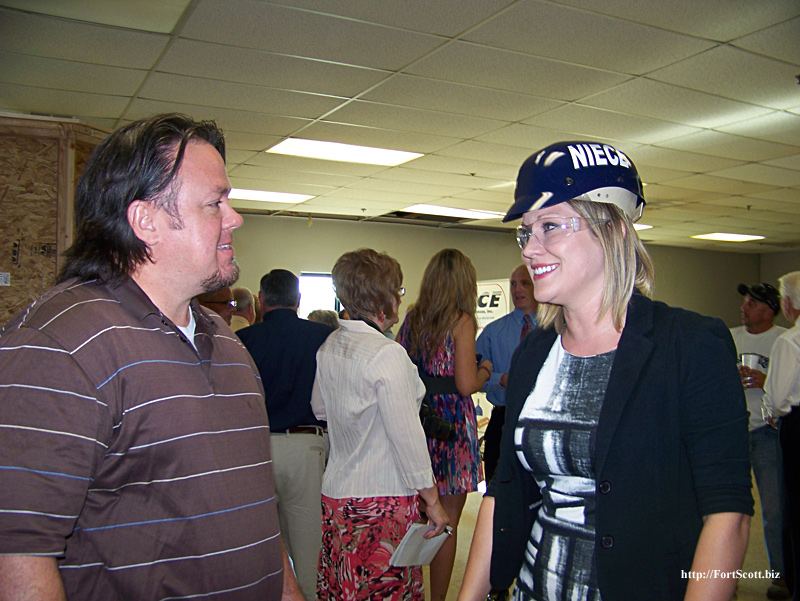
Conversation at this morning’s Chamber Coffee at Niece Products of Kansas revealed another Fort Scott company’s request for fast, reliable internet services on the business level. Al Niece, founder and president of Niece Products of Kansas, NIEMCO and Niece Equipment, explained that the company often sends products overseas and conducts business on the web.

“There’s a 20,000 gallon tank out here going to the Ivory Coast,” Neice said. Neice went on to say that the company will be sending two of these tanks to the Ivory Coast, and another two to Australia. Pat Flanagan, Operations Manager/Partner at Niece Products of Kansas, said the company’s tanker trucks are “rolling service stations,” and that the products are used for a variety of services in construction, but that they are also used to help fight fires. Flanagan also mentioned that a plan was in the works to offer rental of equipment “to service the Midwest.”
The announcements from Niece and Flanagan revealed that the company is forward-thinking with regard to technology, and actively involved in the community. “We hire a bunch of high school kids during the summer,” Flanagan said. Niece added that the company has hired several college students at a Texas location to work on electronic versions of blueprints. “These younger guys and gals just fly through this stuff,” Niece said.
Flanagan spoke of the company’s need for high-speed internet to effectively conduct business operations and allow the company to grow, and City Manager Dave Martin stepped forward in agreement. “High-speed internet,” Martin said, “is the key to moving this community forward. We are making efforts to try to get this.” Flanagan added that though the city is leading the efforts to obtain high-speed internet for the city, it will take the involvement of the entire community to attract an internet service provider that offers these services. “If we work and plan to show them this is a viable market, they’ll come,” Flanagan said.
In other news:

















As with any volunteer-run organization, dedicated volunteers are needed to support the day-to-day operations of the organization. Lee’s Paws and Claws Animal Shelter is no exception.
According to Volunteer Coordinator Barbara Ritter, the shelter has only 3 regular volunteers working during the week. “We desperately need volunteers. We currently have one volunteer on Monday, Wednesday and Thursday 10-2, one on Tuesday, and two on the weekends. It would be nice to have a few more volunteers working with our current ones,” Ritter said.

Ritter explained that the duties volunteers perform range from cleaning to cuddling with the dogs and cats that call the shelter “home.” “The duties are varied in nature and time,” Ritter said. Duties include “cleaning the dog runs, cleaning the cat rooms, sweeping/mopping, laundry, washing feeding bowls, walking dogs or just spending time with the animals.”
The age of volunteers varies, but Ritter said that the “greatest need though is for adults who can volunteer during the week.” Ritter said that volunteers should be above 12 years of age, but that the shelter has two 12-year-old girls who stop by a few times a week to play with the cats.
Ritter reminded those who would like to support the shelter to attend Shelter Night at La Hacienda. The restaurant, which is located at 22 S. Main Street in downtown Fort Scott, hosts a fundraiser for the shelter every Tuesday evening. Ritter also mentioned the adoption days held at Shepherd Team Auto Plaza from 10AM-2PM the last Saturday of every month.
Those interested in volunteering at the shelter should contact Barbara Ritter at 620-223-2888 and/or visit the shelter at 721 240th Street between 10AM-2PM.
Though Gunn Park has been a staple for entertainment and activities for Fort Scott for many years, it continues to evolve in response to the needs of the community through the work of the Kansas Department of Wildlife, Parks and Tourism. Many citizens who frequent the park may have noticed the nearly empty 2nd lake.

According to city officials, the lake is slated to undergo improvements in the future. The improvements to be made to the lake include putting three piers out into the lake 40 feet long 20 feet wide, as well as excavating to make the lake less shallow. The lake is currently drained in preparation for the improvements that are to be done, but recent rains have made the lake bed too wet to get machinery in or out without getting mired down and possibly stuck in the mud.

According to Don George, Fisheries Biologist for the Kansas Department of Parks and Wildlife, the “grant is through Kansas Department of Wildlife, Parks & Tourism’s Community Fisheries Assistance Program (CFAP). Since our division ( Fisheries) is funded by licenses and funds from the sale of fishing tackle, these grant funds are really money from anglers to improve angling opportunities,” George said.
George mentioned that the lake had to be dewatered for spillway and dam repairs the city put into effect, and that the priorities for improving the lake were to “[deepen] the lake basin, construct several earthen piers, a boatramp, a parking lot [and] improve shallow and mid depth habitat.” “The old fishery was not productive and the lake will be restocked with desirable species,” George said.
When asked when the lake will reopen, George said that before that can happen, the lake will have to be rewatered and restocked, and that it would not be open to fishermen for another 2 years. “I hope to get started soon,” George said.

In addition, George answered the question many citizens may have about the disappearance of the city’s fishing permit requirement. “The CFAP project pays the City each year a dollar amount equal to what the city used to generate in fishing permit sales. Now when people want to fish in any of the water in Ft Scott all they need is a state fishing license. No more running around to find a city permit vendor, and the city does not have to enforce this action or keep track of the funds. In turn the City uses this money to buy fish food, mow grass and collect trash around the lakes, etc.”







Bourbon County Commissioners announced the candidate selected for the Bourbon County Road and Bridge Coordinator position at Monday’s meeting. Commission Chairman Allen Warren moved to hire Jim Harris at a yearly salary of $44,000. Commissioner Harold Coleman seconded the motion. Harris’ past work history includes employment at Berry Tractor, Bourbon County Public Works, and the City of Fort Scott.
At today’s county commissioners’ meeting, Bobby Reed of the SEKRCC brought forward numbers he had crunched on jail expenses at Commissioner Albright’s request in an attempt to solving the problem of rising jail expenses. Unfortunately, a permanent solution to the problem seems elusive.
Reed, Undersheriff Bill Martin, and SEKRCC Security Director Julie Miller all presented data that pointed to probation violators as the source of much of the expense, including out-of-county housing. Reed presented reports gathered from the past 19 months. “We may fluctuate a day here or a day there, but until the 26th, we had 45 in and 29 out,” Reed said of the past month. Reed said the number of inmates housed out in the past had been as high as 34. As of today, 32 inmates are housed out of county, according to Reed.
“We have bed space for 52 inmates, but we have to leave a 15% of the 52 open for influx and so forth,” Reed said. Reed explained that jail administration had made a choice last year to house inmates out of county when the number of inmates housed in the county rose to 56, 4 above the maximum.
When asked about the possibility of reducing the jail population, jail officials explained the difficulty of carrying out that request. “The majority [of inmates] are probation violations, and they have to sit there and serve their time,” Miller said. Miller estimated that approximately 75% of inmates are probation violators, and explained further that many of the violators are repeat visitors to the jail. “For a county of 15,000, the population of our jail is outrageous,” Commissioner Harold Coleman said.
“They’re all the same people—it’s a revolving door,” Miller said. Miller explained the process for probation violation, which becomes a cycle for some inmates. “We can only do so much,” Reed said. Miller said that probation violators often “sit for a month” before they go to court because of backlog. “That inmate can sit down there until the judge is ready to see them,” said Martin.
According to Undersheriff Martin, Bourbon County GIS Director Shane Walker is working with the company that created the office’s computer program to help generate more data. The department hopes to generate exact figures on the amount of inmates returning on probation violations.
Commissioner Albright brought up the fact that the national average stay for 75% of inmates is approximately 72 hours. “What’s it going to take to get it down to the national average?” Commission Chairman Warren said. To these queries, Reed responded that many of the arrest warrants that he deals with are “no-bond,” which contributes to the high jail population. Reed estimated that this type of warrant comprises 80% of the warrants he sees.
“We’re not the only county with these issues,” Martin said. “They’re facing the same problems,” Martin explained, and pointed out that eventually housing out of county may not be an option.“If we sift it all out, length of stay is the issue,” Albright said. “What are we doing for effective intervention?” Gray said that there were free programs available and probation counselors whose efforts were directed at preventing probation violations. “It’s the responsibility of the individual,” Martin said of inmates attending counseling and free programs to help inmates fight addiction. “They have to take it upon themselves to stay out of the system.”
With regard to working out a solution, County Attorney Terri Johnson told commissioners that Chief Judge Richard Smith would meet with the commissioners Friday, August 2nd.
Other expenses that commissioners and jail officials considered today were overtime, inmate meal and medical expenses, and supplies.
Commissioner Harold Coleman called the overtime being paid in the Sheriff’s office “staggering.” Coleman said that he had calculated 423.2 hours in the past two weeks. Reed explained that many officers were coming in on their days off in order to transport inmates.
When asked the cost for inmate meals, Reed reported the current cost per inmate per day is only a few cents above $3.00. Gray added that this was reduced from the former cost of $12.00 per inmate per day.
With regard to medical costs, Miller said that the bill for prenatal care for inmates is footed by the SEKRCC budget, as well as any other bills, such as ER visits, that inmates incur while incarcerated. “All these doctor’s bills—they should be repaid by the offender,” Miller said.
In a final query concerning expenses, Warren asked about the recent $1,000 spent on supplies for the jail. “One of the things I think we really need to look at is what are we buying in the way of supplies,” Warren said. Warren said that there had been $1,000 spent on training videos, to which Gray replied that inadequate training leaves the department open to a federal lawsuit.
“Everything we buy is an absolute necessity,” Miller said. Miller explained that she had been sewing to keep materials together and avoid purchasing new materials. “We just need to be looking, always, for ways we can reduce our expenses,” Warren said. “I’d like for the suggestions to come from you.”
In other business:
A drive down National Avenue in the past month may have had residents wondering what was going on behind the Mercy Convenient Care location at 1624 S. National. To accommodate a recent expansion in Occupational Medicine services, Mercy needed additional building space to match.

According to Mercy Regional Marketing/Communications Manager Tina Rockhold, construction on the expansion was completed Friday, July 19th, and staff moved in over that weekend. “Since Tuesday, July 23, Mercy Occupational Medicine has already provided six job assessments on potential co-workers for a local business,” Rockhold said of use of the facility and services. According to a recent Mercy press release, the new addition, which spans 1,2oo square feet, “is dedicated for job ‘fit’ assessments to test workers on their functional skills.”
Of the services that the new expansion makes possible, Eric Baldonado, Mercy Director of Rehabilitation Services said in a recent press release that “Occupational medicine is focused on prevention,” and that Mercy “works side by side with employers to test a potential co-worker on their ability to meet the physical expectations of the job, and that’s just the beginning.” Baldonado also mentioned in the press release that Mercy’s occupational medicine services do contract work with “business and industries to tailor fit occupational medicine needs that will reduce injuries in their specific work environment.”
Mercy Hospital Fort Scott President Reta Baker stated in the press release that Mercy determined the need for the occupational services after holding “conversations with several business leaders in the community.”
According to the press release, services offered at the new location include “medical evaluations such as pre-employment physicals and Fit for Duty’ testing (urine analysis, drug screens and pulmonary function tests)’ therapy services and nationally recognized Work Well TM services. Additional services include on-site vaccinations such as flu shots, job site analysis, education programs and development of functional job descriptions.” Baker said that Mercy had “taken time to assemble a skilled and hughly trained staff to oversee the occupational medicine program,” and that the “team will coordinate care with Mercy Clinic physicians and specialists, registration, lab, imaging and therapy services to provide the full spectrum of occupational medicine services.”
According to Rockhold, the providers and co-workers who comprise the Mercy Occupational Medicine Team are James L. Jordan, MD, Team Consultant, P.K. Gugnani, MD. Medical Director, Jan Boge, APRN, Pamela Moyers, APRN, Leigh Scharff, APRN, Jamie Johnson, PT, Eric Baldonado, PT, Whendi Martin, Admitting Representative, Michelle Bruner, Mercy Clinic Director, Monica Dikeman, PTA and Meghan Woodrum, Radiology Tech, Phlebotomist, Medical Assistant.
Entities interested in contacting Mercy Occupational Medicine should call Whendi Martin at 620-223-8428.
According to Bourbon County Undersheriff Bill Martin, old patrol cars that have been totaled out by insurance will be removed by KCAMP, the county’s insurance provider. According to Sheriff Ron Gray and Martin, the remaining older patrol vehicles have been paid off and will be sold at auction, and bids for 2 new pickup trucks for the department have been offered by Shepherd Team Auto Plaza.
According to Sheriff Gray, the bid from Shepherd’s is $26,382 for the two vehicles. Gray said, “I am very pleased,” regarding the bid for the vehicles from the local dealer. “They actually came in almost a thousand less [than competitors], so they are the low bid.”
Regarding the sale of the four remaining aged vehicles, Gray said, “What you have to sell at auction would be my pickup, the Tahoe, the emergency preparedness truck and Tom Davis’s truck.” Commission Chairman Warren asked for a “ballpark” figure on the price these vehicles might bring, to which Gray replied that they might bring $500 each if sold at local auction, and at a larger auction, the amount would depend on the market the day of the sale. “I think your best option is probably to send them across the auction block,” Gray said.
The commissioners then went into a 15-minute executive session with Gray and Martin present to protect the privacy of non-elected personnel.
In other business:
While Mercy Auxiliary workers quietly work in the background much of the time, their efforts provide a valuable service to the community. Carolyn Crystal of the Mercy Auxiliary stepped forward at today’s Chamber Coffee to make a request of the community. Crystal highlighted the fact that the Auxiliary needs more volunteers to step forward. The pool of volunteers is running a bit low, and the service the Auxiliary provides much-needed services to patients, such as mail delivery, running the gift shop, assisting William James Schafer with pastorial duties, and assisting incoming patients and families. Volunteers also sew stuffed bears to give away to children that come in for shots and emergency visits, in addition to caps for cancer patients and pillows for outpatient surgery patients. “We have workers in here 5 days per week,” Crystal said. Crystal said that the Auxiliary is looking for volunteers of all ages. “I don’t want to put anyone out [of consideration] that wants to volunteer,” said Crystal.
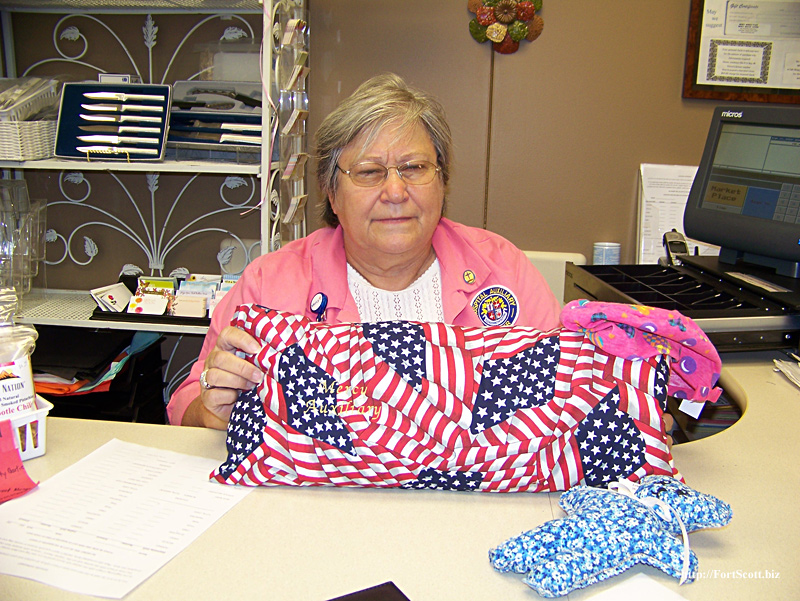
Crystal explained that volunteers work in two shifts, 5 days per week. The morning shift lasts from 8:30AM-1:00PM, and the afternoon shift, from 1:ooPM-5:30PM. For each shift, the worker earns 5 hours of credit. The Auxiliary does request a $5 donation from each worker every year, but that during the first year, it can be waived.
Crystal also pointed out that the volunteer work does have some unique benefits. For each hour that volunteers work, they have 1 hour of credit (1 hour=$1.00) to apply to hospital visits, medications, Health for Life or doctors’ appointments. Additional benefits include a free beverage at the cafeteria during the worker’s shift, a discount at the hospital gift shop and cafeteria, and an annual flu shot and TB test. Crystal also mentioned that the hospital puts on a special banquet every year for volunteers and presents each one with a small gift. “The appreciation dinner is very nice,” Crystal said.
Other activities Auxiliary workers are involved in include the annual gift shop Christmas Show, which is usually held the 1st of November in the MacAuley Room.
In other news: