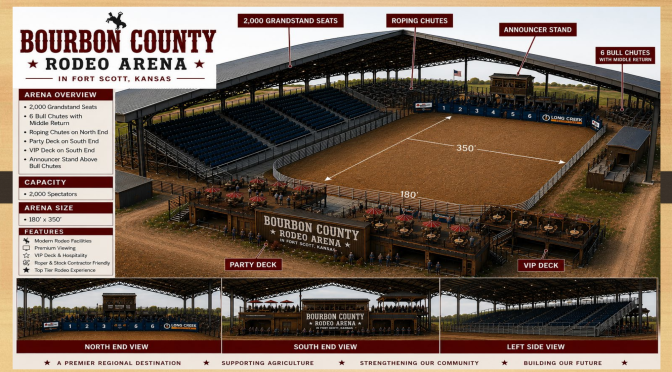
FORT SCOTT, Kan. — City commissioners voted 5-0 Tuesday to authorize City Manager Brad Matkin to begin developing plans for a covered, 2,000-seat rodeo and event arena at the Bourbon County Fairgrounds, a project his own estimate puts at $3,999,000.
What the commission did not do is approve the arena. The motion directs Matkin to bring back firm cost numbers, work with the city’s bond counsel on financing, assemble a task force and seek sponsorships. No bond has been authorized, no lease has been signed, and no construction contract exists.
“I would make a motion that we direct Brad to get real numbers, get with Garth on what he needs, set up the task force, set up the sponsorships, and whatever else he feels is needed to make the Fort Scott Rodeo Arena a reality,” Commissioner Matthew Wells said. The motion was seconded, and all five commissioners voted yes.
The “Garth” in the motion is Garth Herrmann of Gilmore & Bell, the city’s bond counsel. The arena was a new-business action item on Tuesday’s agenda.
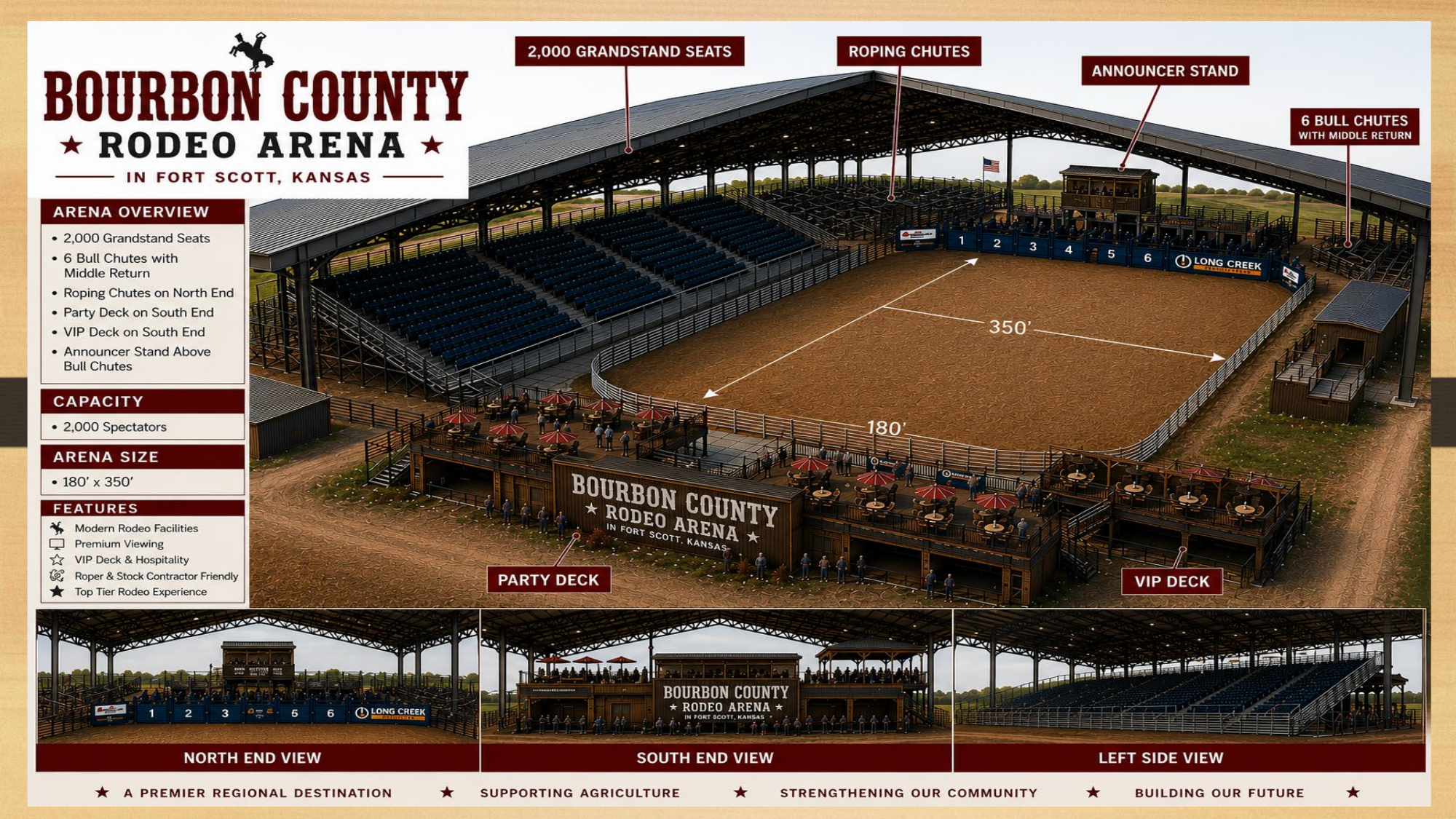
Matkin’s plan builds on the fairgrounds’ existing 180-by-350-foot dirt arena rather than starting from bare ground. The existing bleachers would come down, replaced with 2,000 stadium seats. The design adds six professional bull chutes, three on each side; roping chutes; a party deck and a VIP deck; a food court for local restaurants; and an announcer stand equipped for electronic scoring.
A roof would cover the arena and both decks. The ends would stay open.
“It would not be totally enclosed because heating and AC would be a big expense for that,” Matkin told commissioners. He said Coach Cross from Fort Scott Community College and other rodeo experts told him the roof alone is what they care about.
Speaking Thursday on the weekly “What’s Up Fort Scott” radio program, Matkin added more: livestock holding facilities, concession areas, 250 outdoor stalls for rent, vendor and trade-show space, extra parking and RV hookups, and a sound system. A removable floor over the arena dirt would let the building host concerts, trade shows and conferences. The city would hire a coordinator to book events.
“We’re not just going to use it once a week. We’re not going to use it twice a week,” he said on the air. “We’re planning on using this thing a lot.”
The land would be leased from the Bourbon County Fair Board, which Matkin said has voted to give the city the opportunity. No lease has been drawn up or executed; he told commissioners he had not yet worked it through with the city attorney and would bring an agreement back before signing.
Matkin framed the arena as a revenue problem, not a rodeo one. City sales tax collections are on pace to fall $155,000 from 2025 to 2026, he said, and $302,000 since 2024. Sales tax, he argued, is what keeps property taxes down and pays for police, fire, parks and streets.
His proof of concept is a rodeo the city does not own. Fort Scott Community College’s three-day spring rodeo drew more than 3,900 spectators this year into Arnold Arena, which seats just over 500. Using Placer AI, a foot-traffic service the city subscribes to, Matkin tracked where they went afterward: 772 to Sharky’s Pub and Grub, 770 to McDonald’s, 673 to Casey’s, and several hundred more across Pete’s, the retail center and three local hotels.
He also pointed to a much smaller Kansas town.
“Population of Pretty Prairie, Kansas, 650 people. They put on a four-day rodeo event. Their attendance, 26,500 people,” Matkin said. “I’ve said this for four years. Why not us? Why not Fort Scott?”
The crowding costs the city visitors outright, he argued, describing a barrel racer whose own family skipped her college rodeos here because they could not get seats.
“You are literally just squeezed in there like sardines,” Buchta said, adding that she is grateful the college hosts the events at all.
Matkin’s presentation totals the project at $3,999,000, led by the roof at $1.8 million, lights and electrical at $981,000, and seating at $800,000. Smaller pieces include $85,000 for bathrooms, $68,000 for large fans and $60,000 for bull chutes. Speaking to commissioners he rounded it off: “I’m just going to say, $4 million.”
He said state officials pointed him first at STAR bonds, which use sales tax revenue generated inside a project district to repay the debt. He does not want that.
“To do what this is supposed to do, we don’t want to stop our sales tax from growing,” Matkin said. “So a star bond to me is an option, but not the best when you’re wanting to increase sales tax.”
Buchta asked him to clarify that for the public: he meant sales tax revenues, not the rate. “We will not increase sales tax,” Matkin said.
His preferred mix is a conventional bond paid from the city budget, plus grants, property sales, sponsorships and an annual rodeo gala. He said he has a verbal commitment of $20,000 for the party deck, which he described as a three-year commitment that would then need renewing.
Commissioner Tim Van Hoecke asked whether the city would take a cut of ticket sales or concessions, since it would be paying for the building. Matkin said a portion would come back, though part of any gate goes to prize money. Commissioner Tracy Dancer asked whether the site could handle livestock waste; Matkin said it could, noting a 12-inch water line serves the grounds.
Wells said an earlier feasibility study showed a Fort Scott arena would draw from Oklahoma, Arkansas and Missouri, and warned that at least five communities within 40 minutes are eyeing similar projects.
“If we’re going to strike, we should strike while the iron’s hot,” he said.
Buchta tied it to the budget. “I feel like we really have to focus on revenue creators,” she said. “I don’t want us to have to cut services.”
Earlier in the meeting, resident Michael Hoyt used public comment to flag a new state law that could bear on how a project like this gets financed. House Bill 2622, which took effect July 1, tightens protest-petition requirements on municipal lease-purchase agreements.
“Anything over $100,000 is subject now to a protest petition by the voters if they do not agree with the lease purchase agreement,” Hoyt said. By his count it would take 186 signatures to force the question onto a special election ballot, and he told commissioners past special elections had cost the city roughly $5,000 apiece.
Hoyt raised the law about city budgeting generally, not the arena, and the arena’s preferred financing is a traditional bond rather than a lease-purchase. But the city has not settled on a structure.
Approved July 21: authority for the city manager to pursue the project: firm cost estimates, bond-counsel work on financing options, a task force, and sponsorships.
Not approved, and not yet done: firm costs. A financing or bond decision. An executed lease with the Bourbon County Fair Board. Sponsorships or the proposed annual gala. Hiring an events coordinator. And a decision to build.
Matkin wants the project moving in 2027. “Work just begun, I have a feeling,” he told commissioners after the vote.
Read the full proposal: City Manager Brad Matkin’s 15-slide rodeo arena presentation to the Fort Scott City Commission, July 21, 2026 (PDF).
Official minutes from the July 21 meeting have not been posted. This account is drawn from the meeting and the agenda packet.
Meanwhile I think its disgusting that this same town turned down a grant to help with the growing unhoused issue in this county.
Spare me the “who’s gonna pay for that?”
Most residents in this county are one missed paycheck from homelessness being THEIR problem. But yes, let’s build a multimillion dollar rodeo arena….
Absolutely, SHAMEFUL.