FORT SCOTT — The Fort Scott City Commission split 3-2 Tuesday night on whether to levy a property tax rate above the revenue-neutral rate, then turned around and adopted the 2027 budget unanimously.
Resolution 40-2026 says the county clerk calculated the city’s revenue-neutral rate (the rate that would raise the same money from existing property as last year) at 41.472 mills, and that the commission, “having heard testimony, still finds it necessary to exceed” it (video, 1:38:11). The rate the city adopted is 41.886 mills, 0.414 above revenue-neutral, worth about $24,000 on an assessed valuation of $58,608,895, according to the budget summary the city published Sept. 5.
On the roll call, Mayor Kathryn Salsbury, Julie Buchta and Tim Van Hoecke voted yes. Matthew Wells and Tracy Dancer voted no (video, 1:39:43).
Minutes later the same five voted yes on the budget itself. Wells said so explicitly: “I approve of this budget, yes.”
The vote to exceed does not mean the city is raising its rate. Ben Hart, the city’s financial adviser, told the commission that since 2020 Fort Scott has cut its levy every year but one, “going down by almost six full mills,” and that this year it found a way to cut taxes “by almost a half a mill” even with revenues falling and costs rising.
Hart also commended the commission for having the conversations necessary to enable them to keep the budget as low as they have.
Kansas still requires the hearing and a recorded vote whenever a city intends to levy above the revenue-neutral rate, because rising property values raise more money at an unchanged rate (video, 1:36:10).
Michael Hoyt, who serves on the city land bank board, questioned the budget from the floor, asking about a $3,179,736 lease-purchase principal line and whether the debt service above it covered only the general obligation bonds (video, 1:16:52). He asked why the principal hasn’t been going down. Hart answered that the city adds leases every year; Wells mentioned new police cars, and Hart cited fire apparatus and a rescue truck, “not cheap pieces of equipment.”
What the budget fight was actually about
The argument that dominated the hearing was over $38,976 cut from the general fund demolition budget.
The cut itself had already been made. At the commission’s previous meeting, Wells moved to eliminate the line for one year, which by the published figures took about two-thirds of a mill off the levy (the minutes and Hart both round it to half). Wells, Dancer and Salsbury voted yes; Van Hoecke and Buchta voted no, and it carried 3-2, a different split from Tuesday’s; the mayor was the only commissioner in the majority both times. The budget options in front of the commission before that cut carried a levy of 42.551 mills; the budget adopted Tuesday levies 41.886.
Van Hoecke read aloud an email from a business owner of 20 years. “I watch as you remove demolition from the 2027 budget,” it said. “I would encourage you to reconsider before you adopt a budget” (video, 1:21:40).
Wells responded saying, “I’ve also been reached out to by many citizens who say we demo too many good houses… houses that very easily could have been restored, put back on the market, and sold to somebody at a discounted rate.”
Salsbury said cutting the line does not end demolitions. “Removing the strict code demolition line does not completely remove the ability to demolish houses,” she said. “That is a function that can also be done through the land bank.” Wells said the solution he presented with his motion was to funnel blighted houses into the land bank, which has money to demolish them, or to have a contractor restore them and sell them, as he said Parsons has done.
Dancer argued the money would do more as an incentive than as a demolition line. “Maybe we need to pull back some of the money that we are giving up so freely,” he said, and instead tell developers the city will pay them $5,000 once a rehabilitated house is sold (video, 1:28:14).
Dancer framed the test narrowly: the standard the commission has to apply is whether a structure is dangerous and unsafe, not whether the community dislikes looking at it. Van Hoecke said unsafe was not the whole of it. “If you’re a longtime resident here and you’re paying your taxes, it does come down to quality of life as well,” he said (video, 1:29:56). Salsbury agreed aesthetics matter to people but are not part of the ordinance’s mechanism.
Hart put numbers to it: $40,000 budgeted for the land bank, plus about $82,000 already sitting in cash. Van Hoecke started to move $15,000 back into the demolition fund, then dropped it after being told the land bank would spend that much on blight regardless, having already identified the area it wants to work on (video, 1:33:09).
$15,000 in grants, seven applicants, three winners
The longest stretch of the meeting was the third-quarter small-business grants. Seven applicants came to the table and presented in person for a $15,000 pool: Salon Social, Better and Bourbon, Travis Sawyer, the Fort Cinema, Bourbon County Clay, Midwest Runway Boutique and the Super 8.
Van Hoecke moved first, for a three-way $5,000 split to Bourbon County Clay, Salon Social and the Fort Cinema, saying he was reluctant to see the theater go the way of neighboring towns’ (video, 1:10:45). That motion died for want of a second.
Wells then proposed an even three-way split, $5,000 each to Midwest Runway Boutique, Salon Social and Bourbon County Clay, and asked the others to reapply next quarter. His test, he said, was “return on investment. What are we going to get back as a city?”, noting one applicant expected to create three new jobs (video, 1:06:58). It passed unanimously (video, 1:14:48).
Maria Morris told the commission she had just relocated Midwest Runway Boutique to downtown Fort Scott. Brooklyn Holder is opening Salon Social, which she said would hire three people. The Freemans’ Bourbon County Clay and their Artificers gallery are downtown. Buchta noted, echoing Wells, that applicants who missed out can apply again next quarter.
Also before the commission
Emergency pump. The commission unanimously approved $43,772.30 for an emergency replacement pump at the College Booster Station, upgrading to an impeller that stands up better to chlorine.
Alcohol ordinance. Ordinance 3801, amending the city code on alcoholic liquor, cereal malt beverages and beer gardens, came back for a first reading after being tabled Sept. 1. City attorney Bob Farmer said the fee schedules are unchanged and the draft’s one change is to repeal the former $125 beer garden license; Wells said the beer garden rules were the only place the old code fell out of line with state statute. Commissioners asked for a single revision: language making clear that the common consumption area applies every day of the year, not only during special events, which Van Hoecke said is how the draft read. Salsbury and Dancer also asked whether license fees should distinguish a restaurant that serves drinks from a bar; Farmer said the line is hard to draw. “It is a bar. They just happen to sell food there,” he said (video, 1:53:12). Van Hoecke moved to approve the ordinance with that one change and Wells seconded; the clerk and Farmer said the vote approved only the changes, with the final ordinance to come back at the next meeting. Salsbury first voted no, saying she had made “a personal commitment never to vote in the affirmative on an ordinance that I don’t have the final version of in front of me,” then said “okay, yes” after Farmer clarified that the vote approved only the changes, not the final ordinance (video, 1:56:50).
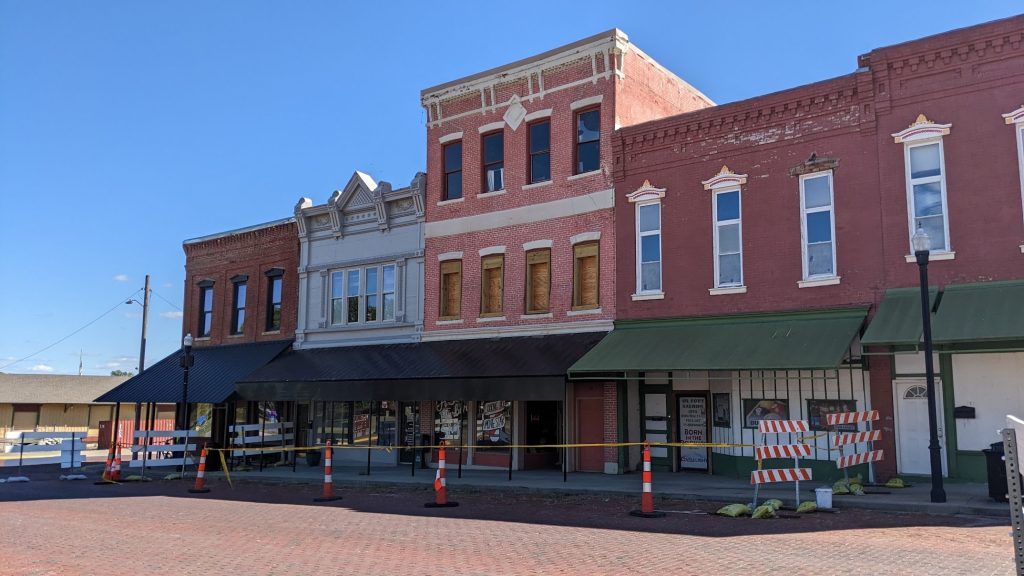
118 E. Wall. Farmer said he told the owner of the blighted building that the city will not pay for it and has been authorized to sue to bring it into compliance, but that the owner should first look at giving the building away. The owner had asked for tax credits, which Farmer said the city cannot grant. City Manager Brad Matkin said two men from a church-funded Kansas City medical business, with locations in Wyandotte and Johnson counties, visited City Hall and said the owner may donate the building to them; the city plans to look at their operations before anything is settled. “It’s not a done deal,” Matkin said. Farmer added that if a use is allowed under zoning, the city cannot pick and choose who occupies a building. At Wells’s request, Matkin said the city will send the notice that starts the 30-day clock for demolition-by-neglect citations and fines (video, 2:03:12).
Moody Building. Farmer said the owner’s corporate status has been revived, so the proper party can now act on the building, and that he is still trying to get an answer from the IRS: an agent who had been responsive no longer returns calls, and the office number rings to a national line that, after 20 minutes on hold, tells him to call back another day. Matkin said the party interested in the building has been cleared to bring in architects and engineers and has started cleaning out the basement, which is why a dumpster is parked outside. Van Hoecke said that when he was downtown Saturday they were pumping out water that “has been in that basement for a long time” (video, 2:07:05).
Lake lots. Matkin was asked to gather survey costs, covenants and deed-restriction information on eight lake lots on the east side and to look at leasing rather than selling, including very long-term leases and RV sites; he said he would come back in about a month. Van Hoecke said selling the lots would help pay down debt on the fire trucks; Wells said he would lease all eight on 199-year leases, as some Colorado resort towns do. Salsbury cautioned about protecting the water supply. “I don’t want to compromise our water supply at all, and I think we just have to be incredibly careful about it,” she said (video, 2:09:56).
Naturalization ceremony. Matkin reminded the mayor that a naturalization ceremony was scheduled for the following day and asked who else planned to attend, saying he would be running sound and would post about it (video, 2:21:52). Twenty-five people are to be sworn in as citizens; Salsbury said she is to speak at the ceremony.
Street repairs. Answering Streeter, Matkin said the city plans to run the striping machine over several streets at once when the cape-seal top coat is finished. He said the dip in the brick street by Streeter’s shop was left by a contractor rather than the street department and will be repaired, and that Wall Street should be finished the next day after the asphalt plant the city buys from broke down twice.
Memorial Hall. Mary Wyatt, the city’s business development director, reported that the Kansas Department of Commerce that morning released the Memorial Hall window and exterior restoration project, approving the single-bidder award to Mid-Continental Restoration so construction can begin. Asked by Van Hoecke whether the city’s Certified Local Government status helped win the grant, Wyatt said it did not; the city was not yet a CLG when it applied (video, 2:16:53).
Public comment. Cory Bryars of Care to Share thanked the city golf course, promoted Fort Fest at Riverfront Park and said the group is now averaging about $12,000 a month to local cancer patients. Ray Streeter urged the city to stripe recently cape-sealed streets, said he is “sick and tired of the brick streets,” and argued against spending grant money on another walking path when streets, sewers and water need it.
Consent agenda. The agenda was approved as amended, adding a late Olson invoice of about $5,381.74 for airport grading and runway-lighting work. The consent agenda also carried a $505,024.42 appropriation ordinance, $114,300 to Jeff Asbell Excavating for the Davis Lift Station and $139,218.75 to Strukel Electric for airport runway lighting repair.
Executive session. The commission closed for seven minutes to discuss information technology under the financial-affairs and trade-secrets exception, then returned and directed the city manager to negotiate an information technology support agreement on behalf of the city (video, 2:43:29).
The commission opened and closed the budget public hearing formally, and adjourned at about 8:45 p.m.