One of the most common leadership questions I have encountered is whether a boss can truly be friends with employees. Many leadership authors caution against becoming too close to those you supervise. Their concern is understandable. Friendships can make accountability, evaluations, discipline, and organizational changes more difficult. While I understand that perspective, my experience has led me to a different conclusion. I believe it is possible to be both a leader and a friend. The key is understanding that the organization must always remain the top priority.
Leadership is not about choosing between friendship and responsibility. It is about having the maturity to separate the two when necessary. Over the years, I have worked alongside people who became genuine friends. We shared victories, challenges, and countless hours pursuing common goals. Yet there were times when difficult decisions had to be made. I recall a situation where an organizational restructuring was necessary to better serve the institution. One of the positions affected belonged to a close friend. The easy choice would have been to avoid the issue. Instead, we sat down and had an honest conversation about the needs of the organization and the reasons for the change.
Was it easy? No. But because our friendship was built on trust and honesty, we separated the personal relationship from the business decision. The organization moved forward, and the friendship remained intact.
The same principle applies in athletics. Imagine a head football coach whose best friend is an assistant coach. If the team struggles and responsibilities need to be reassigned, a strong leader makes the changes necessary for the program’s success. A true friendship can withstand an honest conversation about what is best for the team. The opposite is also true. Leaders who refuse to build relationships often create distance and distrust. People want to know their leaders genuinely care about them.
Leadership is about balancing relationships and responsibility. Friendship should never interfere with leadership, but when handled correctly, it can strengthen it. A leader can be a friend, as long as friendship serves the mission and never replaces it.
Thought for the Week, “The true test of leadership is having the courage to make the right decision for the organization while preserving the dignity of the people involved,” Jack Welch.
Dr. Jack Welch serves as President of Fort Scott Community College. With a career spanning professional sports, public education, and rural community development, he brings a servant-leader mindset and a passion for building trust-driven cultures that empower people to thrive in the classroom, on the field, and in life. He is also the author of Foundations of Coaching: The Total Coaching Manual.
I’ve heard it said that any man can be a father, but it takes a real man to be a real dad. Having experienced a real dad for myself, and watching my late husband be a rad dad to our children for 34 years, I would agree with the lede statement. How fun it would be to spend another day with my dad – with both of us in our younger years! I’m grateful he did the “dad thing” right. He was affectionate, easily demonstrating his feelings of love and acceptance to me and my brother. Interestingly, fatherhood provides men with the choice of either being a rad dad or a bad dad. Yep, it’s a serious responsibility, so choose wisely.
As a daughter growing up, the one-on-one time I spent with Dad wasn’t financially costly or impressive by worldly standards. But to us, it was fun, memorable, and knit our hearts together for all time. Only once did we go quail hunting – I was a bad shot and we never did that again! We were members of the Stockton Saddle Club and we rode our horses with our friends every Monday night at the arena. We also went on trail rides and rode with the Club in the Stockton Black Walnut Festival parade. Dad taught me how to check the fluids in my vehicle, drive defensively and drive “with the traffic” in Springfield. His words were, “You gotta’ drive for yourself and the other man too.”
We would laugh together as we watched our favorite TV series: The Carol Burnette Show, All in the Family, The Honeymooners (Jackie Gleason), Mash 4077, Hogan’s Heroes, and The Dean Martin Show. We watched every Western series known to man: Gunsmoke, High Chaparral, Bonanza, The Virginian, Rawhide, The Big Valley, Wagon Train, and The Rifleman. I wouldn’t trade those special times with Dad for love nor money.
Dad knew how to get the most out of life and that included being the spiritual leader of our home. When the church doors were open, we were there. At home, we found joy in singing gospel songs around the piano. We did our best to study and practice the Word of God. Dad taught us to have a reverential fear of God and to promptly obey Him. A Christian father is a flesh-and-blood example of God to his children. Godly dads who represent their heavenly Father well in front of their kids will subconsciously cause them to believe, accept, and trust Jesus much easier. A rad dad works hard for the good of his family and cares about love, peace, laughter, and the spiritual health of his household.
Fathers, if you make mistakes (and you will because you’re human) God will stand by you. If you fall short of His commandments, He’ll still love you. If you feel worried, He will touch your heart and lift your soul. If you don’t know what to do, He’ll show you. God is wide-awake and He’ll not abandon you in your responsibilities as a dad.
Don’t be blinded by the “bigness” of fatherhood. Don’t allow yourself to be waylaid by our stressed-out, freaked-out culture. And please remember to set aside time to play with, love on, and enjoy your kids! Satan will use every means to make you think you don’t have time to hang out with them. Your kids desperately need you to simply relax and “be you” with them! Your calling as a godly dad is not overlooked by God. He knows every hill and curve along the sometimes bumpy road of fatherhood.
The Key: Fathers, with God’s help, you’ve got what it takes to be a rad dad!
Patty LaRoche. 2023. Author: A Little Faith Lift…Finding Joy Beyond Rejection www.alittlefaithlift.com AWSA (Advanced Writers & Speakers Assoc.)
The story is told of a little girl who developed the bad habit of lying. On her birthday she received a Saint Bernard puppy but told all of her friends she’d been given a lion. When her mother heard this story, she was not happy. “I told you not to lie. Honesty is very important. Now go upstairs and tell God you’re sorry. Promise Him you’ll never lie again.”
The little girl slowly climbed the stairs to her room, said her prayers, and then came back down to play. Her mother was waiting. “Well, did you tell God you’re sorry?” she asked. “Yes, I did,” her daughter quickly responded. “And God said that sometimes He thinks it’s hard to tell a Saint Bernard from a lion, too.”
If there is any sin more prevalent than the lie, I’m not sure what it is. The book The Day America Told the Truth reports that 91 percent of those surveyed lie routinely about matters they consider trivial, and 36 percent lie about important matters; 86 percent lie regularly to parents, 75 percent to friends, 73 percent to siblings, and 69 percent to spouses.
As surprising as those numbers are, who of us hasn’t been guilty? We download illegal songs. Cheat on our tax returns. Embellish our accomplishments. Permanently “borrow” the stapler from the office. Tell our friends we will “pray for them” but don’t. And then… we justify. Not the way to make God happy. After all, He watched the downfall of man begin with lies.
Think about it. Satan introduces himself to mankind by lying about God to Eve– “You shall not die.” In other words, “God fibbed when He warned you of the consequence of eating from the tree of life.” Eve and Adam learn quickly that God means business as they are banished from the Garden of Eden one itty bitty bite later.
In the book of Job, Satan lies to God. “The only reason Job obeys you is because you’re so good to him.” At Jesus’ crucifixion, the same liar convinces the masses to support the Romans and religious zealots who have sabotaged Jesus’ ministry. In the book of Revelation, Satan embodies the antichrist, who tells a lie so believable it brings about the end of the world.
As one author put it, in Genesis he uses a lie to corrupt a godly man. In Job, he uses a lie to criticize a good man. In the New Testament, he uses a lie to crucify the God Man. It’s no wonder John 4:4 warns us: When men are deliberate liars, they prove their kinship to the devil, for Jesus said: “The devil … he is a liar, and the father of it.”
I know someone who lies to make himself feel important and then gets angry when confronted. Repentance is not part of his vocabulary. In fact, typically more lies follow in the cover-up. I wish he could have the same outcome as the store manager who heard his rookie clerk tell a customer, “No, ma’am, we haven’t had any for a while, and it doesn’t look as if we’ll be getting any soon.” Horrified, the manager came running over to the customer and said, “Of course we’ll have some soon. We placed an order last week.” Then the manager drew the clerk aside. “Never,” he snarled, “Never, never, never say we’re out of anything- say we’ve got it on order and it’s coming. Now, what was it she wanted anyway?”
The clerk answered, “Rain!”
For many, deceit holds the key to money, fame, revenge or power. I’d rather hold the key to truth and integrity.
One will keep me in bondage. The other will set me free.
Writer’s Note: I know what you’re thinking – “Nick, don’t you have your own website now?” Yes, yes I do, (check out bourboncountymonitor.com). However, the seed that grew into the Monitor started right here at fortscott.biz, with an article I wrote two years ago about…the hospital. More importantly, this is something I believe every Bourbon County citizen should be aware of, so as far as I’m concerned, the more eyeballs, the better.
This is the first in a two-part series that will be published on both sites.
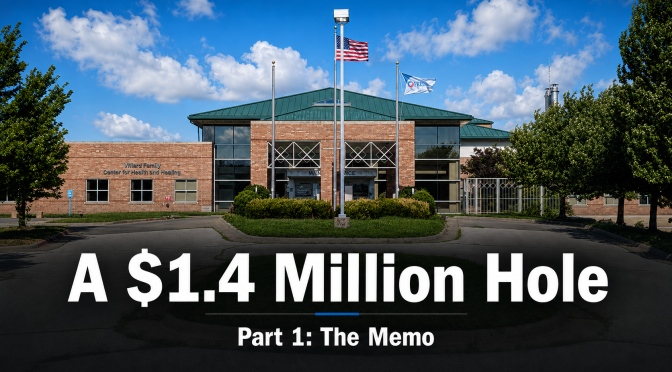
FORT SCOTT, Kan. — An internal memo posted in a local Facebook group last week confirmed weeks of rumors that Bourbon County commissioners are considering legal action to reclaim the former Mercy Hospital building. Until now, commissioners have discussed the matter almost exclusively in executive session.
The memo, authored by Commissioner Gregg Motley, details financial difficulties for building owner Kansas Renewal Institute (KRI) and its primary tenant, Freeman Fort Scott Hospital. It warns that Freeman’s Fort Scott operations are under significant financial strain and face unsustainable losses unless the county implements a plan that involves taking legal action to reclaim the building from owners KRI and Legacy Health.
An Early Warning Sign
Several of the memo’s claims were corroborated by KRI CEO T.J. Denning at a “Capital Update Over Coffee” event hosted by the Fort Scott Chamber of Commerce in late February, weeks before Motley wrote the memo.
Denning told attendees the state had cut KRI’s daily Medicaid reimbursement rate “from about $815 a day to $572,” leaving the organization “losing about $104,000 a month.”
“That’s a big shock to an organization,” he said.
Denning also described KRI’s difficulties getting a 10-bed license from the Kansas Department of Aging and Disability Services (KDADS), saying KRI had tried without success for a year and a half. At the time, he expressed hope of receiving the license within 90 days.
He also spoke about the building’s long history of maintenance issues, saying KRI had bought “a building that had lots of maintenance issues over the years” and was still contending with failing systems.
“We have boiler issues each and every day,” Denning said. “We have chillers that are falling apart with all these things that we put the money back into because I care about the community.”
The Origin of the Memo
In an interview with the Bourbon County Monitor, Motley expanded on the financial issues facing both KRI and Freeman, and why he believes legal action is the commission’s best hope of keeping ER and hospital services in Bourbon County.
Motley said he first learned of KRI’s financial problems at a Feb. 12 meeting of local leaders convened by KRI management to discuss recent difficulties and layoffs.
“(In) February, KRI called prominent citizens of Fort Scott, assembled a group, and assembled the key staff members of KRI,” Motley said. “The topic was KRI needs your help because we are having trouble with the state getting fully licensed…”
KRI management also outlined financial problems Denning would discuss publicly later that month, Motley said.
“They said, ‘We need you to get in touch with anybody you have contacts with and contact the state,’” Motley said.
In response, Motley contacted state Sen. Tim Shallenburger, a longtime friend. He said Shallenburger called back a few days later and told him, “You got problems there. I’m not sure that KRI will ever get fully licensed for the 10 beds.”
“$1.4 Million Is a Big Hole”
Motley said KRI’s inability to license the 10 beds has left both KRI and Freeman in an unsustainable position. He said KRI’s lease with Freeman called for KRI to pay Freeman about $120,000 a month — roughly $1.4 million a year — to manage the beds.
“You do an intake, and generally that’s precipitated by a crisis,” Motley said. “A lot of times, it’s a medical crisis. And so they had an arrangement, an agreement with Freeman to manage those 10 beds for them at a cost to KRI of $1.4 million a year.”
After consulting state agencies, Motley said, both Shallenburger and state Rep. Rick James believe KRI has “no chance” of getting the license, though they have not disclosed why. Without that revenue stream, Motley says Freeman Fort Scott’s chances of achieving financial sustainability are poor. Motley said Shallenburger’s assessment, combined with his own understanding of Freeman’s finances from his time as vice chairman of the hospital’s board, prompted him to ask how to keep Freeman in Fort Scott long term.
“$1.4 million is a big hole,” Motley said. “Having been on the board previously and knowing the numbers, it was, ‘Oh boy, this is bad.’ And then he looped me in with Freeman’s attorney.”
“You Can’t Have a Roof Leak in a Hospital”
That attorney was Pamela Lanier, Freeman Health System’s Director of Government Relations. Motley said he learned from Lanier and other Freeman staff that the hospital had been dealing with roof leaks, HVAC failures and other maintenance problems disrupting operations.
“You can’t have a roof leak in a hospital,” Motley said. “The state will shut you down.”
Motley believes KRI’s difficulty maintaining the building is tied directly to their financial struggles, struggles that have been exacerbated by a large, high-interest mortgage on the building.
A Seven-Figure Mortgage at 13% Interest
Motley’s concerns prompted him to pull all public records on the building’s sale at the Bourbon County Register of Deeds office. There, he found not one but two mortgage agreements.
The first, dated Dec. 20, 2024, was a mortgage for Lots 1 and 2 of the former Mercy Hospital property between Kansas RE Investment Group, representing KRI, and California-based Legacy Health LLC, which shares leadership with the Legacy Healthcare Foundation.
The entire former Mercy Hospital property, along with $2 million in American Rescue Plan Act funds, was donated to Legacy Healthcare Foundation on Nov. 17, 2022, by then-county commissioners Clifton Beth, Jim Harris and Nelson Blythe.
The second agreement, dated Dec. 27, 2024, shows Legacy Health LLC then “flipped” the $2.5 million mortgage with KRI to a California-based company called Pasadena Private Lending.
“Legacy immediately turned around and I would say monetized it. They sold that mortgage, that two and a half million dollar mortgage to Pasadena Private Lending, which is a private equity firm out of California,” Motley said.
In the financial industry, such transactions are often done for cash, Motley said, with the buyer accepting a smaller principal in exchange for a higher interest rate.
“Oftentimes those mortgages are sold at a discount,” he said. “Let’s say the mortgage is $2.5 million and the rate was 5%. They’ll discount it to $2 million and you make the same payments, so the yield goes to 13%.”
After reviewing the documents, Motley said he met with Denning, who told him KRI was making payments on the Pasadena mortgage at a 13% interest rate and had paid Legacy $8.5 million in total for the building — though he did not account for the additional $6 million.
No public records account for the additional $6 million, but Legacy Health Foundation’s 2024 IRS filing reports the building was transferred for $7.5 million — leaving a $1 million gap between the purported purchase price and what was reported to the IRS.
The Memo Is Sent, And The Leaks Begin
What he did not anticipate was that the memo’s contents would be shared with private citizens — including a former elected official with public ties to Legacy Health — before the March 9 meeting even began.
Part 2 will be published on Monday on the Bourbon County Monitor, and Tuesday on FortScott.biz
KRI management was contacted for comment on this series, but did not respond before publication.
Legacy Health management and legal counsel was contacted for comment on this series, but did not respond before publication.
Freeman Health Systems was contacted for this series, and sent a statement that will be included in Part 2.
Public Documents
The public documents referenced in this article are linked below.
Although this week’s meeting did not take place I want to take a moment to talk to you all. I want to commend the people who put themselves out there and open their lives to the scrutiny that may follow. Whether it is running for office, speaking at meetings, authoring articles, or simply standing up and sharing an opinion.
I believe in hard work, respect, accountability, and having the backbone to stand on your decisions and the humility to change your mind. Folks say they want more people involved in government. I agree. People deserve choices (did you notice we will have lots for Governor this year?!). We could also continue as a community with willingness to accept that not everybody is going to think the same way. I believe expectations of 100% alignment are green in this climate. My experience tells me if you think different than the man to your left or right hope for respectful dialogue but prepare to defend.
Recently I have witnessed a decline in self-accountability. We live in a tech driven era where words come easy not always with complete understanding and reality is easily altered through AI and misinformation. With this I expect to bring receipts, and that suits me simply fine, it does not bother me to show and tell rather than just tell.
The part I think can be a large deterrent to potential candidates is when politics turn into twisting words, false narratives, nasty memes, personal attacks, under reporting, over reporting and tearing people down for thinking differently. If media and influencers push narratives and outcomes rather than just delivering facts it becomes troubling for me. Trust your readers, trust your electorate, get out there and help your neighbors understand both sides and let them choose what they believe in and respect them when you cannot align.
From me to you I will continue voting the way I believe is right for Bourbon County. I will continue being upfront and speaking clearly because the people of this county deserve that. Bourbon County deserves representatives who do not hide behind double meaning phrases. Different opinions are part of freedom and if you cannot stand behind yours, then consider change. Moving forward together is important. We have recently seen that if leadership cannot work together, we will not move at all.
Character matters more to me than titles. Ethics matters more to me than gains. Integrity matters more to me than the cost of doing business. I am pure country, raised to work hard, speak with candor, hold my opinion until I have enough verifiable information to form one, tell the truth, keep my faith, and continue working through the storm. I answer to God, my conscience, and the people who elected me to do the job. Strong communities are built by people willing to work, serve, and lead with grit and honesty. If you want to work with me, work as hard as me. If you want to stop me, outwork me. Bullying, intimidation, and half-truths aren’t going to do the trick.
There is one more thing I want to talk about again. Over the last several months, I have watched conversations in our community about who should be asking questions, and continuing to stay informed. Let me just say, “everyone” this is so important!
My thoughts, I support journalism for all. Communities need people willing to attend meetings, ask questions, review records, and keep the public informed. If there is a idea that asking questions should belong exclusively to one group of professionals, it is my opinion that sentiment no longer exists and possibly for good reason. I think journalism, public announcements and citizen involvement can coexist. All have an important role in keeping communities informed.
We live in a time where information moves quickly. Citizens attend meetings. Citizens request records. Citizens make phone calls. Citizens ask questions and compare what they hear with what they see. Many spend hours digging into issues because they care about their community. That involvement should be encouraged, not discouraged.
The answer to information you disagree with is more information. The answer to questions is answers. The answer to concerns is transparency. I trust people to sort through information and make decisions for themselves. I trust them to look at facts, ask follow-up questions, and come to their own conclusions. Not every citizen will get everything right. Not every journalist or elected official will get everything right. That is why facts and records matter. That is why accountability matters. I believe the people of Bourbon County are best served when they can hear from multiple sources, and learn to review the information for themselves, and decide what they believe.
Nobody should be afraid of an informed public. If someone has questions, ask them. I will answer all I can, you may hear me say “I have to ask the county counselor first,” and I hope you understand.
The future of Bourbon County will not be shaped by one journalist, one Facebook page, one elected official, or one voice. It will be shaped by citizens who care enough to get involved, do their homework, and become informed voters, the future of this county belongs to you the citizens! You the voters have more power than you know, you are The People at the Top. I hope you understand that and stay informed and get out there and vote!
Although this week’s meeting did not take place I want to take a moment to talk to you all. I want to commend the people who put themselves out there and open their lives to the scrutiny that may follow. Whether it is running for office, speaking at meetings, authoring articles, or simply standing up and sharing an opinion.
I believe in hard work, respect, accountability, and having the
backbone to stand on your decisions and the humility to change your mind. Folks say they want more people involved in government. I agree. People deserve choices (did you notice we will have lots for Governor this year?!). We could also continue as a community with willingness to accept that not everybody is going to think the same way. I believe expectations of 100% alignment are green in this climate. My experience tells me if you think different than the man to your left or right hope for respectful dialogue but prepare to defend.
Recently I have witnessed a decline in self-accountability. We live in a tech driven era where words come easy not always with complete understanding and reality is easily altered through AI and misinformation. With this I expect to bring receipts, and that suits me simply fine, it does not bother me to show and tell rather than just tell.
The part I think can be a large deterrent to potential candidates is when politics turn into twisting words, false narratives, nasty memes, personal attacks, under reporting, over reporting and tearing people down for thinking differently. If media and influencers push narratives and outcomes rather than just delivering facts it becomes troubling for me. Trust your readers, trust your electorate, get out there and help your neighbors understand both sides and let them choose what they believe in and respect them when you cannot align.
From me to you I will continue voting the way I believe is right for Bourbon County. I will continue being upfront and speaking clearly because the people of this county deserve that. Bourbon County deserves representatives who do not hide behind double meaning phrases. Different opinions are part of freedom and if you cannot stand behind yours, then consider change. Moving forward together is important. We have recently seen that if leadership cannot work together, we will not move at all.
Character matters more to me than titles. Ethics matters more to me than gains. Integrity matters more to me than the cost of doing business. I am pure country, raised to work hard, speak with candor, hold my opinion until I have enough verifiable information to form one, tell the truth, keep my faith, and continue working through the storm. I answer to God, my conscience, and the people who elected me to do the job. Strong communities are built by people willing to work, serve, and lead with grit and honesty. If you want to work with me, work as hard as me. If you want to stop me, outwork me. Bullying, intimidation, and half-truths aren’t going to do the trick.
There is one more thing I want to talk about again. Over the last several months, I have watched conversations in our community about who should be asking questions, and continuing to stay informed. Let me just say, “everyone” this is so important!
My thoughts, I support journalism for all. Communities need people willing to attend meetings, ask questions, review records, and keep the public informed. If there is a idea that asking questions should belong exclusively to one group of professionals, it is my opinion that sentiment no longer exists and possibly for good reason. I think journalism, public announcements and citizen involvement can coexist. All have an important role in keeping communities informed.
We live in a time where information moves quickly. Citizens attend meetings. Citizens request records. Citizens make phone calls. Citizens ask questions and compare what they hear with what they see. Many spend hours digging into issues because they care about their community. That involvement should be encouraged, not discouraged.
The answer to information you disagree with is more information. The answer to questions is answers. The answer to concerns is transparency. I trust people to sort through information and make decisions for themselves. I trust them to look at facts, ask follow-up questions, and come to their own conclusions. Not every citizen will get everything right. Not every journalist or elected official will get everything right. That is why facts and records matter. That is why accountability matters. I believe the people of Bourbon County are best served when they can hear from multiple sources, and learn to review the information for themselves, and decide what they believe.
Nobody should be afraid of an informed public. If someone has questions, ask them. I will answer all I can, you may hear me say “I have to ask the county counselor first,” and I hope you understand.
The future of Bourbon County will not be shaped by one journalist, one Facebook page, one elected official, or one voice. It will be shaped by citizens who care enough to get involved, do their homework, and become informed voters, the future of this county belongs to you the citizens! You the voters have more power than you know, you are The People at the Top. I hope you understand that and stay informed and get out there and vote!
Keys to the Kingdom
By Carolyn Tucker
Forget the Riddles of Life
All curious little kids are the same; therefore, history repeats itself. I can remember being in the kitchen with my mom and asking her one question right after another. Eventually, she got tired of it and her patience flew out the window. I asked another, “Why does this….” and her answer was, “Just to make you ask questions!” Her tone was not as sweet as her first answer had been, so I knew not to ask anything else that day. My own kids did the same thing to me and so do my granddaughters. Answering a few legitimate questions is fine, but a constant barrage of this type interaction becomes annoying. “Why… why… why is water wet?”
I wonder if God sometimes sighs when His children ask Him so many questions that don’t amount to a hill of beans. I suspect most everyone has a gunnysack full of life’s riddles that we can’t solve. Philosophers and scientists have been trying to explain life’s mysteries for years. I don’t believe God gets angry because we ask Him “why” questions; He knows we’re human. But shouldn’t we have an honest understanding that we’re humans and not Almighty God?
Many of God’s ways are past finding out. Job bluntly responds to his so-called friend Bildad: “God stretches the northern sky over empty space and hangs the earth on nothing. His Spirit made the heavens beautiful, and His power pierced the gliding serpent. These are just the beginning of all that He does, merely a whisper of His power. Who, then, can comprehend the thunder of His power?” (Job 26:7,13-14 NLT). These scriptures point out the fact that there’s a million miles between our understanding and God’s.
God didn’t create mankind to be as smart as Him on purpose. We might as well be thankful for God’s unfathomable ways and give our tired brains a rest. We’re liable to blow a gasket if we don’t learn to bury some of our questions in the bosom of our heavenly Father. God tries to help us see that we aren’t going to be able to solve all the riddles in our life. “For My thoughts are not your thoughts, neither are your ways My ways, says the Lord. For as the heavens are higher than the earth, so are My ways higher than your ways and My thoughts than your thoughts” (Isaiah 55:8-9 AMP).
God operates in ways that are beyond our understanding, so we should simply learn to trust His methods and focus on being the best disciple we can be. “Oh, how great are God’s riches and wisdom and knowledge! How impossible it is for us to understand His decisions and His ways! For who can know the Lord’s thoughts? Who knows enough to give Him advice?” (Romans 11:33-34 NLT). It’s never advisable to give God a piece of your mind – like me, you don’t have any to spare.
Believers could greatly benefit in pulling away from trying to solve the mysteries in life. Instead, passionately pursue God and His will. His generic will for everyone is found in His Word and His unique, individual will for us is often discovered through prayer. King David penned, “Show me the right path, O Lord; point out the road for me to follow. Lead me by Your truth and teach me, for you are the God who saves me. All day long I put my hope in You” (Psalm 25:4-5 NLT).
The Key: It’s OK to ask God “why” but it could be a waste of your time.
Patty LaRoche. 2023. Author: A Little Faith Lift…Finding Joy Beyond Rejection www.alittlefaithlift.com AWSA (Advanced Writers & Speakers Assoc.)
As I watched the movie “The Twister: Caught in the Storm,” I was reminded of the tornado warnings we had when I was a child living in Fort Scott. When the warning signs screamed, my mother gathered up the three of us kids and headed to our neighbor’s cellar across the street. I had packed a box loaded with my favorite things, just in case. My stuffed monkey sat atop my plastic horses and pop-bead bracelets, treasures I could not live without. When the all-clear siren blasted, I knew my precious treasures and I were safe… at least for a while. Little did I know, those storms were nothing compared to the figurative storms I would face as an adult. You probably can relate.
Life is filled with storms – crazy schedules, emotional bankruptcy and physical exhaustion. My first reaction is to run and hide until the storm passes, but I have learned that (1) there will always be another storm, and (2) I must be prepared before those trials hit. That means I sometimes must say “no” to requests that do not edify those I love or the Lord. If not, my life becomes pretty chaotic.
My girlfriend Robin and I recently were discussing how easy it is to miss God’s will when we are navigating turbulent decisions. She and her husband moved to another town when they were offered a good price on their home. The only problem? They had to be out in three weeks…not a lot of time to check out other properties on the market in their new location. One prospective house needed a little work, but when the inspector assured them that all was well, they placed a bid that was accepted.
Unfortunately, they had purchased “the money pit.” A few days after moving in, Robin’s husband was in the attic, moving boxes, unaware there was a hole in the ceiling, a hole he fell through, resulting in seven broken ribs, a head laceration, a broken finger and a broken hip. As bad as that was, nothing prepared them for the cockroach infestation, a refrigerator and dishwasher that did not work, and a copperhead that crawled up Robin’s leg when she was in her back yard.
“I probably didn’t pray enough,” she said. “I prayed but clearly panicked with the time constraints.” Oh, how many times have I done the same! There isn’t enough room here to describe my inability to listen to God before I jump in, and usually a storm of some sort is waiting for me. Then again, in my case, that storm might be for my benefit to draw me closer to God.
One of the most recognizable stories in the Bible is when Jesus slept during a violent storm on the Sea of Galilee. The day has been long, filled with teaching, healing, and ministry, and the disciples are weary. Although accomplished fishermen, they, accompanying him in the boat, cannot imagine how he is not awakened as the “waves swept over the boat.”
Matthew 8:26, 27 reports that Jesus replied, “’You of little faith, why are you so afraid?’ Then he got up and rebuked the winds and the waves, and it was completely calm. The men were amazed and asked, ‘What kind of man is this? Even the winds and the waves obey him!’”
Bible Hub tells us that Jesus’ words point to the danger of fear when faith is weak, and they serve as a reminder that true faith trusts in His power and presence. Jesus not only has authority over creation, he also can bring peace to the chaos of life. Think about it. His ability to calm the sea is immediate and complete. There are no after-effects except, of course, in the life of the disciples who once again are witnesses to the person in whom they need to place their faith.
What storm are you enduring? If you are trying to face it alone, you are missing an opportunity to call on the One who can make an everlasting difference, and in this case, you don’t even have to wake him up to ask for his help.
One of the most common debates in leadership revolves around hiring and promotion decisions. Should an organization select the individual with years of experience, or invest in someone with less experience but tremendous potential? After more than four decades in coaching, education, and administration, I have come to a simple conclusion: it is not experience that determines success. It is the person.
Experience certainly has value. Individuals who have spent years in a profession have faced challenges, learned lessons, and developed wisdom that can benefit an organization. However, experience alone does not guarantee success. I have seen highly experienced leaders struggle because they became resistant to change, stopped learning, or relied too heavily on what worked in the past.
On the other hand, I have watched organizations hire young leaders with limited experience who accomplished remarkable things. They brought energy, vision, work ethic, and a willingness to learn. Some built championship programs and transformed organizations. Others struggled because they lacked the personal qualities necessary to lead effectively.
What I have learned is that experience and age are not the same thing. There are individuals in their retirement years who step into leadership opportunities and thrive because they possess humility, character, and a desire to continue growing. There are others with the same amount of life experience who struggle. Likewise, some young professionals excel beyond expectations while others do not.
The determining factor is rarely age or experience. It is the person. Do they have integrity? Are they willing to work hard? Can they build relationships? Are they teachable? Can they adapt when circumstances change? Do they place the mission and people they serve above their own interests?
Scripture reinforces this principle. When the prophet Samuel was sent to anoint a new king, he assumed God would choose one of Jesse’s older, stronger, and more experienced sons. Instead, God selected David, a young shepherd boy. The Lord reminded Samuel, “People look at the outward appearance, but the Lord looks at the heart” (1 Samuel 16:7).
Jesus followed the same pattern. He did not choose the most educated religious leaders of His day. He chose fishermen, tax collectors, and ordinary men. What made them extraordinary was not their credentials; it was their willingness to follow Him and allow God to work through them.
Too often, organizations become fixated on years of experience while overlooking the qualities that truly drive success. Experience, training, and mentorship can help, but none can replace character, passion, commitment, and a servant’s heart.
When making leadership decisions, look beyond age and experience. Find the right person. If you find the right person, they will often find a way to succeed regardless of how much experience they have or do not have.
Thought for the Week, “Experience can teach you many things, but character determines what you do with what you’ve learned.” Jack Welch.
Dr. Jack Welch serves as President of Fort Scott Community College. With a career spanning professional sports, public education, and rural community development, he brings a servant-leader mindset and a passion for building trust-driven cultures that empower people to thrive in the classroom, on the field, and in life. He is also the author of Foundations of Coaching: The Total Coaching Manual.
I’m not a people watcher when I‘m shopping because I‘m usually on a mission and quite focused. However, one day I couldn’t help noticing a woman holding a folded wad of greenback between her lips as she diligently cleaned her cart handle with an antibacterial wipe. This puzzling absurdity blew my mind; I’m sure I stared. I’m no expert, but it’s a known fact that germs like to do a little party dance on money. I guess you could call it dirty dancing.
This scenario reminds me of the scripture in Matthew 23:24 NRS where Jesus is sternly talking to the religious leaders. “You blind guides! You strain out a gnat but swallow a camel.” The rigid Pharisees and teachers of religious law would carefully strain their drinking water to make sure they didn’t accidentally swallow a gnat (the smallest inedible insect for the Israelites.) The camel was one of the largest unclean animals. Gnats and camels were both forbidden as food in the Old Testament. Jesus was purposely using a figure of speech to shock His hearers into getting the point.
Jesus was upset that doing justice, showing mercy, exercising faith in God, and loving Him was not being practiced by the religious leaders. Instead, they were busy straining their water. As Christ followers today, we need to be careful that we’re not majoring on the minors while ignoring the majors. Little trifling things that don’t amount to a hill of beans was not, and is not, what Jesus wants His disciples to major on.
Jesus criticized the Pharisees and teachers of religious law for their misplaced priorities. They neglected the more-important principles of a godly lifestyle. Practicing the weightier matters of loving God and loving others was sadly being neglected. The only people Jesus spoke to with consternation were the religious people who acted righteous on the outside but were unrighteous on the inside. Jesus sure didn’t beat around the bush when He said, “Great sorrow awaits you religious scholars and Pharisees — frauds and imposters! You are foolish to ignore the greed and self-indulgence that live like germs within you. You are blind and deaf to your evil” (Matthew 23:25-26 TPT).
When it comes to the practice of loving others, we believers don’t want to be guilty of making a mountain out of a molehill. Keep in mind that a fellow believer can be rough around the edges and still have a perfect heart toward God. We can read in Hebrews 11 about a lot of imperfect men and women who had a true heart of faith. Jesus said it’s all about the heart. Godliness is not just skin deep and can’t be confused with how a person looks on the outside. A godly person is one whose heart is sensitive toward God and takes Him and His Word seriously. The inside reveals who we really are, not the outside.
Honestly, believers should be hell-bent on majoring on the majors found in God’s Word. And it’s up to us to do our own regular heart checkups. When (not if) we find a problem, we need to submit to spiritual major-heart surgery performed by Dr. Jesus.
The Key: Spiritually speaking, let’s put our money where our mouth and heart is.
Patty LaRoche. 2023. Author: A Little Faith Lift…Finding Joy Beyond Rejection www.alittlefaithlift.com AWSA (Advanced Writers & Speakers Assoc.)
Last week, we looked at Ray Pritchard’s “B” (Build relationships) in the “BLT’s of Evangelism.” Today, we will review his L and T of how to “fish for people.” We are to Look for opportunities to talk to others and then Take these people to places where they can hear the Gospel preached. Many times, those opportunities come in the most unexpected places.
Our grandson, Drake, turned a 12-hour drive from Alabama to Fort Scott into an 18-hour one when he came to a 3:00 A.M. halt on a freeway due to an accident. At one point, he exited his truck and met a 23-year-old in the same predicament. Sitting in the bed of the other driver’s truck, playing cards, Drake shared his faith. His new friend listened and told my grandson that he probably needed to get back to church.
Pritchard’s BLT suggestions seem contradictory. In his “B” category, he told us to keep quiet and basically not be obnoxious with our faith, and his “L” tells us to open our mouths and share what we believe. The author addresses that dilemma, saying that most outspoken Christians are afraid people will think they are too fanatical and run for the hills, but the first need is just to build a relationship and then look for natural ways to share their faith.
Pritchard’s advice? “Look, it’s not difficult. You don’t need to make a big deal about this. Why don’t you begin each day by praying that God will send you at least one person each day to whom you can give a good word for the Lord? After you pray that prayer, just start looking for opportunities to say a good word for the Lord.”
I love his message. “Just say a good word for the Lord.” No big deal. No high pressure. Just look for chances to slip the Lord into your conversations with people in a natural, non-forced way. That’s evangelism.”
Sometimes, what we look for as an opportunity is not what God has in mind. Years ago, I was attending a college lab class. I was much older than the other students, and at my lab table were three fraternity boys, eager to share their party exploits with anyone in earshot. One day, I smiled and said that they were moving up my prayer ladder and that I was worried about their eternal souls. They laughed.
A week later, a girl seated at another lab table asked if she could talk to me. She had overheard my comment to the party boys and had questions. I invited her to my house, and at the kitchen table, she accepted Jesus as her personal Lord and Savior. I realized then that evangelism has little to do with the person sharing and everything to do with God and how He can use any circumstance to bring people to Him.
So you’ve got the B —Build Relationships, and you’ve got the L — Look for Opportunities. There’s only one thing left, the T. Take your friends to non-threatening events where they can hear the gospel. Hopefully, your church provides ministry opportunities like ladies’ luncheons or men’s retreats or Christian concerts or game days. Pritchard cautions against Sunday services as your starting point because they sometimes might be too overwhelming, but “As the Holy Spirit begins to draw your friends to Christ, Sunday worship will begin to seem much more inviting to them.”
So, there you have it, the BLT’s of Evangelism. Build relationships. Look for opportunities to share, and Take others to Christian events. Sounds simple? It is.
Nobody wants to eat crow and humble pie (colloquial expressions for admitting you were wrong). From experience, I’ll tell you that crow tastes better with salt on it. Believers can wrongfully and pridefully think we know everything about running our lives. The Bible defines that as being a self-confident fool. We are not qualified to run anything on our own. “He leads the humble in what is right, and the humble He teaches His way” (Psalm 25:9). I don’t want to disqualify myself from receiving any teaching from my heavenly Father. I need His wise guidance and teaching in my life. In the words of Alan Simpson, “Those who travel the high road of humility are not troubled by heavy traffic.”
“The humble will see their God at work and be glad. Let all who seek God’s help be encouraged” (Psalm 69:32 NLT). My late husband and I used to sing a gospel song entitled, “I Can’t Even Walk Without You Holding My Hand.” The lyrics speak for themselves: “I thought I had done a lot on my own, I thought I could get by, oh, so all alone. I thought of myself as a mighty big man. But I can’t even walk without You holding my hand.”
It’s my job to humble myself. “I humble myself [feeling very insignificant] in the presence of the Lord, and He will exalt me [He will lift me up and make my life significant]” (James 4:10 AMP). If I don’t make the effort to humble myself, God will do it for me, and I don’t want that! So, “I humble myself under the mighty hand of God, and in His good time He will lift me up” (1 Peter 5:6 TLB).
I refuse to get too big for my britches because I want and need God’s schooling in my life everyday. “Pride leads to disgrace, but with humility comes wisdom” (Proverbs 11:2 NLT). Down on our knees is where we learn to stand. That’s where we confess that we can’t even walk without God holding our hand.
When King Solomon was totally devoted and dependent on God, he was the wisest man who ever lived. But before he lived out his earthly life, he forfeited his wisdom for a big bunch of women who turned his heart away from God. You’d think Solomon would’ve had enough wisdom not to get too full of himself. But he did. We must often evaluate ourselves honestly and prayerfully. “And because of God’s gracious gift to me I say to every one of you: Do not think of yourself more highly than you should. Instead, be modest in your thinking and judge yourself according to the amount of faith that God has given you” (Romans 12:3 GNT). Scriptures indicate that Solomon humbled himself before he died, but he sure was miserable when he penned the Book of Ecclesiastes.
Christ followers are commanded to trust God for direction. “Do not be wise in your own eyes; Fear the Lord and depart from evil. It will be health to your flesh, and strength to your bones” (Proverbs 3:7-8 NKJV). We are to practice humility, rejecting prideful self-reliance, and have reverential fear and awe of God. Don’t make the mistake of relying on your personal insight instead of asking for God’s guidance and wisdom.
There’s a lot of songs I’d be pleased to have sung at my funeral. But I sure wouldn’t want “I Did It My Way.” At the end of my life, I want to humbly say, “I did it His way.”
The Key: It’s better to humble yourself. If you have to eat crow, just add salt.