|
|
|
|
|
|
|
|
|
|
|
|
|
|
|
|
|
|
|
|
|
|
|
|
|
|
|
|
|
|
|
|
|
|
|
|
|
|
|
|
|
|
|
|

The group that set up an office on the second floor, above the Star Emporium Downtown General Store, 17 S. Main, has changed the name, but not services.
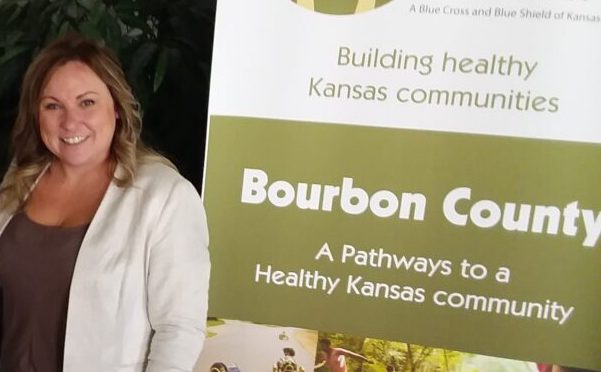
“The partners that made up the Bourbon County Workforce and Entrepreneur Resource Center (BWERC) have decided to name ourselves The Center for Economic Growth,” Jody Hoener, director of the center, said. “We have the same space, model, operations, and services that were provided before.” The one exception is the Bourbon County Commission is not a part of the partnership, she said.
“Our mission is to increase access to physical activity and healthy food, promote tobacco cessation, enhance the quality of life and encourage economic growth,” she said. “We wanted our program and name to tie directly to our mission.”
“The Healthy Bourbon County Action Team Board and our partners re-branded our collaborative efforts,” Hoener said. “Our work to build healthy communities and address the social determinants continues, with health and economic stability as the focus of the center.”
“Specifically, we are working with community members and our partners on economic stability,” she said.
“Priority is given to those businesses owned by low-income, minority, female, or veteran,” she said. “Pittsburg State University Small Business Development Center uses the U.S. Small Business Administration small business definition…typically 500 employees or less with less than $5m in profit in a two-year period.”

“Poverty and low income are drivers of poor health,” Hoener said. ” Bourbon County is a rural community… with higher rates of poverty. Our community has seen low investment and low upward mobility in employment. We are working to create economic opportunities to generate wealth and income for Bourbon County residents.”
The partner organizations are the Fort Scott Chamber of Commerce, Fort Scott Community College, Kansas Works, Pittsburg State University’s Small Business Development Center, and BAJA Investments.
Hoener’s work as the Bourbon County Economic Director ended in March
Continue reading Center for Economic Growth: Focus on Health and Economic Stability
|
|
|
|
|
|
|
|
|
|
|
|
|
|
|
|
|
|
|
|
|
|
|
|
|
![]() |
|
|
|


K-State Extension has a Crop, and Forage Management career opportunity in Southwind District.
The primary office location is negotiable between Iola, Erie, Fort Scott and Yates Center.
See https://www.ksre.k-state.edu/jobs/current_openings/index.html for responsibilities, qualifications and application procedure.
The application deadline is March 17, 2021.
K-State Research Extension is an EOE of individuals with disabilities and protected veterans.
A background check is required.
From the website:
The Southwind District is comprised of Allen, Bourbon, Neosho and Woodson Counties in southeast Kansas. There are 2,314 farms and more than 112 million acres of pasture and crops growing primarily soybeans, corn, wheat, and a diverse selection of native and introduced forages. The population of the district is 46,048. The district is home to Neosho County Community College, Allen Community College, and Fort Scott Community College, as well as ten public school systems. Southwind staff are housed in four office locations and include eight agents, four specialized office professionals, and one 4-H program assistant.
Extension agents are community-based faculty of Kansas State University who make a difference by connecting community needs with university resources. Agents are administratively responsible to the local extension director and the local extension board.
This position will provide primary leadership for the development and implementation of research-based educational programs related to production, management, and marketing issues involved in crop production, especially forages. Programs will include but are not limited to tillage, planting, and variety selection; irrigation; weed, disease, and pest control; soil testing and fertilization; harvesting and post-harvest handling.
Extension agents are professional educators who serve as a link between Kansas State University and communities across Kansas. Agents are administratively responsible to the Director of K-State Research and Extension (represented by a designated administrator) and the local extension board.
|
|
| What You’ll Need to Succeed: | Minimum Qualifications:
Preferred Qualifications:
Other Requirements:
|
| Salary, Benefits, and Professional Development: |
|
| How to Apply: | Please submit the following documents:
|
| Screening of Applications Begins: | Applications will be accepted until March 17, 2021 |
| Equal Employment Opportunity: | Kansas State University is an Equal Opportunity Employer of individuals with disabilities and protected veterans and actively seeks diversity among its employees. |
| Background Screening Statement: | In connection with your application for employment, Kansas State University will procure a Background Screen on you as part of the process of considering your candidacy as an employee. |


The Fort Scott Planning Commission is meeting at 4 p.m. March 1 at city hall, 123 S. Main, to consider a conditional use permit for property south of the town for a micro-meat processing plant.
The property being considered is south of the Kansas Department of Transportation property, according to the press release from the City of Fort Scott. The K.D.O.T property is south of the LaRoche Baseball Park.

The Bourbon County Economic Director Jody Hoenor sent the following information on the proposed plant.
“Billy Madison, the owner of W Diamond M Meats, will be seeking the approval of a conditional use permit from City of Fort Scott Commission,” Hoenor said. “He plans to return to his hometown and build a $2.7million micro meat processing plant located approximately two miles outside the city limits of Fort Scott and south of the Fort Scott Industrial Park.”
“The processing plant will add to our efforts in building resilient and self-sustaining food systems,” Hoenor said. “The COVID-19 pandemic highlighted the need for these smaller-scale processing plants, and we are very fortunate to be considered for this expansion. This proposal has potential to help farmers and ranchers with extra supplemental income act as a stimulus for other sectors such as retail trade and services.”
“The site is currently zoned correctly as heavy industrial for use,” she said. “The City of Fort Scott codes requires an additional conditional use permit approval for a meat processing plant to be built.”
The City of Fort Scott Water Department and Codes Enforcment were consulted on sewer and wastewater issues, she said.
“The codes department let us know we would need a conditional use permit to build on the selected site,” Hoener said.
Since July 2020, Madison has been working with Hoener and Bourbon County Economic Development Council Chairs, Steve Buerge (previous), and more recently Gregg Motley, she said.
“It is Madison’s goal is to be a good neighbor, bring above-average wage jobs, and provide value in under-developed land,” Hoenor said. “Financing of the project and acquisition of land is pending approval of the conditional use permit.”
“All impacts on social, economic, and environmental conditions were investigated thoroughly including air and water quality, crime rate, property valuation, wage growth, employment growth, occupational health, and odor,” she said.
“State of the art wastewater system is used to remove suspended matter such as oils and solids,” Hoenor said. “This is measured through biochemical oxygen demand (BOD). The equipment skims any leftover matter and is sold. Bacteria growth is what creates an offensive odor,” she said.”The requirements in cleaning are incredibly stringent and does not allow time for bacteria to grow. As a result, there is no offensive odor in the processing plant.”
“This is a highly regulated industry with a USDA inspector office on sight,” she said. ” It is a requirement in building plans that the USDA inspector has a separate office with his/her own shower. This inspector is on-site at all times while in operation. There are 3-4 additional inspections per month, in order to keep our food safe to consume.”
“There will be no outdoor pens or holding areas for animals, mitigating smell downwind or in the vicinity,” Hoenor said. “Animals are delivered in the very early morning hours and several hours later slaughtered and processed.”
“Letters of support from residential houses in Johnson County and commercial businesses have confirmed the business is a conscientious neighbor,” she said.
In addition, the product can be sold in other states and will bring new jobs.
“W Diamond M Meats is FSIS approved, allowing the meat to be sold across state lines, injecting capital into our economy,” Hoenor said. “This business will bring 30 full-time jobs that pay higher than Bourbon County average. The new construction increases overall county valuation in property and affords the opportunity to reduce the overall tax burden.”