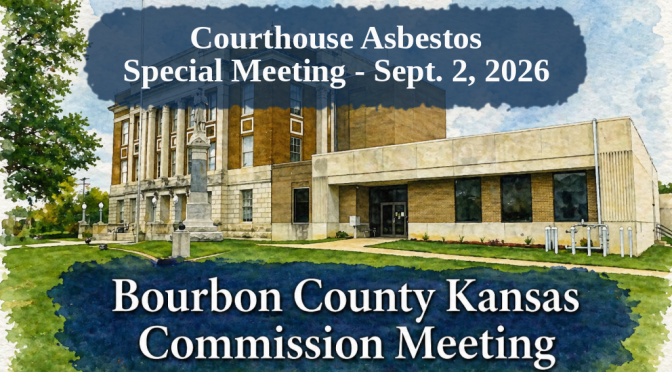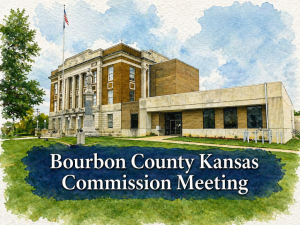
Note: The Bourbon County Commission meeting on Wednesday, September 9, 2026 will begin at 5:00 PM — a change from the regular meeting time. The meeting will be held at 210 S. National Avenue, Fort Scott, KS 66701. A Commission Work Session will immediately follow the regular open meeting.
The full agenda packet, including prior meeting minutes and supporting materials, is attached as a PDF below.
Meeting of the Bourbon County Commission — Regular Open Meeting
September 9, 2026 | 5:00 PM | 210 S. National Ave., Fort Scott, KS 66701
- Call Meeting To Order
- Pledge Of Allegiance
- Invocation
- Introduction
- Approval of Agenda
- NOTE: Account Payable $ -0-
- Approval Of Meeting Minutes from 8-24-2026 & 8-31-2026
- Approval of Meeting Minutes from Special Meeting 9-2-2026
- Training invoice update – Milburn
- Public Comments (limited to 3 minutes)
- Department Updates
- Election deadline updates – Hoyt
- Old Landfill covenant and water testing update – Milburn
- Asbestos Testing update – Beerbower
- Appraisers change letter and interviews – Milburn
- Commissioner Comments
- Build Future Agenda
- Adjournment
Work Session of County Commission
Immediately following the Regular Open Meeting.
The work session discussions will address public works restructuring, costs, fees and separation plan for the transfer station rates, costs, wage analysis, and related topics.
Minutes: Bourbon County Commission Meeting — August 24, 2026
Fort Scott, KS | Monday, August 24, 2026 | 5:30 PM
Citizens Attendance: Kyle Parks, Jason Silvers, Marlon Merida, Clinton Walker, Teri Husley, Anne Dare, Kenny Allen.
I. Call to Order
The meeting was called to order by Chairman Motley.
II. Pledge of Allegiance
III. Prayer
The invocation was led by Commissioner Beerbower.
IV. Introductions
Present: Commissioner Mika Milburn (District 5), Commissioner David Beerbower (District 2), Commissioner Joe Allen (District 3), Chairman Gregg Motley (District 4), Deputy County Clerk Michael J. Hoyt. Commissioner Samuel Tran (District 1) joined the meeting after introductions.
V. Approval of Agenda
The agenda was amended to add: Old Business as item XIII (Wildlife and Parks — withdrawal of walking hunting contract), a Verizon contract extension as item XIV, and Kenny Allen (Public Works) as Department Update item X.c. The budget discussion was prioritized to ensure adequate time.
Motion to approve the amended agenda was made by Commissioner Beerbower and seconded by Commissioner Allen. The motion carried unanimously.
VI. Approval of Minutes 08.10.26
Commissioner Milburn noted that the full dialogue from the clerk’s resignation had been added to the minutes as previously requested.
Motion to approve the minutes of August 10, 2026, was made by Commissioner Milburn and seconded by Commissioner Allen. The motion carried unanimously.
VII. Approval of Minutes 08.17.26
Commissioner Milburn identified revisions needed in the draft minutes, noting that speaker attributions were incorrect, including an error in the recorded vote for vice chairman. The minutes were tabled pending correction reviews.
VIII. Approval of Accounts Payable $304,072.99
Motion to approve accounts payable totaling $304,072.99 was made by Commissioner Allen and seconded by Chairman Motley. The motion carried unanimously.
IX. Public Comments
Kyle Parks addressed the Commission regarding unmowed county roads, specifically noting approximately two blocks in Devon and Range Road, which had not been mowed all summer. Chairman Motley committed to following up with the appropriate department.
X. Department Updates
a. 108 W. Second Update (Courts) – Beerbower
Commissioner Beerbower reported that a preconstruction meeting had taken place and presented a project checklist for the temporary relocation of Bourbon County District Court to 108 W. Second Street, necessitated by the courthouse elevator being out of service. Key tasks identified included wall removal, courtroom technology setup, security camera coordination, determine directional signage, carpet cleaning, and furniture sourcing. It was noted that county maintenance staff and available surplus furniture could cover much of the labor and furnishing needs, with weekend work potentially funded through the jail sales tax fund. Commissioner Beerbower stated his intent to return with an RFP and project budget.
Motion to designate Commissioner Beerbower as project lead for the Bourbon County District Court Temporary Relocation was made by Chairman Motley and seconded by Commissioner Allen. The motion carried unanimously.
Motion to formally approve the use of the building at 108 W. Second Street to temporarily house the district court was made by Commissioner Beerbower and Milburn seconded. The motion carried unanimously.
Motion to close the second and third floors of the courthouse to the public, with staff access only, from October 21 through November 20, was made by Commissioner Milburn and seconded by Chairman Motley. The motion carried unanimously.
Motion to authorize the executive assistant to create a maintenance access card for elevator repair staff was made by Commissioner Milburn and seconded by Chairman Motley. The motion carried unanimously.
b. Elections — Deputy County Clerk Michael Hoyt
Michael Hoyt briefed the Commission on upcoming election deadlines. The ballot for the general election must be submitted to the Secretary of State by September 14, 2026, with work unable to begin until after the September 8th canvass — leaving approximately one week to complete it. The ballot must also be available for overseas military voters by September 19, per the 60-day statutory requirement. Mr. Hoyt requested $4,200 to contract with Clear Ballot for ballot creation services. It was confirmed that sufficient funds remain in the elections training and meetings budget line item to cover this cost without additional appropriation. It was also noted that early voting would be abbreviated to the Saturday–Monday period before the general election to reduce unnecessary expenditure. Mr. Hoyt mentioned a future presentation of other deadline dates in a meeting soon.
c. Kenny Allen — Public Works
Public Works Director Kenny Allen presented a federal funds exchange letter requesting the Chairman’s signature to receive approximately $120,000 in reimbursement for hard surface road work completed to date. The Commission emphasized the importance of advance notice and emailing documents prior to meetings for future requests of this nature.
Director Allen reported that approximately four miles of asphalt had been laid this season, covering Maple Road to 240th, a quarter mile on Osage/215th, and one mile on Hackberry. Work on Yale Road (Maple Crossroads) was expected to begin the following Monday, with an estimated cost of $150,000 for that mile due to a full 5-inch base and overlay construction. The asphalt plant had recently received a replacement part and its performance on the Yale project would be a key indicator of its viability for the following year. The Commission noted that only two to three bush hogs were operational and that mowing had been largely limited to school bus routes.
Motion to authorize the Chairman to sign the federal funds exchange letter was made by Commissioner Beerbower and Allen seconded. The motion carried unanimously.
Director Allen also presented a transfer of funds document reflecting road and bridge expenditures for the year’s asphalt work. The Commission requested that the data be sorted and emailed to all commissioners showing asphalt-specific costs per mile for the current season. Milburn requested a total spent on the four miles of asphalt roads this year.
XI. Approve Cereal Malt Beverage Application
A cereal malt beverage application for a business at Soldier Road and US-69 Highway was presented. The deadline for such applications is September 15.
Motion to authorize the Chairman to sign the cereal malt beverage application was made by Commissioner Allen and Commissioner Beerbower seconded. The motion carried unanimously.
XII. Budget Discussion — Matt Lawn, Baker Tilly
Baker Tilly consultant Matt Lawn presented a scenario analysis in response to Commissioner Milburn’s prior request exploring the effect of holding all non-employee-benefit funds to a revenue-neutral (R&R) mill levy and redirecting the resulting savings to the employee benefit fund and general fund reserves.
Key findings included: the general fund is currently running approximately $290,000 below the adopted 2026 budget; the appraiser fund would be reduced to a near-zero ending fund balance; the election fund faces a significant anticipated expenditure increase; and holding Road & Bridge to R&R would reduce its carryover fund balance to approximately $166,000. The ambulance fund ($66,000) would likely go negative under this scenario.
Lawn noted that with July financials now complete, all projections would be updated for the next meeting. The Commission’s overall objective was articulated as keeping each fund’s ad valorem tax contribution flat at prior-year levels, allowing any assessed valuation growth to build general fund reserves, while permitting funds with independent revenue sources (such as the landfill or ambulance) to grow their budgets accordingly.
Motion to authorize publication of the public hearing notice for the budget at a mill levy not to exceed 56.669 mills, to appear in the Saturday, August 29 paper, for a public hearing on September 14, 2026, was made by Commissioner Milburn and seconded by Commissioner Allen. The motion carried unanimously.
Additional unbudgeted expenditures were identified for incorporation into the 2026 estimate: approximately $50,000 for the tax foreclosure publication and legal process, and $36,000 (three months at $10,000/month) to begin the comprehensive plan contract with Confluence in October. Lawn committed to building these figures into updated budget scenarios for the next meeting, along with a full review of all remaining funds, a benefits-versus-salary allocation analysis, and a 5% across-the-board wage scenario. The budget public hearing remains scheduled for September 14, with the state submission deadline of October 1 at 5:00 PM.
Wildlife and Parks (Old Business)
Motion to withdraw the county’s walking-in hunting contract on the old dump property, as the City had opted out of its portion of the package agreement, and to authorize the Chairman to sign the withdrawal contract, was made by Commissioner Allen and seconded by Chairman Motley. The motion carried unanimously.
Motion to place the old dump property for sale, pending groundwater testing and compliance with KDHE restrictive deed covenants requirements, was made by Commissioner Beerbower and seconded by Commissioner Milburn. The motion carried unanimously.
Verizon Contract Extension: Chairman Motley announced this item was removed from tonight’s agenda due to typographical errors in the contract. A corrected version will be distributed to commissioners prior to the next meeting.
XIII. Future Agenda Topics
Topics identified for future agendas included: separation of the landfill/transfer station from Public Works management and associated rate discussion; the opioid fund grant application; a district meeting attendance roll call; policy and procedure review (after Labor Day); appraiser recruitment and potential county-sharing arrangement with Linn or Anderson County; Verizon contract extension; and an HR discussion.
XIV. Commission Comments
Chairman Motley encouraged all departments and staff to submit supporting documents — contracts, bids, resolutions — to the clerk in advance for inclusion in agenda packets, noting that the county receives more KORA requests than all other jurisdictions served by its IT provider combined, in part because documents are not routinely made publicly available through the agenda.
XV. Adjournment
Motion to adjourn was made by Commissioner Beerbower and seconded by Chairman Motley. The motion carried unanimously. Meeting adjourned at 6:43pm.
Minutes: Bourbon County Commission Meeting — August 31, 2026
August 31, 2026 | 5:30 PM | 210 S. National Ave., Fort Scott, KS 66701
Citizen’s Attendance: Clint Walker, Rachel Walker, Jean Tucker, Marlon Merida, Jason Silvers, Millie Lipscomb, Anne Dare, Jennifer Hawkins, Teri Hulsey, Mike Wunderly, Tim Emerson, Kevin Allen.
I. Call to Order
The meeting was called to order. Attendees were reminded to silence cell phones, take sidebar conversations outside, and refrain from outbursts.
II. Pledge of Allegiance
The Pledge of Allegiance was recited.
III. Invocation
A prayer cited by Commissioner Allen.
IV. Introductions
Present: Commissioner Mika Milburn (District 5), Commissioner David Beerbower (District 2), Commissioner Joe Allen (District 3), Commissioner Gregg Motley (District 4), Deputy County Clerk Michael Hoyt.
Absent: Commissioner Samuel Tran (District 1).
V. Agenda Approval
The agenda was approved as amended, with the removal of the resolution setting meeting rules review and the addition of a public comment period. The District Court relocation item was amended to remove Commissioner Beerbower’s name, and an executive session line item for the appraiser hiring was added.
Motion to approve the agenda as amended was made by Commissioner Milburn and seconded by Commissioner Motley. The motion carried unanimously.
VI. Approval of Accounts Payable $135,585.00
Accounts payable were approved with the exception of two Murphy Tractor invoices totaling $7,849.00; payment was withheld pending verification that the charges were for tires rather than training.
Motion to approve accounts payable minus the Murphy Tractor invoices of $7,849.00 was made by Commissioner Milburn and seconded by Commissioner Motley. The motion carried unanimously.
VII. Approval of Meeting Minutes of 08-17-2026
The minutes of August 17, 2026 were approved without amendment.
Motion to approve the minutes of August 17, 2026 was made by Commissioner Beerbower and seconded by Commissioner Allen. The motion carried unanimously.
a. Approval of Meeting Minutes from 08-24-2026
The minutes of August 24, 2026 were approved pending two corrections: a spelling correction to Commissioner Milburn name, and the removal of an editorial note on the second page that did not reflect any statement made during the meeting. Final will be presented at next meeting on 9-8-2026.
Motion to approve the minutes of August 24, 2026, pending corrections, was made by Commissioner Beerbower and seconded by Commissioner Allen. The motion carried unanimously.
VIII. Public Comment
One public comment was received from Kevin Allen, who addressed concerns regarding the proposed transfer station rate increases and wage adjustments outlined in the public works restructuring proposal. He questioned the rationale for significant CDL driver wage increases without corresponding raises for other staff, the timing of rate increases given current economic conditions, and the financial impact on local businesses and residents.
IX. Department Updates
a. Treasurer Jennifer Hawkins
Treasurer Hawkins reported that the tax sale attorney has completed the first publication in the Tribune, with a second publication scheduled for October and an estimated tax sale date of November or December 2026. Property owners may still redeem their properties up until the day of sale. Publication costs for the delinquent tax list totaled $29,973. The Treasurer’s office is switching to a lower-cost vendor for tax statements, with no change to the information provided. The Treasurer requested and received approval to use the Appraiser’s county vehicle for travel to a conference in Dodge City, saving approximately $486.40 in mileage reimbursement.
Motion to authorize Treasurer Hawkins to use the Appraiser’s vehicle for travel to the Dodge City conference was made by Commissioner Motley and seconded by Commissioner Milburn. The motion carried unanimously.
Hawkins also noted that as outgoing County Clerk Susan’s last day was that date, signatory access to bank accounts would be updated following the Republican Party’s nomination of a replacement the following evening.
Deputy Clerk Update: Deputy Clerk Hoyt reported that all assets assigned to the Clerk’s office had been inventoried and tagged, and that credentialing for the election system was being processed with the Secretary of State’s office. A digital copy of the asset list was offered to commissioners.
X. Budget Discussion — Matt Lawn
Baker Tilly representative Matt Lawn presented an updated budget framework for FY2027. The primary recommendation was to reduce the Road and Bridge mill levy by approximately 4 mills, reallocating those mills to the General Fund and Employee Benefit Fund. This reallocation takes advantage of one-time FEMA reimbursement funds currently in the Road and Bridge Special Improvement Fund, and is understood to be a one-year adjustment requiring the mills to return to their original level in FY2028.
Key highlights included: the General Fund projected with no year-end deficit, a cash reserve buffer of approximately $182,000 in the Employee Benefit Fund, and a more substantial cash reserve built into the General Fund. Commissioner Beerbower requested that funding for the comprehensive plan be split between this year and next year, with approximately $36,000 allocated to the current year. Lawn confirmed this adjustment and noted he would also ensure budget authority exists for the anticipated $50,000 tax foreclosure cost.
Treasurer Hawkins raised a concern regarding the FEMA funds, noting that a portion of the balance in Fund 224 predates the FEMA reimbursements and may include original road and bridge reserves as well as funds needed for bridge grant matching. She committed to pulling detailed reports to clarify which accounts were drawn upon during the FEMA emergency and what, if any, grant matching obligations remain. The Commission directed that this reconciliation be completed before any mill reallocation is finalized.
Lawn noted the budget hearing is scheduled two weeks from the meeting date, with adoption targeted for September 14.
XI. Verizon Contract Extension — Motley
A Verizon document requiring the Chair’s signature was presented. This was identified as an updated tax exemption verification form required by Verizon for their records, not a new contract extension.
Motion to authorize the Chair to sign the Verizon tax exemption document was made by Commissioner Beerbower and seconded by Commissioner Allen. The motion carried unanimously.
XII. S&P Rating Discussion — Motley
Commissioner Motley reported that following discussions with bond counsel Ben Hart and Standard & Poor’s, the county’s bond rating was not downgraded further, though the outlook moved from stable to negative. The commission discussed the importance of building cash reserves toward a meaningful static dollar amount to satisfy S&P’s criteria. The commission agreed to engage Baker Tilly and Ben Hart to develop an incremental plan to improve the county’s standing with S&P, with the understanding that the commission would review and approve any resulting recommendations.
Motion to engage Ben Hart and Baker Tilly in developing a financial improvement plan to address the S&P rating was made by Commissioner Beerbower and seconded by Commissioner Allen. The motion carried unanimously.
XIII. Asbestos Testing Discussion — Motley
Commissioner Motley reported he had consulted with a leading expert on asbestos-related health matters and obtained a bid from ACT Environmental, a testing-only firm with relevant courthouse experience. Following discussion about the scope of testing, the commission voted to test the identified pipe insulation in the courthouse basement and have the company conduct a general inspection of the remainder of the building at no additional cost.
Motion to obtain engage a company that would test the entire courthouse facility to test the identified asbestos concerns and to identify any other areas in the courthouse to inspect and test the remainder of the building was made by Commissioner Milburn and seconded by Commissioner Beerbower. The motion failed 1-3 Milburn voted Yes.
Motion to authorize ACT Environmental to test the identified asbestos concern in the courthouse basement and inspect the remainder of the building was made by Commissioner Allen and seconded by Commissioner Motley. The motion failed 2-2 Milburn and Beerbower voted No.
Commissioner Motley agreed to obtain costs associated with the inspection and testing of the entire courthouse, in addition to the identified areas in the basement.
XIV. Executive Session
Commissioner Milburn motioned pursuant to KSA 75-4519(b1) that the Commission recess into an executive session for 10 minutes to discuss matters of non-elected personnel to protect their privacy. Specifically dealing with appraiser’s position. Included in the executive session will be the 4 commissioners present. We will recess to the executive session room at 18:46pm and return to the commission room at 18:56pm. Motion was seconded by Commissioner Motley and the motion passed unanimously.
Commissioner Motley motioned to return to normal session — no action. Motion was seconded by Milburn and the motion passed unanimously.
XV. Healthcare Sales Tax Review Committee — Gentry & Nichols
Charles Gentry, representing the Emergency Room Sales Tax Monitoring Committee, presented a report covering the period January 1 through June 30, 2026. The 0.25% special purpose sales tax collected $336,741.49 during this period. Of that, $280,602.50 was disbursed to Freeman Hospital of Fort Scott, with a remaining balance of $56,139.44 that was received on June 30 and disbursed in July. The committee confirmed that all funds are being used in accordance with the voter-approved purpose of establishing and operating an emergency room in Bourbon County. The sales tax is effective for five years and terminates upon voter approval of an extension or earlier termination. Upon termination, any remaining funds may be used for EMS services or property tax reduction.
XVI. District Meeting Discussion — Milburn
Commissioner Milburn encouraged commissioners to attend the upcoming Kansas County Commissioners district meeting on October 1, 2026, noting its value for professional development. Commissioners Motley and Milburn indicated they planned to attend.
XVII. Public Works Restructuring — Milburn & Beerbower
Commissioner Beerbower presented a summary of a proposed rate increase and wage adjustment analysis for the transfer station and public works, noting that current county wages and dumping fees are significantly below regional industry standards. Commissioner Milburn noted she had resubmitted Commissioner Beerbower’s earlier restructuring proposal, which identified separate leadership structures for public works, landfill, and maintenance. Transfer station supervisor Diane addressed the commission, cautioning against excessive rate increases that could drive away commercial customers, and raising concerns about the feasibility and equity of proposed wage increases. She committed to bringing recommendations to the work session. The commission agreed a formal work session was the appropriate venue for this discussion.
Motion to hold a work session on public works restructuring was made by Commissioner Beerbower and seconded by Commissioner Milburn. The motion carried unanimously. The work session was scheduled for Wednesday, September 9, 2026, at 5:00 PM.
XVIII. Opioid Grant Program — Milburn
Commissioner Milburn presented a proposed grant application framework for the county’s opioid settlement funds. The purpose is to establish a formal process and file for tracking allocations, applications, and disbursements from those funds, replacing the current practice of tracking decisions through meeting minutes. Self-reporting by recipient organizations would be required, with ineligibility for future grants as the consequence for non-compliance.
Motion to adopt the opioid grant application program and direct the Clerk to establish a dedicated file was made by Commissioner Milburn and seconded by Commissioner Motley. The motion carried unanimously.
XIX. HR Contract/Sourcing Discussion — Allen
Commissioner Allen noted that the county’s HR consulting contract has expired and introduced Millie Lipscomb, a local HR professional, who presented her qualifications and interest in providing HR services to the county. Her background includes 22 years in a client-facing management role, five years in formal HR practice, Six Sigma Greenbelt and Certified Outsourcing Professional credentials, and active SHRM membership. The commission agreed that an RFP should be issued for HR services. Commissioner Allen was asked to head this project.
XXI. District Court Relocation related to renovation to 2nd & 3rd Floor of Courthouse — Milburn
This item was tabled by Commissioner Beerbower. In its place, Commissioner Milburn presented a proposal for renovation of the 2nd and 3rd floor courthouse spaces, to be completed in conjunction with the current relocation of district court staff. Proposed work includes carpet replacement, painting, minor electrical and plumbing for a water line, and moving of cabinetry, all to be coordinated by court staff and county maintenance. Estimated cost of $15,000 to be funded from the jail sales tax fund.
Motion to allocate $15,000 from the jail sales tax fund for the 2nd/3rd floor courthouse renovation was made by Commissioner Milburn and seconded by Commissioner Motley. The motion carried unanimously.
XXII. Burn Ban
Commissioner Allen reported that fire departments in the county were responding to fire calls due to extremely dry conditions, noting that Allen County had already enacted a burn ban. Following a brief discussion about enforceability, the commission approved a two-week countywide burn ban, effective immediately.
Motion to enact a two-week countywide burn ban effective immediately was made by Commissioner Allen and seconded by Commissioner Milburn. The motion carried 3 to 1 Beerbower voting No.
XXIII. Update on Old Landfill Property — Milburn
Commissioner Milburn provided an update on the process for selling the old county landfill property. Work is underway to finalize an accurate legal description for a restrictive covenant, obtain updated water testing quotes, and prepare required disclosures. KDHE approval will be required and may take up to 60 days once formally requested to be sold. No action was taken.
XXIV. Commissioner Comments
Commissioner Motley alerted the public to a rogue email address that was used to hack the city’s IT systems and has been distributing confidential employee payroll data. The commission has blocked the address. Recipients were warned that emails from this address are potentially malicious and that distribution of the hacked data may constitute a criminal offense.
XVIII. Build Future Agenda
A combined regular commission meeting and public works work session was scheduled for Wednesday, September 9, 2026 at 5:00 PM. The work session will address public works restructuring costs, the transfer station rate and wage analysis, and related topics.
XIX. Adjournment
Motion to adjourn was made by Commissioner Motley and seconded by Commissioner Milburn. The motion carried unanimously. The meeting was adjourned.
Minutes: Special Meeting of the Bourbon County Commission — September 2, 2026
September 2, 2026 | 5:00 PM | 210 S. National Ave., Fort Scott, KS 66701
Citizen’s Attendance: Clint Walker, Rachel Walker.
Present: Commissioner Joe Allen (District 3), Commissioner David Beerbower (District 2), Commissioner Mika Milburn (District 5), Commissioner Gregg Motley (District 4), County Deputy Clerk Michael Hoyt.
Commissioner Samuel Tran (District 1) was absent.
I. Call the Meeting to Order
The meeting was called to order by Chairman Motley.
II. Pledge of Allegiance
The Pledge of Allegiance was recited.
IV. Approval of Agenda
The agenda was modified to change the assignment of topic IV to Commissioner Beerbower.
Motion to approve the agenda as amended was made by Chairman Motley and seconded by Commissioner Milburn. Motion passed unanimously by all Commissioners present.
V. Discussion of Asbestos Testing
Research established that federal EPA regulations (National Emissions Standard for Hazardous Air Pollutants) and corresponding state regulations mandate a thorough asbestos inspection before any renovation, demolition, or elevator modernization work may begin. This legal requirement, previously not accounted for in the project timeline, necessitates immediate action.
Commissioner Beerbower noted that the elevator shaft would act as a chimney during construction, drawing air throughout the building, and that suspected asbestos-containing pipe insulation in the basement compounds the urgency. He further noted that Otis, the elevator contractor, must be formally notified of the potential asbestos hazard before work can commence, and that the contractor may need to revise its bid to account for containment measures.
Commissioner Milburn reported that she had contacted Apex Environmental, a firm recommended by a superintendent at J.E. Dunn with firsthand experience of the company’s work. Apex was described as a testing and inspection firm only — not a remediation company — removing any conflict-of-interest concern. The quoted cost was approximately $1,800 for travel and three hours of work, plus $35 per tested sample, with availability within approximately two weeks. Commissioner Milburn emphasized that Apex would provide a written report with findings and recommendations covering the elevator, third-floor renovation, pipe insulation, and any additional areas identified during inspection.
Commissioner Allen noted he had personally observed at least eight areas of concern in the basement warranting testing. Discussion clarified that the inspection scope would need to cover both the historic courthouse and the annex building, and that air quality testing should be included given the planned construction.
The Commission agreed that due to timing constraints — the next regular meeting being September 14, which was considered too close to the construction timeline — a single commissioner should be designated to coordinate all testing, contractor notification, and related logistics. Commissioner Beerbower was designated as the lead coordinator.
Motion to engage Apex Environmental for asbestos testing and inspection services, including the elevator shaft, third-floor walkthrough, pipe insulation, air quality testing, and any additional testing recommended by the inspectors, with Commissioner Beerbower designated as the coordinating lead, and a not-to-exceed budget of $5,000, was made by Commissioner Milburn and seconded by Commissioner Motley. The motion carried unanimously.
VI. Executive Sessions
Commissioner Beerbower motioned pursuant to KSA 75-4519(b1) that the Commission recess into an executive session for 10 minutes to discuss matters of non-elected personnel to protect their privacy. Specifically dealing with salaries. Included in the executive session will be the 4 commissioners present, the Deputy County Clerk Michael Hoyt and, if able, our HR consultant Dr. Cohen, by phone. We will recess to the executive session room at 17:25pm and return to the commission room at 17:35pm. Motion was seconded by Commissioner Allan and the motion passed unanimously.
Commissioner Milburn motioned to return to normal session — no action. Motion was seconded by Allan and the motion passed unanimously.
Commissioner Beerbower motioned pursuant to KSA 75-4519(b1) that the Commission recess into an executive session for 10 minutes to discuss matters of non-elected personnel to protect their privacy. Specifically dealing with salaries. Included in the executive session will be the 4 commissioners present. We will recess to the executive session room at 17:37pm and return to the commission room at 17:47pm. Motion was seconded by Commissioner Allan and the motion passed unanimously.
Commissioner Beerbower motioned to return to normal session — with action. Motion was seconded by Chair Motley and the motion passed unanimously.
Commissioner Beerbower moved that the salary change be approved as suggested, with the salary being reevaluated once the clerk-elect is sworn in and certified by Kansas State Governor Kelly. Motion passed 3 to 1 with Milburn voting no.
Commissioner Beerbower motioned that Chair Motley complete the salary change form required, Commissioner Allan seconded; the motion passed unanimously.
VII. Adjournment
Motion to adjourn was made by Commissioner Allen and seconded by Commissioner Motley. The motion carried unanimously. Meeting adjourned at 17:55pm.
Documents: