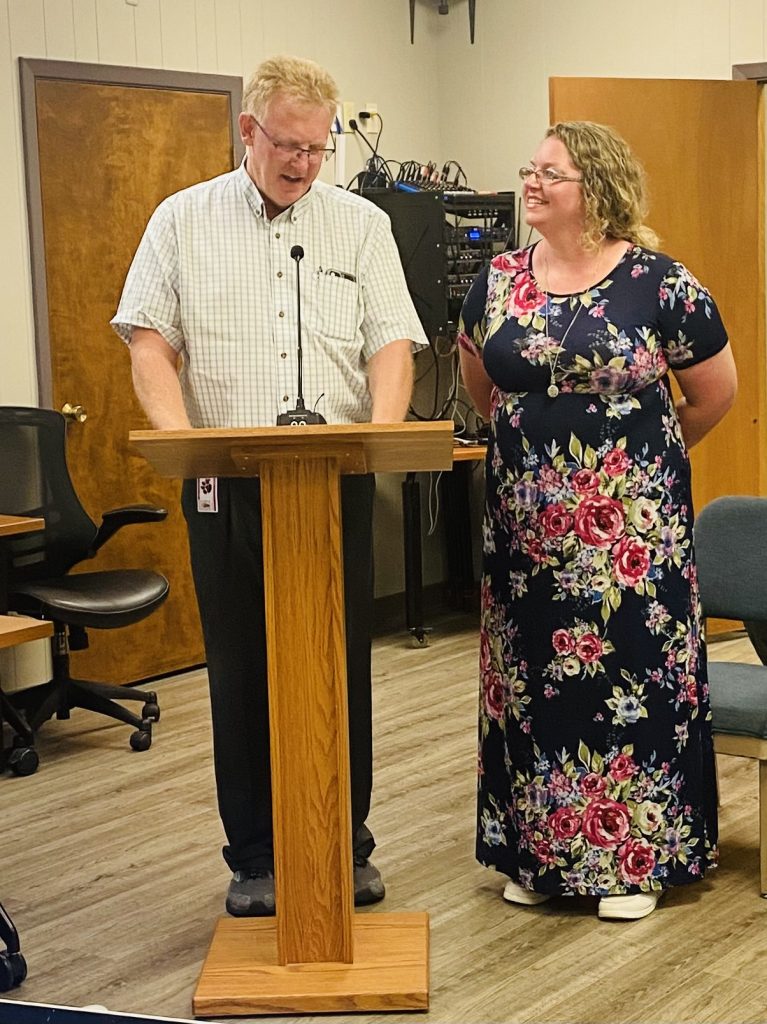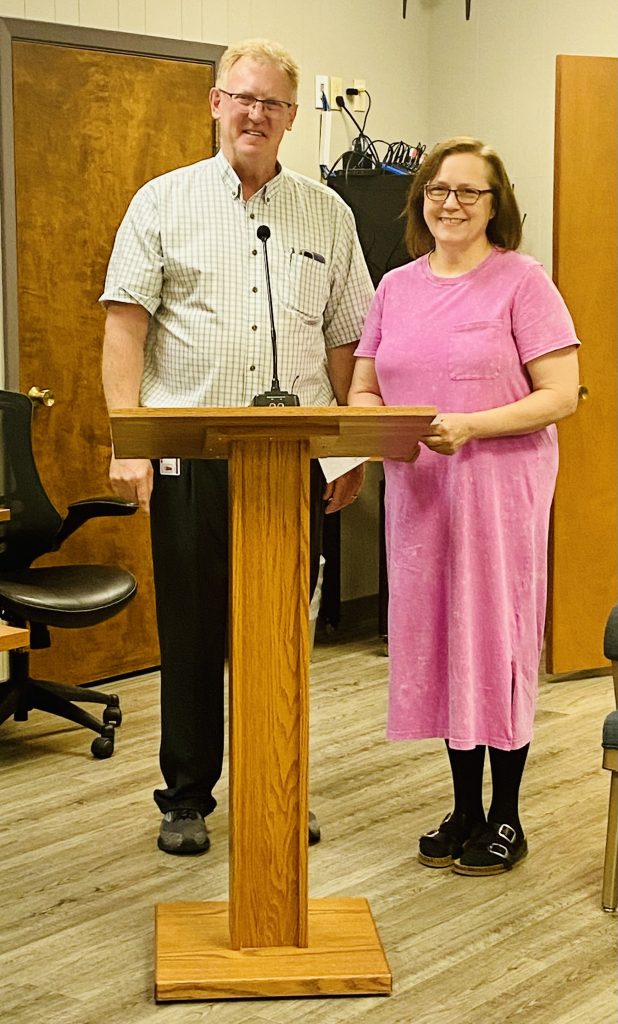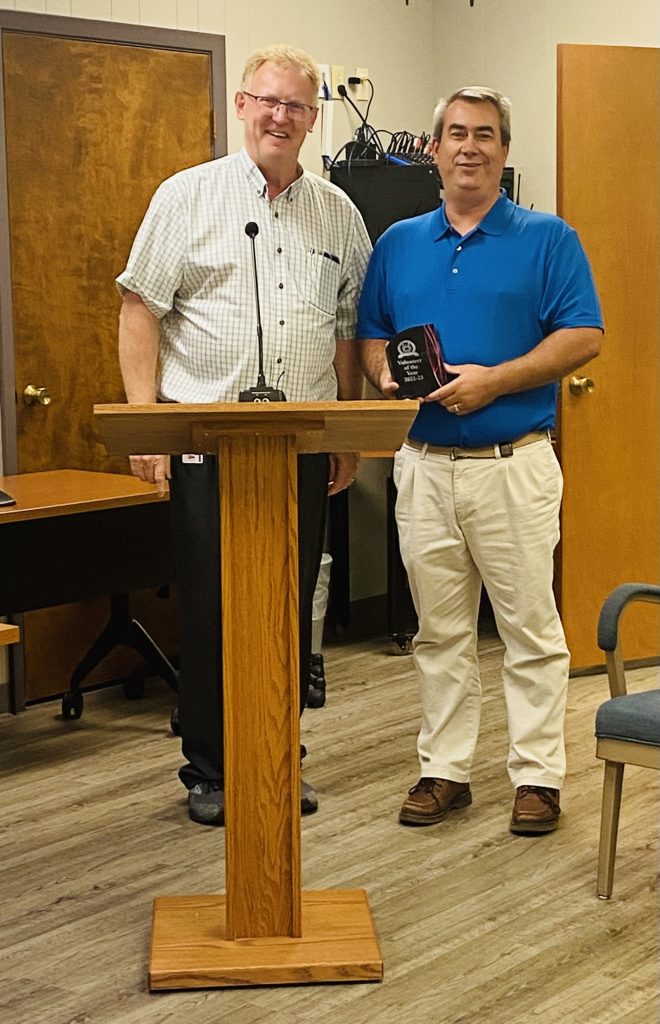
Ralph Carlson introduces the Friday Night Concert musicians May 2019.
This week’s Friday Night Concert will be presented by family trio Kevin and Kathy Wood from Prescott, and their daughter Leah Maxfield. The program will feature country and bluegrass gospel. Musician Sandy Hemphill will also join the trio on guitar.
“The Wood family started singing in church about twenty years ago. Kevin also plays guitar,” concert-series organizer Ralph Carlson said. “We appreciate the opportunity to promote our local musicians and provide wholesome concerts for the whole family. Bring a couple of friends and join us a fun evening.”
The one-hour concert begins at 7 p.m. at the Heritage Park Pavilion at First and Main streets. The event is free and open to the public. Dave Oas and Jim Butler provide the sound each week. Due to limited seating, attendees are encouraged to bring lawn chairs.
In the event of inclement weather, the concert will be moved to The Loading Dock at Common Ground Coffee Co., 12 E. Wall Street.
Kansas’ September Total Tax Receipts
$84.5 Million More Than Last September
TOPEKA – Today, Governor Laura Kelly announced Kansas’ September total tax receipts were $961.0 million. Those collections are $96.2 million, or 11.1%, more than the estimate, and reflect a $84.5 million, or 9.6%, growth from last September.
“Thanks to our laser-sharp focus on creating quality jobs and attracting business to Kansas, we have now seen 26 months of revenue surpluses,” Governor Laura Kelly said. “That has enabled us to provide tax credits for teachers and cut taxes for seniors, veterans, homeowners, and businesses – all while paying off debts and fully funding our schools. These revenue estimates show we are making Kansas the best place to live, work, and raise a family.”
Individual income tax collections were up $31.3 million, or 7.6%, for the month with $441.3 million collected. That is $34.5 million, or 8.5%, more than the same month in 2021. September corporate income tax receipts, which are comprised primarily of estimated tax payments, have continued to trend upward. Corporate income tax collections were $49.2 million, or 40.6%, more than the estimate with $170.2 million collected. That is a growth of $24.9 million, or 17.1%, from the same month last year.
“The higher-than-expected corporate estimated payments suggests that corporations again anticipate favorable profit margins in 2022,” Revenue Secretary Mark Burghart said.
Combined retail sales tax and compensating use collections were $309.6 million, 8.3%, or $23.7 million, more than last September.
Click here to view the September 2022 tax receipts spreadsheet.
Governor Laura Kelly Announces Application for COVID-19 Retail Storefront Property Tax Relief Now Open
TOPEKA – Today, Governor Laura Kelly announced that small businesses can now apply to receive COVID-19 Retail Storefront Property Tax Relief. In June, Governor Kelly signed bipartisan House Bill 2136, investing $50 million to help small businesses recover from the COVID-19 pandemic.
“We’re making sure small businesses can receive the support they need to hire workers, strengthen their products, and better serve their communities,” Governor Laura Kelly said. “My administration will continue to remain laser-focused on creating a stronger, more resilient economy to help every business and every family succeed.”
Businesses can learn whether they qualify for the program and how to access relief by accessing guidance from the Kansas Department of Revenue here.
The COVID-19 Retail Storefront Property Tax Relief Program is funded through the federal American Rescue Plan Act (ARPA), which requires a federal Unique Entity Identifier (UEI) to be completed for a business to be eligible to receive assistance.
“Due to federal requirements, the Kansas Department of Revenue cannot process a retailer’s application for the Retail Storefront Property Tax Relief program unless a business has secured a federal UEI number,” Secretary of Revenue Mark Burghart said. “Doing so helps ensure the program’s guidelines are followed and the accurate accounting for disbursement of funds.”
The UEI is issued at no cost through the federal System for Award Management website, SAM.gov.
Due to recent increases in the number of entities registering with SAM.gov, it may take up to 25 business days for new registrations to be processed. For any issues related to registering with SAM.gov or obtaining a UEI, applicants can contact the Federal Service Desk at 866-606-8220.
Once registration is complete and confirmed, business owners can apply for the COVID-19 Retail Storefront Property Tax Relief Program by going to ksrevenue.gov.
Applicants with questions regarding the COVID-19 Retail Storefront Property Tax Relief Program can contact the Kansas Department of Revenue at 785-368-8660.
Small business owners have until April 15, 2023, to apply for this financial assistance.
Kelly Administration Saves Taxpayers Over $750M by Retiring Debt and
Paying Cash for Projects
~~Fiscal Responsibility is ‘Transformative’ for Kansas~~
TOPEKA – Governor Laura Kelly announced today that actions taken by her administration in Fiscal Year 2022, including paying down debts incurred by the Brownback Administration and paying cash for projects, have saved Kansans $754.2 million in interest payments.
“By prioritizing fiscal responsibility, we have put Kansas back on track and ready for the road ahead,” Governor Laura Kelly said. “My administration has managed our budget wisely in order to save taxpayers hundreds of millions of dollars and axe taxes – all while making historic investments in our schools, infrastructure, and law enforcement.”
In Fiscal Year 2022 (July 2021 through June 2022), the Kelly Administration used the budget surplus to retire debt early and pay for projects with cash rather than through issuing bonds. The Administration paid down $1.6 billion in debt, saving $632.0 million in interest payments, and will pay cash for $203.0 million of new capital projects, saving Kansans more than $100 million in interest that would have otherwise accumulated through bonds.
These savings also include saving Kansans $22.2 million in interest by paying off the nearly $100 million of a $200 million transportation bond that was issued in 2012.
“Utilizing our surplus to pay down this level of debt in one year – while simultaneously building our reserves to record levels – is a transformative event,” Adam Proffitt, State Budget Director, said. “This will insulate our budget from potential future economic volatilities, which will provide fiscal stability, allowing us to continue to fund critical services for all Kansans for years to come.”
These savings include paying off debt to KPERS, for the KBI Lab at Washburn University, and for the National Bio and Agro-Defense Facility in Manhattan, among others.
Lisa Lewis is the new Fort Scott City Clerk, as of Oct. 1, 2022.
Lisa A. Lewis, 56, is the new Fort Scott City and Municipal Court Clerk, as of Oct. 1, when Diane Clay retired.
Lewis and husband, Tony, are new to Fort Scott. The Lewis’s came in 2021, having lived in Chicago and raised their four children there.
From 2019 to 2021 they lived in Queen Creek, AZ but decided they liked Midwest living better than the desert, so decided to move to Kansas, she said.
She started working at the city of Fort Scott as administrative support in January of 2022 working with Jackson Tough and Tourism as well as City Hall.
“My son in Spring Hill, KS was the one responsible for us all moving to Kansas,” she said. “We wanted to come back Midwest, where our heart is, but never back to Illinois. He played baseball for Wichita State University and then minor league for the Chicago White Sox. My husband also played minor league for the San Diego Padres and was sold on Fort Scott because of the LaRoche Stadium, where he currently works, so he is enjoying life here too and hoping to make more opportunities for the city with that aspect.”
“We wanted to move to a small town, from the big cities of previous years, and start to slow down,” she said. “I began working at City Hall but opportunities came fast and furious that changed all of that. Diane Clay took me under her wing and brought me along. She truly is amazing and someone I look up to. I hope to make her proud. I most certainly have a lot to learn in order to represent like she did, but I will get there. I believe I bring a lot of life experiences, I have dabbled in many of the pertinent professional areas over the years. I also have the passion and mindset to be an integral part of a team to help this charming little town be all it can be and more.”
“I come from big towns, and I know how to live ‘big town’, however, I have quickly come to love the charm and pace of small town living; but it is a definite learning curve,” she said. “I hope the residents will afford me that necessary grace period to learn all about Fort Scott and its needs, because my intentions are nothing but good. I am enjoying getting to know everyone. People are friendly here even though I am an outsider. Residents and my co-workers have been extremely gracious, welcoming and patient to date. I am used to being surrounded by shopping and services galore. Now I realize that if Wal-Mart doesn’t have it, we may not really need it anymore…that’s a good thing.”
With her husband of 33 years, Tony, they raised four children.
“My daughter (32) is married with one child and one on the way,” she said. “She lives in Shawnee, KS and her husband works for Johnson County Corrections. Our son (30) lives in Chicago, IL and is a general manager for Menards. He plans to move to Kansas in the near future. Our son (26) is married with one child on the way and lives in Spring Hill, where he is a deputy sheriff for Johnson Co. Sheriff’s Office. Our daughter (16) is a junior at Fort Scott High School and found her passion in the theater there.”
Her work experience includes: Chicago Sun-Times Editorial Graphic Designer (20 years), Illinois DCFS Case Aide /Court Liaison (9 years), worked in healthcare as a CNA, Phlebotomist and Lab Clinical/Clerical Assistant (7 years).
Southeast Kansas has been in a severe drought for most of this year’sgrowing season.
Poor crop and pasture yieldshaveled to limited feed optionsand increased foragepricetagsfor cattle producers. Two thousand twelveoffered very similar conditions to thePlainsthey could get their hands on. One option many Kansas producers found wasto ammoniate wheat straw. Wheat straw is widely considered a poor foragethat isbetter served as bedding, but research conducted by Kansas StateUniversityshows ammoniating bales can greatly improve protein content and digestibility. Wheat straw typicallytestsaround 3.3%crudeprotein and 31% in–vitro dry matter digestibility (IVDMD).Ammoniation rates of1.5%(lbs anhydrous ammonia/dry matter lbs wheat straw) can increasecrudeprotein content to 8.6% and IVDMD to 42%.An ammoniationrateof 3%increased crude proteinto10.8%andIVDMDto46.2%. The process of ammoniating wheat straw isnot overly complicated. An area large enough to hold the stacks of bales will need to be cleared, with some soil pulled away to be used later. Bales should be gathered in rowsandstacked in a pyramid (three bales on the base, two on the second level andone on top).Theentire stack should be covered with a black plastic sheet, about 6 to 8mmthick.A 40’ x 100’ sheet can cover 12 rows of pyramid–stacked bales. The edges of the plastic should hit theground and be covered with loose soil to seal thebales inside the plastic.Any holes in the sheet will need to be patched with tape.Next, a pipe (6–8 ft long) should be placed on the ground and inserted into the center of the stack. Attach the pipe to the anhydrous tank and slowlyempty Once the stacks of bales are covered, it is time to let the anhydrous ammonia go to work. The ammoniation process is dependent on heat, so the straw will be ready to feedsoonerwith warmer temperatures.Average temperaturesabove86°Fwillneedto be sealed for one week, temperatures between59–86°Fneed to remain sealed fortwoto fourweeks, and temperatures below 59°Fneed to remain sealed for up toeightweeks.The October 2021 average daily high and low temperatures at the Kansas Mesonet Station near Uniontown, KS were 71°F and 51°F, respectively. With expectations of a warmer than average October for 2022, we could expect the ammoniation process to take around 4 weeks if started the first week of October. Now, what is the cost? Any producer who fertilized his pasture or crop ground this past spring knows that fertilizer prices have gone through the roof, especially compared to 2012, when producers were using this alternative feed source. The price of anhydrous ammonia at Midwest Fertilizerin Iola, Kansas, was $1,206.67 as of Sept 28, 2022. That equates to $0.60/lb. A 40’x100’ sheet of black plastic can seal a row of 12 pyramids. Assumea tightly wrapped wheat straw bale (tightly wrapped bales work better for ammoniating)weigh on average 1100lbs. 72 total bales, at 90% dry matter, means you will have roughly 35.64drytons of wheat straw to ammoniate.
1.5% ratewill require 1,069.2 lbs anhydrous ammonia 1,069.2lbs x $0.60/lb = $641.52 = $18/dry ton wheat straw 3.0% rate will require 2,138.4 lbs anhydrous ammonia 2,138.4lbs x $0.60.lb = $1,283.04 = $36/dry ton wheat straw Anhydrous ammonia will not be the only cost associated with this process. Let’s assume another $15/dry ton wheat straw to account for fuel, the plastic sheeting, labor, and other miscellaneous costs. This will bring our cost of ammoniating wheat straw to: 1.5% rate: $33/dry ton wheat straw 3.0% rate: $51/dry ton wheat straw Today’s prices may make thedecision morechallenging than it was in 2012, but with prairie hay trading in southeast Kansas at$100–130/ton and wheat straw only trading at $60/ton, ammoniating wheat strawisanoption for those lacking feed this fall. For more questions regarding ammoniating wheat straw and other forage questions, contact Chad Guthrie, crop production and forage management agent, or Hunter Nickell, Livestock Production Agent at any Southwind Extension District office. Locations in Erie, Fort Scott, Iola, and Yates Center. Disclaimer: Caution should be takenas anhydrous ammonia is a dangerous chemical. Releasing the anhydrous too quickly could cause the plastic sheeting to rupture. The plastic will also balloon out during the ammoniation process, so strong winds, hail, or wildlife could puncture the plastic.
Several years ago, when our son was in college and still living at home, he had a beautiful fawn Boxer. I grew up with dogs living outside, but we made an exception for Gus to live indoors because he was such a smart, lovable, and loyal companion. Aaron took responsibility for house training him and all was well — until the evening all three of us left Gus home alone. I guess he got terribly bored, emotionally strung out, or so lonesome he could cry. Anyway, after being gone, I was the first to enter the living room. Gus was just quietly sitting there, but he had eaten the couch and strewn the stuffing all over the floor. I don’t know exactly why he ate such a strange supper. Fortunately, that couch needed to be replaced anyway, so I thought the furniture casualty was extremely funny!
Let’s drop the “ing” from “stuffing” and just focus on “stuff.“ God is greater than stuff (hard times). A partial list of stuff that we might encounter could be: career disappointments, various losses (death, divorce, job) sickness, financial setbacks, family heartaches, etc. But be of good cheer because believers are not up a creek without a paddle. We have this wonderful promise, “God is our refuge and strength, always ready to help in times of trouble” (Psalm 46:1 NLT).
The devil will tell you that your situation is hopeless. But there’s not an iota of truth in that lie. Jesus was speaking to the crowd about the devil and said, “He has always hated the truth, because there is no truth in him. When he lies, it is consistent with his character; for he is a liar and the father of lies” (John 8:44 NLT).
Christ followers are to practice trusting God every day through thick and thin. Otherwise, we’ll live in worry, fear, anxiety, and doubt and that‘s a miserable way to survive. If we fail to trust God and His promises, we’re actually being prideful in thinking we can handle our stuff by ourselves. Having a deep-seated confidence in God proves that we believe He has the solution when we don’t. God says, “I will…make Trouble Valley a Door of Hope” (Hosea 2:15 GNT). God takes care of His children in a precarious world. We can move forward if we’ll trust Him to direct and help us.
When stuff (hard times and challenges) happens, don’t allow the devil to fill your mind with his garbage of anxiety. Make a stout decision to trust God to pull you through the knothole. You can be more than a survivor, you can be an overcomer through Christ. He has experienced every temptation we have and He will help us press through to victory. He said He would never leave us alone and we can take that to the bank.
“To depend” means you can believe in, rely on, bank on, count on, lean on, and pin your hopes on someone who‘s proven to be trustworthy. Written by Randy Phillips and recorded by Janet Paschal, “You Can Depend on Jesus” really brings this truth down where we live: “It’s fairly easy what you need to do, Invest your trust in One who’s tried and true; The Ageless Stone will stand alone when all the sifting sands of life have come and gone. You can depend on Jesus, you can depend on Him. As He was yesterday, tomorrow He’ll be the same. You can depend, you can depend on Him.”
The Key: When life’s cushion falls apart at the seams and stuffing is everywhere, you can depend on God to help clean up the mess.
The nomination deadline for the 2023 Health Champion Award has been . The Governor’s Council on Fitness is excited to partner with the Salina Crossroads Marathon to provide entry to the Salina Crossroads Marathon, Half Marathon, 4.01K, Family Run/Walk and Team Relays on November 5th in Salina, KS.
Anyone who submits a nomination for an individual or an organization for Health Champion will receive a code to register for free to the event of their choice.
The nominee will also receive free entry!
Kansas Health Champion Award Nomination: http://www.getactivekansas.org/…/Health_Champion…Salina Crossroads Marathon website: https://www.runsalinacrossroads.com/
Send your nominations in today for your community’s champion! Organizations, individuals, worksites…anyone!
Jody Hoener The Healthy Bourbon County Action Team, Inc. President and CEO, 620-215-2892, 104 North National,Fort Scott, KS 66701
MEETING HELD IN THE COMMISSION ROOM BEGINNING at 9:00AM.
Call to Order
Flag Salute
Approval of Minutes from previous meeting
Eric Bailey – Road & Bridge Report
Delwin Mumbower – Burn Ban Update
Lora Holdridge—South East Kansas Regional County Officials Meeting
Clifton Beth – SEK Area Agency on Aging – Board Opening
Ashley Shelton – Gas Price Lock In
Justin Meeks – County Counselor Comment
Susan Bancroft – Chief Financial Officer Comment
Shane Walker – Chief Information Officer Comment
Public Comment
Commission Comment
Justifications for Executive Session:
KSA 75-4319(b)(1) To discuss personnel matters of individual nonelected personnel to protect their privacy
KSA 75-4319(b)(2) For consultation with an attorney for the public body or agency which would be deemed privileged in the attorney-client relationship
KSA 75-4319(b)(3) To discuss matters relating to employer-employee negotiations whether or not in consultation with the representative(s) of the body or agency
KSA 75-4319(b)(4) To discuss data relating to financial affairs or trade secrets of corporations, partnerships, trust, and individual proprietorships
KSA 75-4319(b)(6) For the preliminary discussion of the acquisition of real property
KSA 75-4319(b)(12) To discuss matters relating to security measures, if the discussion of such matters at an open meeting would jeopardize such security measures.
Changes in how we produce food has to be the number one reason rural America and Bourbon County (BB) are shrinking; however, agriculture continues to be a major economic influence in small communities and the number one industry in BB. Consider the following 2017 statistics about BB agriculture from the State of Kansas:
Total acres in BB: 406,701 Acres farmed: 335,935, or 82.6%
Total farm employment: 821, or about one in ten workers
Agricultural product sales: $79 million
Cattle population: 71,079, or about 5 cows per BB resident
In the State of Kansas, agricultural produced $8.8 billion in product in 2017, which was 4.6% of the $192.3 billion total Gross Domestic Product (“GDP”) for the State. Nationally, agricultural was 7.7% of the GDP in 1930; by 2002, that percentage had fallen to 0.7%. It is not that agriculture has produced less; rather, our economy has become much more diversified, and most of that has occurred in urban areas. Kansas remains 6.6 times more dependent upon agriculture than the average state.
What about agricultural employment? In 1900, 41% of the labor force in the United States of American (“USA”) were agricultural workers; by 2002, that number had fallen to 1.9% of the labor force. It is easy to see that this 20th Century megatrend has impacted rural America to a far greater extent than their urban counterparts.
It is not hard to discern how this happened. At the beginning of the 20th Century, the industry relied upon horses and mules for the heavy lifting around the farm; these animals, which required care and feeding as well, were replaced by about 5 million tractors and other vehicles and implements. This mechanization, along with improved methodologies, has driven farm consolidation; while the number of farms in the USA has dropped 63%, the average farm size has increased by 67%. Additionally, in 1930, about one-third of farmers earned off-farm income; 70 years later, that number was 93%.
The impact on rural American has not only been devastating in terms of population, but culture. In 1900, about 60% of rural Americans were farmers; the number is about 20% now, and 10% in BB. Once culturally dominate in rural communities, they are now relegated to the sidelines. Anecdotally, when I grew up in a farm community in the ‘50’s and ‘60’s, farmers occupied the key roles in government around the county, including commissioners and school board members; that is seldom the case now.
This is another national megatrend that was out of the control of rural American communities, and characterizes the nature of our demise. No one is to blame, it is all a part of living in a small community with wide open spaces.
Next week, I will take a deep dive into the dramatic increase in government regulations which has further strained rural American businesses, driving many of them to close down or to sell to larger companies. It is another key factor in why BB is shrinking.