KDOT’s Cost Share Program, with additional dollars, to open applications Aug. 17
The Kansas Department of Transportation will begin accepting applications for the fall 2026 round of the agency’s Cost Share Program Monday, Aug. 17. Nearly $170 million has been given to Kansas communities since the program began in 2019.
The Cost Share Program provides financial assistance to local entities for construction projects that improve safety, leverage state funds to increase total transportation investment and help both rural and urban areas of the state improve the transportation system. This is the 15th round of projects to receive funding.
This fall’s round will have approximately $12 million in available funds to award, which is greater than past cycles. The one-time occurrence for the program is possible due to savings from less snow and ice removal needed during the relatively lighter 2025-26 inclement winter weather season. A portion of that leftover cost savings will now be used for Cost Share, with the maximum project award amount increased to $1.5 million this round.
“KDOT’s Cost Share Program improves transportation, creates economic growth and increases job opportunities across Kansas,” said Michelle Needham, Economic Development Programs Manager. “Past Cost Share participants have proven this program to be the financial boost that communities of all sizes needed to achieve their project goals.”
All transportation projects are eligible, including roadway (on and off the state system), rail, airport, bicycle/pedestrian and public transit. Candidate projects should include investments that provide transportation benefits and are not eligible for other KDOT programs.
The deadline for submitting applications is Sept. 24. More information and the application link will be on KDOT’s website on Aug. 17 at https://www.ksdot.gov/programs/economic-development-programs/cost-share-program. All applications will be completed online, and a sample PDF application will be available for preview.
Please contact Michelle Needham at [email protected] with any questions.
Many football fans remember James “Boobie” Miles as the electrifying running back from Odessa Permian High School whose story became the heart of Friday Night Lights. As one of the nation’s most highly recruited players in 1988, he appeared destined for college football stardom before a devastating knee injury changed the course of his life.
I had the opportunity to meet Boobie during the recruiting process while serving as head football coach at Fort Scott Community College. Like many coaches across the country, I recognized his tremendous talent. More importantly, I wanted him to know there was always another path if academics or eligibility became a challenge.
Life after football has not been easy. Boobie has battled legal troubles for many years. Even through the hardships and consequences of his choices, one thing has remained remarkably consistent — his desire to keep other young people from making the same mistakes.
I had the privilege of working alongside Boobie doing school assemblies. His message to students was always sincere and heartfelt: Get your education. Listen to your parents, coaches, and teachers. Don’t throw away the opportunities that have been placed before you. He speaks openly about the years he cannot reclaim and reminds students those poor decisions can erase extraordinary talent.
Athletic ability may open a door, but character, education, and wise choices determine how long that door remains open. Every young athlete dreams of making the game-winning play. Yet the most important decisions are usually made far away from the stadium. They are made in the classroom, at home with family, and in choosing the friends who will influence the direction of your life.
His story also reminds us of the importance of learning discipline early in life. Respect for others, accountability, and making wise decisions are habits that should be developed in childhood. When they are not, those lessons often become much harder to learn later in life.
Boobie shares his testimony and encourages students to choose a better path than the one he traveled. Sometimes the most powerful teachers are those who have experienced failure, accepted responsibility, and are willing to tell others, “Don’t make the same mistakes I did.”
Talent may earn applause, but character earns trust. Education creates opportunity, discipline sustains success, and our choices ultimately determine the legacy we leave behind.
Thought for the Week:“The choices you make today determine the stories you’ll tell tomorrow. Attitude is everything. Choose wisely.” — Tracy Welch, highly respected retired professional, college, and high school football coach and athletic director.
Dr. Jack Welch serves as President of Fort Scott Community College. With a career spanning professional sports, public education, and rural community development, he brings a servant-leader mindset and a passion for building trust-driven cultures that empower people to thrive in the classroom, on the field, and in life. He is also the author of Foundations of Coaching: The Total Coaching Manual.
The Fort Scott Area Chamber of Commerce has 14 businesses involved in this year’s Shop Fort Scott Sales- Tax Holiday event this weekend, August 7-8.
Lindsay Madison is the executive director of the Fort Scott Area Chamber of Commerce. Submitted photo.
Lindsay Madison, Fort Scott Area Chamber of Commerce Executive Director, said the annual event began in 2011, when a few stores approached the Chamber with the idea.
The neighboring states of Missouri and Oklahoma have tax holidays before the fall season each year. Kansas has none.
So, to keep the community and their dollars in Fort Scott, some local businesses are providing the opportunity to save money, while supporting local businesses with an almost 10 percent reduction in their total receipts.
Some retailers will participate in the Shop Fort Scott Sales Tax Holiday Weekend by offering shoppers a 9.65% discount while continuing to collect and remit all applicable sales tax.
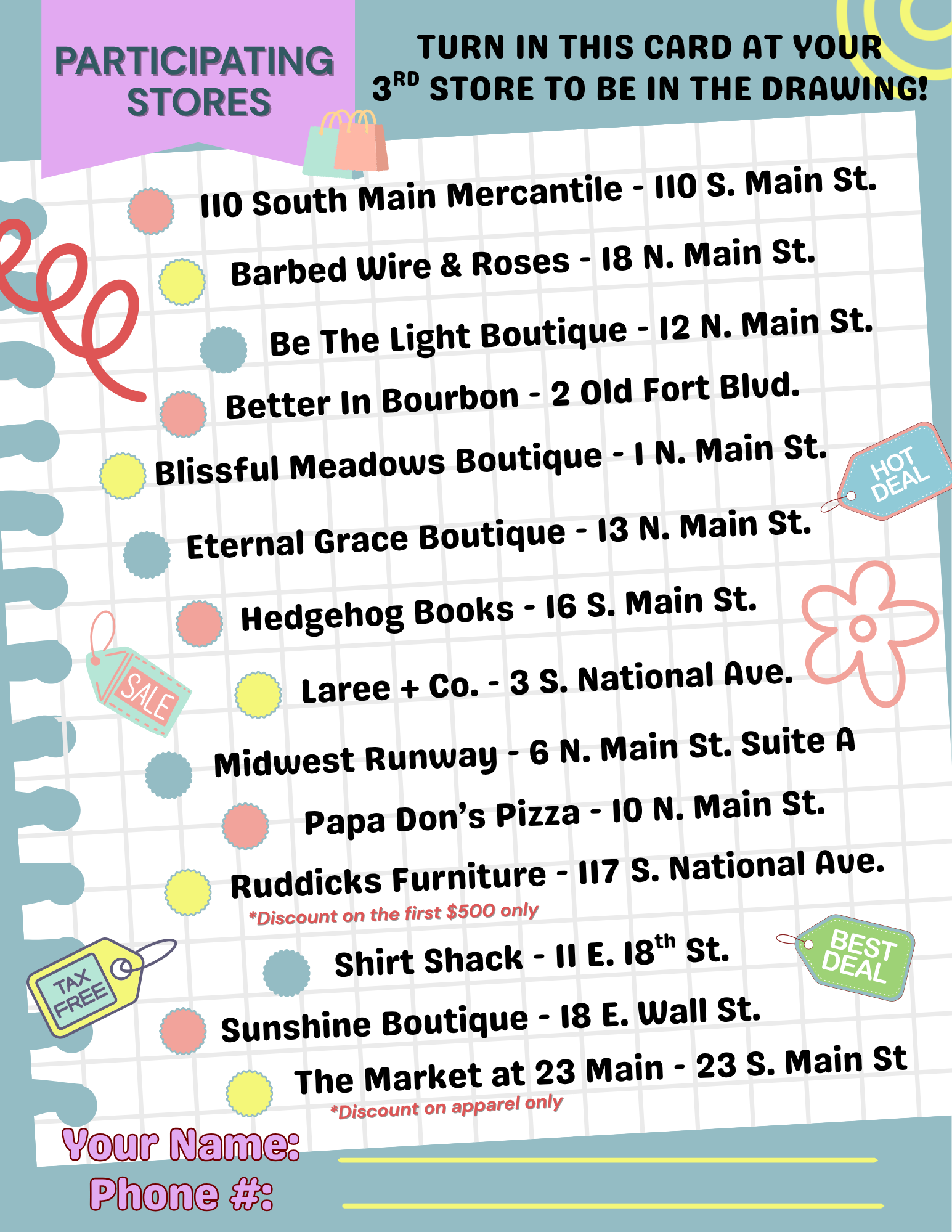
Participating merchants include 110 South Main Mercantile, Barbed Wire & Roses, Be The Light Boutique, Better In Bourbon, Blissful Meadows Boutique, Eternal Grace Boutique, Hedgehog Books, Laree + Co., Midwest Runway, Papa Don’s Pizza, Ruddick’s Furniture, Shirt Shack, Sunshine Boutique, and The Market at 23 Main.
Special considerations include that the discount at Ruddick’s Furniture applies to the first $500 of a purchase, while the discount at The Market at 23 Main applies to apparel only, according to a Chamber press release.
Shoppers may also enter to win $50 in Chamber Bucks.
To qualify for the Chamber Bucks, shoppers must spend at least $5 at three participating businesses and have their event rack card marked at each location. Completed cards should be turned in at the third participating business visited to be entered into the drawing.
Participating businesses offer a wide variety of merchandise, including apparel, home décor, new and repurposed furniture, school supplies, pizza, and much more.
With most participating businesses located in Fort Scott’s Downtown Historic District, shoppers can enjoy a convenient weekend of shopping while supporting local businesses throughout the community, according to the press release.
For more information, contact the Chamber at (620) 223-3566 or visit fortscott.com.
Leslie Godden from her email signature
“We are always looking for new ideas and ways to change things up so the event stays fresh and people continue to get excited about shopping locally,” said Leslie Godden, Chamber Communications and Events Planner.
Fort Scott City Commission Meeting Agenda – August 4, 2026, 6:00 PM
I. Call to Order
II. Pledge of Allegiance
III. Invocation
IV. Approval of Agenda
V. Consent Agenda
A. Approval of Appropriation Ordinance 1413-A – Expense Approval Report – Payment Dates of July 15, 2026 – July 28, 2026: $860,430.86
B. Approval of Minutes: Regular Meeting of July 21, 2026
C. Request to Pay – Gilmore Bell – Invoice #8060797 – Davis Lift Station – Professional Services Rendered for General Obligation Notes: $11,500.00
VI. Public Comment
VII. Appearances
1. Jason Eastwood – Gunn Park House Child Services Center Proposal
2. Mary Wyatt – Small Business Grant Update
VIII. Executive Session
Bourbon County Development Group
IX. Unfinished Business
A. Consideration of Ordinance No. 3800 – An Ordinance Granting to Evergy Kansas South, Inc. a Kansas Corporation, Its Successors and Assigns, an Electric Franchise Including the Right to Construct, Operate and Maintain Electric Transmission, Distribution and Street Light Facilities Within the Corporate Limits of the City of Fort Scott, Kansas – Tabled from July 7, 2026
B. Consideration to Approve Consent Agenda of July 7, 2026 – Tabled from July 7, 2026
Approval of Appropriation Ordinance 1412-A – Expense Approval Report – Payment Dates of July 1, 2026 – July 14, 2026: $442,389.03
Approval of Minutes: Regular Meeting of July 7, 2026 and Special Meeting of July 13, 2026
June Financials
Request to Pay – Earles Engineering & Inspection, LLC – Invoice #18693 – Davis Lift Station – Salary: $6,799.35 – Tabled from July 7, 2026
Request to Pay – Earles Engineering & Inspection, LLC – Invoice #18628 – EEI Project No. 25-12 E. National Phase I – Final Design 80%: $13,800.00
Request to Pay – Stifel, Nicholaus & Company, Inc. – Invoice #M21659-48602-838 – Financial Advisory Fee and Continuing Disclosure Review – General Obligation Temporary Notes Series 2026-1 – Davis Lift Street Project: $16,250.00
C. Consideration to Resolve Issues with 118 E. Wall
D. Consideration of Bids for Investment in CD for $2,000,000.00 for the Period of (12) Months – D. Tally
E. Discussion to Amend Municipal Code Chapter 5.08 – Alcoholic Liquor, Chapter 5.12 – Cereal Malt Beverages, and Chapter 5.14 – Beer Gardens
The Fort Scott Area Community Foundation (FSACF) will begin accepting applications for its annual competitive grant cycle on August 1, with applications due by August 31.
Nonprofit organizations, educational institutions, government entities, and religious organizations serving Fort Scott and Bourbon County are encouraged to apply for funding. Applications are submitted online through the FSACF website, //FSACF.com/Grant-App, where grant guidelines, application materials, and resources for grant writers are available.
Applications received during August will be reviewed throughout September, with grant awards announced mid-October.
The foundation considers proposals based on their ability to improve the quality of life in the Fort Scott area. Particular consideration is given to projects that demonstrate long-term sustainability and collaborative efforts among organizations.
“Community foundation grants have helped strengthen Bourbon County by supporting projects that address local needs and create lasting benefits for our residents,” said Gregg Motley, FSACF Grants Committee Chairman and Board Member. “Over the years, we’ve seen these investments help organizations expand services, improve facilities, and bring people together around common goals. We encourage applicants to think beyond immediate needs and consider how their projects can create sustainable, long-term impact for our communities.”
Organizations interested in applying are encouraged to visit the FSACF website early in the application period to review eligibility requirements and available grant-writing resources.
For more information about the grant program, application guidelines, or eligibility requirements, visit the Fort Scott Area Community Foundation website or contact the foundation directly.
About Fort Scott Area Community Foundation
The Fort Scott Area Community Foundation is a nonprofit organization dedicated to improving the quality of life in Fort Scott and Bourbon County by connecting donors with community needs. Through charitable funds established by individuals, families, businesses, and organizations, FSACF provides grants and resources that support local nonprofits and community initiatives. Since 2007, the foundation has awarded more than $500,000 in competitive grants to benefit the communities it serves.
I’m Josh Jones. Don’t take my word for it — watch the record.
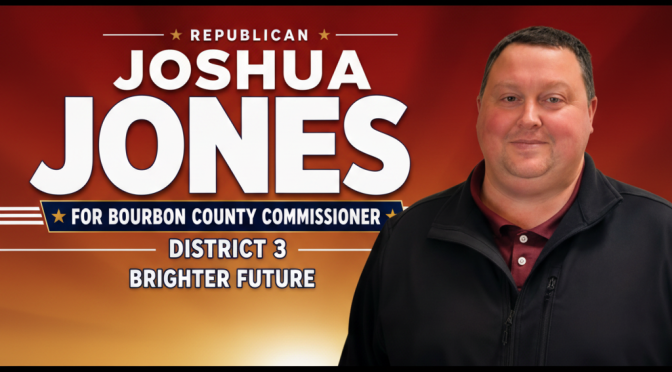
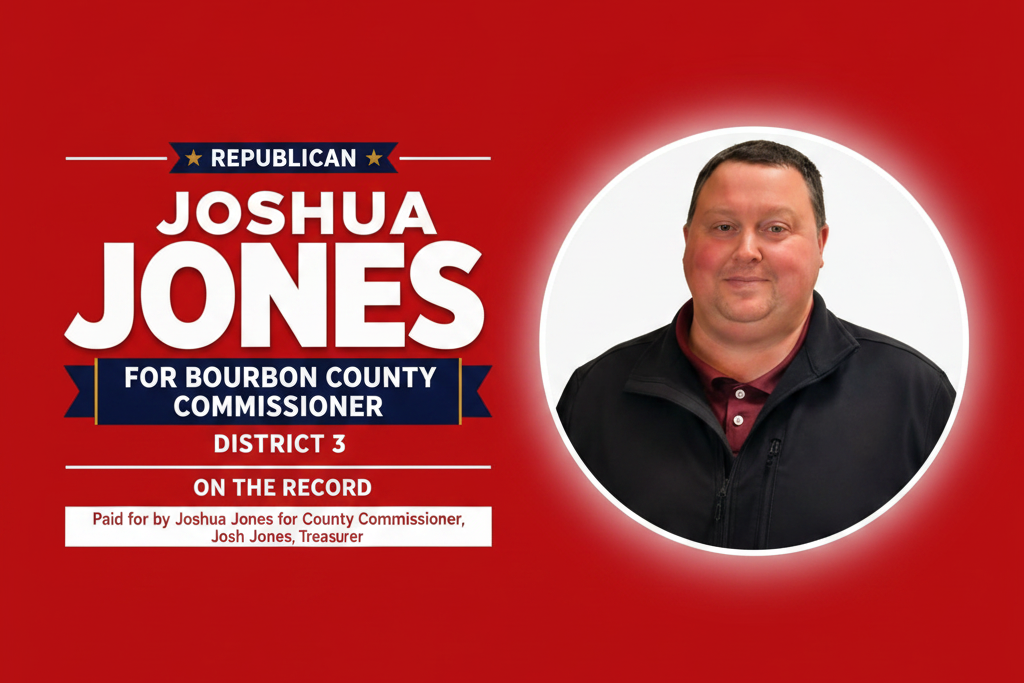
I’m Josh Jones, a lifelong resident and small-business owner, and I’m running for Bourbon County Commissioner, District 3.
Most candidates ask you to imagine how they’d govern. I can just show you. For nearly three years I served on the Fort Scott City Commission — chosen by my fellow commissioners as mayor, and later as commission president. My whole time there is on the public record: the votes, the debates, all of it.
So you don’t have to wonder what kind of commissioner I’d be:
Watch what I already did — it’s on video for anyone to see
I’ve sat through the tough, loud debates and learned how to bring the focus back to getting things done
I make decisions independently — on the merits, on what’s best for the community — even when it involves friends or people I respect
That last one matters. I’ve cast hard votes that didn’t go the easy way for the people closest to me, because the job is to do what’s right for the citizens, not what’s comfortable. A record holds everyone accountable, including me — and in a county where trust is running thin, a track record you can actually check is worth a lot.
Don’t take my word for it. Watch the record for yourself — then vote.
Vote Josh Jones — Bourbon County Commissioner, District 3. A record you can check.
Paid for by Joshua Jones for County Commissioner, Josh Jones, Treasurer.
Between Ralph and I, we have 141 years of experience in playing our musical instruments (guitar and piano). We’ve been music-and-family friends for many years, playing various shows, recitals, and churches together. Recently, we were preparing to play at a local country church and Ralph was tuning his guitar. Since the piano was slightly out-of-tune, we had to troubleshoot and basically tune the guitar to the piano. It wasn’t perfect, but we did the best we could to at least be in tune with each other! It was kinda’ like playing our instruments in a three-legged race. Ralph and I had a blast and nobody threw rotten tomatoes at us, so I think it was a win-win.!
You know, some people can’t carry a tune in a bucket. And if they happen to be singing, there’s just no way to cover that up. The late George Younce, famous Southern Gospel bass singer once said, “I’ve heard so much off-tune singing I kinda’ like it.”
Can Christ followers get out of tune with God? Yes – by disobedience to His Word. Actually, a willfully-disobedient Christian is an oxymoron; like jumbo shrimp, fresh clabbered milk, pretty homely, plastic silverware, and awfully good. Love for Christ is proven and demonstrated by our obedience to all that He says. John the Beloved recorded Jesus’ words, “If anyone loves Me, he will keep My Word; and My Father will love him, and We will come to him and make Our home with him. He who does not love Me does not keep My words” (John 14:23-24 NKJV).
It’s painful for a musician to play an instrument that’s out-of-tune. And when believers are out of tune with God, He can’t stand the dissidence. God can’t literally stand to live in our home when we’re off tune with Him. Something or someone has to give and it’s not going to be God. Here’s a royal plan spoken beautifully by J. Hudson Taylor, “Do not have your concert first and tune your instruments afterward. Begin the day with God.”
Get in tune with God. Maybe you’re playing on the wrong page – repent and change your sheet music. Please don’t tune your life to your own philosophy or today’s messed-up culture. Do your Christian walk God’s way. His way is as plain as day in His Word. God makes so much of our faith, our endeavor, and our obedience. If you have faith even as small as a single mustard seed, your prayers will be answered – one way or another (ref. Matthew 17:20). God isn’t partial – He’s given every believer an equal amount of faith.
Apostle Paul instructed believers, “For by the grace given me I say to every one of you: Do not think of yourself more highly than you ought, but think of yourself with sober judgment, according to the measure of faith God has given you” (Romans 12:3 BSB). Evidently, that beginning portion of faith is enough to get us saved, baptized, and sanctified. Plus, we can make daily faith deposits in our heart account as we walk with Him in full obedience. Sometimes we don’t need more faith, we just need to use the faith we already have! Stop thinking you don’t have enough faith to accomplish great things for God. You do!
The Key: Start every day with God and tune your heart to his heart.
Fort Scott’s budget consultant told commissioners at last week’s work session that the city’s golf course does not cover its own costs, and questioned whether the way the city runs it now is sustainable.
“The revenues that we’re generating is not going to cover the expenses,” Baker Tilly financial advisor Ben Hart told commissioners on July 27, suggesting Woodland Hills might belong back inside the general fund. (watch)
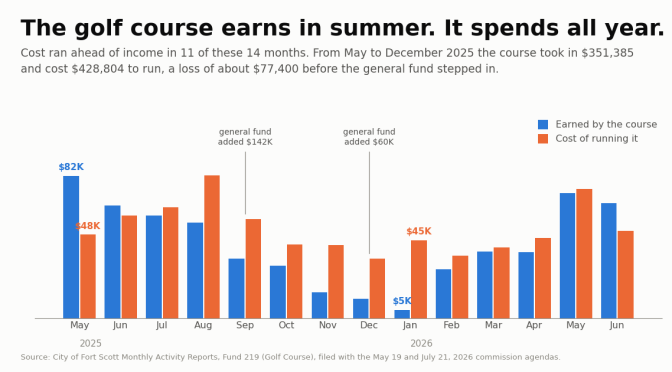
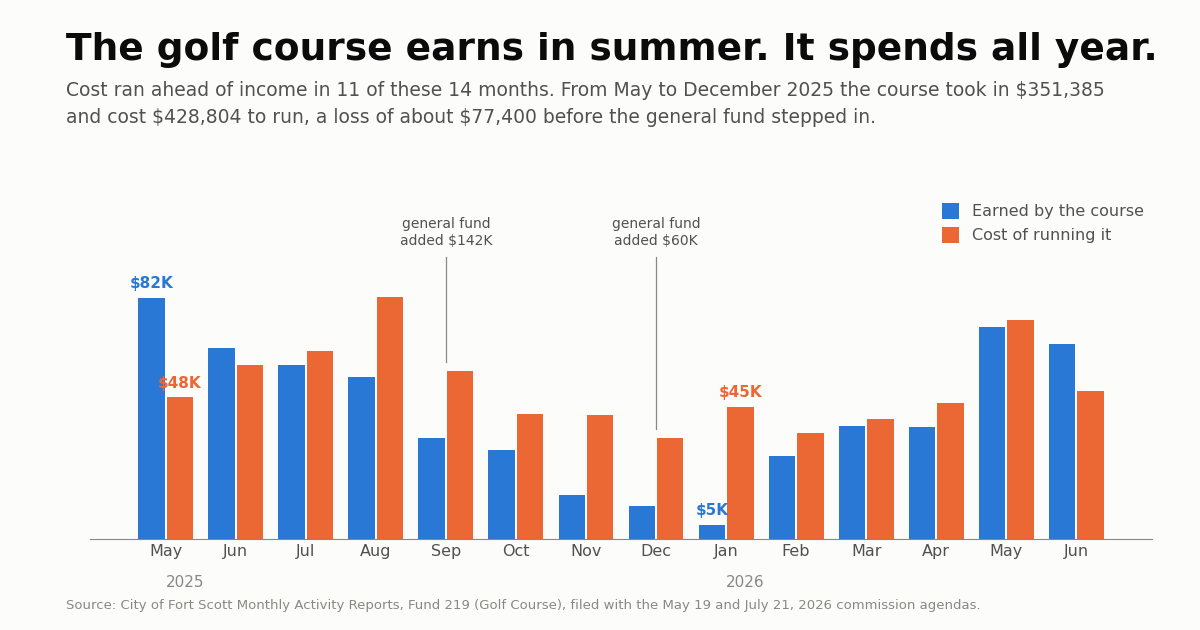
The city’s own monthly reports put numbers to it. Twice last year the general fund transferred money into the golf fund to cover its losses: $142,135.64 in September 2025 and $59,630.23 in December, $201,765.87 together. Strip those transfers out and Woodland Hills ran roughly $77,400 in the red over the eight months from May through December 2025. Through June 2026, the latest month the city has reported, the fund is down about another $44,100, with no transfer so far this year. June was its best month in a year, a $16,299 surplus.
In April, Hart told commissioners the general fund ran a deficit of roughly $987,000 in 2025, driven largely by about $476,000 in transfers out to the golf course, economic development, and parks and recreation. Of those three, the golf course took the most. Over the same eight months the city’s reports show $201,766 going to golf, $147,179 to economic development and $35,566 to recreation.
The gap between the bars is the loss. Cost ran ahead of income in 11 of these 14 months. Source: City of Fort Scott Monthly Activity Reports, Fund 219, filed with the May 19 and July 21, 2026 agendas.
How Fort Scott ended up owning a golf course
The city didn’t set out to be in the golf business.
When Dave Martin became city manager in 2010, people started telling him the city should buy the course before it fell apart. Others told him to stay well clear of it. The owners could no longer keep it up, and nobody else stepped forward.
Martin’s answer was to put it to the town: if residents thought the city should own it, residents should help pay for it. They did. The community raised about $350,000 toward buying and fixing up the course.
“This is what a community can do when they set their sights to work together to make something nice and better in Fort Scott,” Martin said in 2016.
The years that followed brought steady investment. The city hired PGA professional Shannon O’Neil as clubhouse manager and a superintendent, Jon Kindlesparger, to rebuild grounds Martin admitted were “in disrepair.” A new clubhouse opened in February 2016. A $65,000 cart barn went up in 2018, again paid for largely by donations. In 2019 the city’s community development director, Robert Uhler, told a chamber coffee that a bestthingsks.com list had put Woodland Hills among the top ten public golf courses in Kansas.
The course became more than a place to golf. Fort Scott High School, Uniontown High School and Fort Scott Community College teams all played there, and in FSCC’s first year with a golf program two players qualified for nationals. By 2018 the course carried 127 memberships, hosted 25 tournaments a year and logged 9,100 rounds. In 2024 the clubhouse was renamed “The Clubhouse” by public vote, got new carts and furniture, and the city floated a Fort Scott-themed miniature golf course to pull families in.
So does it make money?
Two of the city’s own officials say they had heard for years that it did. That assumption is exactly what the city set out to test, by pulling the course out of the general fund and into a fund of its own, so its revenue and costs could be seen on their own.
Mayor Kathryn Salsbury told the July 27 work session she wants it kept that way. She said she had always heard the “golf course is the only place where we make money. And then we pulled out and found out that’s not true. So I’d kind of like to keep watching it.” (watch)
City Manager Brad Matkin backed her up, saying the old claim never had evidence behind it: “when I first started, it was like we made money. And that was a statement. You didn’t have any, there’s no proof to that.” (watch) Breaking it out, he said, was the only way to find out: “because other than that, you’re just saying things.”
Commissioner Julie Buchta raised a complication worth remembering: when the course did appear to turn a profit, it may have been because maintenance was being deferred. “Didn’t we show a profit, but it’s because basically they were cutting all the fertilizer and everything out?” (watch) A golf course that stops buying fertilizer looks cheaper for a season and worse for years, which is roughly the condition the city bought it in.
The shape of the problem
The chart above shows why this is hard to fix. Woodland Hills earns real money, about $351,000 from May to December 2025, but it earns almost all of it in five months: May alone brought in $82,000 and January brought in $4,748. The cost of running the course does not follow that curve. It ran between $34,000 and $82,000 every single month, summer and winter alike, and over those same eight months the city’s own reports put the cost of running the course at $428,804 against $351,385 of income. The fund’s expense lines run from salaries, health insurance and KPERS through electricity, equipment and irrigation maintenance to fertilizer, chemicals, sand and gravel. The 2026 budget had to add money for fertilizer and chemicals as prices rose.
The city has kept putting money in, and has looked for more out. In February commissioners raised what tournaments pay. Groups booking an event are charged per player, and the city caps what any single event pays for the day: the per-player fee went from $30 to $35, and the cap on one day’s tournament from $4,500 to $7,000. Those terms sit on the city’s golf event application rather than the published green-fee rates, so most golfers never see them; the change falls on the large charity and fundraiser tournaments the course hosts; as of 2018 it held about 25 a year. On July 21 they took $31,000 out of general fund reserves for a used 2021 Ventrac mower, after the 2012 machine failed and its parts were discontinued.
And the 2027 budget now in front of the commission sets aside nothing to cover golf course losses — only the annual golf cart lease. “There’s nothing budgeted here to transfer over for any kind of losses in the golf course,” Hart said. (watch)
Which leaves an unanswered question on the table as budget hearings approach: if the course again spends more than it takes in during 2027, where does that money come from? Hart said he and a Baker Tilly colleague would start producing a running profit-and-loss statement for the course so commissioners can follow it line by line.
The next budget work session is August 18. The public hearing and adoption are set for September 15.
Reporting from the city’s published recordings of its July 21 and July 27, 2026 commission meetings, the 2027 budget presentation filed with the July 27 agenda, the city’s Monthly Activity Reports for Fund 219 filed with the May 19 and July 21, 2026 agendas, and fortscott.biz coverage from 2016 to 2024.
I’m Josh Jones, and you’ll always know what your commission is doing.
I’m Josh Jones, a lifelong resident and small-business owner, and I’m running for Bourbon County Commissioner, District 3.
One of the reasons I got involved in the first place is that I wanted to fight for transparency and public trust in our local government. You deserve to see exactly what your government is up to. Back before our local meetings were routinely posted online, I showed up with my own phone and recorded them myself, so citizens could watch the work for themselves. It made some officials uncomfortable — and that’s the point. Putting government on the record keeps everyone honest, including the people in office.
Here’s how I’ve always worked, and how I’ll work for you:
On the record — meetings on video, so anyone can see exactly what happened
Reachable — I answer questions on social media and meet folks face-to-face at the car lot; I don’t hide from the people I serve
Town halls — a real place to be heard, so the regular meetings stay productive
And here’s the thing I never want anyone in office to forget: this is your county, and those elected officials work for you — not the other way around. If you ever feel like no one’s listening, don’t give up. Make a phone call, write a letter, come to a meeting. Your voice is the whole point.
Vote Josh Jones — Bourbon County Commissioner, District 3. On the record. Within reach.
Paid for by Joshua Jones for County Commissioner, Josh Jones, Treasurer.
Tara Soloman-Smith, Family and Wellness Agent, Sunflower District of Kansas State University’s Extension Office. Submitted photo.
Don’t Get Fooled: Spot Scams Before They Cost You
Scams are more common than ever. Scammers use emails, text messages, social media, phone calls, and fake websites to trick people into giving away money or personal information. Many pretend to be someone you trust, such as a bank, business, government agency, or even a family member.
There are several warning signs that a message may be a scam. Be cautious if you receive an unexpected email, text, or phone call asking for personal information or money. Scammers often create a sense of urgency, claiming you must act immediately to avoid a problem. Requests for payment through gift cards, wire transfers, cryptocurrency, or payment apps are also major red flags.
One of the most common scams is phishing. In a phishing scam, criminals send emails or text messages that appear to be from a trusted company. The message may ask you to click a link, update account information, or verify a password. These links often lead to fake websites designed to steal personal information. Misspelled words, generic greetings, outdated logos, and unexpected requests for sensitive information can all be signs of phishing.
To protect yourself, never click on links or download attachments from unexpected emails or text messages. Instead, visit the company’s official website or call the organization directly using a verified phone number. Use strong passwords that are different for each account, and turn on two-factor authentication whenever possible. Regularly checking bank statements, credit reports, and online accounts can also help you spot problems early.
If you think you have been targeted by a scam, contact your bank or financial institution right away. You should also report the scam to the Federal Trade Commission at ReportFraud.ftc.gov and the FBI’s Internet Crime Complaint Center at IC3.gov. Acting quickly may help reduce financial losses and prevent others from becoming victims.
Information for this article came from the Office of the Comptroller of the Currency (occ.gov). For more information, contact Tara Solomon-Smith, Family & Community Wellness Agent, at 620-244-3826 or [email protected].
Preparing for Preserving: Check Your Equipment and Use Safe Recipes
As gardens begin producing and farmers markets fill with fresh produce, many southeast Kansans are preparing for another food preservation season. Before canning begins, it’s important to take a few steps to make sure equipment is safe and working properly.
One of the most important checks involves pressure canners. The Southwind Extension District offices in Erie, Yates Center, Iola, and Fort Scott offer free pressure canner gauge testing. The process can help ensure home-canned foods are processed safely. Contact your local office to arrange to leave your pressure canner lid or make an appointment for it to be checked while you wait.
Pressure canning is required for low-acid foods such as vegetables, meats, and soups. An accurate gauge is critical because improper processing can allow the growth of harmful bacteria, including Clostridium botulinum, which causes botulism—a serious and potentially deadly foodborne illness.
Pressure canners use either a dial gauge or a weighted gauge. Weighted-gauge canners do not require testing. However, dial gauges should be tested annually for accuracy. Southwind Extension offices use the Presto Testing Unit from National Presto Industries and can test gauges from National, Presto, Maid of Honor, and Magic Seal pressure canners.
According to the USDA Complete Guide to Home Canning, consumer gauges that test two or more pounds above or below the master gauge should be replaced. A gauge that reads incorrectly can result in food being under-processed and unsafe to eat. Until a replacement gauge is obtained, adjustments can be made to reach the correct pressure. For example, if a recipe calls for 11 pounds of pressure and the gauge reads one pound high, the canner should be operated at 12 pounds of pressure.
In addition to accurate gauges, those who use canners should carefully evaluate the condition of any pressure canner they plan to use. While older canners are often available at garage sales and auctions, replacement parts for some discontinued models may be difficult—or impossible—to find.
When purchasing or inspecting a used pressure canner, consider the following:
Is the gauge attached and in good condition?
Is the petcock safety valve complete and functioning?
Are the threads on the opening undamaged?
Does the canner require a gasket, and is it in good shape?
Is the canner perfectly round, with no bulges or distortion?
Is the bottom flat and level? Canners with recessed or rounded bottoms should not be used.
On wing-screw models, are all screws and matching lid slots in good condition?
Many replacement parts, such as gaskets, handles, and knobs, can still be purchased through manufacturers and hardware stores. Although replacement parts may not look exactly like the originals, they often serve the same purpose and can safely extend the life of the canner.
Safe equipment is only one part of successful home food preservation. Using a current, research-tested recipe is equally important. While many families treasure canning recipes passed down through generations, some older recipes may not meet today’s food safety recommendations. Changes in research have led to updated guidelines for acidity levels, processing methods, and processing times.
For the safest results, always use research-based recipes from trusted sources, including:
USDA Complete Guide to Home Canning
So Easy to Preserve from the University of Georgia Extension
Kansas State University Food Preservation resources
Other university Extension publications and research-based sources
By using a well-maintained pressure canner, having an accurate gauge, and following up-to-date, tested recipes, home canners can confidently preserve food that is safe, nutritious, and enjoyable for their families throughout the year.
For more information about food safety and nutrition programs, contact Sandy Haggard, Nutrition, Food Safety, and Health Agent, Southwind District, at [email protected] or 620-365-2242.