The Bourbon County Sheriff’s Office daily reports can best be viewed on a computer.
Click here, then click on the image to enlarge:
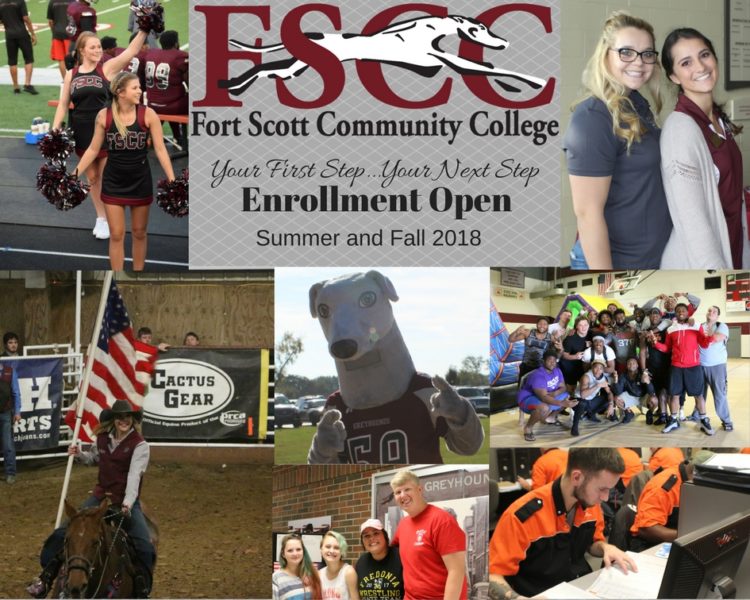
Now is the time to take hold of your future!
Enrollment at Fort Scott Community College is now open for summer and fall 2018. FSCC will be there with you to help your future begin now. Pursue an associate degree or certificate at Fort Scott Community College. For more information visit fortscott.edu or call 620-223-2700.
The Kansas Department of Transportation (KDOT) has begun a resurfacing project on U.S. 69 in Linn County. Work starts north of the U.S. 69/K-52 north junction and continues for six miles, ending south of the Linn-Miami county line.
Project activity includes milling at various locations; a 1-inch reflective crack interlayer (RCI) mix overlay on the driving lanes; and an overlay on exit and entrance ramps. Both north- and southbound traffic is reduced to one lane on the project. The speed limit is reduced to 60 miles an hour, with a driving lane width restriction of 12 feet. Weather permitting, the road work should be finished by late summer 2018.
KDOT awarded the $5.4 million construction contract to APAC Kansas Inc., Shears Division of Hutchinson. Troy Howard, a construction engineer at the KDOT Garnett office, reminds drivers to watch for the signs, slow down and “Give ‘Em a Brake!” at the work zone. Persons with questions may contact Howard at (785) 448-5446, or Priscilla Petersen, KDOT Southeast District public affairs manager, at (620) 902-6433.
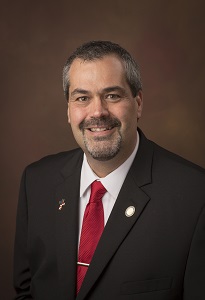
State senator Richard Hilderbrand 13th district
communications from the state capitol
March 30, 2018 ∙ Week Twelve
Quote of the Week:
”If we ever forget that we’re one nation under God, then we will be one nation gone under.”
– Ronald Reagan
HARD FACTS:
April is Financial Literacy Month. Check out Financial Literacy for Kansans (https://kslib.info/1163/Financial-Literacy) for a list of trustworthy resources put together by the State Library of Kansas and organized by age group. Available from the State Library, Learning Express Library (https://www.learningexpresshub.com/productengine/LELIndex.html#/learningexpresslibrary/libraryhome?AuthToken=895C9A93-31CF-45C5-814C-A0788C14776D) has added a new facet to their tutorials. The Student Success Skills Center helps high school and college students develop health money habits including managing debt and investing for life. To get to those tutorials, click on the LE link above, and then click on Skills for Success. Universal Class (https://statelibraryofks.universalclass.com/geo-login-ks.htm) offers online courses such as Personal Finance 101, Investing 101, and Retirement Planning. Select “Finance” under the Areas of Study tab. Both resources require easy registration and self-supplied password to allow you to resume your work. Questions: kslc@library.ks.gov or 785-296-3296.
FLOOR ACTION:
UNFAIR TRADE AND CONSUMER PROTECTION (HB 2580): House Bill 2580 eliminates consumer reporting agencies’ authority to charge certain fees related to consumer report security freezes. HB 2580 amends current law to allow a consumer to place a security freeze on the consumer’s consumer report by written request, sent by certified mail or regular mail, through a secure website if made available by a consumer reporting agency, or by telephone, if the consumer reporting agency does not have an available secure website. This bill passed the Senate 40-0.
REPEALING RESTRICTIONS FOR KPERS INVESTMENTS WITH COMPANIES IN SUDAN (HB 2444): House Bill 2444 repeals requirements of the Kansas Public Employees Retirement System (KPERS) Board regarding new investments and divestment of current investments in companies with business operations in Sudan. The bill would also repeal the associated indemnification for the KPERS Board and its employees, research firms, and investment management. This bill passed the Senate 38-2.(I voted against this bill. While the genocide of Darfur is not completely addressed by the country of Sudan, we shouldn’t be investing with them.)
RAINY DAY FUND (HB 2419): House Bill 2419 concerns transfers to and expenditures from the budget stabilization fund. HB 2419 outlines that the rainy-day fund would earmark any excess revenue or over-projected estimates to be split in half, with 50 percent to pay off debt to the PMIB loan and the other 50 percent to be stored in a rainy-day fund for when projected revenues are short of projections. Historically, the legislature spends available money rather than set aside money to meet the statutory requirement of a seven percent remaining balance. This bill failed the Senate 21-19. (I voted against this bill. While the state continues to delay funds from KDOT, defer payments to KPERS, and have other financial burdens, it isn’t good financial stewardship to put money in a rainy day fund over paying off our current debt.)
AMENDING THE UNIFORM ANATOMICAL GIFT ACT(HB 2472): House Bill 2472 amends the uniform anatomical gift act to give drivers license applicants’ authorization to be listed as an organ, eye, and tissue donor in the Kansas donor registry. HB 2472 would require the word “Donor” be placed on the front of the driver’s license or identification card of an individual who provides authorization on an application for a driver’s license or an identification card to be listed in the Registry. The gift would become effective upon the death of the donor. This bill passed the Senate 40-0.
HEALTH OCCUPATIONS CREDENTIALING FEE FUND (HB 2501): House Bill 2501 would create the Health Occupations Credentialing Fee Fund to be administered by the Secretary for Aging and Disability Services. Fees collected under provisions of the Adult Care Home Licensure Act, Dieticians Licensing Act, Operator Registration Act, and the act regulating speech-language pathologists and audiologists would be deposited into the fee fund instead of the State General Fund. This bill passed the Senate 39-1. ( I voted for this bill)
OMBUDSMAN LONG-TERM CARE PROGRAM (HB 2590): House Bill 2590 amends the state long-term care ombudsman program, activities, and access to certain records. This bill passed the Senate 40-0.
NUCLEAR ENERGY DEVELOPMENT AND RADIATION CONTROL ACT (S Sub HB 2600): Senate Substitute for House Bill 2600 provides for the assessment of fees by the Department of Health and Environment for noncontiguous sites where radioactive material is stored or used. S Sub HB 2600 also directs the Secretary of Health and Environment to study and investigate maternal deaths in Kansas. This bill passed the Senate 40-0.
WORKERS COMPENSATION DEATH BENEFITS (S Sub HB 2184): Senate Substitute for House Bill 2184 amends workers compensation death benefits. The act allows for an initial payment to be shared between the surviving spouse and the dependent children. This bill passed the Senate 35-5. (I voted for this bill)
INCREASED PENALTIES FOR FAKE POLICE CALLS (HB 2581): House Bill 2581 increases the criminal penalties for the crime of giving a false alarm in certain circumstances. The practice which is known as “swatting,” is when a person makes a call to the police with a false story of an ongoing crime in attempt to draw police officers to a particular address. Any false call for emergency help would be at least a misdemeanor, becoming a felony if the person uses a fake identity or electronically masks their identity. HB 2581 would make fake calls that result in death a felony comparable to second-degree murder. This bill passed the Senate 40-0.
HUNTING GUIDES AND OUTFITTER REGISTRATION (SB 301): Senate Bill 301 requires hunting guides and outfitters to register with the Department of Wildlife, Parks, and Tourism. This bill passed the Senate 31-9.( I voted against this bill. This bill will require any individual that is paid as a guide to register and pay a fee with the state.)
EXEMPTING DIVISION OF LEGISLATIVE POST AUDIT FROM PAYING MONUMENTAL BUILDING SURCHARGES (S Sub HB 2129): Senate Substitute for House Bill 2129 exempts the Division of Legislative Post Audit from paying any monumental building surcharge charged and collected by the Department of Administration or any other state agency that is levied against all state agency-leased square footage in Shawnee County. This bill would permit the Secretary of Administration to approve a new lease or renew or extend an existing lease without an energy audit being performed if the Secretary determines an energy audit is not economically feasible. This bill passed the Senate 33-7. (I voted against this bill. This would exclude the Division of Legislative Post Audit from the oversight of the legislative body)
INTEROPERABILITY ADVISORY COMMITTEE (Sub HB 2556): Substitute for House Bill 2556 establishes the state interoperability advisory committee. In 2007, the Statewide Interoperability Executive Committee was created by Executive Order to provide governance and guidance pertaining to the interoperability of public safety communications systems. The committee’s focus has been on radio frequency communications and data interoperability. HB 2556 would take the current statewide council and put it in statute. The bill would direct the committee to make recommendations to the Adjutant General’s Department (TAG). This bill passed the Senate 37-3. (I voted against this bill. This will add another function for our state government)
SPECIAL OLYMPICS, CHOOSE LIFE, WICHITA LICENSE PLATE (HB 2599): House Bill 2599 provides for the distinctive plates for Special Olympics, Choose Life, the Wichita city flag. The bill also authorizes special license plates for veterans of the Korean War, Operation Desert Storm, Operation Iraqi Freedom, and Operation Enduring Freedom. This bill passed the Senate 36-2.(I voted for this bill)
COMMERCIAL DRIVER’S LICENSE RENEWAL (HB 2511): House Bill 2511 would make commercial driver’s licenses renewable every five years. The bill would extend the period of time before expiration from four years to five years. This bill passed the Senate 40-0.
RENEWAL OF DRIVER’S LICESNES; VISION REQUIREMENT (HB 2606): specifies vision test requirements for qualifying applicants for electronic online driver’s license renewal. The bill would waive the requirement currently that a driver’s license examiner administer an eyesight exam prior to the electronic online renewal of a driver’s license only under certain conditions. An applicant for an online renewal must be at least 21 years old but less than 50 years old and confirm under penalty of law that their vision meets requirements currently in law of 20/40 or better in at least one eye as tested by the driver’s license examiner, or 20/60 or better in at least one eye submitted in a vision report from an ophthalmologist or optometrist. The applicant must certify they have undergone an examination by a licensed ophthalmologist or a licensed optometrist within the previous year and must authorize the exchange of vision and medical information between the Division of Vehicles and the applicant’s ophthalmologist or optometrist. This bill passed the Senate 35-5.(I voted for this bill)
DESIGNATING SEDGWICK COUNTY AS URBAN AREA (HB 2597): House Bill 2597 designates Sedgwick County as an urban area, concerning nonprofit cemetery corporations in certain urban area counties. The designation would allow the Kansas Legislature to pass laws specific to those areas. Currently, Johnson, Wyandotte, Shawnee, and Greeley counties already have this designation. The designation only allows for a county to make a request for specific legislation. This bill passed the Senate 39-1.(I voted for this bill)
QUALIFICATIONS FOR LICENSING OF PROESSIONAL OCCUPATIONS (S Sub HB 2386): Senate Substitute for House Bill 2386 implements restrictions on requirements for licensing of professional occupations. S Sub HB 2386 would require any person, board, commission, or similar body that determines the qualifications of individuals for licensure, certification, or registration to revise their existing requirements to list the specific civil and criminal records that could disqualify an applicant from receiving a license, certification, or registration. The revision would occur within 180 days after the effective date of the bill. This bill passed the Senate 40-0.
NURSE LICENSURE COMPACT (HB 2496): House Bill 2496 creates the Nurse Licensure Compact and amend the Kansas Nurse Practice Act to enable the Board of Nursing to carry out the provisions of the Compact and establish the duties of registered nurses (RNs) and licensed practical nurses (LPNs) under the Compact. The Compact allows RNs and LPNs to have one multi-state license, with the privilege to practice in the home state of Kansas and in other Compact states physically, electronically, and/or telephonically. This bill Passed the Senate 40-0.
THE CHILD CARE CRIMINAL BACKGROUND AND FINGERPRINTING FUND (HB 2639): House Bill 2639 requires local and state law enforcement officers and agencies to assist the Secretary of Health and Environment in taking and processing fingerprints of persons residing, working, or regularly volunteering in a child care facility and to release all records of adult convictions and nonconvictions and adult convictions or adjudications of another state or country to the Kansas Department of Health and Environment. KDHE would be required to adopt rules and regulations on January 1, 2019 to fix a fee for fingerprinting such persons as required to reimburse KDHE for the cost of fingerprinting. The bill would create the Child Care Criminal Background and Fingerprinting Fund in the State Treasury to be administered by the Secretary. All fingerprinting fees collected would be deposited in the Fund for use in paying local and state law enforcement officers and agencies for the processing of fingerprints and criminal history background checks. This bill passed the Senate 36-4. (I voted for this bill)
APPROPRIATION REVISIONS (Sub SB 269): Substitute Senate Bill 269 creates appropriation revisions for FY 2018 and FY 2019 for various state agencies.
In FY 2018, Sub. SB 269 recommends expenditures of $16.3 billion, including $6.7 billion from the State General Fund. The recommendation is an all funds reduction of $3.0 million and a State General Fund increase of $1.6 million from the Governor’s Recommendation for FY 2018.
Some key components for the FY 2018 appropriation revisions:
For FY 2019, Sub. SB 269 recommends expenditures of $16.8 billion, including $6.8 billion from the State General Fund. The recommendation is a reduction of $79.2 million, including $80.7 million from the State General Fund, from the Governor’s Recommendation for FY 2019. The bill also reduces State General Fund revenue by $11.7 million for FY 2019.
Some key components of the FY 2019 appropriation revisions:
This bill passed the Senate 34-6. (I voted for this bill)
DEFENDANT’S COMPETENCY AND COMMITMENT FOR TREATMENT (HB 2549): House Bill 2549 creates judicial determinations of defendant’s competency and commitment for treatment. This bill passed the Senate 40-0.
LEGISLATIVE TASK FORCE ON DYSLEXIA (Sub HB 2602): Substitute House Bill 2602 establishes the Legislative Task Force on Dyslexia and Other Reading Comprehension Impairments (Task Force), which would advise and make recommendations to the Governor, Legislature, and the Kansas State Board of Education regarding matters concerning the use of evidence-based practices for students with dyslexia and other reading comprehension impairments. This bill passed the Senate 40-0.
RESCUING VULNERABLE PERSON OR ANIMAL FROM A VEHICLE (HB 2516): House Bill 2516 provides immunity from civil liability for damage to a motor vehicle for a person who enters the vehicle, by force or otherwise, to remove a vulnerable person or domestic animal if they are in imminent danger. This bill passed the Senate 40-0.
SCRAP METAL THEFT REDUCTION ACT (SB 429): Senate Bill 429 delays certain provisions of the Scrap Metal Theft Reduction Act until January 1, 2020. This bill passed the Senate 40-0.
QUALIFICATIONS FOR THE OFFICE OF SHERIFF (HB 2523): House Bill 2523 amends the statute setting forth the qualifications required of sheriffs. Specifically, the bill would narrow language disqualifying a person from holding the office of sheriff if the person has been convicted of a violation of any federal or state laws or city ordinances relating to gambling, liquor, or narcotics. The bill would disqualify only for a misdemeanor related to gambling, liquor, or narcotics within five years immediately proceeding election or appointment. HB 2523 would remove a specific 320-hour training requirement and clarify the training and testing required of sheriffs. This bill passed the Senate 40-0.
SCHOOL TRANSPORTATION FUNDING (SB 352): Senate Bill 352 requires transportation funding for school districts from the state general fund, not the state highway fund; making and concerning appropriations for the fiscal year ending June 30, 2019. This bill passed the Senate 40-0.
LOCAL OPTION BUDGET (SB 422): Senate Bill 422 requires a minimum local option budget and requires school boards to notify the state board of education of their intent to increase local option budget authority. Any resolution increasing a district’s local option budget adopted prior to July 1, 2017, that was not subsequently submitted to an approved by a majority of the district’s qualified electors, would expire June 30, 2018. Districts that desire to increase their local option budget authority for the next school year would submit written notice of such intent to the State Board of Education by March 1. This bill passed the Senate 40-0.
REFERENCES RELATED TO KDADS AND DCF (S Sub HB 2028): Senate Substitute for House Bill 2028 updates statutory references related to the Kansas Department for Aging and Disability Services and the Kansas Department for Children and Families in accordance with 2-12 Executive Reorganization Order No. 41. The bill would make conforming and technical amendments to law. This bill passed the Senate 40-0.
STATEWIDE BROADBAND EXPANSION PLANNING TASK FORCE (S Sub HB 2701): Senate Substitute for House Bill 2701 creates a broadband expansion planning task force. The purpose of this task force is to develop a group to evaluate and expand broadband throughout Kansas. This bill passed the Senate 40-0.
ALLOWING CRIMINAL CASES TO BE STAYED DURING STATE APPEAL OF WRIT OF HABEAS CORPUS (HB 2479): House Bill 2479 allows criminal cases to be stayed during state of appeal of writ of habeas corpus relief. HB 2479 creates procedures and limitations concerning contact with jurors following a criminal jury trial and clarifies grand jury proceedings. This bill passed the Senate 40-0.
COUNTERFEIT CURRENCY, MISTREATMENT LAWS, AND DEFINING LAW ENFOCEMENT OFFICER (HB 2458): House Bill 2458 defines counterfeiting currency as anything intended to defraud through forging currency. Another element of this bill combines the two laws into one that deal with mistreatment of a dependent adult and elder person. HB 2458 also amends the definition of law enforcement officer to include uniformed or properly identified while on duty. This bill passed the Senate 40-0.
GOLF CARTS ON CERTAIN STREETS AT NIGHT (HB 2486): House Bill 2486 allows golf carts to be driven on any public street or highway between sunset and sunrise if the golf cart has lights as required by law for motorcycles and has a properly mounted slow moving vehicle emblem. This bill passed the Senate 36-4.(I voted for this bill)
AMEND CERTAIN SALES TAXATION FOR MOTOR VEHICLES (SB 367): Senate Bill 367 amends current sales tax law that includes the value of a rebate from a manufacturer of a new vehicle to the potential buyer. Current law includes this amount to calculate sales tax liability. SB 367 requires the rebate to be paid directly to the retailer. This bill passed the Senate 38-0.
KANSAS RIGHT-TO-KNOW FEE FUND (HB 2577): House Bill 2577, as amended creates a maximum annual fee for the Right-To-Know Program that would only be used for the administration of the Program. Current law allows the fees to go into a general fund. The Program deals with hazardous substances. This bill passed the Senate 40-0.
CONTROL AND ERADICATION OF NOXIOUS WEEDS (HB 2583): House Bill 2583 clarifies definitions for terms related to noxious weeds. This legislation allows the Secretary of Agriculture to declare an emergency for noxious weeds that can be potentially harmful because of a natural disaster. This bill passed the Senate 36-4.(I voted against this bill. This bill would transfer oversight from the legislative body to KDHE.)
HIGH-PERFORMANCE INCENTIVE PROGRAM TAX CREDIT (SB 430): Senate Bill 430 extends 50 percent of the unused High-Performance Incentive Program tax credits beyond the current carryforward limit, from 16 years to 25 years, for those taxpayers who initially claimed a HPIP credit prior to January 1, 2018. In any tax year after the 16th year, the amount of tax credits used by a taxpayer would be limited to 10 percent of the reduced amount. Taxpayers would be required annually to certify under oath to the Secretary of Commerce that they continue to meet HPIP requirements. This bill passed the Senate 40-0.
QUALIFICATIONS FOR CANDIDATES SEEKING CERTAIN STATEWIDE OFFICES (HB 2539): House Bill 2539 would amend qualifications for certain state offices. This legislation would clarify require these positions to be a “qualified elector.” A qualified elector must be at least 30 years old when becoming a candidate for the office of the governor or lieutenant governor. Another provision is a candidate must be licensed to practice law in Kansas for the office of the attorney general.
The House’s original age requirement for the office of governor and lieutenant governor was 18 before the Senate changed it to 30. The final age requirement will be settled in conference. This bill passed the Senate 29-9. (I voted for this bill)
CORRUPT POLITICAL ADVERTISING (HB 2642): House Bill 2642 amends the “corrupt political advertising” statute. Currently, social media communication is exempt from the requirement to include “paid for” or “sponsored by” information if the limit of characters is 200. The amended bill increases that limit to 280 characters. This bill passed the Senate 40-0.
KANSAS ADOPTION AND RELINQUISMENT ACT (HB 2481): House Bill 2481 provides several provisions to the Kansas Adoption and Relinquishment Act. Senator Molly Baumgardner (R-Louisburg) placed an amendment on the bill which protects faith-based adoption agencies. This bill passed the Senate 28-12. (I voted in favor of this bill)
KANSAS PET ANIMAL ACT (HB 2477): House Bill would create several changes to the Kansas Pet Animal Act pertaining to licensure of those providing temporary care of dogs or cats, maximum license fees, notice of inspections, requested inspections, no-contact inspections, failed inspections, and license renewal dates. This bill passed the Senate 34-6.(I voted in favor of this bill)
INCOME TAX REFUND FOR CERTAIN NATIVE AMERICAN VETERANS (Sub HB 2147): Substitute House Bill 2147 would create a process by which certain Native American military veterans would be able to apply for a refund of state personal income taxes improperly withheld from such veteran’s federal military income in the amount of income taxes paid plus interest. This bill passed the Senate 40-0.
REMOVING ALCOHOL AS A SPECIAL FUEL (HB 2488): House Bill 2488 would remove the word “alcohol” from the definition of “special fuels” under the motor-fuel tax law. The bill clarifies how fuels are taxed. This bill passed the Senate 40-0.
SALES TAX AUTHORITY FOR THOMAS COUNTY (HB 2492): House Bill 2492 increases the maximum local sales tax rate that can be imposed by Thomas Country from 1.5 percent to 1.75 percent, provided all taxes levied in excess of 1.00 percent remain earmarked for financing a courthouse, jail, law enforcement center, or other county administrative facility. An election would be required for an increase in the current Thomas County sales tax, which is 1.5 percent. This bill passed the Senate 38-2. (I voted against this bill. This bill is not uniform, and would give a select few counties the ability to raise their sales tax)
STATE FAIR CAPITAL IMPROVEMENTS FUND (SB 415): Senate Bill 415 creates a diversion of state sales tax receipts so that collections by the Kansas State Fair and retailers on the fairgrounds would be deposited into the State Fair Capital Improvements Fund, effective July 1, 2018. Current law allocates 83.8 percent of collections go to the State General Fund and 16.2 percent go to the State Highway Fund. This bill would repeal an existing statutory transfer from the State General Fund to the State Fair Capital Improvements Fund. This bill passed the Senate 40-0.
NEXT WEEK:
MONDAY-
TUESDAY-
WEDNESDAY
THURSDAY
FRIDAY
Below are links to make it easy for constituents to follow the Kansas Legislature:
Website – www.kslegislature.org. It is great for looking up bills, calendars, journals, as well as, the roster in each Chamber.
YouTube of Legislature – http://bit.ly/2CZj9O0 Did you know the legislature is now streaming its proceedings? The YouTube page has an archive of the sessions thus far – including the State of the State and the State of the Judiciary.
Committee Streaming – http://sg001-harmony.sliq.net/00287/Harmony/en/View/Calendar/ The Kansas Legislature is also streaming committees, with every committee room equipped with audio streaming technology.
Thank You for Engaging
Thank you for all your calls, emails, and letters regarding your thoughts and concerns about happenings in Kansas. Constituent correspondence helps inform my decision-making process and is taken into great consideration when I cast my vote in the Kansas Senate. I hope you’ll continue to engage with me on the issues that matter most to you, your family, and our community. If you are on Twitter or Facebook, I encourage you to follow along with the #ksleg hashtag for real-time updates on legislative happenings in Topeka.
Please know that I am fully committed to addressing the current issues in our state, and I am proud to be your voice in the Kansas Senate.
Agenda
Bourbon County Commission Room
2nd Floor, County Courthouse
210 S. National Avenue
Fort Scott, KS 66701
Date: April 4th, 2018
1st District-Lynne Oharah Minutes: Approved: _______________
2nd District-Jeff Fischer Corrected: _______________
3rd District-Nick Ruhl Adjourned at: _______________
County Clerk-Kendell Mason
11:00-12:00-Commissioners will be attending the Department Head Meeting
Justifications for Executive Session:
· Personnel matters of individual non-elected personnel
· Consultation with an attorney for the body or agency which would be deemed privileged in the attorney-client relationship
· Matters relating to employer-employee negotiations whether or not in consultation with the representative(s) of the body or agency
· Confidential data relating to financial affairs or trade secrets of corporations, partnerships, trusts and individual proprietorships
· Preliminary discussions relating to the acquisition of real property


Jeannie Kay Speer, age 46, a resident of Ft. Scott, Kansas, passed away Monday, April 2, 2018, at the Mercy Hospital Emergency Room in Ft. Scott.
She was born August 5, 1971, in Ft. Scott, the daughter of Harley Anderson and Rhonda Mitchell Anderson. She married Johnny Speer, Jr on September 7, 1995, at Ft. Scott. Jeannie was a devoted wife and mother who loved her family dearly.
Survivors include her husband, Johnny, of the home and two sons, Ryan Speer and Dustin Speer, both of Ft. Scott. Also surviving is her mother, Rhonda Anderson, of Ft. Scott; a brother, James Anderson and Eva, of Ft. Scott and a sister, Tracy Anderson, of Yates Center, Kansas; her grandfather, Troy Mitchell of Pleasanton, Kansas and several nieces and nephews and great-nieces and great-nephews as well as her in-laws, John and Pam Speer, of Redfield, Kansas and Jonathan Field, of Ft. Scott.
She was preceded in death by her father, Harley Anderson; nephew, William Pulliam; great-nephew, Andrew Aerts and her mother-in-law, Judy Field.
Rev. Mark Demas will conduct funeral services at 11:30 A.M. Thursday, April 5th at the Cheney Witt Chapel.
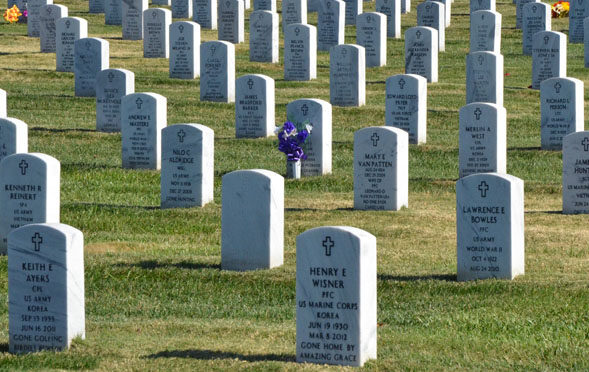
Burial will follow in the U. S. National Cemetery.
The family will receive friends from 6:00 to 7:00 pm Wednesday at the Cheney Witt Chapel. Memorials are suggested to the Jeannie Speer Memorial Fund and may be left in the care of the Cheney Witt Chapel, 201 S. Main, Ft. Scott, KS 66701. Words of remembrance may be submitted to the online guestbook at cheneywitt.com.
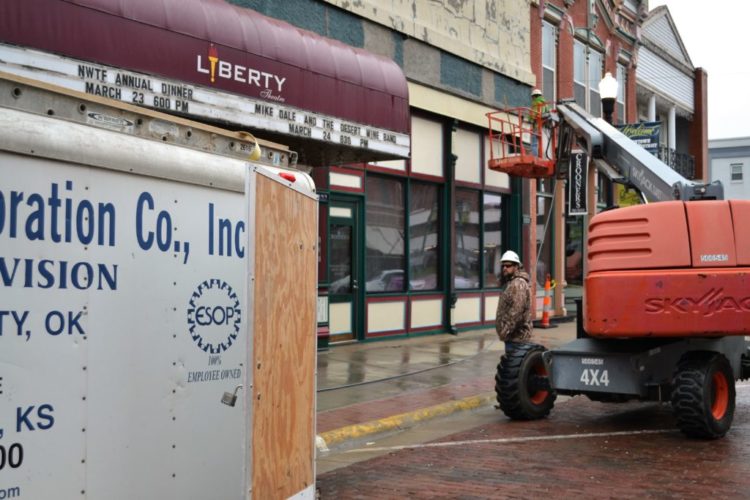
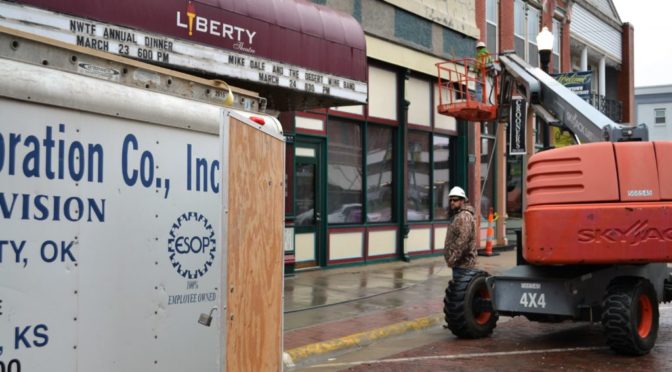
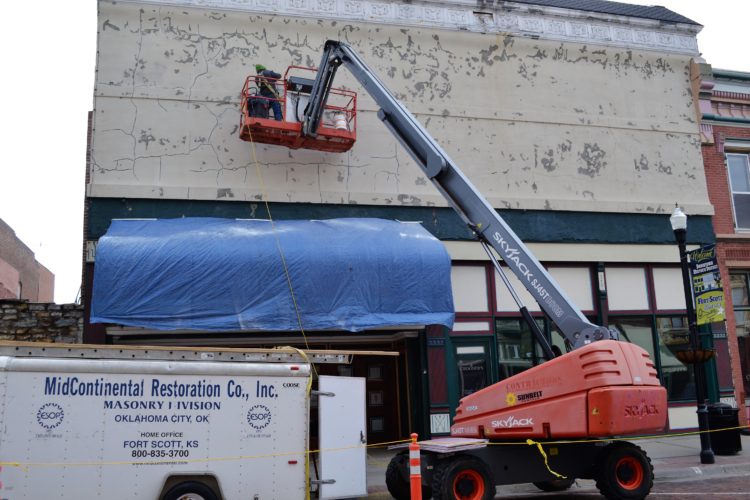
MidContinental Restoration Co, Inc. workers on Tuesday morning prep the face of the Liberty Theater, 113 S. Main, for painting.
Foreman Ronnie Coulter, Bronson, is pictured on the ground while Foreman Jonas Greenway, Bronson is on the SkyJack which lifts him to do the work.
Coulter said they have replaced plaster and wood, re-anchored plastered details and then will paint this week if weather permits.
Liberty Theater Owner Jared Leek said he is giving the theater a facelift in preparation for the event season fast approaching.
Weddings and other special events are a part of the services the theater provides.
The Southpaw Preachers will perform next Saturday, April 14 from 8:30 to 11:30 p.m. at the Liberty, according to Liberty Theater’s Facebook page.
This band draws their inspiration from hard-hitting funk, soul, R&B, and rock. Southpaw blends both original music and covers.
Contact Jared Leek for more information by calling (620) 224-9787.
Leek also owns Crooner’s Lounge next door at 117 S. Main.
Crooner’s is open from 5 to 9 p.m. Wednesday through Saturday with happy hour from 5-6 p.m.
The Kansas 4-H organization experienced budget cuts in the last few years, according to officials, and began a process to keep the youth organization going and growing.
Kansas 4-H implemented a “4-H Program Fee” effective October 2017. This is new since the 4-H organization has traditionally been free for participants.
“Many states have already implemented this type of fee – including Missouri and Oklahoma,” Carla Nemecek, K-State Southwind District Director and Agent said.
The organization gathered input on how to stabilize funding and grow the 4-H program, according to Wade Weber, Kansas State University’s 4-H Youth Development Department Head and State Program Leader.
“We hosted discussions as well as conducted a survey to gain feedback on program impact within K-State Research and Extension,” Weber said. “A task force of eight extension agents was formed to review all information and develop recommendations on how to move forward.”
The task force worked to provide a means to ensure a steady funding stream to grow the 4-H program, Weber said.
The task force members were Candis Meerpohl from Shawnee County, Monica Thayer from the River Valley District, Michelle Beran from Midway District, Melinda Daily from the Sunflower District, Allen Baker from Wichita County, Nancy Honig from Stevens County, Jodi Besthorn from Sedgwick County
and Brian Swisher from the Wildcat District, according to links provided.
A recommendation from this task force was to implement an annual 4-H program fee of $15 per member, beginning October 2, 2017.
“Funds from the 4-H Program fee are placed in a restricted funds account available for use only by the Kansas 4-H Youth Development Department,” according to Weber.
“Funds generated will strengthen our program priorities of volunteer development, project support, and program enhancement,” Weber said.
“K-State Research and Extension had to face several budget cuts over the past couple of years, and this would seem to be an option to help fund Kansas 4-H on a State level.” Carla Nemecek, Southwind District director, and an agent said. ” The Southwind District will not receive any financial benefit, as 100 percent of the program fee is directed to the State 4-H Program.”
Southwind District encompasses Allen, Bourbon and Neosho Counties.
“Some counties were fortunate to have found donors who are offsetting the cost, but we do not know how long those donations will last,” Nemecek said.
“As a 4-H parent and Director for the Southwind District, I am sympathetic to those who are upset about the fee,” Nemecek said. “Kansas 4-H has always been free for anyone to join, so this is taking us down a path we have never been.”
A provision has been made for those for whom it would be a hardship to pay the $15 per child program fee, she said.
“There is a waiver process for those families or individuals who are not able to pay the fee,” Nemecek said.
Message from Weber on benefits for local 4-H programs:
In January Dr. John Floros, Kansas State’s College of Agriculture Dean presented highlights of 4-H Youth Development efforts in the last 12 months to a joint meeting of state senators and representatives.
Also in January, Dr. Floros, Dr. Greg Hadley, Associate Director of Extension and Applied Research and Weber conducted meetings with local leaders to tell of the progress made.
These findings are what they reported, according to Weber:
“Examples of National and State 4-H Funding Efforts Benefitting Local 4-H Programs:
• Kansas 4-H Foundation Expansion Grant – 2017 marked the conclusion of a five-year effort to expand 4-H youth and volunteer participation in 14 extension units. This effort resulted in an increase of 458 4-H volunteers. Evaluation data has been collected from the units and a framework for growing 4-H will be created based on the learning experiences of those involved and will be shared with local units for implementation.
• National 4-H Council Ag Innovators Experience– 2018 will feature 4-H teen leaders in the Cottonwood District reaching area youth with the “Monarchs on the Move Challenge.”
• National 4-H Council Youth Futures: College Within Reach Grant–The focus of this grant is on providing mentoring partnerships to underserved youth in Seward (2017) and Riley (2018) counties. Program results in reaching new audiences will be shared statewide for local unit implementation.
• National 4-H Council Science Matters Grant – Johnson County (2018) is currently collaborating with Bayer to inspire young people to become tomorrow’s science leaders. Program results will be shared statewide for local unit implementation.
Kansas 4-H Youth Development Program Fee Prioritization Survey
• When: Conducted October 19 – November 15, 2017 by the K-State Office of Planning and Analysis
• Who: 612 Respondents statewide: 67% were volunteers or parents
• What: Received input within the following program priorities:
1) Project support and enhancements (i.e. principles of engaged learning, communicate and connect learning opportunities, updating/refreshing existing project materials)
2) Volunteer Development (training materials and support for volunteers; tools for recruitment, growth, evaluation and accountability)
3) Program enhancements benefiting community clubs (including but not limited to updating and refreshing tools for use with youth and volunteer audiences)
4) Foundational Supports (accessibility to all Kansas youth, campus/community partnerships and improved marketing at statewide events, and promotional materials that can be used by local units)
Fast Enrollment Stats 2016-17
•74,837 Kansas 4-H Youth Impact: This includes all delivery modes and has had duplications removed.
• 17,796 4-H Community based Club Enrollment: This includes Cloverbuds (ages 5-6) who are enrolled through a Community Club.
Dean Floros and Dr. Hadley provided the ability for the 4-H Youth Development program to hire a statewide volunteer development specialist while facing increasing budget challenges. This act affirmed the strategic support from administration to assist the 4-H youth development program in growing and modernizing.
Starting on Feb. 5, Shane Potter, New Volunteer Specialist, is tasked with refining the volunteer development process to ensure safe learning environments for youth and grow local 4-H volunteer capacity beyond the 6,000 existing adult 4-H volunteers statewide.”
JOB OF THE DAY – FULL-TIME FACILITY MANAGER – ADVANTAGE METALS RECYCLING
Advantage Metals Recycling is seeking applicants for the position of FACILITY MANAGER. Qualifications include bachelor’s degree in a business discipline, along with a minimum of 2 years’ experience in a business environment required; OR 5 years’ operations, heavy industrial or manufacturing experience with demonstrated leadership ability and understanding of business. Job requirements include creating a “Safety First” culture in each facility, the ability to lead teams, and the ability to represent the organization in local community and political matters. Apply online today! http://ow.ly/G3Qu30jhcMv
This is a reminder that the Downtown Meet & Greet is TOMORROW, April 3rd from 8:30 to 9:30 am at Common Ground. Come join us for networking and to share ideas related to Downtown. Light refreshments will be served. And, of course, if you want to come a little early you may purchase the specialty drink of your choice. The quarterly event is sponsored by the Fort Scott Chamber of Commerce.
Agenda
Bourbon County Commission Room
2nd Floor, County Courthouse
210 S. National Avenue
Fort Scott, KS 66701
Tuesdays starting at 9:00
Date: April 3rd, 2018
1st District-Lynne Oharah Minutes: Approved: _______________
2nd District-Jeff Fischer Corrected: _______________
3rd District-Nick Ruhl Adjourned at: _______________
County Clerk-Kendell Mason
9:00-9:45-Jim Harris-Replacement of tractor and mower
Lawn mower for Elm Creek
9:15-Executive Session-Confidential data relating to financial affairs or trade secrets of a corporation
9:45-10:00-Tim Travis and Lynette Westhoff-Billiard-Hammer
10:15-10:20-Right away for private sign on County property
10:30-10:45-Microbrewery
11:00-Justin Meeks
11:15-Executive Session-Privileged in the attorney-client relationship
11:30-12:00-Landbank and publication of title insurance
12:00-1:00-Commissioners gone to lunch
1:00-1:30-Review of Neighborhood Revitalization program
School Board meetings and FSCC dates and times
1:30-2:00-Clint Anderson/Justin Meeks-Executive Session-Privileged in the attorney-client relationship
2:30-3:00- Review any and all handbook issues/Prep for meeting
Justifications for Executive Session:
Personnel matters of individual non-elected personnel
Consultation with an attorney for the body or agency which would be deemed privileged in the attorney-client relationship
Matters relating to employer-employee negotiations whether or not in consultation with the representative(s) of the body or agency
Confidential data relating to financial affairs or trade secrets of corporations, partnerships, trusts and individual proprietorships
Preliminary discussions relating to the acquisition of real property
Matters relating to the security of a public body or agency, public building or facility or the information system of a public body or agency, if the discussion of such matters at an open meeting would jeopardize the security of such public body, agency, building, facility or information system
Governor Jeff Colyer, M.D. Begins Accepting Nominations for Governor’s Community Service Award Recipients
TOPEKA, KS – Governor Jeff Colyer today announced the start of accepting nominations for the Governor’s Community Service Award. Gov. Colyer, in association with the Kansas Volunteer Commission, is recognizing the hard work and selfless service of Kansas high school students through this award. Starting today, teachers, counselors and administrators can nominate both a junior and senior from their school who have displayed a dedicated commitment to serving his or her community. One junior and one senior from each nominating school will be selected to receive this award. Last year, 55 students received the award from over 40 Kansas communities.
“We have so many exceptional students across our state who are doing a great deal to help in their community and striving to make a difference where they live,” said Governor Colyer, “This award delivers a powerful message to encourage other students to take action. I believe students who possess such dedication to giving back deserve our gratitude.”
“I applaud Governor Colyer’s commitment to recognizing Kansas students who are giving back to their communities,” said Kansas Commissioner of Education Dr. Randy Watson, “Teaching our students to be good citizens builds strong communities and is a critical piece of the Kansans Can vision for education. All of this contributes to what makes Kansas so great.”
“Civic engagement is about students sharing their skills and knowledge through actions that improve their communities,” said Board of Education member Jim McNiece, “This award is a great way to honor students who have chosen to do something with their time that can have a lasting impact on the world around them.”
In order to qualify for nomination for this award, students are required to volunteer their time to help those in need at a nonprofit, community organization, faith-based organization, business, school or national service program. The deadline for submitting nominations is April 30th.
Nominations can be submitted through the following link: https://goo.gl/forms/F5VklxKNJbvFF9Ql2