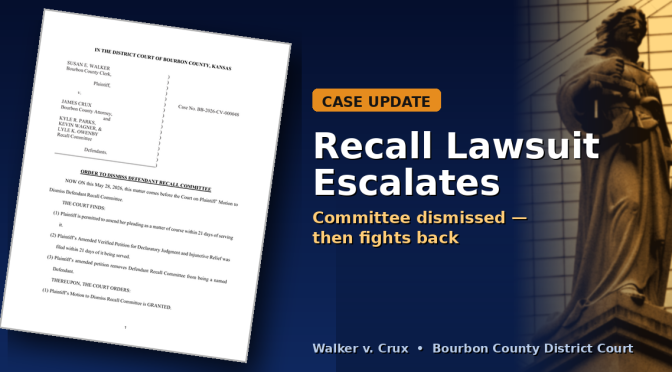
The petition Bourbon County Clerk Susan Walker filed to block the recall petition against her has seen a number of updates in the first week. When the case was filed on May 22, it named County Attorney James Crux and the three members of the recall committee as defendants (see: Bourbon County Clerk Files Lawsuit Seeking to Block Recall Petition). Since then, one recall committee member has hired a lawyer, Walker has narrowed her case, and the judge has already issued (and been asked to undo) an order. Read on for more details.
The biggest development is a motion filed by recall committee member Kevin Wagner under the Kansas Public Speech Protection Act (K.S.A. 60-5320), the state’s “anti-SLAPP” law. That law lets someone who is sued over protected speech or petition activity ask the court to throw the case out early. Filing the motion automatically freezes other motions in the case, and if the person who filed it prevails, the law can require the party who brought the lawsuit to pay their attorney fees.
In response, Walker amended her lawsuit to drop the three recall committee members (Kyle R. Parks, Kevin Wagner, and Lyle K. Owenby) and proceed only against County Attorney Crux. The judge granted Walker’s request to dismiss the committee members. Wagner then asked the court to reverse that dismissal saying he was not given the time to respond that the rules require. He claims that his anti-SLAPP claim (including the possibility of recovering attorney fees) does not disappear just because Walker dropped him as a defendant.
What happened May 26th to 29th
- May 26 — Walker filed an Amended Application for an Ex Parte Temporary Restraining Order, expanding her request for an immediate halt to signature-gathering.
- May 27 — Wagner, represented by Wichita attorney Patrick B. Hughes, entered the case and filed a Motion to Strike under K.S.A. 60-5320. He argues Walker’s suit targets his right to petition, speak, and associate in support of a recall, and notes that filing the motion triggers an automatic stay of other motions.
- May 28 — Walker filed an Amended Verified Petition naming only County Attorney Crux as a defendant, along with a Motion to Dismiss the Recall Committee members from the case. That amended petition still asks the court to declare the recall petition legally insufficient and to block any recall election based on it.
- May 29 (morning) — The Judge signed an Order dismissing the recall committee, finding that Walker was entitled to amend her petition and that the amended version removed the committee as defendants.
- May 29 (afternoon) — Wagner filed a Motion to Set Aside that Order, and an Objection to the dismissal. He argues that he didn’t have time to respond and that the automatic stay from his anti-SLAPP motion would prevent Walker from making the motion to dismiss the recall committee from the case.
Wagner’s filing may seem counterintuitive: he says he would not object to the entire case being dismissed, but he does object to the recall committee being removed while the case continues against Crux. His reasons, as stated in his motion:
- The court is being asked to decide whether the committee’s recall petition is valid. Wagner says the committee members have a direct interest in that question and a right to notice and a chance to be heard — which they lose if they are not parties.
- Under K.S.A. 60-219, he argues the committee members are necessary parties, and that ruling without them could leave County Attorney Crux exposed to conflicting obligations later.
- His anti-SLAPP claim — including the question of attorney fees and possible sanctions under K.S.A. 60-5320 — remains to be decided regardless of whether he is a named defendant.
As of now, the recall committee members have been dismissed from the lawsuit, but Wagner has asked the judge to reverse that. The case continues against County Attorney Crux. The central question raised in the original lawsuit — whether the recall petition meets the legal requirements to move forward — has not been decided. No hearing date had been set as of this writing.
Being named in a lawsuit is not a finding of wrongdoing, and the filings described here reflect each party’s arguments, not the court’s conclusions. FortScott.biz will continue to follow the case.