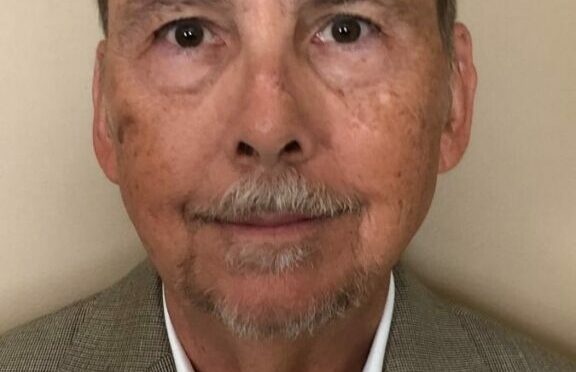
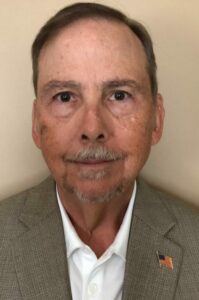
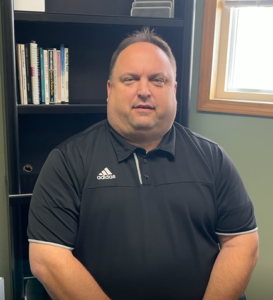
Local businessman Mark McCoy was asked by the City of Fort Scott to consider taking the interim city manager position.
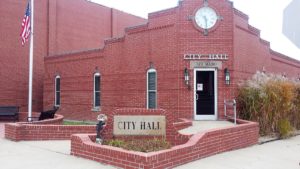
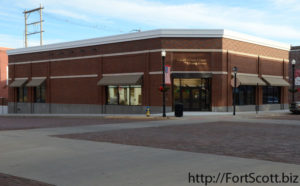
Fort Scott City Hall.
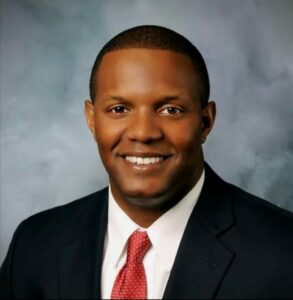
This following the sudden resignation of Jeremy Frazier in the city manager position, after just six months. Frazier tendered his resignation last week and signed a severance package with the city.
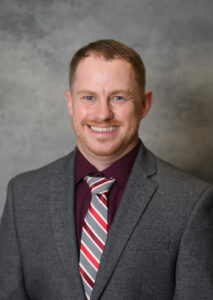
Jeremy Frazier. Submitted photo.
“City Attorney Bob Farmer is putting together a contract for an interim city manager position,” McCoy said. “It will be reviewed and then, if approved, a contract offered.”
The contract for Mark McCoy as interim city manager will be taken before the Fort Scott City Commission for approval at 6 p.m. this evening, City Attorney Bob Farmer said. “Mark has agreed to be our interim city manager as he is a long-time resident and wants to help keep the city moving forward until we have a full-time city manager.”
At a special city commission meeting on Aug. 5, Mark McCoy’s name was suggested for the interim city manager position, by Mayor Josh Jones.
“I have gotten to know Mark over the last year and thought he had a good balance between government knowledge as well as his business mind that could help us through the next 3-6 months until we can find a replacement,” Jones said.
“I am extremely excited about the opportunity, and want to help the community as best I can,” McCoy said. “There are lots of possibilities. I do hope to be a face for positive things. I hope it works out for all.”
McCoy has 46 years of business experience in the
McDonald’s Restaurant system, as a restaurant manager, area training manager, special project manager, supervisor of five restaurants, senior supervisor, business development consultant, regional food safety consultant, director of training, learning and development, and most recently was owner of four McDonald’s in Missouri and Kansas, retiring in 2019.
He has been involved in the local community in the following ways:
Fort Scott Chamber of Commerce past chairman, three times ;
past chairman Fort Scott Community College Trustees
Mercy Health Foundation Board Member for eight years;
past president Kiwanis and current member for 15 years;
SEK Multi-County Health Board Vice-chairman, Highway 69 Project member, member of the Knights of Columbus for 25 years.
There are several new instructors at Fort Scott Community College this year. This is part of a series to feature them.
Classes start on August 12.
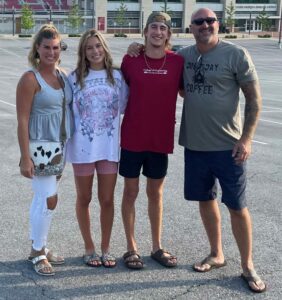
Sara Holder, left, and family. Submitted photo.
Sara Holder, 44, is a new Fort Scott Community College Nursing Instructor. She will teach at the Burke Street Campus.
She is a graduate of William Jewell College in 1999 and has emergency room, same-day surgery experience, and has worked as a school nurse.
Her hometown is Kansas City.
Holder has been married to Bret for 22 years and has two high school-age students: Jet, a senior, and Kate, a junior.
In her spare time, she loves to watch her children compete in sports.
” I also love to decorate,” she said. ” My family serves veterans and actively fights against human trafficking.”
She was inspired to be a nurse “by all the excellent nurses I have worked with over the years,” she said. “I want to teach nursing students to be like them.”
For Holder, the best part of teaching is encouraging students to become safe, compassionate, caring nurses, she said.
What is the greatest challenge for her?
“The transition from being an expert nurse at the bedside taking care of patients for over 22 years, to a brand new instructor in the classroom teaching nursing students,” she said.
Rachel Stauffer. Submitted photo.
Rachel Stauffer, 40, is the new biology, anatomy, and physiology instructor. Her office and classroom are in Bailey Hall.
She earned an associate of applied science in veterinary technology from Maple Woods Community College, a bachelor of science in animal science from Missouri State University, a master of science in education with an emphasis in biology from the University of Nebraska-Kearney, and a specialist in education in educational leadership from Arkansas State University.
“I have taught middle school and high school science for 12 years,” she said. ” Most recently I taught biology, dual credit biology, and anatomy/physiology at El Dorado Springs High School.”
Her hometown is Stockton, MO but currently resides in El Dorado Springs, MO.
“My husband Matthew and I own a small cow/calf operation outside of El Dorado Springs,” Stauffer said. “My daughter, Macy, is active in 4-H and FFA showing cattle and goats. My son, Marshal, is also active in 4-H and enjoys showing cattle and pigs.”
“Following my kids to their activities and helping with the farm, in addition to teaching, keeps me busy,” she said. In addition, she has served as a county extension council member, president of the local teachers association, and a 4-H leader.
She found she enjoyed educating people while working as a veterinary technician.
Several people inspired her to teach.
“I have been blessed to have some great teachers and mentors as I have grown as a teacher and person, Stauffer said. “I had a fantastic high school biology teacher that inspired me.”
The best part of teaching for her is connecting with students and helping create an interest in science, she said.
“I like to find things that apply to their everyday lives and help them to understand those concepts better,” Stauffer said.
The greatest challenge in teaching is the current pandemic.
“Right now the greatest challenge facing us all of the uncertainty with COVID, she said. “Plans often need to be re-evaluated and changed week by week as the situation unfolds. It is up to us to try to maintain a routine for the students and provide them with an excellent educational experience.”
Kim Boyer. Submitted photo.
Kimberly Boyer, 52, is a new Fort Scott Community College English Instructor.
She earned a masters of arts in English from Emporia State University; a bachelor’s in education, 7-12 grade language arts; and speech communication from Chadron State College, Chadron, NE.
She has I5 years of experience teaching high school English, speech, and drama, most recently at St. Patrick’s Jr./Sr. High School in North Platte, NE. She was also the play production director and speech coach there.
For the past three years, she was a full-time writing lab assistant at Mid-Plains Community College in North Platte, NE.
Her hometown is Stapleton, NE.
Her family includes her husband, Bud, ” Who is continuing to run our ranch and trucking business in Nebraska.” They have three daughters, Brianna, Jennifer, and Nikki.
Outside of her job she loves to garden, listen to audiobooks, and bake.
She has been a judge for speech and play production competitions in Nebraska for the past 15 years.
“I attended small one-room country schools for most of my elementary school years…and was inspired by those teachers and originally intended to teach elementary school,” she said. However, she became involved with speech and drama and decided to teach high school so she could coach these activities, settling on a language arts career.
When her daughters began taking dual credit and online college courses in high school, she decided to pursue a master’s degree and search for a job in higher education, she said.
The best part of teaching for Boyer is getting to know the students and watching them succeed in the classroom or extra-curricular activities, she said.
In a previous job, she was able to work with traditional, non-traditional, and international students in the writing lab, student success center, and library, Boyer said. “I loved being able to show all these students how to improve their writing and research skills. However, I am looking forward to the opportunity to have my own classroom again.”
The greatest challenge in teaching for Boyer is engaging students who are in the class because they have to take English, she said. “However, English courses are more than just learning how to write complete sentences or organizing an essay. It involves critical thinking, research skills, sharing of ideas, and learning how to communicate effectively in several modalities.”
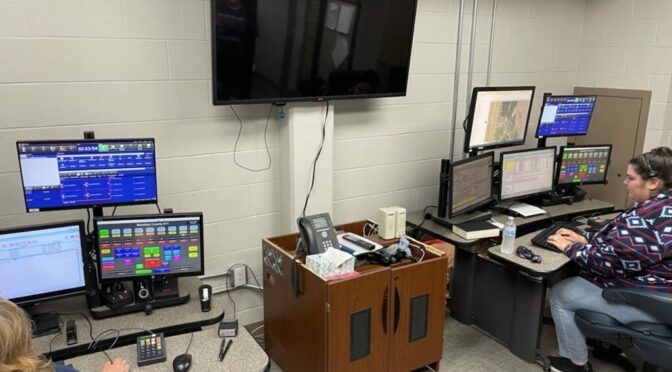
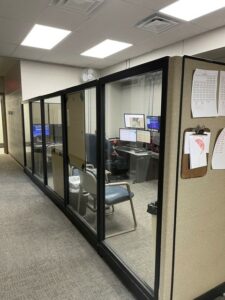
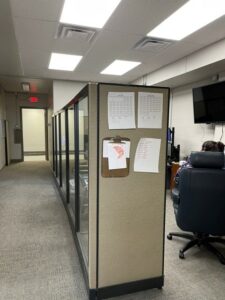
The Fort Scott/Bourbon County Dispatch office is now located in the old jail facility on 207 S. Judson. Submitted photos.
Those who answer emergency calls for the Bourbon County community have been moved to a more secure and bigger space from the Hawkins Public Safety facility at 1604 South National Avenue.
People and equipment in Fort Scott/Bourbon County Dispatch Department moved to 207 S. Judson, on June 22, 2021. The site is the former correctional facility adjacent to the Bourbon County Courthouse.
Parts of the old jail facility were remodeled into Fort Scott/Bourbon County Dispatch and opened on June 22, 2021. Submitted photo.
“We answer all incoming 911 emergency calls and dispatch the appropriate agencies such as police, deputies, fire, and Emergency Medical Services,” Traci Reed, communications manager, said. Reed has been in this position for ten years and in the dispatch department for 14 years.
“We also answer all calls that require calls for service for the community,” she said.
Why the move?
“Personal and structural safety has always been a concern for our dispatch facility,” Reed said. “The Hawkins building housed police, fire, and dispatch, and the shortage of room was an issue as well.”
“The public has access to the Hawkins Building and dispatch should not be physically accessible to the public due to safety reasons,” she said.
“Fortification of dispatch is very important due to bad weather or any other kind of disaster that may occur,” Reed said. “If any disaster would take place dispatch has to be able to continue communications with all agencies to ensure the safety for our citizens of the city and county.”
“The benefit (to the community) is that dispatch can and will continue to run efficiently and serve this community to the best of our ability to ensure safety for not only our citizens but also our First Responders,” she said.
Jobs
Currently, there are seven full-time employees with one part-time employee.
There is one full-time vacancy at this time, she said.
Qualifications for employment require passing a background check, being able to multi-task, have listening skills, and being able to handle stressful situations, Reed said.
To apply go to the City of Fort Scott Website at www.fscity.org to fill out an application.
Women’s Flag Football is coming to Fort Scott Community College.
“Flag football is an emerging sport which has gained popularity across the country in recent years,” Tom Havron, FSCC’s Athletic Director said. “Many NAIA (National Association of Intercollegiate Athletics) schools in the region have started the programs, and FSCC is proud to be one of the founding members at the NJCAA level.”
“Flag football will be a female sport, consisting of 15-20 team members,” he said. “We will have students at FSCC fall of 2022, but the inaugural season will be a spring sport starting in 2023.”
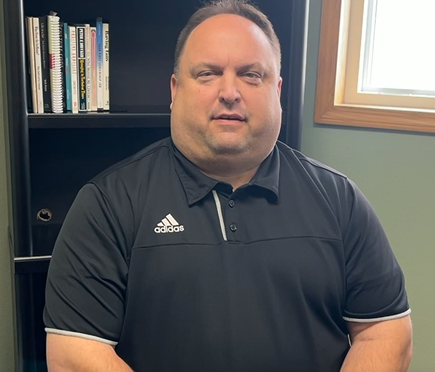
Tom Havron is the FSCC Athletic Director. Submitted photos.
“Women’s Flag Football has been a growing commodity across the nation and FSCC intends to provide an opportunity for these student-athletes to continue their passion for the sport while pursuing their education at the collegiate level.”
“Similar to the Fort Scott youth flag football program, the FSCC team will feature women who play the game at a high level,” he said.
“FSCC is currently recruiting students to start competition in the fall of 2022,” Havron said.
Flag football. Submitted photo.
“As flag football is an emerging sport, there are not many people who have much experience in the region,” Havron said. “We have communicated with the area NAIA schools who have started the program in the past few years and hope to learn and grow with them. FSCC was awarded a $10,000 grant from the NFL and NJCAA. Part of this will be used to seek professional development activities for our coaching staff. ”
“We will practice on the FSCC campus at the turf field, and hope to play our games at Frary Field as well as other regional institutions,” he said.
Brad Matkin, 51, is the new Fort Scott Director of Human Resources. His start day was August 2, 2021.
“I will be recruiting, interviewing, and onboarding new members,” Matkin said. “Working on member benefits, challenging our benefit resources to give us better opportunities/pricing, working with the department managers to provide management/leadership training, and being the ears for the city members, and several other things too numerous to list.”
Matkin’s office is at Fort Scott City Hall, 123 S. Main. The phone number of city hall is 223-0550.
Matkin believes a good human resource person is the backbone of a company/organization, working on policies, processes, and helping create a good working environment for the members, he said.
“With that, I just kept working getting my education and gaining the knowledge it would take to be successful in a position like this… Director of Human Resources for the City of Fort Scott.”
The best part of the career is working with the members of the entity, he said. “I really enjoy the interaction with them even if the situation is sometimes not a good one. I feel members need to be able to voice their opinion to someone that can be confidential but also someone that can possibly help.”
The COVID-19 Pandemic has created challenges in a human resource person’s job.
“Hiring and retaining members is everybody’s challenge currently but I feel the challenge is exciting,” Matkin said. “I feel getting the right mix of people that will create a good team environment plus treating them fair will make them happy to come to work. “Communication is key to retaining members, yes wages and benefits are important also, but if you can make members feel important and create a bond between the groups you will be much more successful. The old saying that members leave their boss not the job is very true.”
Matkin earned a master’s degree in business administration at Pittsburg State University with an emphasis in human resources. He has over twenty years in business management and four years in a human resource and recruiting role.
He is married ” to my wonderful wife of 28 years, Tammy” and they have three grown children and two grandsons, he said.
Outside of his career Matkin enjoys spending time with family and collects sports memorabilia. “I also like watching KC Chiefs football and KC Royals baseball,” he said.
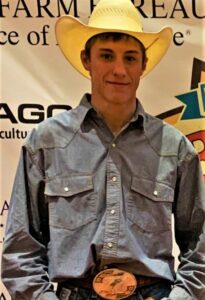
Bryce Eck, 17, comes from a family of bucking horse riders.
“My Dad (Andy) rode bucking horses when he was younger,” Eck said. “My older brother, Colt (19 years old) rides as well.”
All that practice, and talent, paid off for Bryce when he won the 2021 World Championship Junior Rodeo in the bareback riding event, this year held in Guthrie, OK from July 29-31.
“The top eight (contenders) make it back to finals on the third day,” Eck said. “The winner rides on Thursday, Friday, Saturday at noon then that evening.”
“You have to be under 19 years old to go to this rodeo, (and) you have to make it back each round with your score and how well you rode,” he said.
“A good ride is to have the horse bucking and the rider spurring the ride,” Eck said. “You have to stay on for eight seconds.”
At home on the Eck farm, Bryce pitches in.
During the interview yesterday, he was hauling hay for his dad on their cattle farm, near Redfield.
The hay will be for winter feed for the animals on the Eck farm.
“We raise cattle and we have a colt training business,” Eck said. “We train the horses to be ridden.”
Fort more information, call or send him a text (620) 215-5621
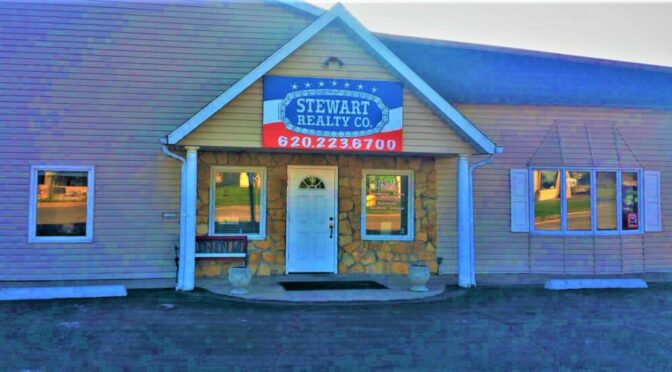
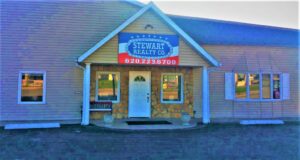
Stewart Realty Co., 1707 S. National Avenue. The photo is from its Facebook page.
In addition to horses, his family has a cow-calf operation south of Fort Scott.
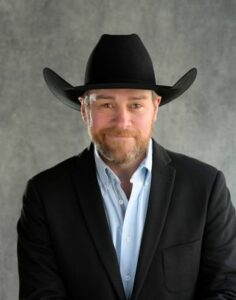
Hays and his wife, April, have two daughters, Isabel, 11 years old, and Dally, 4.
They like to attend rodeos together and Josh is a roper.
“I like roping when I can, I enjoy it,” he said.
Hays is a 1999 graduate of Fort Scott High School, a 2004 graduate of Pittsburg State University with a major in history, and graduated from farrier school in 2010.
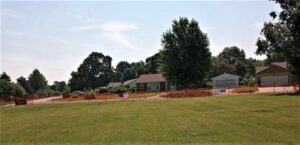
The site of the Burke Street Classic Wiffle Ball Tournament, July 30, 2021. Submitted photos.
Some area youth have organized a tournament in their neighborhood.
The Burke Street Wiffle Ball Classic 2021 starts at 2 p.m. today and is estimated to run until approximately 7:30 p.m., according to event organizer Dryden Cosens, age 17.
The event is located on Burke Street, adjacent to the Cosens’ home at 1320 Marblecrest Drive.
“It’s on a lot between Ralph Hall’s and Frank Halsey’s houses, our neighbors,” Cosens said.
A wiffle ball is a light perforated ball used in a type of baseball.
“The rules are watered down,” Cosens said. “It’s a fun thing to do in the backyard with family and friends.”
But today it is a tournament, that approximately nine teams will be competing in, with around 35-40 people.
The name of the league is Burke Street Wiffle Ball, he said.
“Anybody can come and watch,” Cosens said. “There are some shade trees, but bring your own lawn chairs.”
To aid players on this humid July day with temperatures expected to be near 100 degrees, Cosens and his brother Cal, will have popcicles and a tent set up, along with water.
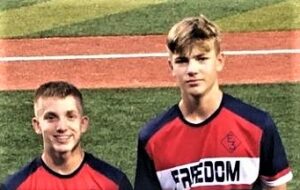
Cal and Dryden Cosens. Submitted photo.
The Cosen brothers have been playing wiffle ball since Dryden was in sixth-grade, he said. He is now 17, and Cal is 15.
“In 2015, we had our first tournament,” Dryden said. “We made a Youtube channel, but kind of gave it up when we got busy with playing baseball.”
A friend, Rocco Loffredo, came to Dryden, with the idea of restarting the tournament.
“I talked to Cal, and we decided it would be a good idea,” he said.
The Lowell Milken Center for Unsung Heroes is located a 1 S. Main, Fort Scott.
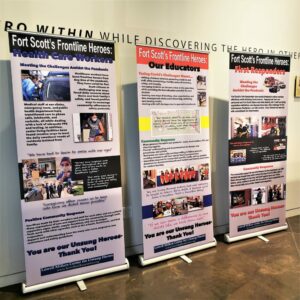
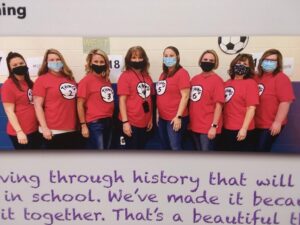
On July 28, the Lowell Milken Center for Unsung Heroes began a new exhibit entitled”Fort Scott’s Frontline Workers”, highlighting groups of local COVID-19 workers.
Hours at the center, located on Main Street at Wall Street in downtown Fort Scott are Monday through Friday from 10 a.m. to 5 p.m. and Saturdays from 10 a.m. to 4 p.m.
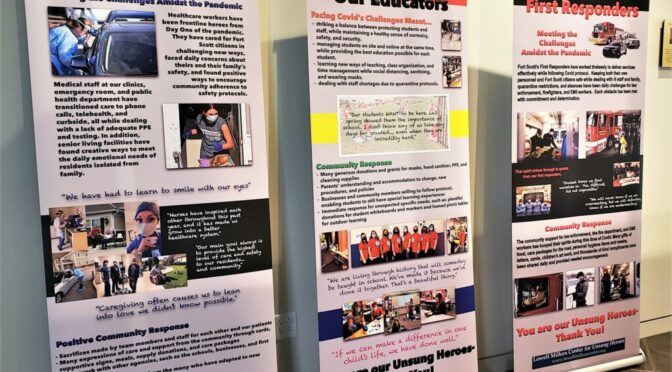
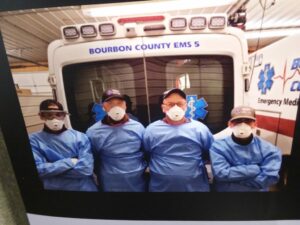
The exhibition is pictorial with text that honors first responders from four local agencies, health care workers from five local agencies, and educators in five local public and private schools.
Lowell Milken Center’s Frontline Workers Exhibit, July 2021. Submitted photo.
“Contacts were made to all the different agencies, we received input from several administrators and staff,” Cathy Werling, spokesperson for LMC said.
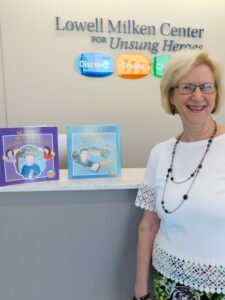
Cathy Werling is a children’s book author at the Lowell Milken Center For Unsung Heroes in Fort Scott, who has published several books depicting unsung heroes at a young child’s level of understanding.
This new exhibit has been made possible with funds received from a Fort Scott Area Community Foundation grant, according to an LMC press release.
“Work began on plans for the project in October of 2020 after we knew we received the Fort Scott Area Community Foundation grant,” Werling said. “Contacting and interviewing all of the various frontline worker’s staff began in January of 2021.”
“The Lowell Milken Center’s Fort Scott’s Frontline Heroes project highlights frontline professions within our community who have been directly dealing with pandemic issues in order to provide safe and direct action for our citizens,” according to the press release.
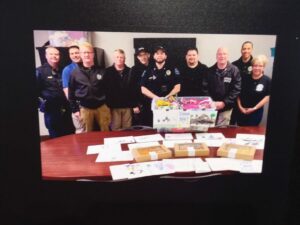
Law enforcement photo from the exhibit.
The following are recognized: firefighters, law enforcement officers, emergency medical services workers, health care workers from Community Health Center of Southeast Kansas, Ascension Via Christi Emergency Department, Southeast Kansas Multi-County Health Department, and long-term care facilities, assisted/independent living facilities, and local teachers/administrators at schools.
Educators. Photo from the exhibit.
“The LMC believes these groups of workers are truly Fort Scott’s unsung heroes, as they have given so much of themselves to our community’s citizens during the pandemic and continue to do so,” according to the press release. “We encourage all Fort Scott area citizens to support these heroes by viewing the new exhibits at the Lowell Milken Center, sharing words of gratitude and support in the LMC guest book and through the LMC’s social media pages on Facebook – www.facebook.com/LowellMilkenCenter, Twitter – https://twitter.com/LowellMilkenCtr, and Instagram – www.instagram.com/LowellMilkenCtr.”
Emergency Medical Services workers. Photo from the exhibit.
COVID-19 is having a resurgence nationwide that includes Bourbon County.
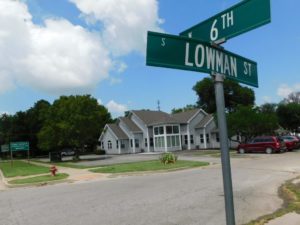
The Southeast Kansas Multi-County Health Department is located between 6th and Lowman Streets and 6th and Horton Streets.
“At this time, I would recommend that if Bourbon County residents vaccinated or unvaccinated cannot socially distance themselves from others in public settings, that they wear a mask,” said Rebecca Johnson, Southeast Kansas Multi-County Health Department Administrator said. “When I left work yesterday evening our active COVID-19 case count was up to 97.”
“This surge compares closest with the surge we had around Thanksgiving time last year,” she said.
“There have been breakthrough cases where fully vaccinated people have contracted COVID-19,” she said. “We have had several cases of the Delta variant, but according to KDHE’s last report, have not had any from the tests they’ve received, in the last three weeks.”
“The Delta variant is a highly contagious strain of the COVID-19 virus that has been detected in the states that surround us as well as many counties that surround Bourbon,” Johnson said.
“I also recommend getting vaccinated if you are able. Bourbon County has four COVID-19 providers: Bourbon County Health Department, Walmart, CHC-SEK, and Walgreens. Practice social distancing, use good hygiene, and stay home when sick!” she said.
Mondays are walk-in days, call for an appointment (620)223-4464.
CHC
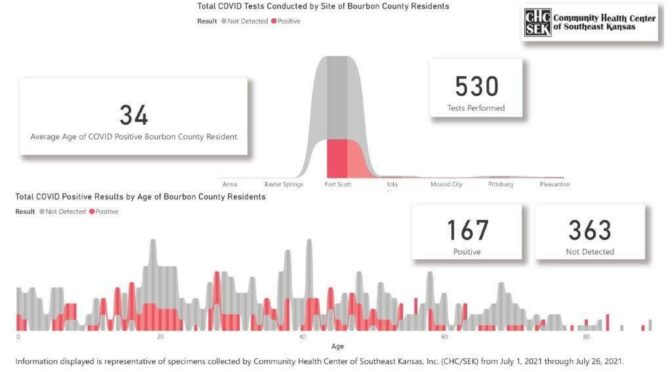
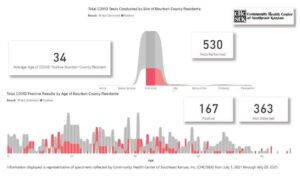
Bourbon County COVID statistics provided by CHC/SEK.
Since July 1, 2021, the Community Health Center of Southeast Kansas has tested 530 Bourbon County residents for COVID-19, Robert Poole, Communication and Marketing Director at CHC/SEK said.
“Of those, 167 tested positive for COVID-19,” he said. “The average age of a COVID-19 positive patient in Bourbon County, for the current month, is currently 34 years old.”
“These are CHC/SEK internal tracking numbers, and do not include the efforts and statistics of the Bourbon County Health Department, Via Christi ER, or other testers in Bourbon County,” Poole said.
According to information provided by CHC/SEK, if one tests positive for COVID-19, they should talk to their healthcare provider about monoclonal antibody treatment, which has been granted emergency use authorization from the U.S. Food and Drug Administration for patients with mild or moderate COVID-19, who are at high risk of developing severe symptoms. This treatment may reduce COVID-19 hospitalizations if given from 10 days from the onset of symptoms.
It is given by infusion at an infusion site with a provider’s order.
This treatment is for those who test positive for the disease, are 12 years and older, and within 10 days of onset of symptoms.
It is also for those over 65 years old, are obese/overweight based on CDC charts, pregnant, have chronic kidney disease, diabetes, immunosuppressive disease, chronic lung disease, Sickle Cell disease, neurodevelopmental disorders or have medical-related technology dependence: tracheostomy, gastrostomy, positive pressure ventilation, not related to COVID-19.
To get tested or get a vaccine contact CHC at 620-231-9873.
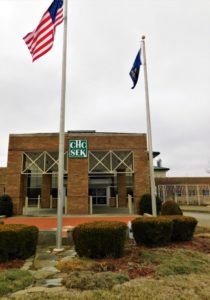
Community Health Center of Southeast Kansas, 401 Woodland Hills Blvd.
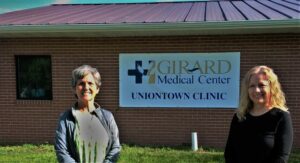
Girard Medical Center of Uniontown Clinic also has rapid testing of COVID-19 available and can schedule a vaccine as well. The clinic phone number is 620-756-4111.
Lori Reith, left, medical assistant, and Stephanie Hallacy, nurse practitioner, stand in front of the newly opened Girard Medical Center Uniontown Clinic.
CDC
The following is information taken from the Center of Disease Control website.
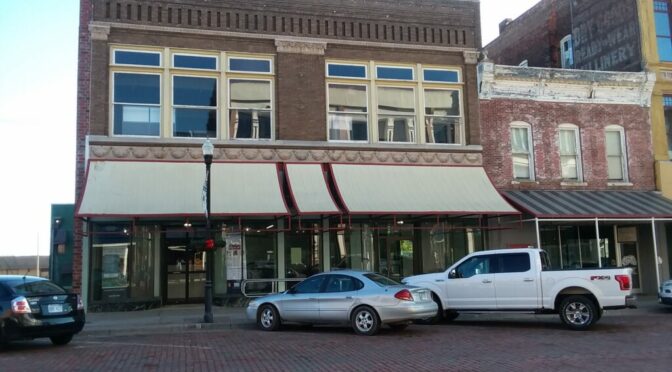
The Star Emporium Downtown General Store, 17 S. Main, January 2021.
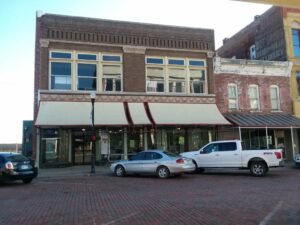
A remodeled downtown building is being sold on August 10 to the highest bidder.
“The Bourbon County Commission took the (Kress) building over… Tuesday, July 13, and on July 19, during a special meeting, the county approved to publicize the sale of the Kress building at 17 S. Main, through a sealed bidding process,” Commissioner Lynne Oharah said.
“At this time BAJA Investments is still the owner of the building,” said Bourbon County Economic Director Rob Harrington. “However they are working with the county at this time to find a new owner of the building.”
“It (the bidding process for the building)) will appear in the paper (The Fort Scott Tribune) three consecutive weeks with the bids being opened on August 10,” Oharah said. “Two scenarios are being advertised. The bids can be for the property and contents or bids can be for the property only.”
Those interested in the property at 17 S. Main should send sealed bids addressed to the Bourbon County Clerk, 210 S National, Fort Scott, KS, 66701 clearly marking the envelope, Oharah said.
The building housed the Star Emporium Downtown General Store from January to May 2021, which was owned by BAJA Investments.
BAJA Investments was granted funds from the Strengthening People and Revitalizing Kansas program for $450,000 for the project. SPARK grants were a part of the monies given to Kansas from the federal government to help with the ongoing effects of COVID-19, according to a prior interview.
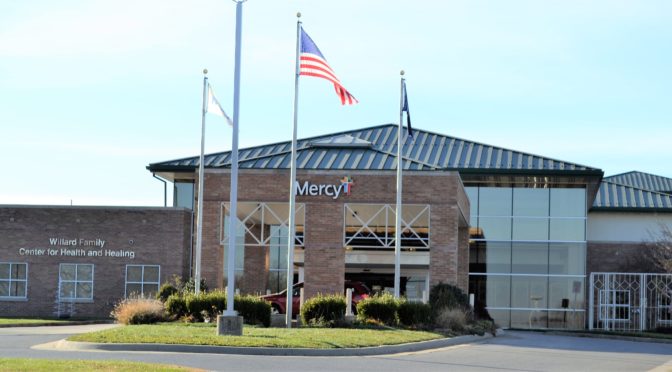
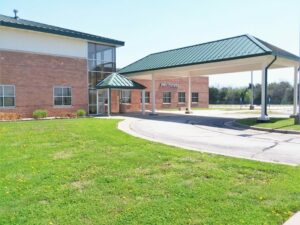
The west end of the former Mercy Hospital, located on South Horton Street at Jayhawk Road.
The Fort Scott City Commission and the Bourbon County Commission signed a contract last week to facilitate Noble Health Corp’s feasibility study of the former Mercy Hospital building.
Mercy Hospital closed its doors in December 2018, following declining patient numbers and shrinking reimbursement.
The building is located just off Hwy. 69 on Fort Scott’s south side at 401 Woodland Hills Blvd.
It currently houses the Community Health Center of Southeast Kansas clinic and the Via Christi Emergency Department. Their leases are ending in 2022.
Noble Health Corp., Kansas City, announced on June 25, 2021, that it will explore the possibility of reopening an acute care hospital facility in Fort Scott, Kansas.
The city will contribute $200,000, the county $800,000 towards the feasibility study, according to the contract. The local government entities will be using American Rescue Plan money from the federal government for the project, according to Bourbon County Commissioner Clifton Beth.
The feasibility study will investigate the condition of title to the development property, the physical condition of the property, the zoning, the economic feasibility, and all matters relevant to the acquisition, usage, operation, valuation, and marketability of the property and the project, as the developer deems appropriate
Should the project prove feasible, the county agrees to contribute at least $2,000,000 to finance certain costs and expenses related to and associated with the project, according to the contract.
The following is the agreement that the Fort Scott City Commission and the Bourbon County Commissioners signed with Access Medical Advisors LLC and Noble Health Corp. on July 21, 2021.