Bourbon County and four individuals have filed their formal response to former county IT director Shane Walker’s federal lawsuit, and the answer narrows what the case is actually about. On the basic sequence of events, the two sides now largely agree. What remains in dispute is why Shane Walker lost his county job — and whether the officials can be held legally responsible for it.
The defendants (the Board of County Commissioners plus Commissioners Sam Tran, Mika Milburn-Kee and David Beerbower, and contractor Dr. Steve Cohen) filed their answer June 23 in U.S. District Court for the District of Kansas (Document 13), represented by Andrew D. Holder of Fisher, Patterson, Sayler & Smith. They answered the complaint rather than moving to dismiss it, on a deadline the clerk had extended to that date. For the claims Shane Walker raised, see our earlier report: Federal Lawsuit Alleging Retaliation, Discrimination, and FMLA Violations.
Where the parties now agree
The answer admits key dates and events in the timeline Walker laid out, even as it denies the bulk of his broader allegations. The county admits that he worked for the county from about December 15, 2005 until he left the payroll on or around July 9, 2025; that the commission’s vote to eliminate his position was unanimous and that the county outsourced the IT department; and that the elected Register of Deeds rehired him around November 17, 2025. It admits that Walker is married to Susan Walker, the current County Clerk and former CFO, and that he filed discrimination complaints with the Kansas Human Rights Commission in September 2024 and September 2025. It also admits the episode in which Commissioner Milburn-Kee asked for passwords, Walker and a coworker refused, and the coworker called police and was later fired.
Where they diverge
The agreement stops at motive. Walker’s complaint casts the elimination of his job as retaliation for those discrimination complaints and for taking medical leave. The county’s answer reframes the same event as a layoff. The county repeatedly “denies that Plaintiff was ‘terminated,’” admitting only that he was “laid off,” and it states that any action it took “was not retaliatory, and would have occurred based on legitimate, lawful, and independent reasons regardless of Plaintiff’s protected conduct, if any.” The county also denies Walker’s allegations about how he was treated after he was rehired.
The word choice carries legal weight. Walker pairs the retaliation claims with a breach-of-contract count and a Kansas Wage Payment Act claim; by calling the move a layoff and arguing it “substantially performed” and later “modified” his employment agreement, the county contests whether any contract was broken or wages withheld.
Beyond the facts, the county’s answer also raises legal defenses that, if accepted, could dispose of parts of the case before a jury weighs the question of motive. The individual defendants assert qualified immunity against the federal civil-rights (Section 1983) claims. The county claims governmental immunity under the Kansas Tort Claims Act. And the answer asserts that punitive damages cannot be recovered against a municipality. On Shane Walker’s free-speech claims, the county invokes Garcetti v. Ceballos, arguing his speech was made as part of his official duties and is therefore not protected. In all, the answer lists 23 defenses and asks that the defendants be dismissed from the case.
Walker, represented by Wichita attorney Gaye B. Tibbets, has demanded a jury trial. The case is Walker v. Board of County Commissioners of Bourbon County, Kansas, et al., No. 6:26-cv-01057, before U.S. District Judge Daniel D. Crabtree. An answer is one side’s response; the complaint’s allegations and the county’s denials and defenses have not been tested in court. The county’s full answer is posted here.
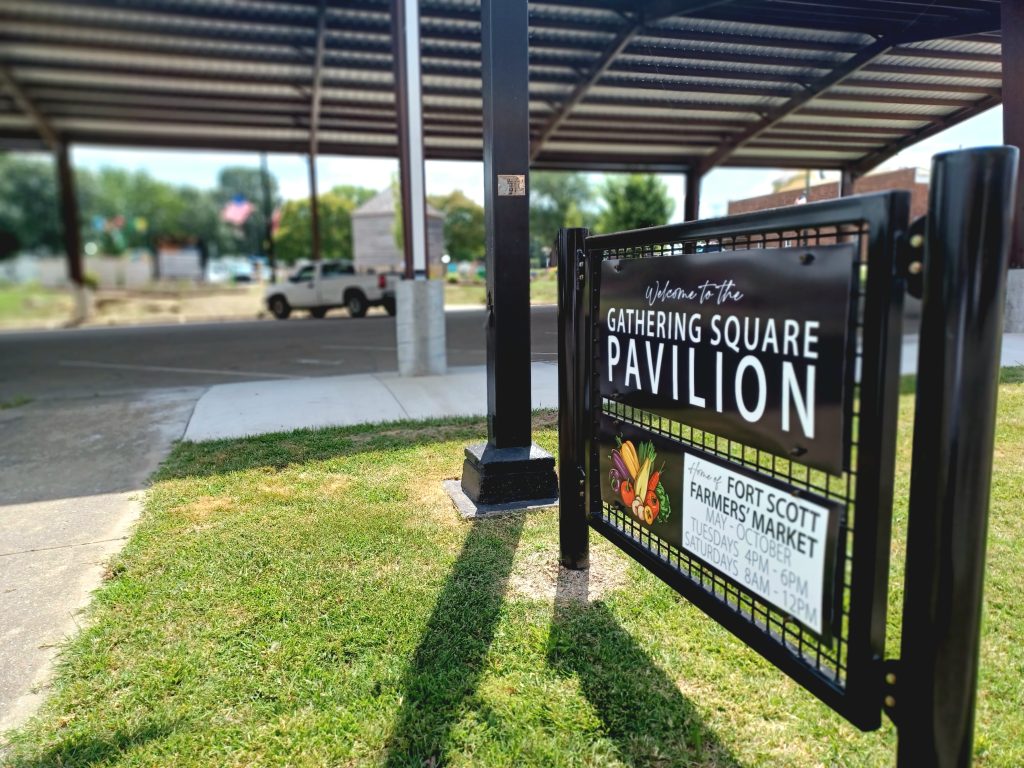
The Fort Scott Farmers Market vendors are planning a party on July 4 at the Gathering Square Pavilion on North National Avenue.
The regular market vendors will be there to purchase from, but in addition, there will be added fun activities for the whole family.
The Gathering Square Pavilion.
“Since Independence Day falls on a Saturday this year, we wanted to make the most of a unique opportunity,” said Stephanie Carrell, secretary of the vendors. “The Farmers Market is already a place where people come together, so adding some patriotic fun felt like a natural fit.”
Join them to celebrate Independence Day with a morning of family-friendly activities and patriotic fun.
“Activities begin at 8:00 a.m. with the ‘Best Cookie of the Market’ Chocolate Chip Cookie Contest, where visitors can participate in a blind taste test and vote for their favorite cookie entry from participating market vendors. Voting will continue until 11:30 a.m., with the Cookie Champion announced at noon.”
All registrations for participating in certain events close on July 2. Find the event on Fort Scott Farmers Market Facebook page or enter at the link listed below.
“At 9:00 a.m., participants of all ages will compete in the Chomp Champion Watermelon Eating Contest, with multiple age divisions and trophies awarded in each group.”
“At 10:00 a.m., the Wheels of Glory Patriotic Parade will invite participants to decorate bikes, wagons, scooters, strollers, wheelchairs, and Power Wheels and show off their patriotic spirit. Spectators will vote to determine the crowd favorite.”
“We were thinking through the pavilion (for the parade). They can circle back along the sidewalk, then park in the center of the pavilion for voting,” she said.
“At 11:00 a.m., teams of up to four people will compete in the Know-It-All Cup Trivia Challenge, featuring questions about Fort Scott.”
“Registration for the scheduled events is free, and trophies and prizes will be awarded. Every participant will receive a prize,” she said.
“Visitors are encouraged to come enjoy the market, cheer on participants, sample cookies, and celebrate the Fourth of July with a morning of fun, friendly competition, and community spirit.”
Fort Scott Farmers Market Association contacts are
President: Lori Hueston and
Secretary: Stephanie Carrell
email: fortscottfarmersmarket@gmail.com
call/text: 620-303-9878
” We hope people will stop by to pick up fresh produce, local meats, sweet treats, and other handmade products for their holiday celebrations, enjoy the festivities, and spend some time visiting with friends and neighbors,” Carrell said. “Celebrating the Fourth of July is about more than fireworks—it’s about community, and we’re excited to give people another way to celebrate together.”
County Clerk Susan Walker’s routine June 15 request to use the commission room for early voting, election nights and election school touched off a heated exchange over a room that is at the center of a criminal case.
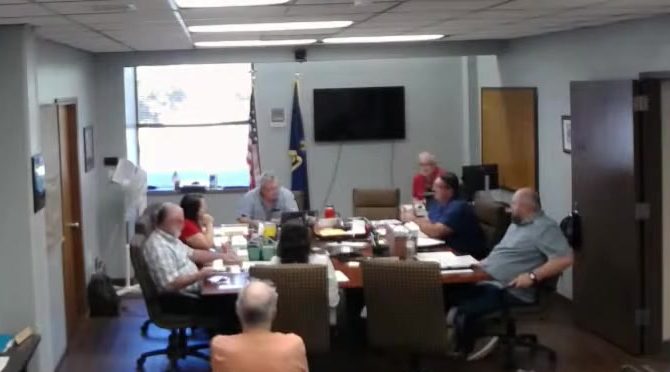
The commission room has doubled as election space for years: voting booths line the courthouse hallway while the room itself is used to check in voters and handle provisional ballots. It was that arrangement, on October 25, 2025, that put Commissioner Mika Milburn-Kee in legal jeopardy. Security-camera footage reviewed by FortScott.biz showed Milburn-Kee seated at the commission table, beside a stack of what the clerk said were unverified provisional ballots, reading a newspaper and waving to a voter while early voting was underway. Walker twice told her election law barred her from the polling area; Milburn-Kee objected that it was her office before moving out about twelve minutes later. In March 2026 the Kansas Attorney General charged her with two misdemeanors, including the polling-place “three-foot rule,” a count that would force her from office if she is convicted. Her jury trial is set to begin July 6, 2026, with a pre-trial conference June 26.
Against that backdrop, Milburn-Kee moved June 15 to deny Walker’s request to use the room, citing its many uses and noting it is the only workspace she has. Walker pushed back saying she has nowhere else, no budget to rent space, and the room is her most secure option. Chairman Samuel Tran disputed that it is “secure,” and the two talked over each other until Walker asked Tran “please don’t be disrespectful to me” and he replied that she was “coming to the table asking for a favor,” and finally telling her to “do what you have to do, madam.” Tran alluded to a past “issue” he didn’t want to “resurface.” Milburn-Kee’s motion failed. Milburn-Kee and Tran were the only ones who voted for it with the rest of the commission against. Commissioner Gregg Motley’s motion to grant Walker’s full request passed with Tran and Milburn-Kee voting against.
The dispute turned on whether the clerk had a workable alternative. Tran proposed moving early voting to the courthouse’s main atrium and using County Appraiser Matt Quick’s office and conference room. Walker rejected that as neither secure nor convenient for her election judges, calling the commission room “the securest” space available; she said she has no other location and no budget to rent one. Milburn-Kee argued the room is needed for its “multi-use purpose,” she said it is her only workspace and that she comes in early and on weekends to set it up, and noted her motion would still lend Walker the county’s Public Works and maintenance crews to move and set up election equipment. Commissioner David Beerbower was skeptical, noting the county would not ask the appraiser or other courthouse officeholders to give up their offices: “I’m baffled.” Commissioner Joe Allen framed the conflict as narrow, “four Mondays, four meetings,” the handful of Monday commission meetings that fall within the voting window, which Walker said she had already worked around so the board could still meet.
Writer’s Note: I know what you’re thinking – “Nick, don’t you have your own website now?” Yes, yes I do, (check out bourboncountymonitor.com). However, the seed that grew into the Monitor started right here at fortscott.biz, with an article I wrote two years ago about…the hospital. More importantly, this is something I believe every Bourbon County citizen should be aware of, so as far as I’m concerned, the more eyeballs, the better.
This is the first in a two-part series that will be published on both sites.
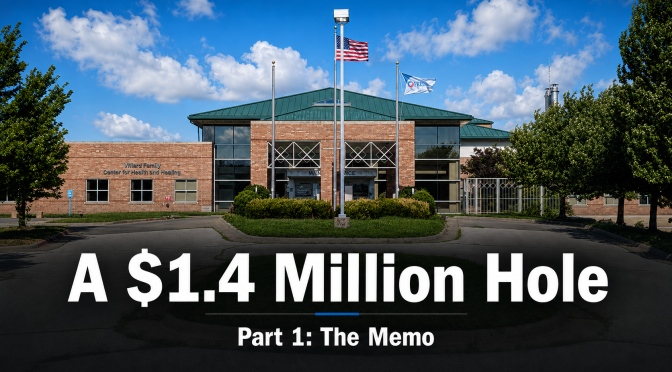
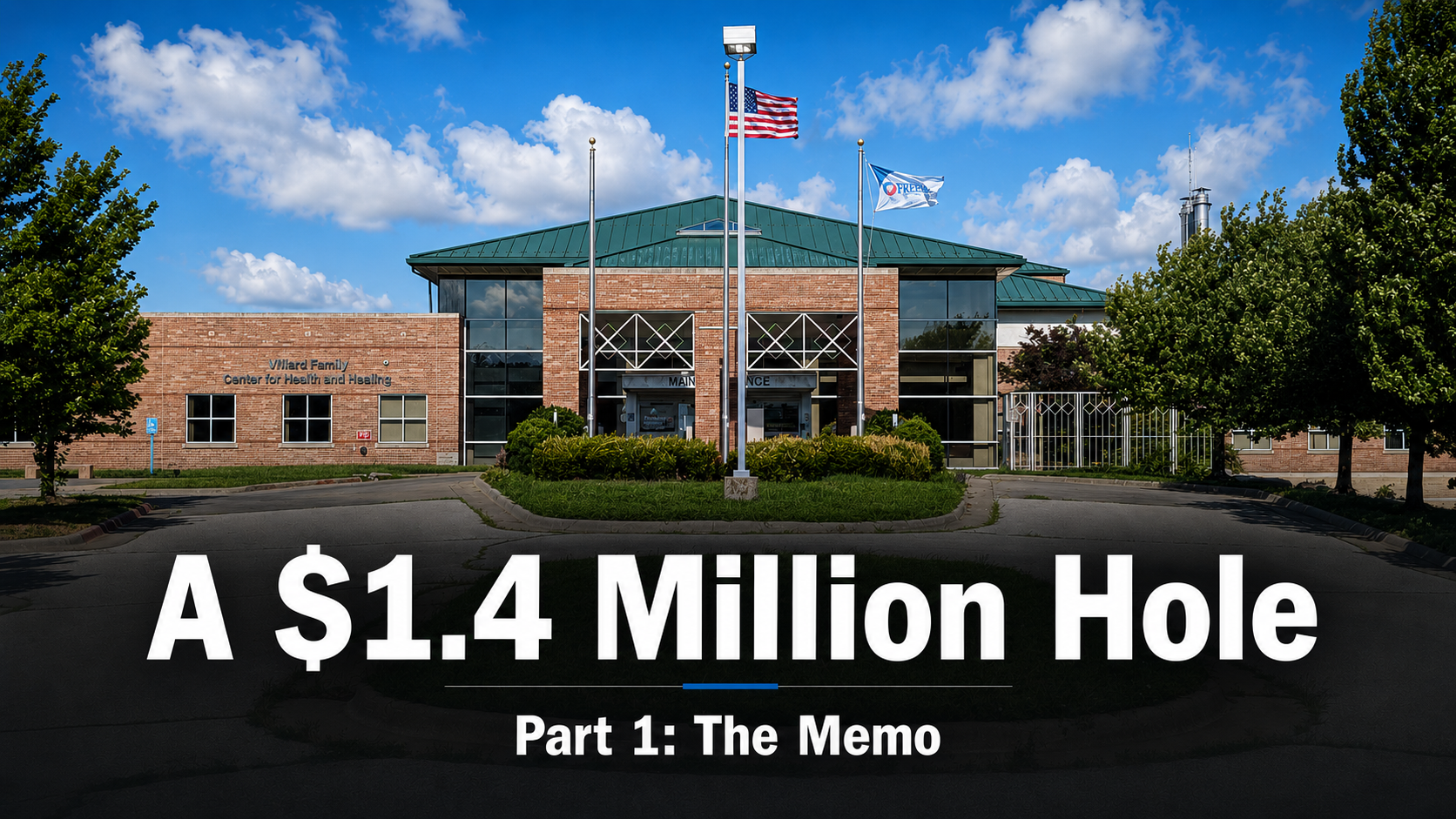
FORT SCOTT, Kan. — An internal memo posted in a local Facebook group last week confirmed weeks of rumors that Bourbon County commissioners are considering legal action to reclaim the former Mercy Hospital building. Until now, commissioners have discussed the matter almost exclusively in executive session.
The memo, authored by Commissioner Gregg Motley, details financial difficulties for building owner Kansas Renewal Institute (KRI) and its primary tenant, Freeman Fort Scott Hospital. It warns that Freeman’s Fort Scott operations are under significant financial strain and face unsustainable losses unless the county implements a plan that involves taking legal action to reclaim the building from owners KRI and Legacy Health.
An Early Warning Sign
Several of the memo’s claims were corroborated by KRI CEO T.J. Denning at a “Capital Update Over Coffee” event hosted by the Fort Scott Chamber of Commerce in late February, weeks before Motley wrote the memo.
Denning told attendees the state had cut KRI’s daily Medicaid reimbursement rate “from about $815 a day to $572,” leaving the organization “losing about $104,000 a month.”
“That’s a big shock to an organization,” he said.
Denning also described KRI’s difficulties getting a 10-bed license from the Kansas Department of Aging and Disability Services (KDADS), saying KRI had tried without success for a year and a half. At the time, he expressed hope of receiving the license within 90 days.
He also spoke about the building’s long history of maintenance issues, saying KRI had bought “a building that had lots of maintenance issues over the years” and was still contending with failing systems.
“We have boiler issues each and every day,” Denning said. “We have chillers that are falling apart with all these things that we put the money back into because I care about the community.”
The Origin of the Memo
In an interview with the Bourbon County Monitor, Motley expanded on the financial issues facing both KRI and Freeman, and why he believes legal action is the commission’s best hope of keeping ER and hospital services in Bourbon County.
Motley said he first learned of KRI’s financial problems at a Feb. 12 meeting of local leaders convened by KRI management to discuss recent difficulties and layoffs.
“(In) February, KRI called prominent citizens of Fort Scott, assembled a group, and assembled the key staff members of KRI,” Motley said. “The topic was KRI needs your help because we are having trouble with the state getting fully licensed…”
KRI management also outlined financial problems Denning would discuss publicly later that month, Motley said.
“They said, ‘We need you to get in touch with anybody you have contacts with and contact the state,’” Motley said.
In response, Motley contacted state Sen. Tim Shallenburger, a longtime friend. He said Shallenburger called back a few days later and told him, “You got problems there. I’m not sure that KRI will ever get fully licensed for the 10 beds.”
“$1.4 Million Is a Big Hole”
Motley said KRI’s inability to license the 10 beds has left both KRI and Freeman in an unsustainable position. He said KRI’s lease with Freeman called for KRI to pay Freeman about $120,000 a month — roughly $1.4 million a year — to manage the beds.
“You do an intake, and generally that’s precipitated by a crisis,” Motley said. “A lot of times, it’s a medical crisis. And so they had an arrangement, an agreement with Freeman to manage those 10 beds for them at a cost to KRI of $1.4 million a year.”
After consulting state agencies, Motley said, both Shallenburger and state Rep. Rick James believe KRI has “no chance” of getting the license, though they have not disclosed why. Without that revenue stream, Motley says Freeman Fort Scott’s chances of achieving financial sustainability are poor. Motley said Shallenburger’s assessment, combined with his own understanding of Freeman’s finances from his time as vice chairman of the hospital’s board, prompted him to ask how to keep Freeman in Fort Scott long term.
“$1.4 million is a big hole,” Motley said. “Having been on the board previously and knowing the numbers, it was, ‘Oh boy, this is bad.’ And then he looped me in with Freeman’s attorney.”
“You Can’t Have a Roof Leak in a Hospital”
That attorney was Pamela Lanier, Freeman Health System’s Director of Government Relations. Motley said he learned from Lanier and other Freeman staff that the hospital had been dealing with roof leaks, HVAC failures and other maintenance problems disrupting operations.
“You can’t have a roof leak in a hospital,” Motley said. “The state will shut you down.”
Motley believes KRI’s difficulty maintaining the building is tied directly to their financial struggles, struggles that have been exacerbated by a large, high-interest mortgage on the building.
A Seven-Figure Mortgage at 13% Interest
Motley’s concerns prompted him to pull all public records on the building’s sale at the Bourbon County Register of Deeds office. There, he found not one but two mortgage agreements.
The first, dated Dec. 20, 2024, was a mortgage for Lots 1 and 2 of the former Mercy Hospital property between Kansas RE Investment Group, representing KRI, and California-based Legacy Health LLC, which shares leadership with the Legacy Healthcare Foundation.
The entire former Mercy Hospital property, along with $2 million in American Rescue Plan Act funds, was donated to Legacy Healthcare Foundation on Nov. 17, 2022, by then-county commissioners Clifton Beth, Jim Harris and Nelson Blythe.
The second agreement, dated Dec. 27, 2024, shows Legacy Health LLC then “flipped” the $2.5 million mortgage with KRI to a California-based company called Pasadena Private Lending.
“Legacy immediately turned around and I would say monetized it. They sold that mortgage, that two and a half million dollar mortgage to Pasadena Private Lending, which is a private equity firm out of California,” Motley said.
In the financial industry, such transactions are often done for cash, Motley said, with the buyer accepting a smaller principal in exchange for a higher interest rate.
“Oftentimes those mortgages are sold at a discount,” he said. “Let’s say the mortgage is $2.5 million and the rate was 5%. They’ll discount it to $2 million and you make the same payments, so the yield goes to 13%.”
After reviewing the documents, Motley said he met with Denning, who told him KRI was making payments on the Pasadena mortgage at a 13% interest rate and had paid Legacy $8.5 million in total for the building — though he did not account for the additional $6 million.
No public records account for the additional $6 million, but Legacy Health Foundation’s 2024 IRS filing reports the building was transferred for $7.5 million — leaving a $1 million gap between the purported purchase price and what was reported to the IRS.
The Memo Is Sent, And The Leaks Begin
What he did not anticipate was that the memo’s contents would be shared with private citizens — including a former elected official with public ties to Legacy Health — before the March 9 meeting even began.
Part 2 will be published on Monday on the Bourbon County Monitor, and Tuesday on FortScott.biz
KRI management was contacted for comment on this series, but did not respond before publication.
Legacy Health management and legal counsel was contacted for comment on this series, but did not respond before publication.
Freeman Health Systems was contacted for this series, and sent a statement that will be included in Part 2.
Public Documents
The public documents referenced in this article are linked below.
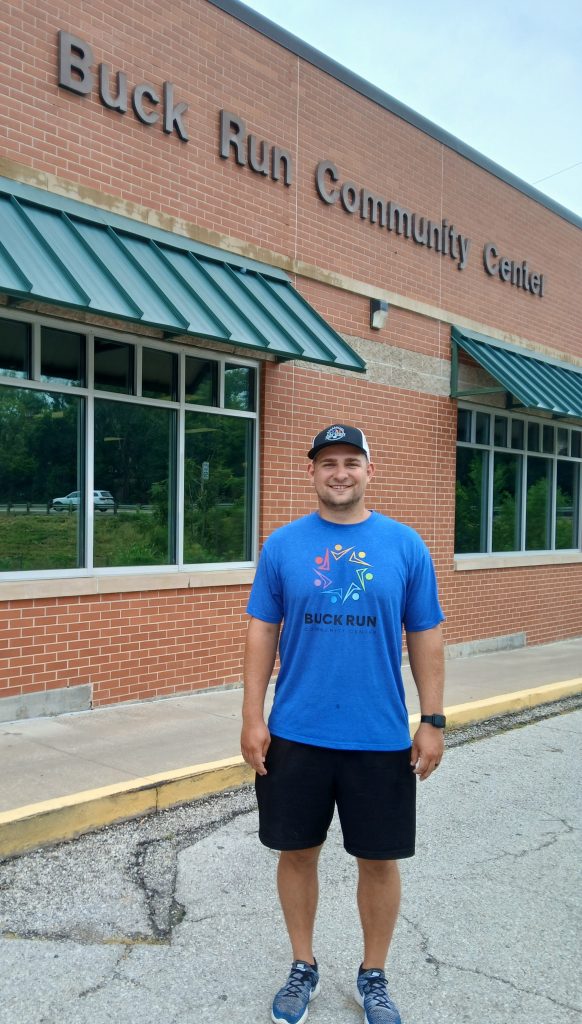
Several new recreational activities are being offered by Buck Run Community Center this summer: an outdoor fitness court, an inaugural Independence Day Run, and a new fitness trainer added to the team.
New Outdoor Fitness Center
The outdoor fitness court is located just south of Buck Run Community Center, at 735 Scott Avenue.
“The new outdoor Buck Run Fitness Court is open,” said Lucas Kelley, Recreation Director and Buck Run Community Center Manager.
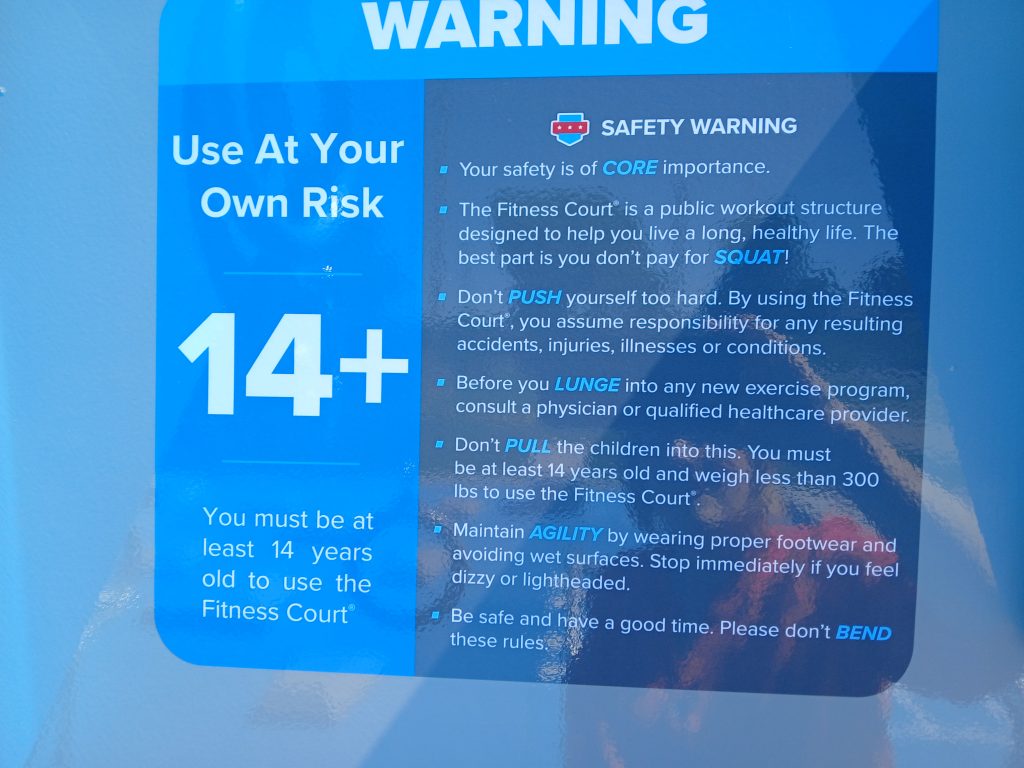
Warnings for using the fitness court.
The new space is free to the public and accessible to people of all ages and levels of expertise, Kelley said.
One can check in daily at the site.
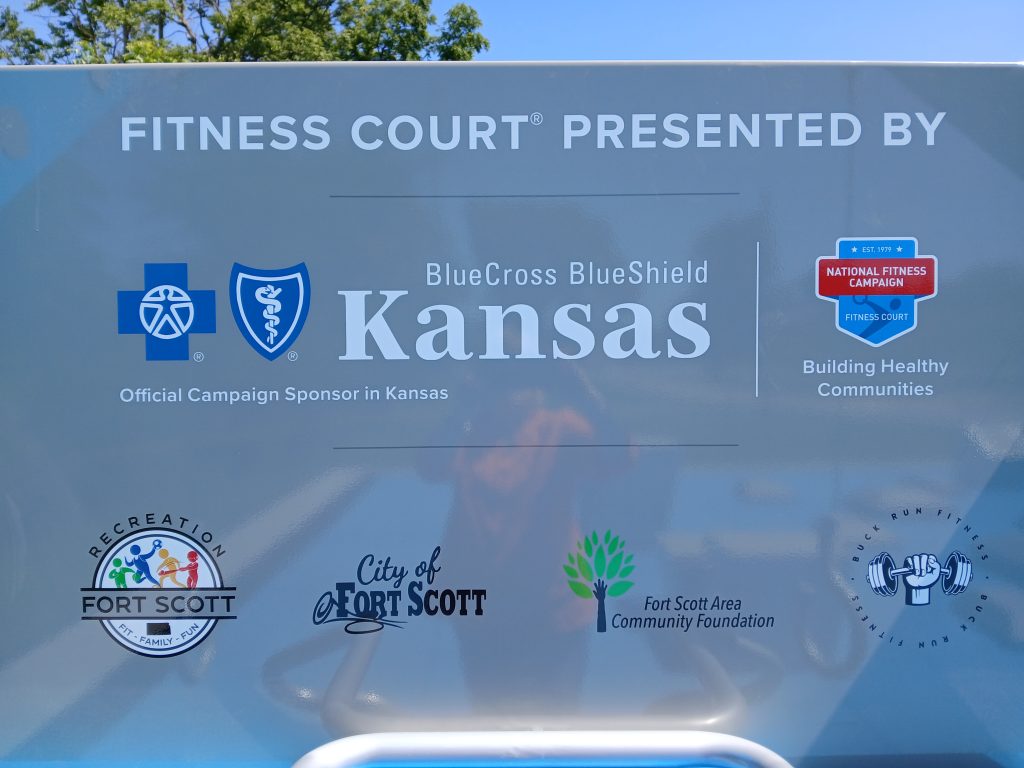
“It was paid for by multiple organizations: Fort Scott Recreation, City of Fort Scott, a grant from Blue Cross Blue Shield of Kansas, and the Fort Scott Area Community Foundation.”
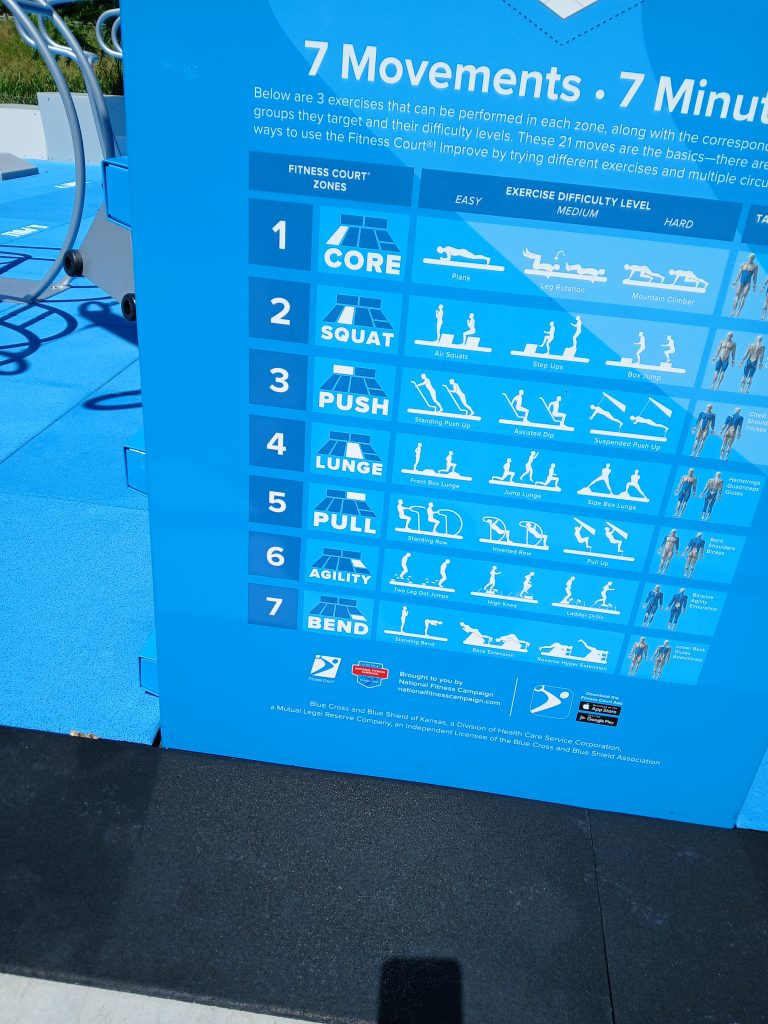
Seven exercise zones explained.
“We wanted to provide another option to the citizens to enjoy the fresh air and stay active in our community! We will also utilize the studio space on the south side to teach classes when the weather is enjoyable.”
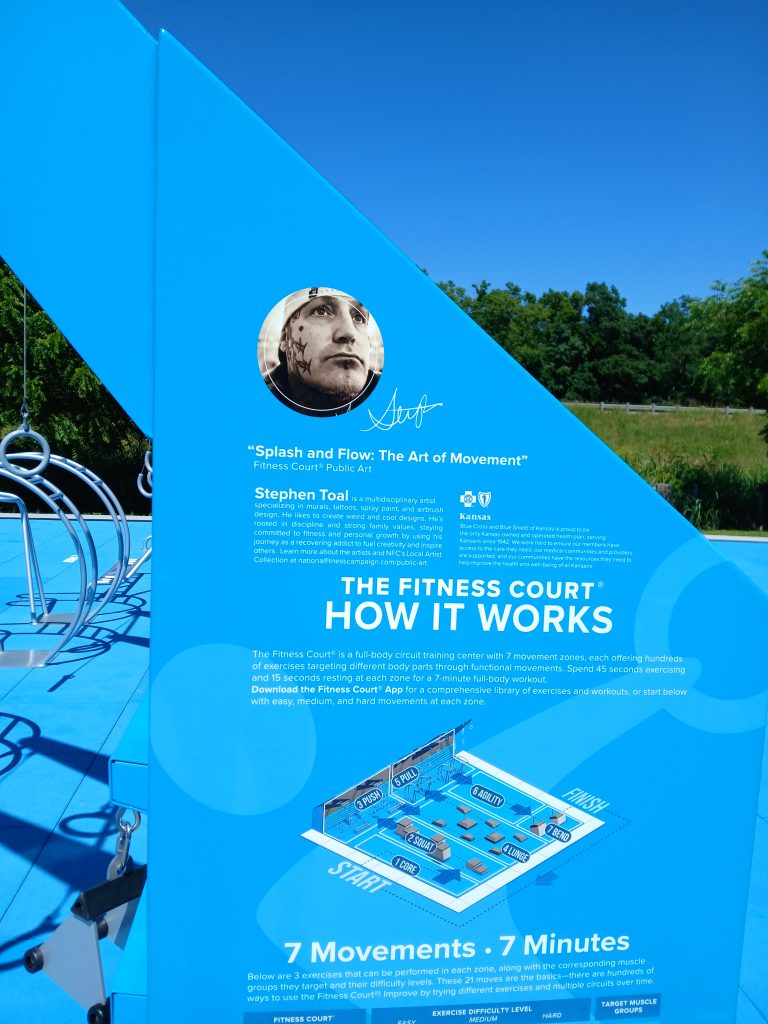
Summer Pilates at the fitness court is June 26. From the center’s Facebook page.Stephen Toal’s artwork at the fitness court.The artist is featured.The fitness court is sponsored by several entities.
The center is offering a first-ever 5K run on the day the community is celebrating Independence Day, June 27.
1St Fourth of July 5k is June 27, offered by the Buck Run Community Center staff. From its Facebook page.
1st Annual Red, White & Run 5K registration is open.
On June 27, the inaugural Red, White & Run 5K is on the list of activities.
“Make it a full day of fun by participating in the race and then enjoying the city’s fireworks and community activities later that evening! Come dressed to celebrate America! Show us your spirit and win a BRCC Running Club T-shirt,” according to the BRCC Facebook page.
The Race Details:
• Start and finish at the Fort Scott Community College Track
• Route travels north on Horton Street, using the sidewalk to 6th Street
• Turn around at 6th Street and head back to the track
awards and prizes:
• Finisher medals for all registered participants
• Trophies awarded to 1st–3rd place in each age division
• $20 BRCC Fitness Center gift cards
• 4 pool passes awarded as prizes
There will also be family fun opportunities while you wait:
The recreation center welcomed Austin Sinn to the Buck Run team recently.
The personal trainer offers in-person training and online coaching.
The in-person training includes initial consultation, a customized training plan, exercise technique coaching and accountability and goal tracking.
The online coaching includes initial consultation, custom workout plan, form review and exercise feedback, ongoing program adjustments and text support.
Lucas Kelley, director of Fort Scott Recreation, of which Buck Run Community Center is a part.
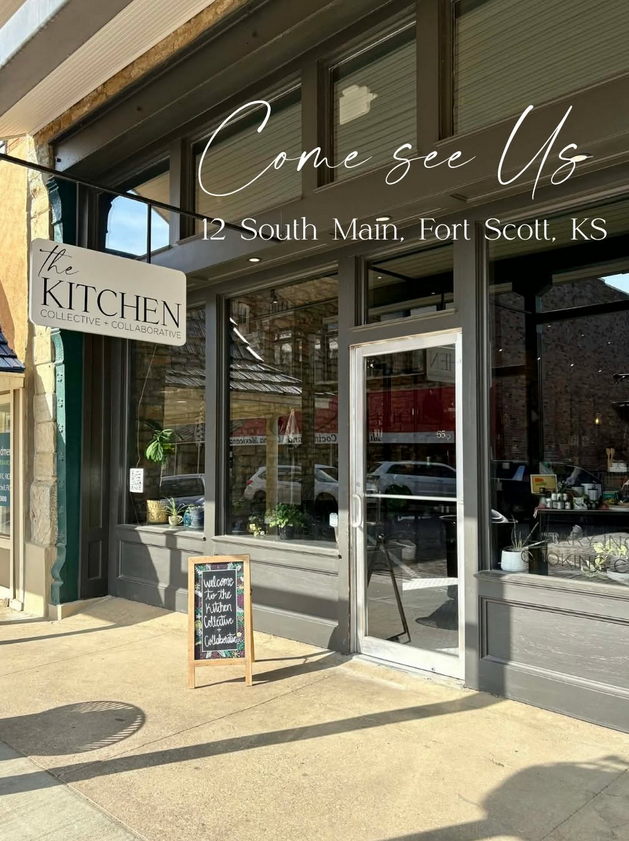
The Kitchen Collective+Collaboration is a modern shared commercial kitchen, retail and event space in historic downtown Fort Scott, at 12 S. Main
The Kitchen Collective+Collaboration is located at 12 S. Main, Fort Scott. From its Facebook page.
They offer grab-and-go meals and cooking classes and can also be privately rented.
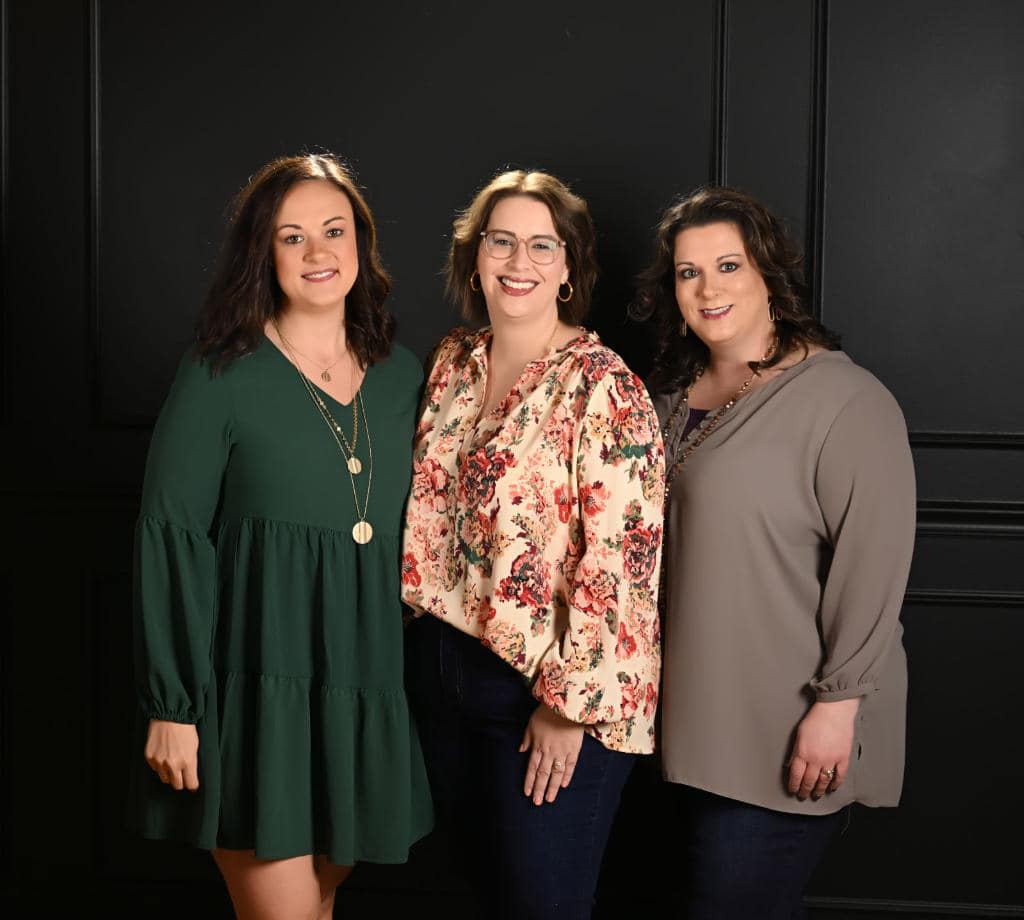
Bailey Lyons, Rachel French and Angie Simon are business owners of The Kitchen Collection+Collaborative. . Submitted photo.
The business owners are planning a Summer Social on June 25 from 5 to 8 p.m.
“The Summer Social is designed to showcase the entrepreneurs, food businesses, and local producers that make up the The Kitchen Collective+Collaborative community and will include Crumstead, owned by Stephanie Carell, featuring a selection of her handcrafted baked goods and desserts. Also, The Golden Swan Bakery, owned by Grace French, will offer some of her signature gourmet cookies and sweet treats. BBQ by Jarod Bower, serving up samples of smoked barbecue favorites. Jonny O’s, one of our close collaborators, is featuring items from his popular food truck menu. Branch Coffee, owned by Ken Walker, is serving specialty beverages and sharing information about their local coffee offerings,” French said.
“We’re also excited to feature several local farmers and ranchers whose products are available in The Kitchen’s market area, including FB Farms, Freedom Farms, and Sweet Country Farms. These producers will be sharing information about their farms and locally raised meats and eggs they provide to our community.”
“In addition to meeting the vendors, guests will be able to shop The Kitchen’s market, enjoy door prizes, and take tours of our incubator kitchen facility. This event allows an opportunity to connect directly with the community, share their stories and showcase products they work so hard to create. It’s also to see how local businesses can collaborate and support one another and strengthen our regional food economy.”
The event was created to showcase the businesses that have grown within The Kitchen Collective+Collaborative.
“Many people know us as a place to grab lunch, take a class or host an event; fewer realize that we were established as Southeast Kansas’ first food business incubator,” she said. “Our mission is to help food entrepreneurs start, grow and sustain a successful business by providing a licensed, commercial kitchen space, business support and retail opportunities.”
“We are continuing to develop educational programming, business resources and retail opportunities that help local food businesses reach more customers. We’re working to strengthen relationships with farmers, ranchers and producers so local products are available to our community.”
The Kitchen is currently partnering with Blue Cross/Blue Shield of Kansas Healthy Pathways Program, so those who qualify will be eligible for matching kitchen rental hours, helping reduce the cost of accessing licensed commercial kitchen space. This program helps remove barriers for entrepreneurs, making it easier for them to test ideas, grow production, and build sustainable businesses, she said.
“We hope to welcome additional entrepreneurs into our kitchens, expand our classes and events, and continue building…a hub where food businesses, producers and the community can connect, collaborate and grow together.
District 4 Commissioner Gregg Motley says the county is pursuing enforcement of a safeguard in the 2022 donation, not seizing a building for Freeman.
Bourbon County has engaged an attorney to determine whether it can unwind its 2022 donation of the former Mercy Hospital building, a step Commissioner Gregg Motley says is about one thing: whether or not the county will still have a hospital in the future.
“The status quo threatens the long-term health care of Bourbon County,” Motley said. “What we need to do is do everything we can to ensure that we have health care in Bourbon County long term.”
Motley, a retired banker seated in January, spoke with FortScott.biz on June 11 after a portion of a memo he wrote for an executive session was posted to a Facebook group. He rejected the spreading claim that the county is taking Kansas Renewal Institute’s (KRI) building to benefit Freeman Health System: the county “does not want to own that building,” and Freeman “is not behind” it.
A safeguard the county built into the donation
The “clawback” is not a legal loophole; it is the remedy the county wrote into the donation itself. Effective Nov. 17, 2022, the agreement gave the former Mercy property and $2 million to Legacy Healthcare Foundation, a California nonprofit. The $2 million could be used only for building maintenance, “development of an Acute Care Hospital and ancillary services,” and reduced rent for community-benefit tenants — the county’s way of tying the gift to keeping health care on the site.
The agreement also set out what happens if the recipient breaks the deal: its “sole and exclusive remedy” is that the property returns to the county, along with a sliding-scale refund — $1 million if the deal is unwound in the first year of operation, $750,000 in years two through four, $500,000 by the fifth. After five years, the county has no remedy at all.
That five-year window — which Motley says closes in November 2027 — is the source of his urgency. The clause exists so that if the recipient fails to deliver, Bourbon County gets the building back instead of watching it slide toward foreclosure or wind up owned by a mortgage company. The claim rests on both Legacy and KRI being in default under the donation agreement and the lease, Motley said.
Much of his information, Motley said, came from a February briefing where KRI told the Fort Scott city manager, chamber president and others they could share what they heard. By that account and his own research, he said, KRI is losing six figures a month; it paid $8.5 million for the building, and the state has cut its daily reimbursement 34%, issued only a provisional license and so far denied its property-tax exemption request.
“It’s really the Mercy situation all over again,” Motley said. “We just bleed them to death and they leave.” If nothing changes, he said, the county is “likely to lose Freeman in four years,” when a five-year healthcare sales tax and the KRI–Freeman lease expire.
The lease had Freeman staffing 10 inpatient beds on KRI’s side for about $120,000 a month, but the state has refused to license the beds and KRI is in default, Motley said. “That is a big hole in the Freeman budget.”
Those missing payments compound other setbacks, Motley said: a subcontractor delayed Freeman’s opening to September, a collapsed lab deal left a seven-figure hole, and it could not bill Medicare or Medicaid until late February — months “virtually without patient revenue.” Persistent roof leaks and HVAC failures, he said, violate both the lease and the donation agreement.
Questions about the sale
Motley also questioned the financing. KRI says it paid $8.5 million, but Legacy’s IRS Form 990s report $7.5 million — “a million dollars unaccounted for,” he said. Legacy sold a $2.5 million KRI mortgage to Pasadena Lending at 13% interest, well above market. “Risk and rate are conjoined,” Motley said. “A high rate means high risk.”
If KRI fails, the building could revert to Legacy or Pasadena Lending through foreclosure, he said — leaving the county “right back where we started.”
Not just the county
The concern did not start with the commission, Motley said: state and elected officials sought his assessment, and hired Kansas City’s Polsinelli law firm at the state’s own expense. Polsinelli, the state and Freeman all agree the agreement was violated in several provisions, he said, and officials are “dubious” KRI will ever be fully licensed.
A more viable operator
Motley’s premise is that KRI cannot sustain the operation on its own, a conclusion he draws from KRI’s own disclosures of mounting losses, its provisional state license, and the state’s refusal to license its 10 beds. If KRI cannot continue, he said, the question is who keeps the same kind of children’s behavioral-health care going on the site.
His answer is Freeman, whose Ozark Center runs behavioral health across the state line in Missouri. Freeman believes it can do what KRI could not — win full licensing and get the 10 beds approved. They could continue the operation, likely hiring many of KRI’s staff, he said. That would put Freeman in KRI’s place as operator; KRI reported 110 employees in 2024, and its five investors, from California, Colorado and the Midwest, pay what Motley said KRI itself describes as “California wages in southeast Kansas,” above local rates.
Those above-market wages, Motley suggested, also help explain some of the opposition to enforcing the terms of the donation agreement. He acknowledged a tension between residents focused on the county’s long-term health care and some who benefit from KRI’s higher pay and would like to see the operation continue as long as possible. “This is why … I’m not their best friend right now,” he said.
“I have a lot of friends and people I dearly love who work at KRI, and I don’t want to see them harmed,” Motley said. “But my number one priority is that we have health care in Bourbon County for the next 50 years.”
What the county is considering
The commission voted 3-2 to explore legal action — Motley, Joe Allen and David Beerbower in favor, Mika Milburn-Kee and Samuel Tran opposed, Motley said. An initial $10,000, overseen by Motley and county counselor Bob Johnson, funds a review of the claim’s viability and title work on the property.
Delay is costly, he said: the reversion window closes in November 2027, the refund the county could recover shrinks each year, and Freeman’s losses deepen. If the case looks winnable, the first step would be a new donation agreement with Freeman to keep both the hospital and the children’s services running. Other possible fixes could also help without any clawback: Freeman misses new rural-health reimbursement enhancements because it was not open in 2020, and the state could restore KRI’s rate or license the beds, he said.
Conflicts and the closed session
Motley said he resigned from Freeman’s board in December, before taking office, as required by Freeman’s conflict-of-interest policy. “I’ve never taken a nickel from Freeman,” he said. “The board positions were unpaid. I have a Freeman t-shirt, but I paid for it.” He is simply applying “45 years of financial experience in accounting,” he said.
The matter began in executive session to protect KRI, not to hide it, he said. “My hope originally was that we could get to this point in executive session, without disclosures, and protect KRI and everyone else involved until we knew,” he said. “But that didn’t work out.”
He said he does not know who leaked the memo, noting only that someone outside the commission had information about what happened in the closed session.
Motley urged residents with questions to contact him directly, at 620-215-7125, rather than rely on social media. The next step is the attorney’s opinion on whether the county can realistically reclaim the building “to try to make sure it gets in the hands of someone that’s on better financial footing” — and keep a hospital here for decades to come.
Reporting note: This article is based on a June 11, 2026 interview with Commissioner Gregg Motley. Building history and donation terms come from prior FortScott.biz reporting and county records. Characterizations of the finances, licensing, lease and legal views are Motley’s account; KRI, Legacy Healthcare Foundation and Freeman Health System were not interviewed and may differ.
Bourbon County Sheriff Bill Martin. Submitted photo.
The following is a statement from Bourbon County Undersheriff Kevin Davidson.
“Sheriff Martin was presenting a life-saver award at Fort Scott Community College (on June 9) and suffered what is believed to be a heart attack. He was transported to a Kansas City Hospital. I spoke with him today, and he is awake and in good spirits. I appreciate the support shown to the Sheriff’s Office from our great community and we are all thankful for everything. The family is asking for prayers for a speedy recovery!”
Kevin Davidson, Bourbon County Undersheriff. Submitted photo.
“I will send an update as I get further information. I will be stepping up in his absence, along with Chief Deputy Shawn Pritchett, to accommodate his absence. There will be no changes in our office for the time being. The Sheriff’s Office is dedicated to serving our community, and that will not change. I appreciate everyone’s support and all the prayers Sheriff Martin has received.”
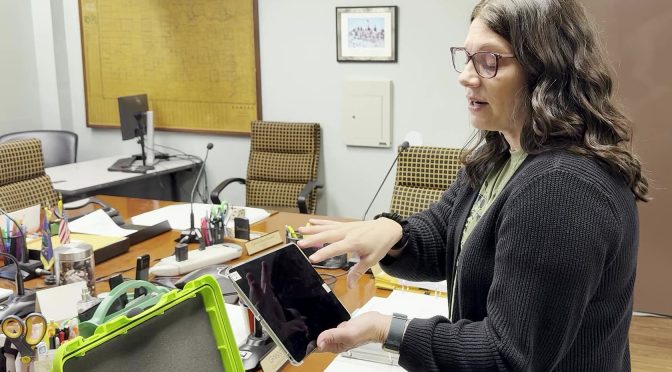
The County Clerk and Election Officer Susan Walker and Deputy Clerk Amber Page walked FortScott.biz through the election process showing the procedures their office uses to take in, track, and reconcile every ballot cast in a Bourbon County election.
This article shows the order that an election unfolds, starting with building the ballot weeks before Election Day and ending with the canvass after Election Day.
Important Terms:
KNOWiNK Poll Pad: The electronic tablet voters sign in on at the polling place. KNOWiNK is the vendor; Poll Pad is the device.
ePolls: The Clerk’s office shorthand for the electronic pollbook export from the Poll Pads. The data feeds into ELVIS after the election.
ELVIS: Election Voter Information System. The Kansas Secretary of State’s statewide voter registration and credit system.
Clear Ballot: The scanner system voters insert marked ballots into at the polling place.
ClearDesign: Clear Ballot’s ballot-design software. Used by the Clerk’s office to build each election’s ballot manually, race by race and precinct by precinct.
UOCAVA: Uniformed and Overseas Citizens Absentee Voting Act. Federal law governing absentee ballots for military and overseas voters.
Manual pollbook: Paper backup pollbook used when Poll Pads fail. Voters sign by hand and are credited in ELVIS afterward.
Provisional ballot: A ballot cast under questioned circumstances (e.g., wrong polling place). Whether it counts is decided later, at the canvass.
Chain-of-custody sheet: Daily log signed by both Walker and Page when retrieving and validating mail-in advance ballots from the office mailbox.
Canvass / Board of Canvassers: Post-election review by the Board of Canvassers (typically the county commissioners) that decides which provisional ballots count and finalizes results.
Supervising judge: The election worker overseeing a specific polling place on Election Day. They serve once a year.
Precinct part: A sub-unit of a precinct that votes on slightly different combinations of races, created by redistricting.
1. Building the ballot
Designing a Bourbon County ballot is a weeks-long process, handled primarily by Page. She uses Clear Ballot’s design software, called ClearDesign. Every piece of information has to be typed in manually: the name of the election, the date, every race, every district, every precinct, which races appear on each precinct’s ballot, which voter groups can vote on each race, and which polling places each precinct’s ballot is available at.
Primary elections add another layer. Every contest has to be mapped to the parties that will appear in it, and every candidate has to be linked to the correct party, so they show up on the right party’s ballot.
Recent redistricting in Bourbon County added significantly to that complexity by creating more precincts and what Page called “precinct parts.” These are sub-units that vote on slightly different combinations of races. The Clerk’s office relies heavily on the district map to determine which precinct or precinct split a given voter belongs to.
Walker said that last year, after an issue discovered with the early voting ballots forced Page to rebuild an entire election configuration, work that would normally have taken several weeks, in hours to have them ready in time for voting day.
The Clerk’s office uses multiple internal and external reviewers to look at the ballot before it goes live, including people outside the office checking for spelling and other errors. Walker said the goal is to keep iterating on the process, “we keep trying to do everything better. We keep doing new processes to make it simpler.”
2. Preparing ballots for the polls
Once the ballot is finalized and printed, every ballot the Clerk’s office sends to a polling place is sealed with a numbered seal. The supervising judge at each polling place is required to keep those seals and return them. If a seal has to be broken, a new seal goes on and is logged. All seals are audited against the equipment they were applied to.
The Clerk’s office also manually counts every ballot before sending it out. On the morning of Election Day, the polling-place staff recount what was delivered and validate the count with the Clerk’s office. At the end of the day, the polling-place staff recount the unused ballots before sending everything back.
3. Voter check-in at the polling place
When a voter walks in to vote, they sign in on a Poll Pad — an electronic check-in tablet running software from a company called KNOWiNK on an iPad. The Poll Pad captures the voter’s signature and identifying information.
If the Poll Pad system goes down, there is a paper backup with the manual pollbook. Voters sign the manual pollbook, and the Clerk’s office later enters those records into the state voter system by hand. Walker described one recent example: on the first day of early voting before the November 2025 election, the Poll Pads malfunctioned, and 29 voters signed the manual pollbook. All 29 were later manually credited with voting in the state system.
If a voter shows up at the wrong polling place, they sign a separate provisional pollbook and fill out additional provisional paperwork. Whether that ballot ends up counting is decided later, at the canvass described below.
4. Mail-in and advance ballots
Some voters cast their ballots by mail rather than in person. Mail-in advance ballots are checked every single day during the advance-voting window. Walker and Page personally retrieve ballots from the mailbox together, count and validate them, log them on a chain-of-custody sheet, and both sign off. The log records how many ballots came in that day but not the voters’ names.
The office tracks who was mailed an advance ballot and who has returned it. If something is wrong — for example, a voter and their spouse have signed each other’s envelopes — the office returns the ballot for correction. Some ballots come back from the post office because of bad addresses. Those, too, are handled manually.
Kansas recently changed the law on advance-ballot returns. Previously, ballots could arrive up to three days after Election Day and still count. Under the new rule, advance ballots must be in by 7 p.m. on Election Day to count. Walker noted the new deadline is currently the subject of litigation, but the Kansas Secretary of State has directed county election officials to plan as though the 7 p.m. deadline is final.
Military voters and overseas voters are tracked separately under federal UOCAVA (Uniformed and Overseas Citizens Absentee Voting Act) rules. Walker said Bourbon County typically sees about two UOCAVA ballots a year.
5. Casting the ballot: the scanner
When a voter inserts a filled out ballot into the voting machine at the polling place, they’re using a system called Clear Ballot. At the end of the day, the Clear Ballot machine produces a report listing how many ballots passed through it.
Occasionally there are anomalies. Walker described one example: a voter who was issued a provisional ballot can sometimes tear the ballot off and run it through the regular scanner instead of returning it to the supervising judge. Those anomalies are noted at the end of the day.
6. Reconciling the count
After Election Day, the Clerk’s office reconciles every election against three independent systems:
The Poll Pad / ePolls export — the electronic check-in log that captures every voter who signed in on a Poll Pad and, after the election, gets imported into the state’s voter system.
ELVIS — short for Election Voter Information System, the Kansas Secretary of State’s statewide voter registration and credit system. ELVIS receives both the automatic Poll Pad import and any manual entries (provisional ballots, manual pollbook entries, etc.).
Clear Ballot — the scanner-side count of ballots that physically went through the machines on Election Day.
Walker said all three numbers are expected to tie out. If they don’t, the office investigates. In her experience, when the numbers don’t match, the discrepancy is almost always in advance ballots or provisionals — what she called “the most room for human error.”
As a concrete example, in last year’s election the office processed 36 provisional ballots, of which 12 didn’t count, and 13 advance ballots.
7. The canvass
After the initial reconciliation, a Board of Canvassers — typically the county commissioners themselves, though they can appoint someone else to do it on their behalf, which Walker said has happened on many occasions — meets to go through every provisional ballot and decide which ones count.
Provisional ballots are evaluated against specific statutory standards. Ahead of the canvass, Page goes through each provisional and identifies which statute applies and whether the ballot likely qualifies, in order to speed up the commissioners’ review. The commissioners make the final call. Once the canvass is complete, the results are entered into ELVIS.
Voters interested in verify their own voting history can go to the Kansas Secretary of State website and enter their name and birthdate. That lookup queries ELVIS.
Walker described cases of voters who had voted but couldn’t find a record on the state site. The cause was usually a name-entry error from years earlier — for example, an entry that placed a voter’s first name into the middle-name field, so the lookup didn’t return a match. The Clerk’s office can fix those records once notified. Walker said voters who can’t find their record on the state site should call the office. (620-223-3800 ext. 100)
Each polling place is overseen by a supervising judge — election workers who are on duty only once a year. Walker said training has historically been short for that reason. The Clerk’s office is planning longer training this year to walk supervising judges through specific responsibilities and procedures.
The Clerk’s office was recently awarded an $8,500 election-security grant from the state.
Walker said the office plans to use the grant to:
Buy five carts to securely hold ballots in transit. Currently, supervising judges — many of whom are elderly volunteers — have to move ballots to the polling places the night before Election Day. With the carts, ballots can stay sealed in the carts and be delivered for them.
Add additional security cameras. Walker mentioned that the office had previously had a camera missing from the election room; the grant will pay to address that as well.
Walker said the grant had been approved just the week before the May 22 walkthrough.
This article is based on a May 22, 2026 demonstration at the Bourbon County Courthouse. The videos of the walk through of the process are shown below.
The Fourth of July is coming early this year in Fort Scott.
On June 27, the City of Fort Scott is hosting its annual community event.
“We wanted to avoid family activities/traditions on the Fourth of July,” said Rachel Carpenter, Fort Scott’s Director of Community Development. “There will not be anything happening from the city on the 4th.”
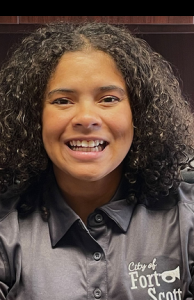
Rachel Carpenter from the City of Fort Scott Employee Directory.
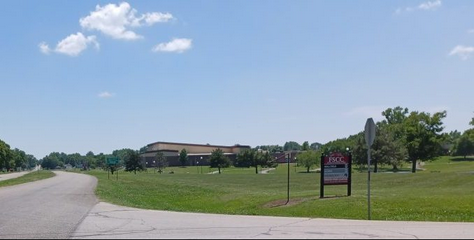
The City of Fort Scott and community partners do invite residents and visitors to celebrate Independence Day at the annual Fort Scott Independence Day Celebration on Saturday, June 27, 2026, at Fort Scott Community College, Carpenter said.
“The family-friendly event will feature an afternoon and evening filled with food, live music, competitions, games, and fireworks, offering something for all ages.”
The churches near Fort Scott Community College are opening their parking lots for the afternoon activities, and there is ADA parking near the cosmetology department on the south central side of the campus.
June 27 city-sponsored activities begin at 3:00 p.m. and include:
Golf cart obstacle course and decoration contest
Slip N Slide Kickball Tournament
Water Wars featuring water inflatables and splash-filled fun
A variety of food trucks offering food and refreshments
Participants are needed for the above activities and the BBQ contest, according to the City of Fort Scott’s monthly newsletter.
Participants can register through the event QR codes available on promotional materials in this publication.
The People’s Choice judging for the Butcher Block BBQ Contest will begin at 5:00 p.m., allowing attendees to help crown the community’s favorite pitmaster.
Live entertainment will be provided throughout the evening with free concerts featuring:
Riker at 5:00 p.m.
The Flatland Band at 7:00 p.m.
Attendees are encouraged to bring lawn chairs and enjoy an evening of great music, food, and community fellowship before the fireworks display.
“This celebration is a great opportunity for families, friends, and neighbors to come together and celebrate our nation’s independence while enjoying everything that makes Fort Scott a special place to live and visit,” organizers said
Residents and visitors are encouraged to wear their red, white, and blue and join in a day of community pride, family fun, and patriotic celebration, according to Carpenter.
For additional event information, follow City of Fort Scott announcements and event updates on social media.
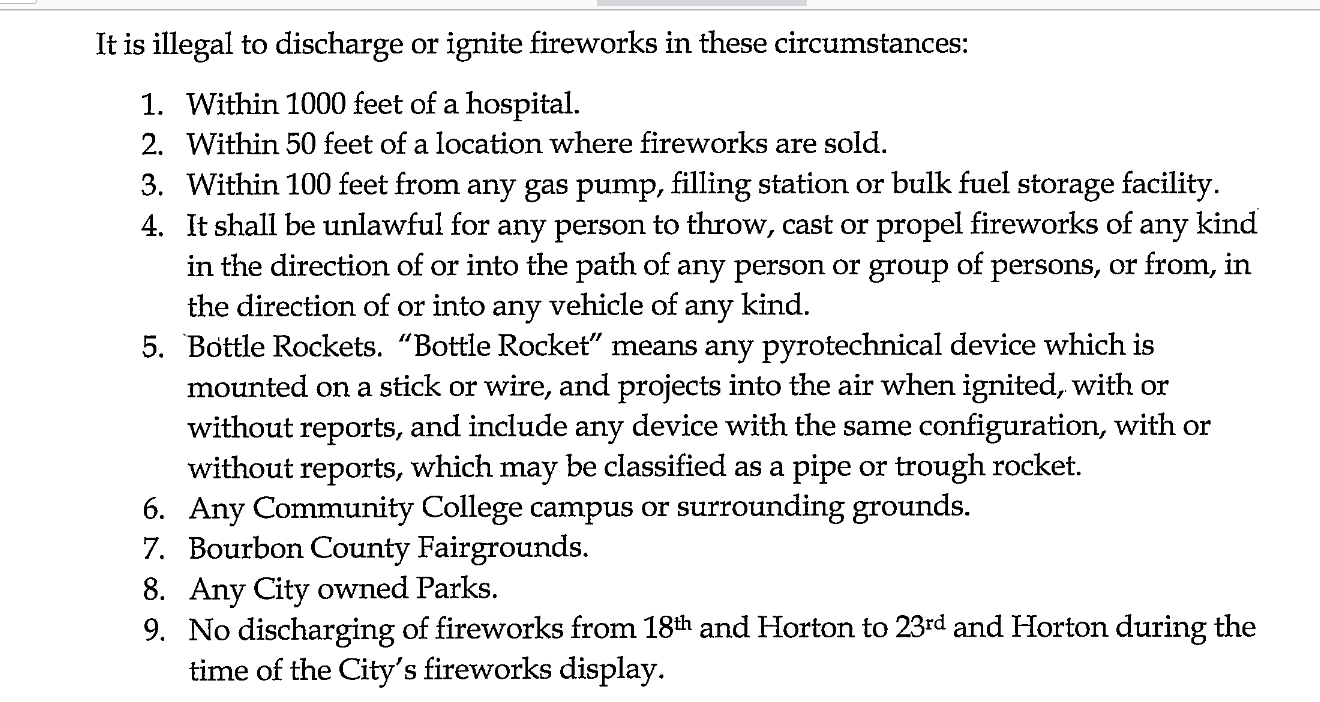
The annual city-sponsored fireworks display will start at 9:30 p.m., Carpenter said. Cars can line up on South Horton Street as in prior years to view the show.
The show will be launched at the Fort Scott Community College campus, at 1801 S. Horton, with lead pyrotechnician Shaunn Pytlowany and his crew from Premier Pyrotechnics handling the setup and shooting.
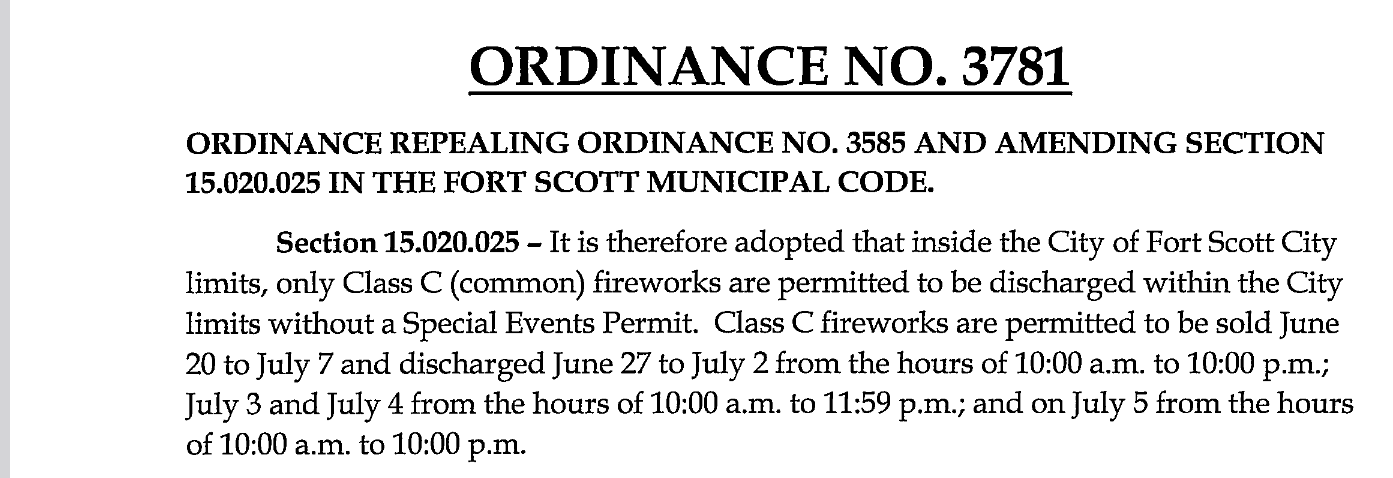
Fire works 2026 Rules
Between 18th and 23rd Streets on Horton Street, cars will be lined up on June 27 for the fireworks display launch at Fort Scott Community College.
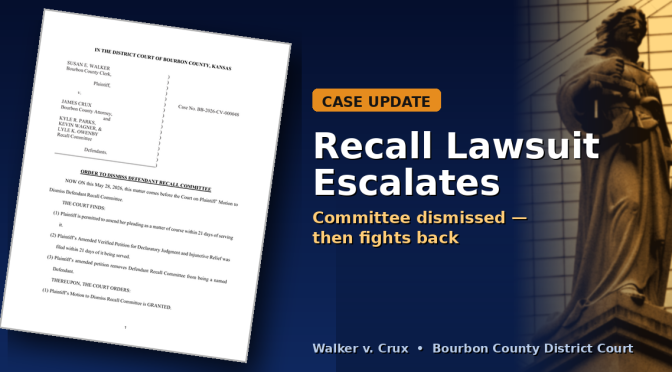
The petition Bourbon County Clerk Susan Walker filed to block the recall petition against her has seen a number of updates in the first week. When the case was filed on May 22, it named County Attorney James Crux and the three members of the recall committee as defendants (see: Bourbon County Clerk Files Lawsuit Seeking to Block Recall Petition). Since then, one recall committee member has hired a lawyer, Walker has narrowed her case, and the judge has already issued (and been asked to undo) an order. Read on for more details.
The biggest development is a motion filed by recall committee member Kevin Wagner under the Kansas Public Speech Protection Act (K.S.A. 60-5320), the state’s “anti-SLAPP” law. That law lets someone who is sued over protected speech or petition activity ask the court to throw the case out early. Filing the motion automatically freezes other motions in the case, and if the person who filed it prevails, the law can require the party who brought the lawsuit to pay their attorney fees.
In response, Walker amended her lawsuit to drop the three recall committee members (Kyle R. Parks, Kevin Wagner, and Lyle K. Owenby) and proceed only against County Attorney Crux. The judge granted Walker’s request to dismiss the committee members. Wagner then asked the court to reverse that dismissal saying he was not given the time to respond that the rules require. He claims that his anti-SLAPP claim (including the possibility of recovering attorney fees) does not disappear just because Walker dropped him as a defendant.
May 27 — Wagner, represented by Wichita attorney Patrick B. Hughes, entered the case and filed a Motion to Strike under K.S.A. 60-5320. He argues Walker’s suit targets his right to petition, speak, and associate in support of a recall, and notes that filing the motion triggers an automatic stay of other motions.
May 28 — Walker filed an Amended Verified Petition naming only County Attorney Crux as a defendant, along with a Motion to Dismiss the Recall Committee members from the case. That amended petition still asks the court to declare the recall petition legally insufficient and to block any recall election based on it.
May 29 (morning) — The Judge signed an Order dismissing the recall committee, finding that Walker was entitled to amend her petition and that the amended version removed the committee as defendants.
May 29 (afternoon) — Wagner filed a Motion to Set Aside that Order, and an Objection to the dismissal. He argues that he didn’t have time to respond and that the automatic stay from his anti-SLAPP motion would prevent Walker from making the motion to dismiss the recall committee from the case.
Wagner’s filing may seem counterintuitive: he says he would not object to the entire case being dismissed, but he does object to the recall committee being removed while the case continues against Crux. His reasons, as stated in his motion:
The court is being asked to decide whether the committee’s recall petition is valid. Wagner says the committee members have a direct interest in that question and a right to notice and a chance to be heard — which they lose if they are not parties.
Under K.S.A. 60-219, he argues the committee members are necessary parties, and that ruling without them could leave County Attorney Crux exposed to conflicting obligations later.
His anti-SLAPP claim — including the question of attorney fees and possible sanctions under K.S.A. 60-5320 — remains to be decided regardless of whether he is a named defendant.
As of now, the recall committee members have been dismissed from the lawsuit, but Wagner has asked the judge to reverse that. The case continues against County Attorney Crux. The central question raised in the original lawsuit — whether the recall petition meets the legal requirements to move forward — has not been decided. No hearing date had been set as of this writing.
Being named in a lawsuit is not a finding of wrongdoing, and the filings described here reflect each party’s arguments, not the court’s conclusions. FortScott.biz will continue to follow the case.
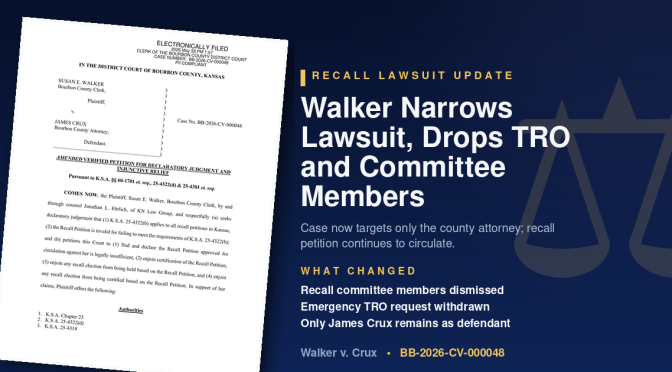
In the week since Bourbon County Clerk Susan E. Walker filed suit to block the recall petition against her, the lawsuit has narrowed substantially. As of May 28, Walker has dismissed the three recall committee members as defendants, withdrawn her emergency request to stop signature-gathering, and re-cast the case as a narrower procedural challenge against the County Attorney. The recall petition continues to be circulated.
Who is still being sued. Only Bourbon County Attorney James Crux remains a defendant. The three recall committee members — Kyle R. Parks, Kevin Wagner, and Lyle K. Owenby — have been dropped.
What Walker is no longer asking for. She has withdrawn her request for a Temporary Restraining Order, the emergency court order she had been seeking to stop the petition from being circulated.
What Walker is still asking for. She still wants the court to declare the recall petition legally invalid (because, she says, the County Attorney never issued the written sufficiency determination required by K.S.A. 25-4322(b) for the version now being circulated), and to block any certification of signatures and any recall election based on the petition.
May 22 — Walker filed her original petition and an application for an ex parte temporary restraining order (an emergency order issued without first hearing from the other side) asking the court to halt signature-gathering immediately. The recall committee members were named as defendants alongside County Attorney Crux.
On or around May 26 — While no written order is shown on public site, it appears the court denied the original ex parte TRO request. The denial is referenced in Walker’s later filing. Her counsel writes that an email “notified Defendant Crux the Court rejected Plaintiff’s request for an ex parte TRO” and asked about scheduling a hearing.
May 26 — Walker filed an amended TRO application (25 pages, up from 17), expanding her irreparable-harm claims. The new filing alleges that “members of the public are photographing Plaintiff and her family to post online with untrue claims,” and that circulation of the petition “causes continuing irreparable harm to the Plaintiff’s ability to perform her duties as Bourbon County Clerk.”
May 27 — Attorney Patrick B. Hughes of Adams Jones Law Firm in Wichita entered an appearance for defendant Kevin Wagner.
May 27 — Wagner filed a motion to strike Walker’s entire petition under Kansas’s anti-SLAPP statute, K.S.A. 60-5320. Anti-SLAPP (Strategic Lawsuit Against Public Participation) laws protect against lawsuits that target their protected speech, petitioning, or association on public issues. Notably the law shifts attorney fees to the losing plaintiff.
May 28 — Walker filed an amended petition (20 pages, down from 28) removing the three recall committee members as defendants. Only County Attorney Crux remains. The new filing drops the request to stop circulation of the recall petition. Instead it only asks the court to declare the petition invalid and block any steps that would occur after collecting signatures.
May 28 — Walker filed a Motion to Dismiss Defendant Recall Committee formally dropping Parks, Wagner, and Owenby. The motion states plainly: “Plaintiff withdraws and will not argue its motions for a temporary restraining order restraining Defendant Recall Committee’s recall petition from being circulated.”
Where things stand:
The case is now significantly narrower and no longer names the people who filed the recall petition. Walker also no longer seeking to stop signature-gathering. What remains is a procedural dispute between the county clerk and the county attorney over whether the recall petition was properly approved for circulation in the first place.
Since Wagner’s anti-SLAPP motion was filed before Walker’s pivot, it isn’t clear if Wagner’s motion just goes away or if it still requires a ruling.
County Attorney Crux, the only remaining defendant, has yet to file any type of response.
Court filings cited above are public records. Descriptions of communications between counsel and individual defendants come from Walker’s own court filings and have not been independently confirmed. FortScott.biz will continue to follow the case.