Tag Archives: featured

Commission declines to pursue hospital donation agreement

The Bourbon County Commission on Monday rejected a proposal to set aside $300,000 in the 2027 budget to pursue enforcement of the hospital donation agreement against KRI and Legacy, and, Commissioner Motley who brought it said he would stop the attorney work already underway.

Motley, who has led the enforcement effort, laid out a detailed case that the agreement governing the donated hospital building has gone unmet on every front.

“Every aspect of the donation agreement has been violated, every aspect of it,” Motley said.

$2 million pledged, $200,000 documented

His central claim concerned money the agreement required be spent on the building. Motley said a review of records covering 2021 through 2024 — including receipts Legacy was obligated to provide — came back far short of the commitment.

“We’ve gone through all of the documents from 2021 to 2024, including receipts that Legacy was to provide to document the spending of the $2 million,” he said. “Those receipts total $200,000. Legacy did not spend the $2 million on that building. And hence we have deferred maintenance.”

Motley described the resulting condition of the property in concrete terms, citing roof leaks and HVAC problems among the maintenance issues, and pointing to the grounds — dead trees, weeds, Johnson grass at the hospital entrance, a burn barrel and piles of logs.

He said the obligation had been communicated: KRI had “certainly” been informed of its responsibility on maintenance, “and it’s not been done.”

Motley also said the property has generated no property tax revenue: “They’ve owned it since 2023, and they have not paid a dollar of taxes on that property either.”

“We gave these entities a $35 million cost building, and we gave them $2 million, and we’re going to give them $3.5 million with the sales tax. That’s over $40 million at stake. The risk of $300,000 is pretty small compared to that,” stated Motley.

The 10 beds and a $1.44 million hole

A second dispute involves 10 beds contemplated in the lease between Freeman and KRI. Motley said the lease had KRI engaging Freeman to manage those beds at $12,000 per bed per month — and that state approval will not come.

“KRI did not get approved for those 10 beds. And the state says they will never be approved for those 10 beds,” he said, adding that the state has not explained why.

By his account that leaves “a $1.44 million budget hole in Freeman that they don’t have any way to plug,” which he characterized as beyond negotiation: “It’s a static fact that can’t be changed through conversation.”

Motley argued the donation agreement takes precedence over subsequent transactions on the property: “The donation agreement is supreme in this case. And so everybody who touches that property, who files a document on that property, it’s subject to the donation agreement and the clawback provisions thereof.”

He framed the effort as a duty of the office, citing the statutory obligation of Kansas commissioners to contract for the protection and promotion of public health and welfare.

The motion fails

Motley moved to reserve $300,000 in the 2027 budget to enforce the agreement, and said plainly he expected to lose. His stated reason for forcing the question was that he could not keep authorizing legal work without knowing the county would act on it.

“I can’t in good conscience continue to ask our attorney to grind through those documents and for us to pay for that without assurance that we can enforce this agreement,” he said.

He added that if a suit were filed, he would seek an agreement from Freeman beforehand to reimburse the county’s legal fees, while acknowledging the underlying risk: “the risk would be we file a lawsuit and we don’t win. And that’s a real risk.”

Commissioner David Beerbower seconded, describing the set-aside as insurance: “We don’t even know if we’re going to have a lawsuit yet, but if you don’t have that money available and it does come around that we do have the legal grounds to safeguard our community, we’re throwing it away.” He went on to describe the detrimental affects to the community of not having a hospital, citing businesses choosing not to locate in Bourbon County and people choosing to leave: “this will go into a decline and you know then budgets will be a moot thing.”

The motion failed with Tran, Milburn, and Allen opposed.

Chairman Samuel Tran objected to committing money without a defined path: “We’re being asked to sign a blank check for $300,000 with no clear avenue to one, progress, two, what’s the end goal? There’s not a plan of action, there’s not a litigation plan.” He said he wanted KRI and Freeman brought to the table first. Commissioner Joe Allen cited hearsay and tight finances; Commissioner Mika Milburn-Kee called it a gamble.

In public comment, Anne Dare argued the money would be better spent elsewhere: “If Bourbon County truly has an additional $300,000 available, I believe those dollars should be directed toward preserving essential services, not expanding investigations. Keeping an emergency room in our community is essential.”

Courthouse elevator failure threatens jury trials

District Court leadership told the commission the courthouse elevator, out of service repeatedly since June 16, is forcing jury-trial continuances and raising the risk of speedy-trial dismissals, along with ADA access and inmate-transport concerns. Commissioners were told the failure has also trapped an employee.

After being told the elevator was fine the previous week, “I got an email from Melissa that said, ‘Judge, the elevator doesn’t work,'” Chief Judge Amy Hart told the commission. “So we’re very up and down , and that just, under federal finding, is not an operational elevator. I’m not getting in it. I walked up the stairs today.”

Hart said a decision on elevator repair is needed by August 9 regarding the next jury trial. She said they have asked the fire marshal’s office to help, as it is responsible for elevator safety in the state of Kansas.

Beerbower raised the post office’s third-floor courtroom as a possible alternate venue and proposed weekly updates.

“Honestly, not to get off on a different tangent, but what we need here in this county is a justice center,” said Tran. “All the other counties in America are building justice centers. I like this grand old building. I don’t have an issue with the building. But in order to facilitate the modern judiciary function, we need a justice center.”

The court presented an otherwise flat budget, supported in part by a $50,000 no-match audiovisual grant.

Old landfill enrolled in walk-in hunting program

The commission voted to enroll the county’s 24-acre former landfill site in the Kansas Department of Wildlife and Parks Walk-In Hunting Access program, over two dissents.

Justin Harbit, district wildlife biologist for KDWP, described the program as walk-in access for hunting only — no vehicles or camping — with the state posting and patrolling the property, paying roughly $10 per acre annually and covering liability. He said the City of Fort Scott owns an adjacent parcel of similar size and has indicated willingness to enroll it as well. The only weapons allowed would be archery and shotgun. There is also a nearby 45-acre parcel owned by KDOT that he is attempting to get enrolled.

Milburn-Kee opposed, saying the land should be sold and returned to the tax rolls, and objected to voting without public input. Tran also opposed, saying he wanted to hear from constituents first.

During public comment, Pete Owenby pressed on why the site has not been sold: “That’s county land. The county owns that. Why does the county own it? That should be on the market.” Staff said a Kansas Department of Health and Environment restriction bars disturbing the soil until 30 years have passed, cited in the meeting as 2039.

Other business

  • Accounts payable of approximately $483,656 was approved, along with minutes from the July 13, July 20 and July 22 meetings and the June and second-quarter financials.
  • The commission entered a 15-minute attorney-client executive session with counselor Bob Johnson and returned with no action.
  • Beerbower flagged decentralized Verizon and commodity purchasing as potential budget savings.
  • Michael Hoyt raised new state laws, including cell-phone and school-zone provisions. Kyle Parks, comprehensive plan and zoning committee member, urged the commission to keep the comprehensive plan and zoning effort moving.
  • Matt Lawn with Baker Tilly went over the initial draft of the county commission’s general fund budget including juvenile detention, courthouse maintenance, IT, fair board, economic development, health board, soil conservation, and other categories.
  • EMS Director Terry Halsey presented the board with detailed information in response to commissioner Milburn-Kee’s comment in last week’s meeting about possibly going to one ambulance for the county, which “opened up a Pandora’s box on Facebook,” said Halsey.
  • Public Works Director Kenny Allen sought a new CAT 420 backhoe for the transfer station (4.99%, funded through existing fees) after the old one’s frame cracked; the commission approved it contingent on Matt Lawn confirming budget, over Motley/Milburn-Kee requests for competing bids.

The commission also signed the Jared Gilmore Phillips audit engagement, approved wiping all Stronghold security-camera credentials removing all access for employees outside of Stronghold, and tabled the planning/zoning department, forensic RFP, opioid-fund application, commission policy, and an election-office space swap (which failed on a vote to defer). Beerbower closed with a pointed statement defending decisive, change-oriented leadership.
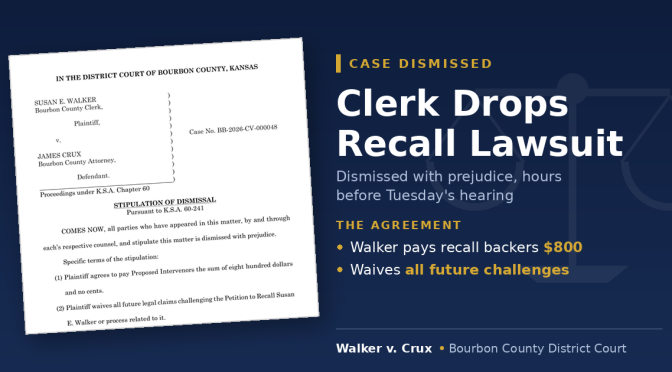
Clerk Drops Recall Lawsuit, Waives Any Future Challenge to the Petition

Bourbon County Clerk Susan Walker has dropped the lawsuit she filed in May to invalidate the petition seeking her recall, ending the case hours before a hearing that had been scheduled for Tuesday afternoon.

A Stipulation of Dismissal was electronically filed at 9:48 a.m. on July 28 in Bourbon County District Court, and District Judge Richard M. Fisher Jr. signed it the same morning. The case, Walker v. Crux (BB-2026-CV-000048), is dismissed with prejudice, meaning Walker cannot bring it again.

A motion hearing had been set for 1:30 p.m. that same day. Court records now show it canceled.

Walker sued on May 22, arguing the recall petition circulated against her was invalid because County Attorney James Crux never issued the written legal-sufficiency determination that K.S.A. 25-4322(b) requires. Her position was that Crux reviewed and rejected an earlier draft but never independently reviewed the amended version that was actually circulated for signatures. She asked the court to declare the petition invalid and to block any recall election based on it.

She originally named Crux along with three recall committee members, Kyle R. Parks, Kevin Wagner and Lyle K. Owenby, then narrowed the case to Crux alone. The three members were dismissed on May 29 and spent June asking the court to let them rejoin.

By July the case had three fully briefed motions waiting on the judge: the committee members’ motion to intervene, Wagner’s motion to set aside the order dismissing the committee, and Crux’s motion for judgment on the pleadings, which asked the court to rule the petition legally sufficient and let it go to the voters. Walker had filed her response to that motion on July 8.

The stipulation was filed under K.S.A. 60-241 by all parties who had appeared in the case. It sets out four terms:

  • Walker agrees to pay the proposed intervenors eight hundred dollars.
  • Walker waives all future legal claims challenging the Petition to Recall Susan E. Walker or process related to it.
  • The proposed intervenors agree to withdraw their motion to intervene.
  • The proposed intervenors waive all claims against Walker for attorney’s fees.

The document is signed by Jonathan L. Ehrlich for Walker, Jacob D. Bielenberg for Crux, and Patrick B. Hughes for the three committee members, who are represented by both Patrick B. Hughes and Quinn M. Hughes.

None of the three contested motions was ever decided.

That distinction matters. Crux’s motion for judgment on the pleadings asked the court to hold that the recall petition was legally sufficient, which was the central legal question in the case. The court never reached it. A judge did not uphold the petition; the challenge to it was withdrawn and waived by the person who brought it.

The motion to intervene was likewise never granted or denied. The committee members withdrew it themselves as part of the agreement. Wagner’s motion to set aside was never decided either.

One note for readers who look the case up themselves: the state’s public case-search portal lists the July 28 disposition as “Dismissed for Lack of Prosecution.” That label does not match the signed order, which is a stipulated dismissal agreed to by every party and entered while the case was actively briefed and set for hearing. The filed document is the authoritative record.

Timeline and documents

For readers who want the fuller history, here are the key filings and our prior coverage, in order:

Background: the recall petition and the clerk’s public statement on the recall.

Read the newest filing: Stipulation of Dismissal (PDF), filed and signed July 28, 2026 in Bourbon County District Court, Case No. BB-2026-CV-000048.

Being named in a lawsuit is not a finding of wrongdoing, and the filings described here reflect each party’s arguments, not the court’s conclusions. FortScott.biz will continue to follow the recall.

City manager: rail spur into the industrial park ‘sounds very possible’

Fort Scott City Manager Brad Matkin told city commissioners on Tuesday, July 21, that he has finally found someone at the railroad willing to talk about running a rail spur into the city’s industrial park — and that the railroad is willing to bring one in.

Nothing has been agreed to, and nobody has voted on anything. But the report was the most concrete public word yet on infrastructure that would shape what kind of employers Fort Scott can try to attract.

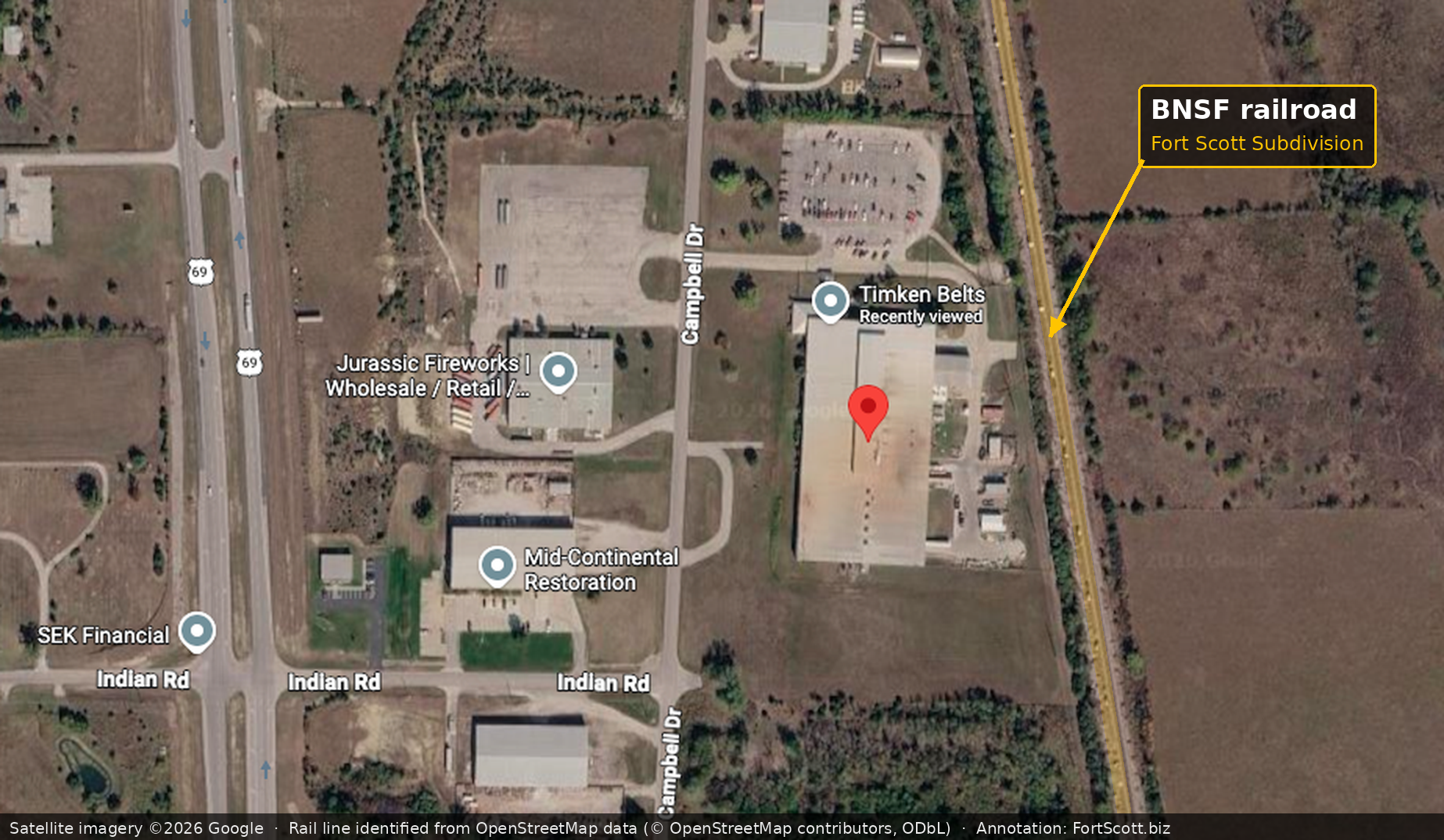
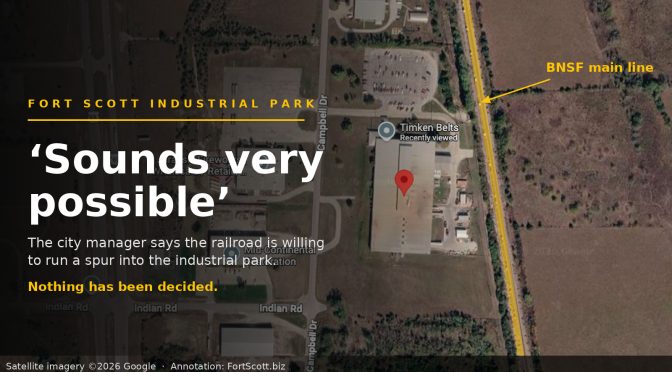
“I finally found somebody from the railroad that wants to talk, and it happens to be an economic development person for the railroad,” Matkin said. After a meeting the previous Friday, he said, “they are willing to bring a spur up right now up to the south of Timken, actually south of Valu.”

“It sounds very possible that we will be getting a railroad spur out to Industrial Park,” he said. “And manufacturing background can tell you how big that is.” He called it “huge for economic development in the future, because not that many industries have spurs going behind them.”

Satellite view of the Fort Scott Industrial Park with the BNSF railroad running north to south along the east edge
The BNSF main line runs north–south just east of the former Timken Belts plant on Campbell Drive. Matkin says the railroad is willing to bring a spur up to the south of the building. Satellite imagery ©2026 Google; annotation by FortScott.biz.

Matkin said they were meeting again that Friday and would “continue meeting until we get this thing ironed out.” He said the railroad “has been listening. They’ve been cooperative. They want the business, of course.”

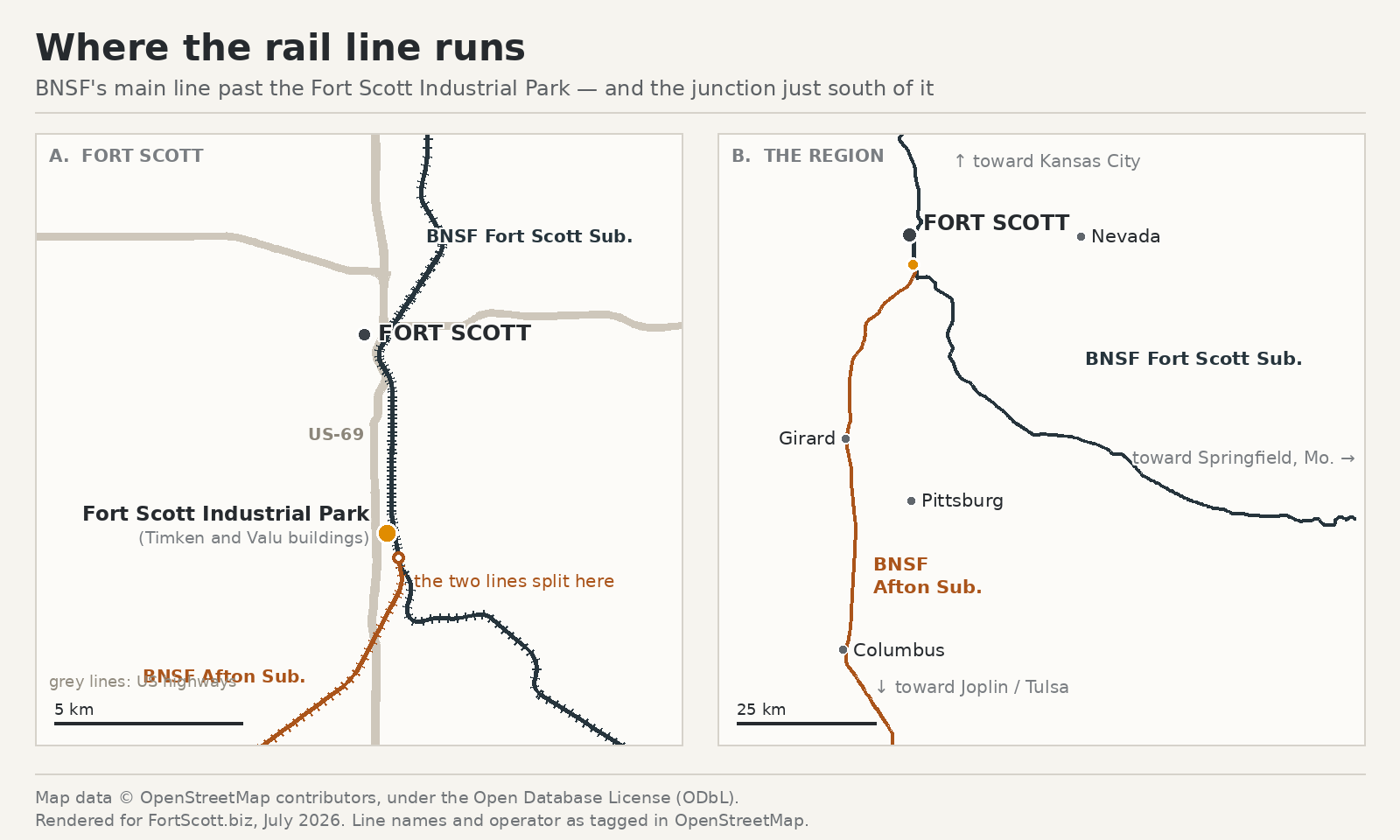
The railroad wants to tie the spur into a Columbus, Kansas, line rather than a Springfield, Missouri, line, Matkin said, adding that he could not explain the reasoning. Public rail maps show two BNSF lines meeting just south of the industrial park — one running southeast toward Springfield, the other southwest through Columbus.

Two-panel map showing the BNSF Fort Scott Subdivision and Afton Subdivision meeting just south of the Fort Scott Industrial Park
Two BNSF lines meet just south of the Fort Scott Industrial Park — one running southeast toward Springfield, Mo., the other southwest through Columbus, Kan. Map data © OpenStreetMap contributors (ODbL).

Matkin’s own ask is that the track not stop short. Running it behind the Timken building, he said, would let more than one company use it: that “would give a runway through their parking lot that you could bring from other companies to that spur.”

That is the case for rail access. A spur ties a plant to the main line, and for a manufacturer that ships heavy or bulk freight, having or sharing one is often what decides whether a site gets a serious look. The company buying the Timken building has raised it with him directly, Matkin said: “They’ve been talking to me about the railroad spur. That’s very important to them.”

The Timken building is why the timing matters. Timken announced in November 2023 that it would wind down its belts plant at 4505 Campbell Road and close it in 2025; about 155 people worked there. On the city’s radio show on July 16, Matkin said “the Timken building is sold. The contract is signed and everything,” with the buyer’s name and line of business expected “later in the month or first of August,” pending paperwork and financing. He has not named the buyer.

Next door, Diversey, the cleaning-products company that said in May it would put a blending plant and warehouse in the former Valu Merchandisers building, is already at work on its building, Matkin said, coordinating with the city’s fire department and engineer on code. Both buildings had been sitting empty. “These are big companies that are coming in,” he said.

A second rail item came up the same night on a different project: Commissioner Matthew Wells asked about the study the city is running with Fontana and Spring Hill through the firm Wilson & Company. That one is about crossings rather than spurs. Fort Scott, Spring Hill and Fontana share a $2.15 million BNSF planning grant, of which $800,000 covers the Fort Scott end of the work; the city put up $40,000 to match it. The study is meant to determine whether Fort Scott needs an overpass, Jayhawk Road is the hoped-for location, and which existing crossing BNSF would want closed in exchange. Matkin said it is underway, with the city’s business development director, Mary Wyatt, leading it.

Matkin’s report on the spur begins about 1:43:40 into the city’s video of the July 21 meeting.

Men’s Grooming Services Shop To Open at 14 E. Wall in August

Parker Stapp and his wife Shawna at the Kentucky Derby. Submitted photo. Stapp wears many hats, the latest is as the owner of the Bourbon Buzz, a new barber shop.

Parker Stapp has always wanted to own a barber shop.

“I’ve been coming to a barber shop since a little boy,” he said. “There is nothing better than walking in, enjoying good conversation, and walking out feeling better; that’s the goal of this new one.”

“We want to be the reason people stay in Fort Scott to get their grooming.”

The Bourbon Buzz is located at 14 E. Wall in historic downtown Fort Scott.

The Bourbon Buzz Men’s Grooming Shop is located at 14 E. Wall, next door to the Common Ground Coffee shop.

“We are offering grooming services: nose and ear waxing, eyebrow shaping (for men),” he said, in addition to haircuts for men.

One of the stations to get a haircut in the Bourbon Buzz barber shop.

He has hired two cosmetologists, Kayla Schwartz and Mac Burton, both of whom grew up here and just moved back. Stapp also recently moved here.

“Fort Scott feels like home,” he said.

Kayla Schwartz. From the business Facebook page.

Kayla has been a licensed cosmetologist for 16 years,  specializing in men’s cuts, trends, and perfecting beards, with a specialty in skin fades, tapering, and razor cuts. 


Macalaster Burton. From the business Facebook page.

Macalaster said she loves helping people leave the chair looking sharp and feeling their best. “Whether you’re coming in for a fresh cut, a beard trim, or just some good conversation, I’d love to have you in my chair.”

Stapp said the owners of the building, Kinede Jennings and her husband, and the city of Fort Scott personnel have helped start the new venture.

Currently, he is waiting on a cosmetology license from the State of Kansas to open the shop, and is putting the finishing touches on the building interior renovation in the historic downtown Fort Scott area.

He hopes to open the shop by August 8.

Hours of operation will be Tuesday through Friday from 10 a.m. to 6 p.m. Saturday hours are 9 a.m. to 5 p.m., and the business is closed on Sundays and Mondays.

Contact information https://www.facebook.com/profile.php?id=61566719832318

Both appointments and walk-in customers are welcome, he said.

The lounge area of the Bourbon Buzz.

Stapp is also a business owner for a taxidermy service and leases about 10,000 acres to do outfitting for deer hunters.

He is delivering white-tail deer mounts this week around the East Coast, he said.


New Women’s Wholeness Seminar Offered by Danielle Bauer

Submitted graphic.
Danielle Bauer and her family have lived in Fort Scott for seven years is offering a free webinar to help women live life to their fullest on July 29 from 6- 7 a.m. CT (online).
Bauer is a mother of four, with another child on the way. She knows the everyday grind of life can be overwhelming.

“After years of feeling overwhelmed and exhausted, I asked out to God for help, peace, and renewed energy. His answer surprised me. He led me to practical skills, intentional habits, and personal formation that transformed the way I lived.

“That journey eventually led me to become a Certified Wholeness Coach.”

“I will be presenting the whole webinar, and I will share more about why women often feel either overwhelmed, anxious, or flat in their lives – why women need more life in their life,” Bauer said.
“Then I will share some practical skills and formation needed to live a life fully alive. And women will hear more about a course I lead women through called the New Woman Masterclass.”
Her testimony
“I can honestly say my life has been transformed by the New Woman Masterclass – a course that has developed in me the skills and formation I never received as a young woman,” she said.
“How is it we get through 12 years of schooling without learning foundational skills like how to make a decision, how to communicate effectively, how to know our irreplaceable self worth and value, how to manage feedback and the opinions of others, how to create boundaries with toxic people, how to have a thriving marriage, how to have optimal health, what deep, meaningful friendships look like, and how to manage our mind, emotions, and thoughts – and direct them to our highest good – not towards our demise.”
“When I had three little children and was underskilled as a young mom, I didn’t realize that challenging moments throughout my day were not big fires – I was making mountains out of molehills because no one had taught me how to manage my thoughts. I was often thinking, ‘my kids are making a mess for me to clean up’, ‘everything depends on me,’ ‘this is TERRIBLE!'”
“Instead, when I learned to manage my mind, I learned to say aloud and in my thoughts: ‘Kids are curious. It’s only a spill; let’s clean it up. This is no big deal.’ Just this one skill of managing one’s own thoughts will impact a woman’s self-worth, her marriage, her family life, her health and so much more.”
“There is so much to be said about how this experience has changed the trajectory of my life. My family is more peaceful. My marriage is thriving. My health has never been better. My house is clean, orderly, and beautiful. My friendships are deep and meaningful. My career is expanding. And I’ve never been more confident and happy ever before in my life. When we begin to see ourselves as a whole woman and gain the skills and formation needed to become the woman God created us to be, then clarity, peace, and order return to our lives (and the lives of those we love)!”

How to join the free online webinar

“If you’re longing for greater peace, purpose, and direction, I’d love to invite you to join me for a FREE online webinar where we’ll explore how to intentionally become the woman God created you to be—instead of simply drifting from one day to the next.

Registration closes soon, and I’d love to have you there.”

Reserve your free seat today:  https://us06web.zoom.us/meeting/register/L8W2Hz-vRrymMI6aoA_rug#/registration


Danielle Bauer. Submitted photo.
Danielle Bauer is Founder at Call Me Blessed, a

Catholic Formation & Wholeness Coaching for Women

She is the RECIPIENT OF 2025 TELEIOS COACHING AWARD
Presented to the Certified Wholeness Coach who embodies and lives out the Wholeness Manifesto
 

Fort Scott backs a $4 million rodeo arena — what was approved

FORT SCOTT, Kan. — City commissioners voted 5-0 Tuesday to authorize City Manager Brad Matkin to begin developing plans for a covered, 2,000-seat rodeo and event arena at the Bourbon County Fairgrounds, a project his own estimate puts at $3,999,000.

What the commission did not do is approve the arena. The motion directs Matkin to bring back firm cost numbers, work with the city’s bond counsel on financing, assemble a task force and seek sponsorships. No bond has been authorized, no lease has been signed, and no construction contract exists.

Rendering of the proposed covered Fort Scott rodeo arena showing grandstand seating, party and VIP decks, and a full roof over the arena.
A rendering of the proposed covered rodeo and event arena at the Bourbon County Fairgrounds, from City Manager Brad Matkin’s July 21 presentation to the Fort Scott City Commission. (City of Fort Scott)

“I would make a motion that we direct Brad to get real numbers, get with Garth on what he needs, set up the task force, set up the sponsorships, and whatever else he feels is needed to make the Fort Scott Rodeo Arena a reality,” Commissioner Matthew Wells said. The motion was seconded, and all five commissioners voted yes.

The “Garth” in the motion is Garth Herrmann of Gilmore & Bell, the city’s bond counsel. The arena was a new-business action item on Tuesday’s agenda.

Matkin’s plan builds on the fairgrounds’ existing 180-by-350-foot dirt arena rather than starting from bare ground. The existing bleachers would come down, replaced with 2,000 stadium seats. The design adds six professional bull chutes, three on each side; roping chutes; a party deck and a VIP deck; a food court for local restaurants; and an announcer stand equipped for electronic scoring.

A roof would cover the arena and both decks. The ends would stay open.

“It would not be totally enclosed because heating and AC would be a big expense for that,” Matkin told commissioners. He said Coach Cross from Fort Scott Community College and other rodeo experts told him the roof alone is what they care about.

Speaking Thursday on the weekly “What’s Up Fort Scott” radio program, Matkin added more: livestock holding facilities, concession areas, 250 outdoor stalls for rent, vendor and trade-show space, extra parking and RV hookups, and a sound system. A removable floor over the arena dirt would let the building host concerts, trade shows and conferences. The city would hire a coordinator to book events.

“We’re not just going to use it once a week. We’re not going to use it twice a week,” he said on the air. “We’re planning on using this thing a lot.”

The land would be leased from the Bourbon County Fair Board, which Matkin said has voted to give the city the opportunity. No lease has been drawn up or executed; he told commissioners he had not yet worked it through with the city attorney and would bring an agreement back before signing.

Matkin framed the arena as a revenue problem, not a rodeo one. City sales tax collections are on pace to fall $155,000 from 2025 to 2026, he said, and $302,000 since 2024. Sales tax, he argued, is what keeps property taxes down and pays for police, fire, parks and streets.

His proof of concept is a rodeo the city does not own. Fort Scott Community College’s three-day spring rodeo drew more than 3,900 spectators this year into Arnold Arena, which seats just over 500. Using Placer AI, a foot-traffic service the city subscribes to, Matkin tracked where they went afterward: 772 to Sharky’s Pub and Grub, 770 to McDonald’s, 673 to Casey’s, and several hundred more across Pete’s, the retail center and three local hotels.

He also pointed to a much smaller Kansas town.

“Population of Pretty Prairie, Kansas, 650 people. They put on a four-day rodeo event. Their attendance, 26,500 people,” Matkin said. “I’ve said this for four years. Why not us? Why not Fort Scott?”

The crowding costs the city visitors outright, he argued, describing a barrel racer whose own family skipped her college rodeos here because they could not get seats.

“You are literally just squeezed in there like sardines,” Buchta said, adding that she is grateful the college hosts the events at all.

Matkin’s presentation totals the project at $3,999,000, led by the roof at $1.8 million, lights and electrical at $981,000, and seating at $800,000. Smaller pieces include $85,000 for bathrooms, $68,000 for large fans and $60,000 for bull chutes. Speaking to commissioners he rounded it off: “I’m just going to say, $4 million.”

He said state officials pointed him first at STAR bonds, which use sales tax revenue generated inside a project district to repay the debt. He does not want that.

“To do what this is supposed to do, we don’t want to stop our sales tax from growing,” Matkin said. “So a star bond to me is an option, but not the best when you’re wanting to increase sales tax.”

Buchta asked him to clarify that for the public: he meant sales tax revenues, not the rate. “We will not increase sales tax,” Matkin said.

His preferred mix is a conventional bond paid from the city budget, plus grants, property sales, sponsorships and an annual rodeo gala. He said he has a verbal commitment of $20,000 for the party deck, which he described as a three-year commitment that would then need renewing.

Commissioner Tim Van Hoecke asked whether the city would take a cut of ticket sales or concessions, since it would be paying for the building. Matkin said a portion would come back, though part of any gate goes to prize money. Commissioner Tracy Dancer asked whether the site could handle livestock waste; Matkin said it could, noting a 12-inch water line serves the grounds.

Wells said an earlier feasibility study showed a Fort Scott arena would draw from Oklahoma, Arkansas and Missouri, and warned that at least five communities within 40 minutes are eyeing similar projects.

“If we’re going to strike, we should strike while the iron’s hot,” he said.

Buchta tied it to the budget. “I feel like we really have to focus on revenue creators,” she said. “I don’t want us to have to cut services.”

Earlier in the meeting, resident Michael Hoyt used public comment to flag a new state law that could bear on how a project like this gets financed. House Bill 2622, which took effect July 1, tightens protest-petition requirements on municipal lease-purchase agreements.

“Anything over $100,000 is subject now to a protest petition by the voters if they do not agree with the lease purchase agreement,” Hoyt said. By his count it would take 186 signatures to force the question onto a special election ballot, and he told commissioners past special elections had cost the city roughly $5,000 apiece.

Hoyt raised the law about city budgeting generally, not the arena, and the arena’s preferred financing is a traditional bond rather than a lease-purchase. But the city has not settled on a structure.

Approved July 21: authority for the city manager to pursue the project: firm cost estimates, bond-counsel work on financing options, a task force, and sponsorships.

Not approved, and not yet done: firm costs. A financing or bond decision. An executed lease with the Bourbon County Fair Board. Sponsorships or the proposed annual gala. Hiring an events coordinator. And a decision to build.

Matkin wants the project moving in 2027. “Work just begun, I have a feeling,” he told commissioners after the vote.

Read the full proposal: City Manager Brad Matkin’s 15-slide rodeo arena presentation to the Fort Scott City Commission, July 21, 2026 (PDF).

Official minutes from the July 21 meeting have not been posted. This account is drawn from the meeting and the agenda packet.

Opinion: Commissioners’ Responsibility to the Taxpayers – Mark Shead

Four years ago Bourbon County handed over significant taxpayer resources to Legacy Healthcare Foundation. This donation was the former Mercy hospital campus and $2 million. The agreement included a list of conditions all designed to make sure the massive donation was used in ways that benefit the taxpayer and ensure that Bourbon County would continue to have access to healthcare.

Some of the requirements imposed on Legacy Healthcare Foundation in return for the donation:

  1. The $2 million can only be spent in three ways: building maintenance, operating costs including “development of an Acute Care Hospital,” and reduced rent for tenants providing “a legitimate community benefit.”
  2. Proof of backing at closing — either a Bourbon County property purchase over $300,000, or a line of credit secured by a lending institution for $2 million or more.
  3. Insurance naming the county — the recipient “shall have the Donor as a secondary insured” against wind, rain, tornado and fire.
  4. An EMS transaction by Jan. 1, 2023. This came with a firm date, and the donation agreement only says it would involve “an agreed upon subsidy”.
  5. Parcels can be transferred, but only where “the general purpose is for the development of these parcels for Bourbon County, Kansas.”

Whether the terms of the agreement have been met or not isn’t entirely clear. If $2 million was spent on building maintenance, it seems odd that the roof would be left to leak buckets of water every time it rains like some of the employees in the building claim is happening. Did Legacy spend the $2 million on maintenance and simply prioritize things other than the roof?

Several parcels have been transferred to Legacy Development Fort Scott Highway 69 Project, presumably meeting the terms of the agreement but that entity has unpaid taxes on that land clear back to 2023.

Since the agreement didn’t include any reporting requirement, it is up to the county commissioners to verify that the taxpayers are getting what they were promised in exchange for the building and cash.

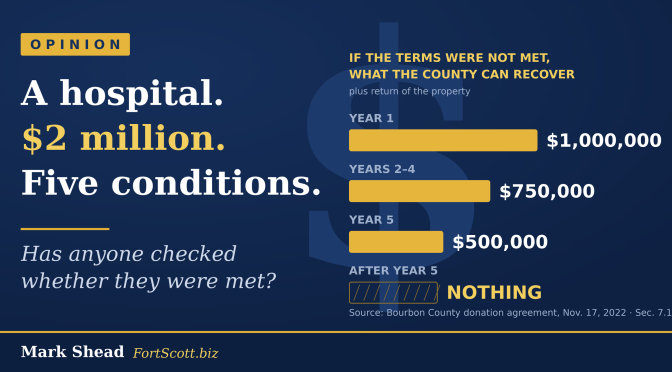
If the terms aren’t met, the agreement gives the county one remedy: unwind the deal, take the property back, plus a refund of the cash donation that shrinks every year: $1 million, then $750,000, then $500,000. After the fifth year, in the agreement’s own words, “Donor will have no remedies.”

We are somewhere in year four. The agreement never says exactly when the clock started, but it becomes more urgent each day.

The commissioners owe it to the taxpayers to make sure this massive donation of taxpayer resources is not squandered. If the commissioners have all done their due diligence, looked into it, and believe the terms have all been met, then they need to state that plainly, show how all the terms have indeed been satisfied, and then move on to other matters. If Legacy hasn’t met the terms, then they need to make sure that the taxpayers don’t throw away what was originally a $45 million building project along with $2 million of cash and end up with a water-damaged, unmaintained building that has no hope of housing any of the healthcare services this county needs.

The worst thing the commissioners could do is to decide they can’t be bothered to see if the terms have been met until it is too late to do anything about it.

Mark Shead

Note: FortScott.biz publishes opinion pieces with a variety of perspectives. If you would like to share your opinion, please send a letter to news@fortscott.biz.

Bourbon County Budget Town Hall: A Growth Debate, Three Fixes and a $625,000 Dispute

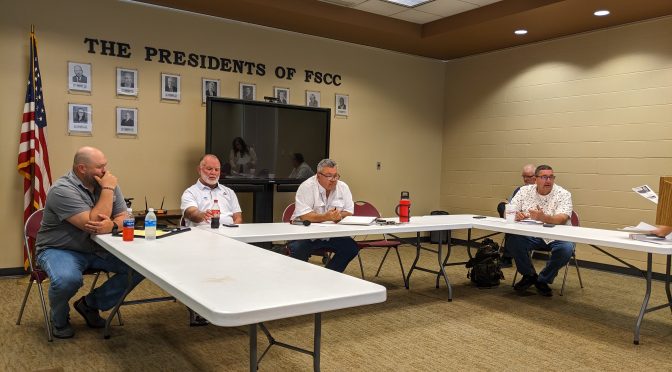
All five Bourbon County commissioners spent two and a half hours at Fort Scott Community College on Wednesday, July 22, taking open-floor questions on the 2027 budget, the county counselor’s contract, the comprehensive plan, outsourcing, staffing and property taxes. The town hall was the most detailed public back and forth with constituents and highlighted the challenges facing Bourbon County.

District 1 Commissioner Samuel Tran, who chairs the board, opened with what he called rules of engagement. “Rule number one, very paramount, is be civil,” Tran said. “Be passionate. But please be civil.” He was joined by David Beerbower (District 2), Joe Allen (District 3), Gregg Motley (District 4) and Mika Milburn Kee (District 5).

Who did the talking

Billed as a chance for residents to be heard, the evening spent about 42% of the time hearing from the audience with commissioners holding the floor approximately 58% of the time. Tran spoke the most, at approximately 29% of the total, followed by Milburn Kee at approximately 11%, Beerbower at approximately 9%, Motley at approximately 8% and Allen at approximately 2%.

Tran argues growth is driving up taxes

A point of numerical and tax distribution disagreement surfaced early: whether Bourbon County is growing at all and whether more homes would raise or lower taxes.

Defending zoning and the comprehensive plan as protective tools, Tran argued the county needs rules in place before development arrives. “People are moving here. People are moving out of the city.” The county doesn’t track how much is being built, he said: “I drive up and down some of these roads and I’m like, wow, that’s a really nice mansion.”

Asked directly whether the county’s population has been growing, Tran conceded, “Right now, I don’t think it’s growing,” arguing instead that rising property values in Miami and Linn counties signal a wave moving toward Bourbon County, and that people who balk at a 30-minute commute today will eventually drive two hours. Pressed that he seemed to be describing the growth of inflation rather than population growth, Tran answered, “It’s both.” He returned to the tax consequence: “Now, can you imagine 500, 600 people moved into Fort Scott and start building these big homes? You don’t think that those taxes, your taxes are going to go up?”

Motley cut in before the topic moved on, with numbers. “Between the 2010 and the 2020 census, Bourbon County lost 810 people, about 81 people per year,” he said. “That rate of decline has slowed down a little bit.” He added that the total mill levy in the county runs about 168 mills, and county government accounts for only about 30% of it — the rest set by schools, cities, townships, fire districts and cemeteries.

Motley’s prescription: bring the work home & fix pay

Asked near the end of the night what he would do with the 2027 budget to move the county toward fiscal stability and a reserve fund, Motley, a retired banker,  made three points.

First, stop outsourcing. Motley noted there were 15,300 banks in the United States when he started in 1979 and fewer than 4,000 when he retired in 2024, with survivors buying scale to escape the outsourcing trap. “It’s 20% more expensive in the long term to outsource functions, especially when we have qualified people within the county,” he said.

Second, the hidden cost of sending money out of town. “Every county has a measured statistic they call pull factor. What percentage of money earned by Bourbon County citizens are spent in Bourbon County? And our pull factor is about 77%,” Motley said. Paying vendors outside the county — or outside the state — drives that number down. “Money spent in the county is spent over and over and over again until it exits somehow. So that’s a hidden cost to us that we don’t see.”

Third, change how the county pays people. Bourbon County has leaned on benefits rather than salary to attract employees, Motley said, and benefits are the part the county cannot control. At Landmark, “we paid in the top one-third of salaries for our employees … but our benefits were in the lower range. And we did that intentionally because we can control this number, but … we can’t control that benefits number. And those benefits are accelerating dramatically.” He had hoped for a salary survey this year and did not get one, and warned against an abrupt switch: “These are human beings … we can’t just pull the rug out from underneath them.”

A $625,000 dispute

Michael Hoyt argued in a prepared analysis that the current commission spends roughly $625,303 more than the last one, about $344,000 of it recurring — citing a county counselor at about $96,000 against a predecessor at $58,000, $114,200 in outside legal fees and outsourced human resources at $56,000. Former commissioners Clifton Beth, Jim Harris and Brandon Whisenhunt may be owed an apology, Hoyt said, arguing they were criticized as irresponsible with money but managed the county’s core functions for less.

Commissioners Milburn disputed the numbers saying the  counselor’s salary is about $2,000 more, closer to $98,000, but he takes neither insurance nor KPERS. The commissioners said that much of the outside legal spending defended the county against inherited litigation, and that all three outsourced contractors submitted flat budgets for next year. Mike Wunderly noted that $116,500 of Hoyt’s total is the comprehensive plan, which Beerbower had already moved on Monday, July 20, to freeze this year, “so that changes that number considerably.” Hoyt later said that his overall numbers did not include the comprehensive plan cost.

What residents asked for

Heather Etheridge, president of the West Plains and Centerville cemeteries, described driving to Linn County to get help creating her cemetery budget. Told an increase amounted to pennies, she pushed back: “How much is it going to cost my people? Because these are my people.”

Jackie Brown, a lifelong resident, said the county is “taxing people out of their homes,” called for a forensic audit, and asked commissioners to end the public bickering among elected officials. “We have to stop voting popularity contests. We have to start voting in people who are capable of doing the job.” Anne Dare backed an audit too — “if you’re going to audit one, you need to audit all” — and called for a return to basics: law enforcement, ambulance service and roads, questioning whether the sheriff’s request of up to $2 million for radios and towers qualifies. Clint Walker said the county leaves FEMA and grant money on the table and has no maintenance program: “We don’t hire diesel mechanics. We farm it all out.”

Beerbower mentioned the theme he says he has pressed all year. “Doing the same thing over and over again, expecting different results is just insane,” he said. “Reset. We need to reset.”

U.S.D. 234 Enrollment Has Started for the 2026-27 Year, With Some New Staff and Teachers

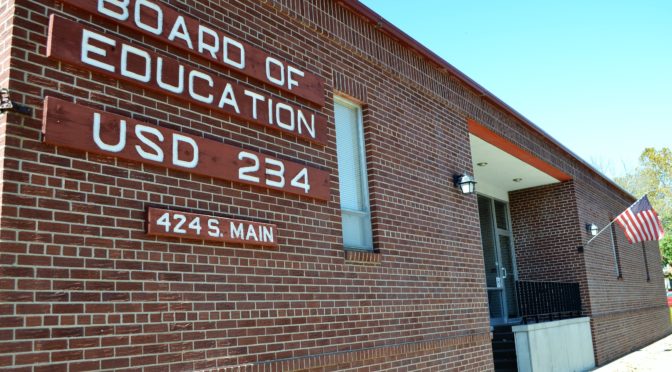
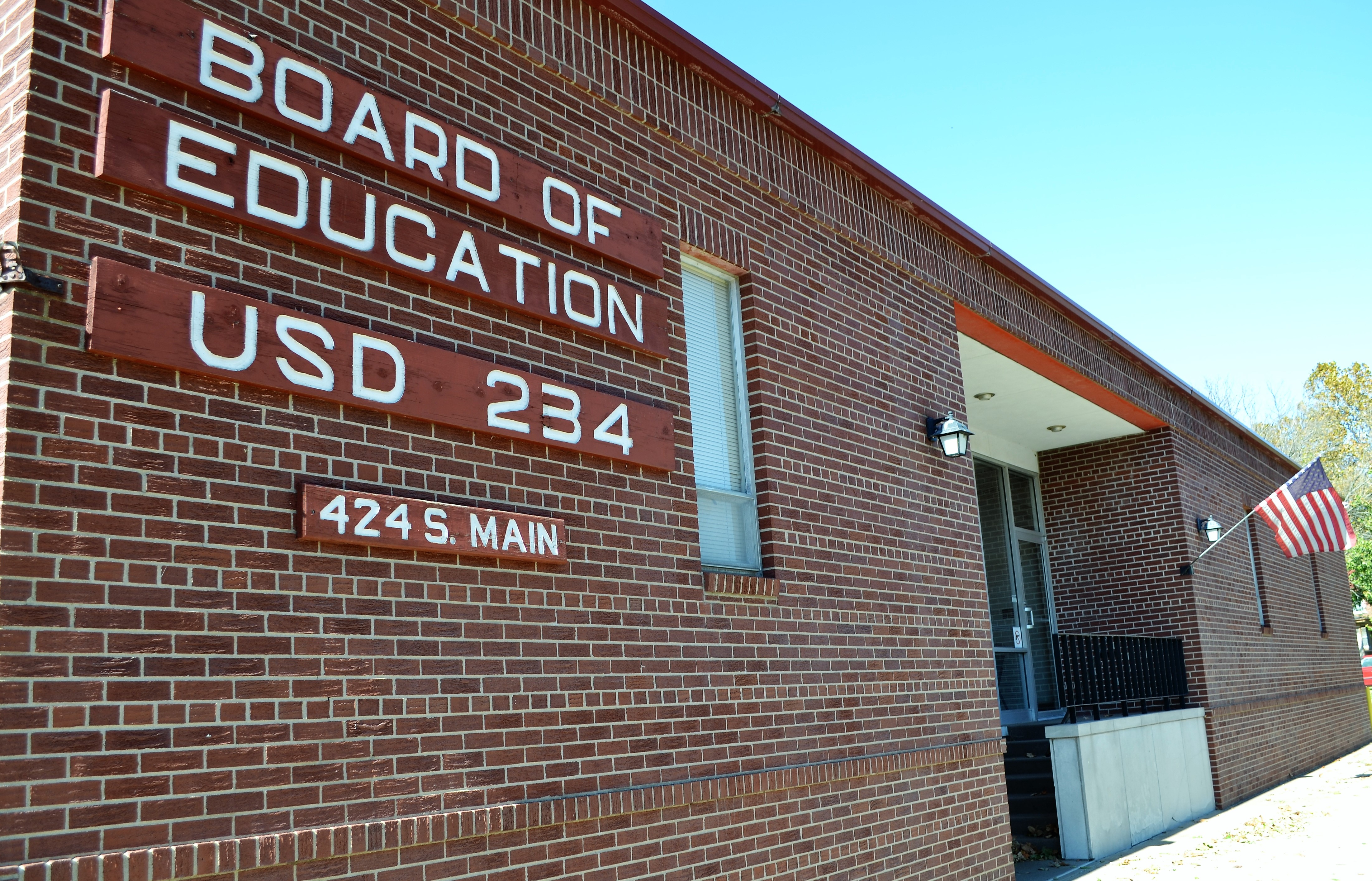
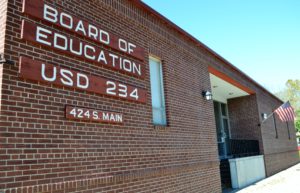
U.S.D. 234 Board of Education Building, 424 S. Main
The U.S.D. 234, Fort Scott School District, starts the 2026-27 school year on Friday, August 14, a little over three weeks away.
Enrollment is currently open and can be done through PowerSchool, a district-wide computer software program.
If a student is new to the district, they must sign up at their school’s building office.
August 10-13 are pre-service and work days in the district.
August 14 is the first day for students.
December 21 through January 1 is Christmas break.
Spring break is March 15-19.
The last day of school is May 14.
The following are newly hired staff and teachers for the year:
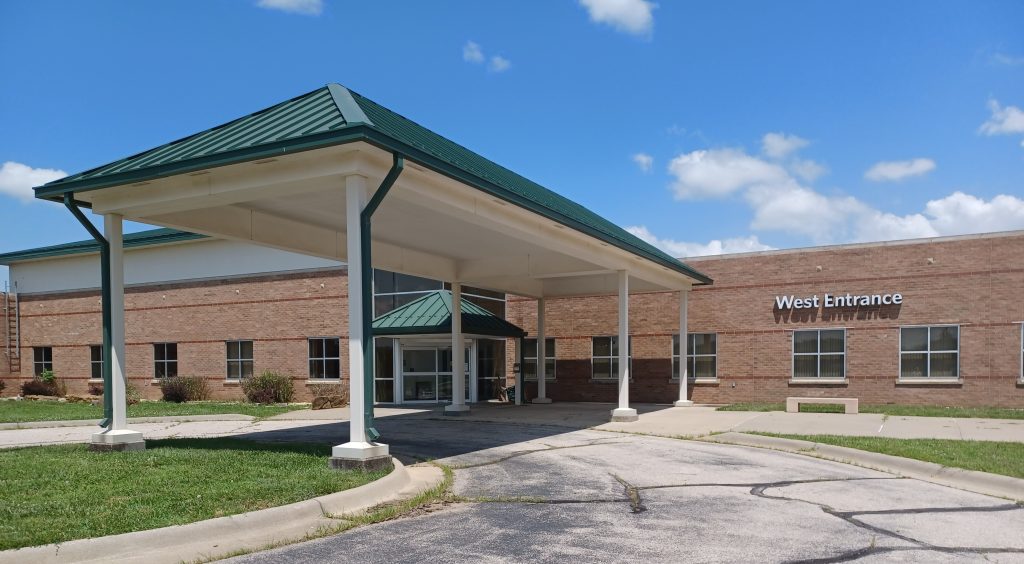
The west entrance of the Kansas Renewal Institute, June 2024.
KRI is located at 401 Woodland Hills Blvd., Fort Scott.
Kansas Renewal Institute-Danae Esslinger
Unified School District 234 is committed to providing general and special education services to KRI residents within school age. These services will be provided on-site at Kansas Renewal Institute, according to a prior fortscott.biz interview with KRI administration.
The Fort Scott Preschool, at 409 S. Judson.
Fort Scott Preschool-Alyssa Smith, special education
Winfield Scott Elementary School, 316 W. 10th Street, Fort Scott.
Winfield Scott Elementary School: Caleb Hendricks-assistant principal, MaKayla Pickert- second grade, Madison Hughes-physical education, Kimberly Demko-speech/language, Katherine Hill and Emily Stephans-special education.
Eugene Ware Elementary School, 900 E. Third Street.
Eugene Ware Elementary School: There are no new teachers, and the administration is still hiring for paraprofessionals that are needed, according to a spokesman at Eugene Ware.
Fort Scott Middle School. 1105 East 12th Street.
Fort Scott Middle School: Jennifer Ellis-science, Don VanBuskirk-business essentials, electives, history instruction, Dawna Krebs-math teacher, Trinadie Oney-science teacher.
Fort Scott High School. 1005 S. Main.
Fort Scott High School: Jared Martin, athletic director; Ashley Keylon-counselor, Dan
i Cummings-business teacher, Sage Hill-special education teacher, and Lucretia Rugero, special education.
The school district’s board of education phone number is: 620-223-0800.

New Women’s Clothing Boutique Opens August 1: Midwest Runway


Maria Morris. Submitted photo.

Maria Morris grew up on the Kansas/Missouri border in Deerfield, MO.

“I bar tended at Sharkey’s Pub for eleven years,” Morris said. “A year ago, I decided to start a different career. I always loved fashion, so I decided to follow my dream and own a clothing store.”

She started her venture in Nevada, MO in 2025.

“I was talking to Dean Striler (co-owner of the new space she is leasing in Fort Scott), and he presented the opportunity to open in Fort Scott. I always loved the community of Fort Scott and wanted to be a part of bringing customers to the area.”

The new space is 6 North Main, the former Tribune storefront.

The name of her new venture is Midwest Runway.

“I am really excited to be a part of the community,” she said. “I believe clothing is more than what we wear, but is also a unique part of who God created us to be.”


The next two weeks are the last weeks at her location at 14182 E. U.S. 54 Hwy, Nevada, and also starting the move to the new location in downtown Fort Scott.


Once she gets moved in, there will be a grand opening on Saturday, August 1, from 9 a.m. to 3 p.m. Normal hours will follow: Monday through Thursday from 10 a.m. to 5 p.m., Friday from 9 a.m. to 6 p.m., and Saturday from 9 a.m. to noon. The business is closed on Sundays.


Morris said she likes to “make women feel empowered and beautiful on the outside and the inside.”


The selection ranges from lounge wear to special-occasion clothing.

“Outfits you can take from day to night,” she said.

Sammie Barner is the manager of Midwest Runway. Submitted photo.

Sammie Barner will be the store manager, and there are some part-time employees as well.

The business can be contacted on its Facebook and Instagram pages or at midwestrunwayboutique@gmail.com.

New Superintendent For Fort Scott School District: Zach Johnson

USD 234 Board of Education Building, 424 S. Main

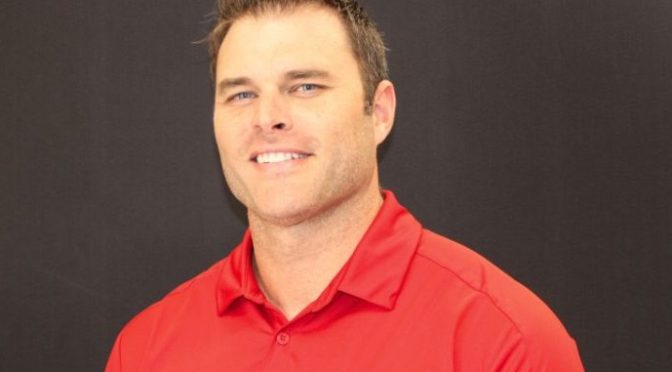
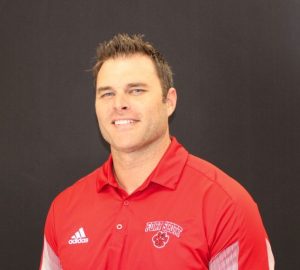
Zach Johnson is the new superintendent for U.S.D. 234, Fort Scott’s school district, as of July 1.

ZJHeadshot – 1

As a leader, Johnson hopes to help facilitate a collective vision that focuses on the success of all students, he said.

“I believe in supporting and creating a culture that adds value and support to our staff. I look forward to working alongside our staff to create positive student outcomes every year.”

Background

“I am originally from Willard Missouri. I have been in education for 13 years. I have spent six of those years as a teacher and coach in Missouri. I then spent four years as an assistant principal/athletic director at Field Kindley High School in Coffeyville and I was the principal at Fort Scott Middle School for three years, and assistant superintendent for one year.”

Family

“My wife Bethany is a therapist at Kansas Renewal Institute (KRI). We have four kids. We are very active in the school and the Fort Scott community. We are excited to be here and look forward to continuing to build connections throughout our community.”

What is the best thing about being in education for you?

” The relationships that are made and the positive impact that is made on students.”

What is a challenge?

” I believe a challenge would be external factors that influence our district and other school districts across Kansas. Examples would be state and federal legislation that affects public education and the day-to-day work of educators.”

Is there anything new on the horizon for the district this year?-

” I am excited for the strategic planning that we will begin working on. This process will involve all stakeholders in our community to help develop the mission, vision, and values for U.S.D. 234. More information will come as we get closer to the school year.”

Frankie’s Mission: Helping the Homeless

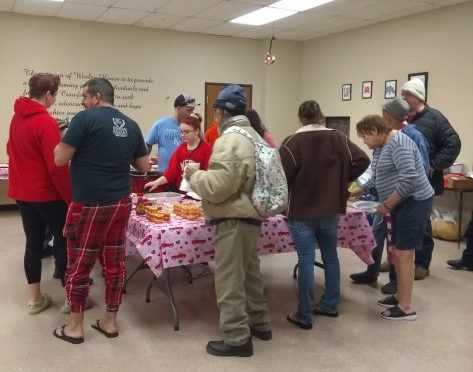
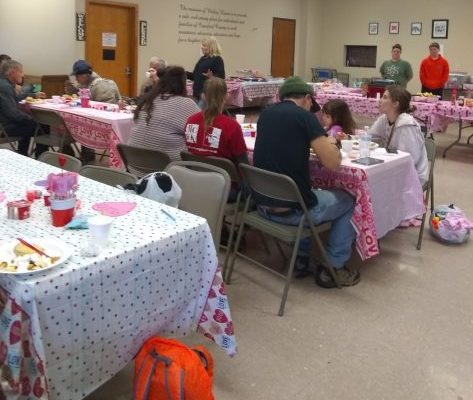
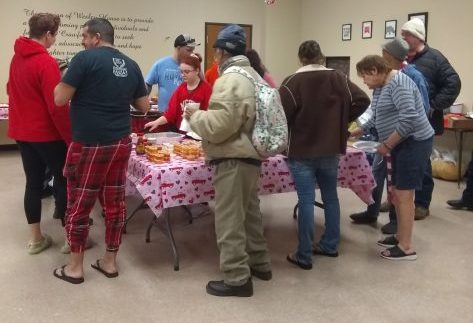
Submitted photos. Frankie’s Mission volunteers had a dinner at Wesley House for the homeless in Pittsburg.
Vickie Crowe, Fort Scott,  started a mission to honor her son Frankie, who died about three years ago, and was homeless.

Since then, the group that has volunteered to help her has held dinners for the homeless at Wesley House and the Salvation Army in Pittsburg because she couldn’t find a place in Fort Scott to do a dinner, she said. She also does mission work in Pittsburg.

Recently, at the Heritage Pavilion in Fort Scott, she and a group of helpers handed out sack lunches to those in need.
“We would like to do more and more often,” she said. “We have to raise money to do this.”
The group that helps the mission consists of Cara Guthrie, Donna Brisbin, Jeri Mitchell, and Burt Hawkins, and recently some others have expressed interest in joining the group, she said.
Submitted photos from Vickie Crowe, a dinner for the homeless in Pittsburg.
Frankie’s Mission is a non-profit organization in Fort Scott.
“We help the homeless and less fortunate,” said Vickie Crow. “We pass out food, hygiene items, clothes, etc. We recently set up at the pavilion and handed out sack lunches and hygiene supplies . The photos I sent are of dinners we have had. We do things to raise money to do this stuff.”
A free-will donation yard sale to benefit the mission will be held on July 31 to August 1 from 8 a.m. to 2 p.m. Donations for the sale are accepted.
The yard sale will be at 2403 Jayhawk.
Submitted photos of the dinner for the homeless in Pittsburg, which Frankie’s Mission volunteers supplied.

For questions, contact Crowe at vickiebrewercrowe@gmail.com

or

phone number 620-215-4816.