John Snalt, a member of the MGODGAOALGMPTA (Make Good Old Days Great Again Or At Least Get More People To Attend) advisory committee, says he has been working tirelessly to restore the annual event to its former greatness, or at least to a level of greatness that can be considered both good and old for at least one day.
“We spent a lot of time carefully studying what made Good Old Days successful in the past,” Snalt said. “The biggest crowds came in 1986. In more recent years, one of the most popular attractions was DockDogs.”
DockDogs, for those unfamiliar, is the event in which highly motivated dogs sprint down a dock and launch themselves into a swimming pool in an effort to see which dog can jump the farthest. It has long been regarded as one of the festival’s more understandable traditions.
According to Snalt, the committee’s research showed that 1986 had a major factor working in its favor.
“1986 was also the year of the great flood,” he said. “We do not believe it was a coincidence that attendance peaked during the same general era in which large portions of the county had recently been underwater.”
The committee reportedly spent months exploring ways to recreate the conditions of 1986. Several proposals were rejected after being described by engineers as “catastrophic,” by accountants as “unfundable,” and by attorneys as “the sort of thing that would follow you for the rest of your life.”
“We had one very promising concept involving levees, backhoes, and just a truly awe-inspiring amount of dynamite,” Snalt said. “But those good-for-nothing lawyers started using phrases like ‘federal charges’ and ‘multi-agency response,’ and that really killed the momentum.”
Forced back to the drawing board, the committee began searching for individual elements of the 1986 experience that could be reproduced without requiring evacuation maps, massive casualties, or court appearances. That is when they found what Snalt calls “the breakthrough.”
“In 1986, millions of people saw that famous photograph of cows standing on a roof here in Bourbon County,” he said. “And when you look at the timing, it’s hard to ignore the possibility that roof cows were the secret ingredient all along.”
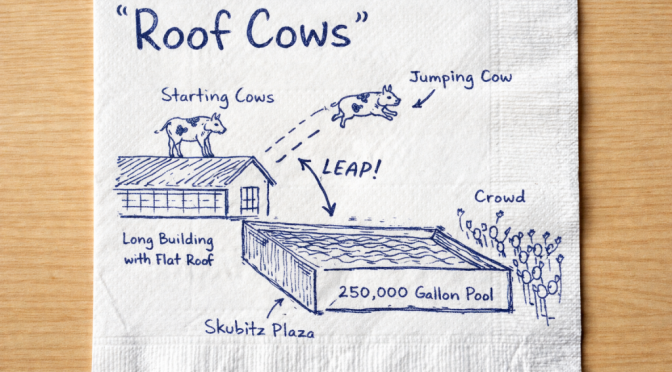
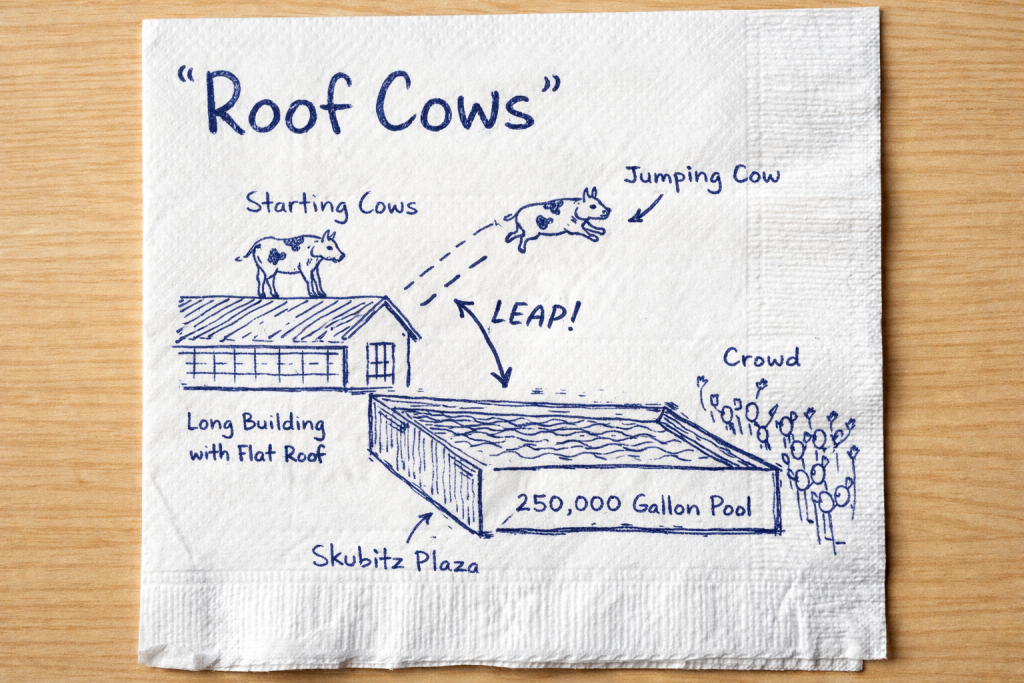
This year’s featured attraction, Roof Cows, is intended to test that theory with what organizers describe as “a data-driven, family-oriented aerial livestock experience.”
Current plans call for the construction of a long, low building with a reinforced flat roof in Skubitz Plaza. Several cows will be positioned on top, where they will be given a short running lane before launching themselves toward a 250,000-gallon pool below in a bold reimagining of DockDogs, but with substantially more insurance paperwork.
Festival organizers say the event will combine nostalgia, local history, and the unmistakable thrill of watching an event conceived with enormously poor judgment executed before your very eyes.
“We’re not entirely sure why images of cows on roofs near floodwater captured the public imagination,” Snalt admitted. “But the data doesn’t lie. People saw roof cows, and shortly afterward Good Old Days had huge crowds. That’s what science people call a pattern.”
Asked whether cows are naturally inclined to sprint across rooftops and leap into deep water before cheering spectators, Snalt said the committee prefers to remain “solutions-focused.”
“There’s always negativity when you’re trying to innovate,” he said. “People said the same thing about DockDogs. Granted, in that case the dogs actually wanted to do it, but still.”
The proposal has already drawn praise from residents who say the festival has been missing the kind of bold thinking that can only come from selective memory, questionable historical analysis, and a total misunderstanding of causation.
Snalt confirmed that the plans were finalized on April 1.
“These ideas really seem to come together best on that date,” he said.
Good Ol Days 1986 was in June. The 1986 flood was in October.
How did the cows on the room affect the 1986 attendance?