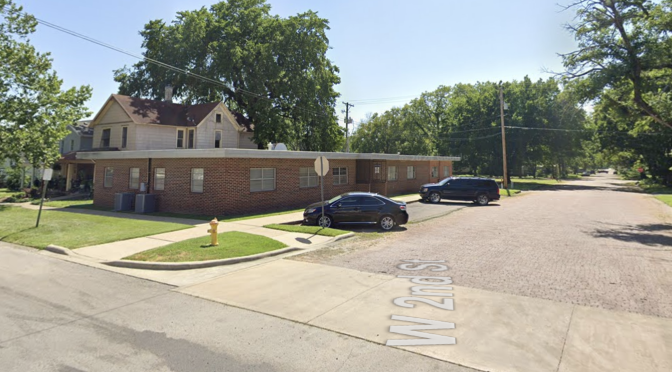
FORT SCOTT — Bourbon County’s chief district judge asked county commissioners Wednesday night to let the district court operate virtually from a county-owned building at 108 W. Second St. for roughly a month this fall, while the courthouse elevator is rebuilt.
Chief Judge Amy Harth presented the plan as a proposal, not a settled decision, and said she cannot commit the court on her own. Commissioners took no votes; it was a work session, and no motions were made.
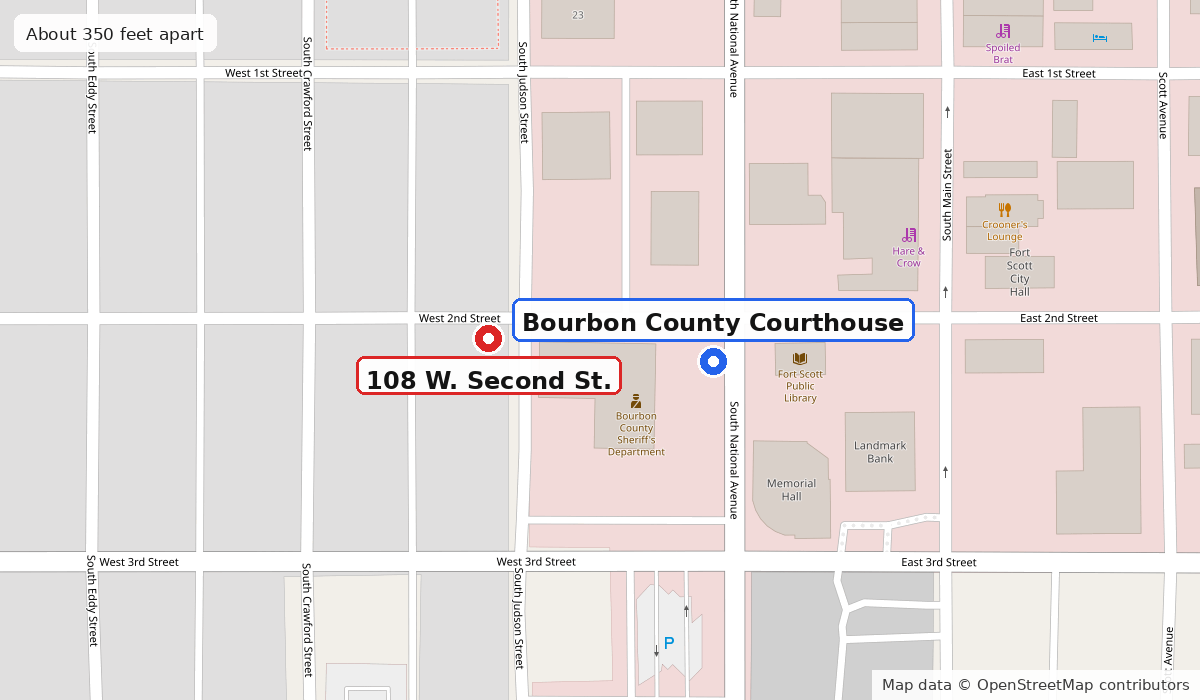
The proposal scales back an earlier concept — building out a 40-by-40 courtroom at 108 W. Second — that commissioners and court staff had been weighing alongside a look at the former federal courtroom at the Fort Scott Post Office. Harth said she developed the new approach over the previous day or two with Chief Clerk Administrator Stephanie Gerken and Bourbon County District Court Clerk Melissa Trim, and had taken it to the district’s other judges.
“In terms of trying to minimize fiscal impact for you all, I am proposing that we use that space,” Harth said. “It will need some work. I want to be clear about that. We can’t use it the way it is right this minute. We’re proposing to use that space to move court virtual for those 30 days, for those four weeks.” (video, 39:53)
The courthouse elevator is working now. The four-week outage under discussion is the planned Otis modernization, not the breakdown that put the elevator out of service earlier this summer.
“When the elevator is under repair, we have to continue with court operations,” Harth said. “We’re operational, which is great. But when it goes down for repair, the days we were quoted was 30.” (video, 34:44)
What the plan would do
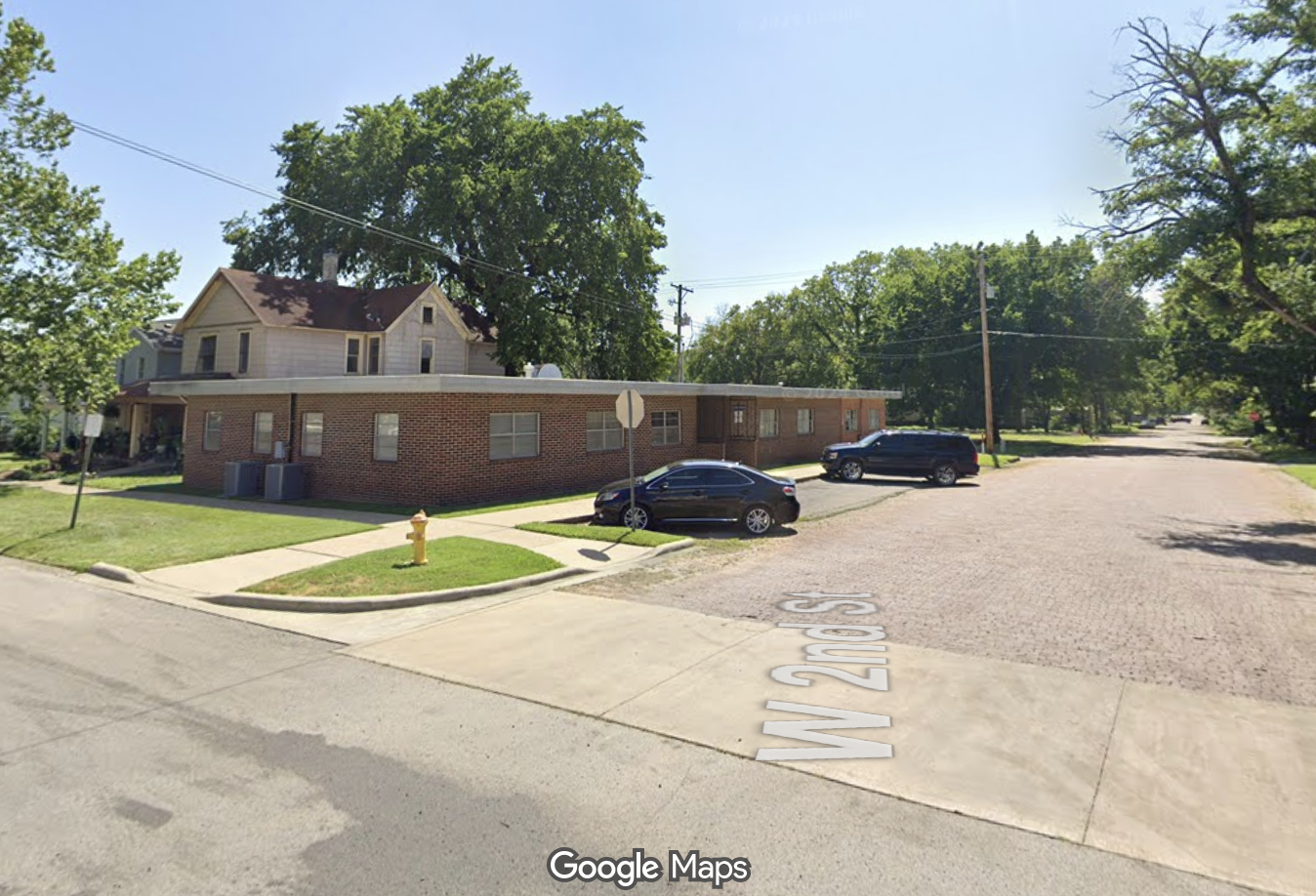
Under the proposal, security would move to the front door at 108 W. Second. Two to three court clerks would be stationed there to handle public interface. The eight offices running around the outside of the building could serve as Zoom rooms and other flexible court space.
“They already have doors on them, so for confidential hearings, that helps out with that,” Harth said, naming child in need of care and adoption cases. The rooms would also let the court separate litigants in protection-from-abuse and protection-from-stalking cases, and give the county attorney a place to sit with a witness. (video, 49:02)
Three smart TVs would live-stream the Zoom proceedings so the public can watch. Hearings would still be recorded from the courtroom upstairs, and inmates would appear virtually from the jail.
Harth asked commissioners to vote to close public access to the courthouse’s second and third floors while the court is operating off site. Since this meeting was a work session no decisions were made. That vote could be made at the next scheduled meeting on Monday.
“The other thing about you all just saying no access is people will get confused about where they’re supposed to go for court,” she said. “Versus if you all post it and say there is no public access to the second and third floor, you can put a sign right at the front and say if you have court business, go to 108.” (video, 60:32)
The court’s shift to centralized case management is what makes the move practical, Harth said: “The great thing about us going to centralized case management is we can just, if we have Wi-Fi, we can pick up and move.” (video, 59:54)
Gerken, the district’s chief clerk administrator, said public access is not optional.
“We’re going to have to have the public access,” she said. “Because this going up there, we were running up and down the stairs trying to serve the public, and that’s just an accident waiting to happen.” (video, 65:35)
The timeline
Chairman Samuel Tran said he spoke with Otis the day of the meeting. The company needs a three-week lead time to get parts delivered, then two weeks for the modernization itself, one week to tie the new equipment into building power, and a fourth week of cushion.
“That’s where the four weeks comes in,” Tran said. … “And then a spare week just in case they need a little bit more time. And that’s standard.” (video, 36:04)
The elevator keeps running until the work actually begins, he said: “Nothing gets shut down until they’re ready to start. The elevator will be fully operational.” (video, 38:29)
Otis currently has the county scheduled for the whole month of October. Harth first asked whether the work could start Oct. 26, then proposed Oct. 20, citing a jury trial expected to run through Oct. 2 and a separate commitment on Oct. 19.
“If they could start the 20th, that would be even better,” she said, adding that it would also leave cushion before Thanksgiving week. (video, 39:17)
Tran said he would ask, and pressed for Otis to come to Fort Scott for a pre-construction meeting with the judge, court staff, commissioners and maintenance personnel.
“They can outline the table of events, how they plan it, all the different phases of construction,” he said. “And then you can decide whether you want it from October the 20th to November the 10th, or do you want it sooner.” (video, 50:43)
Commissioners discussed holding that meeting Wednesday, Aug. 19, possibly an hour before a budget work session, but did not finalize a date. Tran had not reached the Otis representative by the end of the meeting and said he would follow up with Harth.
A possible asbestos question at 108
Tran raised a complication near the end of the meeting. While the others walked the building, he said, he had been looking for hazards, drawing on a safety certification he previously held.
“In one of the closets, there are nine-by-nine floor tiles. And in that room, the carpet is not glued down, it’s taped. So that tells me to be careful,” he said. “Do I think there’s a hazard to your health or your staff’s health right now? No, I do not. But what I’m saying is if you do any type of construction, I would have somebody look at what you’re trying to do.” (video, 55:17)
Nine-by-nine floor tile is a common indicator of asbestos-era material. Tran said he expected an abatement company would have to come from Kansas City. No local company was identified during the discussion.
Paying for it
Commissioner Gregg Motley said grant money looks unlikely.
“There’s very few grants, private grants, for government, and there’s even fewer for construction or remodeling,” he said. Most of the grants they had looked at go to dual-purpose buildings, he said, citing Memorial Hall, which qualified as a citizen-benefit building rather than a government one. He said he would meet with the Southeast Kansas Regional Planning Commission on Thursday. (video, 63:50)
Commissioner David Beerbower suggested the short timeline might require using or adapting a sales-tax approach the sheriff had raised earlier. (video, 64:42)
No price has been put on the buildout. Beerbower said the court’s rough diagram of what it needs in each space, plus an equipment list, would let the county prepare a request for proposals if commissioners decide to proceed. The court will inventory what it already owns first — it has some laptops and possibly pandemic-era tablets, Harth said, but not the three 32-inch smart TVs the plan calls for — and the county may lease chairs rather than buy them.
Beerbower suggested copying the jail’s existing setup rather than designing new stations: “We don’t have to reinvent anything. We just copy what whoever installed for you guys could do.” (video, 61:43)
What happens if the four weeks slips
Harth said she has notified her departmental justice and is prepared to propose the relocation formally to the court. But the plan depends on Otis holding to four weeks.
“If they can’t get it done in four weeks, we’re going to have to regroup on where we’re going for trials,” she said. “We’re going to start running into speedy trial problems with criminal. That’s my biggest concern — where are we going to have jury trials?” (video, 65:49)
Harth laid out the stakes in more detail at the commission’s July 27 meeting, when the elevator was still out of service. The court had been “really down since June 16th,” she said then. One defendant charged with aggravated kidnapping had her jury trial continued because summonses had to go out and the court could not be assured the elevator would work. Because the obstacle is the court’s inability to hold a jury trial, she said, the delay “is not going to be assessed against the defendant” — and “if these people run out of time, these cases will have to be dismissed.” (video, July 27, 62:01)
Background
Commissioners approved the Otis modernization on Dec. 18, 2025, allocating $199,000 from the jail sales tax fund, Fund 370. The funding vote split, with Beerbower voting against that funding source.
Harth appeared at that December meeting, when the elevator was down, and told commissioners: “This is an ADA violation for us and probably a 19-104 violation for the county.” (video, Dec. 18, 2:15:39) K.S.A. 19-104 requires Kansas counties to provide a suitable courthouse and keep it in repair.
Beerbower handed out a maintenance history at Wednesday’s work session. The elevator was installed in 1977, he said, and the commission’s own minutes on it begin in November 2019.
Commissioners gave the court a key so staff can get back into 108 W. Second, walk it again and build a punch list, with the key to be returned to the commission’s executive assistant afterward. Harth said she and Gerken would return Friday with the Office of Judicial Administration’s audiovisual-grant contact to walk the courtrooms.