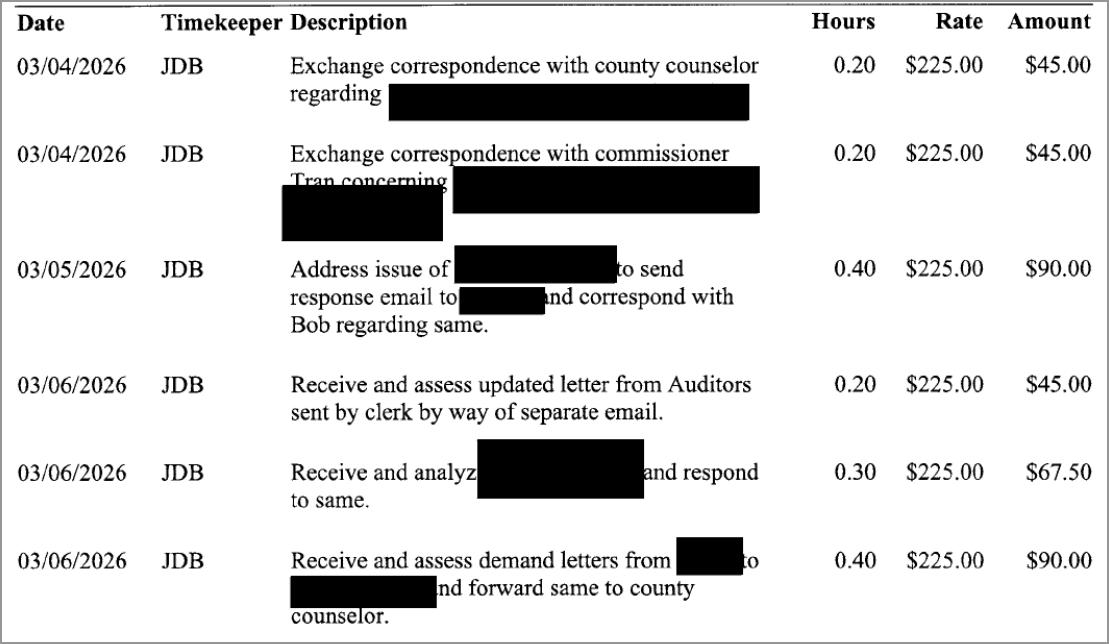
When FortScott.biz asked Bourbon County in May for the bills from its outside law firm, 39 line items came back with their descriptions partly or wholly blacked out, with no line-by-line justification under any exemption in the Kansas Open Records Act. In four months the county never supplied one.
The county released the full bills on Sept. 11, 121 days after the request, once a majority of commissioners told the county counselor to send them. Even then, County Counselor Bob Johnson wrote that he still believed the redactions were “allowed under the law.” Neither he nor the outside firm ever explained how, after FortScott.biz pointed them to a Kansas Supreme Court decision that rejected blanket redaction of legal bills.
A comparison of the blacked-out and unredacted copies shows no consistent rule for what was hidden and what was not. Some of the hidden entries were readable in a copy the county gave another requester. Similar entries, and in one case the same name, were blacked out in one place but left readable elsewhere in FortScott.biz’s own copy.
No entry-by-entry justification
The bills come from Fisher, Patterson, Sayler & Smith, whose attorney Jacob Bielenberg represents the county in the solar lawsuit and also bills a separate “General Advice” file at $225 an hour. The file FortScott.biz received covers 22 invoices totaling $53,485.50. Read the bills as the county released them: the redacted copy sent May 19 (PDF) and the full copy sent Sept. 11 (PDF).
On May 15, Bielenberg emailed the clerk’s office: “I made some light redactions, and the attached can be provided as responsive to Mr. Shead’s request.” The redactions covered 39 entries on four invoices, worth 22.5 hours and $5,062.50. Dates, hours and dollar amounts were left visible. Only the descriptions of the work were blacked out.
On May 20, FortScott.biz pointed out to the county that attorney billing descriptions are public in Kansas unless a specific exemption covers each one. Johnson’s written response, dated May 26, listed statutes: attorney-client privilege under K.S.A. 60-426, the open-records exemptions at K.S.A. 45-221(a)(1) and (a)(2), and the rule in 45-221(d) for separating exempt material from public material. It did not say which exemption applied to which entry. It said entries left readable either did not involve privileged advice or covered matters where privilege had already been waived, and it offered to “mark each entry as A/C privilege or work product, if you would prefer.” By then, Michael Hoyt had already received seven of the entries blacked out for FortScott.biz, with the descriptions readable. Those seven stayed blacked out in FortScott.biz’s copy until September. It was also sent to a misspelled email address and did not reach FortScott.biz until Johnson re-sent it July 20.
On July 17, after 58 days without an answer, FortScott.biz asked again and pointed the county to the Kansas Supreme Court’s 2000 decision in Cypress Media v. City of Overland Park, 268 Kan. 407. Johnson then found and re-sent his May 26 response, and the clerk asked, “Are you wanting each redacted statement cited by statute?” On July 22, FortScott.biz again pointed to Cypress Media and said that line-by-line standard was what it was asking for. The court held that the work-product doctrine “does not offer a per se exemption” for billing records and that “parties claiming the privilege will have to show its application to particular narrative statements in billing records.” It added: “Meeting this burden requires more than generalized allegations, conclusory language, or mere arguments of counsel.”
The county never did that. It never said which exemption covered which entry, and it never explained why the court’s ruling did not apply. FortScott.biz asked again Aug. 25, twice on Aug. 28 and again Sept. 7, seven requests in all. On Aug. 28 it offered the county any one of three ways to settle the matter: explain why Cypress Media did not apply, justify each redaction, or release the bills.
Instead, the decision moved to the commissioners. On July 23, Johnson wrote that he was “awaiting a call from the attorney general’s office on the redaction issue.” On Sept. 1 he wrote, “This is essentially the bocc’s call.” On Sept. 8: “The bocc have advised to provide to you.” On Sept. 11 he sent the unredacted bills: “I still believe the redacted ones are allowed under the law, but a majority of the bocc indicated to send them unredacted.”
For four months, the county maintained it did not have to release the descriptions. It never showed why.
Decided outside a meeting
Johnson called the release “essentially the bocc’s call,” and said a majority of commissioners told him to send the bills. But the commission never took up the bills in public. It met in regular session Aug. 31 and in a special meeting Sept. 2, the day after Johnson’s “bocc’s call” email. Neither agenda listed the bills, and the recordings show they never came up. Recordings of every commission meeting from July until the bills were released Sept. 11 show no agenda item, discussion or vote on releasing them.
The Kansas Open Meetings Act requires county business to be decided in public. It bars a majority of commissioners from reaching agreement outside a public meeting, including through a series of separate calls, emails or texts that together involve a majority. Bielenberg himself laid out that test in January, in the county’s answer to open-meetings complaints filed with the Attorney General: such communications are covered when they “collectively involve a majority of the membership of the body” and are meant to reach agreement on something that requires a vote.
Johnson’s emails describe a decision by a majority of the board, reached outside any public meeting, and the commission never voted on it in public. The Attorney General’s office has said a staff member may sound out board members one at a time, but that the practice “should never be used to take binding action,” because “taking binding action outside of an open meeting is prohibited.”
The penalties are real. A commissioner who knowingly violates the act can be fined up to $500 for each violation in a case brought by the Attorney General or the county or district attorney. A court can void a binding action taken at a meeting that did not substantially comply with the act if one of those officials sues within 21 days of the meeting. Any resident can ask a district court to enforce the law, and the court can order officials to take open-meetings training.
The Attorney General’s office has twice called for Bourbon County commissioners to take that training, both times without going to court. In 2021, after finding technical violations in how the commission closed its meetings, it entered a consent order under which each commissioner faced a $50 fine unless they took the training. Commissioners took it by Zoom that April. On March 24 of this year, in a letter to Bielenberg, the office found that the commission’s motions to close meetings had repeatedly failed to say what would be discussed, and it asked commissioners to complete an hour of open-meetings training within 45 days.
Hidden from one requester, readable for another
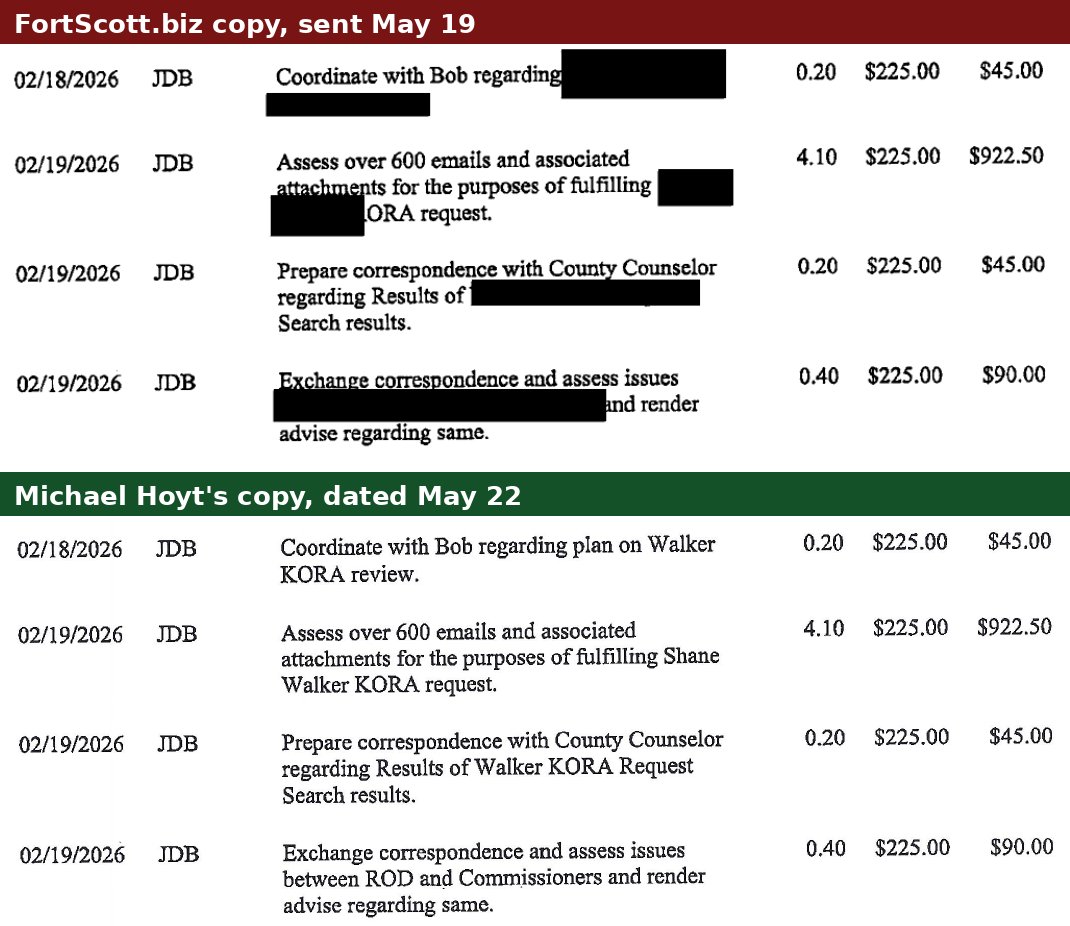
Michael Hoyt filed his own request for the same firm’s invoices. His copy, which he dated May 22, carried the same blackouts on the March invoice. But seven entries hidden from FortScott.biz were readable in his copy, worth 6.8 hours and $1,530. Hoyt’s packet even held two copies of one invoice, one clear and one redacted.
The seven include an entry on “issues between ROD and Commissioners” and Bielenberg’s review of Hoyt’s own February request for attorney invoices.
On May 15, while the bills were being prepared for FortScott.biz, the clerk wrote to Johnson: “You have released these before to JD Handly.” FortScott.biz has not seen a copy released to Handly.
FortScott.biz’s own copy was not consistent either. A Feb. 13 entry to “Address KORA issues with settlement agreement, research AG opinions and provide same to Clerk in support of position it is a fully open record” was left readable. A Feb. 18 entry to “Coordinate with Bob regarding plan on Walker KORA review” was blacked out. A Feb. 17 entry about a “voluminous KORA request from Shane” was left readable. Two days later, Shane Walker’s name was blacked out of an entry about the same request. On the March bill, the name Kemmerer was blacked out of a March 16 entry on a records request and left readable in a March 25 entry about the same request.
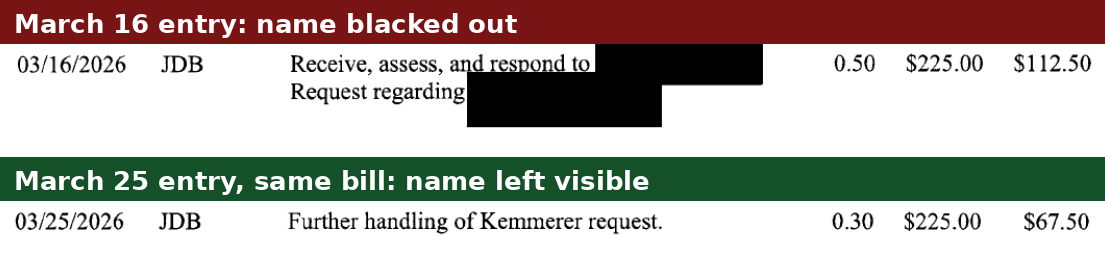
When the same words can be public in one entry or one copy and secret in another, no reader can tell what rule, if any, decided what was hidden.
What was behind the black boxes
The hidden entries describe work billed to taxpayers that was never explained in an open meeting: residents’ complaints, the investigation of the clerk, and commissioners’ own questions taken to the outside firm.
Two of the entries, kept blacked out until September, show the county’s outside lawyer reviewing demand letters sent to a private citizen and billing taxpayers for it. Three commissioners say they did not ask him to. No one has said who did. FortScott.biz will report what those entries show on Tuesday.
What is still missing
Even the unredacted file is not complete. Seven invoices, totaling $11,722.50, appear only as cover summaries with no description of the work in any copy the county has released. Five more invoices, totaling $19,510.60, appear on county vouchers or statements but were not in the file at all.
Timeline
- May 13: FortScott.biz requests the bills.
- May 15: Bielenberg makes “some light redactions.”
- May 18: Motley says in open meeting that the bill named him and private citizens.
- May 19: County sends FortScott.biz the redacted bills.
- May 22: Date on Hoyt’s copy, with seven of the hidden entries readable.
- May 26: Johnson’s list of statutes, sent to a wrong address.
- July 17: After 58 days without an answer, FortScott.biz asks again and cites Cypress Media.
- July 20 to 23: Response re-sent; FortScott.biz asks again for line-by-line justification; Johnson awaits the Attorney General’s office.
- Aug. 25 to Sept. 7: FortScott.biz asks four more times.
- Sept. 1 and 8: Johnson calls it “the bocc’s call,” then says commissioners “advised” release.
- Sept. 11: Unredacted bills sent, 121 days after the request.