

Students are still working on school competitions, even in the pandemic.
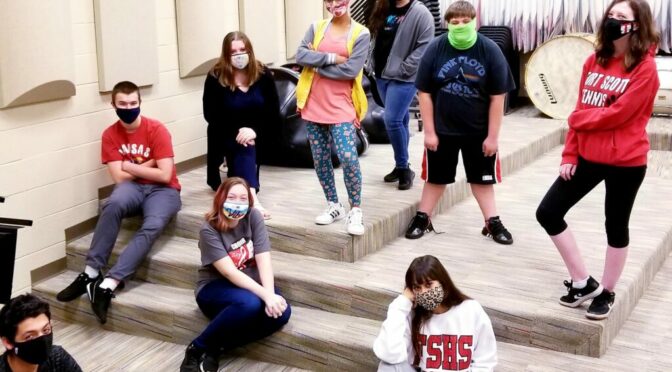
For some local students, the work paid off with earning the right to go to nationals. However, the pandemic has stopped them from physically going to College Park, Maryland to the national competition.
“They were disappointed,” Fort Scott Junior High and High School Enrichment Teacher Angie Kemmerer said.
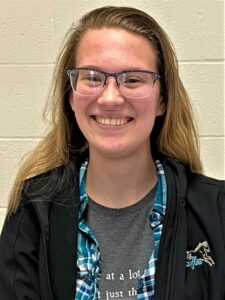
FSHS freshman Katelyn Leavell did a senior individual performance on unsung hero Anna Coleman Ladd titled: “Breaking the Barrier of Social Stigma: Anna Coleman Ladd and the First World War”.
“My project relates to this year’s theme because social stigma is one of the most prominent and hard to overcome barriers in society,” Leavell said. “My project focuses primarily on this barrier and the stigma of disabled WWI veterans. The barrier of social stigma based on physical disfigurements from combat was the hardest to break. Anna’s artistry and mask-making abilities covered the problem areas for a soldier so the world couldn’t see that part of them. With the newfound confidence, the men were able to find themselves and overcome that stigma. Though many were buried with their masks, they still had the confidence through their lives to go out into the world, unrestricted by physical barriers and social anxiety.”
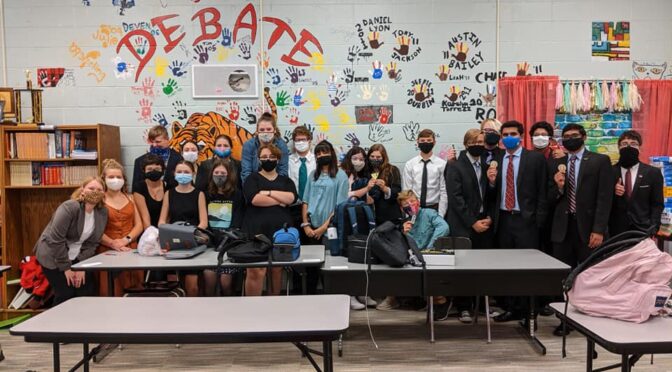
The group knew they wanted to choose a topic that challenged the normal thought process and related to the theme in a creative way, according to information provided by Kemmerer. The group’s first ideas consisted of artists, scientists, and musicians- people who broke barriers on a smaller scale and within their career field. In the end, they decided on Motown because it included that artistic charm.
The most difficult aspect of the project was the script, and was rewritten four times before it was finalized.
Motown’s sound played an important role in demolishing the barrier of race that previously divided the country. Black and white audiences alike attended Motown concerts. Motown also had a significant influence on the music industry, bringing about modern forms of musical production, management, and style.

While doing research on disabled American veterans, the group found multiple articles pertaining to the topic of mental health within soldiers and veterans of WWI. After more research, they decided that they would choose the development and social acceptance of mental health, specifically Post Traumatic Stress Disorder, in soldiers and veterans of major wars.
The stigmatized barrier around the acceptance of PTSD in our society as a mental disorder was the topic chosen. People who had the disorder were shunned and undiagnosed and it was seen as a flaw.
The range of NHD topics encompasses all disciplines and all areas of the world, according to the information provided. These projects speak volumes on how this program promotes global awareness. But it also fosters self-awareness, and creative real-world problem solving that can lead students to understand how each one of us has the potential to positively impact our world.
“NHD allows students to experience the exhilaration that comes from being innovative thinkers and producers.” Kemmerer said.” As their teacher, I hope these experiences help them realize they have the potential to change the world for the better — and the skills to do it.

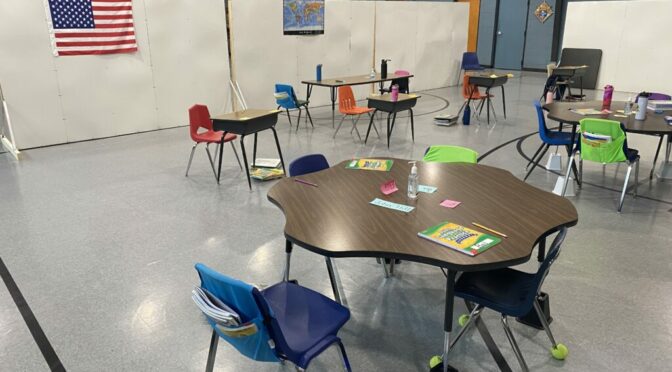
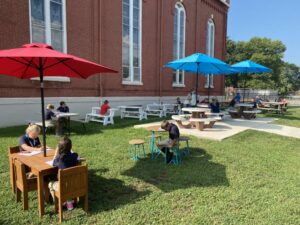
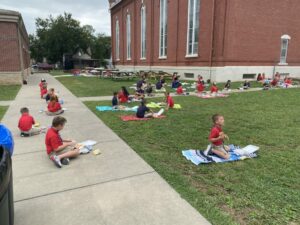
The pandemic has changed the way students are taught across the world and locally as well.
USD 234 in Fort Scott started its’ continuous learning plan on March 30.
Fort Scott Middle School Sixth-Grade Reading and Language Arts Teacher Kathi Hall said the teachers met for several days over Zoom during that week to select essential subjects to be taught.
There would be digital learners and paper packets offered to the students for at-home learning, it was decided.
“We contacted each parent and found out the best way for their continuous learning through our Tiger Dens,” she said. “We started sending lessons on April 6.”
Tiger Dens is a social and emotional learning class that all the students have in middle school, she said.

Students who needed paper packets were because of no internet service, no device nor wanting to borrow one from the school, or their parents wanting them to only have paper packets, she said.
” I think this was one of the most challenging aspects of continuous learning because we as teachers didn’t have the opportunity…. to contact that student through their school email,” Hall said. “We do contact them through their parent’s phone or email to check-in!”
Teachers at FSMS continue to collaborate weekly and plan.
“Our teachers meet several times in the week in Zoom to connect, discuss any concerns or celebrations, and just continue to collaborate,” she said.
Teachers are available for their students and parents through their email or cell phone.
“Most of our teachers are teaching from home through their digital platforms such as Google Classroom, Zoom, and other educational apps that our staff agreed would be the best for the students,” Hall said. “We have had one or two teachers who have spotty or glitchy internet services because of where they reside so they will use their classroom.”
“When I think about the good that comes from our Covid19 situation and continuous learning with students not being in classrooms, there isn’t a whole lot of specifics that I can list as good.” she said. ” However, in any situation, you can find the good. I will say that one of the things that comes to mind is the way our school and district has pulled together as a strong unit.”
“Our lunch and transportation staff made a plan, organized it, looked it over for improvements once it was implemented, and then made it a better plan for our community to receive lunches in a safe and functional way,” Hall said.
“Our teachers and staff have pulled together in a tight organized way to make a plan to reach out to students and connect in a way no one has had to do before.”

“Our tech team has been working seamlessly in providing support, devices etc…for our district,” she said.
“For us at the middle school, our two principals have been on top of things supporting us and the parents/students in a way that feels amazing,” Hall said. “This is so different, new, and uncharted waters for everyone. Yet in a matter of days we begin to see the right decisions made and executed for everyone involved.”
“We definitely have challenges and I am speaking on behalf of our staff that this isn’t an ideal way to educate our students in a long term setting,” she said.
“One of the main challenges is student participation,” Hall said. “Students at the age that we teach, rely on accountability. Their young minds need interaction, sociability, and academic practice (sometimes guided practice).”
“As teachers, it is challenging not to see the faces of our students as well,” she said. “We love our jobs, we are in the profession to change children’s lives through academics, social, and emotional connections.”
“Another challenge we can’t overlook is there are fears and problems (concerning Covid19) in a student’s home with parents out of work, reduced hours, family sick or ill, etc,” Hall said. “The social and emotional well being of our students is a concern. For some students, the school was a safe haven to escape their home lives of whatever is going on that is out of the norm and their control.”
The district is providing learning opportunities for students, not focusing on grades.
“The students who are connected digitally are having feedback on their assignments,” she said. “The teachers are ‘grading the assignment’ and giving feedback through our Google Classroom or email. The paper packets will be looked at once they are turned in.”

USD 234 continues to distribute food in the district to its students during this time of the COVID 19 pandemic, and parents are encouraged to fill out applications for free and reduced meals for the next school year.
“We do have two items that will be in addition next week,” Gina Shelton, USD 234 Business Manager/Board Clerk, said.
“First, on Tuesday, weather permitting, we will be distributing to kids books donated by Hedgehog INK and the (Fort Scott) Kiwanis,” Shelton said. “We know the importance of kids continuing to read and this way they have a ‘new to them’ book to keep their interest. We will be encouraging parents to read with their kids. What a beautiful gift to our kids.”


“Being with the kids every day, oftentimes you do see the good along with the bad that they experience as high school kids. It is challenging to see them experience the bad times because some of those bad times can be very difficult for the kids to navigate as high school kids. But, ultimately, a lot of those bad times help shape them into quality young adults in the future.”

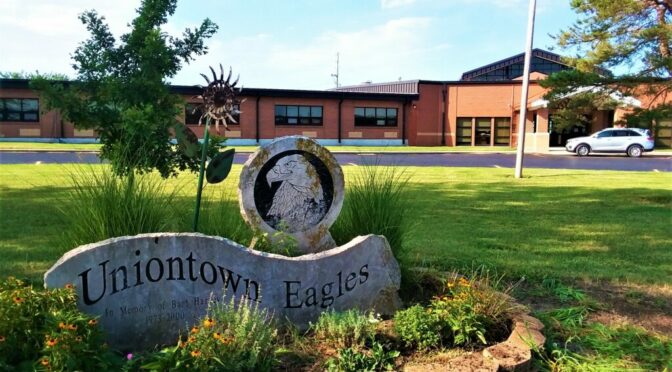
Uniontown’s school district began a continuous learning plan to allow students to learn from home during the nationwide closure of schools, due to the COVID 19 pandemic.
Last week, a parent’s story of how the learning plan was working was published on FortScott.Biz.
This feature is from a teacher’s view.
Rose Gauthier teaches kindergarten at West Bourbon Elementary School.

Following is an interview by email from Gauthier.
When did the USD235 Continuous Learning Plan begin?
“We began Thursday, April 2nd with a practice run with the parents and students to work out kinks. We started our remote learning officially on Monday, April 6th. We will finish on Tuesday, May 19th.”
How much daily planning do you have for the classes?
“A lot. A teacher’s job has never been a 9:00 to 5:00 job, but even more so with this new way of teaching. It is hard to put a certain time frame on all the work the teachers, administration, and staff have put into it. From getting devices into student’s hands, the tech department working out tech issues for teachers and parents, and teachers creating different ways to teach their students with this new way of learning.”
Did you get together as a group of teachers and decide what the most important things to teach are?
“Yes. The school began with many “Zoom” meetings that included administration and teachers, with guidance from KSDE, to determine the best way to reach the kids.”
(Zoom provides users with a cloud (internet) platform for video and audio conferencing, collaboration, chat, and webinars across mobile devices, desktops, telephones, and room systems, according to the Zoom website).
“I create a meeting on Zoom and send the parents an invite.,” she said. “The students click on a link and have a password to log in.”

“Our focus, as for many schools, is primarily the social and emotional spirit of the kids. This is a difficult and confusing time for them and many of the kids do not understand what is going on, especially at the primary levels. Letting them know that we are here for them, we miss and love them. Academically we are focusing on maintaining what the kids have already learned and limited new material to the essential outcomes that were agreed upon as a team”
Do you teach from home or do you go to school?
“Both, the less I need from my classroom the more I teach from home. I go in once or twice a week.”
Have you seen any good come out of this difficult situation of not having the students in a classroom?
“Out of every bad situation, something good always comes out of it. Nothing will replace the social and emotional aspects of being together in the learning environment. The hugs, the high fives, being right beside them to guide them in their learning.”
“This situation has given us the appreciation of each other, the parents an opportunity to be a bigger part of the learning experience, and for all of us to step back and remember what is really important in life. And mostly, we get reminded of what a great community we have. We couldn’t do this without the support of great parents.”
What are some of the challenges?
“The biggest challenge is not seeing the kids every day. Adjusting to remote learning and tech issues are some other challenges, which gets easier as we go along. Also, reaching those kids without internet access is a challenge.”
How do you grade the kindergartners in this new plan?
“In Kindergarten we don’t give a traditional letter grade. We use checklists to provide feedback to parents about where the students are academically. During this time, we will still focus on those checklist skills while understanding that we will need to be prepared to provide the needed remediation to students at the beginning of the 2020-21 school year.”
“The district has worked together to provide a similar learning experience for all students, but obviously this looks slightly different based on the grade, content, teaching style, etc.”


Life is different since the COVID 19 Pandemic has gripped the world.
People are staying home to prevent the spread of the virus, some businesses have closed, and parents are helping teachers with student’s learning at home.
One such parent is Christal Martin of Uniontown.
Christal and her husband, Seth, have two sons, Caden, 5, and Casen, 4.
Caden attended West Bourbon Elementary School and is in Rose Gauthier’s kindergarten class.
He and little brother Casen are learning from the USD 235 Continuous Learning Plan.
“I have been really impressed with USD 235 and Mrs. Gauthier,” Martin said. “Getting technology in the kids’ hands, giving technical support and also getting food to our kid’s communities.”

For her, the best part of the continuous learning plan that the school district USD 235 has is “Being able to have hands-on in Caden’s education. I have really enjoyed it, once we’ve gotten into a routine,” Martin said.
A challenge for her is learning all the different applications that are available online for the continuous education plan.
Her solution?
“In the evening, I play on the app so I’ll be ready to go the next day,” she said.
Caden received an IPad from the school district for use at home.
On Monday, Wednesday, Thursday and Friday, Caden has a Zoom call at 9:30 a.m. from Mrs. Gauthier.

On Tuesday at 9:30 a.m. Physical Education Teacher Jackie Hall and Music Teacher Rhonda Allen give lessons.
Art Teacher Chris Woods prerecords a video of art projects then posts it as an assignment in Google Classroom for students to do.

“The Zoom call is 30 minutes,” Martin said. “We’ve read books, done science lessons, interviewed another student in their class and afterward in a journal they will describe the student.”
Other resources are used throughout the day with reading and math the main focus,” Martin said.
“We spend about three and a half to four hours each day,” Martin said. “The state recommends 45 minutes a day. I don’t want him to get behind. We do a lot of extras. We want to keep them learning and not have them stall, in my opinion.”
“It’s been a learning curve,” Martin said. “It’s adjusting to take care of both of their learning. I’ve been homeschooling Casen, too.

After 32 years as principal of Fort Scott Christian Heights and 14 years as a teacher before that, Terry Chance is retiring as of June 1.
Chance, 70, says his becoming an educator was a process of time.
“I felt like God wanted me to be involved full-time in a Christian ministry,” he said. “I got into music education and have been in education ever since.”
“John Page was our pastor and principal of Christian Heights and was my mentor,” Chance said. “He is my hero.”
Chance said he loves the interaction with students.
“It has been a thrill when they understand what you teach,” he said.
For him, seeing students go on from Christian Heights to serve their family, their community and their church, “That’s success,” he said.
The biggest challenge in his career has been the current pandemic that has closed down all schools in the nation.
“We are trying to figure out how to help our students right now,” Chance said.
Chance said he made up his mind to retire last summer and told the FSCH Board of Education in September.
The board has hired Larry Davolt as the new principal.
Davolt has been a science teacher at the school for 28 years.

Continuous Learning plans at USD234 were started the week of March 30, Superintendent Ted Hessong said.
“Each building rolled their plans out gradually throughout the week,” Hessong said.
“Since school buildings are closed for the remainder of the school year (following stay-at-home orders during the pandemic), school districts needed to come up with a way to provide continuous learning for our students to help them not only academically but also socially,” he said.
” Our principals worked with their Building Leadership Teams using the Continuous Learning Plans guidance from the Kansas Department of Education (KSDE),” he said. ” KSDE collaborated with teachers from all across the state of Kansas to help create these guidance documents to assist school districts. After meeting with their leadership teams, they then worked with the rest of their staff to create the Continuous Learning Plans.”
“Most of the teachers are teaching from home,” Hessong said. “We do have a few staff members who are working from their classrooms to provide Continuous Learning to our students.”
Each school building’s personnel contacted every student to see what they needed to be able to participate in Continuous Learning, he said and based on the feedback each received from the students, the staff worked to provide the necessary materials to be able to participate.
Grading for the new plan will be different.
” With the implementation of our Continuous Learning plans each building is handling grades a little different,” Hessong said. “Each building is keeping in mind what is in the best interest of our students during these uncharted waters of what school looks like today. Our teachers and administrators are demonstrating grace and understanding for all students to do what is best for our students.”
Hessong is thankful, he said.
“I want to thank all of our staff for their help to implement our Continuous Learning plans and our foodservice and support staff in providing meals for the students in our communities. With the assistance of our communities, the county, Kansas State Department of Education, Kansas Department of Health and Environment and the Southeast Kansas Health Department it has allowed our school district to navigate these uncharted waters to make the most of this health crisis.”
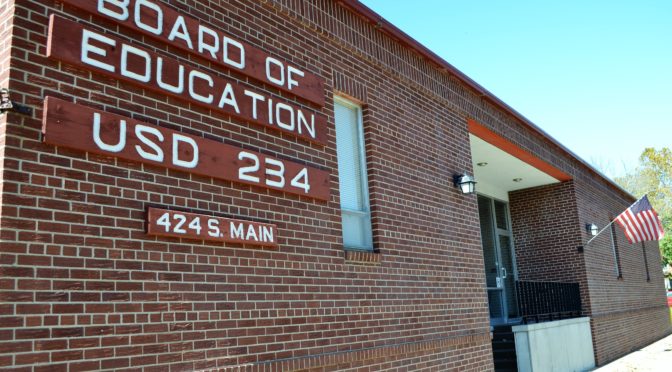
Members of the USD 234 Board of Education met virtually on Monday, April 2, for their regular monthly meeting.
President David Stewart opened the meeting. The board approved the official agenda. The board also approved the consent agenda as follows:
A. Minutes
B. Bills and Claims
C. Payroll – March 13, 2020 – $1,414,782.30
D. Financial Report
E. Bond Proceeds Reconciliation
F. Activity Fund Accounts
G. Parent/Teacher Conference Attendance
H. Point of Information – May Employee Recognition to be held at a later date due to COVET-19
Stephanie George, KNEA President, presented a report. Administrators from each
building shared information with board members.
Superintendent Ted Hessong commended staff throughout the district for their hard work throughout the pandemic, reported on the Continuous Learning Plan, and shared special education information.
Gina Shelton, Business Manager, shared information on employee pay, current business practices, and bond closure.
Board members approved the following items:
· KASB Adoption Agreement and Legal Assistance Fund Contract and Renewal Payment
· Price increase for adult lunch and breakfast meals for the 2020-21 school year
· Roof payments
· Purchase of two buses
· Door bids
· Sale of old high school weight racks
The board also acknowledged receipt of the 2020-21 negotiations lists.
Board members shared comments and then went into executive session to discuss personnel matters for nonelected personnel and returned to open meeting. The board then went into executive session to discuss matters relating to employer-employee negotiations and returned to open meeting.
The board approved the following employment matters:
A. Non-renewal of Don Parsons, high school English teacher, effective at the end of the 2019-20 school year
B. Resignation of Jamie Patterson, preschool paraprofessional, effective April 6, 2020
C. Transfer of Brandon Boyd, Eugene Ware physical education teacher, to Eugene Ware Assistant Principal for the 2020-21 school year
D. Transfer of Pauline Sweyko, high school paraprofessional, to high school special education teacher for the 2020-21 school year
E. Transfer of Matt Glades, high school teacher aide (ISS), to high school technology teacher for the 2020-21 school year
F. Transfer of Sabrina Keating, Winfield Scott first grade teacher, to Eugene Ware fourth grade teacher for the 2020-21 school year
G. Transfer of Brenda Hill, elementary instructional coach, to Eugene Ware fifth grade teacher for the 2020-21 school year
H. Work agreement change for Debbie West, high school secretary, from a 10-month position to a 12-month position for the 2020-21 school year
I. Employment of Clint Heffern as a high school social science/physical education teacher for the 2020-21 school year
J. Employment of Carissa Bowman as a high school FACS teacher for the 2020-21 school year
K. Employment of Pam Hutchison as a high school teachers’ aide for the 2020-21 school year
L. Employment of Fort Scott High School licensed personnel for the 2020-21 school year
M. Employment of Fort Scott Middle School licensed personnel for the 2020-21 school year
N. Employment of Eugene Ware Elementary School licensed personnel for the 2020-21 school year
O. Employment of Winfield Scott Elementary School licensed personnel for the 2020-21 school year
P. Employment of Fort Scott Preschool Center licensed personnel for the 2020-21 school year
Q. Employment of special education licensed personnel for the 2020-21 school year
R. Employment of Clint Heffern as head high school boys’ basketball coach for the 2020-21 school year
S. Employment of Melissa Miller as elementary instructional coach for the 2020-21 school year
T. Employment of Shelly Sanborn as a middle school special education teacher for the 2020-21 school year
The board adjourned.