|
|
|
|
|
|
“…A county conducting a recount may not substitute ballot images for the original paper ballots, unless the person requesting the recount specifically requests such substitution in a county that uses optical scanning equipment or electronic or electromechanical voting systems,” the opinion reads.
|
|
|
|
KDOT requesting comments on STIP amendment
The Kansas Department of Transportation (KDOT) requests comments on an amendment to the FFY 2024-2027 Statewide Transportation Improvement Program (STIP) document.
The STIP is a project specific publication that lists all KDOT administered projects, regardless of funding source, and includes projects for counties and cities as well as projects on the State Highway System. The list of projects being amended to the STIP can be viewed at http://www.ksdot.org/bureaus/burProgProjMgmt/stip/stip.asp.
The approval of the STIP amendment requires a public comment period, which concludes Oct. 4. To make comments on the amendment, contact KDOT’s Division of Program and Project Management at (785) 296-3254.
This information is available in alternative accessible formats. To obtain an alternative format, contact the KDOT Division of Communications, (785) 296-3585 (Voice/Hearing Impaired-711).
###
Census Survey: Nearly 250,000 Kansans
without Health Coverage
~~ Kansas Rate of Uninsured Per Capita Surpasses U.S. Rate
for Second Year ~~
TOPEKA – The U.S. Census Bureau recently released its American Community Survey 1-year estimates, indicating nearly 250,000 Kansans lack health insurance. The survey reflects data collected in 2022 to assess health insurance coverage rates across Kansas and the United States.
For the second consecutive year, Kansas’ uninsured rate for working-age adults surpassed the national rate. Kansas’ rate was 12.5% compared to the U.S. at 11.3%.
Governor Kelly announced yesterday that her top priority for this coming legislative session is Medicaid expansion by kicking off her “Healthy Workers, Healthy Economy” tour. Medicaid expansion would give thousands of working Kansans access to affordable health care.
“While 40 other states have expanded Medicaid, Kansas continues to lag behind the nation in health care coverage because the legislative has yet to accept the federal funding – which Kansans have already paid for through taxes – needed to get more workers insured,” Governor Laura Kelly said. “That’s unacceptable. Kansans should call their legislator and urge them to expand Medicaid this upcoming legislative session.”
Prior to the implementation of the Affordable Care Act by other states, the rate of Kansans with health care coverage was better than the nation. Since the Legislature hasn’t expanded Medicaid, the rate of uninsured Kansans has trended closer to or exceeded the national uninsured rate.
Uninsured Rates for Kansas and the United States, 2009-2022
Graph courtesy of the Kansas Health Institute.
###
Stay Connected with Kansas Office of the Governor:
Facebook Twitter Visit our Website GovDelivery Signup
Dear Governor Laura Kelly:
America is suffering the worst illegal immigration catastrophe in the history of our country.
President Joe Biden’s negligent disregard for America’s national security since the end of Title 42 expulsions have emboldened the cartels, who grow wealthy by trafficking deadly fentanyl as well
as innocent human beings.
Because President Biden has willfully refused to enforce our nation’s immigration laws while systematically dismantling every effective border security policy that previously led to the lowest
number of illegal border crossings in decades, every state in the Union is at risk. The resultant surge in illegal immigration and transnational criminal activity is at an all-time high.
With the end of Title 42 expulsions, President Biden’s own administration estimates that at least 150,000 migrants a day are waiting to cross the U.S.-Mexico border to enter our country illegally.
The flood of illegal border activity invited by the Biden Administration flows directly across the southern border into communities. Not only does it affect US/Mexico border states, but illegals are also flocking into other states including our beloved state of Kansas.
In the federal government’s absence, we, as the elected officials of Kansas, must join to combat President Biden’s ongoing border crisis, and ensure the safety and security that all Americans and
Kansans deserve. We must stand with the oath we all took to defend and protect the Constitution and the American people. The Governor of Texas has taken unprecedented actions to protect Texans and Americans by implementing Operation Lone Star. Since the launch of Operation Lone Star in March 2021, Texas has apprehended more than 435,700 undocumented immigrants and made over 34,000 criminal arrests, with over 30,900 felony charges. Operation Lone Star has also seized more
than 428 million lethal doses of fentanyl that would have otherwise spread into communities across
the nation.
We must support this effort and unite with the other 14 states currently doing the job the federal government has failed to do to protect the American people.
Already, our neighboring states of Missouri, Nebraska, and Oklahoma have stepped up to help fill in the dangerous gaps created by President Biden’s failed open border policies. Additionally, the
Governor of Idaho deployed a team of Idaho State Police personnel to support Texas’ border security efforts in a monthlong mission to prevent the smuggling of people and illicit drugs like
fentanyl into America. The State of Florida has also offered resources, such as hundreds of Florida National Guard soldiers and law enforcement officers, as well as assets like drone technology.
https://gov.texas.gov/news/post/operation-lone-star-defends-sovereign-authority-to-secure-
border.
Therefore, we implore you, Governor Kelly, to stand with the other 14 states and help defend our southern borders by sending the necessary resources including Kansas National Guard troops to
stop this negligent disregard for America’s national security since the end of Title 42 expulsions.
America’s national security depends on the State of Kansas support.
Sincerely,
Trevor Jacobs, District 4
Kansas House of Representatives
Members of Kansas House Members of Kansas Senate
Representative Carrie Barth, District 5 Senator Virgil Peck, District 15
Representative Dave Beuhler, District 40 Senator Mark Steffen, District 34
Representative Lewis Bloom, District 64 Senator Alicia Straub, District 33
Representative Bill Clifford, M.D., District 122 Senator Mike Thompson, District 10
Representative Duane Droge, District 13
Representative Randy Garber, District 62
Representative Scott Hill, District 70
Representative Michael Houser, District 1
Representative Carl Maughan, District 90
Representative Michael Murphy, District 114
Representative Samantha Parshall, District 6
Representative Sandy Pickert, District 88
Representative Bill Rhiley, District 80
Representative Webster Roth, District 79
Representative Joe Seiwert, District 101
TOPEKA – Jobseekers are encouraged to attend the upcoming State of Kansas Agencies Virtual Job Fair from 8:00 a.m. to 5:00 p.m. Wednesday, September 27. This month’s virtual fair, hosted by KANSASWORKS, will feature many exciting employment opportunities available across the state’s 98 government agencies. Currently, there are more than 700 vacancies across the state.
“Our agencies are looking for talented individuals who want to serve Kansas and make it the best place to work, play and raise a family,” Lieutenant Governor and Secretary of Commerce David Toland said. “These are good-paying jobs with great benefits. When we bring in skilled people to fill them, we’re setting the stage for a bright future of growth and prosperity in our great state.”
Registration is required to participate in the event, regardless of previous participation. The Virtual Job Fair portal features a jobseeker training video, a list of participating employers, and channels for attendees to register and log in. Jobseekers are encouraged to dress professionally, as employers might request to engage in a video interview.
Candidates can participate through any digital device, but it is highly recommended to use a computer to be most effective during the job fairs. If a jobseeker does not have access to a personal computer, they are available at KANSASWORKS offices as well as local libraries throughout the state. Any individual with a disability may request accommodations by contacting their nearest workforce center at (877) 509-6757 prior to the event.
To register for the September 27 State Agencies Virtual Job Fair, click here.
About KANSASWORKS:
KANSASWORKS links businesses, job candidates and educational institutions to ensure that employers can find skilled workers. Services are provided to employers and job candidates through the state’s 27 workforce centers, online or virtual services KANSASWORKS is completely free for all Kansans to use. Learn more at KANSASWORKS.com. State employment opportunities can be found at jobs.ks.gov.
About the Kansas Department of Commerce:
As the state’s lead economic development agency, the Kansas Department of Commerce strives to empower individuals, businesses and communities to achieve prosperity in Kansas. Commerce accomplishes its mission by developing relationships with corporations, site location consultants and stakeholders in Kansas, the nation and world. Our strong partnerships allow us to help create an environment for existing Kansas businesses to grow and foster an innovative, competitive landscape for new businesses. Through Commerce’s project successes, Kansas was awarded Area Development Magazine’s prestigious Gold Shovel award in 2021, 2022 and 2023, and was awarded the 2021 and 2022 Governor’s Cup by Site Selection Magazine.
TOPEKA – Governor Laura Kelly announced today the launch of a new partnership that will create savings and streamline services for child care providers across Kansas. The Kansas Department for Children and Families, Child Care Aware of Kansas, and five community-based organizations are partnering on the Shared Service Network to streamline administrative costs for providers and free up time for programs to focus on providing high-quality child care.
“For many Kansas kids, quality child care is essential for them to have a solid start to their developmental growth,” said Kansas Governor Laura Kelly. “This network will provide child care professionals the resources they need so they can focus on young Kansans in their care.”
By participating in the Shared Services Network, child care providers benefit from services that cost less and are often more efficient than what the programs could do on their own. A wide range of services are available to reshape child care, including:
“By working together, child care providers can save money and invest more in key parts of early childhood education, like better pay for their staff, high-quality curriculum, and other supplies needed to operate a child care business,” said Laura Howard, Secretary Kansas Department for Children and Families.
The five community-based organizations that have been selected to implement the Shared Services Network will have the responsibility for delivering services to participating child care programs that result in cost savings.
“Shared Services represent an innovative approach to making the business side of child care work,” said Kelly Davydov, executive director of Child Care Aware of Kansas. “We have a unique opportunity to realize cost savings for participating child care programs so that they can earn more or reinvest in other aspects of their business, like high-quality curriculum for the young children in their care.”
Shared Services Networks will be provided by the following organizations:
For more information, visit Shared Services Network – Child Care Aware.
To learn more about Child Care Aware of Kansas and how you can join us in ensuring access to high-quality child care for all families, visit us at www.ks.childcareaware.org.
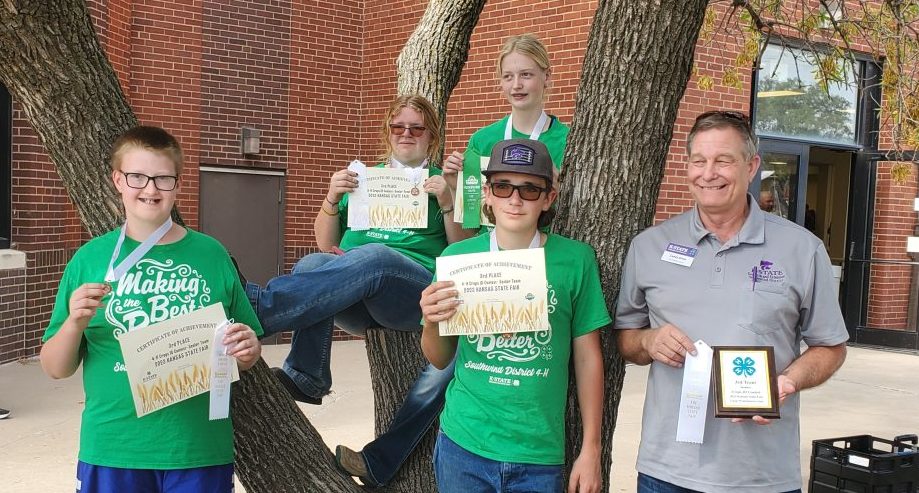
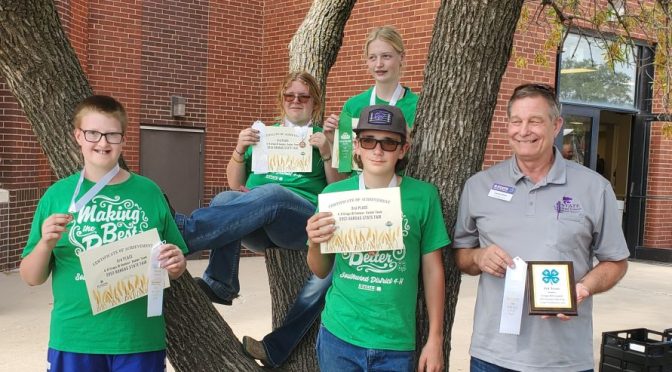
Southwind District 4-H’ers participate in the Kansas State Fair State 4-H Crops/Weeds ID Contest on September 9, 2023, in Hutchinson, Kansas. Three of the four team members moved up from the Intermediate Division to the Senior Division to form a full Senior Team. Results were 3rd Place Team, Carly Kramer 8th Individual, Camryn Wille 15th Individual, Kason Botts 16th Individual, and Henry Kramer 18th Individual.
Pictured are (left to right; front to back): Kason Botts, Henry Kramer, Casey Diver (coach), Carly Kramer, and Camryn Wille.
Gravel Kansas is thrilled to announce the official launch of its innovative cycling initiative, dedicated to crafting unforgettable gravel cycling routes across the picturesque
landscapes of The State That Made Gravel Famous©.
This exciting venture is returning to gravel roots by merging the thrill of gravel riding with the power of storytelling to foster a deep
connection between cyclists and the remarkable places they traverse.
At the heart of Gravel Kansas is a commitment to celebrating the rich heritage, culture, and stories that define the state. Through a meticulously curated selection of gravel routes, cyclists
will embark on journeys that weave through historic towns, rolling prairies, and breathtaking vistas. Each route serves as a gateway to discovery, leading riders to hidden gems and immersing them in the tapestry of Kansas’ diverse landscapes.
“We are thrilled to introduce Gravel Kansas to cyclists around the world,” said LeLan Dains, Founding Chair of Gravel Kansas. “Our initiative is all about forging a profound bond between
people, places, and stories. With every pedal stroke, cyclists will experience the beauty, history, and character of Kansas in an entirely new way.”
This project wouldn’t be possible without funding support from Kansas Tourism. For more information about Gravel Kansas and to explore the inaugural routes, please visit gravelks.com.
Follow Gravel Kansas on Facebook for updates, stories, and exciting cycling content.
About Gravel Kansas:
Gravel Kansas is a pioneering cycling initiative that creates iconic gravel routes across the picturesque landscapes of Kansas. Combining the thrill of gravel cycling with the power of
storytelling, Gravel Kansas aims to foster a deep connection between cyclists and the remarkable places they explore. Through meticulously curated routes and engaging narratives,
Gravel Kansas celebrates the heritage, culture, and stories that define the state.
For more
information, visit gravelks.com.
|
|||||
|
TOPEKA – This week, Governor Laura Kelly traveled to Japan and South Korea to participate in the Midwest U.S.-Japan Association (MWJA/JMWA) Conference. While there, she met with business leaders to continue building on Kansas’ historic economic development success and create new job opportunities for Kansas workers.
“The relationships we’ve established with Japanese and Korean companies like Panasonic, Marubeni, and CJ CheilJedang have been instrumental in the $17.4 billion in private investments made into the state since I took office,” Governor Laura Kelly said. “By strengthening those relationships and building new ones, we continue spurring economic development success and delivering on our mission to make Kansas the best state to live, work, and raise a family.”
While in Japan, Governor Kelly delivered keynote remarks at the MWJA/JMWA conference and, alongside a bipartisan group of Midwest governors, met with U.S. Ambassador to Japan Rahm Emanuel to discuss economic development opportunities.
“Governor Kelly’s commitment to strengthening ties with Japan and South Korea is exactly the kind of forward-thinking leadership needed for trilateral cooperation. These partnerships aren’t just about business; they’re about building a brighter future for Kansans,” Ambassador Rahm Emanuel said. “When I see a state like Kansas making such significant strides in global economic partnerships, it showcases the importance of collaboration, vision, and innovation.”
In Kyoto, Governor Kelly met with Panasonic Energy leadership. In July 2022, Governor Kelly announced Panasonic would be building one of the largest electric vehicle (EV) battery manufacturing plants in the United States in De Soto. The $4 billion investment is expected to create up to 4,000 new jobs, which represents the largest economic development project in Kansas history. Learn more about Panasonic’s historic investment here.
In Tokyo, Governor Kelly toured the Marubeni Corporation headquarters. Marubeni acquired Arkansas City’s Creekstone Farms Premium Beef LLC in 2017. Since then, the company has invested $35 million in facility improvements, including a refrigerated distribution center and 20,000 square-foot child care facility that is now under construction. In 2020, Creekstone Farms was awarded the Governor’s Exporter of the Year Award. Governor Kelly toured the plant in June 2021. Learn more about Creekstone Farms and Marubeni here.
Governor Kelly ended her trip in South Korea, where she visited CJ CheilJedang (CJCJ) headquarters. CJCJ became the parent company of Schwan’s in 2019 and constructed the world’s largest frozen pizza manufacturing plant in Salina, creating 225 new jobs. Its $600 million investment resulted in a new manufacturing plant that opened in May 2023 and a food distribution center that is expected to be completed in early 2025. Learn more about CJCJ’s investment in Schwan’s here.