|
|
|
|
|
|
|
|
|
|
|
|
|
|
 |
|
||||||||||

 |
|
|
|
|
|
|
|
|
|
|
|
|
|
|
|
|
|
|
||||||||||
|
|
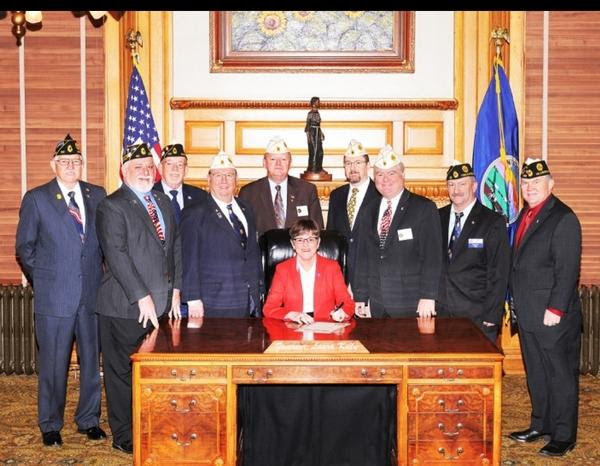
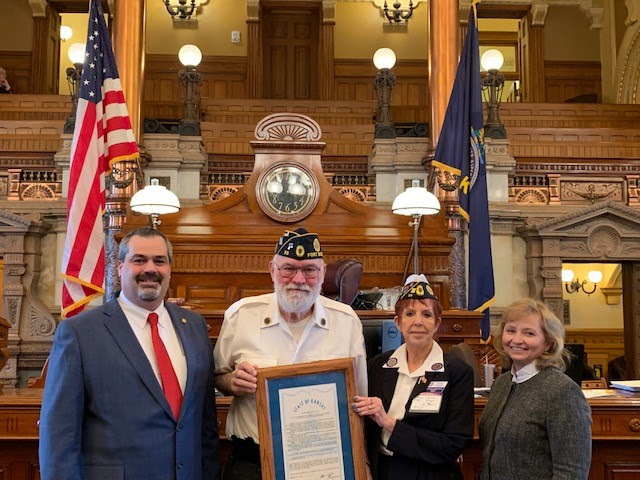
Gov. Laura Kelly recognized the role that Kansas American Legion members play in supporting Kansas veterans by recently signing a proclamation designating March 15, 2019, as Kansas American Legion Day.
“We appreciate the Governor recognizing the significant contributions made by American Legion Posts as pillars in Kansas communities over the last 100 years,” Kansas Department Commander Dan Wiley said. “Kansas has a special place in the history of The American Legion. One of our favorite sons, Harry Colmery, Past National Commander from Topeka, was the author of the post-World War II G.I. Bill of Rights that lifted the standard of living for an entire generation. We look forward to another century of service positively impacting the lives of veterans and the communities in which they live.”
On March 15, 1919, The American Legion was founded in Paris, France by members of the American Expeditionary Force. Over the past 100 years, The Kansas American Legion has become a preeminent community-service organization in Kansas. It has more than 40,000 family members in over 500 Kansas American Legion posts, units, and squadrons. These Legion entities promote a variety of programs that support the goals of The American Legion.
Kansas Department Vice Commander Chuck Shoemaker has participated in three signings in the Governor’s Office proclaiming the state’s gratitude for American Legion activities.
Article from the Hutchison News, submitted by Carl Jowers.
Governor comments on Horton Community Hospital closure, sends agency assistance
Following the closure Tuesday of Horton Community Hospital, Governor Laura Kelly extended assistance from her administration and highlighted the critical importance of community hospitals in rural Kansas.
“I’m concerned for the community of Horton as they face the serious loss of their local hospital,” Kelly said. “This is becoming a far too frequent occurrence in our state. Local hospitals are key to the health of Kansas families and are often one of the largest employers in a small town. Elected leaders must work together to do more to support our local hospitals.”
Three rural hospitals have closed in the last three months. Mercy Hospital in Fort Scott closed on December 31st. Oswego Community Hospital closed in February. And Horton Community Hospital closed its doors Tuesday.
“I’ve directed our agencies to coordinate support for hospital staff during this challenging time,” Kelly said. “A closure of a hospital has ripple effects through the community and region. Our KANSASWORKS team will be in Horton Thursday to assist hospital staff with filing for unemployment benefits, as well as job applications and re-employment services.”
The Governor’s Office, Kansas Department of Commerce and Kansas Department of Labor are working to provide support to employees of the hospital, ensure unemployment benefits applications are streamlined, and re-employment opportunities are available.
In response to Tuesday’s closure, KANSASWORKS will be hosting Rapid Response Informational Meetings Thursday in Horton in conjunction with the Community Outreach Event at the Horton Public Library.
Efforts to assist affected hospital employees will include Rapid Response Informational Meetings at 1 p.m., 2 p.m. and 3 p.m. Thursday at the Horton Public Library, 809 1st Ave E. No registration is required. Information will be shared about KANSASWORKS, Workforce Center employment and training services and how to file unemployment insurance benefits.
Also, the KANSASWORKS Mobile Workforce Center will be at the Horton Public Library from 1 p.m. to 4 p.m. Thursday to provide additional re-employment services. Workforce Center staff will be available to help with registering on KANSASWORKS.com, creating a resumé, job search assistance and filling out job applications.
The Rapid Response team was also sent to Oswego following the closure of its hospital last month.
Any questions about KANSASWORKS should be directed to the Department of Commerce:
The halfway point in the 2019 legislative session is officially passed so all of the work in the eighth week of session was in committees.
Kansas Toll Roads, 236 miles of highway, are managed by the Kansas Turnpike Authority (KTA). In 2015 there was a push to get rid of the tolls. It was not successful but a law was passed requiring the Kansas Department of Transportation (KDOT) and KTA to “achieve the maximum coordination in planning, development and operation of the highway systems in this state”. I supported that legislation and it has helped create efficiencies according to the Interim Secretary of KDOT. The KS turnpike was built from 1954 to 1956 and has been collecting tolls ever since. The initial $160 million bond was paid off in 1994. Since then KTA has issued over $200 million in bonds and over $140 million in interest. Estimates are it will not be paid off until 2040.
A bill brought to the Senate Transportation Committee would allow some roads in Kansas to be funded by tolls. The Interim Secretary of KDOT stressed that local input would be a factor as to where toll roads would be implemented. The KTA collects over $100 million a year in tolls to support the turnpike. Are toll roads the answer to supporting Kansas highway infrastructure? I understand the need for safe infrastructure and it being one of the main functions of government. My record demonstrates this by voting NO on bills that took money from KDOT projects. The Dwight D. Eisenhower National System of Interstate and Defense Highways, i.e. the Interstate Highway, did not allow tolls except in some cases. Tolls are allowed on the KS turnpike because it was established before and grandfathered into the Interstate.
Kansas Taxes, Exemptions, and Credits were discussed in the Senate Tax Committee. Kansas taxpayers paid over $15.2 billion to support state and local governments in 2018. The largest portion of this was property tax at $4.9 billion. Less than 2% of property taxes in Kansas fund state government. The rest, over $4.8 billion, funds local governments and schools. Sales and use tax was more than $4.4 billion and income tax was over $3.8 billion. The rest came from other taxes such as vehicle registration, liquor, beer, cigarette, tobacco, transient guest, and other taxes. The $15.2 billion is an increase from $13.3 billion in 2015. Almost a $2 billion increase in three years! This is not sustainable.
Kansas Public Employees Retirement System (KPERS) SB 9, requiring a missed state payment into KPERS be paid, was signed into law by the Governor. Research reported the delay of payment cost around $24,000 a day, for a total payment plus interest of $115 million. The Governor let the bill sit on her desk 9 days before signing it on the 10th day. Can you imagine letting a bill sit on your desk knowing it was costing almost $24,000 a day? The practice of delayed payments started in previous administrations. I do not support this practice under ANY administration.
It is an honor and a privilege to serve as your 12th District State Senator.
|
||||||||||||||||||||
|
|
|
|
|
|
The Winter 2019 Issue of the WaterFront is now available!
Make sure to save the date for Kansas Water Day in the Capitol on March 21.
|
March 1, 2019
Turnaround is the halfway point in the legislative session. It is a point when bills die that have not passed the originating chamber or have not been in an exempt committee. The Senate exempt committees are Federal & State Affairs, Tax, and Ways & Means. Generally, there is a major push to work as many bills as possible before the turnaround. My first year in the legislature we worked long hours for several days, including 24 hours the last day before turnaround. This year was much different. We worked several bills and then Senate leadership decided to take off the last day before turnaround. Needless to say, it was disappointing. While I appreciate the meticulous pace in working legislation, we could have worked another day on the floor and completed more of the State’s business.
Taking an approved Motor Vehicle Accident Prevention Course will qualify most drivers for a reduction in their motor vehicle insurance. Some insurance companies offer as much as a 10% discount. The course must be completed every three years. Currently, an online course takes four hours to complete, while an in-person course takes eight hours to complete. Senate Bill (SB) 94 would make a course four hours, regardless if online or in-person. The bill passed the Senate unanimously.
KS Department of Wildlife, Parks and Tourism (KDWPT) requested SB 49 that would remove the cap on cabin rentals owned and operated by KDWPT. I did not support removing the cap and raised the question – should state government be in the business of competing with private sector lodging accommodations? The bill passed the Senate with 29 Yes and 11 No votes.
Eudora Community Library District Act, SB 50, would allow the city of Eudora and the local township to continue to be a library district. Eudora was a class 3 city that formed a library district with the local township. However, Eudora became a class 2 city because of an increase in population, which forced a change in the library district. This may not seem like important legislation but it is because most library districts are taxing authorities. Statewide, Kansas libraries collect approximately $114 million a year in property taxes. The new Eudora Library Board would first be appointed, not allowing voters an opportunity to select their representation. While I support libraries, I am a stronger advocate for elected representation. The bill passed Yes 27 to No 12. I voted No.
Law enforcement must obey the rules of the road as we do. SB 34 would give law enforcement some leeway when the rules impede law-enforcement action. The bill passed the Senate 34 Yes to 4 No. I voted Yes.
Advance Ballot Signatures: SB 130 would require county election officers try to contact each voter who submits an advance ballot that is not signed or the signature does not match the signature on file, allowing the voter an opportunity to correct it before final canvass. While I have concern as to the logistics, especially in larger counties, we need to make every attempt that all legal ballots are counted. The bill passed the Senate unanimously.
There were many more bills debated and passed, too many to list here. Many legislators support transparent government, myself included. As a result of this effort committee meetings and daily sessions are available online. Legislation and the meetings can be found at www.kslegislature.org.
It is an honor and a privilege to serve as your 12th District State Senator.
Caryn
|
||||||||||||||||||||||
|
|
|
|
|
|
KDHE’s KIC Website Offers New Data from Emergency Departments
Tool makes diagnoses and other statistics available online for first time
TOPEKA – The Kansas Department of Health and Environment (KDHE) has added a new dataset to its online health data query tool, Kansas Information for Communities (KIC). Emergency department data from the state’s general hospitals is now available on the KIC page.
“Using KIC, individuals and policy makers will be able to see the diagnoses that bring almost 900,000 residents to emergency departments at Kansas hospitals,” said KDHE Acting Secretary and State Health Officer Lee A. Norman, M.D. “This information can provide an insight into the injuries and illnesses affecting Kansans, many of which are preventable.”
Using the KIC emergency department data, individuals will be able to produce statistics on the number of ED visits by county, race, ethnicity, sex and various diagnosis categories. The diagnosis codes are grouped using a clinical classification software developed by the Agency for Healthcare Research and Quality. The same categories are used in the hospital discharge or inpatient diagnoses that are reported in the KIC hospital discharge query tool.
KIC can produce counts, rates and age-adjusted hospital ED or inpatient rates. Other datasets contained in KIC include hospital discharge procedures, births, deaths, pregnancies, cancer and population. Data used in KIC is deidentified with some small counts or unreliable rates suppressed. The KIC web site also hosts a variety of other statistics, data and resources. The URL is http://kic.kdheks.gov.
Governor Kelly outlines first seven weeks in office, encourages focus on schools
The following statement is from Governor Laura Kelly:
Good morning. In the seven weeks since the inauguration, my administration has been hard at work.
I presented a plan that balanced the budget, prioritized schools, paved the way for Medicaid expansion, invested in children and families, enhanced public safety, and left the largest ending balance in two decades.
My budget was structured to stabilize our fragile state finances and pay down the record amount of debt racked up during the last eight years. Not only that, my bipartisan Cabinet hit the ground running with the long, hard task of rebuilding our state agencies.
Together, we’ve increased transparency by sharing, honestly, the severity of the problems we uncovered at the Department of Corrections, Department for Children and Families, and Department of Revenue. We’ve shed light on the number of no-bid contracts hidden throughout state government.
Contracts worth tens of millions of dollars, that didn’t go through the proper channels, and may not be in the best interests of Kansans.
My team at the Department of Administration is currently in the process of developing new, stricter standards of ethics and accountability in the procurement process. We look forward to announcing that plan once it is finalized in the coming weeks. And we are just getting started. We understand the urgency of our work. Our work touches the lives of Kansans every day and we take that very seriously.
Unfortunately, I’m disappointed that the Legislature has yet to act with the same level of urgency, especially given the breadth of our challenges and the deadlines we face.
As a former legislator, I have deep respect for the legislative process. It is not unusual for many of the biggest issues of the session to be resolved later in the session. This is not a race. But the deadlines are real. And they are right around the corner. It’s frustrating that little progress has been made on the most critical issue of the session: school funding.
After seven weeks, I worry that some legislative leaders have allowed serious deliberations and the development of policy alternatives give way to partisan games and unnecessary name calling.
In 2011, the first year of the previous administration, the Legislature debated and acted on 99 more pieces of legislation by this point in the session than they have this year. At this moment, halfway into the session, just one piece of legislation has reached my desk.
I’ve met with leadership. I’ve met with lawmakers of both parties. And my door continues to be open. I’m eager to find bipartisan consensus when lawmakers return for the second half of the session. I’m looking forward to seeing their plans so we can begin negotiations.
On election night in November, I was hopeful that lawmakers could put our differences aside and work together on behalf of Kansas families. Today, I choose to remain hopeful. I am ready to find middle ground.
I was elected to rebuild our state following years of mismanagement and failed policy. I offered a plan to do just that. I hope lawmakers will join me in earnest when they return.
In the meantime, my team will continue to do our work – cleaning up messes and charting a more responsible path forward. We will continue to put the best interest of families first. We will prioritize schools, health care, roads, and job growth.
Thank you for coming today.
February 22, 2019
Kansas Farm Bureau Option for Medical Coverage resulted in an ardent senate floor debate. Senate Bill (SB) 32 would allow KS Farm Bureau to establish and offer medical coverage for KS Farm Bureau members. Healthcare costs are skyrocketing and not everyone can afford insurance. It has been reported that since Obama-care became law, insurance premium costs have increased an average of 12% each year for persons who are non-Medicaid eligible. SB 32 would provide another option for KS Farm Bureau members who cannot afford the rising cost of health insurance. The KS Farm Bureau program would not have all of the benefits of health-insurance, for example –a person would have to qualify for the coverage and not all health-care would be covered. The program is modeled after Tennessee Farm Bureau’s program, which has been in existence for approximately 70 years. The bill passed 28 Yes to 11 No. I voted Yes.
Stop the Fraud and Waste: In 2015, I offered an amendment on a bill to require an electronic identity check when a person applies for government assistance. It was signed into law. A couple of weeks ago I requested information on how the statute was implemented and what the results have been in stopping fraudulent applications. The response I got was that the electronic identity check has still not been implemented. It is things like this that result in little to no confidence in government.
Kansas sales tax and sales tax on food is some of the highest in the nation. According to the Tax Foundation, combining the average county and city sales tax with the state sales tax puts Kansas at the 8th highest sales tax rate in the nation. Kansas is 11th highest for state sales tax and 15th highest for average local sales tax which results in the 8th highest for combined sales tax. These tax rates result in Kansas having among some of the highest sales tax rates on food. Some Kansans can apply for a food sales tax credit when they file their KS income tax return. There are a few ways a person may qualify. One way is a person must be 55 years of age or older, have a federal adjusted gross income less than $30,615.01, and have a Kansas income tax liability to qualify.
The Senate Tax Committee had a hearing on SB 76. The bill is an attempt to decrease the State sales tax on food by 3% in the next three years (1% per year decrease). If passed, it would be a step in the right direction.
Seat belt violations: Current statute is ambiguous and has resulted in varied opinions as to rather a seat belt violation is a traffic infraction or a misdemeanor. SB 41 would make it clear that a seat belt violation is a traffic infraction. Fines would not change. A fine is $30 if age 18 or older, $60 for anyone 17 or younger and not properly fastened in the appropriate restraining system.
It is an honor and a privilege to serve as your 12th District State Senator.
Caryn
|
||||||||||||||||||
|
|