|
|
|
|
|
|
|
|
|
|
|
|
|
|
|

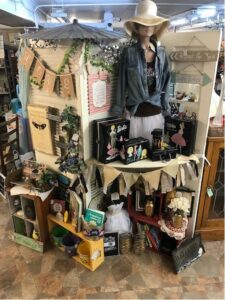
Fort Scott was busy Friday morning, June 12, with a town-wide garage sale, as residents enjoyed a mild day for shopping. The sales continue on Saturday, June 13.
This is the first town-wide garage sale of the season and is a month later than usual, due to the pandemic restrictions.

Maps of sale locations can be picked up at the Fort Scott Chamber of Commerce Office, 231 E. Wall; Bids & Dibs, 108 S. Scott Avenue; Casey’s General Store, 2216 S. National; Pete’s, 1920 S. Main, and 603 S. National Avenue; Fort Scott Smoke Shop,1705 S. National; and 5-Corner’s Mini Mart, 1122 S. Clark.
At least three Christian organizations are having multi-family sales: St. Mary’s Catholic Church, 705 S. Holbrook; Fort Scott Christian Heights School, 1101 S. Barbee Street; and First Southern Baptist Church, 1818 S. Main.

To see the Fort Scott Chamber of Commerce map of all the town’s garage sales, click below:

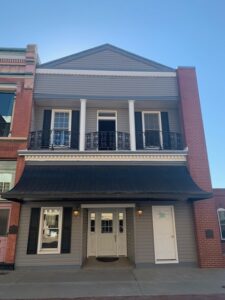
Bourbon County Economic Director Jody Hoener is working on securing leases in the former Mercy Hospital building on Fort Scott’s south end, in hopes of providing the county with a medical mall.
A medical mall is a facility offering comprehensive ambulatory medical services such as primary and secondary care, diagnostic procedures, outpatient surgery, and rehabilitation, except the overnight beds, according to merriam-webster.com.
“Bourbon County demographics show proportionately more elderly, more children living in poverty, lower incomes, and more chronic health conditions,” Hoener said. ” In addition, our community recently felt the impact of fewer health services (with the closing of Mercy Hospital in 2018). Rural health systems can overcome these challenges by creating linkages and efficiencies.”
“Access to robust and diverse health services is much more than a quality of life issue,” she said. “A vigorous and thriving health care system is essential not only for public health and welfare, but to enhance economic opportunity as well.”
Health organizations that currently have a part in Bourbon County health care have shown interest.
“We are currently working on leases with Community Health Centers of Southeast Kansas and Ascension Via Christi,” she said. “These leases will be ten-year long-term contracts,” she said. “Fort Scott Community College Nursing program will also be leasing space through an inter-local agreement.”
Other entities have “paused” conversations.
“Although we have been in talks with additional healthcare providers to occupy space, the COVID-19 pandemic has paused much of these conversations.,” Hoener said. “Recruitment activities will be a high priority with a goal of one additional anchor tenant in the next 3-5 years.”
The combined operation of many entities under one roof provides financial benefits to each involved, Hoener believes.
“The healthcare mall addresses many challenges local providers face in an innovative approach, creating synergy within the four walls, that will help each organization’s bottom line,” she said. ” In general, there are fewer healthcare providers in rural areas, and they operate on very thin profit margins. When compared to urban communities, our local health providers face unique challenges.”
Bourbon County’s vision for the community:
“Our vision is a healthy, safe, and thriving Bourbon County.,” she said. “A strong health care system is a critical piece of any community’s vitality and sustainability.”
The healthcare industry impacts the local economy.
“The healthcare industry is rapidly changing and has the potential to greatly impact access to these services in the future, ” Hoener said.
“Through the healthcare mall, we are becoming proactive in maintaining high-quality local health care services. In addition to health outcomes, healthcare services have shown to have an impact on:
” Americans are spending more dollars on healthcare,” Hoener said. “In 1970 healthcare costs accounted for 7.0 percent of the GDP. In 2017, Americans spent $3.5 trillion on healthcare, or 18.0 percent of the GDP. The projected GDP is 19.4 percent by 2027 (Kansas Health Association, 2019). Capturing a share of this economic growth will only help our community.”
“When residents spend health care dollars elsewhere, rather than purchasing the service locally, it can have a negative economic impact and result in loss of dollars within our local community,” she said. “Out of town trips to obtain healthcare services naturally offer opportunities to spend dollars outside of town that may have been spent locally.”
“Nationwide, employment in healthcare services increased 92 percent from 1990 to 2015. For Bourbon County, in 2017, health services ranked number 3 in terms of employment,” she said. ” Also, in 2017, the health care sector’s impact on retail sales was $19,308,000, county sales tax impact of $270,000, and a total impact of $65,378,000. (Kansas Health Association, 2017).”
“Industry and business leaders look for good health and education services when making location decisions,” Hoener said. “They also want to ensure the local labor force will meet their needs.”
” Attracting and maintaining retirees is also important as this is a special group of residents whose spending can provide a significant source of income for the local economy.”

|
|
|
|
|
|
|
|
|
|
|
|
|
|
|
|
|
|
|
|
|
|
Lifeline Program offers relief to those struggling to keep phone service
TOPEKA – Low income and recently unemployed Kansans may qualify for phone service discounts of up to $17.02 per month with the Lifeline program. Currently more than 10 million low-income Americans, including 35,000 Kansans, are benefiting from Lifeline discounts on home and wireless phones as well as broadband.
At a time when many Americans may be unemployed or facing other circumstances that make them eligible for the program for the first time, the Kansas Corporation Commission is joining utility regulators nationwide in increasing awareness of the Lifeline program.
Under the federal Lifeline Program, those who qualify can receive up to $9.25 per month off their monthly bill. Participants may also be eligible for an additional $7.77 monthly discount through the Kansas program. Fifty-two telecommunication companies offer Lifeline services in the state.
Residents enrolled in any of the following assistance programs are eligible for the Lifeline program: Supplemental Nutrition Assistance Program (SNAP), Medicaid, Supplemental Security Income (SSI), Federal Public Housing Assistance (FHPA), Veterans Pension & Survivors Pension Benefit, Bureau of Indian Affairs General Assistance, Tribally Administered Temporary Assistance for Needy Families, Head Start Tribal Programs (only those meeting its income qualifying standard), and the Food Distribution Program on Tribal Lands.
Those at 135% of the federal poverty level also qualify. Normally, applicants must provide three consecutive months of income documentation or provide a copy of their tax return for the previous year. Due to the COVID-19 pandemic, the requirement of three months of income documentation has been waived until June 30, 2020. Instead, recently unemployed individuals may apply for the program by submitting an official document, including notice of unemployment benefits to confirm their income-based eligibility for Lifeline support.
More information on Lifeline eligibility and enrollment is available on the KCC’s website: http://kcc.ks.gov/telecommunications/lifeline or by calling the KCC’s Office of Public Affairs and Consumer Protection at 800-662-0027 or 785-271-3140. For a complete list of Kansas Lifeline providers, go to https://data.usac.org/publicreports/CompaniesNearMe/State/StateOption/KS.
—

Because of the COVID 19 Pandemic, the annual All-Hit 103.9 Home, Sport, Farm and Garden Show was moved from spring to summer.
The event is now scheduled Friday, June 26 from 5 to 8 p.m. and Saturday, June 27 from 8 a.m. to 1 p.m. at Arnold Arena on the campus of Fort Scott Community College, 2108 S. Horton.

Hosted by Fort Scott Broadcasting, which includes radio stations 103.9, Red Dirt 98.3, and 1600 AM, the event is “a great opportunity to get local businesses to show off their products,” said Deb McKenney. Tim and Deb McKenney own the business.

This year there will be pandemic guidelines, Tim McKenney said.
“We are encouraging people to wear masks and gloves, and we will provide some for those who would like some,” he said. “Also hand sanitizing will be available.”

In addition, there will be more spacing between the vendors, he said.
“There will be fewer booths, so it won’t be so crowded,” Tim said.
This year they are expecting 40 vendors as opposed to 60, he said.
The show began in 1982, and in the late 80s the Pride Organization at Fort Scott Middle School took the reins, as a fundraiser, Deb said.
The broadcast company was asked to take the show on again and they have since continued the showcasing business event for the community.
|
|
|
|
|
|
|
|
|
|
|
EPA Cancellation Order for Dicamba Products Impacts Kansas Agriculture
MANHATTAN, Kansas — On Monday, June 8, 2020, the U.S. Environmental Protection Agency issued a final cancellation order for three dicamba products in response to the recent court ruling that vacated registration for the products. The EPA’s cancellation order intended to clarify the limited and specific circumstances under which these dicamba products can be used for a limited period of time, including provisions for existing stocks. The Kansas Department of Agriculture has identified several unanswered questions about how this order applies to Kansas farmers and agribusinesses and is in communication with the EPA for further interpretation.
The EPA cancellation order addresses the sale, distribution, and use of existing stocks of the three affected dicamba products: Engenia, FeXapan, and Xtendimax with Vaporgrip Technology. Under this cancellation order, further distribution or sale of all existing stocks of these products is allowed only to the end user. Such distribution and sales can only be made by Kansas restricted use pesticide dealers. If growers, commercial applicators, and agribusinesses have these products in their possession, end use applications may still occur provided that all label restrictions are followed. All use is prohibited after July 31, 2020.
As further details become available from the EPA, KDA will share that information on our website at www.agriculture.ks.gov/dicamba. This site will also serve as a source for more detail on the affected dicamba products, the EPA order, and how this order applies in Kansas. If you have additional questions, please contact the KDA pesticide and fertilizer program at 785-564-6688.

|
|
|
|
|
|
|
|
|
|
|
|
|
|
|
|
|
|
|
|
|
|
|
|
|
|
|
|
|
|
|
|