Carla Nemecek is Southwind District Director and agent.
Please join the Southwind Extension District next Thursday, July 28 as we host an Open House to welcome Woodson County to Southwind Family.
Effective July 1, 2018, Woodson County Extension will join the Southwind Extension District. We will celebrate this important merger with refreshments and fellowship on Thursday, July 28 at a come-and-go reception in the Yates Center Office, 211 W. Butler from 2pm-6pm.
Staff and board members will be present at the Extension Office to answer your questions about the District and explain what K-State Research & Extension can do to better serve the residents of Woodson County.
Currently, the Extension programs in Neosho, Bourbon, Allen and Woodson Counties consists of 4 Office Professionals and 8 Agents with specialized expertise in 4-H & Youth Development, Food & Nutrition, Adult Development & Aging, Financial Management, Horticulture, Community Leadership, Livestock Production, and Forage Management.
For more information, please contact Carla Nemecek, Southwind District Director at 620-365-2242.
The Buffalo Grill, 3 W. Oak, was purchased in May 2018 by Al Niece.
Al Niece, the owner of Niece of Kansas Inc., purchased the Buffalo Grill, 3 W. Oak in May 2018 from Dean Mann.
“It’s a fantastic building, lots of options are open” for the development of the property, Niece said.
“The building looked too good a building to be left unattended,” Niece said. “In talking with people in the community and the city, there are not many large eating facilities in the town.”
“When I walked in earlier this year, I was amazed at the condition,” he said.
Conventions, graduations, weddings, Christmas parties “and who knows what else” can use the River Room on the second floor of the building, Niece said. “We’ve already booked events for fall, two weddings and Christmas parties.”
The River Room name will stay the same for the second-floor event space, he said.
“The restaurant will be an additional component to it,” Niece said. “There are a lot of options for that. We don’t know whether we will keep the name Buffalo Grill or not.”
“We are talking to a couple of franchises,” Niece said.
In addition, the business suite on the north-west side of the building is up for rent, with 2,400 square feet of space.
The restaurant will likely be open in the third quarter of 2018 he said.
Jared Leek is the manager of the facility for Niece and can be reached at 620-224-9787.
Personnel matters of individual non-elected personnel
Consultation with an attorney for the body or agency which would be deemed privileged in the attorney-client relationship
Matters relating to employer-employee negotiations whether or not in consultation with the representative(s) of the body or agency
Confidential data relating to financial affairs or trade secrets of corporations, partnerships, trusts and individual proprietorships
Preliminary discussions relating to the acquisition of real property
Matters relating to the security of a public body or agency, public building or facility or the information system of a public body or agency, if the discussion of such matters at an open meeting would jeopardize the security of such public body, agency, building, facility or information system
Joy Miller, K-State Research and Extension Southwind District, Family and Consumer Science, 620-223-3720 or joymiller@ksu.edu
Board games can help connect family and friends in ways that video games can’
Playing board games gets everyone in the same room and helps family members across generations connect, compete, and have a great time together. Board games are easy, inexpensive, and have benefits well beyond the activity itself. Games are an entertaining and painless way to help kids build essential learning skills on the sly or by accidental learning, which means there’s no anxiety or resistance.
The book “Family Treasures: Creating Strong Families” by John DeFrain, covers six qualities that strong, successful families around the world exhibit: enjoyable time together; appreciation and affection for each other; positive communication; spiritual well-being (values, beliefs, life skills); successful management of stress and crisis; and commitment to each other.
If we don’t carve out time as a family, none of those traits will be achieved. Those traits are built in a scaffolding manner – one brings the other. Board games foster that face-to-face time interaction needed to connect deeply with each other and to develop the other traits of strong families.
Social and emotional health – Research shows the link between social and emotional skills and school success is so strong that it is a greater predictor of children’s academic performance than their family background and cognitive abilities. Learning is a social process. Children cannot learn if they struggle with following directions, getting along with their peers and controlling their emotions in any setting.
Every face-to-face game provides a ‘social experiment’ where players learn self-regulation and social skills to play successfully with others, a lot goes on under the surface, even when playing the simplest of games. Children identify and regulate their emotions and behavior, learn to calm down when upset without hurting others, and learn how to win – or lose – with grace and good manners.
Playing games fosters persistence, a willingness to try new things, conversation, cooperative play and thinking of appropriate solutions to conflict. Games also help children learn to interpret others’ behavior and emotions, and can reinforce children’s feeling good about themselves and others.
Basic math concepts – Even some of the simplest board games give children a sense of numbers. For example, the numeral 4 represents four objects, which is greater than 3 and less than 5. Some games introduce geometry concepts with shapes and patterns, how to classify items
Christopher Petty, M.S. Extension Agent Livestock Production and Forage Management K-State Research and Extension Southwind Extension District 210 S. National Fort Scott, KS 66701 (620) 223-3720 Work (620)224-6031 Cell cgp@ksu.edu
According to Walt Fick, a K-State Research and Extension Range Specialist, Sericea lespedeza has been a statewide noxious weed in Kansas since July 1, 2000. Despite control efforts, this introduced, invasive species continues to persist on rangeland, pasture, and CRP acres in the state. Sericea lespedeza has a tremendous seed bank that helps reestablish stands following control efforts. Sericea lespedeza currently infests nearly 500,000 acres in Kansas.
There are no known biological controls that can be effectively used on sericea lespedeza. However, grazing with sheep and goats can suppress sericea lespedeza stands and produce a saleable product. Cattle supplemented with corn steep liquor (CSL) have been shown to consume more sericea lespedeza than animals not supplemented with CSL. Frequent mowing will reduce sericea lespedeza, but is also damaging to plants that might be growing/competing with sericea. A single mowing in mid- to late-July will eventually reduce stands of sericea lespedeza to some extent but has not eliminated sericea, even after several years of mowing. A late-summer mowing will eliminate most seed production. Application of appropriate herbicides about 4-6 weeks after mowing will help reduce sericea lespedeza stands, but will also damage other forbs. Prescribed burning in April seems to stimulate seed germination. Burning in August and early September nearly eliminates seed production.
Herbicides applied at the correct time and under favorable environmental conditions can significantly reduce sericea lespedeza, but retreatment has proven to be required. Early summer is a good time to consider spraying sericea lespedeza. Plants are in a vegetative growth stage and previous research has indicated good to excellent control at this time.
Remedy Ultra (triclopyr) and PastureGard HL (triclopyr + fluroxypyr) can provide effective control when applied during June and into early July when the sericea plants are in a vegetative growth stage.
Products containing metsulfuron, such as Escort XP, Cimarron Plus, and Chaparral, are generally more effective in the late summer when sericea lespedeza is actively blooming.. Use a non-ionic surfactant with all of these products. These products containing metsulfuron may stunt tall fescue.
For spot applications, mix 0.5 fl oz PastureGard HL per gallon of water, use a 1 percent solution of Remedy Ultra in water or 1 gram Escort XP per gallon of water.
Herbicide treatments will need to be repeated at least every 2 to 4 years to keep this invasive species in check. Initial treatments should reduce dense stands to the point where spot treatment can be used in future years. Left untreated, sericea lespedeza will quickly dominate a site, greatly reducing forage production and species diversity.
If you are unfamiliar with sericea lespedeza, learn how to identify the species and get started with a control program. Be persistent with control efforts to keep this invasive species at manageable populations. Contact Southwind Extension District Agent Christopher Petty at 620-223-3720 or by e-mail at cgp@ksu.edu for more information.
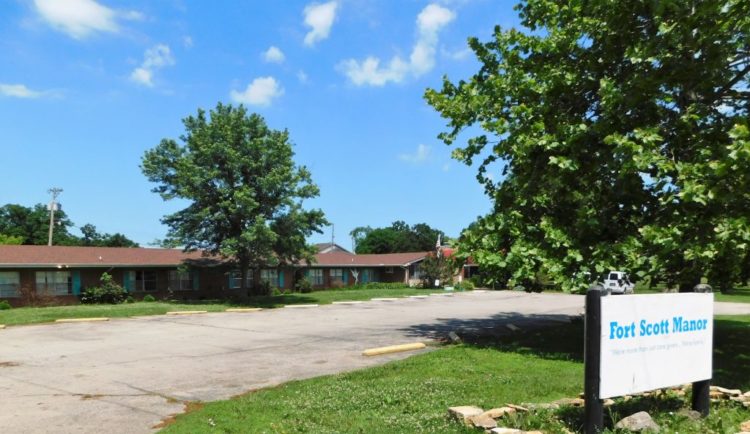
Fort Scott Manor on Heylman Street was recently closed down by the Kansas Department of Aging and Disabilities.
A local nursing home was closed by the State of Kansas in May 2018 for deficient practices and conditions that placed its residents in immediate danger, according to court documents found in the Bourbon County Courthouse, District Court.
In April 2018 the Kansas Department of Aging and Disabilities Services (KDADS) surveyed Fort Scott Manor at 736 Heylman and found that “multiple instances of verbal, mental and physical abuse at the hands of direct care staff” had been inflicted on residents, according to court documents.
“The one nurse that was physically abusive was immediately fired,” Connie Willis, a Fort Scott Manor employee at the time, said.
The facility received a “K” rating which indicated that a situation “where the providers have caused or are likely to cause serious injury, harm or impairment or death to more than a limited number of residents.”
A plan to end the practices and conditions was started by the administrator, Jan Kierl, but not completed, according to the court documents.
Employees of Fort Scott Manor contacted the state that payroll checks had not cleared to pay them, according to the documents.
KDADS was also notified by food service, durable medical equipment and rehab vendors that they had not received payment for services rendered as well.
According to court documents, KDADS stated that conditions at Fort Scott Manor were life-threatening to the residents and that Jan Kierl was unable to pay debts that were owed.
By May, all the residents were found homes in other facilities or homes.
A status conference with Judge Mark Ward and other parties in the case is scheduled for July 23 at 9 a.m. in the Bourbon County Courthouse.
Messages left with Kierl and her attorney were not answered.
An employee account of Fort Scott Manor closing
Connie Willis worked at Fort Scott Manor from January 2014 until May 2018 when they closed, she said.
Willis was a housekeeper and kitchen helper at the facility during that time.
Soon after she started in 2014, the owners, Jan and Dan Kierl, had a contentious divorce.
“It was a big public blow-up,” Willis said.
Soon after, the facility administrator and the director of nursing were fired, Willis said.
“We changed DON’s (Director of Nursing) and administrators so much you never knew who was in charge,” Willis said.
In this time period, Jan Kierl cut back hours of employees and purchases for the nursing home, Willis said.
“I was purchasing some of my own cleaning supplies,” Willis said. “I had to buy a vacuum cleaner to do my work. I got it back last month.”
When Willis left Fort Scott Manor on May 13, there were 18 residents left, she said. The facility was home, at one time, to 45 residents.
On May 14, the state started taking over administrator duties, Willis said.
“They were there to do their job, to make the residents safe,” she said. “I applaud them for that.”
“On my last paycheck, the state had taken over and THEIR checks bounced,” Willis said.
“We were there for the residents trying to keep things normal for the residents,” Willis said. “The residents were great, the people I worked with did their best for the residents. It was so sad to see it closed.”
“They were taking people out of their home, one for 20 years,” Willis said. “That was hard seeing them move out. They didn’t want to move.”