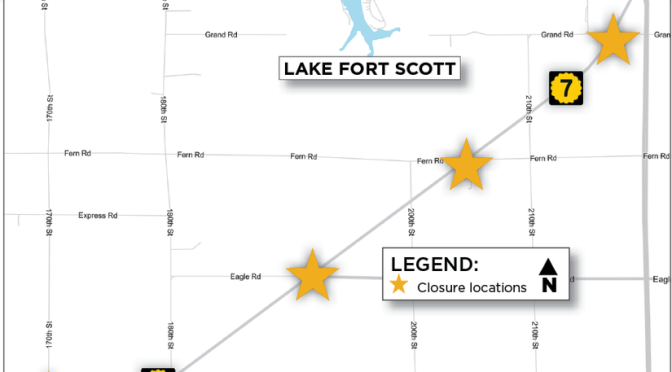
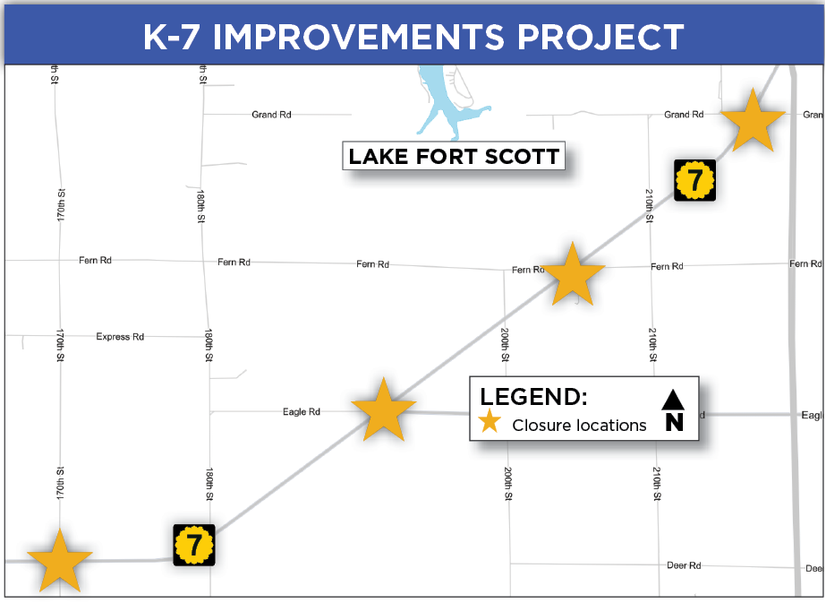
Work on current K-7 improvements between K-39 and U.S. 69 in Bourbon County will require some daytime closures of roads crossing the highway, according to the Kansas Department of Transportation.
K-7 remains closed to through traffic because of the project, but these closures will involve the streets and roads that cross K-7. These daytime closures allow the contractor to work on the road base and start pouring asphalt. Please find an alternate route during daytime hours.
Some closures – 160th Street, 180th Street, 200th Street and 210th Street – have already started and will wrap up after daytime work hours today, Tuesday, Aug. 4.
On Wednesday through Friday, Aug. 5 to 7, 170th Street, Eagle Road, Fern Road and Grand Road will be closed during daytime hours for the same work.
These intersections will reopen to traffic overnight and during times that work is not occurring. No two adjacent side roads will be closed simultaneously.
APAC-Kansas Inc., Shears Division, of Hutchinson, is the primary contractor.
KDOT urges motorists to stay alert, follow posted signs and refrain from hand-held mobile device use in all active work zones. For current road conditions, visit kandrive.gov or call 511. For updates on construction projects in southeast Kansas, visit ksdot.gov/projects/southeast-kansas-projects.
Bourbon County Sheriff’s Office Daily Report – August 5, 2026
Arrested
Cole, Michael Dugan (Age 62) — Arrested 8/4/2026 1:20 PM by Bourbon County Sheriff’s Office. Charge: Warrant – Bourbon County (Failure to Appear). Bond: $5,000.00 Cash/Surety.
Hall, Jeremy Steven (Age 44) — Arrested 8/4/2026 5:42 PM by Fort Scott Police Department. Charges: Criminal Threat – Unknown Circumstance, Disorderly Conduct – Unknown Circumstance. Bond: No Bond.
Released
Greer, Christopher — Released 8/4/2026 2:17 AM via Cash Bond (Self).
Perry, Darrick Lawrence — Released 8/4/2026 8:31 AM via KDOC (KDOC Transfer).
The Bourbon County Commission spent most of its Monday, Aug. 3 meeting on the sheriff’s and corrections budget for 2027 — a review dominated by a looming radio-system upgrade with a price tag of about $3.2 million — and heard election workers ask for more room and more time ahead of the primary. Chairman Samuel Tran presided; Commissioner Mika Milburn-Kee was absent.
Sheriff’s budget review flags $3.2 million radio project
Budget consultant Matt Lawn walked the board through the sheriff’s and corrections budgets with Sheriff Bill Martin present, describing a roughly 2% increase in wages and contractual costs and a larger bump in commodities driven by about $14,000 in computer replacements through Stronghold.
The larger issue was the five-site P25 simulcast radio upgrade — about $3.2 million for the total system infrastructure including the City of Fort Scott and rural fire departments, with a county share of roughly $496,000. Lawn told the board a project with a 15-to-20-year service life is a capital item that should not be absorbed into the annual operating budget. Sheriff Martin said the feasibility findings from TUSA are due Aug. 17, to be followed by a request-for-proposals phase and a proposed third-phase service-contract requirement, “That system from day one should be operating as it was 15 years from now, should be operating the same way as it was the first day that it was installed.”
Martin also stressed what is at stake for deputies and for fire and EMS communications in getting a new radio communication system: “It’s public safety, and I want to make sure that my men and women, both local and county, go home to their families.”
Tran asked Lawn to prepare a sales-tax analysis, including compensating use tax, once the budget work wraps up. Commissioner Gregg Motley and Lawn both cautioned against leaning on sales tax rather than an industrial-revenue-bond or bond package. Lawn asked for one more short work session next week to tie up loose ends in the budget-making process.
Election workers ask for space and time
In public comment, Michael Hoyt, Debbie Schoenberger and Diane Keating each pressed the county for more space and more time for election-day operations, reporting more than 800 early voters and more than 90 ballot styles for the primary. Keating said the crunch of both time and space had her missing her granddaughter’s sheep show at the Linn County Fair.
EMS rates and collections
EMS Director Teri Hulsey presented three years of call-volume statistics and confirmed the current billing structure: a $650 base rate plus $19 per loaded mile. Tran asked her to find out what neighboring counties charge and whether raising the base rate — which insurance companies generally pay without dispute — would close the department’s collections shortfall. Hulsey agreed to come back with numbers.
Courts locked out of their own cameras
Tran said the board’s earlier vote to have Stronghold clean up the courthouse camera system had inadvertently kicked the courts off it, leaving court staff unable to view their own security cameras. The board voted unanimously to restore the courts’ access, working through Stronghold.
Backhoe purchase reopened
The landfill backhoe purchase approved July 27 — a CAT 420 at about $173,675 — was reopened after Tran proposed a two-machine alternative, a Takeuchi TL-12 skid steer plus a TB-260 mini-excavator, which he said could save roughly $38,777 and add tracked mobility. Landfill equipment operator Diane Ballou pushed back, saying a standard skid steer cannot reach over the transfer-station wall and that she cannot afford to be down to a single machine if one breaks. Skitch Allen shared his experience with the machines, and Tran said he would get lease and demo pricing from Kirby Smith of Kansas City by next week.
“I’m not going to direct them on how to do and what to do,” said Tran of his proposal. “I’m just offering an alternative to the process. That’s all I’m doing.”
Other business
Policies and procedures. Commissioner David Beerbower presented a draft county policies-and-procedures manual — prepared with AI assistance and marked “draft” — emphasizing that individual commissioners may not direct department heads, tour facilities unilaterally, or speak for the board without a vote. The board agreed to schedule a work session on it.
Space allocation. Requests involving the old dispatch room (county clerk for election equipment vs. sheriff’s evidence room) and the Register of Deeds’ request for Room 12 — complicated by an unsecured primary server rack in that room — were tabled for two weeks, along with Beerbower’s proposal to seek a grant writer to fund an architectural study of the annex and the courthouse first floor to maximize the space. Motley will informally contact Redfield, a grant-writing firm first.
S&P rating surveillance. Ben Hart briefed the board on a Standard & Poor’s rating-surveillance letter and will sit in on the analyst call scheduled for Tuesday afternoon. The purpose of the call is to answer questions regarding the county’s financial health, which affects the interest rate available for bonds the county may enter in to. “Any kind of movement within your credit rating, just like at home… if it goes up, your costs go down. If the credit rating goes down, your costs go up,” said Hart. He pointed out several things that the county is doing that should reflect well on its credit rating with S&P. He recommended the county adopt a fund-balance policy after budget season.
Landfill items. The KDWP walk-in hunting contract for the old landfill parcel moved toward signature, with Beerbower still researching options. Separately, a KDHE email surfaced flagging that the county has never filed a required restrictive covenant on the closed landfill, with a Sept. 30 deadline; the county attorney will take it up when he returns Aug. 17.
Elevator and backup court space. The courthouse elevator is running again after the OEM part arrived, but a longer outage is expected in October during construction. Beerbower and court staff will tour the federal courtroom at the post office building Thursday morning as possible backup court space.
Beerbower also proposed considering turning the county-owned building at 108 W. 2nd into commission space that could also function as a courtroom. The property has “very little economic value,” said Motley, and thus could be better used by the county as needed meeting, court, and office space.
Asbestos. Responding to a constituent concern about asbestos in the courthouse, the board voted to assign Motley to investigate the county’s EPA responsibilities and develop a plan.
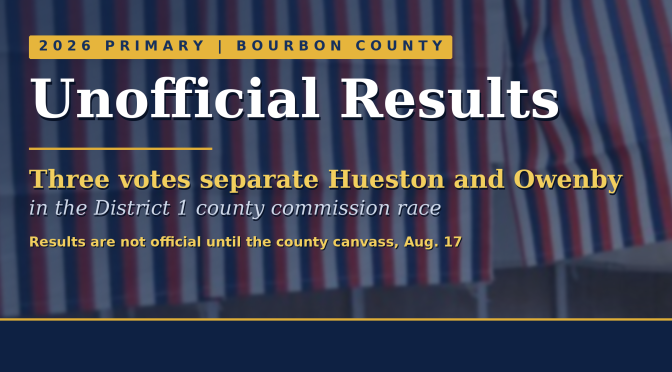
Three votes separate Mike Hueston and Lyle K. (Pete) Owenby in the Republican primary for Bourbon County Commissioner District 1, according to the unofficial results the Bourbon County Clerk’s office posted after Tuesday’s primary election. Countywide, 2,908 ballots were cast.
The race is too close to call, and none of these numbers are final. Provisional ballots are not included in the unofficial totals; the county Board of Canvassers decides which of them count and makes the results official at the canvass, which the Bourbon County Monitor reports is scheduled for Aug. 17. The Monitor also reported that County Clerk Susan Walker said the number of outstanding provisional ballots would be released Wednesday. Under a recent change in Kansas law, mailed advance ballots had to be in by 7 p.m. on Election Day to count. FortScott.biz published a step-by-step walkthrough of how the county counts, reconciles and canvasses ballots in June.
County Commissioner: unofficial totals
District 1, Republican
Candidate
Votes
Vote %
Mike Hueston
163
42.67%
Lyle K. (Pete) Owenby
160
41.88%
Lisa Dillon
59
15.45%
The nominee will appear on the November general election ballot with Clinton L. Walker of Mapleton, unopposed in the Democratic primary.
District 1, Democratic
Candidate
Votes
Vote %
Clinton L. Walker
88
100.00%
District 3, Republican
Candidate
Votes
Vote %
Joe Allen
307
65.60%
Josh Jones
161
34.40%
The results report lists Jones as Joshua Jones; he filed as Josh Jones. No Democrat filed for District 3; the Democratic primary line recorded six write-in votes.
District 4, Republican
Candidate
Votes
Vote %
Gregg Motley
427
100.00%
No Democrat filed for District 4; the Democratic line recorded 12 write-in votes.
Township clerk: unofficial totals
All township clerk candidates ran as Republicans; no Democrat filed for any township clerk office. Marion Township was the only contested race. In the county’s other townships no candidate filed, and those races recorded only scattered write-in votes.
Five Republican precinct committee races drew more than one candidate.
Race
Candidate
Votes
7th Ward Committeeman
Robert S. Love
79
7th Ward Committeeman
Michael Hoyt
73
Drywood Committeewoman
Vickie Shead
67
Drywood Committeewoman
Laura Krom
18
Marmaton D2 Committeeman
Jeffrey L. Reed
68
Marmaton D2 Committeeman
Micheal Bryant
23
Osage Committeeman
Marvin Creager
47
Osage Committeeman
Joshua Kee
22
Timberhill Committeeman
Timothy H. Emerson Sr.
20
Timberhill Committeeman
Brandon Whisenhunt
18
What happens next
The Board of Canvassers will review provisional ballots before certifying the official results. In a race as close as the District 1 Republican primary, those ballots could matter. FortScott.biz will report the official totals after the canvass.
The full unofficial report, “Statement of Votes Cast by Geography,” is posted on the Bourbon County website. It also includes Bourbon County’s votes in the federal, state and statewide-ballot-question primaries; those contests are decided by voters beyond Bourbon County, and the county’s numbers alone do not determine their outcomes.
Post Date:08/04/2026 12:00 PMWork on current K-7 improvements between K-39 and U.S. 69 in Bourbon County will require some daytime closures of roads crossing the highway, according to the Kansas Department of Transportation, according to a press release.K-7 remains closed to through traffic because of the project, but these closures will involve the streets and roads that cross K-7. These daytime closures allow the contractor to work on the road base and start pouring asphalt. Please find an alternate route during daytime hours.
Some closures – 160th Street, 180th Street, 200th Street and 210th Street – have already started and will wrap up after daytime work hours today, Tuesday, Aug. 4.
On Wednesday through Friday, Aug. 5 to 7, 170th Street, Eagle Road, Fern Road and Grand Road will be closed during daytime hours for the same work.
These intersections will reopen to traffic overnight and during times that work is not occurring. No two adjacent side roads will be closed simultaneously.
APAC-Kansas Inc., Shears Division, of Hutchinson, is the primary contractor.
KDOT urges motorists to stay alert, follow posted signs and refrain from hand-held mobile device use in all active work zones. For current road conditions, visit kandrive.gov or call 511. For updates on construction projects in southeast Kansas, visit ksdot.gov/projects/southeast-kansas-projects.
Bourbon County Appraiser Matt Quick has resigned, with his last working day set for August 18. In a letter emailed to all five county commissioners Monday evening, Quick said he and his wife “have been presented with an exciting opportunity to embark on a new life adventure,” and called leaving the office “bittersweet.”
The letter, sent shortly after 5 p.m. on Monday, August 3, was addressed to the commission and copied to the County Clerk’s office, Treasurer Jennifer Hawkins, and the Register of Deeds.
The office he leaves. The county appraiser values all taxable real and personal property in Bourbon County each year, houses, farmland, commercial buildings, vehicles, and business equipment. Those valuations are the base on which the county, cities, school districts, and other taxing entities levy property taxes. Under Kansas law (K.S.A. 19-430), the appraiser is appointed by resolution of the county commission for a four-year term, and an appointee must have at least three years of mass appraisal experience and hold a state credential, either the Registered Mass Appraiser (RMA) designation Quick mentions in his letter, or a certified general real property appraiser’s license.
Quick’s letter counts eight years of service to the community. Commission records show he has led the office since July 2021, when commissioners named him interim county appraiser by Resolution 22-21; a Kansas Department of Revenue compliance reviewer praised his work before the commission that December, and his reappointment to a new four-year term came before the commission in the summer of 2025.
His departure is one of two from the office this month: Quick writes that his personal property manager is also leaving, with a last day of August 14. He notes that no state reports or analysis are due until October, which he says gives the commission time to find a replacement who can do their own analysis for the 2027 tax year, and that Matthew Booker, the county’s district representative with the state Property Valuation Division, will guide commissioners through candidates.
His letter follows in full.
Dear Commissioners,
After much thought and consideration, I am formally submitting my resignation as County Appraiser for Bourbon County, with my last working day being August 18, 2026.
Serving this community for the past eight years has been both an honor and a privilege. I am deeply grateful for the trust placed in me, the collaboration with dedicated colleagues, and the opportunity to contribute to the county’s growth and success.
My wife and I have been presented with an exciting opportunity to embark on a new life adventure, and while I am eager for what lies ahead, leaving this role and the people I’ve worked alongside is bittersweet.
I will be informing Matthew Booker who is our District Rep with Property Valuation Division with the state to let them know. They will be your guides for candidates to replace me as they must be an RMA with the state to qualify. My office will be self-sustainable for the next few months. There are no reports or analysis for the state that needs to be done until October. This will allow you to find a replacement and they will be able to do their own analysis for the 2027 tax year. My Personal Property manager is also leaving and last day will be on the 14th so they can find the right person for them in that position as well. My field appraisers Mike and Herb have been faithful hard-working employees that brave the elements and the people of Bourbon County and will continue to do their jobs at the highest level after I am gone. Janet my office manager has been with the county since 2008. She is a wealth of knowledge about running all aspects of the department and is a loyal and trustworthy employee. She will keep things running smoothly in my absence. I hope that the employees in my office will be treated with respect and dignity that long term dedicated assets that they deserve.
Thank you for the support, guidance, and friendship I have experienced during my tenure. Bourbon County will always hold a special place in my heart.
With sincere appreciation,
Matt Quick
The appraiser’s office is in the county courthouse at 210 S. National Ave. FortScott.biz will follow the commission’s search for a successor as it develops.
Bourbon County Sheriff’s Office Daily Report – August 4, 2026
Arrested
Edmonds, Chad — Arrested 8/3/2026 10:56 AM by Douglas County. Charge: Other Agency Hold. Bond: $0.00.
Ford, Bruce (Age 64) — Arrested 8/3/2026 11:03 AM by Douglas County. Charge: Other Agency Hold. Bond: $0.00.
Kenneson, Conner (Age 32) — Arrested 8/3/2026 11:15 AM by Douglas County. Charge: Other Agency Hold. Bond: $0.00.
Mason, Tabetha L (Age 46) — Arrested 8/3/2026 11:43 PM by Fort Scott Police Department. Charges: Possess Opiates/Opium/Narc Drug and Certain Stim, Possession of Certain Hallucinogenic Drugs, Use/Poss Drug Paraphernalia/Human Body. Bond: $0.00 [No Bond].
Released
Dalager, William Paul — Released 8/3/2026 10:50 AM via Transferred Out (Douglas County).
Greer, Christopher — Released 8/4/2026 2:17 AM via Cash Bond (Self).
Heffner, Evan — Released 8/3/2026 10:48 AM via Transferred Out (Douglas County).
Johnson, Matthias Andrew — Released 8/3/2026 4:03 PM via Surety Bond (Able Bonding).
Reeves, Wanita Louise — Released 8/3/2026 4:20 PM via Surety Bond (Able Bonding).
Richards, Levi Kent — Released 8/3/2026 9:56 AM via Time Served (Self).
Smith, Brandon — Released 8/3/2026 10:49 AM via Transferred Out (Douglas County).
The Bourbon County Inter-Agency Coalition will hold its next General Membership meeting on Wednesday, August 5, 2026, at 1:00 p.m. in the Conference Room at Scottview Apartments, 315 S. Scott Ave.
Agenda
Welcome
Member Introductions and Announcements
Program: Dr. Zach Johnson, Superintendent, USD 234
Open Forum
Adjournment
The next General Membership meeting will be September 2, 2026.
When the State dismissed its misdemeanor case against Bourbon County Commissioner Mika Milburn-Kee in late June, Senior Judge Merlin G. Wheeler’s order set Monday at 1 p.m. in Fort Scott for a first appearance and preliminary examination in the case the Kansas Attorney General’s office told the court it would refile. Five weeks later, no new case has been filed, and the Monday hearing, with no case to attach it to, never made it onto the court’s schedule.
Asked whether the hearing was going forward, the Bourbon County District Court clerk’s office replied by email Monday: “There is no hearing today. The case was dismissed.” Court staff confirmed by phone that nothing has been refiled and “there was nothing scheduled for today.”
At a June 26 pretrial conference, Senior Judge Merlin G. Wheeler denied the State’s eve-of-trial motion to add a felony Intimidation of Voters count to the two misdemeanors Milburn-Kee had faced since March. The State then dismissed the case without prejudice, telling the court it intended to refile all three charges together under a new case number. The judge’s written order, filed June 27, set the Aug. 3 date for the anticipated new case.
That case has not appeared. In Kansas district court records pulled Monday morning, a party search — run both for Bourbon County and statewide — shows no new case against Milburn-Kee. Nothing has been docketed in the dismissed case since the June 27 order. The Attorney General’s office, where Assistant Attorney General Olivia R. Higdon is prosecuting the case, has not publicly explained the delay. When FortScott.biz called the office July 27, a staff member said the only thing the office could share was that the matter was under “prosecutorial review.”
Whether and when the State will refile are open questions. One constraint is the calendar: Wheeler ordered that dismissing and refiling does not restart the speedy-trial clock, which he dated to April 15. Under Kansas’s speedy-trial law, K.S.A. 22-3402, a defendant who is out on bond must be brought to trial within 180 days of arraignment, not counting delays the defense causes — by that measure, roughly mid-October.
All of the charges stem from an Oct. 25, 2025 incident at the county commission room while it was being used as an early-voting polling place. The dismissed case charged interference with the conduct of public business, a Class A misdemeanor, and disorderly election conduct, a Class B misdemeanor that on conviction would mean forfeiture of office under K.S.A. 25-2432. The proposed third count, Intimidation of Voters, is a severity level 7 nonperson felony.
A charge is an accusation, not a finding of guilt, and Milburn-Kee, who has pleaded not guilty, is presumed innocent unless and until a jury decides otherwise. FortScott.biz will report when a new case is filed or a new hearing is set.
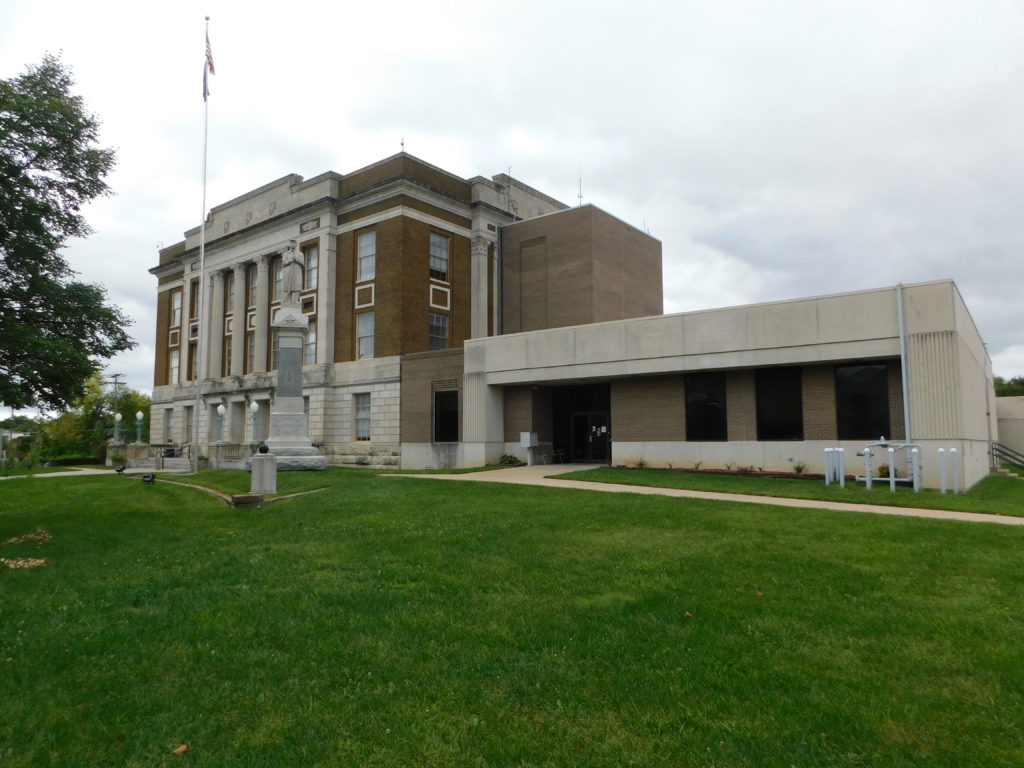
The Bourbon County Courthouse, 210 S. National Avenue.
2026 Bourbon County Primary Election: Candidates and Ballot Question
The Bourbon County Clerk’s office released the official list of candidates and ballot question for the August 4, 2026 Primary Election.
Below is a complete breakdown of every race and the constitutional amendment question that Bourbon County voters will see on their ballots.
Democratic Primary Candidates
United States Senator
Damon Anderson – Shawnee
Christy Davis – Cottonwood Falls
Adam Hamilton – Stilwell
Jason Hart – Wichita
Kevin Latz – Mission Hills
Erik Murray – Kansas City
Sandy Spidel Neumann – Overland Park
Anne Parelkar – Overland Park
Patrick C. Schmidt – Topeka
Michael “Mike” Soetaert – Wellington
Noah Taylor – Kechi
U.S. House of Representatives – District 2
Don Coover – Galesburg
Kansas Governor / Lt. Governor
Ethan Corson / Renee Duxler – Salina
Cindy Holscher / KC Ohaebosim – Wichita
Curt Skoog / Jennifer Bacani McKenney – Fredonia
Kansas Secretary of State
Jennifer Day – Overland Park
Samuel Lane – Shawnee
Kansas Attorney General
Chris Mann – Lawrence
Kansas State Treasurer
Juan C. Luengo – Olathe
Commissioner of Insurance
Dinah Sykes – Lenexa
State Board of Education – District 9
Heather Guernsey – Chanute
Bourbon County Commissioner – District 1
Clinton L. Walker – Mapleton
Bourbon County Commissioner – District 3
No candidate filed
Bourbon County Commissioner – District 4
No candidate filed
Township Clerk (Democratic)
No candidates filed in Drywood, Franklin, Freedom, Marion, Millcreek, Marmaton, Osage, Pawnee, Scott, Timberhill, or Walnut townships.
Democratic Precinct Committeeman/Committeewoman
Precinct
Position
Candidate
7th Ward
Committeewoman
Tracy J. Schafer – Fort Scott
Marmaton D2
Committeewoman
Thelma J. Quirin – Redfield
Millcreek
Committeewoman
Jane L. Gaines – Fort Scott
Scott D4
Committeewoman
Carol K. Lydic – Fort Scott
Timberhill
Committeeman
Clinton Lee Walker – Mapleton
Timberhill
Committeewoman
Rachel Walker – Mapleton
All other Democratic precinct positions: No candidate filed
Republican Primary Candidates
United States Senator
Roger Marshall – St. John
Pond Naramore – Lawrence
U.S. House of Representatives – District 2
Derek Schmidt – Independence
Chad E. Young – Lawrence
Kansas Governor / Lt. Governor
Ty Masterson / Jeffrey Klemp – Lansing
Charlotte O’Hara / Michelle Dombrosky – Olathe
Nick Reinecker / Katy Reinecker – Inman
Stacy L. Rogers / Michael W. Smith – Lansing
Philip Sarnecki / Joy Eakins – Wichita
Vicki Schmidt / Joe Newland – Neodesha
Scott Schwab / Ken Rahjes – Agra
Kansas Secretary of State
Pat Proctor – Leavenworth
Kansas Attorney General
Kris Kobach – Lecompton
Kansas State Treasurer
Steven Johnson – Assaria
Commissioner of Insurance
Daniel Hawkins – Wichita
Kansas House of Representatives – District 4
Rick James – La Cygne
State Board of Education – District 9
Destry Brown – Fort Scott
Kristian Gerken – Paola
Renee Slinkard – Parker
Bourbon County Commissioner – District 1
Lyle K. (Pete) Owenby – Redfield
Mike Hueston – Mapleton
Lisa Dillon – Fort Scott
Bourbon County Commissioner – District 3
Joe Allen – Fort Scott
Josh Jones – Fort Scott
Bourbon County Commissioner – District 4
Gregg Motley – Fort Scott
Township Clerk (Republican)
Drywood: Laura Krom
Franklin: No candidate filed
Freedom: No candidate filed
Marion: Brent M. Smith; Michael Ramsey
Millcreek: No candidate filed
Marmaton: No candidate filed
Osage: No candidate filed
Pawnee: No candidate filed
Scott: Donald Banwart
Timberhill: Jennifer Epting Williams
Walnut: No candidate filed
Republican Precinct Committeeman/Committeewoman
Precinct
Position
Candidate(s)
1st Ward
Committeeman
Kevin W. Davidson
1st Ward
Committeewoman
Cheryl L. Adamson
2nd Ward
Committeeman
Robert J. Uhler
2nd Ward
Committeewoman
Laurie R. Uhler
3rd Ward
Committeeman
Brian Rhoades
3rd Ward
Committeewoman
Brandy L. Rhoades
4th Ward
Committeeman
Matthew Wells
4th Ward
Committeewoman
Katie Wells
5th Ward
Committeeman
No candidate filed
5th Ward
Committeewoman
Jana R. Walker
6th Ward
Committeeman
Douglas E. Niemeir
6th Ward
Committeewoman
No candidate filed
7th Ward
Committeeman
Michael Hoyt; Robert S. Love
7th Ward
Committeewoman
Patricia S. Love
Drywood
Committeeman
Larry Shead
Drywood
Committeewoman
Vickie Shead; Laura Krom
Franklin
Committeeman
Tony Bradbury
Franklin
Committeewoman
Kaitlyn Bradbury
Freedom D1
Committeeman
No candidate filed
Freedom D1
Committeewoman
Janice Seested
Freedom D5
Committeeman
Lawrence Paddock
Freedom D5
Committeewoman
Karen A. Paddock
Marion
Committeeman
No candidate filed
Marion
Committeewoman
Nancy Holt
Marmaton D2
Committeeman
Jeffrey L. Reed; Micheal Bryant
Marmaton D2
Committeewoman
Angela Soetaert
Marmaton D4
Committeeman
No candidate filed
Marmaton D4
Committeewoman
No candidate filed
Millcreek
Committeeman
Boa Casper
Millcreek
Committeewoman
Katie K. Casper
Osage
Committeeman
Joshua Kee; Marvin Creager
Osage
Committeewoman
Mika Milburn-Kee
Pawnee
Committeeman
Kevin Wagner
Pawnee
Committeewoman
Rachel Wagner
Scott D1
Committeeman
Jim Sackett
Scott D1
Committeewoman
Gayle Sackett
Scott D2
Committeeman
Bryan Holt
Scott D2
Committeewoman
Tara Holt
Scott D3
Committeeman
Luke Demko
Scott D3
Committeewoman
No candidate filed
Scott D4
Committeeman
Roy D. Dare
Scott D4
Committeewoman
Anne Dare
Scott D5
Committeeman
Bill Lalman
Scott D5
Committeewoman
Glenda Lalman
Timberhill
Committeeman
Timothy H. Emerson Sr.; Brandon Whisenhunt
Timberhill
Committeewoman
Rebecca Whisenhunt
Walnut
Committeeman
Jason Sutterby
Walnut
Committeewoman
Rebecca Sutterby
Constitutional Amendment Question
In addition to candidate races, voters will be asked to decide on a proposed constitutional amendment regarding how Kansas Supreme Court justices are selected.
Explanatory Statement
This amendment gives voters the right to elect the justices of the Kansas Supreme Court. The justices shall serve terms of six years, with elections of justice positions 1, 2 and 3 to occur in 2028, positions 4 and 5 to occur in 2030, and positions 6 and 7 to occur in 2032, and every six years thereafter. The rules applicable for such elections and the designation of position numbers shall be provided by law. Any vacancy on the court for an unexpired term shall be filled at an election as provided by law.
A vote FOR this proposition would give Kansas citizens the right to elect Kansas Supreme Court justices as provided by law. Justices will hold office for terms of six years. The Kansas Supreme Court nominating commission, whose membership consists of a majority of lawyers, would be abolished.
A vote AGAINST this proposition would continue the current system in which the Kansas Supreme Court nominating commission, whose membership consists of a majority of lawyers, provides the governor a list of three individuals to choose from for vacancies on the Kansas Supreme Court. Justices hold office for a term of six years and retain their offices if they win a retention election in which they do not face an opponent.
Proposed Amendment Text (§ 5 – Selection of Justices of the Supreme Court)
The citizens of Kansas who are qualified electors shall elect the justices of the supreme court. The rules applicable for such elections and the designation of position numbers shall be provided by law. Justice positions 1, 2 and 3 shall be elected at the general election in November of 2028, justice positions 4 and 5 in November of 2030 and justice positions 6 and 7 in November of 2032, and every six years thereafter, respectively. Any vacancy occurring on the supreme court for an unexpired term shall be filled by election as provided by law.
The full text of the amendment, including proposed changes to §§ 8 and 15 of the Kansas Constitution, is available in the attached ballot PDF.
Late in the spring of 2014, a Bourbon County man was working outdoors on his property. He picked up several tick bites and found one tick on his shoulder swollen with blood.
Within a few days he felt sick to his stomach and weak, with diarrhea. A fever came the next day. On the third day he saw his primary care doctor, who prescribed doxycycline, the standard antibiotic for a suspected tick-borne illness.
The next morning his wife found him barely conscious. An ambulance took him to a local hospital, where doctors started intravenous fluids and intravenous doxycycline and kept testing him. Rocky Mountain spotted fever, Lyme disease, ehrlichiosis: they were all negative. He kept getting worse, and on the eighth day they moved him again, this time to the University of Kansas Medical Center in Kansas City (Mitchell et al., Case Reports in Infectious Diseases, 2026), for what the 2015 report calls further evaluation and management. Two days after that he was in intensive care.
Nobody ignored his symptoms. As he failed to improve, his doctors escalated at every step: from a clinic to a local hospital to a tertiary care center in five days. They ruled out the treatable causes before transferring him.
Every test for the tick-borne illnesses anyone knew about came back negative. Two days before he died, doctors sent a sample of his blood to a Centers for Disease Control and Prevention lab in Fort Collins, Colorado.
Eleven days after his first symptom, he died of septic shock. His blood pressure had fallen past what three separate drugs could hold up, and his organs were shutting down (Kosoy et al., Emerging Infectious Diseases, 2015). Scientists at that CDC lab went on to find a virus never before seen in a sick person in this country.
They named it for the county the man came from. Bourbon virus.
Why the antibiotic did not work
Here is the part worth remembering. Doxycycline is an antibiotic, and antibiotics kill bacteria. They do nothing at all to a virus.
Kansas has numerous bacterial tick diseases, including Rocky Mountain spotted fever, ehrlichiosis, and tularemia. Doxycycline is the standard first-line treatment for a suspected bacterial tick illness. Bourbon virus is not bacterial, and that one difference explains most of what makes this disease dangerous.
When the CDC announced the discovery in February 2015, it said this was the first virus of its kind ever shown to make a person sick in the United States.
It comes from the lone star tick
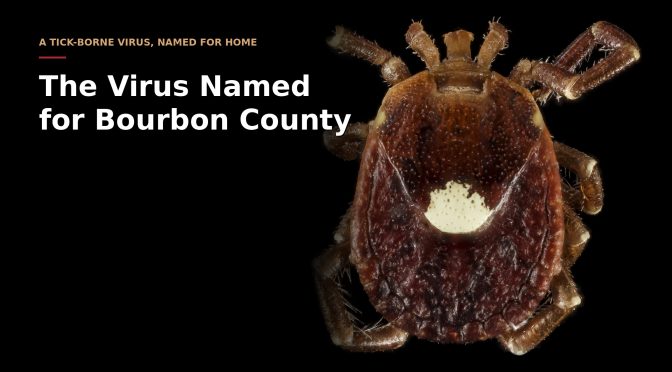
Bourbon virus is believed to spread through the bite of an infected tick, and every known case has followed one. The only species ever confirmed to carry it is the lone star tick, identifiable by the small white dot on the female’s back. A 2023 review of the research notes that in the five cases known at that point, the species of the tick that bit each patient was never identified.
This is not a rare or exotic tick. In a 2024 advisory, the Kansas Department of Health and Environment called the lone star tick the most common tick in Kansas, living across at least the eastern two-thirds of the state and biting people aggressively.
Scientists have also found the virus in ticks collected in the wild. A CDC team tested more than 39,000 ticks collected in northwestern Missouri in 2013 and found live Bourbon virus in three batches, all of them lone star ticks (Savage et al., 2017).
The second death, also in Bourbon County
In the spring of 2024, a 63-year-old man with well-controlled diabetes was preparing hunting ground in the woods of Bourbon County. He pulled two small ticks off himself that day and found a third on his lower back two days later. None of them were swollen with blood.
A week later he nearly fainted while standing, and went to an urgent care clinic with a headache, sore muscles, no appetite, and swollen legs. His blood pressure was 67 over 54.
He reached intensive care already in multi-organ failure. Within four hours he was on maximum doses of four separate drugs to hold his blood pressure up. His kidneys gave out and he went on continuous dialysis, then onto a machine that takes over the work of the heart and lungs. They gave him doxycycline early, in case this was bacterial. It was not. CDC testing came back positive for Bourbon virus.
Late in his stay he developed a fungal pneumonia, which his doctors linked to the steroids used to fight the shock. He died on his 21st day in the hospital. The report lists that infection alongside the virus as what killed him.
His case was written up by KU Medical Center doctors and published in January 2026 (Mitchell et al., Case Reports in Infectious Diseases). The same report notes that the 2014 patient died at that hospital too. In a June 2024 advisory, state health officials wrote: “This year alone, KDHE has investigated several tickborne disease cases with severe health outcomes, including hospitalizations due to Rocky Mountain Spotted Fever and Tularemia, and a fatal case of Bourbon virus.”
A search of the FortScott.Biz archive found no local news coverage of this death at the time.
Two men have died of this virus after picking up ticks in Bourbon County. Their deaths were ten years apart, both at the University of Kansas Medical Center in Kansas City.
The virus is in ticks here
After his diagnosis, the state health department surveyed the man’s land.
They collected 1,253 ticks, and every single one was a lone star tick. Tested in batches, one batch came back positive for Bourbon virus, and eleven came back positive for Heartland virus, an unrelated tick-borne virus spread by the same tick, which causes a similar illness and also has no cure.
That is a finding from 2024, not a footnote from 2014. The virus remains uncommon, though. Earlier CDC surveys near Bourbon County estimated roughly 0.25 to 0.32 infections per 1,000 adult ticks, and a 2016 survey found none at all.
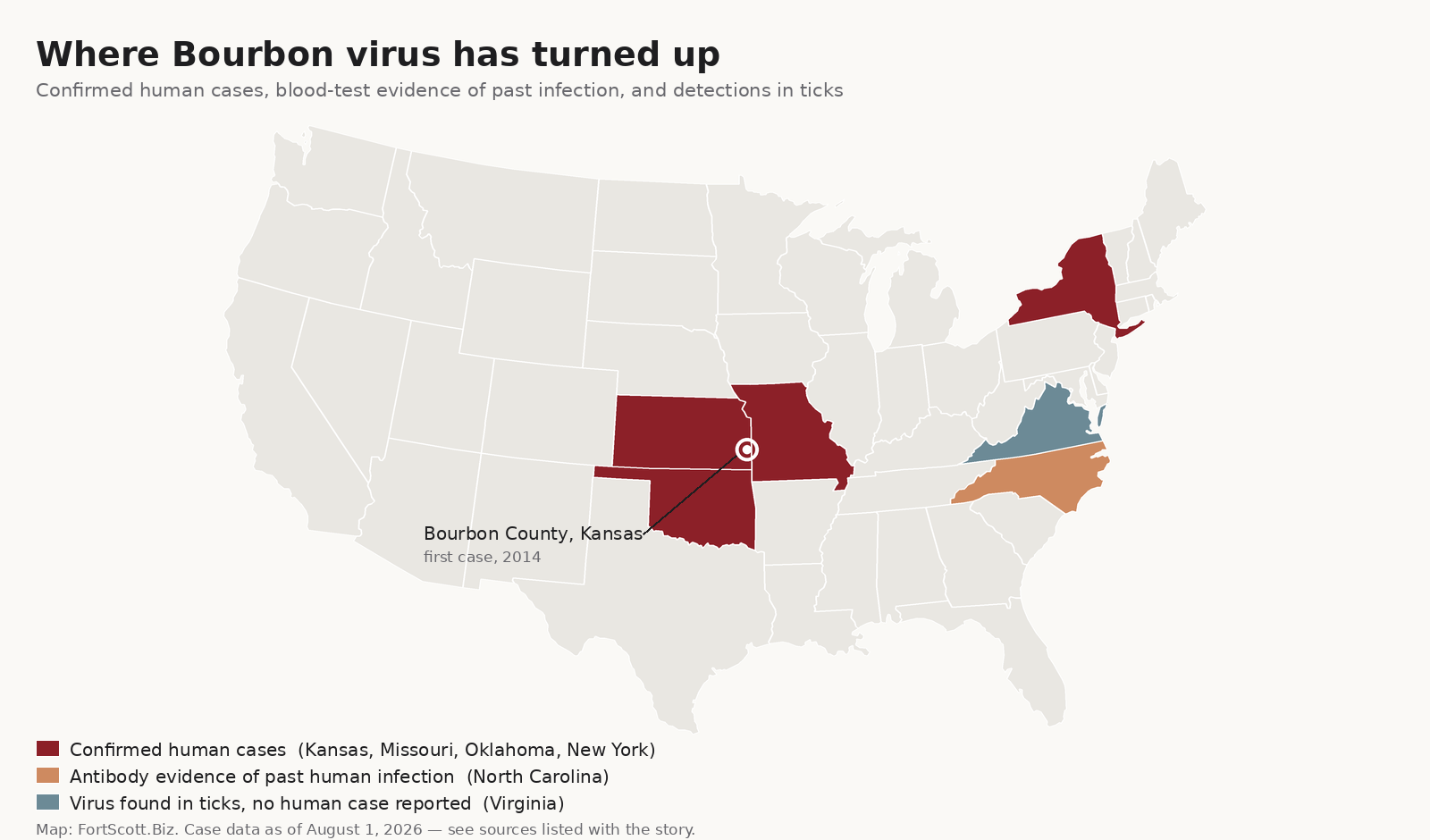
Where Bourbon virus has turned up. Map: FortScott.Biz. Case data as of August 1, 2026.
How rare is it, really
Six human cases have been reported in the medical literature since 2014, in four states: Kansas, Oklahoma, Missouri, and New York. That count comes from the January 2026 case report. The CDC’s own page, updated in June 2026, gives no running total at all.
One of the Missouri cases was a state park official whose death was linked to Bourbon virus in a March 2018 report by The Missourian, a Franklin County newspaper. That case is documented in news coverage rather than in the medical journals, and the 2023 scientific review of the virus cites the newspaper account rather than a case report.
The researchers who study it say the real number is higher. There is no commercial test for Bourbon virus, so a doctor who suspects it has to send samples through the state and then to the CDC. The Stony Brook team notes that many clinicians are unfamiliar with the virus, which raises the chance of a missed diagnosis.
When researchers went looking in stored blood samples in North Carolina, they found four people out of 518 carrying antibodies showing they had been infected at some point (Zychowski et al., 2024). That state has never had a confirmed case.
That does not mean those people got seriously ill, and some infections are probably mild. It does mean the virus reaches more people than the case count shows.
Long Island doctors reported the same kind of finding this summer. They rechecked blood from 107 patients who had a fever after a tick bite between 2019 and 2024, and two carried Bourbon virus antibodies (Bateman et al., American Journal of Tropical Medicine and Hygiene, 2026). One of them was New York’s first confirmed case, identified in April, a patient who had been hospitalized and assumed to have Lyme disease (Stony Brook Medicine, July 2026). Fox Weather reported that the patient recovered.
What to do about it
There is no vaccine and no drug that treats Bourbon virus. Hospitals can give fluids and treat the pain and fever, but they cannot kill the virus.
Since there is no treatment, not getting bitten is the only defense. The advice is the same as for every other tick illness. Treat clothes and boots with permethrin. Use a repellent with DEET, picaridin, oil of lemon eucalyptus, or IR3535. Tuck your pants into your socks. Shower soon after you come in. Then do a real tick check: waistband, armpits, around the ears, belly button, behind the knees, and in your hair. Check the dog too. Pull an attached tick straight out with fine-tipped tweezers, gripping close to the skin.
If you are being treated for a tick bite and not improving, tell your healthcare provider. That failure to improve is the specific clue Kansas health officials tell doctors to watch for.
Kansas health officials tell doctors to consider testing for Bourbon and Heartland viruses when a patient has a fever, a possible tick bite in the last three weeks, certain abnormal blood counts, and an illness that is not responding to doxycycline. Both Bourbon County men were given it. So was the New York patient, who was first thought to have Lyme disease.
The state also says to watch for symptoms for 30 days after a tick bite, and to tell your doctor about the bite. Kansas doctors who want testing help can call the state Epi Hotline at 877-427-7317, option 5.
Bourbon County Sheriff’s Office Daily Report – July 31, 2026
Arrested
Palmer, Neal Gilbert (Age 31) — Arrested 7/30/2026 3:30 AM by Fort Scott Police Department. Charge: Warrant Bourbon County (Failure to Appear). Bond: $0.00 No Bond.
Guffin, Augaio (Age 40) — Arrested 7/30/2026 3:54 AM by Fort Scott Police Department. Charge: Criminal Trespass; Unknown Circumstance. Bond: $0.00 No Bond.
Creek, Brookelynn Marie (Age 20) — Arrested 7/30/2026 9:21 PM by Bourbon County Sheriff’s Office. Charges: Veh Liability Insurance Req, Basic Rule Governing Speed, DUI; Misdemeanor, Possession of Certain Hallucinogenic Drugs, Possession or Attempt to Poss Tobacco; <18 YOA, Use/Poss Drug Paraphernalia/Human Body. Bond: $0.00 No Bond.
Rowden, Leslie Gean Jr (Age 54) — Arrested 7/30/2026 10:35 PM by Fort Scott Police Department. Charges: Possess Opiates/Opium/Narc Drug and Certain Stim, Use/Poss Drug Paraphernalia/Human Body. Bond: $0.00 No Bond.
Mercer-Kent, Sandra Jane (Age 55) — Arrested 7/31/2026 7:07 AM by Fort Scott Police Department. Charge: Criminal Damage to Property; Misdemeanor. Bond: $0.00 No Bond.
Released
Barnard, Jody Lea — Released 7/30/2026 12:39 PM via Surety Bond (Able Bonding).
Cornelius, Leon Lamont — Released 7/30/2026 6:40 AM via Transferred Out (MDOC).
Stubbs, Jacob Wayne — Released 7/30/2026 5:29 PM via Surety Bond (Able Bonding).
Williams, Joella Marie — Released 7/30/2026 5:53 PM via Surety Bond (Able Bonding).