
County Fought for Four Months to Keep Legal Bills From the Public

When FortScott.biz asked Bourbon County in May for the bills from its outside law firm, 39 line items came back with their descriptions partly or wholly blacked out, with no line-by-line justification under any exemption in the Kansas Open Records Act. In four months the county never supplied one.
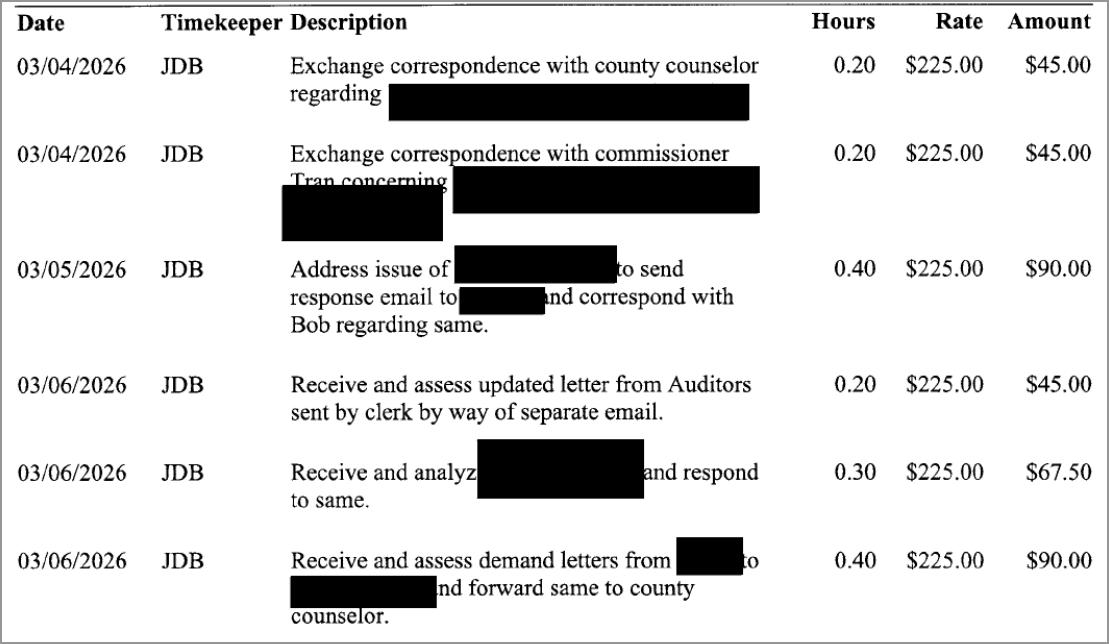
Part of the March 2026 invoice as Bourbon County released it to FortScott.biz on May 19. Only the descriptions of the work were blacked out.

The county released the full bills on Sept. 11, 121 days after the request, once a majority of commissioners told the county counselor to send them. Even then, County Counselor Bob Johnson wrote that he still believed the redactions were “allowed under the law.” Neither he nor the outside firm ever explained how, after FortScott.biz pointed them to a Kansas Supreme Court decision that rejected blanket redaction of legal bills.

A comparison of the blacked-out and unredacted copies shows no consistent rule for what was hidden and what was not. Some of the hidden entries were readable in a copy the county gave another requester. Similar entries, and in one case the same name, were blacked out in one place but left readable elsewhere in FortScott.biz’s own copy.

No entry-by-entry justification

The bills come from Fisher, Patterson, Sayler & Smith, whose attorney Jacob Bielenberg represents the county in the solar lawsuit and also bills a separate “General Advice” file at $225 an hour. The file FortScott.biz received covers 22 invoices totaling $53,485.50. Read the bills as the county released them: the redacted copy sent May 19 (PDF) and the full copy sent Sept. 11 (PDF).

On May 15, Bielenberg emailed the clerk’s office: “I made some light redactions, and the attached can be provided as responsive to Mr. Shead’s request.” The redactions covered 39 entries on four invoices, worth 22.5 hours and $5,062.50. Dates, hours and dollar amounts were left visible. Only the descriptions of the work were blacked out.

On May 20, FortScott.biz pointed out to the county that attorney billing descriptions are public in Kansas unless a specific exemption covers each one. Johnson’s written response, dated May 26, listed statutes: attorney-client privilege under K.S.A. 60-426, the open-records exemptions at K.S.A. 45-221(a)(1) and (a)(2), and the rule in 45-221(d) for separating exempt material from public material. It did not say which exemption applied to which entry. It said entries left readable either did not involve privileged advice or covered matters where privilege had already been waived, and it offered to “mark each entry as A/C privilege or work product, if you would prefer.” By then, Michael Hoyt had already received seven of the entries blacked out for FortScott.biz, with the descriptions readable. Those seven stayed blacked out in FortScott.biz’s copy until September. It was also sent to a misspelled email address and did not reach FortScott.biz until Johnson re-sent it July 20.

On July 17, after 58 days without an answer, FortScott.biz asked again and pointed the county to the Kansas Supreme Court’s 2000 decision in Cypress Media v. City of Overland Park, 268 Kan. 407. Johnson then found and re-sent his May 26 response, and the clerk asked, “Are you wanting each redacted statement cited by statute?” On July 22, FortScott.biz again pointed to Cypress Media and said that line-by-line standard was what it was asking for. The court held that the work-product doctrine “does not offer a per se exemption” for billing records and that “parties claiming the privilege will have to show its application to particular narrative statements in billing records.” It added: “Meeting this burden requires more than generalized allegations, conclusory language, or mere arguments of counsel.”

The county never did that. It never said which exemption covered which entry, and it never explained why the court’s ruling did not apply. FortScott.biz asked again Aug. 25, twice on Aug. 28 and again Sept. 7, seven requests in all. On Aug. 28 it offered the county any one of three ways to settle the matter: explain why Cypress Media did not apply, justify each redaction, or release the bills.

Instead, the decision moved to the commissioners. On July 23, Johnson wrote that he was “awaiting a call from the attorney general’s office on the redaction issue.” On Sept. 1 he wrote, “This is essentially the bocc’s call.” On Sept. 8: “The bocc have advised to provide to you.” On Sept. 11 he sent the unredacted bills: “I still believe the redacted ones are allowed under the law, but a majority of the bocc indicated to send them unredacted.”

For four months, the county maintained it did not have to release the descriptions. It never showed why.

Decided outside a meeting

Johnson called the release “essentially the bocc’s call,” and said a majority of commissioners told him to send the bills. But the commission never took up the bills in public. It met in regular session Aug. 31 and in a special meeting Sept. 2, the day after Johnson’s “bocc’s call” email. Neither agenda listed the bills, and the recordings show they never came up. Recordings of every commission meeting from July until the bills were released Sept. 11 show no agenda item, discussion or vote on releasing them.

The Kansas Open Meetings Act requires county business to be decided in public. It bars a majority of commissioners from reaching agreement outside a public meeting, including through a series of separate calls, emails or texts that together involve a majority. Bielenberg himself laid out that test in January, in the county’s answer to open-meetings complaints filed with the Attorney General: such communications are covered when they “collectively involve a majority of the membership of the body” and are meant to reach agreement on something that requires a vote.

Johnson’s emails describe a decision by a majority of the board, reached outside any public meeting, and the commission never voted on it in public. The Attorney General’s office has said a staff member may sound out board members one at a time, but that the practice “should never be used to take binding action,” because “taking binding action outside of an open meeting is prohibited.”

The penalties are real. A commissioner who knowingly violates the act can be fined up to $500 for each violation in a case brought by the Attorney General or the county or district attorney. A court can void a binding action taken at a meeting that did not substantially comply with the act if one of those officials sues within 21 days of the meeting. Any resident can ask a district court to enforce the law, and the court can order officials to take open-meetings training.

The Attorney General’s office has twice called for Bourbon County commissioners to take that training, both times without going to court. In 2021, after finding technical violations in how the commission closed its meetings, it entered a consent order under which each commissioner faced a $50 fine unless they took the training. Commissioners took it by Zoom that April. On March 24 of this year, in a letter to Bielenberg, the office found that the commission’s motions to close meetings had repeatedly failed to say what would be discussed, and it asked commissioners to complete an hour of open-meetings training within 45 days.

Hidden from one requester, readable for another

Michael Hoyt filed his own request for the same firm’s invoices. His copy, which he dated May 22, carried the same blackouts on the March invoice. But seven entries hidden from FortScott.biz were readable in his copy, worth 6.8 hours and $1,530. Hoyt’s packet even held two copies of one invoice, one clear and one redacted.

The seven include an entry on “issues between ROD and Commissioners” and Bielenberg’s review of Hoyt’s own February request for attorney invoices.
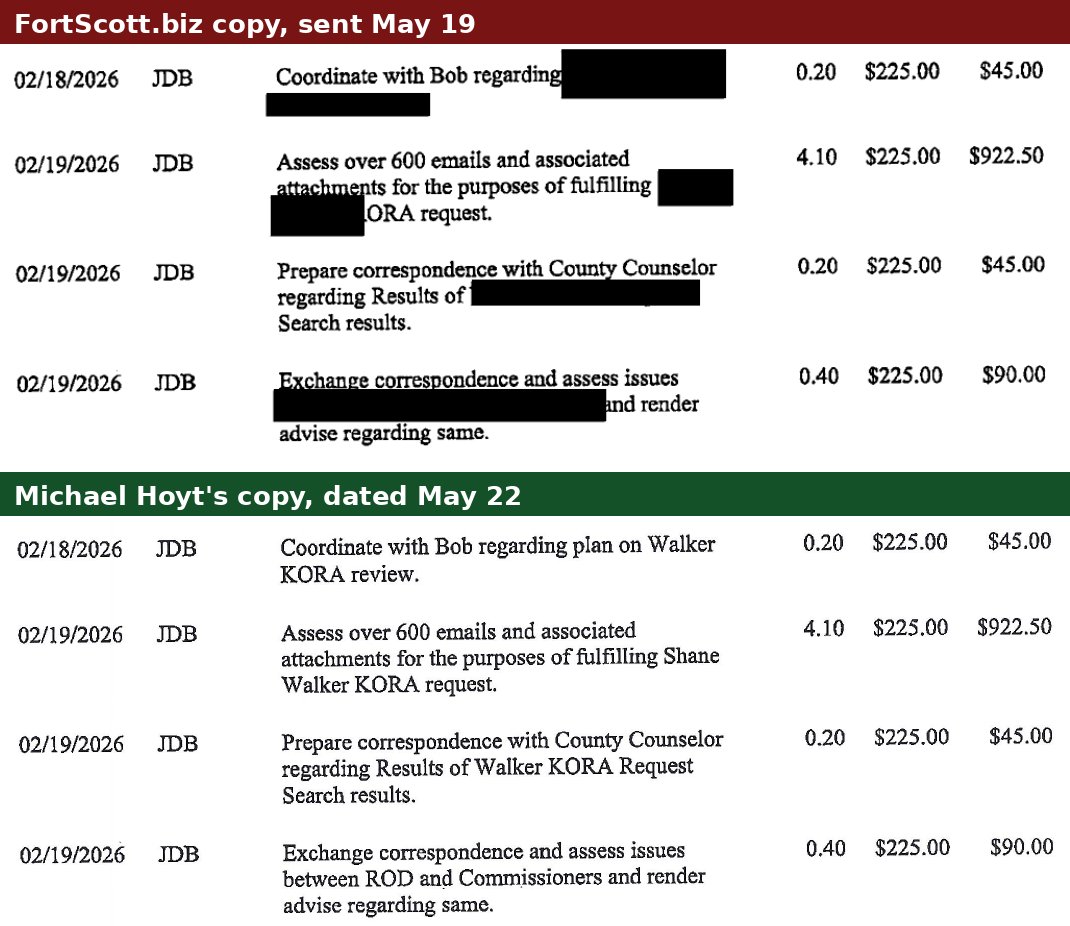
The same four entries from a February invoice: blacked out in the copy sent to FortScott.biz, readable in the copy Michael Hoyt received.

On May 15, while the bills were being prepared for FortScott.biz, the clerk wrote to Johnson: “You have released these before to JD Handly.” FortScott.biz has not seen a copy released to Handly.

FortScott.biz’s own copy was not consistent either. A Feb. 13 entry to “Address KORA issues with settlement agreement, research AG opinions and provide same to Clerk in support of position it is a fully open record” was left readable. A Feb. 18 entry to “Coordinate with Bob regarding plan on Walker KORA review” was blacked out. A Feb. 17 entry about a “voluminous KORA request from Shane” was left readable. Two days later, Shane Walker’s name was blacked out of an entry about the same request. On the March bill, the name Kemmerer was blacked out of a March 16 entry on a records request and left readable in a March 25 entry about the same request.
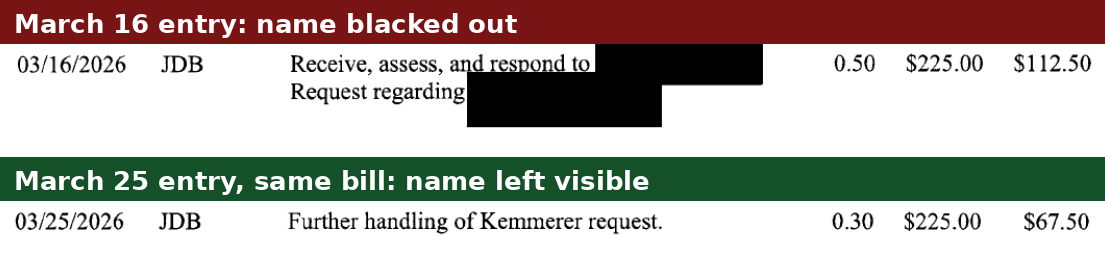
Two entries from the same March invoice, as released to FortScott.biz.

When the same words can be public in one entry or one copy and secret in another, no reader can tell what rule, if any, decided what was hidden.

What was behind the black boxes

The hidden entries describe work billed to taxpayers that was never explained in an open meeting: residents’ complaints, the investigation of the clerk, and commissioners’ own questions taken to the outside firm.

Two of the entries, kept blacked out until September, show the county’s outside lawyer reviewing demand letters sent to a private citizen and billing taxpayers for it. Three commissioners say they did not ask him to. No one has said who did. FortScott.biz will report what those entries show on Tuesday.

What is still missing

Even the unredacted file is not complete. Seven invoices, totaling $11,722.50, appear only as cover summaries with no description of the work in any copy the county has released. Five more invoices, totaling $19,510.60, appear on county vouchers or statements but were not in the file at all.

Timeline

  • May 13: FortScott.biz requests the bills.
  • May 15: Bielenberg makes “some light redactions.”
  • May 18: Motley says in open meeting that the bill named him and private citizens.
  • May 19: County sends FortScott.biz the redacted bills.
  • May 22: Date on Hoyt’s copy, with seven of the hidden entries readable.
  • May 26: Johnson’s list of statutes, sent to a wrong address.
  • July 17: After 58 days without an answer, FortScott.biz asks again and cites Cypress Media.
  • July 20 to 23: Response re-sent; FortScott.biz asks again for line-by-line justification; Johnson awaits the Attorney General’s office.
  • Aug. 25 to Sept. 7: FortScott.biz asks four more times.
  • Sept. 1 and 8: Johnson calls it “the bocc’s call,” then says commissioners “advised” release.
  • Sept. 11: Unredacted bills sent, 121 days after the request.

Documents

Five Fort Scott lake lots on hold over sewer capacity questions

FORT SCOTT — A proposal to sell five city-owned lots on the east side of Fort Scott Lake returns to the City Commission on Tuesday, Nov. 17, after residents raised questions about the lake’s sewer system.

Lake resident Harold Martin told commissioners Nov. 3 that the system was designed for 141 lots. “We’re already at 145 plus the school on Indian Road,” he said, urging them to look at that before adding more load.

Bill Lemke of city utilities said the Indian Road lift station has run well since its impellers were replaced, but he couldn’t say what its limit is, and he said that in his personal opinion five more homes would not be a problem. Jason Dickman of Earles Engineering, the city’s consulting engineer, said he could provide a capacity calculation. Commissioners tabled the sale 4-0 and told staff to find out what an upgrade would take.

Commissioners took no vote on bringing back the Lake Advisory Board. Lake residents can form their own committee, and Commissioner Tracy Dancer agreed to meet with it.

Read the full story on the Nov. 3 meeting.

USD 234 board ties 3-3 on ending its IT services agreement with Fort Scott Community College

FORT SCOTT — A mutual agreement to end USD 234’s IT services contract with Fort Scott Community College failed on a 3-3 vote of the USD 234 Board of Education on Nov. 9, so the board took no action. The agreement, approved in April, was worth $60,000 for 400 hours of IT support from the district’s technology staff.

District staff told the board the college had already signed the termination agreement and the district had received the college’s final payment of $35,000. Board members then asked whether the contract required 60 days’ notice. The college’s written notice arrived in late October, according to the discussion.

One board member said the district honors its contracts but “we don’t make other parties honor contracts.” Another replied, “Even if we hold them to the contract for another 60 days, we’re not going to get anything else out of them.”

Responding, a board member said the contract was with the district’s IT department, not one person, and that the district could still provide the work, which by that member’s math came to six or seven hours a week. After the vote, the presiding officer said, “So we’re three and three. So we’re tied.”

Read the district’s recap of the Nov. 9 meeting.

GriefShare Offers ‘Surviving the Holidays’ Nov. 19

The Holidays Can Be Especially Difficult When You’re Grieving

The holidays are often thought of as a time of joy and celebration, but for those who have lost someone they love, this season can bring sadness, loneliness, and painful reminders of the person who is missing. Familiar traditions, family gatherings, and even holiday music can make that absence feel especially difficult.

Whether your loss is recent or happened years ago, the holidays can bring unexpected emotions and difficult adjustments. Through a meaningful video, small-group discussion, and a Holiday Survival Guide filled with practical suggestions, you’ll find encouragement and helpful ways to approach the season. You’ll also have the opportunity to connect with others who understand and discover that even during a difficult time, moments of peace, comfort, and hope are possible. Sharing during the discussion is welcome, but never required.

Mary Queen of Angels Catholic Church invites you to join them for GriefShare’s Surviving the Holidays on Thursday, November 19 from 5:00–7:00 p.m. There is no right or wrong way to grieve, and you don’t have to navigate the holidays alone. Join us for an evening of support, understanding, and hope as you find your way through the season.

GriefShare’s Surviving the Holidays is a nondenominational event, and people of all faith backgrounds, as well as those who do not belong to a church, are welcome.

Thursday, November 19, 2026 | 5:00–7:00 p.m.
Mary Queen of Angels Catholic Church
705 S. Holbrook St.
Fort Scott, KS 66701

Please RSVP to Laura Meeks at 740-317-6379 or laurammeeks@gmail.com.

Learn more at www.griefshare.org

County health insurance renewal up about 14.71%, broker says, before commissioners’ Monday work session

FORT SCOTT — Bourbon County commissioners will hold a work session on employee health insurance at 5 p.m. Monday, Nov. 16, after a short 4:30 p.m. meeting. Renewing the county’s current Blue Cross Blue Shield plan would cost about 14.71% more, benefits broker Don Doherty told the commission Nov. 9. He said UnitedHealthcare’s renewal is about 11% higher, while two UnitedHealthcare high-deductible plans with health savings accounts came in about 4.95% and 6.78% below the current cost.

The county now puts $925 a month toward employee-only coverage and about $1,700 a month for each of the 17 employees who also cover family members, Commissioner Mika Milburn-Kee said. She has asked the brokers to model a flat county contribution for every employee, and Doherty’s colleague Jeremy Bowman walked through scenarios with flat contributions of $1,100, $1,200 and $1,300 a month.

Chairman Gregg Motley said he would not support a change that raises premiums for employees who cover their children, such as raising a single mother’s premium by $600 or $700 a month. “I will never punish people for wanting to insure their children,” he said. “Having a vote of the majority, that’s the tyranny of the majority. They’re taking money from the minority.” Milburn-Kee replied, “I don’t think that it’s taking money from the minority. I think it’s giving an equal amount to everyone.”

Milburn-Kee asked that employees get a chance to tell the county’s HR consultant, Millie Lipscomb, what they think in private, because “some of them may be speaking against their leaders.” Commissioner David Beerbower agreed, saying employees who want to could talk with Lipscomb individually before Monday. Lipscomb said she would send her email address to department heads and would be at the courthouse two or three times that week.

Read the full story on the Nov. 9 meeting.

Stop Eating Worms by Carolyn Tucker

Keys to the Kingdom By Carolyn Tucker
Stop Eating Worms

When I was in grade school, Mom and I were often invited to go fishing on the Stockton Lake with church friends Howard and Myrtie. I enjoyed the gorgeous water and potent sun on the pontoon boat, and also learned to bait my hook with real worms. In my high school years, I had to dissect a worm in Coach Mays biology class! Down through the years, I decided I didn’t really like worms. They have a bad reputation. Even the great hymnist Isaac Watts used a worm analogy in one of his most-beloved songs: “Alas! And did my Savior bleed and did my Sovereign die? Would He devote that sacred head for such a worm as I?”

If a gal is feeling lowly about herself and life in general, she might glumly say, “I think I’ll go eat worms.” That’s so ridiculous! Worms are gross – instead, eat chocolate with a friend! And then pull yourself up by your bootstraps and get to work for Jesus. Christian author and humorist Barbara Johnson says it like it is: “In your desire to share the gospel, you may be the only Jesus someone else will ever meet. Be real and be involved with people.” So if you’re in the backyard eating worms because you’re feeling sorry for yourself, you can’t help anyone! Eating worms, plus being alone, will just make you feel worse!

People need the Lord and people need you! And people need each other! Unless you’re John the Baptist living alone in the wilderness preparing to be the forerunner of Jesus, get out in the open and be with people. Shake your salt and shine your light! Jesus said to His followers, “You are the salt of the earth. But what good is salt if it has lost its flavor?…It will be thrown out and trampled underfoot as worthless. You are the light of the world – like a city on a hilltop that cannot be hidden” (Matthew 5:13-14 NLT).

I don’t know about you, but I don’t want to be worthless; I want to be useful. The main place we do the work of God is “as we go along.” It happens in the routine corners of our life. Sharing the gospel doesn’t necessarily mean standing on a soapbox at the streetcorner and preaching. I like the expression, “Living the Gospel.” Jesus went about doing good. We’re to do the same — just go about our normal everyday lives being real and living the words found in God’s Word. It really is that simple.

Jesus followers need to see all people with the eyes of our heart. Love notices, love listens, and love remembers. Consider installing a governor on talking about yourself. Try switching from “I” to “U” when conversing with others. And then diligently train yourself to listen and be interested. However, when we do talk, our heartfelt expression of encouraging words and loving actions can minister hope and joy to others which then has a boomerang affect on us too! Genuine compliments are so appreciated and also helps to build and strengthen relationships. Have you ever received a compliment that made your day? Go ahead, make someone’s day!

If the COVID crisis caused you to stay away from your church family and you’re still “going to church online,” it’s way past time to stop eating worms and be with your close-knit band of believers again. We can’t be truly healthy if we have no uplifting and consistent church fellowship. People need each other. You’ll find joy and purpose when you climb over the backyard fence and start contributing yourself to helping others.

The Key: Reach out to others – that’s what Jesus did.

“No single taxpayer pays anyone’s salary”: Beerbower on perks and the ‘golden six’

FORT SCOTT — After Bourbon County barred personal use of its property, Commissioner David Beerbower read a statement arguing that informal perks lead to perceived favoritism and resentment, and that paying taxes doesn’t make anyone an owner of county equipment.

Beerbower said on Nov. 2 that using county property as a perk can boost morale when applied fairly, but that such benefits “lack legal protection and lead to perceived favoritism and resentment.” He said, “When I was first seated, I was told about the golden six that got all the advantages because of their connection to supervision.” He did not say who they were.

He said taxpayers are stakeholders whose opinions matter, but that paying taxes does not give anyone an ownership share of a county vehicle or road grader, or authority over personnel decisions and salaries. Those duties are delegated to elected commissioners, he said, and voters hold them accountable at the ballot box.

“No single taxpayer pays anyone’s salary. Rather, all taxpayers collectively fund the services they expect government to provide,” he said.

Read the full story on the Nov. 2 meeting.

USD 234 plans a special meeting before Thanksgiving on health insurance and weighs a return to self-funding

FORT SCOTT — USD 234 expects to hold a special board meeting before Thanksgiving to approve employee health insurance, so employees can enroll in time for coverage that starts Jan. 1. Assistant Superintendent Terry Mayfield told the board Nov. 9 that the choice will likely come down to proposals from Blue Cross Blue Shield and one other carrier.

The district is also comparing its current fully insured plan with a self-funded plan, which it has used in the past. “Right now, it might make more sense to go with the self-funded option,” Mayfield said. Benefits brokers Don Doherty and Jeremy Bowman were to review the numbers with the district’s benefits committee the next day, and Mayfield said they will be at the special meeting to explain the difference.

In October, the district’s carrier, Blue Cross Blue Shield, proposed a 53% increase in the district’s rates after a year of heavy claims. Asked Nov. 9 whether the district had any warning, the board was told the carrier had signaled an increase but not its size. “We knew our claims experience. We were running hot. But then to come back and see that it was that much, it was a bit of a sticker shock.” A self-funded plan would also give the district monthly data on what it pays in claims.

A second special meeting may be needed after Thanksgiving, the board was told.

Read the district’s recap of the Nov. 9 meeting.

Preparations for Christmas on the Bricks Begin at the Pavilion

Submitted photo. Volunteers worked on the Gathering Place Pavilion today.

This afternoon, workers helped prepare the Gathering Pavilion on North National Avenue for activities during Christmas on the Bricks, the annual Christmas festival, Dec. 4-6 this year.

Those workers were:

Robert and Nathan Coon ( A1 Towing & Recovery), Mathew Wells ( Great Expectations), Jared Weaver (E3), Craig Campbell ( retired pharmacist and dedicated community service leader).

K-RAD Program Eases Burden for SE Kansas Caregivers

CHANUTE, Kan. — In recognition of National Family Caregivers Month in November, Southeast Kansas Area Agency on Aging (SEKAAA) is highlighting the positive impact of the Kansas Respite for Alzheimer’s & Dementia (K-RAD) program on unpaid family caregivers throughout Southeast Kansas.

Caring for a loved one with Alzheimer’s disease or a related dementia can be rewarding, but it also comes with physical and emotional challenges. The K-RAD program helps ease some of that burden by providing financial assistance for temporary respite care, giving caregivers an opportunity to take a break, attend to personal needs, and recharge while knowing their loved one is receiving care.

K-RAD, administered by the Kansas Department for Aging and Disability Services (KDADS) and delivered through local Area Agencies on Aging, provides eligible unpaid family caregivers with up to $1,000 per year to help cover the cost of temporary respite services.

Melinda Feugate, SEKAAA Case Manager, has seen firsthand the difference this assistance makes for families.

“Clients who receive K-RAD often tell us how tremendously helpful the respite services have been. For some caregivers, simply having time away to reset from the mental fatigue of caregiving makes a tremendous difference. They return feeling refreshed, with renewed energy to continue caring for their loved ones. That break can be so important, not only for the caregiver’s well-being but also for the person receiving care,” said Feugate.

“Family caregivers give so much of themselves every day. It is important that they have opportunities to take care of themselves, too,” said Kathy Brennon, Executive Director of SEKAAA. “Programs like K-RAD recognize the important role caregivers play and provide practical support that can help families continue caring for their loved ones at home and in their communities.”

K-RAD is available to unpaid caregivers age 18 and older who live in Kansas and provide care to an individual with a probable diagnosis of Alzheimer’s disease or a related dementia. Exceptions to living arrangements may be requested. Assistance is paid directly to approved respite providers and awarded on a first-come, first-served basis, as funding allows.

Caregivers interested in learning more or applying for assistance can contact SEKAAA at 620-431-2980 or call the statewide K-RAD information line at 1-866-457-2364.

Additional program information and eligibility requirements are available through the Kansas Department for Aging and Disability Services at https://www.kdads.ks.gov/krad.

K-RAD: Kansas Respite for Alzheimer's and Dementia Caregivers logo

About Southeast Kansas Area Agency on Aging

Southeast Kansas Area Agency on Aging (SEKAAA) is a nonprofit, community-based organization established in 1973 under the Older Americans Act. Serving nine counties in Southeast Kansas, SEKAAA works to support older adults in living the lifestyle of their choice through individualized, person-centered services tailored to meet their unique needs. The agency also provides information, assistance, and resources to family caregivers to help them navigate the challenges of caring for an aging loved one.

About the K-RAD Program

The Kansas Respite for Alzheimer’s & Dementia (K-RAD) Program is a state-funded initiative administered by the Kansas Department for Aging and Disability Services. The program helps unpaid caregivers of individuals with Alzheimer’s disease or related dementia access temporary respite services, providing caregivers with an opportunity to rest and recharge while their loved ones receive care.

Contact: Kathy Brennon, Executive Director, Southeast Kansas Area Agency on Aging (SEKAAA), 620-431-2980, Kathy.Brennon@sekaaa.com

Obituary of Kenneth Gene Parker JR

Kenneth Gene Parker JR, 62, of Garland, Kansas, passed away Saturday, November 7, 2026, at his home. He was born June 30, 1964, in Fort Scott, Kansas, the son of Kenneth Gene and Nancy Lynn Prewett Parker.

He attended Fort Scott Schools and graduated from Fort Scott High School, he then attended Pittsburg State University Automotive Department. He worked for Chanute Manufacturing for 20 years. He lived in Garland, Kansas all his life.

JR is survived by 2 half-sisters, Jeanette Joan Manley of Garland, Kansas and Janet Lynn Wallace of Premont, Texas, his Life Partner, Debbie Hurd of the home and several nieces and nephews. He was preceded in death by his parents.

The family will receive friends from 7:00 pm to 8:00 pm, Thursday, November 19th at the Konantz-Cheney Funeral Home. Graveside services will be at 11:00 am on Friday, November 20th at the Evergreen Cemetery under the direction of the Konantz-Cheney Funeral Home. The family suggests memorials to the JR Parker Memorial at the Konantz-Cheney Funeral Home.

15 W. Wall Street, P.O. Box 309, Fort Scott, Kansas 66701.