Early Voting Starts in Bourbon County Next Monday, July 20 at the Courthouse

Voter booths at the Bourbon County Courthouse.
 

Early voting in Bourbon County begins next Monday, July 20 and runs until August 3. The election is August 4.

Voters will be able to vote Monday-Friday 8:30 a.m. to 4:30 p.m. and Saturday 8 am. to noon at the Courthouse only.

Election Day is August 4 and voting will be at the usual polling places on that day from 7 a.m. to 7 p.m.

Those running for office are listed on this document send from the Bourbon County Clerks staff:
“Everyone can vote,” said Bourbon County Election Clerk Amber Page. “But, since August is a Primary, there will only be ballots for Republican and Democrat parties to vote on candidates.
“For those who choose not to affiliate with either of the major parties, there will be an Unaffiliated Ballot with just the Constitutional Amendment question on it.”
“The Constitutional Amendment is copied exactly how the State sent it to us to put on the ballot,” Page said. “If I understood correctly, the strike-through is over the original script that is being voted on to change or remove.”

The following constitutional amendment will be voted on during the August 4, 2026 Primary Election, taken from the Kansas Secretary of State website.

Vote Yes or No

“Explanatory statement. This amendment gives the voters the right to elect the justices of the Kansas supreme court. The justices shall serve terms of six years, with the elections of justice positions 1, 2 and 3 to occur in 2028, positions 4 and 5 to occur in 2030 and positions 6 and 7 to occur in 2032, and every six years thereafter. The rules applicable for such elections and the designation of position numbers shall be provided by law. Any vacancy on the court for an unexpired term shall be filled at an election as provided by law.

“A vote for this proposition would give Kansas citizens the right to elect Kansas supreme court justices as provided by law. Justices will hold office for terms of six years. The Kansas supreme court nominating commission, whose membership consists of a majority of lawyers, would be abolished.

“A vote against this proposition would continue the current system in which the Kansas supreme court nominating commission, whose membership consists of a majority of lawyers, provides the governor a list of three individuals to choose from for vacancies on the Kansas supreme court. Justices hold office for a term of six years and retain their offices if they win a retention election in which they do not face an opponent.

Shall the following be adopted?

“§ 5. Selection of justices of the supreme court. The citizens of Kansas who are qualified electors shall elect the justices of the supreme court. The rules applicable for such elections and the designation of position numbers shall be provided by law. Justice positions 1, 2 and 3 shall be elected at the general election in November of 2028, justice positions 4 and 5 in November of 2030 and justice positions 6 and 7 in November of 2032, and every six years thereafter, respectively. Any vacancy occurring on the supreme court for an unexpired term shall be filled by election as provided by law.(a) Any vacancy occurring in the office of any justice of the supreme court and any position to be open thereon as a result of enlargement of the court, or the retirement or failure of an incumbent to file his declaration of candidacy to succeed himself as hereinafter required, or failure of a justice to be elected to succeed himself, shall be filled by appointment by the governor of one of three persons possessing the qualifications of office who shall be nominated and whose names shall be submitted to the governor by the supreme court nominating commission established as hereinafter provided.

(b) In event of the failure of the governor to make the appointment within sixty days from the time the names of the nominees are submitted to him, the chief justice of the supreme court shall make the appointment from such nominees.

(c) Each justice of the supreme court appointed pursuant to provisions of subsection (a) of this section shall hold office for an initial term ending on the second Monday in January following the first general election that occurs after the expiration of twelve months in office. Not less than sixty days prior to the holding of the general election next preceding the expiration of his term of office, any justice of the supreme court may file in the office of the secretary of state a declaration of candidacy for election to succeed himself. If a declaration is not so filed, the position held by such justice shall be open from the expiration of his term of office. If such declaration is filed, his name shall be submitted at the next general election to the electors of the state on a separate judicial ballot, without party designation, reading substantially as follows:

“Shall

_______________________________
(Here insert name of justice.)

_______________________________
(Here insert the title of the court.)

be retained in office?”

If a majority of those voting on the question vote against retaining him in office, the position or office which he holds shall be open upon the expiration of his term of office; otherwise he shall, unless removed for cause, remain in office for the regular term of six years from the second Monday in January following such election. At the expiration of each term he shall, unless by law he is compelled to retire, be eligible for retention in office by election in the manner prescribed in this section.

(d) A nonpartisan nominating commission whose duty it shall be to nominate and submit to the governor the names of persons for appointment to fill vacancies in the office of any justice of the supreme court is hereby established, and shall be known as the “supreme court nominating commission.” Said commission shall be organized as hereinafter provided.

(e) The supreme court nominating commission shall be composed as follows: One member, who shall be chairman, chosen from among their number by the members of the bar who are residents of and licensed in Kansas; one member from each congressional district chosen from among their number by the resident members of the bar in each such district; and one member, who is not a lawyer, from each congressional district, appointed by the governor from among the residents of each such district.

(f) The terms of office, the procedure for selection and certification of the members of the commission and provision for their compensation or expenses shall be as provided by the legislature.

(g) No member of the supreme court nominating commission shall, while he is a member, hold any other public office by appointment or any official position in a political party or for six months thereafter be eligible for nomination for the office of justice of the supreme court. The commission may act only by the concurrence of a majority of its members.”

“§ 8. Prohibition of political activity by justices and certain judges. No justice of the supreme court who is appointed or retained under the procedure of section 5 of this article, nor any judge of the district court holding office under a nonpartisan method authorized in subsection (a) of section 6 of this article shall directly or indirectly make any contribution to or hold any office in a political party or organization or take part in any political campaign, except when such judge is a candidate for election to a position on an appellate court.”

“§ 15. Removal of justices and judges. Justices of the supreme court may be removed from office by impeachment and conviction as prescribed in article 2 of this constitution. In addition to removal by impeachment and conviction, justices may be retired after appropriate hearing, upon certification to the governor, by the supreme court nominating commission that such justice is so incapacitated as to be unable to perform adequately his duties. Other judges shall be subject to retirement for incapacity, and to discipline, suspension and removal for cause by the supreme court after appropriate hearing.”

⬭ Yes
⬭ No

Fulton Is Issued a Boil Water Advisory Today

Contact: Jill Bronaugh
[email protected]

Boil Water Advisory Issued for the City of Fulton, Bourbon County

TOPEKA – The Kansas Department of Health and Environment (KDHE) has issued a boil water advisory for the City of Fulton public water supply system located in Bourbon County.

Customers should observe the following precautions until further notice:

  • Boil water for one minute prior to drinking or food preparation or use bottled water.
  • Dispose of ice cubes and do not use ice from a household automatic icemaker.
  • If your tap water appears dirty, flush the water lines by letting the water run until it clears.
  • Disinfect dishes and other food contact surfaces by immersion for at least one minute in clean tap water that contains one teaspoon of unscented household bleach per gallon of water.
  • Water used for bathing does not generally need to be boiled. Supervision of children is necessary while bathing so that water is not ingested. Persons with cuts or severe rashes may wish to consult their physicians.

The advisory took effect on July 15, 2026 and will remain in effect until the conditions that placed the system at risk of bacterial contamination are resolved. KDHE officials issued the advisory because the city cannot currently maintain the minimum required chlorine residual. Failure to maintain required chlorine residual levels may put the system at risk for bacterial contamination.

Regardless of whether the public water supplier or Kansas Department of Health and Environment (KDHE) announced a boil water advisory, only KDHE can issue the rescind order following testing at a certified laboratory.

For consumer questions, please contact the water system at 620-857-4464, or KDHE at 785-296-5514. For consumer information please visit KDHE’s PWS Consumer Information webpage:https://www.kdhe.ks.gov/468/Disruption-in-Water-Service

Restaurants and other food establishments that have questions about the impact of the boil water advisory on their business can contact the Kansas Department of Agriculture’s food safety & lodging program at  [email protected] or call 785-564-6767.

###

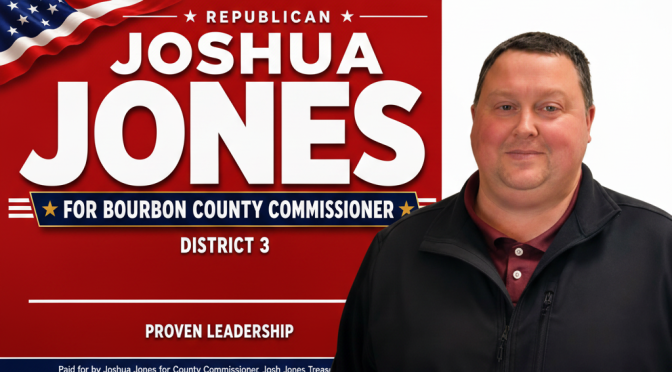
Ad: Josh Jones — Rooted Here

I’m Josh Jones — born here, built my life here, running to serve here.

Joshua Jones, Republican for Bourbon County Commissioner, District 3 — Rooted Here

I’m Josh Jones, and I’m running for Bourbon County Commissioner, District 3.

My family has been in this county since the 1850s, and so has my wife’s. I grew up here. I tried leaving once — it lasted about three weeks before I moved right back. By the time I had my first kids at 20, I’d made up my mind: I was going to build something here, so my family would never have to leave to find a good life.

So I went to work. Nearly 20 years as a small-business owner — Fort Scott Sanitation, rental properties, and today Bourbon County Cars. For a stretch in between, I even drove a school bus for our middle- and high-school sports teams, so I wouldn’t miss being part of my kids’ school experiences. And along the way I learned you don’t fix a community by complaining about it. You find good people who care as much as you do, and you get to work:

  • Joined the volunteers who resurfaced the tennis courts so our kids have a place to play
  • Pitched in on scholarships for young people going into the trades
  • Acquired the Lowman Street lot where the historic church Gordon Parks attended once stood, and donated it to the Gordon Parks Museum — so that piece of our history stays alive here

None of that was about me. It was about people who are passionate about this town pulling in the same direction — and I’ve been lucky to be part of it. That’s exactly what I want to bring to the county: see a problem, bring the right folks together, and actually get it done.

I’d be grateful for the chance to earn your vote.

Vote Josh Jones — Bourbon County Commissioner, District 3. A neighbor who shows up.

Paid for by Joshua Jones for County Commissioner, Josh Jones, Treasurer.

Learn more and get in touch: Josh Jones on Facebook

Bourbon County Commission Tables Property-Tax-Rate Decision to July 20 — July 13, 2026

The Bourbon County Commission met July 13, 2026, with Chair Samuel Tran presiding and Commissioners Mika Milburn-Kee, Gregg Motley present, and Joe Allen arriving late. Commissioner David Beerbower was absent.

Property-tax rate decision tabled to July 20

The centerpiece was Baker Tilly’s budget forecast for the general fund and Revenue Neutral Rate (RNR) presentation. Lawn reviewed a 2026 general fund estimated to end near $594,000 and a preliminary 2027 deficit of about $201,000 if general-fund property-tax revenue stays near the cap. He laid out three options: hold the mill levy flat at last year’s 56.669 mills (about $8.15 million, roughly a $22-per-person increase), cut 15 percent (about $718,000 less, roughly a $50-per-person rebate), or adopt the true revenue-neutral rate, keeping the dollar amount of taxation the same as last year at $7,858,000, or 54.664 mills, a two mill reduction accounting for the 3.7% growth in the county. This option will reduce the county’s income by about $300,000 from the current mill rate of 56.669.

Lawn recommended the commission notify the county clerk that it reserves the right to exceed the revenue-neutral rate, capping at 56.669 mills. “I would not want to see you go lower than that.,” he said.

Milburn-Kee strongly opposed exceeding the RNR, arguing a flat rate would work. “We have proved time and time again, if we levy it, we’ll spend it. So if everybody wants an excuse to raise it and levy it, then consider it spent,” she said.

Tran cited concerns about unforeseen legal and litigation costs and a pending employee-benefits presentation; Allen pointed to aging Public Works equipment, ambulance needs, and employee raises after three years without one. The commission reached consensus to table the rate decision to its July 20 meeting, when Beerbower returns and Lawn brings a full employee-benefits fund budget.

“I don’t believe the revenue neutral rate should ever be a consideration for a county unless that county is growing considerably and there is a positive, non-strained economy,” Lawn stated to the commissioners. “Lowering it that much would severely hurt your ability to operate, I believe.”

Minutes and accounts payable

Minutes from June 29 were approved. Minutes from July 6 were tabled and later approved 2–1, with Milburn-Kee voting no because she had not yet read them. The commission addressed accounts payable of $543,225.90; Motley questioned a “desert snow training” line item in the Sheriff’s Department budget. A representative from the Sheriff’s office said it refers to narcotics training.

Treasurer’s report

Treasurer Jennifer Hawkins reminded residents that July 31 is the last day to pay property taxes before delinquent names are published (with a publication fee), and pointed to missingmoney.ks.gov for unclaimed property. She also publicly disputed a comment Milburn-Kee made the prior week that the treasurer had not returned a call about postage, saying the call came two hours before that meeting with no voicemail, text, or email. Milburn-Kee did not stay in the room to hear Hawkins dispute, but walked in and out several times during her report.

Other business

The commission pushed the Jarred Gilmore Phillips auditor engagement to July 20 to allow Milburn-Kee to obtain a competing bid from Barney and Associates.

Motley pointed out that switching auditors increases the cost to the county because of setting up the paperwork.

Allen spoke with a representative from GovDeals who pointed out the items that would sell and the items that will not sell and should be trashed or scrapped. The commission agreed that Allen should created the recommended lots and list the items for sale with deals.gov.

Milburn-Kee addressed the question of what the opioid fund can be used for. She suggested the county create an application process for awarding grants from the fund. Motley mentioned the 16-page list of permitted uses for the fund that the Kansas Attorney General’s office provided.

For the prior week’s budget discussion, see Bourbon County Commission — July 6, 2026.

Commissioner Comments

Milburn-Kee encouraged the commissioners to use their resources, particularly with regard to gravel roads in the county, which she claims are getting thinner. She referred to a road engineer provided for no charge by KAC who has had some meeting with the public works director in her district.

Allen asked about the HR study on salary surveys. They are expected to be done in the coming year, said Tran. Allen also encouraged visiting the county fair this week.

Tran talked about how crazy the budget season is for the commission. He said he is happy with the mill levy at its current level, but has concern about the funding the future. He said the commissioners have a fiduciary responsibility, and owe the citizens of the county an explanation for their decisions regarding taxes.


Bourbon County Sheriff’s Office Daily Report – July 14, 2026

Bourbon County Sheriff’s Office Daily Report – July 14, 2026

Arrested

Nunley, Richard Sr (Age 51) — Arrested 7/13/2026 10:06 AM by Bourbon County Sheriff’s Office. Charge: Warrant Bourbon County (Bond Revoke). Bond: $0.00 No Bond.

McCarty, James (Age 45) — Arrested 7/13/2026 12:03 PM by Douglas County. Charge: Other Agency Hold. Bond: $0.00 No Bond.

Bartlett, Nathan Edward (Age 46) — Arrested 7/13/2026 3:51 PM by Bourbon County Sheriff’s Office. Charge: Sentenced. Bond: $0.00 No Bond.

Released

Hoyman, Rusty — Released 7/13/2026 11:35 AM via Transferred Out (Douglas County).

Lee, Nicole Marie — Released 7/13/2026 9:50 PM via Surety Bond (American Western Bonding).

Salazar, Joshua None — Released 7/13/2026 11:25 AM via Transferred Out (Douglas County).

Schermerhorn, Clint Wayne — Released 7/13/2026 11:30 AM via Transferred Out (Douglas County).

Seepersad, Brandon — Released 7/13/2026 11:20 AM via Transferred Out (Douglas County).

Woolery, James Kenneth — Released 7/13/2026 4:44 PM via Surety Bond (A+ Bonding).

Total Inmates Released: 6

Documents:

Political Signs Not Allowed on Highway Right of Way

July 13, 2026

It’s a sign of the season – political campaigning and the posting of campaign signs. The Kansas Department of Transportation reminds the public that all political campaign signs or billboards are prohibited from being placed on state highway right of way.

By law, all right of way on state highways is exclusively for public highway purposes. Only regulatory, guide signs and warning signs placed by KDOT are allowed on the 9,500-mile state highway system. KDOT has jurisdiction over all interstate, Kansas and U.S. routes.

When KDOT maintenance crews find political signs on state highway right of way, the signs will be removed without notice. All such signs will then be taken to the closest KDOT Subarea office. Political campaign signs not retrieved from the Subarea offices will be disposed of after the election.

Political campaign advertising is allowed on private property bordering state right of way. However, people placing or erecting signs on private property must first obtain permission from the property owner.

A state law passed in 2015 related to placement of campaign signs on city- or county-owned right of way does not apply to state highway right of way. Persons placing signs on city street or county road right of way should consult the local jurisdiction on any rules.

Bourbon County Fair 2026 Schedule

Bourbon County Fair 2026 Schedule

Monday

  • 9am – 11am: Enter and Conference Judge All 4-H Indoor Exhibits
  • 2pm – 6pm: Enter Open Class Exhibits
  • 5pm – 8pm: Enter Poultry and Rabbit
  • 6pm – 8pm: Market Animal Weigh-In

Tuesday

  • 8am: Rabbit Show
  • 11am: Poultry Show
  • 12pm: Open Class Bake Sale @ Myers
  • 5pm – 8pm: Vendor Mart @ Merchants
  • 5pm: Sheep Show
  • 6:30pm: Meat Goat Show
  • 7pm: Draft Horse Pull

Wednesday

  • 9am: Dairy Cattle
  • 9:30am: Dairy Goat Show
  • 9am – 11am: Judging Contests @ Cloverleaf – Crops/FCS/Hort/Photo
  • 5pm – 8pm: Vendor Mart @ Merchants
  • 6:30pm: Bucket Calf Show
  • 7pm: Beef Show

Thursday

  • 8am: Chamber Coffee @ Hubenett Pavilion
  • 9am: Swine Show
  • 3pm: Round Robin Showmanship
  • 5pm – 8pm: Vendor Mart @ Merchants
  • 6:30pm: Bucket Calf Show
  • 6:30pm: Uniontown FFA Corn Hole Tournament

Friday

  • 9am: Livestock Judging Contest
  • 12:30pm: Barnyard Olympics
  • 3pm – 5pm: Check Out 4-H Exhibits (Static and Non-Sale Livestock)
  • 5pm – 8pm: Check Out Open Class Exhibits
  • 5:30pm: Buyer’s Supper @ Hubenett Pavilion
  • 7pm: Livestock Sale

Saturday

  • 9am – 10am: Check Out Open Class Exhibits
  • 9:30am: Dairy Goat Show
  • 9am – 10am: End of Fair Clean-Up

Building Hours

  • 9am – 8pm: Open Class Exhibits @ Myers
  • 9am – 9pm: 4-H Exhibits @ Cloverleaf

Bourbon County Fair 2026 Schedule

LMC Raises Awareness About Fort Scott and Kansas With New Grant

 The Lowell Milken Center for Unsung Heroes has been awarded a grant from the LMCFreedom’s Frontier National Heritage Area (FFNHA) to support the “Unsung Heroes of Fort Scott” project.


The project, titled “Unsung Heroes of Fort Scott,” will include a wall-mounted 55-inch digital screen with touch and interactive capabilities.  The screen will be placed in the museum and contain information about Fort Scott and Kansas unsung heroes and their histories. The wall mount contains technology that will allow for AI portraits of unsung heroes like native son and Renaissance man Gordon Parks, one of Fort Scott’s early Jewish businessmen Alfred Weil, and Kansas suffragist Carrie Langston Hughes, to name only a few! An interactive map will also pinpoint the connections to all of the Fort Scott unsung heroes! Through this effort, the Lowell Milken Center for Unsung Heroes aims to promote tourism, improve our local economy, and engage our local, national, and international visitors in new and exciting ways!


“We are really excited to work with the Freedom’s Frontier once again in our mutual effort to raise awareness about Kansas and Fort Scott unsung heroes and their history!” said Norm Conard, Executive Director of the LMC of Unsung Heroes in Fort Scott.


Freedom’s Frontier is a congressionally designated national heritage area that spans eastern Kansas and western Missouri, working with partners to preserve and share the stories of the region’s role in shaping the nation’s history.  FFNHA provides grant funding to support projects promoting heritage tourism, historic preservation, and public interpretation.


The project is expected to be completed by the end of this summer.


Lowell Milken Center for Unsung Heroes: The LMC is a non-profit 501 (c) (3) that works with students and educators within a range of diverse academic disciplines, to develop projects focused on unsung heroes. Our mission is to share those projects and the stories of these unsung heroes with our community through our museum at the Center!

Freedom’s Frontier National Heritage Area (FFNHA): FFNHA builds awareness of struggles for freedom in western Missouri and eastern Kansas. Established by Congress in 2006, FFNHA covers a unique physical and cultural landscape across 41 counties and 31,000 square miles. It promotes three diverse, interwoven, and nationally significant stories: frontier settlement, the Kansas-Missouri Border War and Civil War, and enduring civil rights disputes. FFNHA inspires respect for multiple perspectives and empowers area residents to preserve and share these stories, achieving its goals through interpretation, preservation, conservation, and education for all residents and visitors. It is one of the 62 federally recognized national heritage areas across the United States.


KS Governor Denies Carr Brothers Clemency

Governor Kelly Denies Both Carr Brothers’ Requests for Clemency


TOPEKA
– Today, Governor Laura Kelly issued the following statement announcing the denial of Reginald Carr and Jonathan Carr’s clemency requests for commutation of their death sentences to life in prison without the possibility of parole:

“I have long supported the repeal of the death penalty, believing it an impractical, expensive burden on the state. And, because it mandates multiple opportunities for appeal, it drastically delays closure for the families of the victims. A sentence of life in prison with no chance of parole makes much more sense for all concerned.

“However, the death penalty is current law in Kansas and, if ever there were a situation in which the death penalty is justified, it is that of the unspeakably heinous acts of torture and murder committed by Reginald and Jonathan Carr.

“Because of the horrific nature of their crimes and because it appears that their punishment was meted out after thoughtful consideration by a jury of their peers, I am denying the death sentence commutation requests of both Reginald Carr and Jonathan Carr.

“I hope that this denial provides some comfort for those who still grieve their loved ones 26 years later.”

The process by which individuals who have received a death penalty sentence are allowed to make clemency requests for commutations of death sentences to life in prison without the possibility of parole is as follows:

Individuals who have received a death penalty sentence may request a commutation of that sentence to life without the possibility of parole by submitting an application to the Prisoner Review Board (PRB). The PRB must provide a 30-day notice to victims, the prosecuting attorney, and the judge of the court in which the defendant was convicted. After the 30-day notice has elapsed, the PRB must submit a report on the application to the governor within 120 days. The governor cannot take action on a request for clemency before receiving the report from the PRB, unless, if after 120 days, the PRB has not yet submitted a report. Additional information about the clemency process can be found here and here.

As of July 14, 2026, the Office of the Governor has denied clemency applications from the following individuals sentenced to death: Reginald Carr (denied), Jonathan Carr (denied), John Robinson (denied).

###

KS Governor Appoints Jayaram For Kansas Supreme Court

Governor Kelly Appoints
Judge K. Christopher Jayaram to Fill Vacancy on the Kansas Supreme Court


TOPEKA
– Governor Laura Kelly today appointed Judge K. Christopher Jayaram to the Kansas Supreme Court. Jayaram will fill the vacancy created by the retirement of Chief Justice Marla Luckert.

“Appointing a Kansas Supreme Court justice is a significant responsibility, and it is a decision I never make lightly,” Governor Laura Kelly said. “It is paramount that justices have deep understanding of the law and ability to apply it fairly, as they weigh many nuanced, complicated situations that have wide-ranging impacts on our state every day.”

“Kansas’ nomination process for selecting Supreme Court justices is rigorous and consistently produces highly qualified nominees thanks to input from both attorneys and laypeople across our state. Each of the nominees were exceptional, and I appreciate their service to our state.

“Judge Jayaram has extensive experience as a trial attorney and on the bench, which makes him well-qualified and well-prepared to step into this role as the next Kansas Supreme Court justice. I am confident that he will be a steady voice that upholds the rule of law and acts with the utmost degree of impartiality.”

Jayaram has served as a District Court Judge in Johnson County District Court since 2021. His initial assignment was as a Family Court judge, where he adjudicated matters related to divorce involving minor children, annulment requests, parentage determinations, protection from abuse and stalking cases, and third-party visitation claims. He currently presides over civil disputes as a judge in the Civil Department.

Prior to his time on the bench, Jayaram was an attorney with both the Horn, Aylward & Bandy and Smith, Freed, Heald & Chock law firms, where he practiced as a civil litigation attorney. His areas of practice included complex commercial/business litigation, product liability litigation, professional and health care provider liability matters, and transportation-related issues.

Jayaram earned a Bachelor of Arts degree in Environmental Science from the University of Kansas and a Juris Doctor from Northwestern School of Law of Lewis and Clark College in Portland, Oregon, where he was an Associate Editor of the school’s primary law review publication, Environmental Law.

Jayaram has been heavily involved in legal community as a faculty member at the National Judicial College, a member of the American Judges Association, the American Bar Association, and the Johnson County Bar Association. He also served as a trustee of the Johnson County Bar Foundation, a member of the Earl E. O’Conner American Inns of Courts, the Johnson County Family Law American Inns of Court, and the Kansas City Metropolitan Bar Association. Beyond legal organizations, he is a member of the American Association for the Advancement of Science and the United Soccer Coaches.

In addition to his professional activities, Jayaram is involved in his community by serving as a competitive youth soccer coach for Toca FC and is a member of the Saint Thomas the Apostle’s Episcopal Church in Olathe.

“I am profoundly honored and humbled to have been selected from the group of incredibly distinguished and capable applicants for this position on the Kansas Supreme Court,” said Judge K. Christopher Jayaram. “I look forward to completing my work at the District Court over the coming days and joining my new colleagues at the Supreme Court thereafter.  As I did at the District Court, I pledge to serve all Kansans in this new role through the fair, just, and impartial application of the law to cases that come before the Supreme Court.”

“There are big ‘shoes’ to fill, following the retirement of Chief Justice Luckert, and I will strive to live up to the legacy she leaves behind. I am grateful to my family, my friends, Governor Kelly, the Nominating Commission, and my colleagues on the District Court bench, as I begin this new role.”

Kansas Supreme Court Justices are appointed through a merit-based nomination process. When there is a vacancy on the court, the Supreme Court Nominating Commission submits the names of three nominees to the governor. The governor then has 60 days to make the appointment.

The Supreme Court Nominating Commission is an independent body created by the Kansas Constitution consisting of nine members. Four of its members are appointed by the governor from each of the state’s four congressional districts. These appointees are laypeople. Four other members are attorneys elected by attorneys in each of the state’s congressional districts. The commission chair is an attorney elected by attorneys in a statewide vote.

To be eligible, a nominee must be at least 30 years old and admitted to practice in Kansas and engaged in the practice of law for at least 10 years, whether as a lawyer, judge, or full-time teacher at an accredited law school.

Every justice must stand for a retention vote in the general election following their initial appointment. If retained by voters at that time, they then face retention votes every six years for as long as they serve on the bench.

###


GovDelivery logo

Fort Scott Commission Declines Continuum of Care Grant for Transitional Housing

The Fort Scott City Commission voted 4–1 on July 13 to decline a Continuum of Care grant that would have had the city acquire and operate the former convent building as a transitional housing project.

The vote came during a continued special meeting, where the grant was the central agenda item. The proposal — known as BridgePoint Community — would have used federal Continuum of Care funding to renovate the building into a transitional housing facility for people experiencing homelessness.

City Manager Brad Matkin opened the discussion by reading a prepared statement opposing the plan. He said his objection was not to transitional housing itself, but to the city owning and operating such a facility: grant funding is temporary, he noted, while the long-term operating costs would ultimately fall on taxpayers. A qualified nonprofit, he argued, would be better positioned to run the program.

Commissioner Julie Buchta then moved to reject the grant. “Our first decision, in my opinion, is that we disapprove this consideration, continuum of care grant,” she said. Commissioner Tim Van Hoecke seconded, and the motion to reject the grant passed 4–1. Commissioner Matthew Wells cast the lone dissenting vote, saying that even if he had been inclined to vote yes, he had already been outvoted.

Commissioners said the proposal felt rushed, raised concerns about the building’s location near an elementary school and Gunn Park, and felt the scale of the project was too large for the city to take on.

An extended public comment period followed, with residents and operators of existing transitional-housing programs sharing their perspectives on homelessness in Fort Scott — including personal recovery stories and calls for the community to keep working on the issue through other approaches.

Bottom line: the grant will not move forward. The city will not submit the application to acquire and operate the convent building as a transitional housing project.

Special Meeting Agenda — July 13, 2026 (PDF)