|
||||||||||||||||||||||||||||||||||||
|
2026 CFSEK Scholarship Stories: Kaylee Lunsford,The Power of Legacy

Most students talk about the financial relief of a scholarship, but it’s truly special when a student feels a personal connection to the fund’s history.
Kaylee Lunsford, a homeschooled student from Fort Scott, is currently studying animal science at Oklahoma State University. As a multi-year recipient of the Bill House Agricultural Scholarship through the Community Foundation of Southeast Kansas (CFSEK), Kaylee’s goals are global, planning to pursue a career in International Ag Law to “give farmers a voice on the world stage.”
“I’m shocked every time I’m notified that I received the scholarship,” Kaylee said. “I’m just so happy the committee thinks I’m deserving of it.”
The connection goes deeper than just the scholarship. Kaylee grew up showing Hereford cattle with the American Hereford Association (AHA)—an organization where the late Mr. House once served as president.
“I feel a connection to Mr. House through our shared participation in the AHA,” Kaylee noted. “While I never met him, I hope I can carry on his legacy.”
Beyond easing financial stress, Kaylee says the award serves as a motivator to work harder. Her advice for future applicants? Be open and reflective. “I try to give the (review) committee a chance to see why I am worth investing in. I want them to get to know me, my passion, and my goals.”
CFSEK scholarship applications close March 31st, 2026. A full list of scholarships and their requirements is available at SoutheastKansas.org/Students/Scholarship. Scholarship applications are available online at SoutheastKansas.org/Scholarship-App.
The Community Foundation of Southeast Kansas awarded over $2.8 million in grants from all foundation funds in 2025 and has facilitated over $28 million in total granting to Southeast Kansas since its inception in 2001. CFSEK serves the region by providing donors with various charitable interests and encouraging charitable giving, which addresses present and future needs in our area. The Columbus Area, Fort Scott Area, and Girard Area Community Foundations are affiliates of CFSEK. More information about CFSEK is available at SoutheastKansas.org.
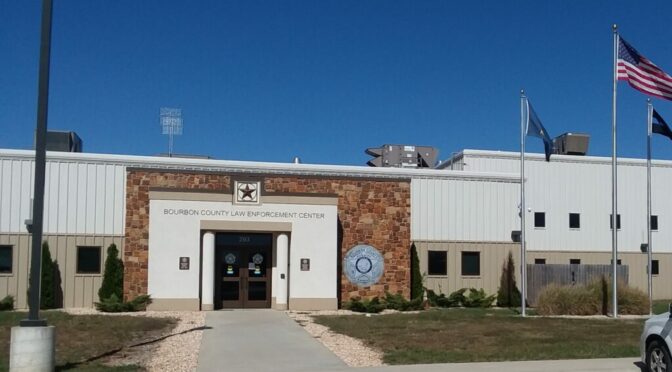
The Bourbon County Sheriff’s Office Daily Reports March 24
U.S. Senator Jerry Moran Newsletter
March 23
Hello,
Welcome to “Kansas Common Sense.” Thanks for your continued interest in receiving my weekly newsletter. Please feel free to forward it on to your family and friends if it would interest them.
Intelligence Briefing on Worldwide Threats
On Wednesday, the Senate Select Committee on Intelligence held its annual worldwide threats hearing with the leaders of the Intelligence Community. I used the opportunity to ask CIA Director John Ratcliffe about how the conflict with Iran will benefit Russia in its ongoing war against Ukraine. I am concerned that providing Russia with sanctions relief on its oil exports will provide Vladimir Putin with more revenue to sustain his war machine, and I am also concerned about the disruption of supply chains that are critical to providing for Ukraine’s defense. As military operation in Iran continues, our military continues to make progress in degrading Iran’s capabilities that threaten our interests and partners in the region. As the Iranian regime continues to block the Strait of Hormuz, it is necessary for ships carrying energy, fertilizers and food to be permitted safe passage. I continue to pray for the safety of our Armed Forces as they carry out their missions.
You can watch the video of my questioning here.
Introducing Bipartisan Legislation to Revitalize Rural Hospitals
This week, as a member of the Senate Rural Health Caucus, I introduced bipartisan legislation with Sen. Michael Bennet (D-Colo.) to strengthen rural hospitals by providing zero-interest loans to support new construction and the renovation of existing hospital facilities. The resources would be provided through the U.S. Department of Agriculture’s (USDA) Community Facilities Direct Loan Program to improve the ability of hospitals to provide essential health care services to rural communities.
Rural hospitals are critical to the well-being of the communities they serve in Kansas and across the country. Our legislation would provide a pathway for qualifying rural hospitals to make needed renovations and facility upgrades, helping to promote the long-term viability of rural hospitals and communities. You can learn more about the Rural Health Revitalization Act and my efforts to support rural Kansas health providers here.
VA Committee Passes 24 Bills Promoting Key Veterans Priorities
This week, I chaired a Senate Committee on Veterans’ Affairs legislative markup, where our committee passed 24 pieces of bipartisan legislation to improve the lives of veterans, servicemembers and survivors across the country. I introduced four of the 24 bills that advanced out of committee, including the Love Lives On Act, the Guard/Reserve G.I. Bill Parity Act, the Veterans Prosthetics Advancement and Reform Act and the Fisher House Availability Act.
Under current law, surviving spouses of fallen servicemembers lose eligibility for most Department of Defense (DOD) and Department of Veterans Affairs (VA) benefits if they remarry before the age of 55. I introduced the Love Lives On Act to allow surviving spouses to retain their DOD and VA benefits upon remarriage regardless of age so their families can continue receiving the benefits they need. Military service is family service, and no one knows that as well as a survivor. I am grateful this legislation passed out of committee and look forward to bringing it – and the other bipartisan pieces of legislation approved by the committee this week – forward for a full vote in the Senate.
You can learn more about the legislation and the markup here.

FAA Announces New Aviation Safety Standard
This week, U.S. Department of Transportation (USDOT) Secretary Sean Duffy and Federal Aviation Administration (FAA) Administrator Bedford took an important step to improve the safety of our skies by requiring air traffic controllers to use radar technology to coordinate aviation traffic near our nation’s busiest airports. Our aviation system is fragile, and the tragic mid-air collision on January 29, 2025, highlighted the urgent need to strengthen and modernize safety standards. The implementation of radar-only tracking for helicopters and airplanes was recommended by the National Transportation Safety Board (NTSB) following its investigation into the crash of Flight 5342, and I commend USDOT and FAA leadership for enacting this safety measure.
There is still work to be done, including passage of ROTOR Act, my legislation that would implement the broad adoption of location-transmitting technology, known as Automatic Dependent Surveillance – Broadcast (ADS-B), for planes and helicopters in busy airspace. I will continue working to pass the ROTOR Act to further strengthen critical aviation safety standards. You can learn more here.
Recognizing Women in Agriculture Day
During National Agriculture Week, I joined my colleagues in introducing a resolution designating March 21, 2026, as National Women in Agriculture Day, honoring the more than 1.2 million women who contribute to American agriculture. Earlier this year, I also cosponsored a resolution recognizing 2026 as the International Year of the Women Farmer. In Kansas and across the nation, women play an important role in advancing the future of agriculture by managing family farm operations, educating the next generation of producers and supporting our rural communities. As we celebrate National Women in Agriculture Day, we extend our gratitude for their hard work, resilience and unwavering commitment to keeping our agricultural industry strong and investing in the future of rural America.
Update on the SAVE America Act
This week and into the weekend, the Senate held extended debate on the SAVE America Act. If enacted, this legislation would set voter identification requirements, including proof of U.S. citizenship when registering to vote in federal elections. It would also require citizens to show photo ID, like a driver’s license, to vote in federal elections. Federal law already prohibits non-citizens voting in federal races. This legislation would create a uniform standard to verify that requirement across all 50 states.
Legislative Update by State Senator Caryn Tyson
March 20, 2026
In the last week of regular session, the Senate debated too many bills to cover here. All the bills can be found at www.KSLegislature.gov. Here are some of the bills that may impact you:
Banks and other financial institutions would be allowed to establish a trusted contact that could be contacted if there is suspected fraud. HB 2591 would also allow suspicious transactions to be delayed for up to 10 business days when the institution has reported the suspected fraud to law enforcement or to the Kansas Department for Children and Families (DCF). There was a series fraud case in Linn County that involved cryptocurrency and we need this protection. It passed unanimously.
Cryptocurrency Automated Teller Machines (ATMs) would be required to warn users before a transaction occurs. The warning must be in bold letters, “WARNING: CONSUMER FRAUD OFTEN STARTS WITH CONTACT FROM A STRANGER…” Virtual currency kiosks, crypto ATMs, would also be limited on the transaction amount should HB 2515 became law. It passed unanimously.
Invasion of Privacy laws are strengthened in HB 2518 by making it clear that violations can involve any kind of image, video, or digital recording, including altered or AI-generated content. It significantly increases penalties when young victims are involved. It passed unanimously.
Property tax appeals at the Board of Tax Appeals (BOTA) would require county appraisers to use a single-property appraisal that evaluates the specific characteristics of an individual property, rather than relying on mass appraisals that assess groups of properties. It passed 38 to 2. I voted yes.
Kansas Law Enforcement and federal immigration authorities’ cooperation would be strengthened by Senate Substitute for HB 2372. Sheriffs would be able to detain individuals based on valid ICE detainer requests or warrants. It establishes procedures for detention and release and would help detain criminals who entered the country illegally. The bill passed the Senate on a partisan vote 31 to 9. I voted yes.
The Crush Transnational Repression in Kansas Act, created by SB 454, would protect individuals from foreign intimidation and coercion within the state. It targets transnational repression and extortion, where foreign governments attempt to threaten, surveil, or control people living in Kansas. The bill increases criminal penalties for offenses like harassment, stalking, or threats when tied to these efforts and requires training to help law enforcement better recognize and respond to such cases. It passed unanimously.
Alcoholic Beverages would be authorized for sale 23 hours a day, seven days a week, if a county opts in and SB 393 becomes law for the duration of the FIFA 2026 World Cup – another bill just for the World Cup. I voted no, but the bill passed on a vote of 21 to 19.
Property Tax Relief Efforts are ongoing as the House and Senate advanced different constitutional amendments. The House proposal would average property values starting in 2028, while the Senate supports a 3% annual assessment value cap beginning in 2027. Lawmakers will now negotiate a compromise, aiming to provide relief and predictability for taxpayers. It’s much needed reform, like in 1975 when Kansans passed a Constitutional Amendment to protect farmers and ranchers from rising taxes. Polls show strong support for a 3% cap. In fact, 75% of those polled want the cap.
It is an honor and a privilege to serve as your 12th District State Senator.
Caryn
KS Bill Banning Use of Personal Electronic Devices During School Day Is Signed
|
Kansas Will Capitalize on Timber Production and Protect Communities from Devastating Wildfires
USDA Announces $115.2 Million in Nine States, $1.72 Million in Kansas, to Capitalize on Timber Production and Protect our Communities from Devastating Wildfires
(Topeka, Kansas, March 23, 2026) – U.S. Department of Agriculture Rural Development’s Rural Business Cooperative Service Administrator J.R. Claeys announced $115.2 Million across eight states through the Timber Production and Expansion Guaranteed Loan Program (TPEP), to ensure sawmills and other wood processing facilities have the necessary funding to establish, reopen, expand, or improve their operations. In Kansas, Berg Reinvigorations LLC is receiving $1,725,500 dollars.
“We cannot allow wildfires to devastate and destroy our rural communities,” said Claeys. “That’s why the USDA is taking this bold action to stop the destruction of our forestlands by investing in sawmills and wood processing facilities that support sustainable timber harvesting. Through the announcement made today, the Trump Administration is strengthening local businesses, driving rural prosperity, and supporting 485 jobs for hardworking Americans.”
“Wildfires have already been devastating for parts of Kansas, and prairie and range management is not enough for wildfire control,” said Gimmie Jo Jansonius, Director of Rural Development in Kansas. “This investment will assist in forestland management and create and keep jobs in Kansas.”
Berg Reinvigorations in Montgomery County will use the Timber Production Expansion Program Guaranteed Loan Program to make building improvements, purchase machinery and
equipment, refinance debt, and pay loan related costs.
Today’s announcement assists with projects in seven other states. The full details on the Kansas project are:
A $1,725,500 loan for Berg Reinvigorations will assist with building improvements, purchasing machinery and equipment, refinancing debt, and paying loan related costs. Berg Reinvigorations is an existing sawmill located in Montgomery County, Kansas. This project is expected
to create eight jobs and retain seven jobs.
These investments represent a commitment by the Trump Administration to expand American timber production by 25%, reduce wildfire risk, and save American lives and communities by strengthening domestic wood processing capacity.
“The value of National Forest Systems lands is demonstrated by providing various forest products, such as timber, lumber, paper, bioenergy, and other wood products,” said U.S. Forest Service Chief Tom Schultz. “The American forest products industry is critical to maintaining the health of the nation’s forests. The Timber Production and Expansion Guaranteed Loan Program is one of many ways the Forest Service partners with the timber industry to maintain rural jobs, processing facilities, and an outlet for wood that needs to be removed from national forests.”
The Timber Production Expansion Guaranteed Loan Program is made possible by a partnership between the USDA Rural Development and US Forest Service. The program helps address the wildfire crisis by investing in local sawmills that clear out dangerous fuel in our forestlands, helping to remove the most immediate threats to communities, critical infrastructure, and natural resources. This program is available to qualified lenders whose loan applicants want to establish, reopen, expand, or improve a sawmill or other wood processing facility that processes ecosystem restoration byproducts from USDA Forest Service National Forest System lands.
For more information on USDA Rural Development investments in rural America, visit the Rural Data Gateway. The Rural Data Gateway is an online tool that strengthens USDA Rural Development partnerships with rural people, entrepreneurs, government officials and Congress by making RD’s investment data accessible to the public.
If you’d like to subscribe to USDA Rural Development updates, visit GovDelivery subscriber page.
USDA is an equal opportunity provider, employer, and lender.
###
Bourbon County Investigation: Summary of Documents
Prepared from KORA documents requesting the “empirical evidence” Commissioner Tran said he had seen of “fraud, waste, and abuse,” civil court records, commission minutes, County Attorney correspondence, Attorney General correspondence, and related materials. Summaries are informational and intended to serve as an index to the actual sources of evidence and documentation. Readers should validate all summaries by clicking through and using the original sources to form opinions.
Overview
Commissioner Samuel Tran publicly stated he had “empirical evidence” of fraud, waste, and abuse in Bourbon County government. This generated significant public interest in what that evidence was and whether it would lead to prosecution. The documents in this summary are those obtained by KORA request for that evidence.
The allegations center on payroll submissions made by County Clerk Susan Walker in connection with employment contracts the BOCC had voided, and a $20,000 payment to departing Public Works Director Eric Bailey. The central factual dispute in the Bailey payment is whether HR consultant Dr. Steven Cohen verbally authorized it. In October 2025, Cohen sent a written email to Commissioner Milburn stating he had not authorized the payment and was “shocked” it had been made. However, the payroll clerk who processed the payment stated Cohen had called her directly and directed her to make it, a phone record shows a call from Cohen’s number to the payroll clerk the day before the payment, and Commissioner Motley — after independently contacting Cohen, the payroll clerk, and Bailey in February 2026 — concluded that Cohen confirmed he had approved the payout and that there was “no fraud, or intent to defraud the county.”
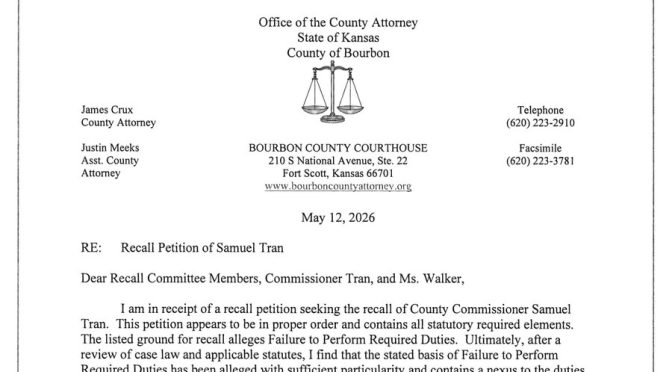
Bourbon County Attorney James Crux declined to prosecute in March 2026. In his letter closing the case, he noted that a number of prosecutors had reviewed the case and reached the same conclusion, and that the Attorney General’s Office had also weighed in. He gave two reasons: first, there was no way to establish based on the evidence that anything was done knowingly — the legal standard required for the alleged offenses; and second, the Attorney General’s Office pointed out that recent civil litigation between the same parties provided “ample evidence of a solid defense,” a conclusion Crux said was “strengthened even more by the recent settlement” in that case.
[TL] that links directly to the relevant page in the source documents.
Hover over any citation to see the source description. A full source key appears at the bottom.
Blue bordered blocks contain facts corroborated by multiple documents.
Yellow bordered blocks contain points where the available documents provide conflicting or one-sided accounts.
Green bordered blocks contain context or analytical observations drawn from the documentary record.
Corroborated by multiple documents
Disputed or one-sided account
Context / analytical observation
- The Employment Contracts (2021–2022)
- The Contracts Are Voided (January 2023)
- Personnel Departures and Public Context (June–July 2025)
- The Lawsuit: Filing, Service, and Default (Feb–May 2025)
- The County’s Defense: From “Improper Service” to “Computer Hack”
- Setting Aside the Default: The $8,000 Payment (Sep 2025)
- The Separation Payout Requests and Walker’s Emails (July 2025)
- Shane Walker’s Final Paycheck Overpayment
- The Eric Bailey $20,000 Separation Payment
- Payroll access given to Treasurer; KOMA Complaints (Oct–Dec 2025)
- Personnel Changes on the BOCC (2025–2026)
- Criminal Investigation and County Attorney’s Decision Not to Prosecute
- Settlement, Closing of the Criminal Case, and Subsequent Developments (Feb–Mar 2026)
1. The Employment Contracts (2021–2022)
⚠ Disputed / Single-source
Who drafted the contracts, and why, are described differently by different witnesses.
One former commissioner told the investigating deputy that Susan Bancroft approached the BOCC and told them salaried employees needed vacation and sick accrual to comply with federal law, and that he personally believed she had drafted the other two contracts by re-writing her own and changing the names and job titles.[N1]
A second former commissioner described the primary driver as Bailey and Shane Walker expressing concerns about job security, with the BOCC agreeing to formalize their employment.[N3]
A third former official noted that complaints came mainly from other county employees who felt the contracts were unfair.[N2]
No documentary evidence of who specifically drafted the contracts has been identified in the cited records.
2. The Contracts Are Voided (January 2023)
On January 27, 2023, the following payouts were issued for unused vacation and sick time. The figures were calculated by Susan Bancroft herself — including her own payout — and reviewed and approved by the BOCC before payment:[TL][N3]
- Susan Bancroft (CFO): $4,917.95
- Shane Walker (CIO): $8,670.36
- Eric Bailey (Public Works Director): $7,027.37
- Total: $20,615.68
Whether the payout amounts were correctly calculated.
Two former county officials stated that because the contracts had only been in force for approximately six months (not a full year), the accruals should have been prorated — not paid at a full year’s rate as they were.[N5][N6]
In the cited KORA materials and Walker’s response, the calculation method is not directly explained, and no cited document indicates that the BOCC raised an objection to the methodology at the time of approval.
Whether the individuals “agreed” to the 2023 resolution.
The county has argued in the civil litigation that all three employees accepted the January 2023 resolution and continued working under the modified terms without objection, and that this constitutes acquiescence or accord and satisfaction. Walker disputes that the resolution constituted valid notice under the contract terms or that her continued employment amounted to a waiver of her contractual rights.[CV-16][CV-2]
3. Personnel Departures and Public Context (June–July 2025)
4. The Lawsuit: Filing, Service, and Default (Feb–May 2025)
This section covers the civil lawsuit Walker filed against the county and the circumstances surrounding the county’s failure to respond — which resulted in a default judgment of nearly $200,000.
On February 24, 2025, Susan Walker filed her original petition against the Bourbon County Board of County Commissioners (Case No. BB-2025-CV-000015) alleging breach of her 2021 employment contract and violations of the Kansas Wage Payment Act. She filed a First Amended Petition on February 26, 2025. Her claimed damages totaled $199,527.04, broken down as follows:[S8a][CV-2][CV-5]
- Claimed salary shortfall (difference between her CFO contract rate and her County Clerk pay): approximately $15,000/year
- Claimed additional vacation entitlement under the contract (28 days/year beyond standard)
- Four months’ (120-day) aggregate salary severance per the contract termination clause
- Statutory penalties under the Kansas Wage Payment Act
- Total sought: $199,527.04
On May 8, 2025, District Judge Richard M. Fisher Jr. entered a default judgment of $199,527.04 plus interest in favor of Walker.[CV-8]
5. The County’s Defense: From “Improper Service” to “Computer Hack”
The county’s explanation for why it failed to respond to the lawsuit evolved significantly over the course of 2025. The full sequence is documented in the court filings.
The improper service argument.
The county initially argued that service was improper because the certified mail was not signed by the treasurer personally. Walker’s response, filed May 28, 2025, directly rebutted this by presenting evidence that the county had actual notice of the lawsuit from multiple independent sources before the default was entered. Specifically, Walker’s response alleged that Commissioner Wisenhunt had received a copy of the petition and that Treasurer Patty Love — whose office accepted the certified mail — was aware the lawsuit was coming before it arrived.[CV-11]
ⓘ Analytical Observations on the Default Sequence
Several aspects of the documented record warrant attention:
1. The county knew about the lawsuit before the default was entered. The county’s own June 2025 court filing acknowledges that two county officials — a commissioner and the county treasurer — received the petition. The petition was served February 27, 2025. The default was not entered until May 8, 2025 — more than two months later. The cited filings do not explain why neither Wisenhunt nor Treasurer Love took any action during that period.[CV-12]
2. The improper service argument was withdrawn after Walker presented evidence that the county had actual notice. The county’s initial motion argued technical service failure; once Walker presented evidence that multiple officials actually had the petition, the county withdrew that argument and, in the same filing, raised the computer hack as an alternative explanation. The cited filings do not reflect what prompted the change in position.[CV-10][CV-11][CV-12]
3. The computer hack timeline. The county’s June 2025 filing states Johnson’s computer was at the repair shop March 24–27, 2025, and that a March 25 email went undelivered as a result. The lawsuit was served February 27, 2025 — approximately 25 days before Johnson’s computer was taken to the repair shop. The filing does not explain why the lawsuit went unaddressed between February 27 and the default being entered on May 8, given that a commissioner and the treasurer had already received the petition.[CV-12]
4. Commissioner Wisenhunt’s resignation. The county’s June 11, 2025 reply noted in a footnote that Commissioner Wisenhunt had resigned from the BOCC. The timing of the resignation — occurring between Walker’s May 28 filing that identified him as having prior notice, and the county’s June 11 reply that acknowledged his receipt of the petition — is notable, though the record does not explicitly connect the two events.[CV-12]
6. Setting Aside the Default: The $8,000 Payment (Sep 2025)
One of the KOMA complaints filed with the Attorney General (Complaint PP-25-000306, filed by Michael Hoyt) specifically questioned the $8,000 payment to Walker. The county’s January 2026 KOMA response confirms the payment was made “as consideration for an agreement to set aside a default judgment” and characterizes it as a legally authorized settlement expenditure.[KR2]
7. The Separation Payout Requests and Walker’s Emails (July 2025)
The email chain documents the following submissions:
- Shane Walker payout, email 1 (8:40 AM, July 14): $72,100.58, calculated “per contract”
- Shane Walker payout, email 2 (approx. 3:10 PM, July 14): $65,056.69 — a revised figure. Walker’s explanation was that she had recalculated using a 1-day-per-month sick accrual rate because the employee handbook was inconsistent between pages 40 and 41.
- Eric Bailey payout (July 15): $35,338.56, sent by Walker directly to HR consultant Dr. Steven Cohen with a copy to Commissioner David Beerbower, also labeled “per contract.”
These email records are included in Walker’s March 2026 commission response.[SW]
Whether submitting these requests constituted false claims under Kansas law.
The commission and the investigating deputy characterize the July 14 submissions as knowingly false claims, because the contracts had been voided by Resolution 06-23 in January 2023.[N5][S1]
Walker’s position is that the county never provided proper 45-day written termination notice under the contracts, and therefore the contracts remained legally valid and her submissions were consistent with her simultaneously pending civil lawsuit. She further notes that her July 14 emails to the payroll clerk were expressly forwarded to the Bourbon County Commissioners for approval — she was not attempting to secretly divert funds.[SW][CV-2]
Walker had filed her civil lawsuit in February 2025 — five months before the July 2025 payout requests. The lawsuit itself was premised on the argument that the contracts remained valid. It is difficult to characterize the July payout submissions, made while active litigation on the same question was pending, as “knowingly false” if Walker genuinely believed (and was actively arguing in court) that the contracts were still in force. The criminal knowledge question is what County Attorney Crux later identified as the central obstacle to prosecution. See Section 12.
8. Shane Walker’s Final Paycheck Overpayment
The amount and cause of the overpayment differ by account.
The commission states the overpayment was approximately $1,000, representing 23.47 hours at $42.60/hour, caused by his last day of employment being misreported. The commission further states that Susan Walker was present at the courthouse when Shane cleared out his office on July 9, and therefore knew his actual last day — implying she intentionally submitted incorrect end-date information.[TL][S1]
Walker’s response states the overpayment was $681.60, representing pay for five days instead of three, that it was a payroll clerk error (not Walker’s), and that it was corrected once the clerk was made aware on July 29, 2025. Walker also notes the commission received advance notice of the payroll register before it was processed and raised no objection at that time.[SW]
9. The Eric Bailey $20,000 Separation Payment
This is the most directly contested sequence of events in the record, with contemporaneous documentation on both sides that is difficult to reconcile. Notably, a sitting county commissioner has concluded there was no fraud in the transaction.
⚠ Directly Conflicting Accounts
Whether the payment was authorized is the central dispute.
The commission’s account: No severance agreement had been executed and no BOCC authority had been given to release payment. On October 16, 2025, Dr. Cohen sent a written email to Commissioner Milburn stating he “did not authorize, verbally or in writing, the Clerk’s office to pay [Bailey] any amount of money” and that he was “shocked to learn that the Clerk’s Office made the payment without authorization.”[S5][N4]
Walker’s account: On September 4, 2025 at 11:07 AM, Dr. Cohen called the payroll clerk on her personal cell phone and verbally directed her to pay Bailey $20,000 on the September 5 paycheck. A screenshot showing an incoming call from Cohen’s number at that time is included in Walker’s response. The preliminary payroll register disclosing the payment had been sent to all commissioners and the county counselor two days earlier (September 3) with no objections.[SW]
Commissioner Motley’s independent review: Commissioner Gregg Motley (elected to the District 4 seat, sworn in January 12, 2026 — see Section 11) wrote a memo dated February 13–18, 2026 stating he independently contacted Bailey, the payroll clerk, and Dr. Cohen. He writes that Cohen “affirmed her recollection and confirmed to me that he had approved the payout.” His conclusion: “there was no fraud, or intent to defraud the county inherent in the transaction.”[SW]
The record thus includes: Dr. Cohen’s October 2025 written statement denying authorization; a phone record showing a call from his number to the payroll clerk the day before the payment; and a sitting commissioner’s February 2026 account that Cohen confirmed authorization to him directly. These documents are unresolved.[S5][SW]
Dr. Cohen’s statements directly contradict each other across time. In October 2025, he told Commissioner Milburn in writing that he was “shocked” by the unauthorized payment. By February 2026, when Commissioner Motley independently contacted him, Cohen reportedly confirmed to Motley that he had approved the payout to the payroll clerk by phone. No explanation for this discrepancy appears in the available documents reviewed here. Cohen is not a county employee, and no further documentation from him appears in the available record reviewed here. The inconsistency between his two statements is one of the most significant unresolved factual questions in the entire matter.
10. Payroll access given to Treasurer; KOMA Complaints (Oct–Dec 2025)
Whether the October 7 meeting and related closed sessions complied with the Kansas Open Meetings Act (KOMA).
Between approximately October and December 2025, Susan Walker and others filed nine separate KOMA complaints against the county with the Kansas Attorney General’s office. The complaints concerned: the October 7 emergency meeting itself; various executive sessions held in connection with the Bailey payment dispute and the criminal investigation; and the $8,000 payment to Walker for the default judgment agreement.[KR1][KR2]
Walker’s response characterizes the commission’s transfer of payroll and related actions as retaliatory and outside their authority.[SW]
11. Personnel Changes on the BOCC (2025–2026)
Commissioner Wisenhunt subsequently resigned. His resignation is noted in the county’s June 2025 court filing, which also disclosed that he had received Walker’s petition before the default was entered; the filing does not state a reason for his departure.[CV-12]
Samuel Tran was selected at a Republican Party convention in June 2025 and appointed to fill the District 1 vacancy created by Wisenhunt’s departure.[FSB11][FSB9]
Prior to running, Motley had announced his candidacy in a letter to the editor, stating his priorities included rebuilding trust in county government, detailed budget reviews, and improving HR routines. He is a retired banker with a background in accounting and economics.[FSB6]
Approximately five weeks after taking office, Motley wrote the memo concluding there was “no fraud” in the Bailey payment (see Section 9). Deputy Murphy’s investigation had recommended charges in connection with that same payment. The memo was submitted by Walker as part of her March 2026 commission response. Motley had run for office on a platform that included rebuilding trust in county government.[SW][N5][FSB6]
12. Criminal Investigation and County Attorney’s Decision Not to Prosecute
The specific accusations underlying the charges were:
- Presenting a false claim (KSA 21-6004) — the “per contract” payout calculations: On July 14–15, 2025, Walker calculated severance and accrued-leave payouts for Shane Walker and Eric Bailey under the voided 2021–2022 contracts, all labeled “per contract.” (Walker was pursuing her own compensation claims through the civil lawsuit she had filed in February 2025, not through a payroll submission.) The Shane Walker calculations were emailed to the deputy payroll clerk, who forwarded them to Dr. Cohen, Commissioner Beerbower, Commissioner Milburn, and Commissioner Tran for approval. The Bailey calculation was emailed by Walker directly to Dr. Cohen, with a copy to Commissioner Beerbower. The BOCC rejected both. The BOCC’s position was that the contracts had been voided by Resolution 06-23 in January 2023, making the submitted figures false claims.
- Official misconduct (KSA 21-6002(a)-6) — Shane Walker’s final regular paycheck: This is separate from the “per contract” calculations above. Shane Walker’s ordinary final paycheck covering his regular hours went through normal payroll and was approved by the commissioners as part of routine accounts payable. The commission alleged, however, that the paycheck was inflated by approximately $1,000 (23.47 hours at $42.60/hour) because Walker submitted an incorrect end date for his final day of work — and that Walker, who was present when Shane Walker cleared out his office, knew his actual last day. The overpayment was discovered July 28 and subsequently returned.
- Misuse of public funds (KSA 21-6005) — the $20,000 Bailey payment: On September 5, 2025, a $20,000 payment was processed through county payroll to Bailey. The BOCC’s position was that no severance agreement had been signed and no authorization had been given to release the funds. Dr. Cohen wrote to Commissioner Milburn on October 16, 2025, stating he had not authorized any payment and was “shocked” the Clerk’s Office made it.[N5][S1]
Walker’s position on each: the contracts were still legally valid because no proper 45-day written notice was ever given; the payout calculations were openly submitted for BOCC approval, not hidden; the Bailey payment was verbally authorized by Dr. Cohen before it was processed; and the Shane Walker paycheck discrepancy was a payroll clerk error rather than an intentional submission by Walker. Her civil lawsuit, filed five months before the payout calculations, was premised on the same argument that the contracts remained in force.[SW][CV-2]
ⓘ Observation: Two Independent Bars to Prosecution
These appear to be distinct obstacles, not restatements of the same one. The first — inability to prove knowing intent — suggests a prosecution would have faced a substantial mens rea problem. The second — the civil litigation showing a solid defense — can be read as indicating that prosecutors also saw at least one substantial defense arising from the civil dispute. Together, they reflect Crux’s stated rationale, which he said was shared by the AG’s Office and multiple other prosecutors, for concluding the case should not be pursued.
Notably, Crux issued the declination before Walker delivered her formal commission response. His decision was issued March 2, 2026 — two weeks before Walker delivered her formal commission response on March 16. The phone records showing a call from Cohen to the payroll clerk, the September 3 payroll register that had been sent to all commissioners before the payment was made, and Commissioner Motley’s “no fraud” memo were all submitted after Crux had already closed the case. The public record reviewed here does not show that those later-submitted materials were before Crux when he made the declination decision.[SW][CA]
13. Settlement, Closing of the Criminal Case, and Subsequent Developments (Feb–Mar 2026)
The settlement was reached February 26, 2026. The county attorney closed the criminal case March 2, 2026. Walker delivered her commission response March 16, 2026.[CV-21][CA][SW]
The three commissioners who voted for the forensic audit include Motley, who had already concluded “no fraud” in the Bailey payment, and Tran, who cited “empirical evidence” as his basis. Whether the audit will address the same transactions at the center of the Walker dispute, or different county financial matters raised by citizens, is not specified in the available reports.
ⓘ Summary of Key Unresolved Inconsistencies
The following conflicts in the documentary record reviewed here remain unresolved:
1. The Cohen authorization question: Dr. Cohen denied authorization in writing in October 2025, but confirmed authorization verbally to Commissioner Motley in February 2026. This question matters because the authorization question is effectively the entire basis for why payroll sent the payment: the payroll clerk’s account is that Cohen called her directly and directed the payment. If true, the payment was authorized; if false, it was not. Deputy Murphy’s investigation included interviews with commissioners and former officials, but the available investigation narratives reviewed here do not reflect an interview with the payroll clerk herself — the person who received the alleged call and processed the payment. Motley’s independent review, by contrast, included a direct conversation with the payroll clerk, who affirmed Cohen had called her. No explanation for the discrepancy between Cohen’s October 2025 written denial and his February 2026 verbal confirmation to Motley appears in the available record reviewed here.
2. The county’s knowledge of the lawsuit: The county acknowledged in June 2025 that a commissioner and the treasurer had the petition from late February 2025, yet no action was taken for over two months. The cited filings do not provide an explanation for this inaction.[CV-12]
3. The computer hack timeline: The county’s June 2025 filing states Johnson’s computer was at the repair shop March 24–27, which it says caused a March 25 email to go undelivered. The lawsuit was served February 27 — approximately 25 days before Johnson’s computer was taken in — and a commissioner and the treasurer had both received the petition. The filing does not address why no response was filed during the period before the hack.[CV-12]
Sources
All links below open the referenced document. Links marked “compiled PDF p.X” open to a specific page in the combined KORA document. All files are in the County Accusations folder on your computer.
Timeline – Investigation Folder
— compiled PDF p.4
Chronological summary prepared as part of the sheriff’s investigation.
Investigation Narrative 1
— compiled PDF p.9
Deputy Murphy’s interview with a former BOCC commissioner (redacted name), November 1, 2025.
Investigation Narrative 2
— compiled PDF p.10
Deputy Murphy’s interview with a former County Clerk (redacted name), November 1, 2025.
Investigation Narrative 3
— compiled PDF p.12
Deputy Murphy’s interview with a second former BOCC commissioner (redacted name), October 31, 2025.
Investigation Narrative 4
— compiled PDF p.13
Deputy Murphy’s interview with Commissioner Mika Milburn-Kee, November 1, 2025.
Investigation Narrative 5
— compiled PDF p.15
Deputy Murphy’s concluding narrative summarizing interviews and recommending criminal charges.
Investigation Narrative 6
— compiled PDF p.20
Deputy Murphy’s interview with a former county official (redacted name), November 1, 2025.
Transcription of Phone Call
— compiled PDF p.21
Transcribed recording of conversation between Commissioner Milburn and a deputy payroll clerk regarding the Shane Walker payout request.
Commissioner Documents – Section 1
— compiled PDF p.25
Commission statement summarizing its position on the unauthorized payment and alleged pattern of misconduct.
Commissioner Documents – Section 2
— compiled PDF p.42
Resolution 06-23 (January 2023) defining employment status of exempt employees; the resolution that voided the contracts.
Commissioner Documents – Section 3
— compiled PDF p.39
Eric Bailey’s Public Works Director employment agreement (June 17, 2022), including leave and termination terms.
Commissioner Documents – Section 4
— compiled PDF p.60
Additional copy of CIO employment contract and related documents.
Commissioner Documents – Section 5
— compiled PDF p.79
Dr. Cohen’s email of October 16, 2025 to Commissioner Milburn denying authorization, and phone call screenshots.
Commissioner Documents – Section 6
— compiled PDF p.92
Payroll records including the September 5, 2025 payroll showing the $20,000 Bailey payment.
Commissioner Documents – Section 8a
— compiled PDF p.147
Walker’s original petition in Case BB-2025-CV-000015, including quoted January 2023 BOCC meeting minutes and Walker’s allegation that the county did not provide the required 45-day written notice.
Susan Walker – Commission Response, March 16, 2026
— compiled PDF p.163
Walker’s formal written response to the BOCC (~80 pages), including her timeline, Commissioner Motley’s “no fraud” memo, payroll registers sent to all commissioners, email records, and phone call screenshots.
CIO Employment Agreement
— compiled PDF p.243
Signed employment contract for Shane Walker as Chief Information Officer (June 7, 2022), including full terms on salary, vacation, sick leave, termination, and severance.
Files in the walker-vs-bbco-civil-docket folder.
First Amended Petition — Feb 26, 2025
Walker’s formal breach of contract claims, including the 45-day notice argument, quoted meeting minutes, and $199,527.04 damages calculation.
Return of Service — Mar 6, 2025
Certificate showing certified mail delivery signed by treasurer’s assistant on March 3, 2025.
Motion for Default Judgment — Apr 3, 2025
Walker’s motion noting the county’s failure to respond and detailing the $199,527.04 claim.
Journal Entry of Default Judgment — May 8, 2025
Court order entering $199,527.04 judgment plus interest in favor of Walker.
Motion to Set Aside Default Judgment — May 14, 2025
County’s initial motion arguing both improper service and excusable neglect.
Plaintiff’s Response to Motion to Set Aside — May 28, 2025
Walker’s response presenting evidence that Commissioner Wisenhunt and Treasurer Love had actual prior notice of the lawsuit.
County Reply in Support of Motion to Set Aside — Jun 11, 2025
County withdraws improper service argument; details the Bob Johnson computer hack narrative; notes Commissioner Wisenhunt’s resignation in a footnote.
Agreed Journal Entry Setting Aside Default Judgment — Sep 12, 2025
Court order setting aside the default by agreement and allowing the case to proceed on the merits.
Defendant’s Answer and Affirmative Defenses — Oct 6, 2025
County’s formal denial of Walker’s claims; raises affirmative defenses including waiver and estoppel, Kansas Cash Basis Law, failure of consideration, and statute of limitations.
Joint Motion for Continuance – Settlement Reached — Feb 26, 2026
Both parties state they “have reached a settlement agreement and are waiting for the checks to arrive.” Terms not disclosed.
Files in the koma-violations folder.
County KOMA Response to AG — Nov 24, 2025
County’s attorneys respond to KOMA complaints PP-25-000258, 000268, 000270, and 000277 concerning the October 7 emergency meeting and related email communications.
County KOMA Response to AG — Jan 9, 2026
County’s attorneys respond to KOMA complaints PP-25-000306, 000355, 000357, 000358, and 000359 concerning the $8,000 payment to Walker and the longevity pay dispute; confirms the $8,000 was paid “as consideration for an agreement to set aside a default judgment.”
fortscott.biz – Bailey resignation, July 16 BOCC meeting
Coverage of the July 16, 2025 commission meeting at which Bailey submitted his resignation letter; includes Hall’s resignation.
fortscott.biz – August 4, 2025 commission meeting
Bailey’s final commission meeting; he presented safety documentation for the Public Works department, and Hall was reported to have rescinded his resignation.
fortscott.biz – Kruger resigns at March 17, 2025 commissioner meeting
District 3 Commissioner Leroy Kruger announces resignation, effective immediately.
fortscott.biz – April 15, 2025 special meeting
Milburn-Kee’s first regular meeting as newly appointed District 3 Commissioner, replacing Kruger.
fortscott.biz – June 12 convention to appoint new District 1 county commissioner
Coverage of the Republican Party convention held to select Wisenhunt’s District 1 replacement; Tran was selected.
fourstateshomepage.com – Commissioners propose forensic audit amid fraud claims
Coverage of the 3–2 BOCC vote to seek a forensic audit; includes Commissioner Tran’s statement citing “empirical evidence.”
fortscott.biz – Motley announces run for District 4 (letter to editor)
Motley outlines his candidacy priorities: rebuilding trust, budget review, HR improvements. Background as retired banker.
fortscott.biz – Greg Motley new Bourbon County Commissioner
Coverage of Motley being sworn in as District 4 Commissioner in January 2026.
November 2025 election results (PDF)
Official Bourbon County general election results, November 2025.
fortscott.biz – New District 1 commissioner Samuel Tran joins Bourbon County commission
Coverage of Tran joining the commission after the District 1 vacancy was filled.
County Attorney Declination Letter — March 2, 2026
Letter from James Crux, Bourbon County Attorney, RE: Case 26-0041BB, declining to prosecute — citing inability to prove the allegations were “committed knowingly” and the civil settlement as providing “ample evidence of a solid defense.”
Commission Minutes – January 23, 2023 (quoted in Walker petition, compiled PDF p.148)
Meeting at which Resolution 06-23 was considered, negating employee contracts. The January 2023 standalone minutes PDF is not in the available collection; the minutes are quoted verbatim in Walker’s original petition.
Commission Minutes – September 8, 2025
Regular meeting at which the BOCC approved the payroll consent agenda containing the $20,000 Bailey payment without recorded objection.
Commission Minutes – October 7, 2025 (Emergency Meeting)
Special meeting at which payroll was transferred from the County Clerk to the County Treasurer.
Commission Minutes – January 12, 2026
Meeting at which new commissioners were sworn in following the county’s expansion from a three- to five-member commission. Gregg Motley (District 4), Milburn-Kee, and Joe Allen joined the expanded board.
Document prepared March 2026 • Sources include commission minutes, civil court record filings, county attorney’s decision to close the case, and AG KOMA responses • Source files are hosted on fortscott.biz
Young Professional League Restarts In Fort Scott, Next Social Hour is March 24


History of YPL In Fort Scott
“YPL was launched by a small group of young professionals in the fall of 2008,” said Jamie Armstrong. We hosted a large group of local young professionals, and Kendall Gammon, former long-snapper for the K.C. Chiefs, was our speaker.”
“It was a moment to capture a common sense of community and connection, and it served as a great catalyst to our launch. We started off focused on economic development, community service, civic engagement and social connections.”
“Over the next seventeen years, we served many community roles, and we grew. Until we didn’t,” Armstrong said.
” Many of us shifted out of leadership roles in YPL and into other community and civic responsibility and our purpose changed. Post COVID Pandemic, the membership has dwindled, and we disbanded. I am thrilled to see young professionals like Henry and Hunter Witt and others coming back to the table to once again talk about the future of this amazing community we live in.”
From the Bleachers-755 by Dr. Jack Welch

FROM THE BLEACHERS-755
BY DR. JACK WELCH
No Honor Among Thieves
If you spend enough time around teams, businesses, or organizations, you eventually learn an important truth: not everyone in the room is pulling in the same direction.
Some people spend their time building others up. Others spend their time tearing people down. They smile in the boss’s office and then mock him in the hallway.
The interesting thing about people who gossip and backbite is they often live-in constant paranoia. They assume others are talking about them because they know exactly what they say about others. I have always believed there is no honor among thieves. The person who talks bad about someone behind their back will eventually do the same to you.
I recently witnessed an employee who worked in an office where the boss had just finished speaking to the staff about the direction of the business. After the meeting, several employees gathered in this person’s nearby office. The young lady started poking fun at the boss’s message, mimicking his tone and joking about his ideas while others laughed.
What they didn’t realize was the boss had left the meeting shortly after and was walking down the hallway. As he passed the office, he could clearly hear the conversation. He didn’t stop. He didn’t say a word. He simply kept walking.
What the young lady never knew was that the boss had been considering her for a promotion. She was talented and doing good work. Leaders look for more than talent. They look for character, loyalty, and trust. What do you think about the possible promotion? Good leaders pay attention to how people behave when they think no one is watching. So how do you deal with people who gossip and tear others down?
First, recognize who they are. Not everyone deserves the same level of trust. Second, try to help them if you can. Sometimes people fall into gossip because they want attention or approval. Third, pray for them. People who tear others down often have something broken inside themselves.
Most importantly, be wise enough to understand their character. Great teams are built on trust and people can change. Teammates defend one another, support one another, and speak well of one another. The truth is simple. If someone constantly tears others down behind their back, eventually they will do the same to you.
Remember, there is no honor among thieves.
Thought for the Week, “Character is revealed not by what people say in front of others, but by what they say when others leave the room.” Jack Welch
Dr. Jack Welch serves as President of Fort Scott Community College. With a career spanning professional sports, public education, and rural community development, he brings a servant-leader mindset and a passion for building trust-driven cultures that empower people to thrive in the classroom, on the field, and in life. He is also the author of Foundations of Coaching: The Total Coaching Manual.
Draft Minutes of the Uniontown City Council on March 10
The Regular Council Meeting on March 10, 2026 at Uniontown Community Center was called to order at 7:00PM by Mayor Jurgensen. Council members present were Amber Kelly, Mary Pemberton, and Kyle Knight. Also in attendance for all or part of the meeting was City Superintendent Bobby Rich, City Treasurer Sally Johnson and City Clerk Haley Arnold.
SPECIAL CONSIDERATIONS/PROJECTS
CITIZENS REQUEST
FINANCIAL REPORT
Treasurer Johnson presented the February 2026 Treasurer’s Report. Beginning Checking Account Balance for all funds was $244,279.23, Receipts $30,427.36, Transfers Out $3,024.25, Expenditures $50,647.95, Checking Account Closing Balance $221,034.39. Bank Statement Balance $221,850.42, including Checking Account Interest of $45.56, Outstanding Deposits $0, Outstanding Checks $816.03, Reconciled Balance $221,034.39. Water Utilities Certificates of Deposit $43,432.35, Sewer Utilities Certificate of Deposit $24,422.45, Gas Utilities Certificates of Deposit $50,925.50, Total All Funds, including Certificates of Deposit $339,814.69. Year-to-Date Interest in Checking Acct is $92.47, and Utility CDs $633.31 for a Total Year-to-Date Interest of $725.78. Also included the status of the Projects Checking Account for the month of February 2026, Beginning Balance $0, Receipts $0, Expenditures $0, Ending Balance $0. February Transfers from Sewer Utility Fund to Sewer Revolving Loan $1,400.25; from Water Utility Fund to GO Water Bond & Interest $1,624.00, for Total Transfers of $3,024.25. Net loss for the month of February $23,244.84, Year-to-Date Net Income $20,288.93. Budget vs Actual Gas Fund YTD Revenue $41,872.97 (32.4%), Expenditures $16,034.84 (12.2%); Sewer Fund YTD Revenue $6,743.25 (18.7%), Expenditures $5,159.58 (12.1%); Water Fund YTD Revenue $22,994.33 (18.5%), Expenditures $12,604.35 (8.8%); General Fund YTD Revenue $33,972.85 (23.1%), Expenditures $17,454.62 (7.4%); and Special Highway YTD Revenue $2,010.48 (27.6%), Expenditures $1,422.03 (12.7%). The March 2026 payables to date in the amount of $23,075.39.
CONSENT AGENDA
Motion by Kelly, Second by Pemberton, Approved 3-0, to approve Consent Agenda:
- Minutes of February 10, 2026 Regular Meeting
- February Treasurer’s Report, Profit & Loss Report by Class & March Accounts Payables
DEPARTMENT REPORTS
Superintendent Rich informed the Council that the cost of Bio Mist used for mosquito fogging has increased to $111.00 per gallon, totaling approximately $278 per fogging session. The Council and Rich discussed the possibility of more affordable alternatives; however, Rich reported that he has been unsuccessful in identifying any cheaper effective options. The Council agreed to continue using the current product. Beginning in April, fogging will be scheduled every three weeks instead of every two weeks. As peak mosquito season approaches, the schedule will return to every two weeks. Rich also suggested including a paragraph in the city newsletter to remind residents that standing water in yards or around homes serves as a breeding ground for mosquitoes. The notice will include tips on how individuals can help reduce the mosquito population.
Clerk Arnold reminded the Council of upcoming City Hall closures on March 11–13 due to the CCMFOA Conference, and on March 26–27 due to the Municipal Court Clerk Conference. Arnold asked the Council to determine dates for the Spring and Fall citywide cleanups. The Council decided that two roll-off dumpsters would be provided for the 2026 cleanups, scheduled for April 27–30 and August 31–September 3. There was discussion regarding hosting a town-wide garage sale this year; however, the Council ultimately decided against it due to low community participation in previous years. Arnold also confirmed with the Council whether to order fish food again this year for the pond located by the school. The Council approved the purchase and requested that Arnold obtain pricing from multiple vendors.
COUNCIL REPORT
Councilman Knight – requested an update on when Marbery Concrete Inc. would begin work on the FEMA project at 2nd and Clay Streets. Mayor Jurgensen reported that a recent vehicle accident involving Marbery Concrete Inc. resulted in the loss of equipment, which put a delay on the start of the project. Weather permitting, work is expected to begin once conditions allow. Knight also asked if new culverts will be put in and Treasurer Johnson had confirmed they will replace with new culverts to help with water flow.
Councilwoman Kelly – none
Councilwoman Pemberton – inquired about who is responsible for unlocking the storm shelters during severe weather events. Superintendent Rich informed the Council that the shelters remain unlocked during this time of year due to the increased likelihood of inclement weather. Pemberton also asked whether it would be possible for someone not affiliated with the city to perform ditch cleanout and replace a culvert at 201 2nd St. Mayor Jurgensen responded that this is not allowed, as the city is responsible for ditch and culvert maintenance. Superintendent Rich added that he would inspect the area and address the ditch and culvert to the best of his ability.
Councilwoman Pritchett – absent
Councilman Stewart – absent
Mayor Jurgensen – none
OLD BUSINESS
FEMA Flooding– As previously discussed earlier in the meeting, Marbery Concrete Inc. will begin repairs when weather permits. Mayor Jurgensen and Treasurer Johnson informed the Council that a one-year extension on the project has been filed and approved.
Water and Sewer Rate Adjustments– Treasurer Johnson informed the Council that the City has not raised water rates since 2024 and sewer rates have not been increased since 2013. Johnson proposed new water and sewer rates to take effect in April 2026. The Council reviewed the figures provided and discussed the proposed adjustments.
Moved by Pemberton, seconded by Knight, and approved 3–0, to set the minimum monthly water rate for users within city limits at $28.66 for the first 1,000 gallons, with an additional $12.98 per 1,000 gallons thereafter. For users outside city limits, the minimum monthly rate will be $29.90 for the first 1,000 gallons, with a charge of $13.55 per 1,000 gallons thereafter. The motion also includes an additional 3% annual increase on the water rate.
Moved by Kelly, seconded by Pemberton, and approved 3–0, to set the minimum monthly sewer fee at $27.50 for the first 1,000 gallons of water usage, with an additional $0.31 per 1,000 gallons thereafter, per water meter. The motion also includes an additional 3% annual increase on the sewer rate.
Knight asked how the City’s rates compare to those of surrounding areas. A discussion followed regarding rates in neighboring communities and the differences in bulk water purchase rates compared to those areas.
NEW BUSINESS
Moved by Kelly, Second by Knight, Approved 3-0, to adjourn at 7:55PM
What’s Happening In Fort Scott March 23 Edition

What’s Happening in Fort Scott March 23 Edition!

Tuesday, March 31st 📱 Google Business 101 This 1-hour Business Builder Workshop is a great fit for local businesses and retailers looking to improve visibility, local search results, and customer trust. Have you registered yet? Click the button below! Register HERE

🚎 Historic Trolley Tours are Back! Ride Dolly the Trolley and explore Fort Scott’s history with a narrated tour. Fridays & Saturdays – Now Boarding!

- 📻 Radio Auction on 103.9 FM – Every Wednesday & Thursday at 3PM.
- 🏛️ Fort Scott National Historic Site – Visitor Center and historic buildings open Friday–Tuesday, 8:30am–4:30pm. Grounds open daily from ½ hour before sunrise until ½ hour after sunset.
- 🎨 The Artificers – Classes for ALL ages!
- 🎯 BINGO – Hosted by American Legion Post 25 every 1st and 3rd Thursday (not on holidays). Doors open 6pm, Bingo starts 7pm at Memorial Hall.
- 💼 KANSASWORKS – Every Tuesday 9am–4pm at Healthy Bourbon County Action Team, 104 N. National Ave. Call 620-231-4250.
- 📚 FS Public Library: Wednesday Writers – Every Wednesday @ 1:30–3pm, 201 S. National Ave.
- 📊 Kansas Small Business Development Center – At the Chamber, 231 E. Wall St. Every 2nd and 4th Thursday, 9am–3pm.
- 🤝 Grief Share Support Group – Mondays 5–7pm, Mary Queen of Angels Church, Rm 203. Jan 2nd–March 30th.
- 🎬 $3 Tuesdays at Fort Cinema!
- 📅 Full community calendar: fortscott.com/events/calendar/
🔵 Monday, March 23
- 💛 GriefShare Support Group
- 🏛 Bourbon County Commission Meeting
- 🐜 Beyond the Bite: Ticks & Alpha-Gal Program hosted by Southwind Extension District
🟣 Tuesday, March 24
- 💼 KANSASWORKS (9AM–4PM)
- 🤝 Kiwanis Weekly Meeting
- 🎬 $3 Movie Day at Fort Cinema
- 🌮 VFW Taco Tuesday
- 🐄 Beef Quality Assurance
🟢 Wednesday, March 25
- ✍️ Wednesday Writers – FS Public Library
- 🌱Seed Snail Gardening Workshop – Shead Farm (6-8pm, Garland, KS, $25)
🟡 Thursday, March 26
- Chamber Coffee hosted by Bids & Dibs, 121 E. 2nd St.
🔴 Friday, March 27
- 🎶 Olivia Lane & Rhett Walker Event (City of Fort Scott)
- 🚋 Trolley Tour of Historic Fort Scott
- 🍽 Friendship Lunch – Potato Bar (11:30 AM – 1:00 PM)
👉 Hosted by First United Methodist Church in Fellowship Hall
🟢 Saturday, March 28
- 🚋 Trolley Tour of Historic Fort Scott
- 👩🍳 Little Chefs Class – The Kitchen C+C, 9am
- ✈️ Flight of Honor Gala – “Come Fly With Us”
⏰ 6:00 – 9:00 PM
📍 River Room Event Center,
3 W. Oak St., Fort Scott