|
|

|
|
|
|
|

|
|
|
|
|
|
|
|
|
|
|
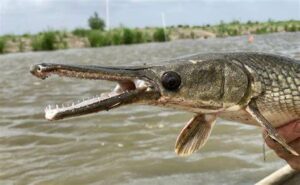
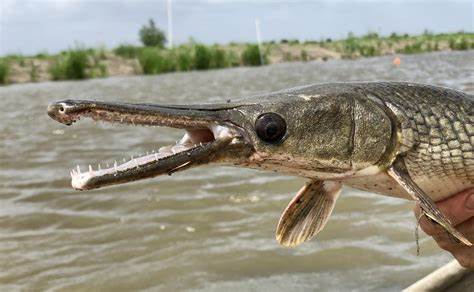
PRATT – When a lure drops below the water’s surface, it’s not always known what might rise to meet it. On a warm night late last month, one angler fishing the Neosho River east of Parsons caught something he probably never expected to see – a four and a half-foot, 39.5-pound Alligator Gar. The kicker? Alligator Gar aren’t native to Kansas and have never been documented here.
Though not always common, Alligator Gar are distributed from southwestern Ohio and southeastern Missouri and Illinois, south to the Gulf of Mexico, and a small portion of northeastern Mexico. A predatory fish, Alligator Gar are sometimes referred to as “living fossils” since fossil records trace them back nearly 100 million years. As the name implies, Alligator Gar are easily identified by their broad snouts that loosely resemble that of the American Alligator. Alligator Gar are the largest gar species with specimens weighing more than 300 pounds and measuring more than 8 feet long. Just three gar species are native to Kansas: Longnose, Shortnose, and Spotted Gar. Longnose Gar are the most common and largest gar species in Kansas. While the Longnose Gar are common in the state and reach lengths exceeding 5 feet, they are distinguished from the Alligator Gar by a narrow snout and smaller overall size, among other characteristics. So, Kansas Department of Wildlife and Parks Fisheries biologists must ask, “What’s an alligator gar doing in the Neosho River?”
It’s a good question, and one KDWP Fisheries biologists are attempting to answer.
“We’re confident the information from the angler is accurate and the fish was, in fact, caught from the Neosho River,” said KDWP Fisheries biologist Connor Ossowski. “However, that doesn’t mean the fish originated from the river.”
To determine the fish’s origins, KDWP biologists have several unique options.
Since all states involved in Alligator Gar reintroduction efforts for populations in decline have been tagging each hatchery-produced Alligator Gar, KDWP staff had the option of looking for a tag. After using a “wand” to detect any identification markers, KDWP staff are confident this catch was not part of a formal reintroduction effort.
“Because most populations of this species can be distinguished from one another with a sample of the fish’s fins, another option we’re considering is genetic identification,” said KDWP assistant director of Fisheries research, Jeff Koch. “This will tell us if the fish came from an existing population in another state.”
If genetic testing doesn’t pan out, not all hope is lost; KDWP Fisheries biologists would still have one more option.
“Microchemistry is another technique at our disposal,” Koch added.
Microchemistry is performed by measuring the elemental proportion of a bone on a given fish and comparing it to the elemental concentration of a surrounding water. If consistencies exist, the data may be able to help Fisheries biologists determine at least how long the fish had been in the Neosho River.
Of all the potential scenarios for how this giant came to be in the Neosho River, there’s one hypothesis that rings the truest – the possibility that the Kansas-caught Alligator Gar was released from an aquarium.
“It’s not unlikely that this fish was once somebody’s pet or purchased from a pet store, and simply released into the river once it became too large,” said Doug Nygren, KDWP Fisheries Division director. “These techniques should allow us to determine which mode of introduction occurred.”
Time will tell if the Neosho River Alligator Gar made its way to the Sunflower State by natural or assisted means. While it would be very difficult for this fish to have made its way to Kansas naturally, due to the distance to the nearest population and the series of dams along the river, KDWP Fisheries biologists won’t jump to conclusions; they’ll do as they always have, which is rely on verifiable data from proven research methods.
Once their research is complete, KDWP Fisheries biologists will publish the results of this catch on ksoutdoors.com and on the Kansas Fisheries Division Facebook page at www.facebook.com/KDWPFisheries.
In the meantime, it’s important to note that transporting and releasing fish or other species in public waters, whether native or non-native, is illegal in Kansas. Chris Steffen, KDWP Aquatic Nuisance Species coordinator, warns, “Transporting and releasing fish risks spreading other harmful species such as microscopic zebra mussels, fish diseases, or aquatic vegetation that might be present in the water used to transport the fish.”
To report a rare species find in Kansas, email [email protected] and visit https://ksoutdoors.com/Services/Threatened-and-Endangered-Wildlife/Rare-Species-Sighting for more information.
TOPEKA – This morning the Kansas Corporation Commission denied a Petition for Reconsideration (PFR) filed by the Natural Gas Transportation Customer Coalition (NGTCC). In its PFR, NGTCC asked the Commission to reconsider its September 9 decision rejecting NGTCC’s motion to subpoena S&P Global Platts Gas Daily for documents relating to the daily gas index during February’s winter weather event.
In today’s Order denying NGTCC’s PFR, the Commission found NGTCC’s request for a subpoena was designed to protect a specific subset of commercial customers (also referred to as Transportation customers) from financial penalties associated with their use of gas supplied by Kansas Gas Service (KGS) when their third party suppliers could not deliver. The requested subpoena was not designed to investigate price manipulation, price gouging, or profiteering in the wholesale markets to protect all Kansas ratepayers from the elevated gas costs of Winter Storm Uri.
“It is the Commission’s job to weigh the evidence, balance interests, and find the right solution for Kansas,” said KCC Chair Andrew French. “Today’s decision does not limit the already expansive scope of our investigations; it simply makes clear no customer groups will be given special treatment at the expense of other customers.”
The order also explains the serious consequences of reducing or eliminating penalties for unauthorized gas usage. Because a portion of the penalties represent the cost of providing gas to transportation customers, eliminating legitimate or appropriate penalties could cause remaining customers to subsidize NGTCC’s members.
“Thus, NGTCC recognizes that by advocating for reduction or elimination of penalties, it is potentially subjecting residential customers to a large portion of the $390 million of additional gas costs that might otherwise be paid by the gas marketers. So, to be clear, NGTCC is seeking the subpoena for the benefit of its members and their gas marketers, rather than to root out profiteering or to protect residential customers – who NGTCC very clearly does not represent.”
Despite its concerns of potential discrimination against residential customers, the Commission emphasizes no decision has been made on the reasonableness or appropriate amount of any potential penalties, so NGTCC’s argument that it faces excessive penalties is premature. NGTCC and other intervenors will have an opportunity to argue their position as this proceeding progresses.
The Commission’s order concluded by emphasizing the importance of not affording preferential treatment to certain subsets of customers while investigations remain ongoing.
“If FERC finds certain markets or indices should be retroactively adjusted, then all Kansans and Kansas businesses – whether sales or transportation customers – can be treated equitably in accordance with those findings. Granting NGTCC’s request for special treatment as compared to other Kansans at this phase would be inequitable and wrong.”
Today’s order can be viewed at
http://estar.kcc.ks.gov/estar/ViewFile.aspx?Id=ae27c56a-4294-453f-b098-52d4f08e7bea
A recording of the Commission Business Meeting is available at https://www.youtube.com/watch?v=m9eApI4p2WE
K-3 closed on Oct. 13 for wind tower crane move
K-3 will be closed from K-39 south to K-47 on Wednesday, Oct. 13. The daylong closure will start at 7 a.m., when a wind tower crane will be moved across the highway between Birch Road in Bourbon County and Arrowhead Road at the Bourbon-Crawford county line.
A detour will be signed on K-146, U.S. 59 and K-39. Traffic should use the detour and other alternate routes. Persons with questions may call Kansas Department of Transportation Area Superintendent Derrick Shannon at (620) 901-6550 or Public Affairs Manager Priscilla Petersen at (620) 902-6433. For updates go to www.kandrive.org.
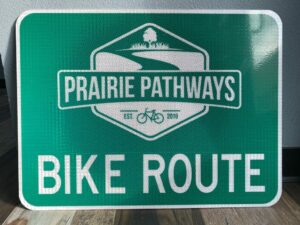
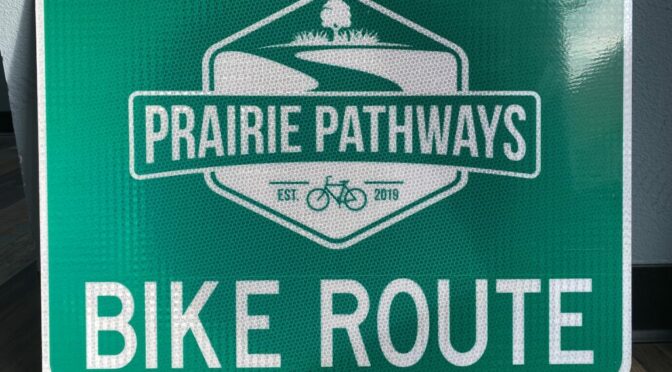
The men then detailed the entirety of the route along old Highway 54 from Fort Scott to Iola, to the city commission, Leahy said.
“We needed to appear before the (FS)city council because we were seeking final approval of the signs for the Prairie Pathways within Fort Scott city limits,” he said.
“The route has been set in all three counties,” Jody Hoener, Healthy Bourbon County Action Team CEO said.
“Bourbon County will have approximately 23 miles of the total 43 miles from Fort Scott to Iola,” Leahy said.
“We are working on gaining permission through each of the cities (in Bourbon County),” Hoener said. “We have obtained permission for signs from the City of Fort Scott. They will also be presenting to the City of Uniontown and to Bronson City Council to gain permission for sign placement.
“Eric Bailey with Bourbon County’s Public Work will be helping us with installing (sign) posts,” she said. ” Right now they are working hard on getting as many miles as asphalt down as possible. They will help us with installation as soon as they can.”
“In respect to a timeline, Thrive is working with both Allen County Public Works as well as the City of Iola Public Works Department,” he said. “We are trying to coordinate both so the signs are installed along a similar time frame after the…(Allen County Public Works)asphalt season.”
Hoener can be reached at [email protected]
” Funding for the planning stage is from the Sunflower Foundation,” Hoener said. “We have grant dollars from Blue Cross Blue Cross Pathways to Healthy Kansas for signage and posts.”
“Funding for the planning stage is from the Sunflower Foundation,” Hoener said. “We have grant dollars from Blue Cross Blue Cross Pathways to Healthy Kansas for signage and posts.”
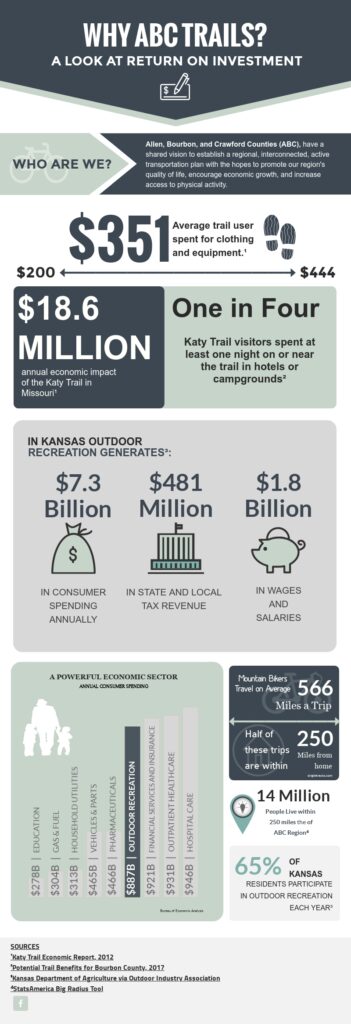
Why I feel Fort Scott needs Michael J. Hoyt on the city commission:
Michael is a tireless fighter for upholding the rights of the citizens and holding everyone accountable for theirs actions, 2) He authored and fought for the petition to strike down Charter Ordinance #31 (Ordinance was to make it legal to transfer funds from sanitary sewer income), which the Voters said “NO” by a 2 to 1 margin and freed up over $800,000 for our storm sewers and should double funds for our sanitary sewers, 3) He holds a law degree and uses his knowledge to interpret laws, statutes, ordinances and specifications, 4) He has the backing and support of the silent majority who are tired of the status quo, 5) He strongly believes the 1987 1% city sales tax was to be used for streets and is working hard to get it back onto the ballot to let the Voters decide the issue, 6) He is currently working on clarifying the connecting links agreement with the State of Kansas, which will put the costs of maintenance if highways 54 and 69 within the city limits, into the hands of the State. The agreement has been misinterpreted by both city and state for many years. The agreement is clear as to city and state responsibilities and Michael is the one to make it happen, 7) Michael is also working on the clarification and enforcement of K.S.A 12-825d, which clearly states the revenue from water funds are to be used “to operate, renew or extend the plant or distribution system”, payment of interest and debt, and payment of employee salaries, 8) Michael’s campaign slogan is “Do It Right” 9) Michael has been at the forefront as a volunteer for projects such as helping on the reconstruction of the Woodland Hills tennis courts, both financially and labor, and helping to install the drain behind the wall at Buck Run, 11) Michael is an advocate for Veterans, helping several to be eligible for benefits they could not obtain on their own, 12) He is promoting a GED program for prisoners incarcerated in the County Jail and pushing to establish a vaping information program for our youth in Fort Scott, 13) Michael has attended every commission meeting both city and county and he has a good working relationship with most of the county officials, he will hit the ground running! Michael’s roots run deep in Fort Scott, spending weekends and summers with relatives that lived and worked here and he has relatives buried in the National and Evergreen Cemeteries. Four years ago, Michael moved to Fort Scott to care for his mother and he intends to remain here when she passes. The above statement is made as my right as a citizen of Fort Scott and may not reflect the opinions of other city commissioners, of which I am one.
Signed: Pete Allen, Citizen
|
|
|
|
|
|
|
|
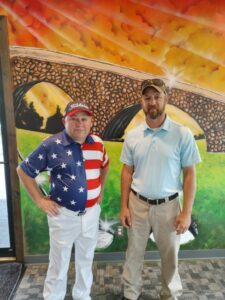
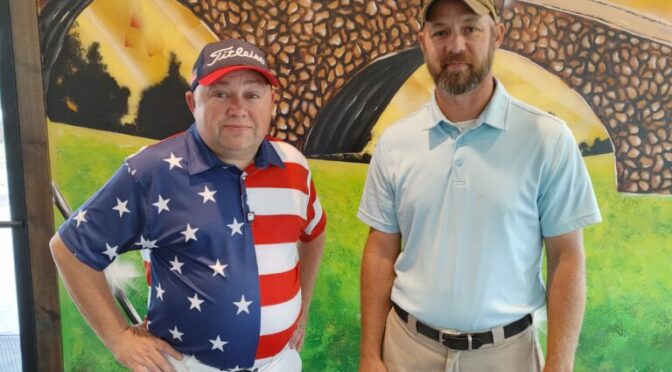
Steve Anthony, 49, is the new Woodland Hills Golf Course Clubhouse Manager in Fort Scott. The course is owned and operated by the City of Fort Scott.
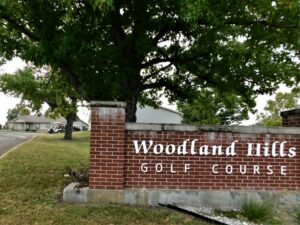
He replaces Shannon O’Neil, who left in July.
Anthony feels that he and Doug Guns, the golf course superintendent, are a good team.
“I feel I have a good grasp of things and if things come up that need two heads to make a decision, Doug and I make the decision as we are pretty much on the same page and we make our decision on what’s best for the club and or our member’s,” he said.
Anthony’s hometown is Parkersburg, West Virginia and he is married to Stephanie Anthony.
“I have been an avid golfer since I was a young kid back in West Virginia,” he said. “I have been in Fort Scott for nine years now.”
“I have always had a love for the sport of golf and when the opportunity came to pursue the golf course (position) here, I jumped at the chance to take it on,” he said.
“When I started, I knew I wanted to do some different things that had not been done here,” Anthony said. “For example, having watch parties for National Football League games and it has grown each week. My hope is once the colder weather sets in we will have more folks come out to join us for games as they will be tired of just sitting at home.”
He enjoys coming to work each day, getting to do something that he loves, Anthony said.
“The Woodland Hills Golf Course is in really beautiful shape as Doug (Guns)and his crew do a great job making it look beautiful,” he said.
In the community, Anthony has been involved with Special Olympics, a large sports organization for people with intellectual disabilities.
“I, along with Bourbon County Undersheriff Ben Cole, host a golf tournament each year to benefit Special Olympics,” he said. “I am also on the Board of Directors for Special Olympics Kansas.”
He enjoys coming to work each day, getting to do something that he loves, Anthony said.
Anthony can be reached at 620-223-5060 or his cell phone at 620-215-2392.

Supplemental Pandemic Food Assistance program announces benefit distribution dates
TOPEKA – The Kansas Department for Children and Families (DCF) announces the distribution of the Supplemental Pandemic EBT food assistance benefit to eligible Kansas students.
Distribution of the one-time benefit of $375 per child will begin to be issued starting tomorrow, Oct. 12. This benefit is for the summer months of June, July and August 2021.
All school aged children who were eligible for free and reduced-price meals during the 2020-2021 school year through the National School Lunch program will receive the one-time benefit. This includes Head Start children who attend a Community Eligible Provision (CEP) school or were enrolled in the National School Lunch program.
Qualifying school aged children who did not receive P-EBT for the 2020-2021 school year because they attended school in person and do not already have a Kansas Benefits Card will receive a preloaded card in the mail beginning Oct. 26. Eligible households that do not receive the benefit by Nov. 4 will need to provide additional information to DCF through the DCF Self Service Portal after Nov. 1.
The benefit can be used to purchase eligible food items from approved vendors that accept food assistance benefits like grocery stories and online at Aldi, Amazon or Wal-Mart.
The Supplemental P-EBT program provides temporary food benefits to families of children who normally receive National School Lunch program benefit but the education cycle was disrupted due to the COVID-19 Pandemic. Learn more at www.dcf.ks.gov/pages/p-ebt.aspx.
Contact DCF at 1-888-369-4777 with questions or visit the P-EBT page on www.dcf.ks.gov.
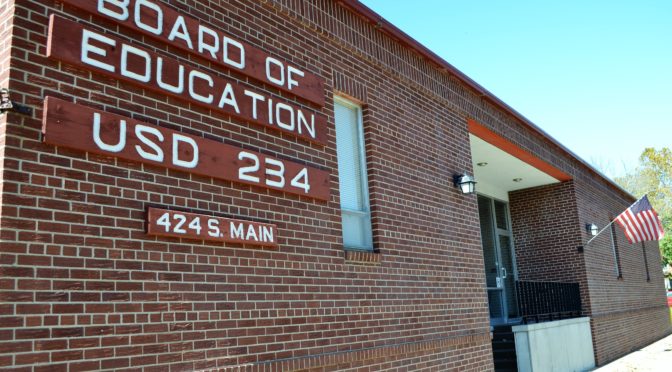
There will be no school for USD 234 students on Friday, October 15, due to a Teacher Work/Plan Day.
Parent/Teacher conferences for the USD 234 School District will be held on Monday, October 18, and Tuesday, October 19.
Conferences will be held at the following times:
Fort Scott Preschool Center – 4:20 to 7:50 p.m.
Winfield Scott and Eugene Ware – 4:15 to 7:45 p.m.
Fort Scott Middle School and Fort Scott High School – 4:30 to 8:00 p.m.
There will be no school for USD 234 students on Friday, October 22.
Classes will resume on Monday, October 25.
Teacher Work/Plan Day – No School – October 15
` Parent/Teacher Conferences – October 18 and 19
No School – October 22
Contact: Ted Hessong, Superintendent
USD 234
424 S. Main
Fort Scott, KS 66701
TOPEKA – Today, Governor Laura Kelly released the total allocation amounts for each hospital participating in the Frontline Hospital Workers Retention Plan.
“This $50 million will help us retain and attract more frontline hospital workers as we continue to fight his virus,” said Governor Laura Kelly. “For over 18 months, our heath care workers have risked their lives every day to protect Kansans from COVID-19 – it’s our responsibility to make sure they have the support they need to continue. In the meantime, I encourage all Kansans to do their part to beat this virus by getting vaccinated immediately.”
As proposed by the Strengthening People and Revitalizing Kansas (SPARK) Executive Committee, hospitals will receive an allocation based on the number of licensed, acute and intensive care unit beds in each facility. The full list of allocations can be found here.
In September, the SPARK Executive Committee approved $50M in available funding for eligible hospital workers. Qualified facilities may use the funding for either premium pay as defined in the American Rescue Plan Act (ARPA) or for funding a custom program designed by the facility to improve the retention of nursing resources and support personnel.
To receive the allocation, hospitals must submit a completed application by October 29, 2021. Awards will be made on a rolling basis following application review.
For more information on the Frontline Hospital Worker Retention Plan, the SPARK committee, or about the Office of Recovery, please visit https://covid.ks.gov.