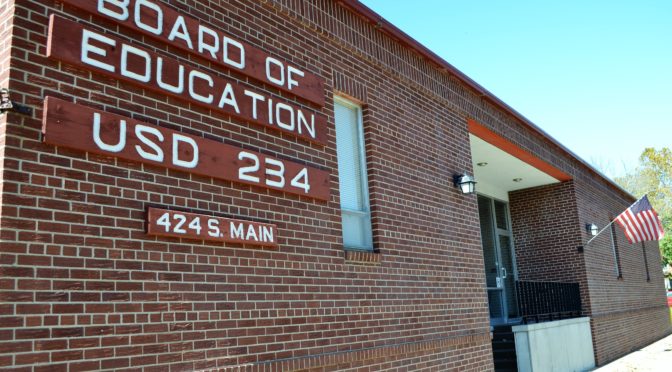
USD 234 Shares Update on Mill Levy
The following was submitted by USD234 regarding the mill levy.
USD 234 Shares Update on Mill Levy
Fort Scott USD 234 would like to share the answers to questions that have recently arisen about the district’s mill levy and property taxes.
First, it’s important to understand how the budget process works. The Board of Education meets with the district administrators in the spring as we begin the process of building the budget. The Board provides the administration direction as to how they want the budget prepared after reviewing the needs of the district and input from the administration. Typically, the Board directs us to keep the tax rate flat or to reduce or be lower than the previous year. The administration then works on the budget preparation through the months of June and July in partnership with the Bourbon County Clerk and Appraiser, who sets assessed property valuations we use to build the budget. We present a draft of the budget to the Board of Education for feedback in August with the final presentation and budget hearing in September.
Another common question is about the Recreation Commission and Buck Run Community Center. The Recreation Commission is a separate entity from the USD 234 school district. They operate under their own board, budget, set their tax rate, and have their own budget hearing independent from the school district.
What’s Happening with USD 234’s Mill Levy?
Good news! The district’s tax rate will actually be slightly lower this year. Here’s a look at the numbers:
| Fund | 2024-25 Actual | 2025-26 Proposed | Difference |
| General | 20.000 | 20.000 | 0.000 |
| Supplemental General | 14.895 | 14.891 | -0.104 |
| Capital Outlay | 7.896 | 8.000 | +0.004 |
| Bond & Interest | 9.669 | 9.757 | +0.088 |
| Total | 52.660 | 52.648 | -0.012 |
Even though USD 234 will technically “exceed revenue neutral” because of rising property valuations in the county and State aid, the actual tax rate is going down slightly. Over the last 10 years, the district tax rate has remained stable, dropping just over 1 mill during that time period.
Why does the district choose not to be Revenue Neutral?
Each year, the Kansas Department of Education determines the percentage of state aid the district will receive based on the poverty level in the district. That number changes yearly. This year, we will receive between 65% and 69% of our funding for the supplemental general, bond and interest, and capital outlay funds from the State. That leaves only 31% to 35% of those budget totals to be funded locally. Our state aid percentage has gone up each year, which brings additional dollars into the district from other parts of the State. This was part of the equalization lawsuit that went through the courts years ago.
Why was there a discrepancy between what the County sent to taxpayers and the actual budget being published by the district?
Some of the confusion comes from the Notice of Proposed Property Tax report that Bourbon County recently mailed to taxpayers. Those numbers were based on early estimates and don’t always match what the district actually adopts. We are required to provide the County Clerk with our estimates very early in the budget building process, creating a discrepancy between the proposed and the actual budget numbers.
Here’s how the county’s estimates compared with USD 234’s proposed levy:
| Fund | County Estimate | USD 234 Proposed | Difference |
| General | 20.000 | 20.000 | 0.000 |
| Supplemental General | 17.001 | 14.891 | -2.110 |
| Capital Outlay | 8.000 | 8.000 | 0.000 |
| Bond & Interest | 9.757 | 9.757 | 0.000 |
| Total | 54.758 | 52.648 | -2.110 |
As can be seen, the original estimates were a little higher than what USD 234 is actually proposing to the Board of Education.
Clearing Up Misinformation
The District appreciates the taxpayers and the funding they provide for our students’ education. Because of the funding provided to the district, the District is able to provide high quality teachers, staff, and resources to prepare every student with the skills and knowledge needed to be successful beyond high school. The district welcomes any questions you may have about our budget or anything else concerning the school district. Should you have any questions, please contact:
- Superintendent Destry Brown at (620) 223-0800 or [email protected]
- Assistant Superintendent Terry Mayfield at (620) 223-0800 or [email protected]
- Assistant superintendent Dr. Zach Johnson at (620) 223-0800 or [email protected]
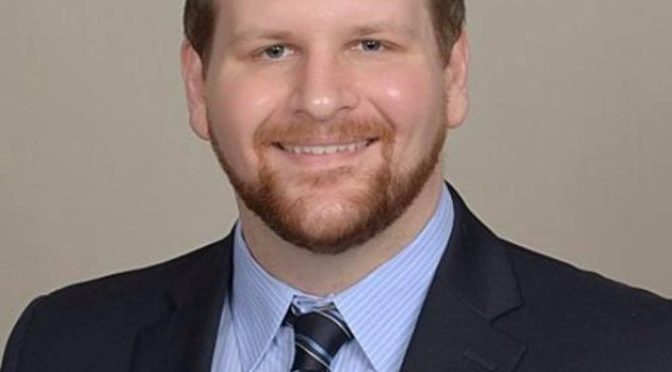
NRMC welcomes Dr. Smith home to serve the community
Nevada Regional Medical Center (NRMC) is pleased to welcome Dr. Colby Smith back to Nevada. Dr. Smith will be joining the staff at Nevada Medical Clinic. He is board certified in Family Medicine and proud to return home as a Nevada High School alumnus. Dr. Smith will begin seeing patients in September.
Dr. Smith cares for patients of all ages & offers services including:
- Acute or Chronic Illness Care
- Blood Pressure & Diabetes Management
- Preventive Care & Routine Exams
- Well Child Exams
- Wellness & Health Education
- Work, School & Sports Physicals
Dr. Smith’s office is located within Nevada Medical Clinic, 900 S Adams. He is accepting new patients. Appointments can be made by calling 417-667-6015.
###
About Nevada Regional Medical Center
NRMC is a 71-bed acute, intensive and skilled care hospital providing comprehensive health care services. Staff represent more than a dozen medical specialties including ear, nose & throat, family practice, general surgery, gynecology, internal medicine, orthopedics, pain management, pediatrics, psychiatry and wound care services. Additionally, consultation clinics are held regularly by specialists in cardiology, dermatology, neurology, podiatry, pulmonology and urology.
NRMC is centrally located between Kansas City and Joplin along the I-49 corridor.
Letter To The Editor: Deb McCoy
OUTSTANDING PROPERTY TAXES VS. TAX ABATEMENTS
AND HOW IT IS AFFECTING OUR COMMUNITY
Deb McCoy
Look what is happening in our small community. As of the 2020 Census, the total population of the incorporated cities in Bourbon County was 8,464, and 5,896 live in unincorporated communities and rural regions, making our total population of Bourbon County 14,360.
As citizens, we need to be held accountable for the actions that we are responsible for. Without taxes, our City and County Government cannot provide the essential services and infrastructure in our community. They primarily fund: Public Schools, Public Safety to support police and fire protection, Roads and Infrastructure contribute to the maintenance and construction of roads and public transportation, and Community Services that include local health and social service programs, libraries, parks, recreational facilities, and other community amenities. Overall, Property taxes are a crucial source of revenue for local governments, enabling them to provide essential services and to maintain the infrastructure of our community.
“Most Americans do not like doing or paying their income taxes, but every year about 85% of them will voluntarily pay the full amount of the taxes they owe. Even so, the IRS estimates that the United States loses over $400 billion of revenue each year because people fail to file their taxes, underreport their income or underpay the amount of taxes they owe.” (4/11/2024 “The Conversation” by Michele Frank)
The recent Legal Notice printout of Bourbon County 2024 outstanding taxes totals of $1,355,870.93. The following figures are outstanding taxes from 2017 through 2023 that were received from our treasurer’s office:
2017 – $70,123.81
2018 –$80,569.78
2019 –$89,831.45
2020 – $94,115.88
2021 – $159,182.00
2022 – $316,810.93
2023 – $500,321.48
Another Program that gives residents tax breaks is The Neighborhood Revitalization Tax Rebate Commercial or Residential Program. This program is a partnership between the City and County, with the City responsible for promoting revitalization and development. To qualify the property must be located within the contiguous city limits of the City of Fort Scott, Conform to the City of Fort Scott’s Comprehensive Land Use Plan & Zoning Ordinance, Conform to all applicable building codes, rules & regulation in effect at the time the improvement are made and for the length of the term of the rebate., and be up to date on all property tax & special assessment payments. The following list from 2015 through 2025 breaks down the annual rebates on taxes that were given in Bourbon County through the County Appraiser’s Office:
2015 – $822,736
2016 – $3,328,018
2017 – $4,817,118
2018 – $108,850
2019 – $425,832
2020 – $1,985,078
2021 – $2,754,027
2022 – $1,097,830
2023 – $4,816,782
2024 – $6,927,358
2025 – $5,466,190
The total amount of taxes that are unpaid or rebated in our community for 2024/2025 is $6,822,060.93.
The questions on whether cities should have caps on the number of grants awarded is complex and subjective and perhaps, we as a city and a county should consider caps on tax rebate incentives to ensure they are used effectively and equitably and based on community needs. It’s essential to consider the economic impact of these grants on local communities, as well as the need for flexibility in grant allocation. Ultimately, the decision of our local government should be based on a thorough assessment of the specific circumstances and needs. The purpose of the Neighborhood Revitalization Program was intended to encourage reinvestment and improvement of areas of decline or areas of architectural or historical significance within the community, per K.S.A. 12-17.114. Are we following these requirements and who is monitoring the program to ensure that we are within the purpose and factual findings of this program? These programs are enticing, but have we overextended our means to the point that we cannot meet the basic needs of our essential services and to maintain the infrastructure of our community without imposing additional sales taxes?
The Bourbon County Sheriff’s Office Daily Reports August 19
Chamber Coffee Is Hosted by Trinity Lutheran Church on August 21
|
|

|
|
|

|
|
|

|
|

|
|
|

|
|
|

|
|||||||||||||||
|



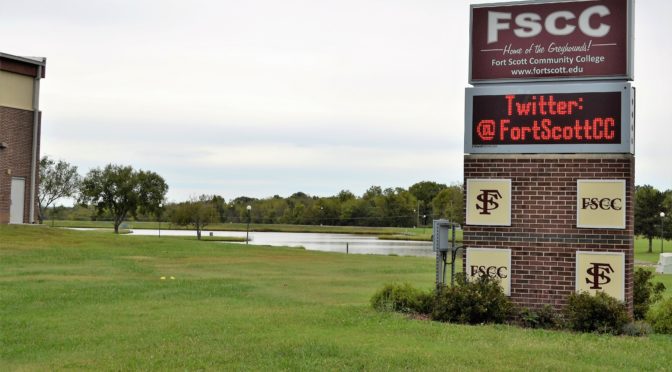
FSCC Trustees Hold A Board Workshop on August 22
The Fort Scott Community College Board of Trustees will hold a board workshop on Friday, August 22 at 12:00 pm in Cleaver-Burris-Boileau Agriculture Building to prepare for the regular board meeting to be held on August 25.
They may adjourn to executive session if needed.
No action will be taken at this workshop.
Cost of Bourbon County Employee Benefits in 2024
The cost of employee benefits in 2024 for Bourbon County has come up frequently in recent discussions about the county budget. Generally, the number has been given at around $4,000,000 for about 100 employees.
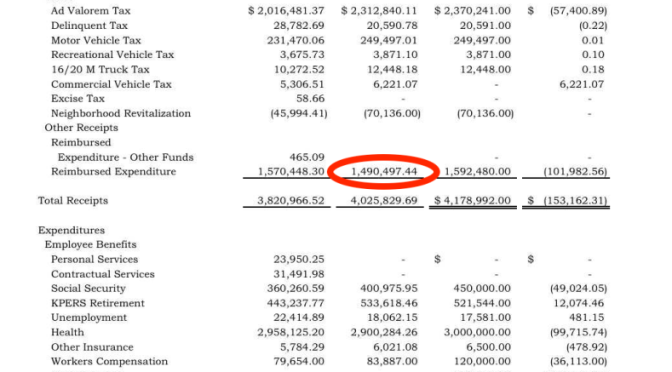
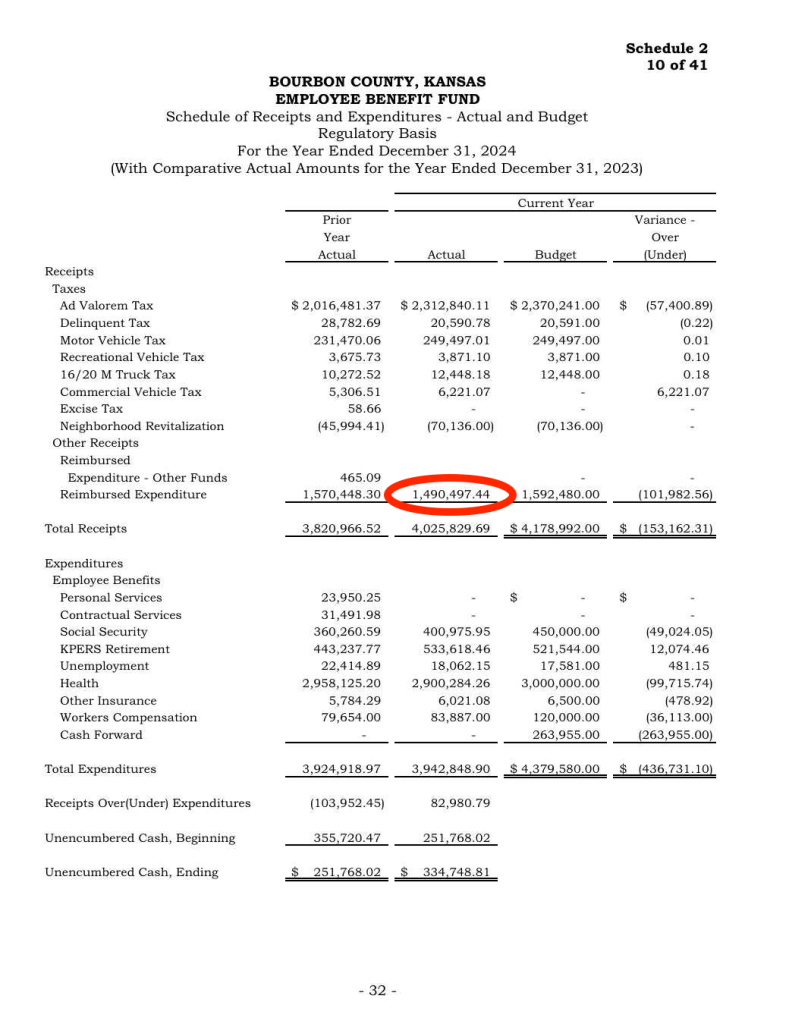
In paperwork from the county, the actual amount budgeted for 2024 was $4,379,580, but the amount actually spent in 2024 was $3,942,848.
While those numbers are correct in the sense that they represent the amount that shows up on the accounting document, the roughly $4 million amount includes money that is deducted from the employee’s paycheck for various benefits. For example, if an employee’s family is being covered by county health insurance, the employee is responsible for a portion of those premiums, but the amount the employee reimburses still shows up as outflow under the Health line item.
In 2024, $1,490,497.44 was deposited into the employee benefits account as “Reimbursed Expenditure” from employee salary deductions, which covered employee contributions for benefits. These deductions include various types of insurance that the employee can choose to pay for, as well as money funding health savings accounts or flexible spending arrangements.
So to get a better idea of how much of the money being payed out in employee benefits is actually being paid by the county and not the employees, the amount that is being paid by employee payroll deductions needs to be subtracted from the amount flowing out of that account. The total employee benefit expenditures minus the amount reimbursed via payroll deductions come to $2,452,351.46.
With approximately 100 employees, this would bring the average spent per person on county employee benefits closer to the $24,000 range, rather than the $40,000 range, as it might appear at first glance.

GriefShare Begins August 26 at Community Christian Church

“Classes begin Tuesday evening at Community Christian Church Use the southeast side door. Classes will run from 6:00 p.m. to 8:00 p.m. for 13 weeks beginning August 26th,” said a spokesman, Jon Bailes. “Everyone is welcome and there is no charge except for a workbook.”
“This is a Biblically based program that has been operating with great success at helping people who have lost a loved one.”
Community Christian Church is hosting, but is not responsible.

US Representative Derek Schmidt Newsletter
|






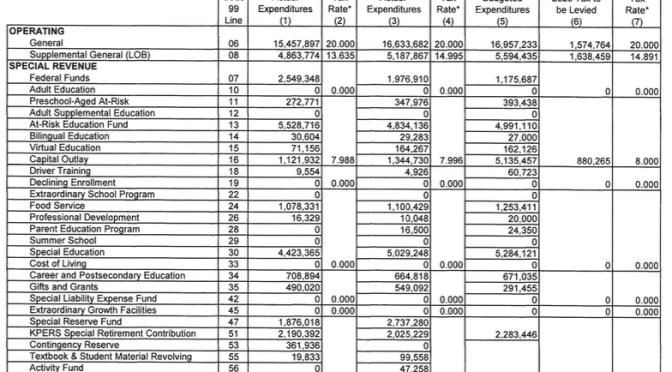
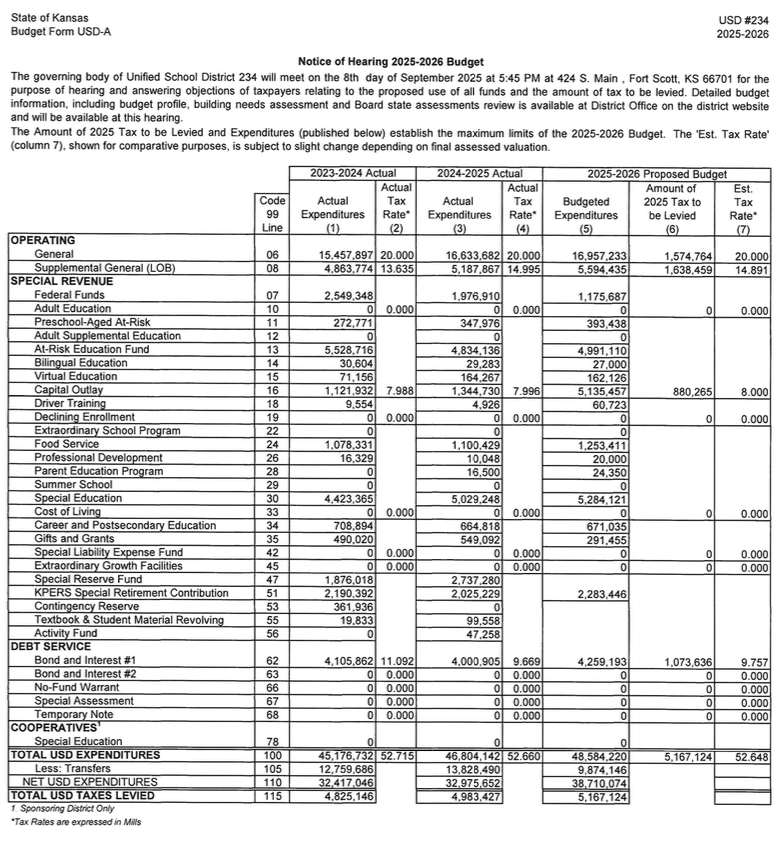
USD234 Hearing Notice and Proposed Budget for 2025-2026
Update: It appears that the dates published in the notice that was mailed to residents and the USD 234 public hearings will be on 9/11/2024 at 5:30 at 424 S Main. The USD 234 Recreation (Buck Run) will be at 9/3/2025 at 12 PM at Buck Run Community Center.
According to Terry Mayfield, Assistant Superintendent at USD234, the public hearing regarding the district’s proposal to exceed the revenue-neutral rate will be held on September 8th, 2025, at 5:30 & 5:45 p.m. at 424 S. Main, Fort Scott, KS 66701. The county’s Notice of Proposed Property Tax Increase and Public Hearing mailing, which was previously mailed to county residents, had listed the hearing dates as September 3rd and September 11th.
According to the notice, “Detailed budget information, including budget profile, building needs assessment and Board state assessments review is available at the District Office on the district website and will be available at this hearing.”
See the attached PDF for the proposed budget amounts:
USD 234 Hearing Notices 2025-2026
August Parent Empowerment Circle Meeting Reminder
August Parent Empowerment Circle Meeting Reminder for August 24.
Our next Parent Empowerment Circle will focus on fun! The gathering will be held on
Sunday, August 24 from 130 – 3:30
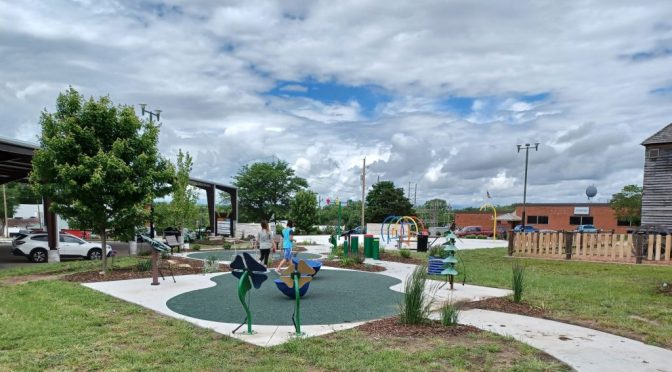
at the Splash Pad and Sensory Park, 111 N. National Avenue in Fort Scott.
Families should bring their own:
*lawn chairs
*water to drink
*snacks for their kids
*sunscreen
*towels
*dry clothes for their kids
Questions? Contact Cherri Walrod, our Community Health Worker: 620-223-3720 or [email protected]
Cherri Walrod
Community Health Worker
K-State Research and Extension Southwind District