FSHS THESPIANS HOST VIRTUAL AWARDS CEREMONY

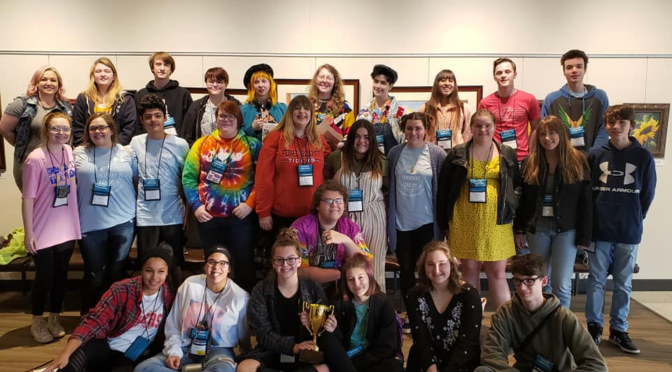
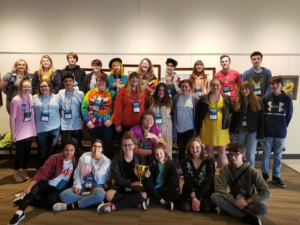
FSHS Thespian Troupe members attending the 2020 KS State Thespian Festival. Left to right, top row – Angie Bin, Tailynn Harding, Jacob Ham, Italeigh Harding, Sierra Long, Amber Russo, Wendy Monahan, Christina King, Levi Bin, Daniel Watson. Second row – Carlee Studyvin, Alexis Williams, Israel Carreno, Kaitlyn Leavell, Olivia Wilterding, Tina Ramirez, Montana Laroche, Mackenzie Peoples, Avery Dorsey, and Justin Stevens. Bottom row (Thespian Officers) – Ashanti Green, Zaria Byrd, Alexa Bukowski, Dominic Cannon, Mesa Jones, and Sage Hill. Submitted photo.

The Fort Scott High School Thespian Troupe #7365 held it’s 3rd Annual Golden Thespie Awards Banquet on May 4.


This year’s banquet was quite different, as it was held over a virtual Zoom call. Current Thespian Officers and Thespian Director Angie Bin made the presentations. Officers include Vice President Sage Hill, Historian Alexa Bukowski, Publicity Chair Zaria Byrd, and State Representatives Jenna Stockstill and Ashanti Green.


The troupe recognized Thespians who performed at the KS State Thespian Festival in January including Mackenzie Peoples – Musical Solo, Amber Russo & Wendy Monahan – Duet Acting, Tina Ramirez – Musical Solo, and Dominic Cannon and Sage Hill – Duet Acting. Special recognition went to the following students who received Superior Ratings at State and will perform in the Virtual International Thespian Festival in June: Ashanti Green – Monologue, Mesa Jones – Musical Solo and Jenna Stockstill – Musical Solo. The troupe was also recognized for receiving the highest state honor a troupe can receive, the Gold Honor Troupe Award given for performance, public service, community involvement, and troupe organization. This is the fourth year in a row that Fort Scott has received the Gold Honor.


The FSHS Thespian Improv Troupe was recognized for participating in Operation Show this year at the Westport Coffee House Theatre in Kansas City, MO under the direction of Mark Bergmann. These students studied improvisational comedy with professional actors and performed for a public audience along with other students from around the KC area. They include Daniel Watson, Kaitlyn Leavell, Justin Stevens, Lola Umarova, Jo Goodbody, Dominic Cannon, Wendy Monahan, Tina Ramirez, Sierra Long, Anthony Russo, and Improv Troupe Captain Amber Russo.


To letter in Theatre, students must participate in both main stage productions (cast or crew), participate in 6 theatre-related fundraisers, activities, or community service projects, and be in good academic standing. First year letters went to Israel Carreno, Kinsley Davis, Bareigh Farrell, Ashanti Green, Jacob Ham, Christina King, Luke Majors, Khris Patel, and Olivia Wilterding. Second year bars were awarded to Alexa Bukowski, Zaria Byrd, Avery Dorsey, Gabriel Graham, Tailynn Harding, Sage Hill, Mesa Jones, Wendy Monahan, Amber Russo, Jenna Stockstill, Carlee Studyvin, and Alexis Williams.


The highlight of the banquet is the awarding of the Golden Thespies. These are awards voted on by the troupe members. Honors went to the following: Most Involved – Alexa Bukowski, Drama Mama (someone who helps out everyone else) – Zaria Byrd, Drama Papa – Jacob Ham, Newcomer of the Year – Kinsley Davis, Designer of the Year – Amber Russo for lighting design, Techie of the Year – Jacob Ham for Stage Management, Dancer of the Year – Addy Labbe, Singer of the Year – Mesa Jones, Actor of the Year – Sage Hill, Actress of the Year – Ashanti Green, and Triple Threat (best overall singer, dancer, and actor) – Mesa Jones.


The troupe also recognized graduating seniors and ended the banquet with a slideshow of pictures from throughout the year. New officers will be elected when the new school year starts.



County Seeking Businesses That Need Funding Due to COVID 19 For Grant

Bourbon County Economic Director Jody Hoenor is exploring business needs, outside of Fort Scott City limits, for the CDBG-CV grant opportunity. The goal of the grant is job retention.
” We are looking for all business in the county, outside of Fort Scott city limits, with 1 to 50 employees who have been impacted by the Coronavirus pandemic.  Funding can be used for inventory or working capital needed to reopen or help keep a business operating.”
“The City of Fort Scott will have opportunity to apply for funding if they have used all their current funding.”  she said  in a press release.
Please share and reach out to Jody Hoener, [email protected]
“So we can be sure to get your business included in our grant application,” she said.

Online Classes Pose Some Challenges For Middle School Student

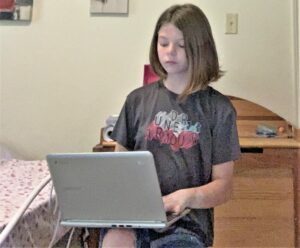
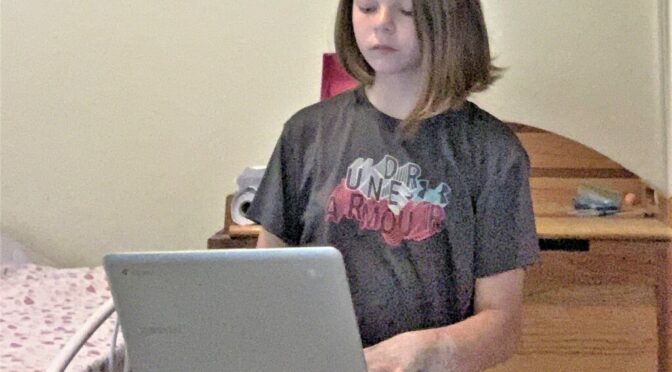
Alexis Tourtillott at home doing online school work. Submitted photo.


Alexis Tourtillott, age 11, attended Fort Scott Middle School until the COVID 19 Pandemic, closed down classes nationwide in March 2020.

Tourtillott started about a month ago to do lessons with teachers on the internet as a part of USD 234 Continuous Learning Plan.

“I started four weeks ago and I am doing online school for about five classes,” Tourtillott said via an email interview.

“A typical school day is waking up, doing a zoom class, then work,” she said. “I probably spend about one-and-one-half hours on it daily.”

She has faced some challenges, she said.

Submitted photo.

“Doing my work at home is kind of hard because there are so many distractions,” Tourtillott said.  “My greatest challenge is pushing myself to do the work even though I don’t want to.”

“I think the new learning plan is going well, especially for the amount of time the teachers had to plan for it,” Alexis mother, Amy Wiltse said. “I cannot imagine the stress that this causes for them.”


SEK Health Department COVID 19 Update

SEK Multi-County Health Departments

Allen, Anderson, Bourbon, and Woodson Counties

Coronavirus (COVID-19) Update

May 6, 2020

Allen County

Current Positive Cases 0
Current Recovered Cases 0
Total Positives Since Testing 0
Deaths 0

Anderson County

Current Positive Cases 0
Current Recovered Cases 0
Total Positives Since Testing 0
Deaths 0

Bourbon County

Current Positive Cases 0
Current Recovered Cases 5
Total Positives Since Testing 6
Deaths 1

Woodson County

Current Positive Cases 1
Current Recovered Cases 5
Total Positives Since Testing 6
Deaths 0

Recovered cases are based on dates of onset of symptoms, not on day testing results are received.

Kansas Farmer Honored For Mask to New York Disaster

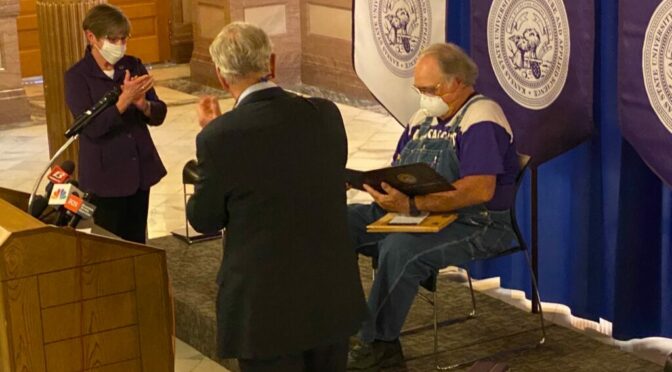
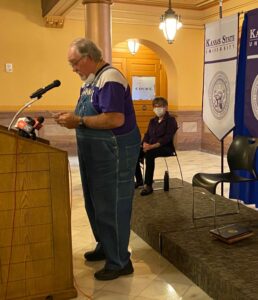
Farmer honored by Gov. Kelly. Submitted photo.

Governor Kelly, K-State President Myers confer degree upon Kansas farmer who sent N95 mask to New York

Ruhnke shows the best in humanity, encapsulates what it means to be Kansan

Editor’s note: Please take time to view the video from the presentation. I think you will find it inspiring.

A video of the presentation can be found here.


Governor Laura Kelly today joined Kansas State University President Richard Myers to confer a bachelor’s degree upon Dennis Ruhnke, of Troy, Kansas.


Ruhnke recently garnered national attention when he sent a letter to New York Governor Andrew Cuomo, in which he enclosed an N-95 mask to give to a nurse or doctor in New York.


Ruhnke wrote to Governor Cuomo: “I am a retired farmer hunkered down in Northeast Kansas with my wife who has but one lung and occasional problems with her remaining lung. She also has diabetes. We are in our 70s now and frankly, I am afraid for her.


“Enclosed find a solitary N-95 mask left over from my farming days. It has never been used. If you could, would you please give this mask to a nurse or doctor in your city. I have kept four masks for my immediate family. Please keep on doing what you do so well, which is to lead.”


“Dennis’ donation, at the height of our country’s protective gear shortage, showed us the best in humanity when we needed it the most,” Governor Kelly said. “I would like to thank Dennis for the example he’s set on how to serve – and how to be thoughtful and generous in an extraordinary way.”


In 1971, Ruhnke was studying agriculture at Kansas State University when his father passed away. At that time, he was two credits away from earning his degree, but chose to leave school to take care of his mother and the family farm.


“After speaking with President Myers, we both agreed that Dennis perfectly encapsulates K-State’s democratic mandate to be of service to people,” Governor Kelly said. “Which is why I am very honored that I was able to help present Dennis with his well-deserved bachelor’s degree in agriculture.”


“Along with his fantastic demonstration of kindness and generosity, Mr. Ruhnke’s academic work at K-State in his chosen field of agriculture qualifies him to receive his degree,” President Richard Myers said. “Kansas State University is proud to officially recognize Mr. Ruhnke as an alumus and valued member of the Wildcat family.” 


. A video of the presentation can be found here.

FSA Reminds Producers of Ongoing Disaster Assistance Program Signup


Payments Have Started for Producers Impacted by Drought, Excess Moisture

WASHINGTON, May 1, 2020 – The U.S. Department of Agriculture (USDA) has started making payments through the Wildfire and Hurricane Indemnity Program – Plus (WHIP+) to agricultural producers who suffered eligible losses because of drought or excess moisture in 2018 and 2019. Signup for these causes of loss opened March 23, and producers who suffered losses from drought (in counties designated D3 or above), excess moisture, hurricanes, floods, tornadoes, typhoons, volcanic activity, snowstorms or wildfires can still apply for assistance through WHIP+.

To date, FSA has received more than 33,000 WHIP+ applications,” said Richard Fordyce, Administrator of USDA’s Farm Service Agency (FSA). “We want to remind producers that we are still accepting applications for WHIP+, and we encourage producers to call our offices for next steps on how to apply.”

To be eligible for WHIP+, producers must have suffered losses of certain crops, trees, bushes or vines in counties with a Presidential Emergency Disaster Declaration or a Secretarial Disaster Designation (primary counties only) for qualifying natural disaster events that occurred in calendar years 2018 or 2019. Also, losses located in a county not designated by the Secretary as a primary county may be eligible if a producer provides documentation showing that the loss was due to a qualifying natural disaster event.

For losses due to drought, a producer is eligible if any area of the county in which the loss occurred was rated D3, or extreme drought, or higher on the U.S. Drought Monitor during calendar years 2018 or 2019. Producers who suffered losses should contact their FSA county office.

In addition to the recently added eligible losses of drought and excess moisture, FSA will implement a WHIP+ provision for crop quality loss that resulted in price deductions or penalties when marketing crops damaged by eligible disaster events. To ensure an effective program for all impacted farmers, the Agency is currently gathering information on the extent of quality loss from producers and stakeholder organizations.

USDA Service Centers, including FSA county offices, are open for business by phone only, and field work will continue with appropriate social distancing. While program delivery staff will continue to come into the office, they will be working with producers by phone and using online tools whenever possible. All Service Center visitors wishing to conduct business with the FSA, Natural Resources Conservation Service or any other Service Center agency are required to call their Service Center to schedule a phone appointment. More information on Service Centers can be found at farmers.gov/coronavirus, and more information on WHIP+ can be found at farmers.gov/whip-plus.

#

USDA is an equal opportunity provider, employer, and lender.

USDA Reports Record Enrollment in Key Farm Safety-Net Programs


WASHINGTON, April 21, 2020 – Producers signed a record 1.77 million contracts for the U.S. Department of Agriculture’s Agriculture Risk Coverage (ARC) and Price Loss Coverage (PLC) programs for the 2019 crop year, which is more than 107 percent of the total contracts signed compared with a 5-year average. USDA also reminds producers that June 30 is the deadline to enroll in ARC and PLC for the 2020 crop year.

Producers for several years have experienced low commodity prices, a volatile trade environment and catastrophic natural disasters,” said Richard Fordyce, Administrator of USDA’s Farm Service Agency (FSA). “Farmers looking to mitigate these risks recognize that ARC and PLC provide the financial protections they need to weather substantial drops in crop prices or revenues.”

Producers interested in enrolling for 2020 should contact their FSA county office. Producers must enroll by June 30 and make their one-time update to PLC payment yields by September 30.

FSA attributes the significant participation in the 2019 crop year ARC and PLC programs to increased producer interest in the programs under the 2018 Farm Bill and to an increase in eligible farms because of the selling and buying of farms and new opportunities for beginning farmers and military veterans with farms having 10 or fewer base acres. Enrollment for 2019 ended March 16.

USDA Service Centers, including FSA county offices, are open for business by phone only, and field work will continue with appropriate social distancing. While program delivery staff will continue to come into the office, they will be working with producers by phone and using online tools whenever possible. All Service Center visitors wishing to conduct business with the FSA, Natural Resources Conservation Service or any other Service Center agency are required to call their Service Center to schedule a phone appointment. More information can be found at farmers.gov/coronavirus.

For more information on ARC and PLC, download the program fact sheet or the 2014-2018 farm bills comparison fact sheet. Online ARC and PLC election decision tools are available at www.fsa.usda.gov/arc-plc. To locate the nearest USDA Service Center, visit farmers.gov/service-center-locator.

#

USDA is an equal opportunity provider, employer, and lender.

Utility Disconnects Suspended Until May 31

KCC extends emergency order suspending utility disconnects until May 31


This morning, the Kansas Corporation Commission approved extending its emergency order suspending utility disconnects for nonpayment until May 31.   The action, taken during a Commission business meeting, will offer continued relief to those experiencing hardship from the COVID-19 virus. The directive covers all electrical, natural gas, water and telecommunications utilities under the KCC’s jurisdiction.


The Commission’s original suspension order was issued on March 16 to expire on April 15. On April 14, Commissioners extended the order to May 15. Today’s order runs concurrently with Executive Order 20-28 issued last week by Governor Laura Kelly. The Governor’s order prohibits utilities, not under the jurisdiction of the KCC, from disconnecting customers until May 31.


“Even as the state begins the phased reopening process, Kansans continue to deal with the financial challenges brought about by COVID-19.  Maintaining utility services is critical to ensure public health and safety as the state works toward recovery,” said Commission Chair Susan Duffy.


The Commission may elect to extend the suspension order in a subsequent order if conditions warrant.


Today’s order can be viewed at: http://estar.kcc.ks.gov/estar/ViewFile.aspx?Id=b6d84c9c-e3f3-487a-bbd2-95eec6d895fe


Aging and Disability Services Implements Steps For COVID 19

KDADS Implements New Steps to Safely Maintain State’s Psychiatric Hospital Services

TOPEKA – Kansas Department for Aging and Disability Services (KDADS) Secretary Laura Howard announced proactive steps to keep the state’s two psychiatric hospitals operating while keeping patients and staff safe during this pandemic. The principle behind these steps is to manage the state’s critical mental health infrastructure while creating capacity to quarantine any new patients in a single room for symptoms monitoring for up to 14 days after admission. Additionally, the hospitals have planned for isolation of any symptomatic or COVID-19 positive patients.

To implement this plan at Larned State Hospital (LSH), KDADS will work with the courts and providers to temporarily adjust hospital occupancy and actively manage a waiting list in response to COVID-19 as part of the hospital’s Pandemic Response Plan. Voluntary patients to Larned’s psychiatric services program will be diverted to community hospital resources under a diversion plan. Involuntary admissions will be accepted. Should the reduced occupancy require it, a waiting list will be established and those admissions will be on a first-come, first-served basis.

“Because this plan involves a reduction in the number of state hospital beds available at Larned, resulting in a possible delay in the ability to admit people, we are making a formal notification to the court of our plan to establish a managed moratorium,” Secretary Laura Howard said. “To help alleviate the effects of this reduction, we are tapping into the strong partnerships we’ve established with community partners like community mental health centers, private hospitals and law enforcement to identify community-based resources for voluntary admissions and beds.”

Pursuant to KSA 59-2968, the Secretary of KDADS is authorized to declare a moratorium on admissions to a state psychiatric hospital and must make a formal notification to the Chief Justice.

Osawatomie State Hospital (OSH) is also taking steps to safely manage patients through a shift to single patient rooms, the creation of a triage unit and the creation of isolation units to quarantine admissions and safely isolate COVID-19 positive or suspected positive patients. This results in a small census reduction that may have a slight impact on the hospital’s current waiting list.

The goal is to keep the state’s behavioral health hospitals open to receive patients referred for treatment in a way that protects staff and other patients from exposure to COVID-19. The principle is to manage the state’s critical mental health infrastructure while creating capacity to quarantine a new patient or offender in a single room where they can be monitored for symptoms for up to 14 days after admission to determine his/her risk of COVID-19 infection. For forensic cases ordered to the State Security Hospital at LSH, during the pandemic, very limited evaluations are being conducted to minimize opportunity for exposure to possible COVID-19, especially from jail settings. KDADS has used mobile competency with success over the last several months and will request that courts consider allowing mobile competency evaluations and treatment orders as a viable alternative to inpatient evaluation when the pandemic subsides.

The proposed shift to single rooms and active quarantine of new patients in the intake and treatment units reduces each hospitals’ capacity to admit referred patients at the same pace, resulting in longer waiting times for admissions but will improve their ability to manage the inflow of patients that could potentially be infected with COVID-19 and assess impact on other patients and staff. The impact of the capacity changes at LSH reduce available psychiatric services beds from 90 to 72 for patients and at OSH from 60 to 58.

The ability to create quarantine rooms at Larned and Osawatomie involves arranging what are now most often double-occupancy rooms into single rooms in units that receive new patients or adding bed space on campus to house incoming patients during the 14-day quarantine period.

“Both hospitals are actively screening admissions for COVID-19 symptoms,” Deputy Secretary of Hospitals and Facilities Scott Brunner said. “Implementing this temporary census management protocol allows us to effectively isolate new admissions to improve the ability of the medical staff to monitor and manage health conditions while reducing the chance of exposure of hospital staff and other patients.”

LSH began actively screening staff, including taking temperatures, on March 27, 2020. At OSH, these safety measures for staff were implemented March 24th.

Throughout the period that a moratorium is in effect, a district court or Community Mental Health Center (CMHC) may request that an individual be placed on a waiting list for involuntary admission. When the census drops below the new occupancy level, an admission will be arranged with a court or CMHC according to the chronological order in which individuals were entered on the waiting list maintained by the respective hospital. If there is no waiting list, the hospitals may admit the next individual who meets admission criteria

COVID-19 has also reduced the options for patients ready for discharge. Many of the programs, shelters and nursing facilities that prior to the COVID-19 outbreak would have accepted state hospital patients on discharge are closed to new admissions. KDADS is working with partners to create discharge paths to ensure the adult mental health system can function across the continuum of care.


KDADS plans to engage help from HealthSource Integrated Solutions (HIS) to identify regional diversion beds for patients that could be referred to LSH. HIS currently does this for OSH. The Larned staff will continue to move patients through treatment and moving them back into community services.

Bourbon County Local News