Abby Helt, 23, will be the new Fort Scott High and Middle School Choir Teacher for 2020-21.
Helt received a Bachelor’s of Music Education from Kansas State University and student taught in the Shawnee Mission School District.
Her hometown is Lenexa and her parents and family all live in the K.C. area.
Helt has been involved in her community as a member of the Kansas City Choir, Te Deum.
The following is an email interview with the new teacher:
How did you become an educator?
“I have always wanted to be an educator throughout my whole life. My sisters and I would play ‘school’ all the time growing up, and I’ve always been very musical. I want to be able to instill that passion for music in my students, whether it be just a hobby or a potential career.”
Is there someone who inspired you to teach?
“My high school choir director really inspired me to teach music because he made the choir class such a welcoming environment where everyone was able to be themselves. I want to create that in my classroom.”
What is the best part of teaching for you?
“The best part of teaching is getting to know the kids and watching them grow from the first day of school to the last day of school/when they graduate.”
What are the greatest challenges in teaching?
“As I am still fairly new to my career, I have not experienced any great challenges!”
Safe Kids Kansas provides tips to keep your family safe out on the water
Topeka – National Safe Boating Week is May 16-22, and Safe Kids Kansas reminds families to follow safety recommendations before heading out on open water.
“We know during this time of COVID-19, many of us are eager to get out. First and foremost, we encourage everyone to be mindful of the pandemic and follow any state and local guidance in place to ensure your family’s safety,” Cherie Sage, Safe Kids Kansas Director, said.
U.S. Coast Guard statistics show that drowning was the reported cause of death in four out of every five recreational boating fatalities in 2018, and that approximately 84 percent of those who drowned were not wearing life jackets.
“Any time you are around open water, you should wear a life jacket,” Sage said. “It’s important for adults to set the right example – children notice and mirror our safety habits. Accidents on the water can happen too fast to reach and put on a stowed life jacket.”
Kansas law requires children ages 12 and under to wear life jackets while on board a boat or when being towed behind a boat on skis or a tube. In addition, children under 13 are required to wear life jackets on any recreational vessel in waters under Coast Guard jurisdiction. Life jackets must be approved by the U.S. Coast Guard. “Water wings” and other inflatable swimming aids such as inner tubes are just toys and do not prevent drowning.
Safe Kids Kansas also recommends the following tips to keep your family safe while boating:
Always wear a life jacket on all watercraft, including motorboats, kayaks and canoes. Make sure life jackets are Coast Guard approved and fit properly. A child can slip out of a jacket that is too big.
Actively supervise kids in and around water. Supervision around water is crucial, as drowning can happen quickly and silently. Designate a grown up as a Water Watcher for a certain amount of time (such as 15-minute periods) and have adults take turns to prevent lapses in supervision.
Teach children about swimming safely. Every child is different, so enroll children in swimming lessons when you feel they are ready. Make sure kids swim only in areas designated for swimming. Teach children that swimming in open bodies of water is not the same as swimming in a pool. They need to be aware of uneven surfaces, currents and undertow.
Check the weather. Look at the forecast before you head out on the water. Have a weather radio or weather app handy to alert you of severe weather, which can move in quickly.
Keep a Carbon Monoxide (CO) Detector on your vessel. CO is an invisible, odorless gas that can be deadly. Traveling at slow speeds or idling in the water can allow CO to build up on the surface of the water and inside the vessel. Keep a detector on board and test it regularly.
Take the time to learn CPR. We know you have a million things to do but learning CPR should be on the top of the list. This life-saving skill can also give you some peace of mind.
Take a Safe Boating Course and always do a vessel safety check. Safe Kids Kansas encourages ALL boat operators to get safety training. Kansas law requires all unaccompanied boat operators between the ages of 12 and 20 to pass a boater safety course and carry a boater education card. Boating Safety courses can be found at www.uscgboating.org.
Safe Kids Kansas also reminds parents and caregivers:
Don’t let kids under 16 operate or ride on personal watercraft (such as jet skis).
Never drink alcoholic beverages while boating — a large portion of boating accidents that occur each year involve alcohol consumption by both boat operators and passengers.
Nobody should swim near a dock or marina with electrical hookups or lighting — swimmers can be electrocuted in the water and drown.
Kansas State Treasurer, Kansas Bankers Association propose plan to provide COVID-19 relief for Kansas businesses
Topeka— The Kansas Bankers Association today proposed the start of the Kansas Economic Recovery Linked Deposit Loan Program with the full support of Kansas State Treasurer Jake LaTurner and other stakeholders. This COVID-19 relief measure would utilize existing state idle funds to provide low-interest loans to businesses seeking relief from losses sustained due to COVID-19.
In order to fund the program, the legislature would need to allow for the reallocation of $60-million dollars currently set aside for the Kansas Housing Loan Deposit Program (KHLDP), which began in 2008 and is currently not being utilized. The funds are distributed to banks using what is called a linked deposit program model where the State of Kansas makes a certain amount of its idle funds available for banks to borrow at less than the daily market rate so that they can turn around and provide loans to their customers at a lower rate.
“Kansas businesses have taken some devastating losses during the drastic economic downturn we are facing due to COVID-19, and the time to act is now. We owe it to our businesses and ag producers to utilize the resources we have available to help them during this time,” said LaTurner. “This is not a government handout. It is a free market solution to assist our Kansas businesses and families. I urge the legislature and the governor to make this law as quickly as possible so that we can assist as Kansans rebuild from this pandemic.”
The Kansas linked deposit program was successfully utilized in 2000 when the Kansas Legislature allocated $50 million for the Kansas Agricultural Production Loan Deposit Program (APLDP) to assist struggling Kansas farmers with their day-to-day farming expenses at a low interest rate. Within 3 weeks of the KS Legislature approving the $50 million to be used for the program, 36 banks had requested and received nearly the full amount allocated for the benefit of over 400 borrowers. In 2001 the Kansas Legislature added an additional $5 million to the program.
In this new proposal for the Economic Recovery Linked Deposit Loan Program, loans would be authorized for a length up to 10 years with a maximum individual loan limit of $250,000. Participating financial institutions would be responsible for the underwriting of each loan and the state would be repaid on those deposits at a floating rate of 2% below market rate with a floor of 0.25%. The interest rate spread for participating institutions would be capped at 3%.
Doug Wareham, President and CEO of the Kansas Bankers Association has been working closely with legislative leaders to develop a robust state-level response addressing the need for low-cost credit for Kansas businesses and supports repurposing the KHLDP funds for COVID-19 relief.
“We support the Kansas State Treasurer and policymakers arming the business community with tools needed to restructure debt when feasible and to allow struggling businesses to manage their way through this crisis,” said Wareham. “The COVID-19 pandemic has severely harmed businesses, including farmers and ranchers, across Kansas. Shuttered storefronts, a crippled energy sector, low farm commodity prices and disruptions in the food processing sector are causing a ripple effect that will negatively impact the cash flows of agricultural operators and small businesses for the foreseeable future. The negative economic impact of COVID-19 has been unprecedented and Kansas businesses will need both short and long-term credit strategies to remain viable.”
Surrounding states, such as Missouri, Oklahoma and Iowa have similar programs that are currently infusing
hundreds of millions of working capital dollars into businesses in their respective states.
A Catholic priest and a Methodist pastor from two local churches are standing by the side of the road, feverishly pounding a handmade sign into the ground with a large rock. The sign reads: “The End is Near! Turn Yourself Around Now Before It’s Too Late!”
As a car speeds past them, the driver yells, “Leave us alone, you religious nuts!”
From the curve they hear screeching tires and a big splash. The pastor turns to the priest and asks, “Do you think the sign should just say ‘Bridge Out’?”
Have you ever met a person who has a knack for complicating things? The other day, as some of us were visiting-while-distancing on our deck, a woodpecker began thumping away on a nearby tree. “Jon” was the first to locate the intruder. “He’s right there,” pointing to where he spotted the bird. None of us could follow his finger’s guide. “Right there. Go up to the first branch. Then it splits a little and goes a different direction. Follow that aways and then go right. To the left of that is the bird, hiding behind the leaves.”
T.M.I. Now it was my turn. I simply followed the sound of the pecking…and put on my teacher hat. “Follow the trunk to the height of our deck. Where the first branch splits to the left, follow it about five feet…” Specifics.
You get what I’m saying if you ever have tried to learn a new card game when the explainer cannot start at the beginning or dumb it down. My frustrations are in high gear whenever we play games with a certain, unnamed family member named Dave who has a tendency to assume that we get what he is saying. Although I’ve played the game 100 times, even I am confused. Most times, our kids or grandkids or friends will turn to me and ask for an interpretation…a dumbed-down interpretation. (I do not take that personally.)
Recently, I’ve been asked to give my opinion on a doomsday video that is circulating, prompting people to question if we are in End Times, and last night a friend forwarded an email in which a leading doctor proposed the Covid-19 is a conspiracy to depopulate the world. Both were way above my retired paygrade, so I forwarded them to brilliant friends who could “dumb them down” for me and give me their take on what they heard.
I quickly learned that some people are incapable of simple explanations. There was one, however, whose brilliance did not deter her from speaking at my level. (No comments necessary.) Line by line, she presented facts opposing what the reader had presented. Analysis such as “a sweeping generalization without one shred of evidence” or “If truth is subjective then each group has their own truth,” etc. were specific to the writer’s critique. Perfect! I copied and pasted her response to my doubting friend…who answered, “So what if truth is subjective?” Round and round we go.
After several days of watching videos, seeking experts’ opinions and attempting to explain the fallacies in what I was seeing/reading, I knew it was time for something drastic. The “bridge is out” story gave me my answer. People needed to “turn themselves around before it’s too late.” Period. I would do what I do best, dumb down my answer and share this: “I want to focus only on Jesus, and every minute I spend analyzing end-of-the-world theories is one less minute I have to think about him.”
Actually, that’s not dumbing it down at all. That might be the smartest thing I’ve said in my entire life.
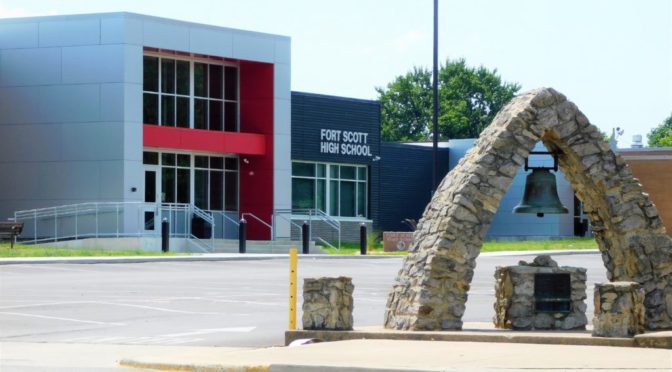
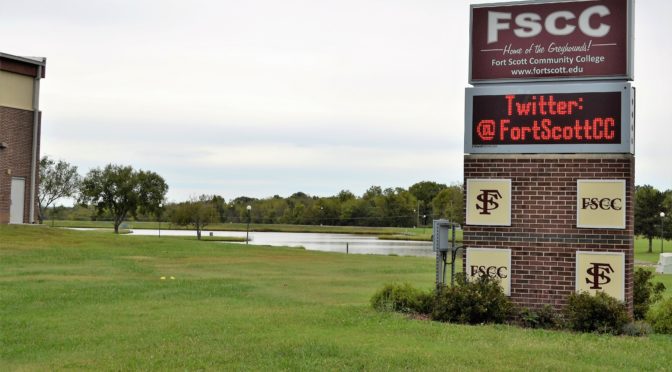
Fort Scott, KS–Fort Scott Community College is proud to CONGRATULATE our 2020 graduates! FSCC has over 382 graduates this year How amazing is that?! Unfortunately, we are unable to celebrate together. BUT we will celebrate together in December (more details to come). Our Greyhounds had to endure so much change this semester and they did an awesome job, you all should be proud of yourselves.
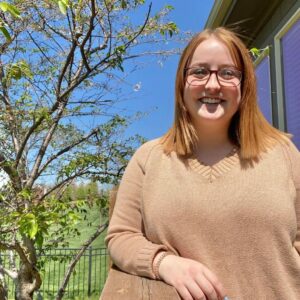
We also wanted to announce our Outstanding Sophomore is Fort Scott native, Hannah Reel! Hannah has been very active on campus through President’s Ambassadors, Christians on Campus, Phi Theta Kappa, and so much more!
Hannah’s future plans: “I plan on moving to Pittsburg, KS this fall to began my bachelors degree at Pittsburg State University. I will major in Communication with an emphasis in Communication Education certified in Secondary Education. I will eventually like to go back to school after bachelors to get my master’s degree to work at a community college as a Speech teacher. I am truly grateful for the professors and staff I was able to create a close relationship with especially through Christians on Campus, TRiO, & Ambassador Program.”
Congratulations Hannah!!
To all graduates, we look forward to seeing you in December for our big graduation celebration!! Congratulations to you all, GO GREYHOUNDS!!
For a full list of graduates and to watch the graduation video, please click below:
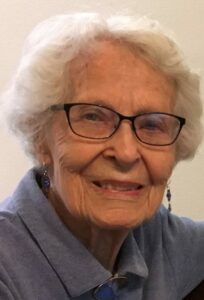
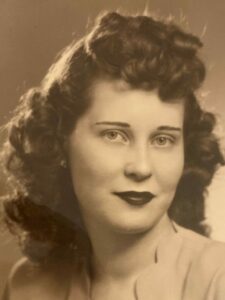
Mary Barrett Irvin, 99, of Fort Scott, formerly of Rogers, Arkansas, passed away Wednesday, May 8, 2020, at her home in Presbyterian Village. She was born in Murdock, Minnesota, on August 1, 1920 to Agnes and Earl Barrett.
She was preceded in death by her parents, six of her eight siblings, and Willis Hugh Irvin, her husband of 74 years.
Mary graduated from St. Cloud, Minnesota School of Business, moving to San Francisco to work as a secretary during the war.
There she met Hugh while his ship was in the Navy yard. They were married on June 19, 1945, before her new husband left to prepare for the invasion of Japan. After his discharge the nationwide adventure began. Mary and Hugh lived in 11 states, adding three children along the way- Roger in Florida, David in Omaha, and Barbara in New Jersey.
Mary and Hugh retired to Rogers, Arkansas, in l981 from Fairfax, Virginia. She was active as a volunteer at St. Mary’s hospital, St. Vincent De Paul church and Meals on Wheels. She belonged to Roger’s Friendship Club and enjoyed playing bridge.
Presbyterian Village in Fort Scott was home since 2013. There she was a member of Mary Queen of Angels Church.
Mary was dedicated to Hugh, her family and the many friends they made over the years as they moved across the country. Together they embraced square dancing in Texas, both making fast friends and Mary making the costumes. She pursued new places and relationships with equal interest.
Mary grew up in the difficult time of the great depression and she became strong and confident in her ability to succeed. It was hard, if not impossible, to win an argument with her.
She managed the family’s business with the organization and efficiency of a CEO—overseeing multiple moves, setting up a dozen different homes, managing the finances, helping her kids through college.
Hard work never deterred her. Mary was a problem solver who rarely failed to find a solution to issues that others didn’t know they had.
She will be remembered as a talented seamstress, furniture refinisher, decorator, painter, and lifelong volunteer to friends, relatives, and her community. She excelled at many things and wouldn’t submit to any praise.
Her presence remains in the good works she left behind.
Mary is survived by two sons, Roger (Susan) of Monroe, Oregon, and David (Janet) of Fort Scott, Kansas; a daughter, Barbara Irvin (Bruce Mayer) of Madison, Wisconsin; four grandchildren, Patrick Irvin (Jarita), Christopher Irvin (Annie Brice), both of Oregon, Kelly Irvin and Betsy Philipp (Nick), both of Kansas; and six great-grandchildren, Tyler, Henry, Jack and Shail Irvin of Oregon and Barrett and Theo Philipp of Kansas. Surviving siblings are two Barrett brothers: Gerome of Melrose, Minnesota, and Patrick (Kay) of Coon Rapids, Minnesota.
The family would like to express their appreciation to Integrity Hospice for their extraordinarily kind and attentive care of Mary over the last few months and Presbyterian Village staff for their compassionate support over many years.
Interment will be at the Fort Scott National Cemetery at a later date. In lieu of flowers, the family suggests donations to Presbyterian Village of Fort Scott Good Samaritan Fund.
Contributions may be sent to, or left in the care of the Konantz-Cheney Funeral Home, 15 W. Wall St., P.O. Box 309, Fort Scott, Kansas 66701. Condolences to the family may be submitted to the online guestbook at konantz-cheney.com.
Forty highway projects selected for IKE development pipeline
Governor Laura Kelly and Kansas Department of Transportation (KDOT) Secretary Julie Lorenz announced today that preliminary engineering work will begin on 40 highway modernization and expansion projects.
These are the first projects to move forward under the Eisenhower Transportation Legacy Program (IKE), which was created in March.
“These transportation investments come at a critical time for our state’s economy. A robust development pipeline will help jumpstart our economic recovery by creating jobs and allowing the state to take advantage of potential federal stimulus dollars,” said Governor Kelly. “I’m thankful to the Legislature for passing IKE, a critical employment tool that will help put more Kansans back to work.”
“A modern transportation system moves people, freight and technology and these 40 projects will allow us to do all those things better in every region of the state,” Secretary Lorenz said. “We’ve selected smaller projects, which can advance to construction quickly, and larger projects that will employ many people in all phases of development or construction.”
More than 2,000 Kansans participated in local consult discussions that shaped the IKE program and modernized how transportation should be delivered in Kansas. Here are a few notable features:
IKE is a rolling program, which means major highway modernization and expansion projects will be selected every two years rather than once a decade as previous programs did. This ensures the State can address the most pressing needs and adjust to fluctuating revenues.
Emphasis on right-sized, practical improvements. For example, utilizing passing lanes rather than 4-lane expressways where applicable.
New partnership programs (Cost Share, Local Bridge) between the State and local governments to address more needs.
Investments in broadband and new technologies.
Continued commitment to multimodal transportation with public transit, aviation, short-line rail and bike/pedestrian programs.
Previously, the only projects in KDOT’s development pipeline were the remaining T-WORKS projects. The development pipeline includes all the phases of work prior to construction such as design, acquiring right-of-way or moving utilities. KDOT is not committing to constructing these 40 projects, but this will allow the necessary advance work to begin.
“I’ve directed KDOT to explore all options for accelerating project delivery for these 40 projects and for the delayed T-WORKS projects, which we remain committed to constructing,” the Governor said. “Transportation investments provide short-term and long-term economic benefits to communities and we’re committed to capturing as many of those opportunities as we can.”
The 2009 American Recovery and Reinvestment Act, the last stimulus for transportation infrastructure, prioritized shovel-ready projects. Currently, discussions are underway for a new federal stimulus bill for infrastructure, which will likely have similar requirements. Today’s announcement will allow KDOT to get more projects shovel ready.
“Thanks to Governor Kelly, the Legislature and Kansans, IKE was tailor made for this moment,” Lorenz said. “It provides us the flexibility we need now and in the future. Today’s announcement is only the beginning. We know we have much more work to do.”
More information about IKE, including the list of 40 projects selected, is available at http://www.ksdot.org/IKE.asp
Kelly: COVID-19 metrics indicate progress, but caution still needed
This afternoon, Kansas Governor Laura Kelly signed Executive Order 20-32, which establishes a new phase to the “Ad Astra: Plan to Reopen Kansas.” The new “1.5” Phase, effective May 18, 2020, continues reopening efforts while preserving some data-driven restrictions necessary to prevent community transmission of COVID-19.
“The good news is that hospitalizations and COVID-related deaths continue to decline, enabling us to move forward with our efforts to safely reopen Kansas,” said Kelly. “Unfortunately, the daily rate of disease spread has not shown the downward trajectory necessary to move fully into Phase 2. I said from the beginning that public safety must remain the top priority, which means that our reopening efforts must be driven by data, not dates. Phase 1.5 will continue our transition, but with necessary caution.”
Key Phase 1.5 highlights:
Mass gatherings of more than 10 individuals continue to be prohibited;
Nail salons, barber shops, hair salons, tanning salons, tattoo parlors and other personal service businesses where close contact cannot be avoided may open, but only for pre-scheduled appointments or online check-in;
Fitness centers and health clubs may open, but in-person group classes may not occur and locker rooms must be closed except as necessary to use restroom facilities.
In-person commencement or graduation ceremonies may occur with no more than 10 individuals in a room, gymnasium, or facility at one time as long as 6-foot social distancing is maintained. Outdoor drive-through graduation ceremonies during which no more than 10 individuals are in the same area outside of their vehicles at a time (i.e. school administration, graduate, family members, etc.) are allowed.
Under Phase 1.5, the following, unless they are repurposed for use in an essential function under the Kansas Essential Function Framework, shall remain closed to the public:
Bars and night clubs, excluding already operating curbside and carryout services;
Non-tribal Casinos;
Theaters, museums, and other indoor leisure spaces (trampoline parks, arcades, etc.);
Community centers;
Outdoor and indoor large entertainment venues with capacity of 2,000 or more;
Fairs, festivals, carnivals, parades;
Swimming pools (other than backyard pools);
Organized sports facilities, sports tournaments, sports games, and sports practices; and
Summer camps.
The Governor will evaluate the state’s disease spread, testing rates, death rates, hospitalizations, ability of state and local public health authorities to contain outbreaks and conduct contact tracing, and personal protective equipment availability when determining if the state should move to the next “Phase.” Regardless of phase, the State Health Officer retains the authority to impose additional public health interventions in any area that contains an emergent and significant public health risk.
Throughout all phases, Kansans should continue to adhere to hygiene and social distancing protocols, including:
Washing hands frequently, while avoiding contact with one’s face;
Remaining home when sick or running a fever;
Following isolation and quarantine orders issued by state or local health officers;

 How amazing is that?! Unfortunately, we are unable to celebrate together. BUT we will celebrate together in December (more details to come). Our Greyhounds had to endure so much change this semester and they did an awesome job, you all should be proud of yourselves.