Tag Archives: featured

From the Bleachers: When Zero Doesn’t Mean Zero

Dr. Jack Welch

FROM THE BLEACHERS-781

BY DR. JACK WELCH

When Zero Doesn’t Mean Zero

Last weekend, the stadium thought it had witnessed the final snap. Michigan launched a desperate Hail Mary pass that fell incomplete as the game clock hit zero. The field erupted under the assumption that time had expired and Western Michigan had pulled off an incredible upset victory.

Then instant replay intervened. Officials reviewed the play and discovered that a fraction of a second still remained on the clock, even though the clock showed zero. Officials put 0.1 seconds back on the clock, giving Michigan another play and another opportunity to throw a Hail Mary.

Here lies the confusion. Stadium scoreboards do not display tenths of a second during the final countdown. They transition from one second to zero. Fans, players and coaches rely on that visual cue. When the clock shows zero, we believe the game is over.

Yet the officials had access to something the people watching the game could not see.

That got me thinking about the workplace. Leadership sometimes operates with its own invisible “tenths of a second” rules, expectations or fine-print measurements that employees do not know exist until a retroactive review happens.

What management calls a standard policy; the workforce may experience as a sudden rule change. What leadership considers obvious may not be obvious to the people expected to carry it out. Transparency is only real when everyone is reading the same clock. So how do we prevent this kind of confusion in our organizations?

Publish the hidden metrics. Leadership must make the invisible visible. Standardize what words such as done, complete, deadline and zero mean. Over-communicate system adjustments.

Create fast feedback tracks. Give employees an open channel to identify confusing guidelines and ask questions before misunderstandings become bigger problems.

This is not just a football problem. It is a leadership problem. If the scoreboard says zero, people are going to believe the game is over. If there is a tenth of a second that matters, everyone affected by the outcome needs to understand that before the final buzzer. The same is true in our organizations. If there are “tenths of a second” that matter, our people deserve to know about them before the clock reaches zero.

Thought for the Week, “Good leadership does not hide the tenths. Good leadership makes sure everyone can see the clock.” Steve Crosby, Kansas Sports Hall of Fame NFL Football Coach.

Dr. Jack Welch serves as President of Fort Scott Community College. With a career spanning professional sports, public education, and rural community development, he brings a servant-leader mindset and a passion for building trust-driven cultures that empower people to thrive in the classroom, on the field, and in life. He is also the author of Foundations of Coaching: The Total Coaching Manual.

Drought and Heat Stress Continue to Affect Trees and Shrubs

Krista Harding

Rainfall across the Southwind Extension District has been scarce for several weeks. The U.S. Drought Monitor update released on September 3 now places much of our area in a D1 Moderate Drought classification. Unfortunately, long-range forecasts indicate that drought conditions may persist for the foreseeable future. The combination of prolonged heat and limited rainfall is creating challenging conditions for both people and plants.

One group feeling the effects most acutely is newly planted trees and shrubs. When a tree is transplanted, it typically experiences a period known as transplant shock. During this time, the plant is adjusting to its new environment and establishing roots. It is not uncommon for newly planted trees to lose a significant portion of their leaves during the first growing season. This year, however, the combination of drought and extreme heat has intensified that stress, resulting in more severe leaf drop and decline than usual.

While this can be alarming for homeowners, the good news is that many trees experiencing transplant shock will recover and produce new growth the following spring. Even so, newly planted trees and shrubs will require close attention as drought conditions continue.

Watering Recommendations for Newly Planted Trees

To help young trees survive periods of drought:

  • Create a low berm around the planting area to help retain water over the root zone.
  • Water deeply once each week, applying approximately 10 gallons of water per tree.
  • For trees with a trunk diameter greater than 2 inches, apply an additional 10 gallons of water for each inch of trunk diameter.
  • Continue monitoring trees into the fall and winter months. Supplemental watering may still be necessary if dry conditions persist.

Watering Recommendations for Shrubs

Shrubs generally require less water than trees due to their smaller size. Apply enough water to thoroughly moisten the entire root ball to a depth of about 8 inches. Under drought conditions, a deep watering once per week is usually sufficient.

Caring for Established Trees

Mature trees are more drought-tolerant than newly planted trees, but they can still suffer from extended dry periods. Focus on providing deep, thorough watering rather than frequent light applications. Water should penetrate at least 10 inches into the soil.

Be sure to water beyond the drip line of the tree, where most of the absorbing roots are located. Avoid concentrating water directly at the base of the trunk, as this area contains relatively few roots that take up moisture.

A simple way to check watering depth is by inserting a screwdriver or metal rod into the soil. The tool will move easily through moist soil and stop when it reaches dry ground, allowing you to determine whether enough water has been applied.

If you have concerns about the health of a tree or shrub on your property, please do not hesitate to contact me. I am happy to answer questions and can schedule a home visit if needed.

Krista Harding is a K-State Extension Horticulture agent assigned to the Southwind District. She may be reached at kharding@ksu.edu or 620-244-3826.

K-State Research and Extension is an equal opportunity provider and employer.

Billy Webster and His Shirt Shack: 50 Years in Business


Billy Webster has owned and operated the Shirt Shack for 50 years in the same location, 11 East 18th Street, Fort Scott.

The Shirt Shack is having a sale this weekend to celebrate 50 years in business, and everyone is invited to the business milestone anniversary party.

There is a special sale inside the store today and Saturday, September 12, after the store closes, there will be a street dance.

A  band,  Shades of Blue, will be performing live, so bring lawn chairs and get ready for an evening of music and dancing!

The street in front of Shirt Shack, at 11 East 18th Street, will be blocked off with plenty of room to sit, celebrate, and hit the dance floor from 7 to 10 p.m.

Food and drinks from Cohn’s Cafe will be available for purchase, and Tiger Ice will be serving sno-cones and shaved ice.


Billy Webster began his clothing business 50 years ago, 1976,  and has no thoughts of retiring.

“In high school, I worked for a company that sold car wax at car shops. At the shows, I would see T-shirt sellers making money.”

He graduated from Fort Scott High School in 1975.

“I was 17 years old, didn’t know what I was doing and didn’t have a business plan back then.”

“I got a deal on a printing machine and got a bunch of print designs and began printing.”

“I started merchandising for bands, Aerosmith and ZZ Top, but it got too crazy…I would come back here to reset.”

The shop he began his business was at the same site where he does business today.

“it was an old beauty shop. 15 foot by 12 foot. I covered the walls with gunny sacks. I started printing new T-shirt designs. At one time, I had 400 designs.”

He has added to that original building and expanded his products.

Now he sells stylish shirts, jeans, and sportswear in addition to the T-shirts.

Cinch, Red Dirt, Ariat brands, among others.

“Fifteen years ago I went into Western Wear. We were a surf store, but nobody surfs in Kansas. There are a few cowboys here, though.”

For Webster, the best thing about being a business owner in Fort Scott: the people.

“You meet a lot of great people. When it’s your own business, you put your energy into it, and you meet great people.”

Webster has no plans to retire.

“What would I do?” he asked.

The store has four employees and is open from 10 a.m. to 6 p.m. Monday through Saturday, and can be contacted at 620.223.4680.


No Cruise Liner for This Guy by Patty LaRoche

Patty LaRoche. 2023.
Author: A Little Faith Lift…Finding Joy Beyond Rejection
www.alittlefaithlift.com
AWSA (Advanced Writers & Speakers Assoc.)

Jonah runs. God gives him clear direction to speak to the evil Ninevites and turn them to Him instead of the idols they worship. Sounds relatively easy, only this prophet hates the Ninevites and does not want them to repent and change the way they are living. So, Jonah runs 180 degrees in the opposite direction. What Jonah does not know is that if you want to run from God, Satan will always give you a ride. God’s request is a 500-mile trip; Satan’s is 2500 miles. Better than doing something nice for my enemies, Jonah tells himself. Jonah jumps aboard a cargo ship to Tarshish, forgetting that God directs everything, including the weather. His voyage triggers a violent storm at sea, and the sailors, recognizing Jonah as the cause, reluctantly throw him overboard to calm the waters.

Enter the whale, the whale’s belly to be exact, where Jonah finds himself. Get that? Jonah prays to be rescued all right, but he is thinking more like a dinghy or a life jacket or a Carnival cruise liner to pick him up. Instead, God gives him a fish. The slip-and-slide ride down the fish’s throat has to be terrifying, but that’s not the end of the story. Jonah is helpless but not hopeless. Jonah’s problem is God’s provision. Three days he slushes around amidst dead fish and sea algae, ultimately praying and repenting. I love how God waits to move. At the right time, three days after Jonah nose-dives into the fish’s belly, God does His thing. (If “three days” rings a bell, it should. Jonah serves as a foreshadowing for Jesus himself.)

God commands the fish to release Jonah onto dry land, and the prophet heads to Nineveh where he proclaims God’s warning of impending judgment. The people listen and repent, making Jonah do the happy-dance to see God’s mercy first-hand.

Not! Jonah is one cranky character. After all, he deserves God’s mercy because he’s such a holy man, but these Ninevites? They represent your worst enemy on steroids. The pouting prophet retreats to a hillside outside of Nineveh and constructs a simple shelter to observe the city. From there, he says that it would be better to die than to witness what God is doing for his enemies. Human resentment versus divine compassion at its finest.

Some people just don’t get it.

Sure glad I don’t ever fall into that category.

4-State Insurance Agency Opens in Downtown Fort Scott

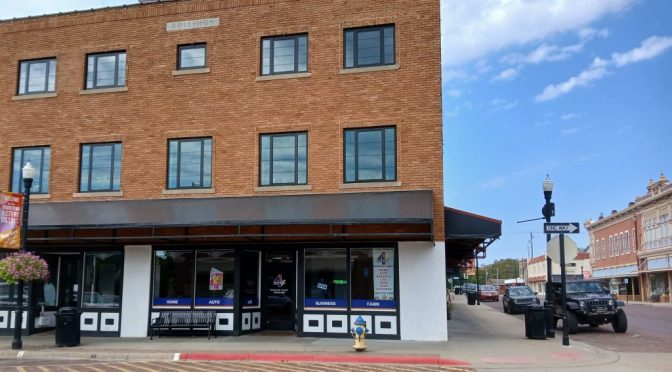
4-State Insurance Agency opened the Fort Scott office on August 19, 2026.

A new insurance agency has opened a store front in historic downtown Fort Scott.

Leah Smith is the owner of the 4 State Insurance Agency, Lisa Schossow is the Senior Agent who oversees the Farm and Ranch Division; Dan Shireman is the Agency Development Director; and Josie King is the Farm and Ranch Service Advisor. All were born and raised in the Girard area.

Smith has an office in Overland Park, which opened about 15 years ago, and she opened an office in her hometown of Girard eight years ago.

The agency opened shop at the corner of Wall and Main Street on August 19.

Josie King, left, is a farm and ranch service agent, Lisa Schossow is the senior farm and ranch agent.


“We thought Fort Scott would be a perfect location between Overland Park and Girard. Leah has always wanted to open another office here it was just waiting for the right timing,” said Schossow. “We found the perfect office location in downtown Fort Scott and are excited to be a part of the happening downtown area. We can’t wait to be involved in community events and support all the area local businesses.”

The 4 State Insurance Agency currently has Sales Advisors, one Commercial Insurance Advisor, three Service Advisors, and a Claims Advisor on staff. “We are looking to hire four full-time people in this office,” Schossow said. “Right now, we are rotating staff from the Girard office.”

“We will be hiring insurance advisors as well as customer service representatives. They will need to hold an insurance license; if they aren’t currently licensed, we will provide resources to pass the tests needed and ongoing training to make sure each advisor is successful.”

The agency provides insurance in the following areas: home, auto, business, crop, livestock, and farm insurance.

“We have a brokerage arm, which gives our team the ability to not only quote through Farmers Insurance, but partner with a variety of insurance carriers to get our clients the best coverage for the right price,” Schossow said. “We also have a team of licensed crop insurance agents in our Farm & Ranch Division who can provide area farmers with Federal crop insurance, Livestock Risk Protection, and insure their farm operation.”

Hours of operation: 8 a.m. to 5 p.m. Monday through Friday and weekends by appointment.

For more information, contact 620.670.4590, visit us on Facebook


USD 235 Preschool Building: Upgrade For the District


A sign in the preschool.

The new USD 235 Preschool building, at the southeast corner of the West Bourbon Elementary School in Uniontown, is 99 percent complete, said Superintendent Vance Eden.

The school held an open house on Labor Day, alongside the Dale Jackson Memorial Car Show, in the small town of almost 300 people.  The town celebrated its annual Old Settlers Picnic.


The new preschool serves 32 three-year-old and four-year-old students and is free, regardless of income. Up to 20 students are allowed in each age group.


A view of the new USD 235 preschool classroom.

The preschool is funded through the Kansas Preschool-Aged At-Risk Program.

The new building includes a large classroom, a child-sized bathroom, and a food preparation area, along with two offices.

The oversized preschool classroom for 3 and 4-year-old students.

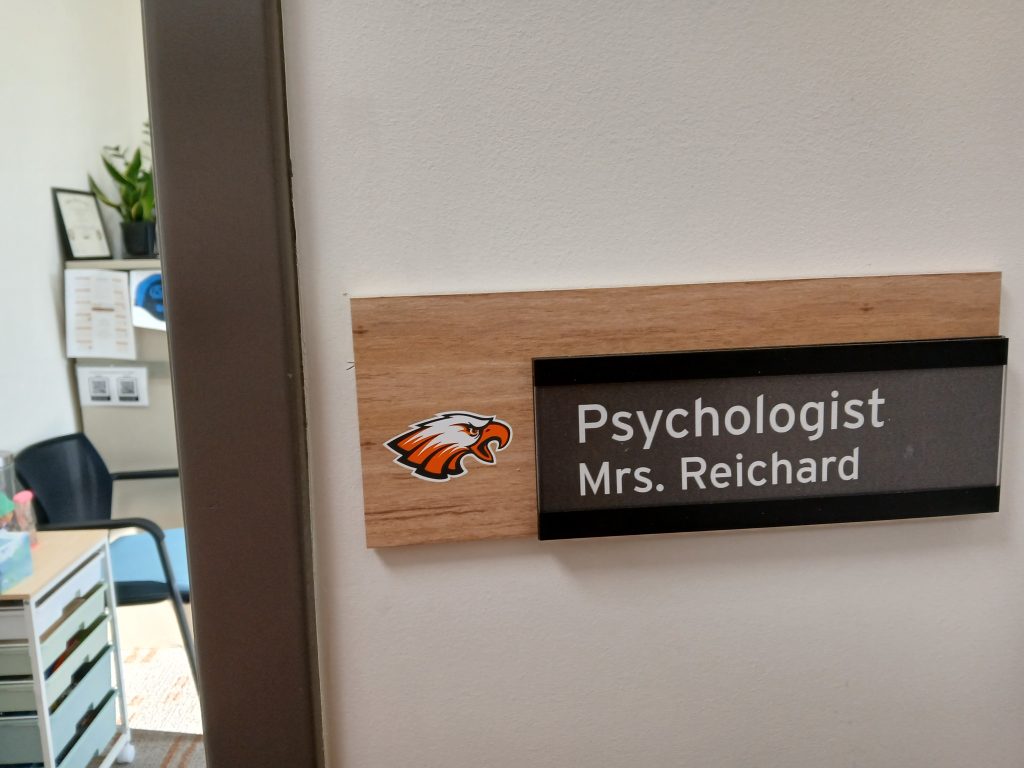
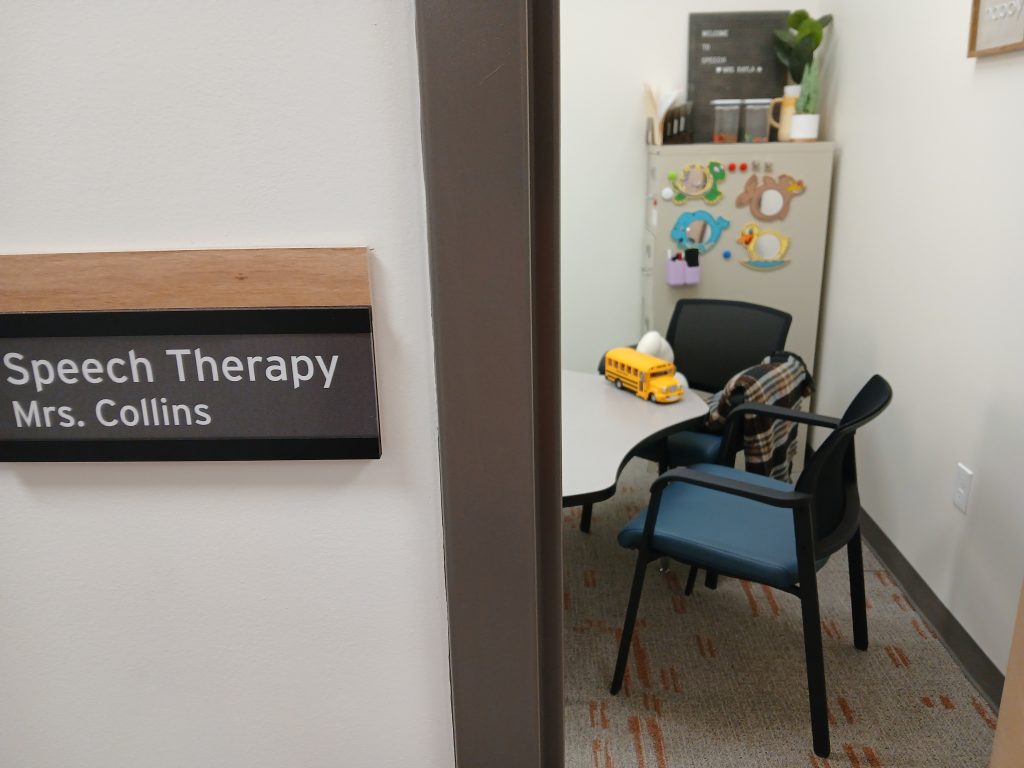
The school Psychologist Shelby Reichard, and Speech Therapist Kayla Collins also have dedicated office space in the new building.

The preschool building also houses the school psychologist’s office, Mrs. Reichard.
The preschool also houses an office for the speech therapist, Mrs. Collins.


The building was made possible through a successful bond election in March 2025 in the school district, and it replaces an old modular unit.


Old Settlers Picnic 2026

Old Settlers Picnic’s annual culmination is the Labor Day parade.

This year, the theme was Family, Friends, and Community, with Becky Shinn as the grand marshal, leading the parade.

Grand Marshal Becky Shinn (in wide brimmed hat) had a float of family and friends in the parade. Here they wait for the parade to begin at the Uniontown Fire Department building.


Following are glimpses of the day in Uniontown.

The annual Dale Jackson Memorial Car Show was held at the West Bourbon Elementary School parking lot, starting at 9 a.m.  , with awards announced at 1 p.m.

Vendors and the USD 235 Preschool Open House were also happening at the car show.

In the downtown area, vendors were busy with onlookers.

Vendors line the square in Uniontown.
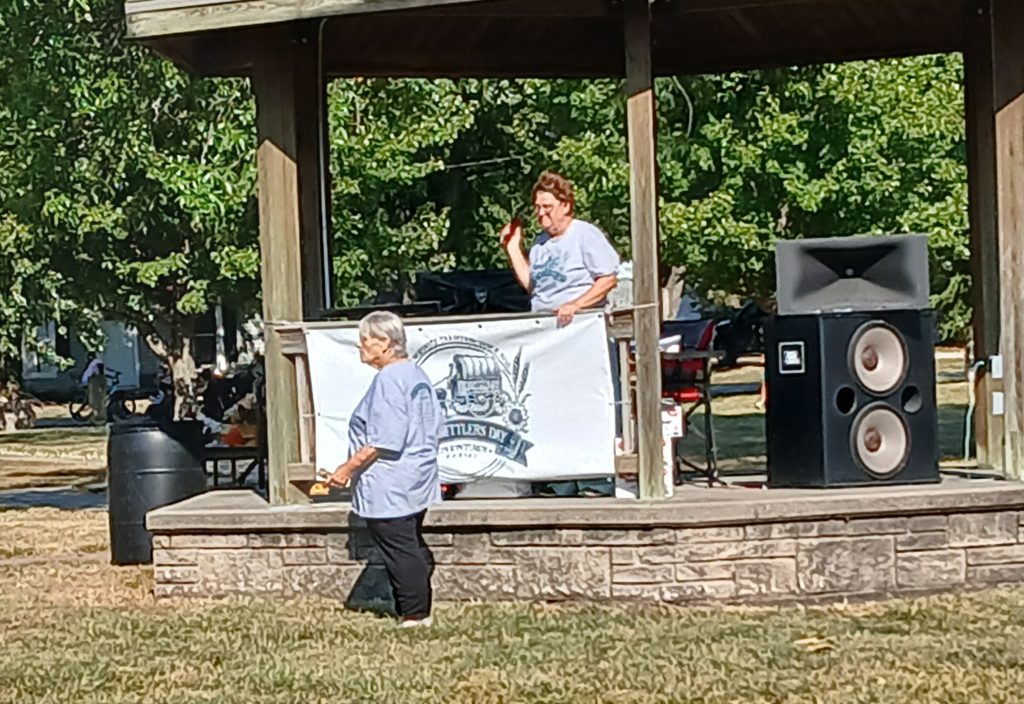
Old Setters Picnic planning committee members Mary Pillion and Rhonda Dewitt give instructions from the gazebo on the square in Uniontown.

The children’s parade started at 10:30 a.m., followed by the parade at 11 a.m.

Children wait in the shade of the fire station for the children’s parade to begin.
Bicyclists are the front line of the children’s parade.
Bourbon County Sheriff’s Officers lead the way in the parade.
Scouts from Iola were the color guard.
Grand Marshal Becky Shinn points to a crowd member from her float of family and friends.


Following the parade were a picnic, recognition of old settlers, kids races, street games and the drawings for prizes.

Other highlights of the weekend were a fishing derby, rodeos, a 5k run/walk, bingo and family fun night in the park.

The weekend events were planned by Mary Pillion, Rhonda Dewitt and Mike Ramsey.


Bourbon County Commission orders courthouse asbestos inspection; elevator project can’t begin without it

FORT SCOTT — Bourbon County commissioners voted at a special meeting Wednesday evening to hire an environmental firm to inspect the courthouse for asbestos, two days after competing proposals to test the building failed to produce an authorization.

What changed in between was the commission’s understanding of a federal rule. Commissioner David Beerbower, who asked for the meeting, said research he did after Monday’s meeting showed the county cannot begin its planned elevator modernization — or any wall removal or demolition in the courthouse — until an asbestos inspection is done.

“So before we can even begin with this, we need to have these inspections done,” Beerbower said (video, 6:06).

Four of the five commissioners took part in the 5 p.m. meeting: Chairman Gregg Motley (District 4), Beerbower (District 2), Joe Allen (District 3) and Mika Milburn-Kee (District 5). Commissioner Samuel Tran of District 1 was not present. The amended agenda the county circulated that afternoon listed the asbestos item under Motley’s name; the commission’s first vote of the night moved it to Beerbower’s, because the meeting was his request.

What the commission approved

Milburn-Kee moved that Motley contact Apex Environmental and arrange the scope of work the county needs — the elevator, a walkthrough of the third floor, the pipe insulation, air-quality testing, and whatever else the firm judges is required or recommends (video, 19:13).

Motley seconded, but with an amendment: rather than run the testing himself, he wanted one commissioner coordinating all of it — the testing firm, elevator contractor Otis, and the remodeling work — and proposed Beerbower. “I think we need one person in charge of this whole process,” he said (video, 19:41). “I would gladly help Commissioner Beerbower, but I think it just needs to be coordinated.” Milburn-Kee amended her own motion to match.

The commission then added a not-to-exceed cap of $5,000, after Beerbower pointed out that Apex’s quote covered three hours of work with no stated rate for anything beyond that. “We’re right where we were Monday night, when we didn’t know additional cost,” he said.

The motion carried on a voice vote with no opposition heard. Motley announced the result as “5-0,” though four commissioners were present (video, 26:38).

Milburn-Kee said she was referred to Apex by a superintendent at construction firm J.E. Dunn who she said had verified, first-hand experience of the firm’s work. A representative quoted her roughly $1,800 for travel and three hours of work, plus $35 per sample tested, and said the firm could fit the county in within about two weeks. An elevator mechanic would have to be on site to shut the shaft down so it can be inspected.

She stressed that Apex tests and inspects but does not do remediation. “They’re not coming in to test something and turn around and sell us the work to fix it,” she said. “I know that was a worry” (video, 16:45).

“We need to lean on and rely on the experts in this situation,” Milburn-Kee said. “If we hire people who know this work and understand the requirements, we can make decisions based on facts, testing, and documentation, and professional recommendations, not just what we think we need to happen” (video, 17:30).

Milburn-Kee had made the legal point herself, before Beerbower’s research came up in discussion. “The biggest point I want us all to understand is that testing of the elevator is required by law before the work can move forward,” she said. “This is something that Apex brought to my attention” (video, 16:08).

The rule that stopped the elevator project

Beerbower said both federal and state rules require an asbestos inspection, but only when it is triggered by renovation, alteration or demolition — a building in routine operation needs none. The federal standard, he said, is the Environmental Protection Agency’s National Emission Standards for Hazardous Air Pollutants, which he said requires an owner to thoroughly inspect an affected facility before any renovation, elevator modernization, wall removal or demolition begins. Kansas enforces it under authority delegated by the EPA, he said.

That, he told the commission, is what rules out doing the job in pieces.

Motley said it changed his position. “So I think what’s changed for me is Mr. Beerbower pointing out that we simply can’t start, we can’t do it incrementally,” he said. “We can’t start the elevator project without a full inspection of the courthouse” (video, 17:52). On Monday, Motley had argued for testing the known material in the basement first and deciding about the rest of the building afterward.

Beerbower also said the county is obliged to notify Otis that asbestos is suspected in the building — a suspicion is enough, he said, and a positive test is not required — and that doing so may send the elevator work back for a new bid.

He described what the construction would do to the building. “When you start the construction of the elevator, when you start that modernization, the elevator shaft acts like a chimney, and it’s going to suck air from the bottom, and air is going to go through the top,” he said (video, 11:08). Crews would have to “basically bubble in” the first floor on each side of the elevator, he said. He also said the county would have to run air-quality monitors that people entering the courthouse can walk up to and read for themselves, and raised remote work and shortened work weeks as options for courthouse staff while the work runs.

What removal would cost, if any is needed, is still an open question. Beerbower said mitigating the whole building would run somewhere between $50,000 and $250,000 — “that is the light side of it” — and that extensive building-wide mitigation can exceed $500,000 (video, 4:29).

No regulator, contractor or environmental firm was at the meeting. The commission acted on Beerbower’s account of his own research and Milburn-Kee’s account of a phone call she made to Apex about an hour beforehand. Nothing in the building has yet been sampled or tested.

Allen: eight spots in the basement

Allen said he had come in early Wednesday and gone through the basement himself. “I saw eight spots that I think need to be checked on the old side of the building,” he said (video, 9:39). He said the elevator is on the annex side, which he said was built in 1971, and asked how work there bears on material elsewhere in the building. He also noted that a wall has already been built downstairs around pipes on the annex side, and that the wrapping there does not look like the wrapping in the older part.

Beerbower’s answer was the chimney effect — and the pipes. The wrapped pipe in the basement was most likely a boiler pipe, he said, and anywhere that same pipe and the same wrapping is exposed elsewhere in the building would have to be inspected too. Allen noted that some pipes in the basement have been stripped or painted over at some point. Beerbower said that does not settle anything: if the work was not done by a qualified contractor, the material may still be a risk, and it is the inspection team’s job to say.

Whether to put it out for bid

The commissioners also disagreed over process. Beerbower questioned hiring Apex without competitive bids.

“I don’t know Apex Environmental any more than I know the company that you were talking about, and I know there’s other companies out there,” he said. “So, I mean, if we’re going to go this route, I mean, shouldn’t we do a bid process?” (video, 22:15)

Motley said he was hesitant about bidding because of the timing. Milburn-Kee said she was “really not particular,” but that going out to bid would be a lengthy process and she did not want to push the courts back further. Allen said he had made the same point Monday: the commission needed to move.

Beerbower gave way. “If you guys are okay with this company, I’m okay with this company,” he said. Motley replied that he was inclined to vote for the motion because of timing, and added that a bidding process “would, I’m sure, kind of drive you nuts.”

“It would, yeah,” Beerbower said. “Because that’s how government’s supposed to work” (video, 24:50).

Milburn-Kee agreed that spelling out what the county wants and putting it out to bid would be ideal — and said the county had passed the point where that was practical.

“But we’ve already scheduled the elevator rebuild. We’ve already moved the courts,” she said. “We put the cart before the horse here” (video, 24:57).

Beerbower kept pressing on cost after that. He asked whether Otis would have to send people to the courthouse on the day of the inspection, and what that would cost: “Otis isn’t going to come down here for free.” Milburn-Kee answered that the county already has a service agreement with the company. “They are our service company for the elevator,” she said (video, 26:20).

The court move may get bigger

The commission voted last month to move district court to the county-owned building at 108 W. Second St. while the elevator is out of service, and to close the courthouse’s second and third floors to the public from Oct. 21 through Nov. 20. Under the plan as it stood, only part of the court’s operation was to move.

Beerbower said Wednesday that may no longer be enough, and that moving the county attorney and the courts across the street entirely may be the better and safer course. That pushes the timeline, he said, because 108 W. Second cannot be made ready that fast — and because the building may need an asbestos inspection of its own. Tran, who Beerbower said has a background in this kind of inspection, flagged a couple of items there as suspicious when commissioners walked through it.

Beerbower said he asked for a special meeting rather than waiting because the commission’s next regular meeting, Sept. 14, was too close to the construction timeline.

Background: the June walkthrough

As FortScott.biz reported in June, asbestos in the courthouse — a 1930s building at 210 S. National Ave. — came before the county after a former maintenance director circulated photographs of deteriorating pipe insulation in the basement. He said he was fired the day after asking in writing to have the material tested; county officials declined to comment on his departure at the time, and the county cited his probationary, at-will status in ending his employment.

A Kansas Department of Health and Environment representative walked the building afterward. The preliminary finding, relayed then by Bourbon County Emergency Manager Lou Howard, was that nothing looked hazardous. It carried a caveat that has now become the whole question. The walkthrough was visual and no samples were taken, and Howard said the representative told her it would be a different matter “if there was active construction going on at the time.”

Construction is now scheduled.

Also Wednesday

The commission held two closed sessions on the salary of a non-elected employee, both under K.S.A. 75-4319(b)(1). Deputy County Clerk Michael Hoyt joined the first, along with the county’s HR consultant, Dr. Cohen, by phone; the commission returned from it with no action.

After the second session it voted to authorize a salary change, in effect until the new county clerk is sworn in and approved by the governor, at which point it can be revisited. That vote was not unanimous with Milburn-Kee voting against it (video, 52:14). At Milburn-Kee’s reminder, the commission also directed the chairman to complete the payroll change form the change requires.

Related coverage: State walkthrough finds no immediate asbestos hazard at Bourbon County Courthouse, Bourbon County Commission enacts two-week burn ban, clears disputed Aug. 17 minutes, Commission chooses 108 W. Second for court during elevator outage, Courthouse elevator shutdown set for Oct. 21–Nov. 20.

Broken and Worthless Branches by Carolyn Tucker

Keys to the Kingdom

By Carolyn Tucker

Broken and Worthless Branches

I have several mature trees on my place and, after a windstorm in the night, I will usually  see broken tree branches and dead sticks littering the yard. Sometimes the branches do not break clean, so they’re just hanging on by the skin of their teeth. These damaged branches will initially look alright, but after a few days the leaves begin to die and turn brown and crispy. What an ugly mess! These once-healthy branches didn’t have the strength to hang on to the tree, so now they’re nonproductive and worthless and must be hauled off to the burn pile. These branches are simply good for nothing.

God told Moses “I AM”, and Jesus told His disciples “I am…” John the Beloved recorded Christ’s words: “I am the true vine, and my Father is the vinedresser. Every branch in Me that does not bear fruit He takes away, and every branch that does not bear fruit He prunes, that it may bear more fruit. Already you are clean because of the word that I have spoken to you. Abide in Me and I in you. As the branch cannot bear fruit by itself, unless it abides in the vine, neither can you, unless you abide in Me. I am the vine; you are the branches (John 15:1-4 ESV). The Bible is the believer’s owner’s manual for our life that sometimes goes in one ear and out the other – or is flat-out neglected. Jesus teaches how we are to live so we need to heed His words in order to live right.

The biblical definition for abide is: to remain, continually dwell, or walk daily in a close, enduring, personal relationship with Christ Jesus. Disciples of Jesus are to abide in Christ,  develop a healthy, fruitful life, represent Him well, and bring glory to His Name.

I have two godly women in my life and both have one small tattoo. One tat simply reads “Abide” and the other is “Faith” – both of these gals are serious about constantly abiding in Christ and following His Word. All believers must somehow remind ourselves about staying connected to the Vine in order to bear lots of fruit. We’re to live abundantly in life-union with Jesus. He said, “I am the way, the truth, and the life. No one can come to the Father except through Me” (John 14:6 NLT). No one can truly live the way God intended for us until we surrender to Jesus and choose to abide in Him. Make the critical decision to stick with Jesus so you’ll bear fruit. Otherwise, you’re on your own and the definition of that is FAIL.

Whoever abides in Me and I in him, he it is that bears much fruit, for apart from Me you can do nothing” (John 15:5 ESV). This is a sobering scripture. We must live every day of our lives in Christ – attached at the hip, heart, and mind. Without His empowerment and wisdom we can do nothing spiritually for the Kingdom of God. Man, I don’t want to stand before God with an empty fruit basket — how embarrassing and needless!

“If anyone does not abide in Me, he is thrown away like a branch and withers; and the branches are gathered, thrown into the fire, and burned” (John 15:6 ESV). I don’t want to be fruitless for the devil, I want to be judged fruitful for the Lord when I cross the Jordan River at the end of my journey.

The Key: If you don’t want to be broken and worthless, abide, abide, abide in Christ Jesus.

When Great Thought Is Not Enough by Patty LaRoche

Patty LaRoche

By Patty LaRoche

Dave and I thought we had thought this “moving thing” through. We would pack most of our belongings into storage for a few weeks, but some items we would need until we could move into the house we were renovating. The plan was to live in the basement of the house we bought until the upstairs was ready to be inhabited, so great thought went into what we would need temporarily. We made mistakes. Clearly, “great thought” was not enough.

For example, we kept back the portable vacuum cleaner…but not its battery charger. Same with the leaf blower. They both lost their power within the first week we were here. We failed to keep the coffee pot and toaster and so breakfasted on frozen Jimmy Dean sandwiches. (The house came with a microwave.)

And yes, I know, these are not big problems. There is, however, one area in which thinking things through can have eternal implications. This is fresh in my mind because I focused my Bible reading this morning on Matthew 7 where Jesus speaks to his disciples about who will make it to Heaven and who won’t. One of the most convicting, disturbing, thought-provoking passages of scripture is found in Jesus’ words: “Not everyone who says to me, ‘Lord, Lord,’ shall enter the kingdom of heaven, but he who does the will of my Father in heaven. Many will say to me on that day, ‘Lord, Lord, have we not prophesied in your name, cast out demons in your name, and done many wonders in your name?” And then I will declare to them, ‘I never knew you, depart from Me, you who practice lawlessness.”

Think about it. God will judge what’s going on inside us. If that doesn’t shake you up, you’re pretty unshakeable.

I don’t know about you, but I can’t brag about prophesying or casting out demons or doing “wonders” in Jesus’ name. I haven’t led hundreds to the Lord. I haven’t even prayed faithfully or read my Bible every day. I’ve spent weeks trying to memorize Psalm 91 (a prayer for my family members) and still stumble at verse nine.

The fact that I go to church, write this article, speak to Christian audiences, am in a Bible study and don’t cuss will not be enough. My thought life needs to be melded to God’s heart. I need to know His will and do His will…and that requires thoughts that lead me to love the unlovely and not judge, to mourn over my sins and be a peacemaker, to do nothing for others’ approval and not let the sun go down on my anger. Thoughts that cause me to do good works will be the evidence of a relationship with Christ, not the basis for it. No matter what my circumstances are, I need to trust that God is in charge and I’m not. In secret, I need to honor Him, yield to Him, obey Him, and “think these things through.”

Giving God his rightful due is a critical “thought” that demands I do just that.

Re: freshed Salon and Spa Expands and Moves Shop


{Re Freshed} Salon and Spa has a new, expanded building at 102 S. Judson.


Business owner and aesthetician Delane Godden has moved to a new location, 102 S.Judson, and is open for business as of September 1.


“We have grown significantly and needed a bigger space,” Godden said.
The building has 3,500 square feet of space.


The building, at 102 S. Judson, was at one time Fort Scott Family Physicians, then Reynold Law Firm, she said.

In addition to the five technicians already at {Re:freshed} Salon & Spa , she has added another aesthetician to her team, Meghan Owenby, who will specialize in headspa services and facials as well.

Godden started her aesthetician business in the Lyons Mansions, then moved to the Five Corners Strip Mall, just off of Highway 69 in 2016.

Delane Godden with eight month old son, Jagger.

Julie Daly has been a provider of massage therapy and nail/pedicure technician services at the salon/spa for nine years. She can be reached at 620.215.3436

Kayla Greenway has provided manicures/pedicures, eyelash services and spray tans for eight years at the spa, contact her at  620.363.0195

Bailey Hall has been a hairstylist for six years there; contact:  620.215.0107

Owenby recently started as a second aesthetician; contact: 620-215-6987


Dr. Saeid from Kansas City has been providing injectable cosmetic services on weekends at the spa for about one year, and has 20 years of experience in aesthetics. Contact “In Town Aesthetics by MD”  at 913-602-6265

Cali Emerson is a hairstylist specializing in hair extensions and is also a receptionist, and has been with Re: freshed Spa for a few months.

Heather Jackson has been a receptionist for two years.

Godden can be contacted at 620.215.269

The spa is open Monday and Friday from 10 a.m. to 5 p.m., and Tuesday, Wednesday, and Thursday from 10 a.m. to 6 p.m.

Saturday hours are undetermined at this time.


Godden has created a brand of skin care products that is comprised of plant-based ingredients including perfumes and hand sanitizers, and facial products.

“We also have a line of laundry detergent, multi-purpose cleaning spray, hand soaps and room and linen sprays, as well as Bathhouse Trading Co. products and several skincare and body care line options as well,” she said.

One of a kind greeting cards are for sale by Laura Garzone and Cindi Lipe.


Other retail items include hair clips/scrunchies, belt bags, and insulated tumblers etc.

Services provided


Massages starting at $55


Hair cuts starting at $20


Facials starting at $75


Spray tans-$35


Make-up sessions: $40


Manicures starting at $30, pedicures at $50.


Waxing starting at $5

Brow tint and shape: $20

History of the Discussions on County Commission Minutes

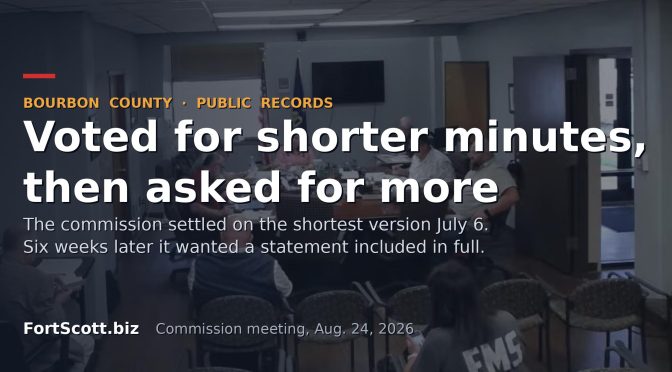
The Bourbon County Commission meets Monday, and one of the first items is a set of minutes it already sent back — the Aug. 17 minutes, tabled on Aug. 24 after Commissioner Mika Milburn-Kee said they needed “extensive revision.”

That is not unusual. The commission has sent minutes back over the past ten months, and not always for the same reason. Members have never agreed among themselves on what the minutes are supposed to be.

The county has used AI software to help produce its minutes since at least the fall of 2025. The current program, HeyGov, was demonstrated to the commission in January 2026 by then-Clerk Susan Walker. It offered three levels of detail, she said then — “a simple level, a medium level and a detailed level.”

Acting County Clerk Michael Hoyt described the current process: after a meeting is uploaded to the county’s YouTube channel, the video is downloaded as a file and run through a program called HeyGov, which transcribes the meeting and matches what was said to each item on the agenda. Hoyt then proofs the draft against his own notes.

“All I have to do is go through and proof to my notes — you know, who made the motion,” he said. “Even sitting there as close as I am, you sometimes don’t hear who seconded, or if two second at once, who wants to take credit for it.”

The draft then goes into the agenda packet for the next meeting. The commission either approves it, or gives corrections and approves it later. Once signed, it is the official record.

Hoyt said he checks requested corrections against the video before making them, because “I’m the keeper of the records. Even though it’s their meeting and it’s their minutes, they still can’t make things up after the fact.”

The method is not new. In October 2025, Walker described nearly the same pipeline with different software. “I take what’s on YouTube and I take that link and push it into this software,” she told the commission. “And then it can produce a full transcript, but it was 145 pages long.”

The alternative is doing it by hand. Walker said a full-length meeting took her office about eight hours, “because you have to sit up there and listen to everything and then try and figure out who the speaker is.”

The commissioners’ requests have not pointed the same direction.

At the Oct. 20, 2025 meeting, with the commission ten sets of minutes behind, then-Chairman David Beerbower read out his view of what belongs in them, and argued against detail.

“They are official, they are permanent, they are legal record,” Beerbower said. “They are distinct from a full transcript, though. Details that should be in there is motions and resolutions, voting outcomes, summary of discussions — but it is not a direct quote.”

A week after Beerbower’s speech, Chairman Samuel Tran asked for more — and what happened to that request is instructive.

The minutes he objected to covered an Oct. 22 special meeting on the county’s decision to move payroll out of the clerk’s office. Walker had read a prepared statement, and the minutes record its sharpest line: “The decision to remove payroll responsibilities from the clerk’s office was portrayed as a cost savings, improved processes. I must say plainly that it was not an operational improvement, it was a political move.”

The minutes give Walker five bullet points, ending with that accusation. They give the commissioners five, all procedural — reach out to the vendor, get everyone to the next meeting, discuss the timeline, review the noise ordinance, “Commissioner Beerbower will contact legal counsel.” Nothing the commissioners said in reply appears.

They said a good deal. Tran answered at length: “In everything I’ve ever done in my life you either help or you hinder — if we have a problem, come to the table with the solution or a possible solution, not hindrance.” And: “We’re sitting here, I’m listening to a speech that does not paint us well in a public forum. We are elected by them. We are their voice. And I apologize for being terse, but I’m very frustrated.”

Tran did not dispute Walker’s cost figures or her account of how the decision was made; his objection was to the speech being delivered in public. The closest thing to an answer on the substance came from Beerbower: “And that’s a decision that we made at the time. And I’m going to stick with that.”

At the Oct. 27 meeting, Tran asked for those replies to be added, but the version the commission went ahead and signed on Dec. 1, 2025 appears to have been unchanged.

By June 2026 the software was producing longer minutes, and Tran objected to how they read. At the June 15 meeting, citing the May 11 minutes, he singled out phrases like “attempted to,” “push back gently” and “echo this point forcefully.”

“Minutes should be very bland. It should not have narratives in it,” Tran said. “I think we need to go back to just reporting what people say and leave it alone and not paint certain commissioners in a bad light.” He said the concern was not about any one commissioner.

The June exchange showed some differing opinions about what the commissioners think they can ask for.

Walker responded to Tran by explaining that the software produces long, medium and short versions, and that she had already changed which one she used.

“Before, I was being ridiculed for not doing enough, and so I went to the long version,” Walker said. “And now I’m being told the long version is [wrong], so now I need to go back to the medium version or the short version?”

Tran declined to say which he wanted.

“I’m not telling you anything, Madam Clerk. I’m not telling you anything. You’re an elected official. You do your job the way you see fit,” he said. “I’m just saying the final product does not meet my expectation of what minutes should be.”

On July 6, Beerbower put the question on the agenda to settle it: pick one of the three versions and move on.

He argued for the shortest, because “it provides just what is necessary by law to have.” Minutes “shouldn’t be about what you say,” he said, “it should be about what was done in the meeting.” Motley agreed: “My vote would be the short version.” Joe Allen said he had no preference, noting school boards “keep a shorter minute.”

Milburn-Kee’s answer was again about accuracy rather than length. “I’m happy with whichever one you want, Mr. Beerbower. I will read and correct whatever I need to do,” she said. “If they don’t send them to me with mistakes, I won’t have to make any corrections.”

County Counselor Bob Johnson gave the legal standard. “You shouldn’t have editorialized minutes,” he said. “It should be a concise description and summary of what was done. And I think that’s the law.” He added that the county’s minutes run “generally three times longer” than those of other boards he works with.

Tran said length had never been his concern. “That’s all I’m asking for, whether we vote on the long, the medium, or the short version,” he said. “To me, it’s always been one adjective in there changes the narrative.”

Then Tran made the motion: “So I move that we approve the short minute version of our minutes.” Motley seconded. The minutes of that meeting record that it carried unanimously.

Six weeks later, Tran asked for something the short version does not produce. At the Aug. 17 meeting, reviewing minutes that condensed Walker’s resignation statement, Tran said the full text should be in the record.

“I think it would be a disservice to the county if we did not include the whole verbiage of that resignation statement,” he said. Asked by Beerbower whether the letter would already be in county records anyway, Tran said the minutes are what people actually go to: “Very few people go back through and look at the actual documents.”

The commission agreed. Walker’s full three-page statement was attached to the Aug. 10 minutes, which were approved Aug. 24.

Running alongside the disagreement over length is a separate one about accuracy, and that request has been the same throughout.

Walker told the commission in June why speakers get mixed up: “It doesn’t pick up your voices because you don’t announce when you’re talking, and so therefore sometimes it might get Beerbower and Allen mixed up.” She added, “Oftentimes it says Mrs. Milburn is a man.”

Milburn-Kee has raised the same point at least three times. In October 2025 she asked that “great attention be paid before they’re sent to us in the first place.” A week later: “It’s important for me not to have extra things that are untrue in there, mainly.” On Aug. 24 she said it again: “Please, please make sure the right speaker is notated in there before sending it out as the minutes. I think I’m the only one bringing back edits for that.”

The commission takes up the Aug. 17 minutes again Monday, with corrections, and will review the Aug. 24 minutes.

Hoyt is doing the work alone. He said he is the only person in the clerk’s office, “replacing three people and doing it all.” He is seeking appointment as county clerk at the Bourbon County Republican convention on Sept. 1.