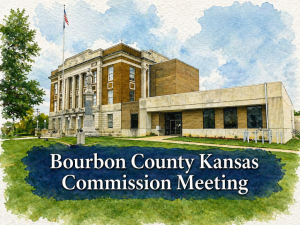
Tag Archives: featured

Cases similar to the charges against Commissioner Mika Milburn-Kee

Similarities and differences in prior Kansas polling-place prosecutions and the current Bourbon County case.

The charges against Commissioner Milburn-Kee

On March 24, 2026, the Kansas Attorney General’s office filed a two-count misdemeanor complaint against Bourbon County Commissioner Mika Milburn-Kee. Count One is a general charge for interfering with public business in a public building. Count Two,  what is looked at in this article, charges her under K.S.A. 25-2413(c), the polling-place “three-foot rule”: a Class B misdemeanor to come within three feet of a voting booth or an election-board table unless you are there to vote or the supervising judge lets you. The law is associated with K.S.A. 25-2432, which says a public official who is convicted of an election crime loses their office (25-2413; 25-2432).

What is alleged

A prior FortScott.biz summary of the security-camera video describes the commission meeting room being used during early voting to validate voters and handle provisional ballots. On October 25, 2025, Milburn-Kee is shown sitting at the commission table near a stack of what election officials said were unverified provisional ballots, reading a newspaper, and waving and greeting a voter through the open doorway. County Clerk Susan Walker is shown twice telling her she cannot be in the polling-area rooms; on the second try, Walker offered to help move her things and said she would call the police if required. Milburn-Kee moved to an adjoining office about twelve minutes after first being told to leave.

The closest Kansas comparison: Blubaugh

In October 2024, Meghan Blubaugh — the wife of a newly elected Sedgwick County commissioner — wore a T-shirt with her husband’s campaign name on it to an early-voting site in southwest Wichita. Poll workers asked her to turn it inside out, and she refused. The county Election Commissioner then came to the site in person and asked her again, and she refused a second time. Poll workers called the Secretary of State’s office, and Blubaugh was charged under K.S.A. 25-2430 (electioneering), a Class A misdemeanor. In January 2025, the case was resolved by diversion, with about $160 in court costs and completion of a county election-worker training. Diversion is not a conviction, but does usually require one to admit fault. If she finishes the program, the case is dismissed with nothing on the record.

This seems to be about the closest match to an election-related case in Kansas. The original polling-place misdemeanor filing, a politically connected defendant, and an alleged refusal to follow an election official’s on-site instruction. The result was Blubaugh choosing to admit guilt and take a diversion rather than fight the charge.

But there are differences. Blubaugh wasn’t a sitting elected official, so forfeiture of office was never on the table; the statute charged was different, and her conduct unfolded over a shorter window than the roughly twelve minutes in Milburn-Kee’s video summary. Diversion can be offered in one case and declined in another, so the fact that it was used in the Blubaugh case doesn’t mean it would be an option in another case, even if the situation were the same.

Milburn-Kee was not charged under 25-2430 herself, even though she greeted a voter. That statute is aimed at campaign advocacy (candidates, parties, ballot questions).  The public description of her interaction doesn’t mention campaign material.

The same-statute comparison: Ceballos

Joe Ceballos-Armendariz, the former mayor of Coldwater, was charged in November 2025 with six felonies for voting as a Mexican citizen and lawful permanent resident in three prior elections. His defense attorney, Jess Hoeme, initially told KCUR he was “confident he’ll beat this” by arguing Ceballos never intended to commit crime a before a jury. However, his case was resolved when he plead guilty to a lesser crime.  April 20, 2026 Ceballos pled guilty to three Class B misdemeanor counts of K.S.A. 25-2413 (the same statute cited in Count Two against Milburn-Kee). In exchange, the court dismissed all six felonies Ceballos was charged with. The sentence after the plea deal involved a $2,000 fine plus costs, six months jail per count (but this was suspended), and one year of probation.

His sentence after pleading guilty to the lesser charge is probably the most current example of how 25-2413 has been applied in Kansas, but Ceballos’ case isn’t a perfect parallel for Milburn-Kee’s charges. Under Kansas law, elected officials must be legal electors, so he had to step down from Coldwater’s city council immediately instead of waiting to see if he won or lost the case. He also faced possible federal deportation tied to a conviction. Both can change what a plea is worth in ways that wouldn’t apply to a U.S. citizen serving out an elected term in an office they are legally qualified to occupy. He was also negotiating down from six felonies. With Commissioner Milburn-Kee’s case, it isn’t clear what lower charge might be offered in exchange for a plea, should she decide not to fight the charges.

Gaps in the record

Every Kansas 25-2413 and 25-2430 case that could be found ended in the defendant admitting guilt through a plea or diversion, and none of them went through trial to a verdict. So it is hard to determine, from past cases, how a judge or jury would apply the three-foot rule to facts like the current situation. The forfeiture-of-office statute is also doesn’t come up in these cases. It appears to make loss of office automatic on final conviction, but Ceballos wasn’t in office at the time of conviction, and Blubaugh wasn’t running for office. How forfeiture would work for an official who stays in office through a conviction is an open question.

One caveat: the Attorney General’s office, like most prosecutors, generally files cases it thinks it can win or settle, avoids cases it doesn’t think it doesn’t think are very strong, and publicizes wins more than losses.

On the one hand, this might indicate that the Attorney General doesn’t bring charges until their investigation gives them full confidence of a conviction. On the other hand, there might be cases that the AG drops that are harder to find in the judicial record. If they exist, they might indicate potential for Milburn-Kee to mount a successful defense.


Laws and legal filings:

Links to news stories on Kansas cases with similarities:

The Dillons Open The Market at 23 Main


Rob and Lisa Dillon. From her Facebook page.

Rob and Lisa Dillon purchased Main Street Gallery on April 9 and reopened the store on April 14 as The Market at 23 Main.

“We bought the inventory and historic building, the Von Fossen Building, at 23 S. Main,” Rob said. “We have always enjoyed flea market shopping, and we were looking to start a business with another downtown merchant, and that didn’t work out. This came available, and we jumped on it.”

The products they sell are consignment items, antiques, home decor, clothes, collectables, and knick-knacks on the multi-level booth areas.

Along with Lisa and Rob and their children, they have hired an employee, Madi Collins, who worked for the previous owners, the McClellans.

The current hours are 10 a.m. to 5 p.m. Tuesday through Saturday.

The store’s phone number is 620.223.2210.

They currently have over 30 consignors and 28 vendors who sell items at the store. “Each booth is based on square footage,” he said. “We are looking for more vendors.”

Lisa is the Housing and Urban Development coordinator for the City of Fort Scott, which includes the Land Bank and the Certified Local Government designation.

Rob has been a locksmith for 15 years and can make duplicate keys for the public. He is hoping for the future of the business to add leather works to the store and an engraving business (on wood, slate, and leather).


Opinion: When Truth Is Stranger Than Fiction

April 1st has long been an important date in journalism. From the BBC’s “Bumper Spaghetti Crop” story in 1957 to the ads saying that Taco Bell had bought and renamed the  Liberty Bell to Taco Liberty Bell in 1996, the date has always offered a fun diversion — and a good opportunity for self-reflection. Just how gullible am I?

FortScott.biz publishes a few April Fool’s posts each year. Past stories have included everything from a new snake pit going into Gunn Park to an alligator petting zoo that organizers pointed out would help keep the local emergency room in business. This year, we had a resolution against light pollution in which commissioners said they would outlaw any light source stronger than “a jar of lightning bugs with a towel draped over it.” Another described efforts to build a new monument where important events could be inscribed. Originally, the plans called for it to be 15 feet tall, but to accommodate the many lawsuits, organizers were now trying to raise trillions of dollars for a 4.5-mile-tall monolith.

(Archive of FortScott.biz’s April Fool’s posts.)

Usually, I feel we do a good job of including enough absurdity that any reader paying attention will quickly catch on to the joke. This year, though, we reached a new milestone. On April 3rd, I started getting messages that KOMB was reading our April Fool’s stories as part of their news segment — without mentioning they came from FortScott.biz or that they had been published on April 1st.
I’m not sure how you read stuff like this with a straight face:
“We have lost touch with the natural darkness that is a vital part of Bourbon County’s attractive quality of life,” one commissioner said while holding a printed chart no one could read because the room lights had already been turned off in anticipation of the vote.
And yet, here we were. What should be an obviously absurd joke was being read as actual news. I called the radio station and explained that while we’re happy to have them share content from FortScott.biz, it would be nice if they mentioned the source — and suggested they might want to exercise a bit of caution with absurd stories published on April Fool’s Day.
We find ourselves in a situation where a “photograph” of nothing but a black rectangle — purporting to show the commissioners signing an ordinance that would require nighttime driving to rely on “moonlight” and “quiet-instinct” — doesn’t seem far-fetched enough. (Commissioner Allen texted me to say thank you for capturing his “good side” in the blank “photograph.”)
On one hand, maybe I’m losing my ability to think of things that are truly absurd. Maybe that’s a faculty that diminishes with age, and statements like this just reveal my waning capability to conjure up silliness:
Commissioners said the new rules are necessary to preserve residents’ God-given right to see every star in the heavens, including several “fainter ones that have historically been none of our business.”
On the other hand, maybe the absurdity of what is actually happening has simply caught up with fiction. Consider the following:
  1. A good number of the past few Bourbon County commissioners launched a lawsuit against their own official positions, then once seated, rescinded a motion by the county’s lawyer to have the lawsuit dismissed, then flipped county resources to attack the co-defendants.
  2. Bourbon County Commissioners have literally outlawed the level of noise produced by many relatively subdued evening conversations — meaning any impassioned discussion of politics or sports is an offense punishable by a fine. Also banned: the operation of most home air-conditioning units. Based on the text of the actual ordinance, the commissioners’ willful continuation of road maintenance appears to put them on the hook for $500 for each road grader operated each day in the county. We have commissioners who carefully reviewed payroll, voted to approve it, and then claimed they had approved an illegal payment.
  3. An elected official had her agenda item removed, then had her 3-minute public comment cut short when the commissioners terminated the entire meeting. While the audio recording is sometimes hard to hear, it captured the crystal clear sound of her calling them “chicken shit” as she left the room.

Any of these things would pass as a fine April Fool’s story. Unfortunately, these are the things that are actually happening in our community.

We find ourselves here because of a lack of leadership — not a lack of difficult, cerebral, highly abstract leadership ideas, but much more mundane leadership skills. Basic things like having enough curiosity and general knowledge to ask, “How loud is the 45 dB noise level that we are talking about banning?” Enough trust of employees to ask, “How much trouble will it cause if we stop letting you edit your own timesheets?” And even just leaning a tad more toward self-preservation than hubris — enough to move five feet to an adjacent room as soon as you discover your presence might be violating election laws.

Maybe this can change. There have been a few recent, small glimmers of common sense. Three of the five commissioners took feedback from employees and voted to let them edit their own timecards, as they had always done in the past. Taking months to change a trivial payroll setting to fix a problem of the commissioner’s own making is hardly something to celebrate as progress. However, without the two new commissioners, the vote would have failed. Maybe the county is starting to see some return on investment in those two additional seats.

For better or worse, that is where we are as Bourbon County — a place where even the most outrageous April Fool’s stories can pass for actual news on the radio. But maybe we are starting to turn in a better direction. Maybe, just maybe, by next year, Bourbon County’s reality will be different enough that April Fool’s articles will sound enough like fiction to not pass for news on the radio.

Mark Shead

Note: FortScott.biz publishes opinion pieces with a variety of perspectives. If you would like to share your opinion, please send a letter to [email protected]

Boil Order for Water Will Be In Effect For Days


Bourbon County with Township designations, from the Bourbon County KS website.

Bourbon County is still under a boil advisory, following the mainline water break in Fort Scott on April 18.

The Kansas Department of Health and Environment issued a boil water advisory for the City of Fort Scott, Bourbon County Rural Water District # 2C, and City of Uniontown public water supply systems located in Bourbon County on Saturday.
The city of Fort Scott experienced a mainline water break on Burke Street between Eighth and Ninth Streets at around 4:30 a.m. Saturday, April 18, said Scott Flater, Public Utility Director.
“It wasn’t reported until  6 a.m,” he said.
“I’m collecting water today that will be sent back to the lab,” Flater said.
As soon as the city sends the water sample, it has to incubate for 24 hours. Then the Rural Water District #2 will get notifications to take water samples, to send in to KDHE, which must be incubated for 24 hours as well. Once the samples are cleared, the boil order will be lifted, according to Mark Pollmeir, RWD#2 spokesman.
This advisory does not affect customers of the City of Fulton, nor Bronson, who are both in separate water districts, but does affect all the other small rural towns and rural residents in the county.
City of Uniontown Clerk Haley Arnold said she has put notices up at Union Station (gas station), the Uniontown Post Office,  City Hall, and her personal Facebook page asking others to share the news, to help get the word out about the boil order.
Communicating to residents in rural areas about these events is difficult, and Arnold is open to suggestions for getting the word out, she said.
Lou Howard, Bourbon County Emergency Manager, said she called the local radio station to help get the word out and published it on the Bourbon County website.
Both receiving and delivering communication has been difficult regarding the boil advisory, Howard said.
“While communicating the boil water advisory presented some challenges, we will continue working to improve how important information is shared with the public,” she said.
“Residents can receive emergency alerts and general community information through several sources, including local television and radio stations, wireless cell phone alerts, official websites, and other online resources. Important updates are also often shared through friends, family members, neighbors, and coworkers,” Howard said.
“Community members are encouraged to help ensure information reaches everyone. If you know someone who does not regularly use the internet or a cell phone, please consider sharing important alerts and updates with them so they can stay informed and prepared,” she said.
Emergency alerts are transmitted through:
or for this specific boil order for rural residents:
Consolidated RWD2 website to register for their alerts – Home | Consolidated Rural Water Dist. 2.
Jack Ripper, Bourbon County Water District #4, which serves Bronson and the surrounding area, said he had not heard of the boil order for the rest of the county.
“We have our own lake for our water supply,” he said. “So we are not affected at all.”
According to the KDHE notification sent out by the City of Fort Scott on its Facebook page, customers should observe the following precautions until further notice:
1) Boil water for one minute before drinking or food preparation or use bottled water.
2 ) Dispose of ice cubes and do not use ice from a household automatic icemaker.
3) If your tap water appears dirty, flush the water lines by letting the water run until it clears.
4) Disinfect dishes and other food contact surfaces by immersion for at least one minute in clean tap water that contains one teaspoon of unscented household bleach per gallon of water.
5 ) Water used for bathing does not generally need to be boiled. Supervision of children is necessary while bathing so that water is not ingested. Persons with cuts or severe rashes may wish to consult their physicians.
The advisory took effect on April 18, 2026 and will remain in effect until the conditions that placed the system at risk of bacterial contamination are resolved.
KDHE officials issued the advisory because of a waterline break in the city of Fort Scott’s distribution system, resulting in a loss of pressure in the distribution system. Failure to maintain adequate pressure may result in a loss of chlorine residuals and bacterial contamination, according to the press release.
The City of Fort Scott water system provides water to Bourbon Co RWD 2C, which distributes water to Bourbon County.
Only KDHE can issue the rescind order following testing at a certified laboratory.
For consumer questions, contact the City of Fort Scott water system at 620-223-5160, or Bourbon Co RWD 2C water system at 620-223-1110, or the city of Uniontown water system at 620-756-4742, or KDHE at 785-296-5514. For consumer information please visit KDHE’s PWS Consumer Information webpage:
Restaurants and other food establishments that have questions about the impact of the boil water advisory on their business can contact the Kansas Department of Agriculture’s food safety & lodging program at [email protected] or call 785-564-6767.

New Collegiate Summer Baseball Team Needs Host Families


A new collegiate summer baseball team, a part of the 2026 Mid-America League, based in Fort Scott, will begin the season next month. The team name honors the U.S. Army’s 1st Regiment of Dragoons, a mounted infantry unit at Fort Scott National Historic Site in the 1840s.


“The Dragoons are a developmental collegiate league, a wood bat league baseball team,” said Steve Anthony, Dragoons Host Family Coordinator. “There will be 26 players on the team from all over the United States coming to Fort Scott. The Players will be from NCAA Division 1, Division 2, and Division 3 NAIA and Junior Colleges.”

“This will be the first season in Fort Scott. League play starts in late May and will run until late July,” he said. “They will be playing their home games at LaRoche Stadium here in Fort Scott. Folks who decide to house players will receive season tickets as well as discounts at the concession stand.”

“From what I understand, the players will have their own transportation to and from home games, and they require a bed and bathroom, and also provide meals for the players.”

The team is owned by Bill Larsen, managed by Mike Albin, with Justin Miles as General Manager.

From Instagram.

The team is still being assembled, but  Fort Scott athletes, Lennox Vann and Kanin Brown, among others,  have signed on to play with the Dragoons, according to its Facebook page.


From its Facebook page.
From Facebook.

From a press release:

Fort Scott Dragoons Announce 2026 Season Schedule

The Fort Scott Dragoons have officially released their 2026 season schedule, featuring a summer packed with competitive baseball and family-friendly entertainment. After starting the season on the road, the Dragoons will host their Opening Night in Fort Scott on May 26.

The upcoming season highlights include:

Competitive Matchups: Key games against the Meridian Blues, Bryan Yard Dogs, and Nacogdoches Niners.

Fan Experience: A full slate of promotions, theme nights, and premium seating options.

Community Focus: Affordable entertainment designed for youth teams, businesses, churches, and local organizations.

Mid America League Action: The league features talented collegiate and professional players dedicated to community connection.

Brazilian Student Experiences High School Life in Uniontown

Gabriella Basso, 17, is an international student attending Uniontown High School this school year.

She is from Garibaldi, a municipality in Rio Grande do Sul in southern Brazil,  with an area of approximately 35,000 people. Uniontown has around 300 people.


“I learned about the exchange program through my sister, who also participated in one during the 2022–2023 school year. She originally found out about it on YouTube, and after hearing about her experience, I became really interested in doing the same,” Gabi said.


Her first experience in America was visiting Walt Disney World when she was young.

Gabi at Disney World when she was a child. Submitted photo.

“At that time, everything felt very big and exciting,” she said. “Later on, through movies and social media, I imagined American high schools as having a lot of school spirit and opportunities. When I finally came as an exchange student, I realized many of those impressions were true, especially the size of the schools and how involved students are in activities.”


“While living here, I’ve learned that sports are a big part of student life, and many people are very involved in school activities. I also noticed how important cars are for daily life, since most people rely on them to get around. Another thing that stood out to me is the strong sense of pride people have in their schools and colleges, as well as the sense of community in many towns.”


Learning all the differences in everyday English and adapting to a new culture have been the biggest challenges for her, she said.


“Even though I studied English before coming, it was still difficult at first to understand everything and express myself the way I wanted. Being away from my family and adjusting to a different routine was also challenging, but it helped me grow a lot as a person.”


“Here in the U.S., I’ve had the opportunity to take classes that are not usually offered in the same way in Brazil, especially as separate, specialized subjects. For example, I’ve taken Human Anatomy & Physiology, FACS (Family and Consumer Sciences), and Agriculture classes. These types of courses are more hands-on and focused on specific skills or career areas, which makes them very different from what I would typically experience in Brazil.”

“American high schools are quite different from schools in Brazil. Here, students have more flexibility to choose their classes and schedules, while in Brazil the curriculum is more fixed.”

“There is also a much bigger focus on extracurricular activities, like sports and clubs, which are a central part of student life. In addition, American schools often have a strong sense of school spirit, which is something I found really interesting.”

The hosting family

She is being hosted by the Chris and Lael Woods family.

“We have enjoyed hosting Gabriella,” said Lael Woods. “Not only is she a sweet, kind-hearted, and fun person, but it has been fun learning about her culture and seeing her experience life as an American teenager. She has been busy learning all the sports and participating in AG and art classes, along with earning a 4.0 GPA.”
“We have a sophomore daughter, Makiah, who is also involved in many activities, so it has packed this year to the brim with fun.”
“Gabi is a Junior. She arrived a week before school started this year, on August 12th. She will leave at the end of May,  two weeks after school is out.”
“While she is here, our obligation as her host family is to provide  three meals a day and transportation.”
“We have encouraged her to participate in as many activities as she wanted to explore and she has taken that advice to heart! We’ve supported all those endeavors, however, her family pays for any of the expenses that come from her extracurricular activities, like equipment and clothing.”


About the organization that brought Gabi to Uniontown

“Gabi has tried a lot of new activities – sports, art, clubs….everything,” said Janice Rake,  with the sponsoring organization, the Pan American Foundation, that matched Gabi with her host family. “Right now, we are working to place many wonderful students for the upcoming school year. They are eager to experience American culture and share their culture—but without a host family, that opportunity is not possible.  Families who do host often describe it as a life-changing experience, forming lasting relationships and gaining a global perspective right from their home.”

Rake can be reached at
[email protected]

or
iwanttohost.org .

Bourbon County’s New Emergency Manager: Lou Howard

Lou Howard, Bourbon County Emergency Manager. Submitted photo.

Lou Howard was hired as the new Bourbon County Emergency Manager on February 13.

She knows the area because she has lived and worked here her entire life.

“I have spent many years serving in public safety in several different roles. I served with Bourbon County Fire District 3 for many years as a firefighter / EMT,” Howard said. “I held several officer positions and served as a board member for several years. I gained extensive experience in emergency response, incident command, and working alongside other first responders to protect our community.”

“I also worked for the City of Fort Scott as a Communications Technician before becoming the 911 Communications Director for the Fort Scott Police Department/Bourbon County 911 Communications Center. As Communications Director, I oversaw the day-to-day operations of the 911 center and supervised staff while helping ensure emergency calls and radio communications were handled accurately and efficiently.”

She is currently working full-time at the Bourbon County Sheriff’s Office as an administrative assistant for the sheriff and Bourbon County Corrections.

The Emergency Manager position is a part-time position.

“Fortunately, Sheriff Martin, Major Moore, and my coworkers have been very easy to work with,” she said. “I can leave the office if I need to take care of Emergency Management issues or attend meetings or trainings, and make up the time as long as everything is getting done.”
“Anything that can be taken care of for Emergency Management outside of business hours, I have been doing before clocking in at the Sheriff’s office or after clocking out and working weekends on it.”
“Emergency Management, like other emergency services, is definitely not a Monday through Friday 9-5 job. It has been a balancing act juggling both positions, but I feel like I am handling it well so far.”
Yes! Our Facebook page is Bourbon County Kansas Emergency Management.

What does the Bourbon County Emergency Manager do?

“As the Bourbon County Emergency Manager, my role is to coordinate activities relating to the prevention, mitigation, preparedness, response and recovery to natural disasters, major emergencies, or terroristic events. I will work closely with local fire departments, law enforcement, EMS, public health, and local, state, and federal government officials to coordinate emergency planning and response efforts.”

My responsibilities include disaster preparedness planning, coordinating response efforts during emergencies, supporting training and exercises, and helping educate the public about preparedness and safety.

“One of the first projects I am working on is implementing Genasys Protect, which will replace CodeRED as Bourbon County’s emergency notification system. The system will allow residents to receive important emergency notifications and updates, including severe weather alerts and other public safety information.”

To learn more about emergency management and the new alert system, stop by the Emergency Preparedness booth at the 103.9 Home Show this Saturday, April 11, from 9 a.m. to 3 p.m. at the Fort Scott Community College.

With the Kansas tornado season in full swing, this is a good time to know where to get alerts.

“I will have a Bourbon County Emergency Management booth and will be happy to help residents get registered for the new alert system and answer questions.”

Education and Experience

She graduated from Fort Scott High School and has continued her education and training through her career in public safety.

She completed Firefighter I and Fire Service Instructor, and many other training courses through the University of Kansas Fire and Rescue Training Institute.

“I completed my Kansas Board of EMS Emergency Medical Technician certification through Fort Scott Community College and went on to complete the Emergency Medical Training Officer certification. I am an American Heart Association instructor and have completed coursework in Emergency Management through Barton County Community College.”

“In the field of emergency communications, I earned certifications through The Association of Public-Safety Communications Officials (APCO) as a Public Safety Telecommunicator and Communications Training Officer, and completed the Center Manager Certification Program through the National Emergency Number Association (NENA).”

The Bourbon County Courthouse.

Contact information

Lou Howard, Bourbon County Emergency Manager, has an office in the courthouse at 210 National Avenue, Fort Scott.
Phone: 620-215-6316
Email: [email protected]
Website: bourboncountyks.org

The Facebook page is Bourbon County Kansas Emergency Management.

Kingfisher Inn: Boutique Vacation Accommodations in Historic Mansion Reopens


Inside the Kingfisher Inn, 742 S. National Avenue, Fort Scott. From its Facebook page.

The two historic mansions on South National Avenue are back to business.

Following a couple of changes of ownership since they were known as The Lyons Mansions, the north mansion is ready for travelers once again, and the south mansion is currently rented for office spaces.

Daniel Kerr is the owner of Kingfisher Properties LLC and owns the two mansions, plus a small house on the property that faces Judson Street.

“In December, I was hired as the manager,” said Mindy McDonald. “We offer boutique lodging,  more upscale. We are just now starting to get the word out that we are open.”

Mindy McDonald is the manager of the Kingfisher Inn in Fort Scott. Submitted photo.


One can rent the entire mansion or a single room.

Single use allows usage of the common areas in the building: living area, billiard room, sun room, she said.

The east side of the Kingfisher Inn. One can see the sun room available for guests. From its Facebook page.

“To rent the entire mansion, prices start at $600 per night,” she said. “It will sleep 16 people.”

There is a full kitchen with various coffee makers,  stove, oven, full fridge, and dishwasher available for guest use.

The single room starts at $130 per night, excluding the cleaning fee and taxes.

“There is a family suite on the third floor that starts at $210, with two bedrooms and two baths and a sitting area. It sleeps 8 people, with three beds in one room and one bed in another.”

“The Kingfisher Inn stands out as a piece of history in Fort Scott,” she said. “It’s pretty important to keep these historic buildings alive. It’s unique to stay in an historic building. My husband and I stayed in the Lyons Mansion when visiting Fort Scott, when Miss Pat was the host and owner.”

“We operate like an Airbnb, through me,” she said. “They self-check into their room and contact me with any issues during their stay.”

To rent a room, use the business website: http://thekingfisherinn.com

One can learn more about the business also on its Facebook page.

The Kingfisher Inn, 742 S. National Avenue, Fort Scott. From its Facebook page.


Good-Old-Days Roof Cows Expected to Restore Festival Glory – April 1st

John Snalt, a member of the MGODGAOALGMPTA (Make Good Old Days Great Again Or At Least Get More People To Attend) advisory committee, says he has been working tirelessly to restore the annual event to its former greatness, or at least to a level of greatness that can be considered both good and old for at least one day.

“We spent a lot of time carefully studying what made Good Old Days successful in the past,” Snalt said. “The biggest crowds came in 1986. In more recent years, one of the most popular attractions was DockDogs.”

DockDogs, for those unfamiliar, is the event in which highly motivated dogs sprint down a dock and launch themselves into a swimming pool in an effort to see which dog can jump the farthest. It has long been regarded as one of the festival’s more understandable traditions.

According to Snalt, the committee’s research showed that 1986 had a major factor working in its favor.

“1986 was also the year of the great flood,” he said. “We do not believe it was a coincidence that attendance peaked during the same general era in which large portions of the county had recently been underwater.”

The committee reportedly spent months exploring ways to recreate the conditions of 1986. Several proposals were rejected after being described by engineers as “catastrophic,” by accountants as “unfundable,” and by attorneys as “the sort of thing that would follow you for the rest of your life.”

“We had one very promising concept involving levees, backhoes, and just a truly awe-inspiring amount of dynamite,” Snalt said. “But those good-for-nothing lawyers started using phrases like ‘federal charges’ and ‘multi-agency response,’ and that really killed the momentum.”

Forced back to the drawing board, the committee began searching for individual elements of the 1986 experience that could be reproduced without requiring evacuation maps, massive casualties, or court appearances. That is when they found what Snalt calls “the breakthrough.”

“In 1986, millions of people saw that famous photograph of cows standing on a roof here in Bourbon County,” he said. “And when you look at the timing, it’s hard to ignore the possibility that roof cows were the secret ingredient all along.”

This year’s featured attraction, Roof Cows, is intended to test that theory with what organizers describe as “a data-driven, family-oriented aerial livestock experience.”

Current plans call for the construction of a long, low building with a reinforced flat roof in Skubitz Plaza. Several cows will be positioned on top, where they will be given a short running lane before launching themselves toward a 250,000-gallon pool below in a bold reimagining of DockDogs, but with substantially more insurance paperwork.

Festival organizers say the event will combine nostalgia, local history, and the unmistakable thrill of watching an event conceived with enormously poor judgment executed before your very eyes.

“We’re not entirely sure why images of cows on roofs near floodwater captured the public imagination,” Snalt admitted. “But the data doesn’t lie. People saw roof cows, and shortly afterward Good Old Days had huge crowds. That’s what science people call a pattern.”

Asked whether cows are naturally inclined to sprint across rooftops and leap into deep water before cheering spectators, Snalt said the committee prefers to remain “solutions-focused.”

“There’s always negativity when you’re trying to innovate,” he said. “People said the same thing about DockDogs. Granted, in that case the dogs actually wanted to do it, but still.”

The proposal has already drawn praise from residents who say the festival has been missing the kind of bold thinking that can only come from selective memory, questionable historical analysis, and a total misunderstanding of causation.

Snalt confirmed that the plans were finalized on April 1.

“These ideas really seem to come together best on that date,” he said.

Protestors Plan Lock-in For Next Election – April 1st

The recent attorney general charges against a sitting commissioner for unlawfully and willfully entering a polling area for purposes other than voting during the last election have raised some concerns for local resident John Snalt. Snalt feels that laws saying someone running for election can’t be present in a polling area are silly and outdated.

Snalt explained, “Someone on Facebook left a comment saying a commissioner was facing charges because they were too close to ballots in a voting area. At first I wasn’t sure what to think, but thanks to all those Facebook comments, I’ve made up my mind.”

“These nonsense laws that outlaw sitting at a table being used to process ballots were written back when people were traveling by horse and buggy. Maybe it made sense to say you can’t go into a polling area to do your work years ago back when people were concerned about the integrity of the election process, but we live in modern times and laws have to change. Change isn’t going to happen unless we make it!” said Snalt.

To bring attention to the issue, Snalt is planning a “lock-on protest” at the next election. He is asking for volunteers to go into the polling area during early voting and chain themselves to the commissioner’s table to raise awareness of how ridiculous he feels these voting laws are.

When asked if he saw any issues with encouraging others to commit a crime, Snalt said, “I haven’t read any of the statutes related to this so it isn’t a crime for me.” Snalt feels he can’t be charged for a crime if he doesn’t know it is a crime. “A comment by someone I don’t know on Facebook said it would only be illegal if we knew it was illegal, so I don’t think we’ll get in any significant trouble, but we’ll be able to let our voices be heard and bring attention to these senseless voting interference laws.”

Snalt looked a bit confused when asked if he saw any contradiction between saying he wasn’t familiar with election laws while also claiming to protest those laws. “I’m not sure about all that, but people on Facebook said that you shouldn’t be prosecuted for something you don’t know is illegal, so we are going to do our best to get all the chains locking us to the chairs and table before anyone can show up and tell us about any ridiculous laws that would say we aren’t allowed to be in there.” 

Snalt also plans to distribute earplugs to make it harder for any of the protestors to hear anything that might inform them of any of the election interference laws that they plan to protest by “unknowingly” breaking. 

When asked why they were starting the planning so early, Snalt explained, “There is really only one day each year when we can announce something like this, and today is the day it can be done. If we wait until closer to the election, we’d have to wait to announce it until 4/1/2027.”

Bourbon County Living Monument Planned for Courthouse Lawn – April 1st

If a local Bourbon County resident’s plans come to fruition, Bourbon County will have a new monument in front of the courthouse. John Snalt, a graduate of Fort Scott High School, is raising funds to put a large commemorative pylon on the courthouse lawn.

“We are constantly making history in Bourbon County, and this monument will be a way for future generations to appreciate what has been accomplished,” Snalt explained. He said he wants to make sure that people 100 years from now can fully appreciate all the hard work that went into keeping Bourbon County alive.

The pylon is designed to have four sides. One side will cover achievements related to education. “The goal is to record noteworthy events,” he said. “We’d like to list the number of graduates in the county each year and any relevant educational achievements made in the county.”

Another side would be dedicated to achievements in sports. “When a local team gets to state finals, we want to make sure people remember it,” said Snalt. He said seeing what your community has done in the past is a good way for future generations to aim high themselves.

Another side will be dedicated to business achievements and show new businesses that have opened or places that have closed.

The fourth side would be dedicated to local government and highlight key events. “This side of the monument will help record the names of people serving in local government as well as notable events and achievements,” explained Snalt.

The monument will start out mostly blank, so information can be added each year. “We want this to be a type of living historical record where the acts and achievements of today are recorded for the future,” said Snalt.

Originally, the monument was designed to be 20 feet tall in order to accommodate records for the next 50 years. However, recent events have sent Snalt back to the drawing board to design a much larger monument.

Based on rapid turnover in the county commission, Snalt says a 20-foot monument would only have enough room to handle the records for the next two years.

“Don’t forget we don’t want this to just be a dry record of names,” he said. “We want more of what was actually happening. That includes the good and the bad, so we plan to include things like the significant lawsuits that the county is involved in.”

Snalt said that when the current commissioner turnover and the vast number of lawsuits being started are taken into consideration, the monument will need to be approximately four and a half miles high. That larger size requires a much larger budget. Snalt is hoping for local residents to join the cause and help him raise the approximately 3 trillion necessary for the granite needed in construction. “We hope to have enough donors to start construction in exactly one year from today on April 1st.”

Snalt was previously involved in the efforts to build a snake pit in Gunn Park back on April 1st, in 2024, and inspired the alligator petting zoo plans from April 1st, 2025.

County Commission Approves Sweeping Light Polution Ordinance – April 1st

In what stargazers are calling a “bold step toward celestial stewardship,” the Bourbon County Commission voted Monday to approve a new rural dark-sky ordinance so strict that residents will no longer be allowed to use vehicle headlights at night anywhere in the county.

The ordinance, passed after what attendees described as “an unusually confident discussion of lumens,” sets maximum allowable outdoor light levels at just below “a jar of lightning bugs with a towel draped over it.” Standard vehicle headlights, porch lights, flashlights, and “overly ambitious glow sticks” are now considered unlawful light pollution.

Commissioners said the new rules are necessary to preserve residents’ God-given right to see every star in the heavens, including several “fainter ones that have historically been none of our business.”

“We have lost touch with the natural darkness that is a vital part of Bourbon County’s attractive quality of life,” one commissioner said while holding a printed chart no one could read because the room lights had already been turned off in anticipation of the vote. “If people need to travel after sunset, they need to plan ahead, drive slower, and perhaps ask themselves whether the trip is really worth disrupting Orion.”

Under the new ordinance, drivers must now choose from a list of county-approved nighttime navigation methods, including moonlight, memory, passenger-operated lantern shielding, and “quiet instinct.” The commission is also expected to publish a voluntary map of roads considered “less ditch-prone.”

Reaction from the public has been swift. Farmers raised questions about operating equipment before sunrise, parents wondered how evening activities would work, and several teenagers were reportedly delighted to learn the county had made it illegal for school buses to pick them up before sunrise.

At the same meeting, commissioners tabled a related proposal that would require all porch lights to be replaced with “period-appropriate candles in shaded mason jars.” That measure is expected to return next month after further study by the county’s newly formed Subcommittee on Responsible Gloom.

At press time, officials were considering a minor amendment allowing one headlight per vehicle, provided it is pointed mostly downward and described in county records as “more of a suggestion than a beam.”