|
|
|
|
|
|
|
|
~~Students Can Receive $1,000 for Educational Goods and Services~~
TOPEKA – As Kansas students prepare to head back to school this month, Governor Laura Kelly announced that families in all 105 counties across Kansas have applied for the Kansas Education Enrichment Program (KEEP). She is encouraging more qualifying parents and guardians to take advantage of the one-time award of $1,000 per child to cover educational goods and services, including school supplies, tutoring, music lessons, and academic camps.
“The KEEP program is providing Kansas families the support they need to encourage their child’s learning over the summer and long after, whether that’s through new books, tutoring, or school supplies,” Governor Laura Kelly said. “I encourage all who qualify to join the other families who have applied and to take advantage of this resource.”
In June, Governor Kelly expanded eligibility for KEEP to students with household incomes of less than 300% of federal poverty guidelines. The Kansas Office of Recovery partners with Merit to implement KEEP.
“As students head back to school, Merit is pleased to help facilitate the diverse and enriching educational experiences Kansas children will receive through KEEP,” said Tomer Kagan, CEO, Merit. “Merit’s online education marketplace connects parents and guardians with educational goods and services provided by approved service providers.”
Parents can spend their student’s program funds on a variety of academic enrichment opportunities such as:
The funds are not eligible for private school tuition.
Students in a current foster care placement are also eligible regardless of household income. More information on how families can apply for and receive funds is available on the KEEP program website: www.keep.ks.gov.
###
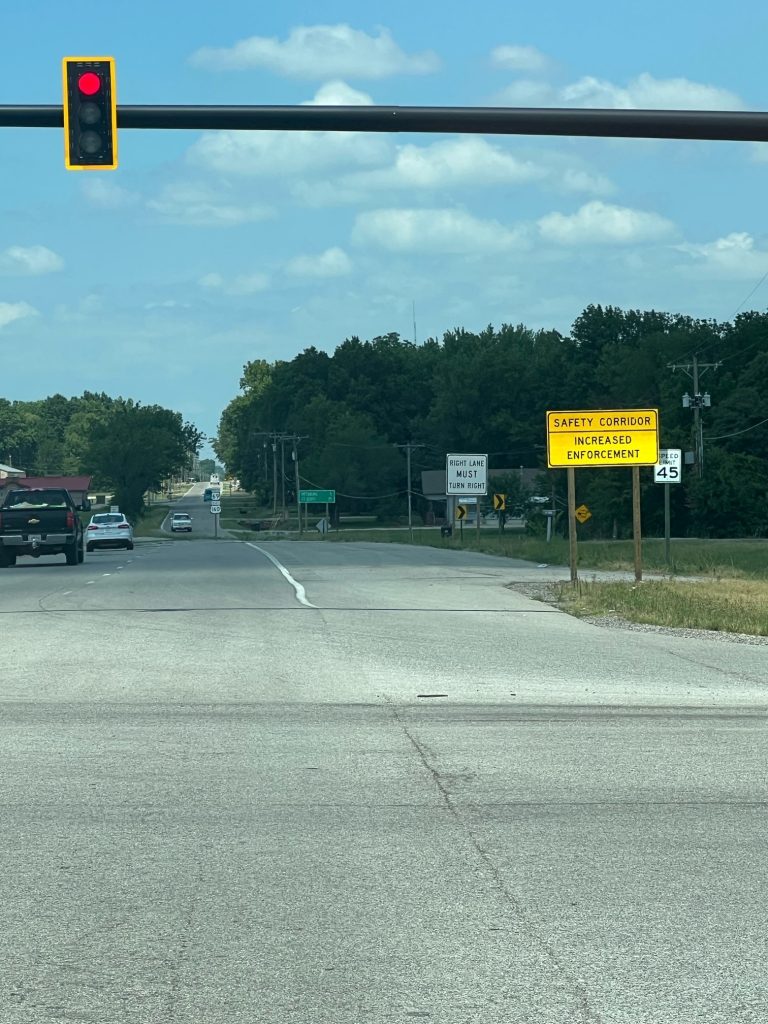
Road users traveling U.S. 69 in Crawford County will see newly installed yellow “Safety Corridor – Increased Enforcement” signage. These warning signs bring attention to heightened law enforcement efforts as part of a Safety Corridor Pilot Program launched in Summer 2023. The Safety Corridor Pilot Program is a five-year initiative aimed at reducing fatal and serious injury crashes on four selected highway corridors in Kansas. The Program entails a comprehensive set of strategies in enforcement, education, engineering, and emergency response.
The U.S. 69 Safety Corridor extends from the U.S. 400 junction north through Frontenac and Pittsburg to the U.S. 160 junction. Crash reports indicate 98 total crashes occurred along the U.S. 69 corridor route over a five-year timeframe (2016-2021), including 4 fatalities and 19 serious injuries. The Kansas Department of Transportation installed signage to alert motorists of increased enforcement of risky driving behaviors associated with crash risk.
“U.S. 69 was selected for this pilot safety initiative based on a history of fatal and serious injury crashes and crash reports noting a reoccurring pattern of risky driving behaviors,” said Southeast District Engineer Wayne Gudmonson. “The goal is to help travelers get home safely by bringing attention to the importance of obeying traffic laws, wearing seat belts and advancing a culture of safe driving behaviors.”
The Safety Corridor Pilot Program will run until 2028. Secondary educational messages in schools and businesses along the four corridors will be distributed beginning this month. For more information on the Safety Corridor Pilot Program, visit the program website at https://www.ksdot.gov/bureaus/burTrafficSaf/safetycorridor.asp.
###
TOPEKA – Governor Laura Kelly announced today that the Broadband Equity Access and Deployment (BEAD) Initial Proposal Volume 1 is available for public viewing and comment. The BEAD 5-Year Action Plan, along with Volume 1 and Volume 2, will identify served, unserved, and underserved locations across the state and map out a plan to expand access to high-speed internet.
The BEAD program, established by the federal Infrastructure Investment and Jobs Act of 2021, has allocated more than $451 million to Kansas for the development of broadband networks.
“Universal internet access is essential, and BEAD is a catalyst to a more connected and prosperous Kansas,” Governor Laura Kelly said. “From remote work to telehealth and other critical services, my administration is committed to ensuring every Kansan has the opportunity to thrive in the digital economy.”
Residents, community organizations, businesses, and local authorities from across the state are encouraged to participate in the public comment period for Volume 1 of the Initial Proposal. The document adheres to National Telecommunications Information and Administration (NTIA) guidelines and includes a description of each requirement and attachments.
Volume 1 includes:
“It’s essential to have opportunities for meaningful public comment and connection with the Office of Broadband Development if we are to achieve the goal of universal service,” Lieutenant Governor and Secretary of Commerce David Toland said. “Kansas is on the path to a more digitally accessible future, and participation in the public comment period will play a crucial role in shaping the success of the BEAD program.”
These strategic planning documents aim to bring robust broadband connectivity to every corner of Kansas, bolstering economic growth, education, health care, and public safety.
“This historic investment will make bold strides toward closing the digital divide and empowering Kansas communities,” said Jade Piros de Carvalho, Director of the Kansas Office of Broadband Development. “Input from Kansans is needed to ensure everyone will have the opportunity to enjoy enhanced broadband access, creating greater opportunities for all residents.”
Public comments on Volume 1 can be submitted online here until August 30.
Learn more about the Broadband Equity Access and Deployment Plan here.
TOPEKA – Governor Laura Kelly announced today that total tax collections for July 2023 were $681.0 million. That is $13.9 million, or 2.1%, more than the estimate. Total tax collections are up $94.7 million, or 16.2%, from July 2022.
“We are starting this fiscal year on strong financial footing, thanks to my administration’s laser-sharp focus on attracting businesses and growing the state’s economy,” Governor Laura Kelly said. “The numbers are clear: we must put money back in the hands of working Kansans through responsible tax cuts.”
Individual income tax collections were $313.7 million. That is $3.7 million, or 1.2%, more than the estimate, and a $13.2 million, or 4.4%, growth from July 2022. Corporate income tax collections were $44.7 million. That’s $4.7 million, or 11.9%, more than the estimate and up 22.2% from July 2022.
“It is important to note that wage withholding, the largest component of the $313.7 million in individual income tax receipts, is 13.4% more than in July 2022. Kansas wage income continues to be strong as the state moves into Fiscal Year 2024,” said Secretary of Revenue Mark Burghart.
Combined retail sales and compensating use tax receipts were $315.3 million, which is $12.3 million, or 4.1%, more than the estimate and up 38.8% from July 2022.
Click here to view the July 2023 revenue numbers.
 |
|
||||||||||||||||||
|
||||||||||||||||||
|
TOPEKA – Governor Laura Kelly today announced that Kansas has been selected to participate in the National Governors Association Center for Best Practices (NGA Center) Policy Academy to Advance Youth Apprenticeship. Through the Policy Academy, Kansas will develop a strategy to expand apprenticeship opportunities to youth ages 16 and older to help them build the skills needed for the modern workforce.
“My administration has focused on apprenticeships as a way to build the Kansas workforce in a way that is both pro-business and pro-worker,” Governor Laura Kelly said. “Now, we are furthering our efforts by developing a plan to ensure more of our high school students graduate with the skills they need to get good-paying jobs that don’t require a four-year degree.”
With Kansas’ unemployment rate at 2.8% and a surge in economic development activity that continues creating new jobs, the state is pursuing multiple avenues to build up the pipeline of prospective workers. Apprenticeship is one proven method of developing home-grown talent.
“Expanding the apprenticeship pipeline to include younger Kansans is a logical next step to support our historic growth,” Lieutenant Governor and Secretary of Commerce David Toland said. “The Kansas Office of Registered Apprenticeship is developing top-tier talent that makes it easier for businesses to invest in our rural communities.”
Youth apprenticeship is defined as a structured, work-based learning program that supports high-quality outcomes for young people and employers include:
“With more than 160,000 high school students across the state, Kansas youth apprenticeship has significant potential,” said Shonda Anderson, Director of Apprenticeship and Internship for the Kansas Office of Registered Apprenticeship. “The Policy Academy will support Governor Kelly’s focus on improving employment opportunities for young adults, especially in rural parts of the state.”
The Policy Academy to Advance Youth Apprenticeship officially kicks off in Washington, D.C., in August when teams from six states convene for a day of learning and action-planning with state peers, federal leaders, and national subject matter experts.
“From my perspective, this collaboration between unions, industries and educators across multiple sectors to engage young people in Registered Apprenticeship opportunities is exciting,” John Nave, Executive Vice-President of Kansas AFL-CIO, said. “I believe this strengthens the economic prosperity in Kansas now and for generations to come.”
The Kansas team includes officials from the Governor’s Office, Kansas Office of Apprenticeship, Kansas Apprenticeship Council, Kansas Department of Education, Wichita Plumbers and Pipefitters Union, IBEW 304, Kansas AFL-CIO and other stakeholders representing education and industry. To see a list of members of the Kansas Youth Apprenticeship Collaborative, or to find out more about Youth Apprenticeship in Kansas, click here.
###
~~Kansas Office of Apprenticeship Receives More Than $6M to Modernize and Expand State’s Registered Apprenticeships~~
TOPEKA – Governor Laura Kelly today announced that the Kansas Office of Apprenticeship has launched the MeadowLARK — Leading Apprenticeship Results in Kansas — Initiative to expand the state’s Registered Apprenticeship opportunities further.
“MeadowLARK is an important tool that will be used to grow the state’s skilled workforce in rural and urban communities across multiple industries – further advancing Kansas’ economic growth,” Governor Laura Kelly said. “By continuing to work together, we are fostering a brighter, more resilient, and more prosperous future for all who call the Sunflower State home.”
Funding for MeadowLARK was delivered through a State Apprenticeship Expansion Formula (SAEF) grant from the U.S. Department of Labor, which provides targeted support to state Registered Apprenticeship Programs. A total of $6,331,847 was awarded to Kansas.
The Kansas Office of Registered Apprenticeship will utilize these funds to continue revolutionizing apprenticeship in Kansas. MeadowLARK will also greatly expand the office’s efforts by developing Multi-Employer Intermediaries focusing on high-demand, high-wage occupations to meet industry needs.
“Since it was established last year, the Kansas Office of Registered Apprenticeship is making huge strides to expand the highest quality earn-and-learn opportunities across our state,” Lieutenant Governor and Secretary of Commerce David Toland said. “Through the MeadowLARK funding, the office will continue bringing together businesses, industries, labor, workforce boards, higher education systems, state departments, and other stakeholders, with one objective: Making Kansas a top 25 apprenticeship state by 2025.”
“MeadowLARK represents the latest and most significant opportunity for us to revolutionize how we develop and engage the workforce system and Multi-Employer Intermediaries.,” Shonda Anderson, Director of Apprenticeship and Internship for the Kansas Office of Registered Apprenticeship, said. “With this model, we’re able to create easier pathways for businesses to grow their own workforce.”
In addition to modernization, MeadowLARK will invest nearly $5.7 million over the next three years to advance integration efforts with local Workforce Boards across Kansas and establish Statewide and Regional Multi-Employer Intermediaries.
The Statewide Multi-Employer Intermediaries include:
Statewide Multi-Employer Intermediaries convene and ease the development of Registered Apprenticeship programs for specific employers.
“This Registered Apprenticeship program is a critical step toward addressing the teacher shortage here in Kansas,” Kansas Commissioner of Education Dr. Randy Watson said. “These additional grant funds will help ease the financial hurdle many aspiring educators face on their way to earning a college degree and enable us to expand the program.”
Local Workforce Boards such as Kansas WorkforceONE will convene opportunities for populations with barriers to employment.
“Kansas WorkforceONE is excited about the opportunities that the MeadowLARK grant will provide us,” said Deb Scheibler, Executive Director at Kansas WorkforceONE. “We can use this to expand Apprenticeship and Pre-Apprenticeship opportunities across central and western Kansas for some of our most vulnerable populations.”
The Regional Multi-Employer Intermediaries include:
For more information about the Kansas Office of Registered Apprenticeship, click here.
###
TOPEKA – Governor Laura Kelly today announced that she has signed Executive Order 23-03, directing all executive branch state agencies to update their Continuity of Operations Plans (COOP). Having updated plans is vital in the event of natural or other emergencies that impact state agencies or degrade their ability to deliver services.
“These plans are essential to our preparedness for emergencies, so Kansans have peace of mind and confidence in our continuity of government,” Governor Laura Kelly said. “These plans serve as a guide for our agencies to coordinate and manage their essential functions and services during disruptions of normal operations.”
Agency COOPs will address essential functions, critical facilities, order of succession, delegation of authority, communications, testing, training, and exercises, among other topics. State agencies are also directed to update COOP annually and provide those updates to the Kansas Division of Emergency Management.
In her order, Governor Kelly encouraged other statewide elected officials, independent boards and commissions, the Regents Universities, and the Judicial and Legislative Branches to implement Continuity of Operations planning and to be part of state continuity preparedness discussions.
Executive Order 23-03 provides a deadline of December 31, 2023, for agencies to update their COOP.
A copy of Executive Order 23-03 can be found here.
###
TOPEKA – Evergy customers will have one more opportunity to attend a public hearing to learn about the company’s rate increase request, ask questions and make comments before the Kansas Corporation Commission. The third and final public hearing will be held this Thursday at Wichita State University’s Lowe Auditorium at the Hughes Metropolitan Complex, 5014 SE 29th St. North, beginning at 6 p.m.
The application, filed with the KCC on April 25, requests an average monthly rate increase of $14.24 for Evergy Central customers and $3.47 for Evergy Metro customers. Commission approval is required before a regulated utility can change its rates.
For those unable to attend the hearing in person, a virtual option via Zoom is available to allow remote participants to comment. Advance registration on the KCC’s website is required for those participating by Zoom. The hearings will be broadcast on the KCC’s YouTube channel for those wanting to view the hearing without participating.
The Commission is also accepting written comments regarding the rate increase request through 5 p.m., September 29, 2023, on its website, by mail to the Commission’s Office at 1500 SW Arrowhead Rd, Topeka, KS 66604-4027 or by calling the KCC’s Office of Public Affairs and Consumer Protection at 785-271-3140 or 800-662-0027.
The Evergy Central service area includes Wichita, Topeka, Lawrence, Olathe, Leavenworth, Atchison, Manhattan, Salina, Hutchinson, Emporia, Parsons, Arkansas City, El Dorado, Newton, Fort Scott, Pittsburg and Independence, among other towns and rural areas. The Every Metro service area includes Lenexa, Overland Park and other communities near the Kansas City metro area.
Hearings were previously held in Topeka on July 11 and Overland Park on July 13. Recordings of both hearings are available on the KCC’s YouTube channel.
###
For Immediate Release: Contact: Governor Kelly to Welcome Dolly Parton to Kansas for Imagination Library of Kansas
|