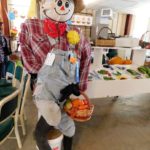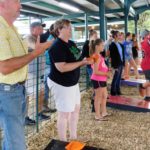
K-State Extension Agent Joy Miller speaks to the attendees of the Fort Scott Chamber of Commerce Thursday morning during their weekly coffee in the Open Class Myers Building. She summed up the fair for fair youth: hard work and determination.
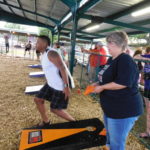
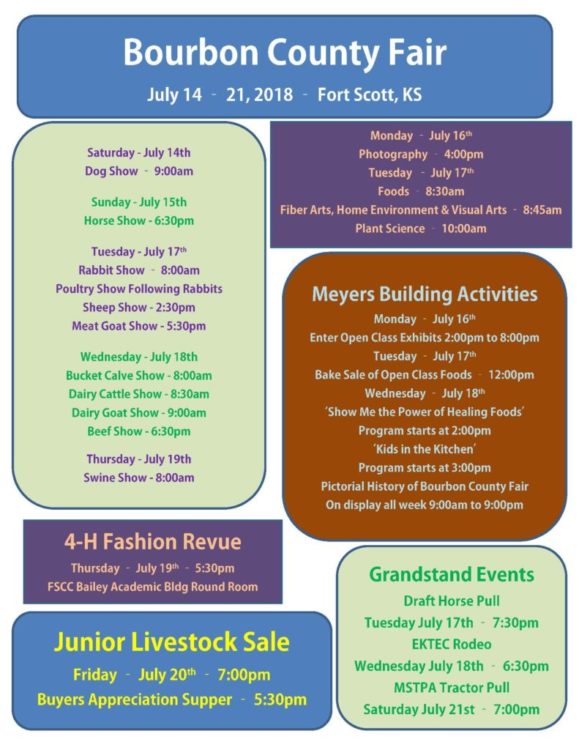
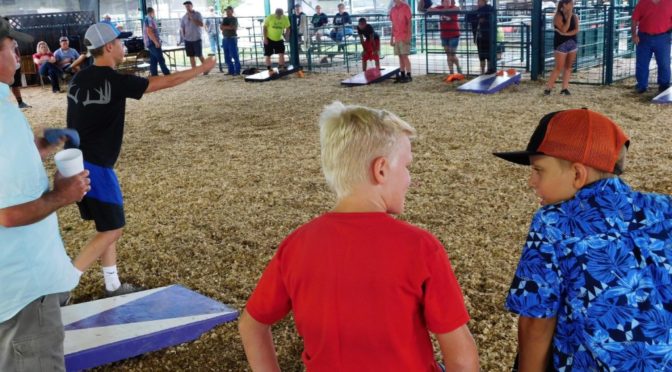
Thursday at the Bourbon County Fair started with the Fort Scott Chamber of Commerce Weekly Coffee and the Open Class Swine Contest. The Bourbon County Sheriff’s Office served lunch at the Chuck Wagon eatery at the fair and in the evening was the 4-H Fashion Revue at Fort Scott Community College. There was a corn hole contest fundraiser presented by the Uniontown FFA in the arena.
Friday at the fair includes the livestock judging contest, viewing of open class exhibits, the 4-H Barnyard Olympics, the Buyer’s Appreciation Supper and the Junior Livestock Sale.
Saturday is checking out exhibits and clean-up. There will be a Missouri State Tractor Pullers Contest at the grandstand in the evening.
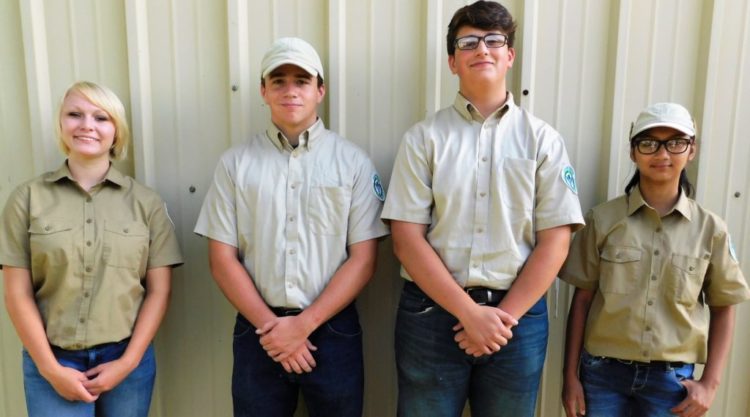
The Youth Conservation Corp from the Fort Scott National Historic Site were first-time visitors to the Chamber Coffee. They announced Family Day this Saturday at the Fort. Cooking, gardening, and small arms demonstrations will be in the morning session. Crafts and games will be in the afternoon session. Check out what this group planned as part of their duties at the Fort: For Families: Art Show July 28; Scavenger Hunt August 4 at The Fort
From left: Reaghn Dowell, Kaden Primm, Jesseden Kiwan and Anthea Montojo, all of Fort Scott High School, comprise the YCC.
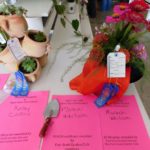
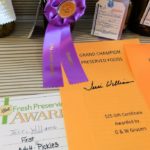
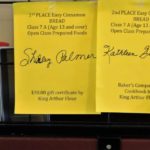
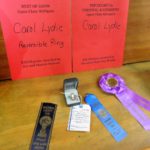
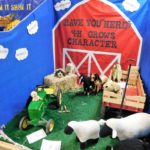
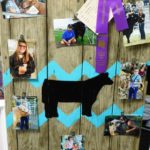
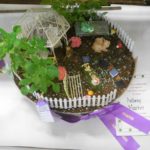
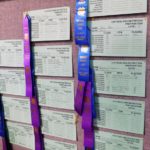
The following are the entries that won Grand Champion in the Open Class Department, housed in the Myers Building.
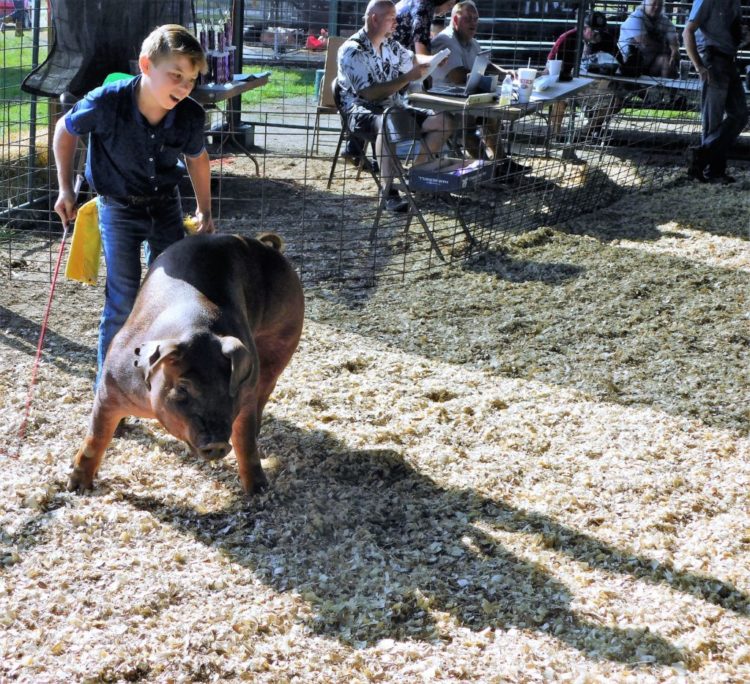
The Swine Contest was held in the arena.
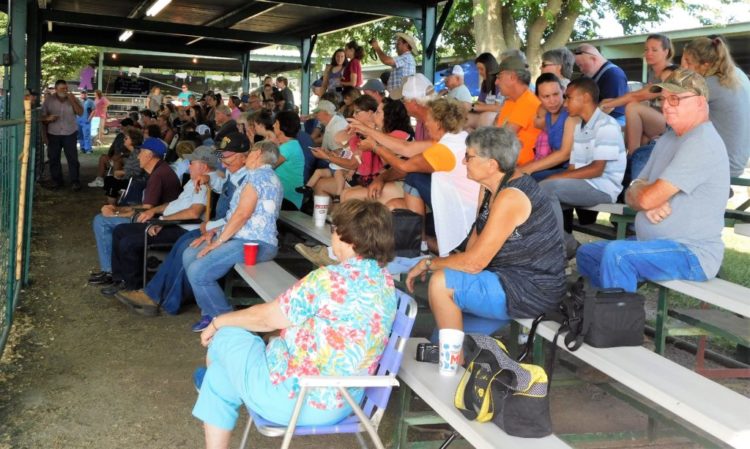
A crowd filled the bleachers to watch swine and their owners in the FFA, 4-H and Open Class contests.Blaine Pitts is the Duroc Swine Grand Champion.
Jennifer Terrell, District Extension Agent 4-H Youth Development Southwind District – Erie Office, 620-244-3826.
County fairs are an integral part of life in rural America.
Bourbon County is no different.
Today, Saturday July 14 at 9 a.m. the Bourbon County Fair begins with the dog show at the fairgrounds on South Horton Street, across from Fort Scott Community College.
” In Bourbon County, the opportunities in 4-H are truly infinite,” Jennifer Terrell, K-State District 4-H Youth Development Agent, said. “Youth ages 7-18 are eligible to participate as full-fledged 4-H members. For those youth ages 5 and 6, there is a Cloverbud Program. Beyond being a member of the monthly community club, youth are encouraged to attend projects meetings, 4-H Camp, 4-H Days, the County Fair, and other State 4-H Events.”
The county fair is a good way to see the youth in our community put forth effort on projects and a good way to see if it is a fit for your family.
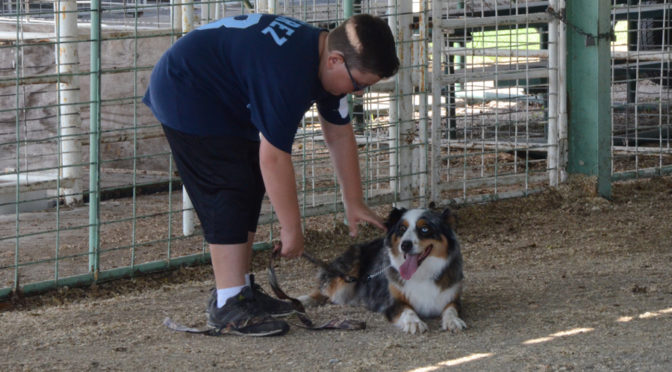
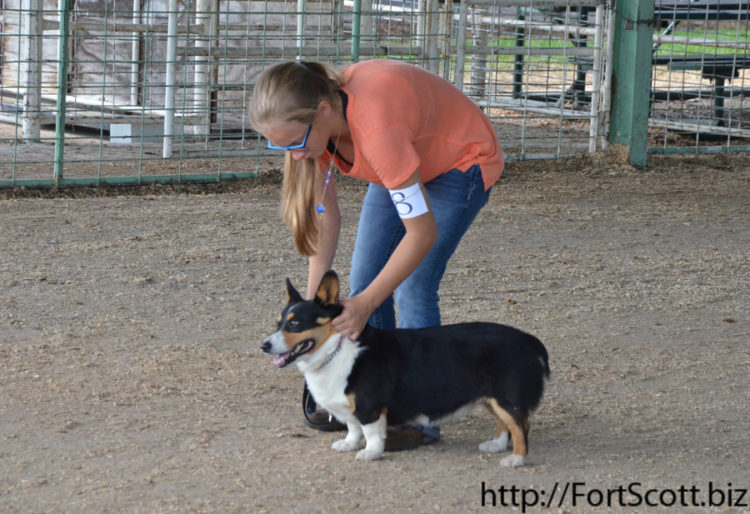
Today, July 14, the dog show was held at the Bourbon County Fairgrounds.
” At the Bourbon County Fair, 4-H members pre-enter to exhibit in the 4-H Division and other youth may participate in Open Class,” Terrell said. “Families considering being involved in 4-H are encouraged to visit the county fair to view all of the hard work.”
The following is a press release from Terrell and the poster of the events of the fair:
“It is county fair time across the State of Kansas! While you may attend the fair as a form of entertainment, 4-H’ers and their families know this is time to display the hard work put into their year-long project learning in the 4-H Program.
While visiting the county fair, it is hard to miss the different colored ribbons or stickers placed on the exhibits.
Have you ever wondered why there are different colors and how that came about? Well, I am going to share with you the judging process.
In 4-H most judging involves the Danish System of judging. In this system, the judges do not judge one person’s work by comparing it to another’s. The evaluation is made against a standard.
A judge looks to see whether requirements are met. Exhibits are placed into four ribbon groups.
The best ribbon placing is purple which means the project is outstanding on all standards.
Blue means it exceeds the minimum standard and may have minor flaws where improvements can be made.
The ribbon placing that meets all minimum standards and may show visible signs of needed improvements is red.
And projects failing to meet minimum standards receive a white.
One advantage of this system is that everyone whose work fulfills minimum qualifications can receive a ribbon. If all entries are judged to be excellent, all receive blue ribbons.
The purpose of using the Danish System is to give every 4-H member the recognition deserved for the work that was done. It also helps young people recognize the need to improve their skills and to “make the best better.”
So, how did that ribbon placing come about you might be asking?
You should know that having one’s accomplishments evaluated can be motivating and educational for 4-H’ers.
When judges critique their work or performance, it serves as a guide to further improvement. The judging process is probably more valuable than the award or recognition. To plan, practice, and present a finished product is to “learn by doing.” To graciously accept constructive criticism of one’s work is a real life experience. 4-H’ers learn quickly that judging results reflect a personal opinion, and that evaluation will vary among judges.
There are three different types of evaluation in 4-H.
The first is conference or interview. This is where the judge will interview the participant as he/she evaluates the product against a set of standards. The purpose of this is to determine what the 4-H’er learned in completing the project. Comments are provided verbally mostly, but can also be found written on a score sheet.
Another way 4-H’ers are evaluated with their projects is performance judging. The judge evaluates how a 4-H’er accomplishes a task or a goal in progress. The judge looks for skills being used, as well as evaluating the end result. This type of event enables the 4-H’er and the judge to see how the performance directly effects the end product. Comments are often provided verbally and also in writing on a score sheet.
And the final type of evaluation is project judging. The judge evaluates the finished products against a set of standards without the member present. The focus is the quality of the project itself and not the learning process. Comments are provided to the participant in writing, usually on a score sheet.
As you have read, there is a lot to know and understand with the judging process of projects in 4-H. It is not something taken lightly.
I encourage you to visit your local county fair this year to view all of the exhibits and pay close attention to those 4-H exhibits. And maybe for fun evaluate the exhibits and see what placings you would give.
For more information on 4-H Youth Development, give me a call at 620-244-3826 or email at jkterrell@ksu.edu.”
Christopher Petty, M.S. Extension Agent, Livestock Production and Forage Management, K-State Research and Extension Southwind Extension District, 210 S. National Fort Scott, KS 66701, (620) 223-3720 Work (620)224-6031 Cell, cgp@ksu.edu
According to the University of Nebraska Extension Professor Bruce Anderson, while it may be uncomfortable [outside] for you and me, it is particularly hard on livestock out on pasture. To help them survive, much less thrive, under these conditions, they need plenty of good, clean water.
Not only do they need plenty of good, clean water – they need it close by. Once upon a time, it was common to make cattle walk a mile or more to water. And they’d do it.
But just think how hard it is on animals in this heat and humidity. Once they get to the water, the last thing they want to do is turn around and go all the way back to where they came from to graze. As a result, they do little grazing more than a half mile away from water.
In fact, research shows that when cattle need to travel more than 1000 feet to water, they spend less time grazing, they burn off pounds walking, and they graze distant areas incompletely.
So, how can you improve your water and grazing distribution?
More ponds, wells, windmills, and dugouts will help, but they can get expensive. Plus, they can only be placed in certain locations and can’t be moved.
So maybe a pipeline would be better. They can be put almost anywhere. And if you want to add more water locations, pipelines can be tapped into anywhere along the line. You might even qualify for cost-share dollars to help pay for the installation. Check with your local Natural Resources Conservation Service office for more information. You also can leave your pipe on top of the ground, saving trenching costs, if you only need water during the growing season. Over time, water improvements pay for themselves with better grass and improved animal performance.
Contact your local Southwind Extension District office in Fort Scott, Erie, Iola, or Yates Center for more details. I am happy to visit with you about your livestock watering systems, and am available via e-mail at cgp@ksu.edu, by telephone at 620-223-3720, or for on-site farm visits.
Submitted by: Carla Nemecek, Southwind Extension District, Director & Agent
With the addition of Woodson County to the Southwind District, July 1, 2018, marks an important mark in time for K-State Research and Extension. The extension districting model has been in place in Kansas since 1994 when Lincoln and Mitchell Counties formed the Post Rock District, and currently contains 50 counties in 17 Districts across the State.
Increased efficiency and effectiveness were major forces when the 1991 Kansas Legislature passed the Extension District Act. The merger of county extension councils can result in increased efficiency of resources and greater effectiveness of personnel through specialization, resulting in higher quality educational programming for Kansas citizens.
Locally, the Southwind District was formed in 2010 with Allen and Neosho Counties, Bourbon County was added in 2011, and Woodson County joined our family this week. Prior to districting, all extension units operated within their own counties, most commonly with two agents in each office to represent agriculture and family & consumer sciences with shared responsibility for 4-H.
In our Southwind district model, each local office houses two agents, but job responsibilities are more focused for better specialization and agents travel throughout the district to meet the needs of local residents.
In my opinion, the district model creates an environment of teamwork and synergy that we never had as an isolated county office. Extension staff is supervised and report to the District Board, which consists of four residents from each county who are elected in the general election of odd-numbered years.
Woodson County representatives were appointed by the County Commissioners for their first term.
As District Director, I am responsible for working with our finance committee to complete the annual budget, working with the personnel committee to set goals and conduct performance reviews, and the marketing committee promotes the district through various media avenues.
We remain strongly connected to Kansas State University as it relates to funding, staffing, personnel, educational requirements, and the organizational structure of extension councils and districts. An operational agreement and memorandum of understanding were developed with the district and Kansas State University.
With the addition of Woodson County, there is a new level of energy and excitement across our staff and offices. We have high expectations for expanded opportunities for all of our programs, and we look forward to including Woodson County for years to come.
If you haven’t already, please find more information about Southwind District on our website, www.southwind.ksu.edu or our Facebook page: Southwind Extension District. Folks are welcome to contact me anytime cnemecek@ksu.edu or 620-365-2242.
Kansas State University Southwind Extension District Agents hosted an Open House in Yates Center on Thursday, June 28 as Woodson County joins Allen, Bourbon and Neosho Counties in the Extension District.
Agents pictured include Joy Miller, Krista Harding, Carla Nemecek, Christopher Petty, Jennifer Terrell, Dale Lanham, Barbara Stockebrand and Kathy McEwan.
K-State Extension will offer cooking classes this week for area children 2nd through 5th grade.
During each class, all students will prepare and then consume the different dishes.
Ft. Scott Cooking Classes
Summer Cooking Classes by K-State Research and Extension will begin on June 26 and continue through June 28 at the First United Methodist Church basement, in Fort Scott. The classes will include students that have completed 2nd-5th graders and are full with 24 enrolled students. The classes will begin at 9 a.m. and end at 11:30 a.m.
Bronson Cooking Classes
The Bronson cooking classes will begin on June 26 and continue through June 28 at the Bronson Community Center. Classes will be from 2-4: 30 p.m.
Krista Harding is a K-State Research and Extension Agricultural agent assigned to Southwind District.
Nineteen years – that’s how long I have been a K-State Extension agent and it has been a very good career for me! I thoroughly enjoy visiting with people and helping whenever I can.
When I began as an agent, I was amazed by the fact that not everyone knew what the Extension service was. I always heard the phrase “Extension is the best-kept secret” and I thought to myself….I’m going to change that!
Unfortunately, nineteen years later, I still frequently visit with folks that have absolutely no idea of the services the Extension office can provide. So many services in fact, it’s too numerous to list. But one of those that I want to draw your attention to is our horticulture services.
Anyone that has a lawn or landscape can benefit from the local Extension office. The weeds you try to keep from growing in your lawn, or the tree that has holes in the trunk, or the spots on your tomato leaves are all areas the Extension office can help you.
We offer you that one-on-one personal service that you cannot get from Google.
From the Extension office, you can obtain information on trees, turf, flowers, insects, gardens, soils and other related topics specific to Kansas. The key point here is – specific to KANSAS.
It is so easy to just turn to the internet to find information. However, many times the information you find is from another state and it is not relevant to our area. Or worse, it is inaccurate.
The Extension office can assist you with any specific plant or insect problem you may encounter – free of charge. Home visits are also available.
There are never any dumb questions when you call the Extension office. My job is to help the public with whatever question or issue they may have and to try to educate them. I may not always have the answer they are looking for immediately, but 99% of the time I can find an answer. We also have access to K-State specialists and laboratory diagnostic services.
This summer, there are three demonstration gardens in the Southwind District for people to view and take notes of plant performance.
Pepper plants are being trialed at the Elm Creek Community Garden in Iola, tomato plants at the Cherry Street Youth Center and squash at the community garden in Fort Scott. The plots are labeled so feel free to stop by and take a look.
I am most excited about the tomato trials at Cherry Street. This is a great learning opportunity for the youth! They are working under the direction of Denise Hastings who is an Extension Master Gardener. The youth will record data and make careful observations of the varieties. At the end of the season, results will be reported to K-State and combined with other data from other trials across the state. All of this data will be used to help update the list of K-State recommended vegetable cultivars.
During the growing season, I am in the Erie office Monday, Wednesday, and Friday; Iola on Tuesday and Fort Scott on Thursday.
However, you can always reach me by e-mailing kharding@ksu.edu or call 620-244-3826.
K-State Research and Extension is an equal opportunity provider and employer.
Carla Nemecek is Southwind District Director and agent.
Please join the Southwind Extension District next Thursday, July 28 as we host an Open House to welcome Woodson County to Southwind Family.
Effective July 1, 2018, Woodson County Extension will join the Southwind Extension District. We will celebrate this important merger with refreshments and fellowship on Thursday, July 28 at a come-and-go reception in the Yates Center Office, 211 W. Butler from 2pm-6pm.
Staff and board members will be present at the Extension Office to answer your questions about the District and explain what K-State Research & Extension can do to better serve the residents of Woodson County.
Currently, the Extension programs in Neosho, Bourbon, Allen and Woodson Counties consists of 4 Office Professionals and 8 Agents with specialized expertise in 4-H & Youth Development, Food & Nutrition, Adult Development & Aging, Financial Management, Horticulture, Community Leadership, Livestock Production, and Forage Management.
For more information, please contact Carla Nemecek, Southwind District Director at 620-365-2242.
Joy Miller, K-State Research and Extension Southwind District, Family and Consumer Science, 620-223-3720 or joymiller@ksu.edu
Board games can help connect family and friends in ways that video games can’
Playing board games gets everyone in the same room and helps family members across generations connect, compete, and have a great time together. Board games are easy, inexpensive, and have benefits well beyond the activity itself. Games are an entertaining and painless way to help kids build essential learning skills on the sly or by accidental learning, which means there’s no anxiety or resistance.
The book “Family Treasures: Creating Strong Families” by John DeFrain, covers six qualities that strong, successful families around the world exhibit: enjoyable time together; appreciation and affection for each other; positive communication; spiritual well-being (values, beliefs, life skills); successful management of stress and crisis; and commitment to each other.
If we don’t carve out time as a family, none of those traits will be achieved. Those traits are built in a scaffolding manner – one brings the other. Board games foster that face-to-face time interaction needed to connect deeply with each other and to develop the other traits of strong families.
Social and emotional health – Research shows the link between social and emotional skills and school success is so strong that it is a greater predictor of children’s academic performance than their family background and cognitive abilities. Learning is a social process. Children cannot learn if they struggle with following directions, getting along with their peers and controlling their emotions in any setting.
Every face-to-face game provides a ‘social experiment’ where players learn self-regulation and social skills to play successfully with others, a lot goes on under the surface, even when playing the simplest of games. Children identify and regulate their emotions and behavior, learn to calm down when upset without hurting others, and learn how to win – or lose – with grace and good manners.
Playing games fosters persistence, a willingness to try new things, conversation, cooperative play and thinking of appropriate solutions to conflict. Games also help children learn to interpret others’ behavior and emotions, and can reinforce children’s feeling good about themselves and others.
Basic math concepts – Even some of the simplest board games give children a sense of numbers. For example, the numeral 4 represents four objects, which is greater than 3 and less than 5. Some games introduce geometry concepts with shapes and patterns, how to classify items
Christopher Petty, M.S. Extension Agent Livestock Production and Forage Management K-State Research and Extension Southwind Extension District 210 S. National Fort Scott, KS 66701 (620) 223-3720 Work (620)224-6031 Cell cgp@ksu.edu
According to Walt Fick, a K-State Research and Extension Range Specialist, Sericea lespedeza has been a statewide noxious weed in Kansas since July 1, 2000. Despite control efforts, this introduced, invasive species continues to persist on rangeland, pasture, and CRP acres in the state. Sericea lespedeza has a tremendous seed bank that helps reestablish stands following control efforts. Sericea lespedeza currently infests nearly 500,000 acres in Kansas.
There are no known biological controls that can be effectively used on sericea lespedeza. However, grazing with sheep and goats can suppress sericea lespedeza stands and produce a saleable product. Cattle supplemented with corn steep liquor (CSL) have been shown to consume more sericea lespedeza than animals not supplemented with CSL. Frequent mowing will reduce sericea lespedeza, but is also damaging to plants that might be growing/competing with sericea. A single mowing in mid- to late-July will eventually reduce stands of sericea lespedeza to some extent but has not eliminated sericea, even after several years of mowing. A late-summer mowing will eliminate most seed production. Application of appropriate herbicides about 4-6 weeks after mowing will help reduce sericea lespedeza stands, but will also damage other forbs. Prescribed burning in April seems to stimulate seed germination. Burning in August and early September nearly eliminates seed production.
Herbicides applied at the correct time and under favorable environmental conditions can significantly reduce sericea lespedeza, but retreatment has proven to be required. Early summer is a good time to consider spraying sericea lespedeza. Plants are in a vegetative growth stage and previous research has indicated good to excellent control at this time.
Remedy Ultra (triclopyr) and PastureGard HL (triclopyr + fluroxypyr) can provide effective control when applied during June and into early July when the sericea plants are in a vegetative growth stage.
Products containing metsulfuron, such as Escort XP, Cimarron Plus, and Chaparral, are generally more effective in the late summer when sericea lespedeza is actively blooming.. Use a non-ionic surfactant with all of these products. These products containing metsulfuron may stunt tall fescue.
For spot applications, mix 0.5 fl oz PastureGard HL per gallon of water, use a 1 percent solution of Remedy Ultra in water or 1 gram Escort XP per gallon of water.
Herbicide treatments will need to be repeated at least every 2 to 4 years to keep this invasive species in check. Initial treatments should reduce dense stands to the point where spot treatment can be used in future years. Left untreated, sericea lespedeza will quickly dominate a site, greatly reducing forage production and species diversity.
If you are unfamiliar with sericea lespedeza, learn how to identify the species and get started with a control program. Be persistent with control efforts to keep this invasive species at manageable populations. Contact Southwind Extension District Agent Christopher Petty at 620-223-3720 or by e-mail at cgp@ksu.edu for more information.
Carla Nemecek is Southwind District Director and agent.
Submitted by: Carla Nemecek, Southwind Extension District
Although the cost of fuel has declined the past few days, input costs are still high especially on the farm. With hay baling, planting soybeans and wheat harvest upon Southeast Kansas, one of the largest expenses will be fuel, so being conscientious how certain vehicles are used could aide in lowering those costs. Several tips are offered by K-State Research & Extension.
Avoid unnecessary driving. Maybe the task can be handled with a phone call instead of a trip.
Match the vehicle to the task. Take the family car to pick up parts instead of the four-wheel-drive truck.
Get rid of junk. Extra tools, supplies and other nonessentials in the back of a vehicle add weight that decreases fuel mileage.
Keep vehicles in good running order. Clogged filters and injectors rob power and efficiency from tractors, trucks, and cars.
Check the tire pressure. Underinflated or overinflated tires can increase rolling resistance and fuel use.
Switch to a minimum or no-till farming practices. Fewer tractor passes through the field means less fuel used.
Match the tractor to the task. Don’t use a large field tractor when a smaller one will work.
Make sure the tractor is ballasted properly. Tires on a poorly ballasted tractor will slip and increase fuel use. Too much ballast for the task uses more fuel than necessary.
Gear up and throttle back when performing field tasks that don’t require full engine power. Operating a tractor at three-quarters power can save 5 to 15 percent, compared to full-throttle operation.
Consider auto steer attachments for field tasks. Accurate work reduces overlaps or skips with sprayers and tillage equipment, reducing fuel use.
Avoid unnecessary engine idling. Idling can account for 15 to 20 percent of fuel use.
Paint fuel storage tanks white. A dark-colored, 300-gallon fuel storage tank can vent up to 120 gallons of fuel a year.
For more information, contact the Southwind District Office in Iola at 620-365-2242 or www.southwind.ksu.edu
Kathy S. McEwan Family and Consumer Sciences Agent Foods & Nutrition, SNAP-Ed Coordinator Southwind Extension District – Iola Office P.O. Box 845, Iola KS 66749 620-365-2242 kmcewan@ksu.edu
Training focuses on addressing food issues in local communities
The Kansas State University Pollution Prevention Institute has formed a partnership with the Kansas Alliance for Wellness to present three upcoming workshops on minimizing food waste and keeping unused food out of local landfills.
The workshops will take place from 10 a.m. to 4 p.m. at the following locations:
– June 14 – Salina Public Library.
– June 21 – Iola courthouse.
– June 28 – Oakley, Buffalo Bill Cultural Center.
There is no cost to attend and lunch will be provided, but interested persons are encouraged to register in advance at www.sbeap.org.
The workshops are being held to address the fact that 40 percent of food produced in the United States goes uneaten, while one in eight Americans struggle to put enough food on the table.
The workshops follow a train-the-trainer approach, allowing participants to learn more about what they can do to address food issues in their community. Organizers say the training will follow the U.S. Environmental Protection Agency’s hierarchy of food recovery, which includes donating food to food-insecure populations as one of its top solutions.
The workshop also will include training on strategic communications, including advocacy, marketing and messaging, which can be used to conduct public campaigns aimed at food system policies.
The U.S. Department of Agriculture’s Rural Utilities Service provided funding for these workshops.
For more information, or if you need accommodations to attend the Iola workshop, contact Kathy McEwan, Southwind Extension District, at kmcewan@ksu.edu or 620-365-2242.