Category Archives: Government

Ken Collins, Kansas State Representative-Second District

Thoughts From Under the Dome


Week two of the 2026 Kansas Legislative Session is now in the books and there is a great deal of talk about property tax relief right now and how it can be achieved. A majority of what a property owner pays goes to local governments and school districts so that shifts the focus on possibly limiting valuation increases and there are several proposals floating around at this point so all that I can say right now is to stay tuned.


House Bill 2412 also known as Benny’s Bill is my main focus this year when it comes to legislation that I am sponsoring. Benny’s Bill increases the severity levels for crimes relating to endangering a child under the age of six changing what is now a misdemeanor into a felony. The House Judiciary Committee held a hearing on the bill and while they haven’t voted on it yet as of my writing of this the response that I have received from committee members has been positive. I was greatly impressed by Shelby Cannon and Lisa Eastwood the mother and grandmother of Benny Cannon the child who suffers as a result of day care negligence and was the inspiration for HB 2412.  Jordan Chessher from Project Heaven in Wichita also testified. His organization advocates for stronger laws to protect abused and neglected children. His input was very helpful as well.


On a final note I am a cosponsor of House Bill 2473 along with Representatives Brett Fairchild, Stephanie Sawyer-Clayton and others. This bill would eliminate the parental consent exception to the legal age to marry in Kansas of 18. Times have changed and I believe that the once common practice of child marriage never turns out well in this day and age.


That’s it for now. I’m wishing the best for everyone and if there are any questions or concerns please don’t hesitate to reach out. Ad Astra Per Aspera.


KS Office of Early Childhood First Report Is Submitted to Legislature

Governor Kelly Announces
Kansas Office of Early Childhood Inaugural
Annual Report Submitted to the Kansas Legislature


TOPEKA
— Governor Laura Kelly and the Kansas Office of Early Childhood (KOEC) today announced that the KOEC’s inaugural Annual Report has been submitted to the Kansas Legislature.

“We are making Kansas the premier state to raise a family by building a comprehensive early childhood system that is transparent, efficient, and easier for Kansas families, child care providers, and businesses to navigate,” Governor Laura Kelly said. “Establishing the Kansas Office of Early Childhood was a foundational first step in this process. The inaugural Annual Report outlines significant progress toward building a more robust system and provides a pathway to set the Office up for long-term success.”

Once established on July 1, 2026, KOEC will unify over 20 early childhood programs into one central office, providing parents, providers, and communities with a single point of contact for programs and services supporting Kansas children. The submission of the Annual Report to the Kansas Legislature is statutorily required, pursuant to K.S.A. 75-7702.

Nearly 180,000 children under age 5 live in Kansas, and demand for early childhood services remains high, with 67 percent of young children living in households where all available parents are in the workforce. The establishment of KOEC represents a significant step toward simplifying access to programs and services for families, reducing administrative burden for child care providers, and strengthening accountability for public investments. Governor Kelly has appointed Christi Smith to serve as the inaugural director of the office.

“This inaugural report reflects our commitment to transparency and continuous improvement, and it sets clear priorities for the work ahead,” said Christi Smith, Acting Director, Kansas Office of Early Childhood. “It also establishes a precedent for ongoing data reporting on what matters most so we can strengthen services, improve outcomes for Kansas children, and better support the families and providers who care for them. We’re excited to get this important work underway.”

As required by House Bill 2045, the legislation that established KOEC, the Annual Report provides a transparent update on progress to date toward transitioning all programs to KOEC in advance of July 1, 2026, including early operational planning and first-year priorities as Kansas continues to build a more comprehensive early childhood system. The Annual Report is a crucial first step for Kansas in transforming the currently siloed components of the state’s early childhood landscape into a more efficient and effective system.

The inaugural Annual Report outlines recommendations for KOEC’s first year, system performance, and progress toward statewide early childhood goals. Recommendations for KOEC’s first year center on strategic planning to improve resource efficiency, internal organization, field-facing systems, communications, and purposeful collaboration across the early childhood ecosystem.

The inaugural Annual Report be found here.

###

FSCC Trustees Meet Today for Workshop

01/23/26 – 12:00 p.m. – Special Board of Fort Scott Community College Trustees Meeting for purposes of Board Workshop​​​​
01/26/26 – 5:30 p.m. – Regular Board of Trustees Meeting ​​​.
The trustees will meet in the Ellis Center on the campus, 2108 S. Horton.

BOARD OF TRUSTEES SPECIAL MEETING

ELLIS FINE ARTS BUILDING

JANUARY 23, 2026 – 12:00 P.M.

PUBLIC AGENDA


1.0 Call Meeting to Order

2.0 Flag Salute & Invocation

3.0 Oath of Office by new trustees Destry Brown, Chad Cosens, and Marilyn Hoyt

4.0 Appoint Chair and Clerk for this board meeting (Action)

5.0 Leadership Reports & Updates (Information)

5.1 Academics

  • Vice President of Academic Affairs

5.2 Advancement

  • Foundation Director
    • Gordon Parks Museum
      • Gordon Parks Museum Strategic Plan
      • Thank You notes from visit

5.3 Athletics

  • Athletic Director

5.4 Finance & Operations

  • CFO – Vice President of Finance & Operations
    • Debt Map for FSCC
    • Business Office & Maintenance Update

5.5 Student Services

  • Vice President of Student Affairs
    • Inclement Weather procedure
      • Main
      • Outreach

5.6 Administrative Committees

  • Scholarship Committee proposals
    • Present for board consideration in February
      • Academic
      • Institutional
      • Employee Scholarship

5.7 Presidential Update

  • President Dr. Jack Welch

6.0 Review of January 26, 2025, agenda items (Information)

6.1 Appointment of Officers, Positions, and Officials

6.2 Consent Agenda

  • Minutes
  • Financials – Cash Flow Report
  • Check Register – $629,588.01
  • Payroll – December 15, 2025 – $659,789.66
  • Contract Ratification
  • Resolution 26-01: Banking Signers
  • Resolution 26-02: Participation in State of Kansas Municipal Investment Pool
  • Board Member Conflict of Interest
  • Acknowledgment and Consent to Release Pledged Collateral

6.3 Community, Employee, and Student Recognition

6.4 Old Business

  • Important Board Dates 2026.pdf
  • Trustee Emeritus
  • Academic Calendar 2026-2027
  • Sale of 701 N National

6.5 New Business

  • State of the College address will be May 21st at 12 pm in the Ellis Fine Arts building
  • Association of Community College Trustees
  • Member of Good Standing 2026
  • Special Board Meeting – February 2, 2026, Ellis Fine Arts Building
  • Bid Acceptance – CNC Machine using Perkins funding
  • INA Alert proposal
  • Mission Statement update

6.6 Other Business – Personnel Matters

6.7 Board Member Comments

7.0 Enter Executive Session – Security Measures (Action)

8.0 Exit Executive Session – Security Measurers – return to open session (Action)

9.0 Enter Executive Session – Personnel Matters (Action)

10.0 Exit Executive Session – Personnel Matters & return to open session (Action)

11.0 Board Member Training – Governance 101 (Information)

12.0 Adjourn (Action)


Energy Assistance Starts Today

Low Income Energy Assistance Program (LIEAP) Application Period Opens in Kansas

DCF Begins Taking Applications Jan. 20

TOPEKA – The Kansas Department for Children and Families (DCF) has announced that applications are now being accepted for the Low Income Energy Assistance Program (LIEAP). The application period runs from Tuesday, Jan. 20, through 5 p.m. on Tuesday, March 31, 2026.

LIEAP provides a one-time per year benefit to help qualifying households pay winter heating costs, whether the home is heated with electricity, natural gas, propane, or other home heating fuels. In 2025, more than 43,000 Kansas households received an average benefit of about $680.

“LIEAP plays a critical role in helping Kansas families remain safe and warm through the state’s often harsh winter months,” said DCF Secretary Laura Howard.

The federal government shutdown in late 2025 delayed the distribution of LIEAP funding to states for the 2026 season, which in turn delayed DCF’s planning efforts and the start of the 2026 application period.

Qualifying for LIEAP

To qualify, households must have an adult at the address responsible for the home’s heating costs. Applicants must be at or below 150% of the federal poverty level (see the 2026 income eligibility guidelines below). The level of benefit received varies according to household income, number of people living in the home, type of residence, type of heating fuel, and utility rates.

Applying for LIEAP

Applications can be accessed online at dcf.ks.gov​ by clicking the “Apply for Services” button on the top right side of the website.

DCF is planning in-person events to help Kansans submit their LIEAP applications. For a schedule of in-person LIEAP application events, visit lieap.dcf.ks.gov and click on “Where are the in-person LIEAP application events being held this year” in the drop-down menu.

When applying for LIEAP, Kansans should have their identification, proof of income for all adult household members, copies of heating utility bills (gas, electric, propane, etc.), and a copy of their rental agreement if they are living in subsidized housing.

2026 Income Eligibility Guidelines

​​​Persons Living at this Address​      Maximum Gross Monthly Income
​1      $​1,956​​
​2​​      $2,644​​
​3      $3,331​
​4      $4,019​
​5      $4,706​
6​      $5,394​
​7      $6,081​
​8      $6,769​
​​​   ​+1 $688 for each additional person​

Learn more about LIEAP​ in Kansas, including frequently asked questions, other community resources, and the complete schedule of LIEAP application events at lieap.dcf.ks.gov. Funding for LIEAP is provided by the U.S. Department of Health and Human Services, Office of Community Service through the Federal Low Income Home Energy Assistance Program.


###

\

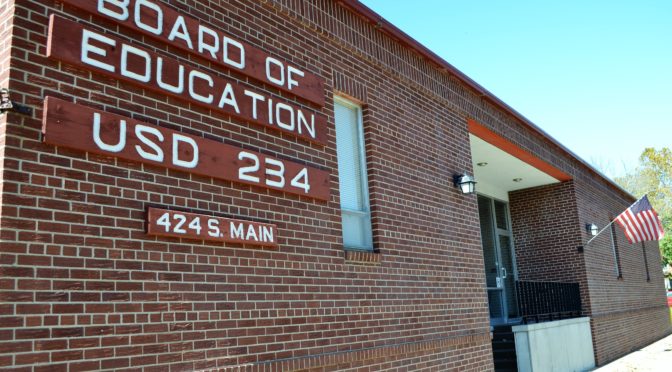
USD 234 Demonstrates Academic Growth Across Core Subjects

USD 234 is proud to share academic progress reflected in the recent Kansas Assessment Program (KAP) results. These results demonstrate meaningful gains in Math, English Language Arts (ELA), and Science.

Over the past several years, USD 234 students have steadily improved proficiency rates on the state assessments required by KSDE. Proficiency status represents students mastering grade level standards that are included on the state assessment each spring. USD 234 now ranks near the top of other Southeast Kansas League schools in multiple subject areas. In Math and ELA, Fort Scott’s proficiency levels have climbed consistently, placing the district among one of the strongest performers among other Southeast Kansas League schools for the 2024–25 school year. Science results also reflect sustained and consistent growth over the last few years.

These results reflect the dedication and hard work of all USD 234 staff. This is also a reflection of each students’ commitment to continuous learning. We are thankful for these individuals’ efforts each and every day.

More detailed assessment information is available through the Kansas State Department of Education Report Card at datacentral.ksde.gov.”


KS Legislative Hotline: Information For Legislative Sessions

All-Year Access to the Kansas Legislative Hotline

Powered by the State Library of Kansas

TOPEKAKansans are encouraged to call the Legislative Hotline, 1-800-432-3924, for information about the 2026 Kansas Legislature and legislative sessions, as well as past sessions. Kansas’ Legislative Hotline can also be accessed by emailing [email protected] or using the chat online, library.ks.gov/chat. The Legislative Hotline is a trustworthy resource for state residents with questions about the Kansas Legislature and is staffed by skilled librarians.

The Legislative Hotline is Kansas’ one-stop resource to learn who their legislators are, acquire up-to-date legislative contact information, check the status and history of bills, understand the legislative process, locate historical information and other inquiries related to Kansas government.

“It is essential for Kansans to have accurate and timely information about their state government and the issues they care about,” said State Librarian Ray Walling. “By using the Legislative Hotline, Kansans will access the information they need from a trusted source, trained librarians from their own State Library.”

Kansas residents can connect with the Legislative Hotline by phone, chat or email: 

Live Legislative Hotline assistance is available Monday through Friday, 8 a.m. to 5 p.m. Messages left via voicemail or email are promptly returned on the next business day. Additionally, Kansans can engage in real-time conversations with librarians through the Ask a Librarian service at library.ks.gov/chat, Monday through Friday, 8 a.m. to 5 p.m. TTY users can dial 711 for assistance.

The State Library of Kansas supports the informational needs of government entities and the people of Kansas and serves as a repository for government publications. Through the coordination of statewide resource-sharing initiatives and grant programs, the State Library plays a crucial role in strengthening public libraries. The State Library of Kansas also oversees the Talking Books program, which provides specialized materials and support services to qualifying Kansans. Learn more at library.ks.gov.


School Board Recognition Month

Unified School District 234

424 South Main

Fort Scott, KS 66701-2697

www.usd234.org

620-223-0800   Fax 620-223-2760


DESTRY BROWN Superintendent                                                                                                                                

TERRY MAYFIELD                                                                                                              Assistant Superintendent


Join us in thanking our Board of Education

January is School Board Recognition Month, and our school district would like to thank each of our board of education members for their incredible service to our community and our public schools.

School board members in USD 234 develop policies and make important decisions that help shape the future of our education system.

This January, please join us as we thank our school board members for volunteering their time, their passion for serving our district and for advocating on behalf of every child in our community.

The board members serving USD 234 and their years of service are:

David Stewart – President          Stewart Gulager – Vice President

Doug Hurd                                 Nick Barrows

Mike Miles                                  Phil Jackson

Rory Chaplin

Sincerely,


Destry Brown

USD 234 – Fort Scott

Legislative Update by State Senator Caryn Tyson


January 16, 2026


…and they’re off.  Well, that’s what the first week of session was like.  Committee meetings were the big focus.  The Governor’s State of the State was also the first week of session, which was unusual.  Who knows why she gave her last one early in session.  Most likely because she has heard what most legislators have heard – it is going to be a short session because a few in leadership are running for statewide office.  The Senate President has said it will not be a shortened session and that we will use the 90 days as defined in the Kansas Constitution (even numbered years can only last 90 days).  That is good because there is plenty of work.


Property Taxes have reached a boiling point.  The appraisal system is not always accurate, and some local government officials continue to deny that there were property tax increases – when we all know we are paying more.  The Senate Tax Committee had hearings on Senate Concurrent Resolution (SCR) 1616, Cap Assessment-value Protection (CAP) Amendment, to cap your annual assessment value increases to 3% or less with a base year of 2022, and the capped assessment value would transfer with the property when it sells.  The CAP Amendment is a constitutional amendment that would help rein in sudden property tax jumps on individual properties.


The Governor was silent on property taxes in her State of the State speech.  As you know, it takes a supermajority in each chamber for a constitutional amendment and then a vote of the people.  Other legislation takes a simple majority in both chambers and the Governor or a supermajority to override a Governor’s veto.  It took a few years to pass income tax cuts, including exempting Social Security from state income tax and a property tax freeze for seniors in need and disabled veterans.  I am working diligently with numerous colleagues to achieve property tax relief and to repair a broken system.


Redistricting it appears there are not enough legislators who want to tackle redistricting of U.S. Congressional seats in Kansas.  There has been much national attention on the issue, and several states are moving forward on the effort – red and blue states.  It is not to be taken lightly, and it appears it will not happen in Kansas.


Waste and Fraud have national attention.  Concerns about welfare fraud in Kansas, fueled by taxpayer frustration and high-profile cases like Minnesota, are resulting in much needed increased reporting and investigations.  SNAP (food stamps) and TANF (welfare cash assistance) benefit cards have been hacked in Kansas with card readers that steal card numbers and PINs, allowing a clone card to drain the funds.  In Kansas, it’s mainly being reported in the KC and Wichita areas.


KSLegislature.gov has bill information, a list of legislators, videos of committee meetings and floor debates, and much more available information.  My email address is [email protected] or phone number during session is 785.296.6838.


It is an honor and a privilege to serve as your 12th District State Senator.

Caryn


U.S. Congressman Derek Schmidt’s Newsletter

Rep. Derek Schmidt's header image

Friends,


While there is still much work to be done, it was a rewarding week in Congress as several commonsense bills advanced, some becoming law, and Americans’ tax dollars are being handled with much greater care and transparency than has been the case in many years.

On Monday, the House of Representatives passed H.R. 909, the Crime Victims Fund Stabilization Act, a bill I had the pleasure to co-lead with Congresswoman Ann Wagner (MO-2). When I served as Kansas attorney general, I oversaw critical support services for crime victims and their families. These services are vital to support victims of rape, domestic violence, and child abuse. Our bill will stabilize funding for these services for several years until a permanent fix to declining funding can be agreed upon. I appreciate the House approving our bipartisan legislation with broad support and hope for a similar outcome in the Senate to get our bill to President Trump’s desk.

Rep. Derek Schmidt (KS-2) speaking on the House floor on the Crime Victims Fund Stabilization Act (H.R. 909). Click here to watch remarks.

Earlier this week, the House also passed S. 269, the Ending Improper Payments to Deceased People Act, sending it to the President. This bill makes permanent the Trump administration’s priority of eliminating government payments to deceased individuals by tearing down bureaucratic walls that have allowed those who commit fraud to hide their misconduct. I was proud to join my colleagues in both political parties in supporting this bill. In my view, its just common sense.

On Wednesday, I cosponsored the American Dream Act (H.R. 7051), which would allow individuals 65 or older to sell any real property, including rental houses, with a sales price of $500,000 or less to a first-time homebuyer without the sale being subject to capital gains tax. In my view, removing the capital gains tax on sales to first-time homeowners will help increase the supply of houses available for first-time buyers by encouraging owners of those houses to sell to first-time buyers. This is a creative and reasonable step to make homeownership possible for more new buyers, and I am proud to be an original cosponsor on this bill.

Funding annual government operations through the ordinary appropriation process that is open and transparent is progressing. The House passed Wednesday night two more annual appropriation bills – National Security and Department of State & Financial Services and General Government (H.R. 7006) – that fund operations of the federal government. This brings to 9 the total number of annual funding bills that have passed the House (there are 12 in total).

On Thursday, the Senate passed the three appropriation bills that had passed the House last week with bipartisan support – Commerce, Justice, and Science; Interior and Environment; and Energy and Water (H.R. 6938). They will now make their way to the President’s desk.

My goal in the appropriations process is to reduce overall federal spending as much as possible because of the urgent need to slow the explosive growth of the federal government. Once Congress has an agreement on how much spending can be reduced and still pass the appropriation bills, then my focus becomes fighting hard to make sure our priorities in the Second District are fully considered within those limits.  So far in this Congress, I have secured funding for the following district priorities:

  • Crawford County: $5.1 million for research and commercialization at Pittsburg State University, including $1.5 million for the Center for Graphene, $1.5 million for the Center for Commercialization, and $2.1 million for the Kansas Cyber Security Institute.
  • Shawnee County: $750,000 for expanded mental health services for the Shawnee County Department of Corrections
  • Leavenworth County: $1.25 million for water distribution system improvements for Leavenworth Waterworks
  • Montgomery County: $4.0 million for water distribution system improvements for Caney. Schmidt secured this funding in close cooperation with Senator Jerry Moran (R-Kan.)
  • Labette County: $2.3 million for public safety modernization for Parsons
  • Marion County: $600,000 for fire station modernization for Hillsboro
  • Neosho County: $668,975 for medical imaging equipment and department modernization and related community health needs for the Neosho Memorial Regional Medical Center

Funding for other Second District community priorities is pending in the remaining bills that have not yet passed.

Constituent Services

My team stands ready to help Kansans in the Second Congressional District who are dealing with unresolved federal issues. This includes assistance with the VA, Social Security, the IRS, and other federal agencies.


If you are experiencing an issue with a federal agency and need assistance, please call my office at (785) 205-5253 or fill out the form on our website.


New Preschool Facility Is Expected by December 2026

Exterior work at 904 S. Horton. Submitted photo.

USD234 Assistant Superintendent Terry Mayfield provided an update  on the district’s new preschool facility at 904 Horton, which has been an ongoing project for several years.

This former medical clinic is being transformed into a modern preschool.

Background on the Project
“The district purchased the building during the 2023–24 school year with the long-term goal of creating a dedicated early childhood and preschool facility,” Mayfield said in a press release. “Following the purchase, the project timeline extended longer than originally anticipated for several reasons: the previous owner/tenant remained in the building through Fall 2024, which delayed demolition and construction activities. Once the building was fully vacated, the district completed demolition of the first floor to open the space for preschool use.”

Additionally, as the project moved forward, the scope was revised due to budget constraints, updating designs with engineers and architects, addressing structural needs (excavation, foundation waterproofing,  and drainage improvements), he said

“While these steps added time, they are important to ensure the building is safe, functional, and durable for long-term use as a school facility,” he said.

About the Program

“The Fort Scott USD 234 preschool program provides early childhood education for young learners, with a strong focus on school readiness, social-emotional development, and foundational academic skills,” said Mayfield. “The program also serves as the district’s early childhood special education site, supporting students with identified disabilities as well as children considered at risk.”

The current preschool center is located at 409 S. Judson. Services for the district’s preschool program are located at this site and also Winfield Scott Elementary School.

“Bringing these services together in one purpose-built facility will improve coordination, accessibility, and overall support for students and families,” he said.

Exterior work on 904 S. Horton by the Fort Scott School District in preparation for use as a preschool. Submitted photo.
Exterior work. Submitted photo.
Interior work at 904 S. Horton. Submitted photo.

Current Status and Timeline
“Excavation and waterproofing work is currently underway, with interior shoring in the final stages of approval. Once approved, shoring installation is expected to begin in mid-January and be completed within a couple of weeks. Architectural plan development is ongoing, with a revised timeline targeting final plan approval and submission to the construction manager, Crossland Construction, by June. Bidding and Board approval of pricing are anticipated in July, followed by a late July construction start. Project completion and turnover to the district are projected for late November to early December 2026.”

“In addition, playground equipment for the site has already been manufactured and is ready for delivery. Installation is planned for late January or early February, with an on-site coordination meeting scheduled to finalize logistics and align the work with ongoing site activities.”

Current Enrollment and Capacity
“The preschool program currently serves approximately 120 students. Enrollment typically grows throughout the school year as children age into the program. At present, the district operates two preschool classrooms in the existing preschool building and utilizes two additional classrooms at Winfield Scott Elementary to accommodate enrollment.”

“The new facility will initially include four dedicated preschool classrooms, allowing the district to fully serve current enrollment in one centralized location. The building has also been designed with future expansion in mind, including the potential to add an additional classroom as enrollment needs grow.”


Terry Mayfield. Submitted photo.


Terry Mayfield, Assistant Superintendent
Fort Scott USD 234 can be reached at
620-223-0800 or