The Uniontown School District Don’t Quit Fitness Center is open to the community, with stipulations.
“To be able to use the fitness center, you would need to be a resident of our school district or have students that are attending,” West Bourbon Elementary School Principal Vance Eden said.
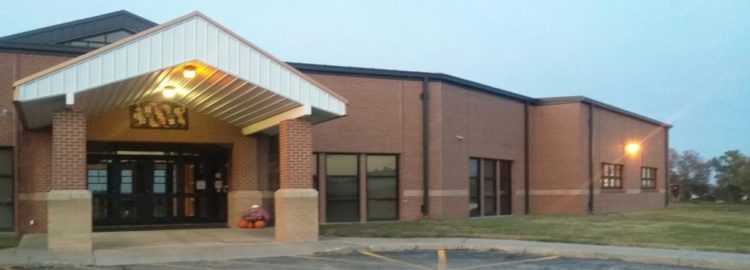
The fitness center is located in the junior high wing of the school. Pictured here, it is the area with the light, to the right. Entrance is a door on the east of the fitness center.
Eden is the contact person to get a key-card.
School district patrons must pay a for a card.
“There is a $10 fee that applies when the account is activated and the card is programmed for use at the fitness center,” Eden said. “The only other time there would be a fee is if the card is lost or destroyed.”
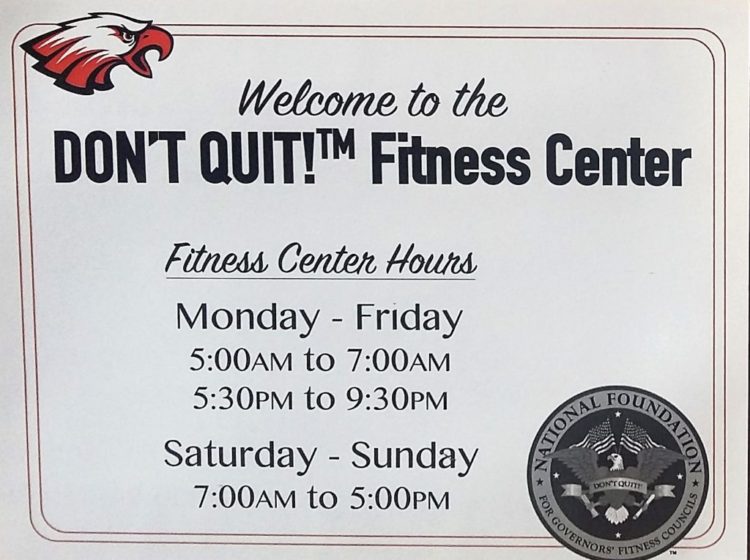
The hours are from 5-7 a.m. and 5:30-9:30 p.m. Monday through Friday and 7 a.m. to 5 p.m. Saturday and Sunday.
Students in the district are using the center during school hours for physical education classes.
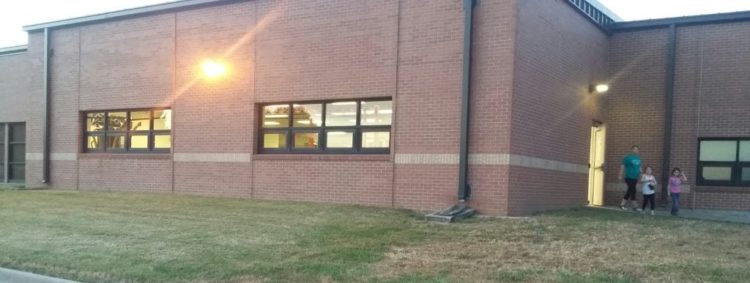
A family leaves the fitness center on Tuesday evening. They are leaving through the acess door, which is located on the east side of the fitness center.
Those who are granted access to the center may find their key-card temporarily disabled as the rules and regulations change.
Users will need to sign a new form in order to be able to use the facility.
If the key-card isn’t working, email Eden at veden@uniontown235.org.
The problem will be worked on the next business day, according to a sign on the fitness center door.
An American Red Cross Blood Drive will be at Buck Run Community Center, 735 Scott from 1 to 7 p.m. Thursday, Oct. 25 and 9 a.m. to 1 p.m. Friday, Oct. 26.
Please call 620-223-5946 to schedule an appointment.
According to Bob Weaber, K-State Research and Extension Professor and Cow-Calf Specialist, Dr. Weaber, Dr. Dustin Pendell from the Department of Agricultural Economics, Dr. Bob Larson and Dr. Brad White from the Kansas State University College of Veterinary Medicine Beef Cattle Institute have been recording a weekly podcast called BCI Cattle Chat.
The podcast can be downloaded on your smartphone or online at https://ksubci.org/media/podcast. Recordings began in May of this year, and now include over 20 podcasts with topics such as: should we test forage and why, challenges of bull buying, advocacy in agriculture, and selecting replacement heifers.
Dr. Weaber States “we feel like we’ve kinda hit our stride, and want to share this audio resource with you. If you’re not already a listener, please give it a whirl. If you are already a listener, send us some feedback: what you like, don’t like, or think we should discuss”.
BCI Cattle Chat is always on the lookout for new material and guests. Please send topic ideas and guest suggestions to your local extension agent, and ask him or her to forward these suggestions to the Beef Cattle Institute.
The most current sessions include a podcast featuring Southeast Area K-State research and Extension Beef Specialist Dr. Jaymelynn Farney, from Parsons, and a podcast featuring a sports dietician from the Kansas State University training table.
“I am pleased to have the Crawford Street Church of Christ produce this Friday’s concert,” Ralph Carlson, organizer of the free Friday Night Concerts at Heritage Park.
“Their acapella music is a real treat to hear and the songs they do are songs that are familiar to the audience,” he said. “It often ends up with the entire audience taking part in the singing.”
In the event of inclement weather, the show will be moved indoors from the regular location at First and Main Streets to The Common Grounds Coffee shop on Main.
The concert starts at 7 pm.
“Come early as seating is limited. You might want to bring lawn chairs,” Carlson said.
Carla Nemecek is Southwind District Director and agent.
Submitted by; Carla Nemecek, Southwind Extension District Director
For Release: Week of October 22, 2018
Unpredictable weather, falling net farm income, spotty health care services and a host of other factors can make for incredible stress on farms and in rural communities. Many of the factors causing sleepless nights are beyond an individual’s control, yet there are often ways to manage the stress, according to North Dakota State University family science specialist Sean Brotherson.
“People will power through even if they don’t feel well,” said Brotherson, speaking at a recent K-State Research and Extension workshop in Manhattan. “There’s a cost to that. You can’t put your health or relationships on the back end for long without consequences.”
The most important asset of any agricultural operation is the health and wellness of the farm operator, said Brotherson, who also presented a workshop on the same topic in Dodge City.
Farming and ranching ranks in the top 10 of the most stressful occupations. That stress can lead to depression, anger, health concerns, failed marriages, loss of friendships or relationships with family members, alcohol or substance abuse or worse.
“When we talk about farm safety, we often talk about accident prevention but we tend to neglect talk about mental and emotional health,” Brotherson said, adding that’s a mistake.
Despite the overall U.S. economy booming, the farm economy has been in a slump the past several years: “This great economic condition is not translating into a good farm economy. Many farmers are very good at what they do, yet some still find themselves in situations that they can’t control,” Brotherson said.
Net farm income, a broad measure of profits, is forecast to decrease $9.8 billion (13.0 percent) from 2017 to $65.7 billion in 2018, after increasing $13.9 billion (22.5 percent) in 2017, according to an August report from the U.S. Department of Agriculture’s Economic Research Service.
Net cash farm income is forecast to decrease $12.4 billion (12.0 percent) to $91.5 billion. In inflation-adjusted 2018 dollars, net farm income is forecast to decline $11.4 billion (14.8 percent) from 2017 after increasing $13.0 billion (20.3 percent) in 2017.
If realized, inflation-adjusted net farm income would be just slightly above its level in 2016, which was its lowest level since 2002.
The situation is taking a toll, Brotherson said. Some feel extra pressure because their farm has been in the family for generations and they don’t want to be the one to lose it.
“Stress signals are like the warning lights blinking on your truck’s dashboard,” Brotherson said. “We often want to ignore them but at some point there is a price to pay – a heart attack, broken relationships, depression or worse. You maintain your car to keep it running properly. You have to maintain your health, too.”
Coping strategies include things that help you unwind, include exercise, getting enough sleep, hobbies, or reaching out to someone for support or help – a friend, a counselor, or a loved one.
This is part of a series introducing the candidates in the November 6 election
State Representative, 2nd District (vote for one)
Adam J. Lusker Sr. 452 S. 210th St. Frontenac 66763 Democratic
Kenneth Collins 102 E. 1st Street Mulberry 66756 Republican
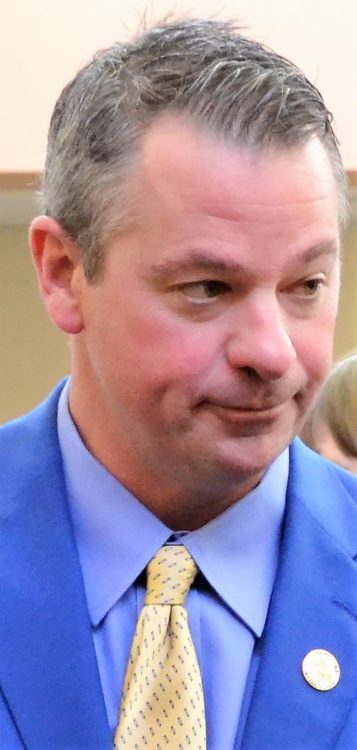
Adam Lusker
Name: Adam J. Lusker Sr.
Age: 46
Position running for: 2nd District Kansas State Representative
Residence: Frontenac, KS
Occupation: Mason
Community involvement:
Member of the following: American Legion Post 43, Frontenac Rotary, Frontenac Unified Methodist Church, Sacred Heart Church, Elks Lodge, Masonic Lodge 187, Mirza Temple Shrine, Scottish Rite, Former Member of Frontenac Education Foundation and USD 249 School Board, 25-year business owner
Party affiliation: Democrat
What is the biggest issue, if elected, and how do you plan to address it?
Maintaining a consistent revenue source, to ensure our budget is balanced and meets the needs of our community.
Give your views on the sales tax.
Sales taxes are regressive taxes. Higher sales taxes affect people’s buying power in a negative way, especially our lower and fixed-income citizens. Therefore, food sales tax impacts these same folks adversely. Our sales tax also puts border counties like ours at a disadvantage economically in regard to retail sales, food, mercantile, equipment, etc, with our neighboring state. I think we should work to reduce food sales tax, as well as sales tax in general as other sources of revenue, are realized.
Give your views on legalizing marijuana.
I do not believe Kansas is ready for legalizing marijuana. Several states are still continuing to deal with legal marijuana. We were a test site for a very costly tax plan; I think we should let other states be the petri dish on this experiment.
Give your views on health care for our state, including Medicaid.
We should continue to find ways to reduce health care costs, increase access to medicine and promote wellness in our state. Regardless of anyone’s opinion of the Affordable Care Act, it is law and Kansas has to take advantage of all we can to keep our hospitals open. Kansas taxpayers have sent over $3 billion of our money to other states to expand Medicaid. The numbers show that expanding Medicaid would have a positive impact on our healthcare systems and our communities.
Give your views on abortion and Planned Parenthood.
I have a pro-life voting record and will continue. I think we should continue to invest in adoption and education to prevent unwanted pregnancy.
10:00-10:30-Terry Sercer-Audit letter and 2018 budget balances
10:15-Budget Discussions
10:30-10:45-Bill Martin-Executive Session
10:45-Discussion about Fencing
11:00-12:00-Justin Meeks
Executive Session-Privileged in the attorney-client relationship-30 min.
Executive Session-Personnel matters of non-elected personnel-30 min.
12:00-1:30-Commissioners gone to lunch
2:30-2:40-Future of Bourbon County Health Care Updates
Updates of Meetings
2:45-3:15-NRP
Justifications for Executive Session:
Personnel matters of individual non-elected personnel
Consultation with an attorney for the body or agency which would be deemed privileged in the attorney-client relationship
Matters relating to employer-employee negotiations whether or not in consultation with the representative(s) of the body or agency
Confidential data relating to financial affairs or trade secrets of corporations, partnerships, trusts and individual proprietorships
Preliminary discussions relating to the acquisition of real property
Matters relating to the security of a public body or agency, public building or facility or the information system of a public body or agency, if the discussion of such matters at an open meeting would jeopardize the security of such public body, agency, building, facility or information system
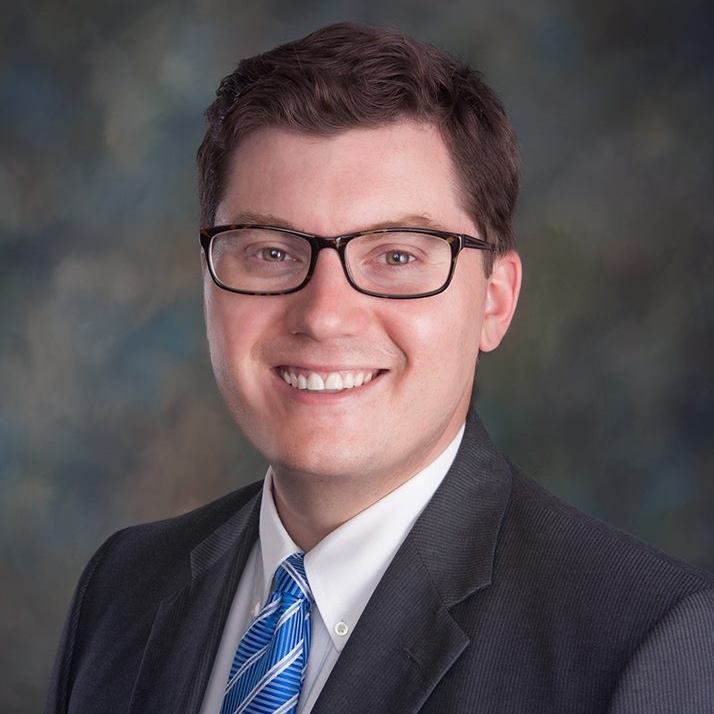
Candidate for the position of Kansas State Treasurer
Place of residence: Topeka, Kansas
Current occupation: Kansas State Treasurer
Community involvement: Various church and community-related activities.
Party affiliation: Republican
What is the biggest issue, if elected, and how do you plan to address it:
Having served as State Treasurer for the last year and a half, I am proud to say that we improved the services offered to all Kansans while saving the taxpayer’s money.
I have taken the time to analyze agency operations, allowing us to find innovative solutions, efficiencies, and streamline processes.
For example, this last fiscal year we set a record for the most unclaimed property returned to Kansans’ in a single year by more than 12%. We have put over $37 million back into the pockets of Kansans.
Our Learning Quest 529 Education Savings Accounts were ranked Top 5 in the nation by Forbes.
We also launched the ABLE savings program for individuals living with a disability and enhanced it with legislation.
Additionally, we launched a brand new, user and mobile friendly website that improves the claims process and allows for direct deposit.
All of these things have been accomplished while decreasing the square footage of the office and reducing the budget.
I list these things because not only am I running for State Treasurer, but I have a proven record of success in the office. If elected to a full-year term, I will continue to look for ways of providing a better service at the best possible cost.
Give your views on food sales-tax:
Prior to becoming State Treasurer, I was honored to represent Fort Scott in the Kanas Senate. While in the legislature, I repeatedly voted to remove and/or reduce the sales tax on food.
Give your views on legalizing marijuana:
While in the legislature, I voted against the legalization of recreational marijuana.
Give your views on healthcare – including Medicaid:
Access to quality healthcare is a critical issue to Kansans, especially in our rural areas. Costs continue to increase and many Kansans are struggling to pay their bills. This is something families across our state grapple with daily, specifically, my heart goes out to the Ft. Scott community as they cope with their recent decrease in healthcare access. I believe we can find Kansas based solutions that increase access and affordability.
Give your views on abortion and Planned Parenthood:
I am pro-life and have a 100% pro-life voting record with Kansans for Life. My wife Suzanne and I are proud members of the pro-life generation because we believe women and their unborn children deserve better than abortion.
The vast majority of Kansans do not want their hard-earned tax dollars going to subsidize abortion providers like Planned Parenthood. My voting record on this issue is clear.
Monday, October 22, 2018
Ellis Fine Arts Center on the Campus of FSCC
Doors Open 5:30 p.m., Forum Begins 6:00 p.m.
FORT SCOTT – The Fort Scott Area Chamber of Commerce announces a Candidates’ Forum for the 2018 General Election will be held Monday, October 22nd at the Ellis Fine Arts Center on the campus of FSCC, 2108 S. Horton. The doors will open at 5:30 pm and the forum will begin at 6 pm. Attendees are invited to arrive early to meet and greet the candidates.
Races that have been invited to the forum include Governor/Lt. Governor, U.S. House of Representatives District 2, Secretary of State, Attorney General, State Treasurer, Commissioner of Insurance, Kansas Senate District 13, Kansas House of Representatives Districts 2 and 4, State Board of Education District, Bourbon County Commissioner District 1, Bourbon County Attorney, and Bourbon County Treasurer.
The general public may submit questions to the Chamber prior to the event by submitting them via email to information@fortscott.com or dropping them off at the Chamber, 231 E. Wall Street, by 12:00 p.m., Monday, October 22nd. There will also be information presented at the forum on the “Liquor by the Drink” local issue that will be on the ballot for Bourbon County.
The forum will run in the hierarchy of offices from the federal, state, then local level. Candidates will have the opportunity to make a one-minute opening statement and two-minute closing statement. Three questions will be asked of each candidate, with each candidate being allowed one minute to respond. Individuals representing candidates, not in attendance will be given an opportunity to make up to a three-minute statement.
For more information please contact the Fort Scott Area Chamber of Commerce at (620) 223-3566.
10:45-11:00-Christi Keating-Mercy EMS and Mercy closing
11:00-12:00-Justin Meeks
Executive Session-Privileged in the attorney-client relationship-30 min.
Executive Session-Personnel matters of non-elected personnel-30 min.
12:00-1:30-Commissioners gone to lunch
1:30-2:00-Joe and Barbara Peine-Memorial for Harold Coleman
2:00-2:15-Bill Martin-purchase of fence
2:15-2:25-Future of Bourbon County Health Care Update
2:25-2:40-Executive Session-Preliminary discussion relating to the acquisition of real property
2:40-3:00-Executive Session-Data relating to the financial affairs or trade secrets of corporations, partnerships, trusts, and individual proprietorship
Justifications for Executive Session:
Personnel matters of individual non-elected personnel
Consultation with an attorney for the body or agency which would be deemed privileged in the attorney-client relationship
Matters relating to employer-employee negotiations whether or not in consultation with the representative(s) of the body or agency
Confidential data relating to financial affairs or trade secrets of corporations, partnerships, trusts and individual proprietorships
Preliminary discussions relating to the acquisition of real property
Matters relating to the security of a public body or agency, public building or facility or the information system of a public body or agency, if the discussion of such matters at an open meeting would jeopardize the security of such public body, agency, building, facility or information system
This is part of a series featuring candidates in the Nov. 6 election.
State Representatives, 4th District (vote for one)
Lawrence Forbach 305 Dement Street Mound City 66056 Democratic
Trevor Jacobs 1927 Locust Rd Fort Scott 66701 Republican
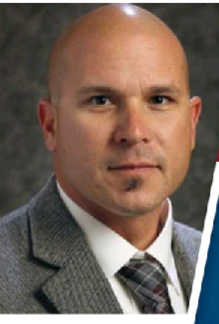
Name: Trevor Jacobs
Age: 42
Candidate for the position of 4th District Kansas House of Representatives
Place of residence: Fort Scott Ks
Current occupation: BNSF Railway
Community involvement:
Preach on KMDO 1600 AM, KOMB 103.9 FM, Sunday mornings, for the radio broadcast Jesus Saves Ministries, preach at Linn County, Mound City Jail, Fort Scott Country Place, Fort Scott Guest Home Estates, Fort Scott Medical Lodge, and have a Bible outreach program, with Jesus Saves Ministries.
Party affiliation: Republican
1) What is the biggest issue, if elected, and how do you plan to address it?
To stand for our God-given rights of “Life, Liberty, and the Pursuit of Happiness.” I stand to protect our constitutional freedoms. To stand for true American and Kansas traditional values that have made this nation and state great. I stand for the life of the preborn and the protection of the elderly. I stand unashamedly for Biblical morality. I stand for our God-given right to protect ourselves, our families, and our property from government intrusion.
2) Give your views on food sales tax:
I oppose sales tax on food. I voted every time to abolish the sales tax on food. This issue had been introduced and debated multiple times, in the Kansas House Chamber and was voted down everytime by the liberal fringes of both parties. If it wasn’t for partisan politics this issue would have already been resolved.
3) Give your views on legalizing marijuana:
I oppose legalizing marijuana.
4) Give your views on health care for our state, including Medicaid:
This is a very important topic and issue and when considering the future of our healthcare system, the state has put itself in obligation to provide a safety net of healthcare to the elderly, disabled, and the poor. This program is taxpayer funded. It is extremely important to maintain the mindset that there must be serious checks and balances and a degree of accountability with the healthcare programs. Healthcare is not about the quantity of recipients on a particular plan, but of the quality of healthcare that the recipients are receiving.
5) Give views on abortion and Planned Parenthood:
I oppose the murder of children in the womb and I strongly believe it is contrary to the traditional values of the Founding Fathers and documents of this nation. “Life, Liberty, and the Pursuit of Happiness.” God has formed and created every person for a purpose and a plan.
As for Planned Parenthood, I believe they do not deserve any taxpayer money…given the chance, I would vote to defund Planned Parenthood.