Category Archives: Bourbon County

Uniontown Collaboration: New Health Clinic Coming

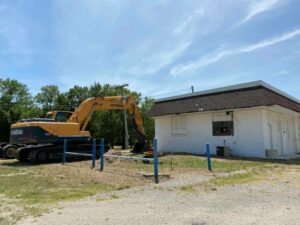
Mark Warren, Uniontown Ruritan member, opens the door of the proposed medical clinic just south of the football field.

A community collaboration of Uniontown Ruritan, Girard Hospital, USD 235 School District, Bourbon County Commission, and the City of Uniontown have been working to get a health clinic in the small town in western Bourbon County.

It’s been a long time coming.

Uniontown Mayor Larry Jurgensen had tried to get a medical clinic here several years ago, Mark Warren said.  Warren is a Ruritan Governor and member of Uniontown Ruritan.

Mark Warren, Uniontown Ruritan Member and initiator of the most recent medical clinic idea sits at a table in the proposed clinic on Feb. 18, during an interview with fortscott.biz..

“Mercy Hospital had no interest at that point,” Warren said.

Even before Mercy Hospital Fort Scott closed in Dec. 2018, Warren had been thinking about initiating a medical clinic in Uniontown, but when the hospital closed, “I thought this is bad, no hospital, nor a clinic,” he said.

Someone mentioned to Warren that Uniontown resident Holly Koch is the Chief Financial Officer of Girard Hospital and about 1.5 years ago he visited with Koch about the issue. Koch said she would visit with the CEO Ruth Duling and a meeting was set up.

Girard Hospital is 31 miles from Uniontown.

Uniontown is 19 miles from Fort Scott, 25 miles from Iola, both sites of  the nearest health care clinics. The clinic would serve western Bourbon County, eastern Allen County, northeastern Neosho County and northern Crawford County rural residents, Warren said.

“They came and we presented some statistics,” Warren said. Since then there have been approximately eight meetings with various Girard Hospital staff and local entities to talk through the idea.

Locally, Warren, Jurgensen, U235 Superintendent Brett Howard, Uniontown Council President Jess Ervin, Uniontown City Clerk who is also U235 Board of Education Member Sally Johnson, Bourbon County Economic Director Jody Hoenor and Bourbon County Commissioner Lynne Oharah have been in the collaboration.

Warren, Jurgensen and Jurgensen’s wife, Judy, along with  Bourbon County  Commissioner Lynne Oharah, recently went before the Girard Hospital board to give a history of how the idea for a clinic came about.

The board was favorable to the idea, Warren said.

The proposed building for the medical clinic is south of the Uniontown High School Football Field.

On Feb. 17, members of the collaborative group met at the proposed site on the campus of Uniontown High School, just south of the football field. Originally, the superintendents office, of late the building has housed the office of the school’s kitchen manager.

“They came, had the blueprints,” Warren said.

The hospital engineering staff will work on the design reconfigurement of the building into a medical clinic, Ruth Duling, Girard Hospital CEO, said.

Next will be getting materials, estimating the costs and raising funds to make the building into a medical clinic, Warren said.

There is no timeline for opening the clinic, Duling said.

Local volunteers will be helping with the labor of the building reconfiguration.

As soon as everything is in place, the hospital will begin the certification process to become a rural health clinic, Duling said.

Staff at the clinic will include a nurse practitioner and one other staff member, serving as both nurse and receptionist, Duling said.

Initially the clinic will be open 2-3 days a week.

“You don’t know until you do it,” if it will be feasible, Duling said. “It will be dependent on people to use the clinic and make it viable.”

One positive for the community:

“There are a lot of passionate people that want to see this come to fruition,” Duling said.


Homecoming Victories for Eagles Basketball Teams

by Adelay Martin, UHS Student Sports Media Reporter

The Uniontown Eagles faced the Pleasanton Blu-Jays on February 14 for our Homecoming basketball game. Both Varsity teams won, and so did both JV teams.

The Varsity girls beat the Blu-Jays 55 to 35. Scoring for this game was very even, all the Varsity starters and subs scoring at least one basket. Danielle Howard lead in points, scoring 23 over the course of the game. Howard also had 5 rebounds, 2 assists, and 7 steals. Karleigh Schoenberger had 8 points and 4 rebounds. Gwenyth Fry and Breleigh Harris each scored 6 points and had 3 steals; Fry also had 5 rebounds. Sammie Hampton had 5 points, 9 rebounds, and 3 steals. Coach Miller said, “It was another good night for the Lady Eagles. Glad to see some different girls step up tonight and impact the game. Our next contest will be Monday, February 17, when we face Southern Coffey County at home.” The game on the 17th will be our last home game for the season.

The boys’ Varsity also won against Pleasanton, with a score of 60 to 46. Jake Harvey scored 21 points and had 6 rebounds, 5 assists, and 2 steals. Clay Sutterby had 15 points and 6 rebounds, as well as 2 assists. Hunter Schaaf had 7 rebounds and 11 points. Luke George had 3 steals, 12 rebounds, and 10 points. “The 1st half was a little rough,” said Coach Hays. “We missed some layups and free throws, but our defense kept us in the game. We came out at half and got into a rhythm. I thought we did a much better job of sharing the ball, which opened up some good shots. I’m proud of boys and their resiliency.”

Foster Care Needs Of Bourbon County: What You Can Do

TFI Family Services of Kansas which has an office in Fort Scott at 710 W. 8th, Suite 203, provides child welfare services to Bourbon County.

There are several current needs of families involved with TFI, Crystal Walker, permanency support worker, said.

“We are looking for good quality foster homes,” Walker said. “Also full-time drivers to transfer kids to court, visitation with families, etc. and furniture for those who may have just found a house and don’t have furniture, some need clothing. It’s on a case by case  basis.”

To contact Walker, phone 620-371-8011 or email [email protected].

TFI partners with the State of Kansas to provide an array of services, Taylor Forrest, marketing specialist, said.

Besides foster care, adoption services are offered.

This includes recruitment, training and support of the homes.

Family preservation is there “If a family that needs extra help with parenting skills, we work with them to get them on the right track,” Forrest said.

There is a new program called Grow Nurturing Families that is offered, which is a parent-child interaction therapy, Forrest said.

It also offers the Family First Prevention Services Act services, Forrest said.

The following is from an interview with Forrest:

What does TFI stand for, the initials?

The Family Initiative  


What services do you provide the community?

TFI Family Services provides an array of services to the community including foster and kinship care, family preservation, domestic and international adoption, counseling support and education, TIPS-MAPP training and visitation and exchange centers.


Where located?

TFI Family Services has locations across the entire State of Kansas, but our CEO office is in Topeka, KS.


What are the needs currently?

The biggest need TFI has is for more foster parents. In Kansas, there are more than 7,600 children placed into out of home care.  There are approximately 2,000 foster homes in Kansas.  This disparity means that children from your community are being placed outside of their home community, or in shelters. Foster parents are one of our essential partners in providing quality services to children and families.


Additionally, families we serve have many needs, to learn more about how you can support kids, visit www.tfikidsfund.org.


Contact information?

If you are interested in making a difference in the life of a child by becoming a foster parent, please call us at 833-7FOSTER or visiting us online at www.tfifamily.org.


Statistics on number of children in foster care placement and those needing placement in Bourbon County?

The State of Kansas provides detailed reports of children in foster care, broken down by each county. In January 2020, there were 75 youth in out of home placement in Bourbon County. Here is a link to that report: http://www.dcf.ks.gov/services/PPS/Documents/FY2020DataReports/FCAD_Summary/PlacementbyCountyFY20.pdf


What does being a foster family entail?

All individuals interested in becoming foster parents are required to take TIPS-MAPP training. TFI walks alongside and supports all our foster parents so they can best care for the children in their homes. To learn more about foster parent requirements, visit www.tfifamily.org/start-here/


TFI Fort Scott Employees, from left to right: Stormi Rosete, Permanency Support Worker,; Crystal Walker, Permanency Support Worker; Jordan Flauding, Case Manager; Taya Drake, Case Manager; and Jordan Johnson, Case Manager. Submitted photo.


To learn more:

https://tfifamily.org/

Walk Kansas is back!

K-State Research and Extension Southwind District

Family Consumer Science

Joy Miller

620-223-3720 or [email protected]


March 15-May 9, 2020

Once again…it’s time for Walk Kansas! K-State Research and Extension has been offering this health initiative since 2001. Walk Kansas is a team-based program, designed to inspire you to lead a healthier life by being more active, make better nutrition choices, and learn positive ways to deal with stress.

New features for Walk Kansas 2020 include a Walk Kansas app. The app is being piloted in iOS format for iPhone and iPad and is free through the App Store. The app allows tracking activity and may be synced with a fitness tracker.

Newsletters and activities will focus on the Blue Zones nine lifestyle characteristics. Blue Zones are the places across the world where people live measurably longer and healthier lives. Physical activity, walking in particular, is the heart of Walk Kansas, participants will be introduced to the Mediterranean eating style, developing social connections that support healthy living, share ways to lower personal stress, focus on your sense of purpose, and more!

The last feature being introduced this year is badges that can be earned for logging your progress, checking online resources, and using the online system in several ways. The badges will appear on the account dashboard when earned.

How does Walk Kansas work? Walk Kansas is an eight-week team-based program. A group, up to six people, form a team with one serving as the captain. Teams can be family, coworkers, friends, community organization members, neighbors, or part of a faith-based community. Team members do not have to live in the same town, county, state or country.

Each team selects a goal, or challenge, they will collectively work towards. Beginning March 15th, log minutes of physical activity and amount of fruits/vegetables eaten each week. Participants also receive a weekly newsletter and motivational messages.

Take the first step, register for Walk Kansas. Online registration is available February 19 through March 15 at walkkansasonline.org. Paper form registration is available at your local extension office or download at southwind.k-state.edu/walk-kansas. If you do not have a team and would like to join one, register as an individual. You will be connected with a team that has similar goals. Cost is $10 per participant, youth K-12 are free.

For more information or resources, visit walkkansas.org or contact me at 620-223-3720 or [email protected].

Winter Ranch Management Seminar Series Coming Soon


Christopher Petty, M.S.
Extension Agent
Livestock Production and Forage Management
K-State Research and Extension
Southwind Extension District
210 S. National
Fort Scott, KS 66701
(620) 223-3720 Work
(620)224-6031 Cell
[email protected]


Attention cattle ranchers! The Kansas State University Winter Ranch Management Seminar series will take place on Thursday, February 27, from 5:30 until 8:30 pm. At the Woodson County 4-H building in Yates Center, Kansas.

The meeting will begin with a meal, and will feature several informative presentations such as “Value captured from improved production practices: What’s the sale data say” by Ester McCabe from Kansas State University. Other topics include “Forage sampling and testing” by K-State Research and Extension agents Christopher Petty and Wendie Powell, and understanding pregnancy loss in cow herds by Kansas State University Professor and Veterinarian Dr. Gregg Hanzlicek . The program will then finish up with a town hall style question and answer session featuring K-State Research and Extension beef cattle state specialists including Dr. Jaymelynn Farney and Dr. Robert Weaber.

A $10 registration fee is payable at the door, and we would ask that you would please pre-register by Feb 20. To pre-register to attend, or for more information contact Dale Lanham in the Southwind Extension District – Yates Center Extension office at 620-625-8620 or by e-mail at [email protected]. You may also contact Christopher Petty in the Southwind Extension District -Fort Scott office at 620-223-3720 or by e-mail at [email protected].

Bourbon County Commission Agenda Feb. 18

Agenda

Bourbon County Commission Room

1st Floor, County Courthouse

210 S. National Avenue

Fort Scott, KS 66701

Tuesdays starting at 9:00

Date: February 18, 2020

1st District-Lynne Oharah Minutes: Approved: _______________

2nd District-Jeff Fischer Corrected: _______________

3rd District-Nick Ruhl Adjourned at: _______________

County Clerk-Kendell Mason

9:00-9:45 – Jim Harris

10:00-10:15 – Justin Meeks, Tax Sale

10:15-10:30 – Justin Meeks, Executive Session – Consultation with an attorney for the body

or agency which would be deemed privileged in the attorney-client relationship

11:30-11:45 – Kevin Gleason, Wind Turbines

12:00-1:30 – Lunch

1:30-1:45 – Barb Peine, Wind Turbines

1:45-2:00 – Mike Wunderly, Wind Turbines

2:00-2:15 – Tim Emerson, Wind Turbines

2:15-2:30 – Ann Dare, Wind Turbines

Community Snapshot: Bourbon County Economy

The tagline for the 2020 Census is “Shape your future. START HERE.” Courtesy photo.

The 2020 Census is coming on April 1, 2020, and with it comes the opportunity to provide for community needs.


The data used is helpful because it impacts everything from school lunches to libraries to wastewater systems, Kansas Secretary of Commerce David Toland said in an April, 2019 press release.


It is vital to Kansas businesses and communities to have a full and accurate count of people living in the state, Secretary Toland said.


“Census results help determine how billions of dollars in federal funding flow into states and communities each year.

The results determine how many seats in Congress each state gets.

It’s mandated by the U.S. Constitution in Article 1, Section 2: The U.S. has counted its population every 10 years since 1790.” according to the census website.


The census gives a snapshot of communities.


For example, the per capita income in Bourbon County was $22,822 in 2018, according to  https://www.census.gov/quickfacts/fact/table/bourboncountykansas/PST045219


Per capita income is determined by dividing an area’s income by its population and counts each man, woman, and child, even newborn babies, as a member of the population.  Household income counts all people residing under one roof as a household, according to investopedia.com


In Bourbon County, the median household income is $40,733 in 2018, according to the census website.


People living in poverty account for 16 percent of Bourbon County’s population.


Snapshot of Bourbon County

To get a snapshot of the local economic scene, FortScott.Biz asked local business, school and government entities some questions on what their employees earn and what services they provide the community.


The information given is intended to  look at the wages in the  public and private sectors. It also includes services the entities provide.


The Bourbon County Courthouse.


Bourbon County

The county has a land area of 635 square miles, and in 2019 had 14, 653 people living here, according to the government census website.


The Bourbon County government has 112 employees.


Jody Hoenor is the economic development director for Bourbon County and is the highest-paid employee earning $70,000 a year.


The lowest hourly wage, $8.58 in the county, is for election board workers, according to files provided by Bourbon County Clerk Kendall Mason.


The county provides county law enforcement, emergency medical services (ambulance) in collaboration with the city of Fort Scott, road and bridge repair and maintenance, emergency preparedness, landfill, land deeds,  health department services, economic development services, appraisal services, Elm Creek Lake services.


For more information about the county, click below;

http://www.bourboncountyks.org/january-2020-minutes/

http://www.bourboncountyks.org/


USD 234 Board of Education Building, 424 S. Main


USD 234

USD 234 is the Fort Scott School District that provides education for pre-school through high school students.


It is also one of the biggest employers in the city.


“Currently we have 373 that we consider being full-time employees receiving benefits for our purposes,” Gina Shelton, USD234 Business Manager, said. “Full-time with the school is 630 hours a year or more which is the Kansas Public Employee Retirement System threshold. On a typical month, we run a payroll of 440 employees, which would include subs, recreation hourly, and other part-time help. The recreation department is a part of our budget and their employees are part of our payroll,” Gina Shelton, business manager of USD 234 said.


To view the USD234 Salary Schedule, which is on the website of the district:


https://core-docs.s3.amazonaws.com/documents/asset/uploaded_file/464450/USD_234_Salary_Schedule_19-20.pdf


To view the classified employees pay schedule:

https://core-docs.s3.amazonaws.com/documents/asset/uploaded_file/464459/Classified_Pay_Schedule_19-20.pdf


Ted Hessong, superintendent of the Fort Scott school district, is the highest-paid employee and earns $118,000 a year, according to the info provided by the district.


The lowest hourly wage in the district is for summer part-time not- on-contract and bus monitor employees, who earn $7.25 per hour, according to the info provided by the district.


Uniontown High School

USD 235

The Uniontown School District serves the area outside the Fort Scott district and the campus is located in western Bourbon County.

USD 235 provides education to pre-school through high school-age children and also has a fitness center for students and patrons in the district’s use.

“We have 123 employees on the payroll, with 79 full time,” Sherri Hartman, clerk for the district, said.

“The entry-level pay varies by position, but the lowest entry-level pay is 80% of $12.27 hourly. The highest entry-level pay is 80% of $19.65 hourly. Teacher placement is according to the salary schedule.”
“The highest earner is the superintendent, Brett Howard, at $95,350,” she said.
For information on the school district, click below:


Fort Scott Community College

Fort Scott Community College


Fort Scott Community College is a two-year college.


For January the FSCC payroll  had 173 faculty and staff, 56 adjunct instructors,  and 33 work-study students, Juley McDaniel, human resource director at the college, said.


The lowest entry-level wage for employees at FSCC is $9.50/hr. for full time regular staff employees working at an hourly wage.  FSCC has federal work-study students and tutors that are hired at a flat rate of $8.00/hr. and are part time student-filled positions.


“Median faculty salary is $41,967,” McDaniel said. “This does not count adjunct wages as they are paid per credit hour taught. Median staff wage is $37,450 when counting part time assistant coaches. This does not count student workers, but does take into account the migrant grant positions in other states where we serve as the fiscal agent. Median staff wage is $40,050 when not counting part time  assistant coaches. This does not count student workers, but does take into account the migrant grant positions in other states where we serve as the fiscal agent.”


To be considered full time for faculty is a bit different at the college level.


“Per the negotiated agreement between faculty and administration, full time entails 32-40 hours a week,” McDaniel said. “Our faculty fall into one of four categories – 169 day, 189 day, 209 day, and 12 month.”


Some of the services the college provides to the community:

The community service of student clubs and athletic teams, reading with elementary students, cleaning, supporting USD 234 activities like Family Fun Night, reading, first day of school welcome, fundraiser product disbursement , etc.   Over 6000 hours were clocked from athletics alone in 2018.  This doesn’t count student clubs like President’s Ambassadors, Phi Theta Kappa, Student Nurse Organization, McDaniel said.

Other services FSCC provides:

  • Bourbon county tuition waiver up to 15 credit hours per semester,
  • Bourbon County High School Waiver for any Bourbon County high school student taking a concurrent class for one KBOR-approved class,
  • Ellis  Fine Arts Center– school programs, community meetings, etc. (multiple use by school district including testing, theater),
  • Gordon Parks Museum – free to visitors and hosts school field trips to schools,
  • Student Success Center – computer, internet, and printer access (up to 10 pages free) for students and general public,
  • Library access,
  • Host annually Math Relays, Music Contest, National History Day, Aggie Day,
  • Cosmetology services through Cosmetology Program,
  • Continuing ed. classes for the public, specialized training for businesses as needed,
  • Walking trail and old Lincoln Schoolhouse are maintained by FSCC maintenance,
  •   Free Kid’s Fairs twice a year
  •    Home Show help
  •   Kid’s College once a year
  •  Parade participation
  • Cosmotology provides free haircuts for students
  •  Cosmotology provides free hairstyling  and manicures at nursing homes (Pittsburg)
  •   Zumba classes last year
  • Donations to community events, prom/after proms, and other events
  •  Band volunteers at the Veteran’s Day celebration


http://www.fortscott.edu/About


Fort Scott City Hall.


City of Fort Scott

Deb Needleman, Human Resource Director for the city gave the following information:


The highest-paid employee earns $107, 463- City Manager Dave Martin.


Earnings of part-time entry-level positions are for summer seasonal help-life guards and golf cart attendees, Needleman said.


The lowest full-time entry-level employee in the city is $21, 555 per year.


The city has 100 full-time employees.


The city provides police and fire services, emergency medical services(in collaboration with the county government), public water services, public works (including streets), parks, lakes, the LaRoche Ball Park, an aquatic center,  a golf course, an airport, community development, economic development, and a tourism office, according to information provided by Needleman.


To learn more about the city of Fort Scott, click below:

http://fscity.org/


The Fort Scott Public Library although not a department of the city, does receive MILL Levy funds which pass through the City of Fort Scott,  but the City is a pass-through only for those funds, Needleman said.


Buck Run Community Center (BRCC) is owned by the city and the city provides funds to maintain and operate it, the decisions about activities that are offered operates through the recreation board, Needleman said.


For a private sector view, Ward-Kraft, Inc. gave the following information.

Ward-Kraft, Inc.

Ward-Kraft, Inc. is one of the largest employers in the county and has six companies under its umbrella. It is not a public entity like the others featured.


Ward-Kraft Holding Company, Inc  includes Ward-Kraft, Fort Scott Munitions, KW Cattle, Reprologix, 4-States Sanitation, and Christian Learning Center and has 326 employees, according to Gina Staudinger, Chief Business Officer with Ward-Kraft.


Average work hours involve three shifts for production 7 am – 3 pm, 3 pm – 11 pm, 11 pm – 7 am.     Office hours vary between 7 am – 5 pm.     All full-time members are expected to work at least 40 hours per week, and overtime as needed, Staudinger noted.


The median wage for employees is $15.50.


Entry-level wages are    $10.00 – $11.81 per hour base but vary with previous job experience and position filled.    For office personnel  is it $10.26 – $15.60; off-line production – $10.00 – $16.30; press operators, collator operators, machinists, machine maintenance – $11.60 – $22.20.


Non-government entities are not required by law to supply information and Ward-Kraft said they do not share who the top earner is in the business.


To learn more about Ward-Kraft, click below:

http://www.wardkraft.com

Citizens are asked to complete the U.S. Census Bureau survey when received on April 1, 2020.


BoCo Democrats Meet Feb. 16

The Bourbon County Democrats will meet Sunday, February 16, at 2:30 p.m. at The Boiler Room Brewhaus, at the corner of Wall St and National Ave. 

 
At Sunday’s meeting, Jacki Prettyman will give a report on the Presidential Primary training session she attended in Wichita. The upcoming Washington Days in Topeka will also be discussed.
 
Though optional, a donation of a package of diapers is requested. This month, Democrats are collecting diapers to donate to The Beacon. This is part of the #DemocratsCare program, a monthly collection of donations for various local charities. Past donations have included winter coats, canned goods, and hygiene pantry items. 
 
For more information about the Bourbon County Democratic Party, visit their page on Facebook: facebook.com/BBCOdems.

Special Executive Session for County Commission for Feb. 14

Agenda

Bourbon County Commission Room

1st Floor, County Courthouse

210 S. National Avenue

Fort Scott, KS 66701


Date: February 14, 2020

1st District-Lynne Oharah Minutes: Approved: _______________

2nd District-Jeff Fischer Corrected: _______________

3rd District-Nick Ruhl Adjourned at: _______________

County Clerk-Kendell Mason

9:00 – Executive Session – Consultation with an attorney for the body or agency which would be deemed privileged in the attorney-client relationship (Lynne Oharah, Jeff Fischer,

Nick Ruhl and Justin Meeks)

UHS Basketball Wins Against Yates Center


By Addie Martin, Uniontown High School Sports Writer

The Uniontown Eagles and the Yates Center Wildcats went head-to-head in Tuesday’s game. Both Varsity teams came home with another couple of wins for Uniontown.

The girls’ Varsity beat the Wildcats 53 to 38. Danielle Howard scored 17 points this game, and Karleigh Schoenberger scored 18. They each had 8 rebounds, and Howard also had 7 assists and 3 steals. Sammie Hampton was another prominent player this game, scoring 6 points and rebounding the ball 5 times. Gwenyth Fry scored 7 points and rebounded twice. Breleigh Harris had 5 points, 1 assist, and 2 steals. “Extremely proud of how our team bounced back from a very disappointing loss last Friday,” said Coach Miller. “These young ladies chose to get better in practice on Monday, and it showed on the court tonight. On Friday, February 14, we will host Pleasanton for our winter homecoming.”

The boys’ Varsity also won against the Wildcats with a score of 53 to 43. This was a tense game for many players, as well as students past and present. Jake Harvey once more lead in points, racking up 21 during the game. Luke George scored 17 points. Both Harvey and George made half of their field goals; also, George made 2 three-point shots out of the 3 he took and was 9 for 10 on free throws. Drew Perry had 4 rebounds and 2 assists, Hunter Schaaf had 5 rebounds, and Clay Sutterby scored 8 points and had 11 rebounds. 20 of our points were made inside the lane. Coach Hays said, “The atmosphere for our game against Yates Center was awesome. It was great seeing so many Eagle fans travel to Yates Center to support our teams. I thought we got off to a slow start, but the boys responded well and played extremely hard. We shot the ball well and rebounded well tonight.”

K-State’s Tarpoff: Plan now to assure successful calving season


Stocking supplies, cleaning equipment are among management strategies


MANHATTAN, Kan. – Cattle producers who have not yet started the spring calving season still have time to plan ahead, and a Kansas State University veterinarian notes that could make a big difference in having a successful year.


“This is the time for a pre-emptive strike,” said A.J. Tarpoff, a beef veterinarian with K-State Research and Extension. “If you haven’t started calving yet on your operation, now is the time to start thinking about what you can do to be ready.”


Tarpoff noted that producers need to make sure they have the necessary supplies on hand, which may require buying or repairing items and facilities. Then, he adds, set in motion a plan to manage the birth of the new calves.


“Calving books are a phenomenal tool,” Tarpoff said. “It could be just a little pocketbook where you write down who calved, when they calved, if there was difficulty, and whether it was a male or female coming out. There is a lot of information that we can capture about the birthing process so that we’re able to make better decisions within our herd in the future.”


One of the newer management techniques that can lead to successful calving is to feed cows at dusk. “There have been several research studies that show reliable results that a higher percentage of animals are born during daylight hours when we feed the cow in the late evening hours,” Tarpoff said.


Feeding late in the evening, he said, will help decrease midnight or early morning births, which are hard on workers and can make the birth more complicated if there are difficulties.


Tarpoff hosted a series of calving schools across Kansas over the last several weeks to help the state’s producers be adequately prepared to bring in as many healthy animals as possible. The final session for this season was video-streamed on Facebook Live. A recording of that session can be seen on the K-State Research and Extension Facebook page.


One of his recommendations is that producers use a cooler to store tools and equipment: “On cold days and nights, the cooler will help equipment to stay nice and warm. We can close it up and know that our equipment is not going to freeze,” he said.


Tarpoff said producers should check calving chains or obstetric straps for rust, sharp spots or fraying. He also suggests having multiple sets on hand in case there are multiple births at once. The straps should be cleaned, disinfected and hung to dry after each use.


“Once those straps are dried, put them in a closed container so that you don’t re-contaminate them by accident,” he said. “Then, throw them back into your cooler kit.”


Producers should have a meeting with their local veterinarian to discuss situations that may occur, and what medicine or other supplies may be needed to handle those. “They can prescribe the products you’ll need and set you up to be a little more prepared,” Tarpoff said.


Producers can also contact their local extension agent or visit KSUBeef.org for more information on getting prepared for spring calving.