The April issue of the Uniontown High School Talon Newspaper is ready to view here:
Category Archives: Bourbon County
The Water Boil Order Is Lifted For Uniontown, KS
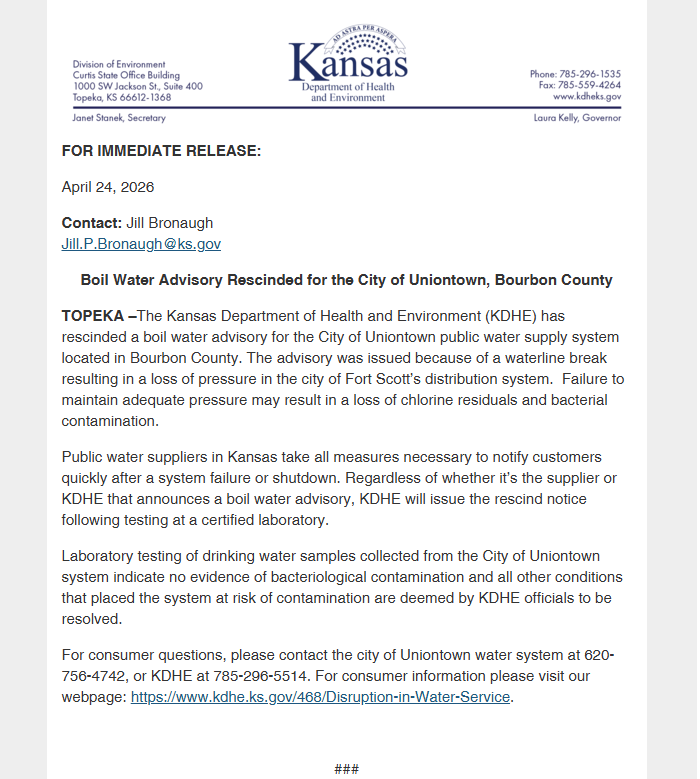
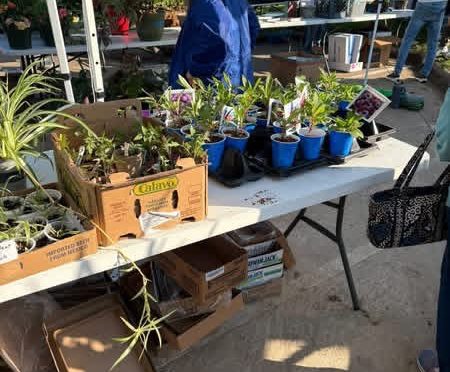
Get Planting: Bourbon County Garden Club Sale at Fort Scott Farmer’s Market on May 2
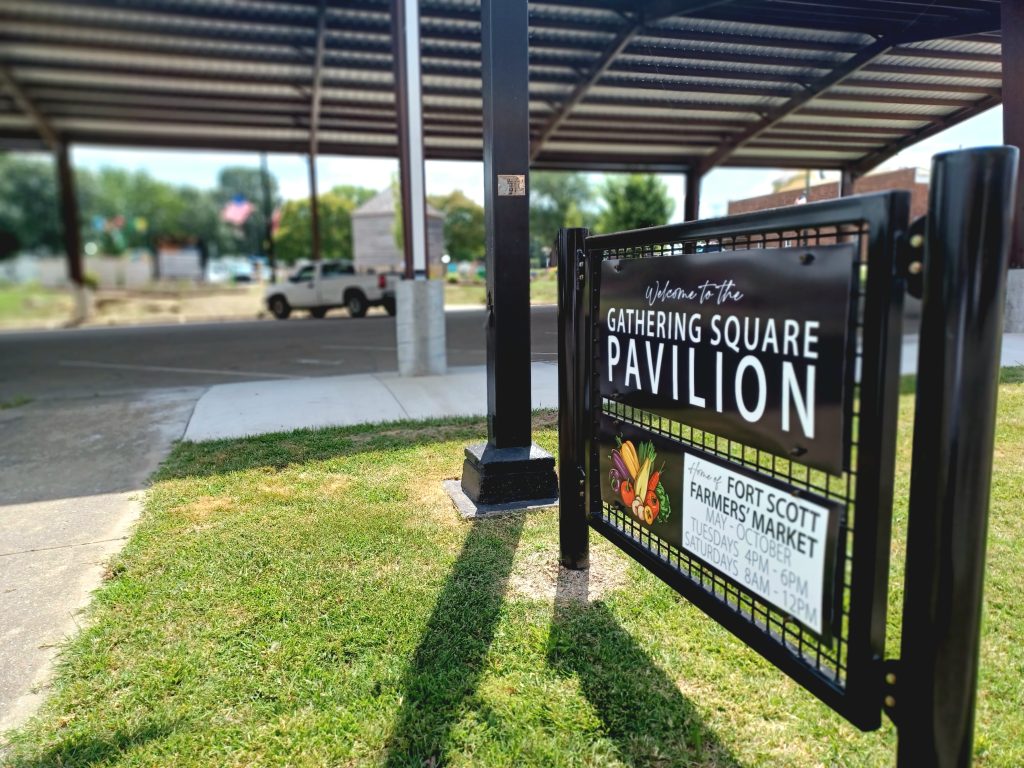
Spring is finally here, and the Fort Scott Farmer’s Market will start May 2 at the Gathering Square Pavilion, located at 111 N. National Avenue, just across from Brickstreet BBQ.
The Gathering Pavilion is a community hub featuring a covered pavilion, splash pad, and the Glide synthetic ice rink (during the winter).
The pavilion houses the Farmer’s Market (May–October), in addition to concerts and events. It serves as a central venue for community gatherings.
The local garden club will offer plants for sale as a fundraiser, as they have done for the last several years.
The Bourbon County Garden Club will hold its annual plant sale on the opening day of the downtown Farmers’ Market, Saturday, May 2, from 8 a.m. until noon, at the north end of the pavilion.
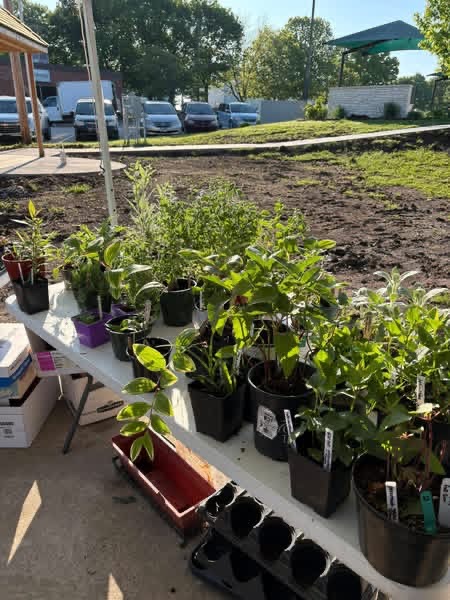
“Proceeds from the sale support beautification efforts throughout the community, including the city swimming pool islands, Heritage Park, the North Main area, and Riverfront Park,” according to Martha Jane Gentry, a spokeswoman for the group.
“Assistance is also provided with the plantings, at the downtown splash pad (adjacent to the pavilion). The garden club partners with Tri-Valley Developmental Services to sell a wide variety of plants, all of which are geared to our area’s challenging weather. Club members offer plants freshly dug from their own gardens.”

“Tri-Valley provides annuals, herbs, and both floral and foliage hanging baskets, all of which are ideal for Mother’s Day gifts. Other garden-related items will be available, such as pots, plant markers, tools, and books. There will also be drawings for several unique pots of flowers and herbs. Knowledgeable members and Master Gardeners will be available to offer advice and answer questions about gardening during the sale,” she said.

“This year’s plant sale has a committed focus, beyond community beautification,” she said. “The garden club has pledged $1,000 toward the replacement of the Lexan roof of the Tri- Valley greenhouse. The (greenhouse) site provides plants for civic areas, individual gardens, and fund-raising, in addition to horticultural therapy for developmentally disabled adults.”

Those who are interested in gardening can join the club.
“The Bourbon County Garden Club meets on the second Tuesday of the month, March through October. The next meeting will be on Tuesday, May 12th, at 6 p.m. Like us on Facebook for news, specific meeting announcements, and photos,” she said.
“Support the Bourbon County Garden Club’s commitment to the Tri-Valley greenhouse’s new roof project, and community beautification by shopping at the plant sale on Saturday, May 2,” she said.
Boil Water Advisory Still In Effect For City of Uniontown
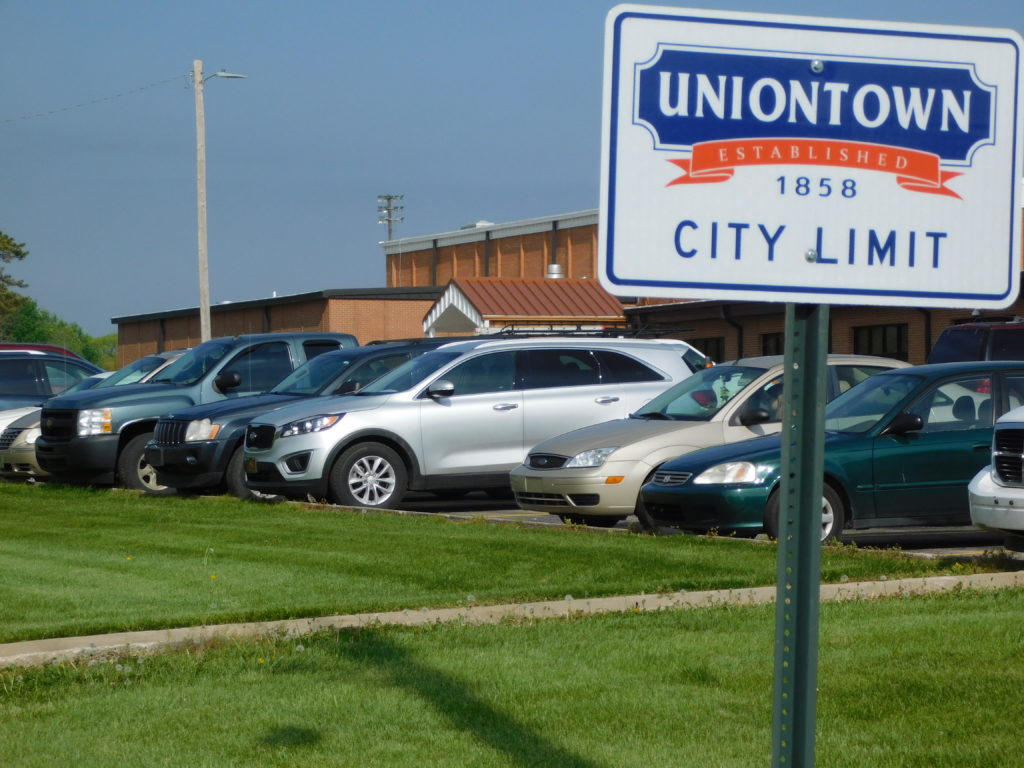
The Kansas Department of Health and Environment rescinded a boil-water advisory for the Bourbon County Rural Water District # 2 public water supply system on April 23, according to the KDHE website press release. But the City of Uniontown, located 17 miles west of Fort Scott, is still under a water boil order. That boil order should end this afternoon, if the water samples submitted are cleared.
The City of Fort Scott was cleared to stop boiling its drinking water on April 21, following water samples sent to a KDHE-approved lab.
“Fort Scott has to be cleared first, then Water District #2, and then Uniontown,” said Uniontown City Clerk Haley Arnold.
“(Uniontown City Superintendent) Bobby Rich took the water samples yesterday to the lab at Frontenac to submit them. They have to incubate for 24 hours, so we should find out by 2 p.m. today.”
“Some people thought we were out of the boil order because Water District 2 is our supplier, but we are following the guidelines we have been given,” she said.
The advisory was issued last weekend because of a waterline break resulting in a loss of pressure in the city of Fort Scott’s distribution system. Failure to maintain adequate pressure may result in a loss of chlorine residuals and bacterial contamination.
The Boil Water Advisory is still in effect for the City of Uniontown public water supply system, according to the press release.
“Public water suppliers in Kansas take all measures necessary to notify customers quickly after a system failure or shutdown. Regardless of whether it’s the supplier or KDHE that announces a boil water advisory, KDHE will issue the rescind notice following testing at a certified laboratory,” according to the press release.
“Laboratory testing of drinking water samples collected from the Bourbon Co RWD 2C system indicates no evidence of bacteriological contamination, and all other conditions that placed the system at risk of contamination are deemed by KDHE officials to be resolved.
“For consumer questions, please contact the Bourbon Co RWD 2C water system at 620-223-1110, or the city of Uniontown water system at 620-756-4742, or KDHE at 785-296-5514. For consumer information, please visit our webpage: https://www.kdhe.ks.gov/468/Disruption-in-Water-Service.”
Cases similar to the charges against Commissioner Mika Milburn-Kee
Similarities and differences in prior Kansas polling-place prosecutions and the current Bourbon County case.
The charges against Commissioner Milburn-Kee
On March 24, 2026, the Kansas Attorney General’s office filed a two-count misdemeanor complaint against Bourbon County Commissioner Mika Milburn-Kee. Count One is a general charge for interfering with public business in a public building. Count Two, what is looked at in this article, charges her under K.S.A. 25-2413(c), the polling-place “three-foot rule”: a Class B misdemeanor to come within three feet of a voting booth or an election-board table unless you are there to vote or the supervising judge lets you. The law is associated with K.S.A. 25-2432, which says a public official who is convicted of an election crime loses their office (25-2413; 25-2432).
What is alleged
A prior FortScott.biz summary of the security-camera video describes the commission meeting room being used during early voting to validate voters and handle provisional ballots. On October 25, 2025, Milburn-Kee is shown sitting at the commission table near a stack of what election officials said were unverified provisional ballots, reading a newspaper, and waving and greeting a voter through the open doorway. County Clerk Susan Walker is shown twice telling her she cannot be in the polling-area rooms; on the second try, Walker offered to help move her things and said she would call the police if required. Milburn-Kee moved to an adjoining office about twelve minutes after first being told to leave.
The closest Kansas comparison: Blubaugh
In October 2024, Meghan Blubaugh — the wife of a newly elected Sedgwick County commissioner — wore a T-shirt with her husband’s campaign name on it to an early-voting site in southwest Wichita. Poll workers asked her to turn it inside out, and she refused. The county Election Commissioner then came to the site in person and asked her again, and she refused a second time. Poll workers called the Secretary of State’s office, and Blubaugh was charged under K.S.A. 25-2430 (electioneering), a Class A misdemeanor. In January 2025, the case was resolved by diversion, with about $160 in court costs and completion of a county election-worker training. Diversion is not a conviction, but does usually require one to admit fault. If she finishes the program, the case is dismissed with nothing on the record.
This seems to be about the closest match to an election-related case in Kansas. The original polling-place misdemeanor filing, a politically connected defendant, and an alleged refusal to follow an election official’s on-site instruction. The result was Blubaugh choosing to admit guilt and take a diversion rather than fight the charge.
But there are differences. Blubaugh wasn’t a sitting elected official, so forfeiture of office was never on the table; the statute charged was different, and her conduct unfolded over a shorter window than the roughly twelve minutes in Milburn-Kee’s video summary. Diversion can be offered in one case and declined in another, so the fact that it was used in the Blubaugh case doesn’t mean it would be an option in another case, even if the situation were the same.
Milburn-Kee was not charged under 25-2430 herself, even though she greeted a voter. That statute is aimed at campaign advocacy (candidates, parties, ballot questions). The public description of her interaction doesn’t mention campaign material.
The same-statute comparison: Ceballos
Joe Ceballos-Armendariz, the former mayor of Coldwater, was charged in November 2025 with six felonies for voting as a Mexican citizen and lawful permanent resident in three prior elections. His defense attorney, Jess Hoeme, initially told KCUR he was “confident he’ll beat this” by arguing Ceballos never intended to commit crime a before a jury. However, his case was resolved when he plead guilty to a lesser crime. April 20, 2026 Ceballos pled guilty to three Class B misdemeanor counts of K.S.A. 25-2413 (the same statute cited in Count Two against Milburn-Kee). In exchange, the court dismissed all six felonies Ceballos was charged with. The sentence after the plea deal involved a $2,000 fine plus costs, six months jail per count (but this was suspended), and one year of probation.
His sentence after pleading guilty to the lesser charge is probably the most current example of how 25-2413 has been applied in Kansas, but Ceballos’ case isn’t a perfect parallel for Milburn-Kee’s charges. Under Kansas law, elected officials must be legal electors, so he had to step down from Coldwater’s city council immediately instead of waiting to see if he won or lost the case. He also faced possible federal deportation tied to a conviction. Both can change what a plea is worth in ways that wouldn’t apply to a U.S. citizen serving out an elected term in an office they are legally qualified to occupy. He was also negotiating down from six felonies. With Commissioner Milburn-Kee’s case, it isn’t clear what lower charge might be offered in exchange for a plea, should she decide not to fight the charges.
Gaps in the record
Every Kansas 25-2413 and 25-2430 case that could be found ended in the defendant admitting guilt through a plea or diversion, and none of them went through trial to a verdict. So it is hard to determine, from past cases, how a judge or jury would apply the three-foot rule to facts like the current situation. The forfeiture-of-office statute is also doesn’t come up in these cases. It appears to make loss of office automatic on final conviction, but Ceballos wasn’t in office at the time of conviction, and Blubaugh wasn’t running for office. How forfeiture would work for an official who stays in office through a conviction is an open question.
One caveat: the Attorney General’s office, like most prosecutors, generally files cases it thinks it can win or settle, avoids cases it doesn’t think it doesn’t think are very strong, and publicizes wins more than losses.
On the one hand, this might indicate that the Attorney General doesn’t bring charges until their investigation gives them full confidence of a conviction. On the other hand, there might be cases that the AG drops that are harder to find in the judicial record. If they exist, they might indicate potential for Milburn-Kee to mount a successful defense.
Laws and legal filings:
- The criminal complaint in State v. Milburn-Kee, Bourbon County District Court Case No. BB-2026-CR-000079.
- K.S.A. 25-2413 — Disorderly Election Conduct
- K.S.A. 25-2432 — Forfeiture of Office or Employment Upon Conviction
Links to news stories on Kansas cases with similarities:

Free Services for Families

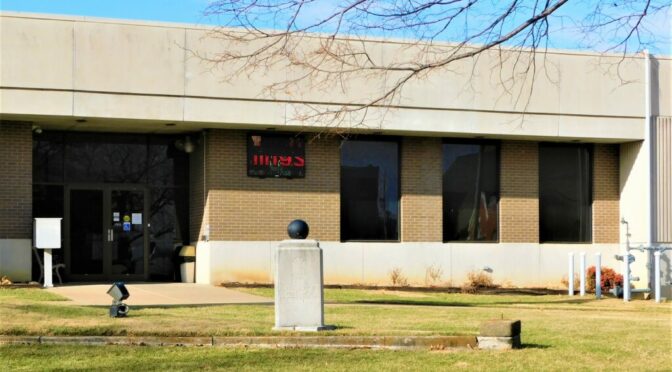
Bourbon County Planning Commission Meeting, 4/22/26 at 5:30
Bourbon County Planning Committee Agenda for Wednesday April 22nd, 2026 at 510 S. National
1. Pledge
2. Roll
3. Approval of Agenda
4. Approval of minutes from April 15th
5. Discuss Upcoming Interview Questions
6. New Business
7. Public Comment
8. Next Meeting and Agenda
9. Adjournment
Kansans Encouraged to Contact 811 Before Digging
Don’t Dig Until You Do This: The Essential Step for Safe Home Improvement Project
As the weather warms up, Kansans are eager to get started on their home improvement and gardening projects. But before the first shovel goes in the ground, there is an important step that every do-it-yourselfer must take.
Contact 811 or submit a request online through Kansas 811 at kansas811.com before you begin any excavation project. This free service is essential for projects big or small, from installing a mailbox to building a deck.
Why is this necessary?
You know your property, so why does someone else need to be contacted? Underground utilities, including natural gas lines, can vary in location and depth. Even if you think you know where those lines are, contacting 811 is an important first step to prevent damage and keep you and your community safe.
When you dig without contacting 811, you risk hitting a natural gas line, which can cause:
- Injuries or death
- Damage to underground lines
- Service disruptions for you and your neighbors
- Financial penalties
- Costly delays to your project
By contacting 811 or submitting a request at kansas811.com, professional locators will mark all of the underground facilities within the designated project area with flags and/or paint at no cost to the home or business owner. Once the project is marked, be aware of the tolerance zone: a minimum of 24 inches. Hand or soft dig techniques should be used within this area.
Take the Safe Digging Pledge!
Kansas residents can prioritize safety by taking the 2026 Safe Digging Pledge at beadigherokansas.com and recognizing the importance of contacting 811 before their shovels or excavating equipment hits the ground, regardless of the size of the digging project. By pledging to always contact 811 before digging, participants will be entered for a chance to win an $811 gift card.
Contacting 811 before you dig is a simple step that helps keep projects on track and communities safe. Learn more about safe digging and take the pledge at beadigherokansas.com for your chance to win an $811 gift card.
Digital Toolkit:
Access b-roll, Safe Digging Month flyer and graphics here.
About Kansas Gas Service
Kansas Gas Service provides a reliable and affordable energy choice to more than 653,000 customers in Kansas and is the largest natural gas distributor in the state in terms of customers. Headquartered in Overland Park, Kansas Gas Service is a division of ONE Gas, Inc. (NYSE: OGS), a 100-percent regulated natural gas utility that trades on the New York Stock Exchange under the symbol “OGS.” ONE Gas is included in the S&P MidCap 400 Index and is one of the largest natural gas utilities in the United States.
For more information and the latest news about Kansas Gas Service, visit kansasgasservice.com and follow our social channels: @KansasGas, Facebook, LinkedIn.
https://www.linkedin.com/company/kansas-gas-service
###
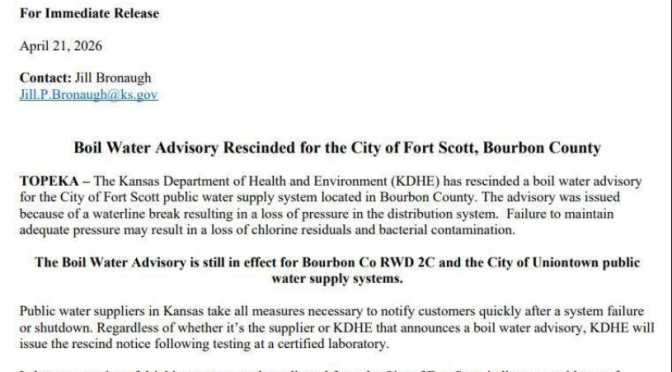
FS Water Boil Order Lifted, But Remains for Bourbon County Residents
County Commission Approves Disaster Proclamation, Continues to Wrestle with Employee Benefits Issue
Commissioner Samuel Tran opened 2 bids, saying there was no bid for 225th and Native Road.
The first bid was for $5 for 255th at the Radar Tower. The other bid received was for $600 on 1999 Prairie Road, Fort Scott.
Bids were accepted as received.
Milburn Kee took issue with the vote on coming out of executive session, saying she voted for no action.
She also wanted it on record that the employee payroll discussion contained incorrect statements.
Department Updates
Jennifer Hawkins, County Treasurer
Taxes are due May 10, which is a Sunday, so May 11th will be the last day to pay without penalties. The Treasurer’s office will be open 7AM to 7PM on Thursday, May 7 and Friday, May 8. Hawkins will be doing remote tax collections throughout the county per the schedule linked here: Property tax reminder from the Bourbon County Treasurer.
Hawkins reminded everyone that there are no statements mailed for the second half of property tax payments due for 2025.
The online tax portal is now open to pay taxes online. The link is in the slip that came in each property owner’s tax statement.
Klenda Austerman is the attorney’s office that handles tax sales for Bourbon County. They are currently doing title work to prepare for a property sale in August or September. Hawkins said that they are working with multiple counties and auctioning off many parcels in the state Kansas.
Executive Session B1 for non-elected personnel regarding sick leave, called by Beerbower. The meeting included all commissioners and the employee and was held for 20 minutes.
After returning to regular session with no action, they voted to return to executive session for the same purpose for an additional 10 minutes.
They returned with action. Beerbower moved to continue the precedence set with the employee on his time to end in one week. Commissioner Gregg Motley seconded. Commissioner Joe Allen abstained.
Motion carried.
Mike Wunderly: Appreciated the joint session between Fort Scott Commission and Bourbon County Commission. He said that the growth of the county is encouraging, mentioning growth at Lake Fort Scott.
“My main concern here is Elm Creek Lake and the rock quarry,” he said. He mentioned the amount of activity that lake attracted in the past. Turning it into a rock quarry would remove the lake as an option for recreation.
Todd Miller: Ordained elder and county employee. Spoke to the commission as an elder. He thanked the commissioners for stepping up and trying to be part of the solution. “There’s not a long line of people who want to step up and sit in these chairs,” he said.
He also thanked them for opening their sessions with prayer. He said that many people in the county are counting on them to listen to the Holy Spirit they call on in those prayers.
He also reminded them that as leaders and elected officials, they are held to a higher standard than common citizens.
He mentioned Chairman Tran using the Lord’s name in vain twice during the April 13 meeting, which he found very discouraging.
“Are we just praying just to get the prayer over with and then to move on, or are you actually really wanting help from God and the Holy Spirit to move forward through this? I’ve never seen a council that needs the Holy Spirit more than this one…You guys are going to need as much help as you can get,” said Miller.
He then asked Tran to publicly apologize for using the Lord’s name in vain. He also suggested that Tran ask God to forgive him, as Miller said he himself has done when he made mistakes in the past.
Tran then interrupted Miller, telling him he had reached his time limit.
SEKCAP Representatives: This organization provides housing vouchers throughout counties in the region. They are currently applying for a grant to enable them to expand the housing assistance they currently offer with rapid rehousing services. They are planning to combine it with their tenant-based rental assistance program that helps with homelessness prevention.
They asked the commission for a signed letter of support to assist with the grant application process.
They also mentioned the transportation services they provide and their concern with being able to keep it going. They have received enough support from the community to continue services. Now they have realigned their calendar year to match the county’s fiscal year.
He gave documents to the commissioners information about their current use throughout the county.
Commissioner Gregg Motley asked for a general breakdown of how they are funded. The core of their funding is a federal block grant. The transportation services they offer are funded 30% locally, 30% by the state, and 40% federally.
They are seeking a total of $24,000 from the entirety of the county, including Bourbon County, the City of Fort Scott and other sources, to keep operational.
Old Business
Planning Commission – Milburn
Brian and other committee members brought a report.
There were five firms who responded to the RFP. The range of cost is $38,000-$117,000. After consulting their mentor, they recommend interviewing three firms: Confluence at $105,000, MPC at $95,000, and Foster and Associates at $38,000 with some addition expenses possible.
Foster and Associates is the least expensive with the narrowest scope. Confluence seemed to have the most comprehensive scope, followed by MPC.
They each offered a 12-18 month time frame.
Milburn-Kee asked if the board had a favorite. Brian responded that the three they’ve chosen seemed like the best fit.
MPC, based in Nebraska, has done work in many counties in Kansas. Confluence, out of Kansas City, had a comprehensive presentation. Foster and Associates is based in Wichita. They did the zoning for Labette County.
The planning commission will be meeting later this week. Brian asked for a budget. He asked for the county commission’s approval to schedule the interviews and for their presence at that meeting.
Motley said he preferred to leave it in the planning committee’s hands to choose their preference.
The commissioners thanked the committee for their hard work thus far and noted how much work they will be doing going forward.
Juvenile detention -Sheriff Bill Martin, Angie Eads, Director of Sixth Judicial District Juvenile Corrections, and James Crux, County Attorney.
Eads offered data about the number of juvenile detainees from Bourbon county from 2018 through March of 2026. She also distributed a copy of HB 2029 and a brief about it in regards to detention stay changes.
Eads attended a meeting with Johnson County Community Corrections. They stated that their study shows a marginal increase in detention stays will most likely result from HB 2029. Eads agrees with their assessment. She also mentioned the provision for juvenile stabilization centers, the details of which have not been outlined yet, but could affect time spent in juvenile detention centers.
Crux said there was a total of 1225 billable days for Bourbon County juvenile detainees for the six year span from 2019-2024, and 543 of those days were one individual. Most of those days were spent on four juveniles.
“Most of the days we’ve had this year are outlier days. They’re not the norm.” said Crux, referring to an out of state runaway that was housed through Bourbon County juvenile detention.
He said Bourbon County does need a detention center somewhere.
Juvenile’s are those over 10 years old and under 18.
There’s no real consistency to the number of juvenile detention billable days from Bourbon County.
Johnson County charges $150 per day.
The county paid $134,000 in 2025 as part of their contract with Gerard. It’s a flat rate regardless of days used.
Martin said he doesn’t see an increase in juveniles needing detention and he wants to save the county money. He also mentioned the principle of getting kids back home as soon as possible.
Tran said that the county should create a slush fund to fund juvenile detention. He asked to do a work session to collect information and “do a deep dive,” so they can “put this to bed once and for all.”
Vacation & Sick Leave Resolution – Beerbower
Last week, the commission tabled the resolution to give the commissioners and legal advisors time to look it over. Beerbower said he made some changes based on feedback.
Changes include a change to the scale of vacation days allotted based on years of service. He also changed the rules to allow payout of unused vacation balance after 10 years of employment. He also added a provision to freeze employees current vacation accumulation until the amount banked matches the new schedule. He also wants to change accrual to begin at the beginning of the calendar year, not based on hire date alone.
Beerbower said he would not have brought the resolution if there was not a problem. His goal is to simplify the process.
Regarding sick leave, Milburn-Kee expressed concern about paying out sick leave to employees who leave before retirement age.
Beerbower said that he wants included FMLA leave in the sick leave hours.
Commissioner Joe Allen brought up the idea used in school districts of “discretionary time” which can be used for sick leave or dependent care.
Milburn-Kee read a statement of her opinion about the proposed resolution Beerbower introduced saying, “If the goal is to reduce complaints, I’m not convinced that it will be achieved.”
Tran said that he did “a deep dive” to help a number of employees with issues and never found any evidence that leads him to believe the system is faulty. “We need to work to give it a chance,” he said of the Payentry system.
He asked the commissioners to look over the information that Milburn-Kee brought to the table before voting. Milburn-Kee said that the documentation provided by County Clerk Susan Walker in last week’s meeting is inaccurate.
Milburn-Kee said that some employees were on accrual and some on front-loaded vacation and sick leave.
After some heated discussion, Tran called for a 3 minute recess and encouraged Beerbower and Milburn-Kee to calm down.
The commission came back after the recess and continued the discussion. Tran suggested that Beerbower do a deep dive on each of the employees who claim to have a problem with their vacation and sick leave hours. He also said that there’s a place for policy exemptions, but a full policy change is not going to fix the problems people have been having.
Beerbower said that gathering all that information isn’t going to gain anything for the county. Putting off passing the resolution will just prolong the problem.
Tran asked for one more week to go over the information.
Beerbower said the only thing he is in favor of is passing the resolution now.
Allen said that he came in as commissioner in the middle of the issue. He said that everyone on the commission is passionate about their jobs and it’s time to swallow pride and stop blaming the past and move forward.
“We’re just beating this dead chicken around the table, and we’ve gotta go somewhere,” he said.
“I just want one thing: whatever anybody thought they had on 12/31/2025, I want that restored. I don’t care how it got there,” said Motley. “I don’t care how it’s done, it just needs to be done, cause it’s not their fault.”
“A lot of them have already self-corrected,” said Milburn-Kee.
“A lot of them is not all of them,” said Motley.
Allen said he would like time to go over the changes that Beerbower made to the resolution before voting.
They decided to table the issue until next week.
Executive Session B4 to discuss contract negotiations with five commissioners and Bob Johnson by phone.
Returned to regular session with no action
Tran said that the Elm Creek Quarry has enough rock in it to last a generation. The lake is leaking. If they use it as a quarry, they can produce their own rock, they’re not in danger of loosing a lease, and it’s good rock. It was approved under a previous commission’s administration.
Milburn-Kee said that she has been told that the lake was put into Bourbon County’s hands for the enjoyment of the people. She moved that they hold it. Motion was seconded.
Beerbower said he was against using it as a quarry back when it was approved by the previous commission. He said there is other land in that area that the residents have expressed interest in leasing.
“There’s a lot of potential at that lake,” said Beerbower. He suggested an RV park may be a good idea and that a rock quarry would hurt that. He said he is more interested in working on making the lake a tourist attraction than in using it as a quarry. He questioned the financial benefit of the county quarrying it’s own rock, suggesting a deep dive into whether or not it’s profitable.
Motley asked Mike Wonderly why the lake isn’t as popular as it used to be. Wonderly said that Fort Scott lake is closer and bigger.
Allen said he grew up in the area and it was very popular when he was growing up. He still takes his kids out there fishing and he suggested camping with RV hookups would be good for development.
Resolution for Disaster Proclamation
Tran read the proclamation stating a state of local disaster emergency exists covering all of the county as of April 17, 2026. This will remain in effect for 14 days unless terminated early.
Property Tax Reminder from the Bourbon County Treasurer
Property tax reminder from the Bourbon County Treasurer
Property tax reminder from the Bourbon County Treasurer
2nd half 2025 taxes are due 5-10-2026.
The Treasurer’s Office will have extended hours from 7:00 a.m. – 7:00 p.m. on Thursday, May 7th and Friday, May 8th.
The Treasurer will be accepting payments at the following locations in the County from 5:00 p.m. to 7:00 p.m.
Monday 5/4/2026 Garland Community Center
Tuesday 5/5/2026 Mapleton Community Center
Wednesday 5/6/2026 Uniontown High School
Thursday 5/7/2026 Fulton City Hall
Friday 5/8/2026 Bronson Community Building
You can pay your taxes online at the following website: https://www.kansas.gov/propertytax/
You will need the following information to make online payments:
- A county property tax statement
- A form of payment (Visa, Mastercard. Discover, or e-check)
- A KanAccess username and password (Sign in or Sign up on the web page)
For questions, contact:
Jennifer Hawkins, Bourbon County Treasurer
620-223-3800 Ext. 192
jhawkins@bourboncountyks.org
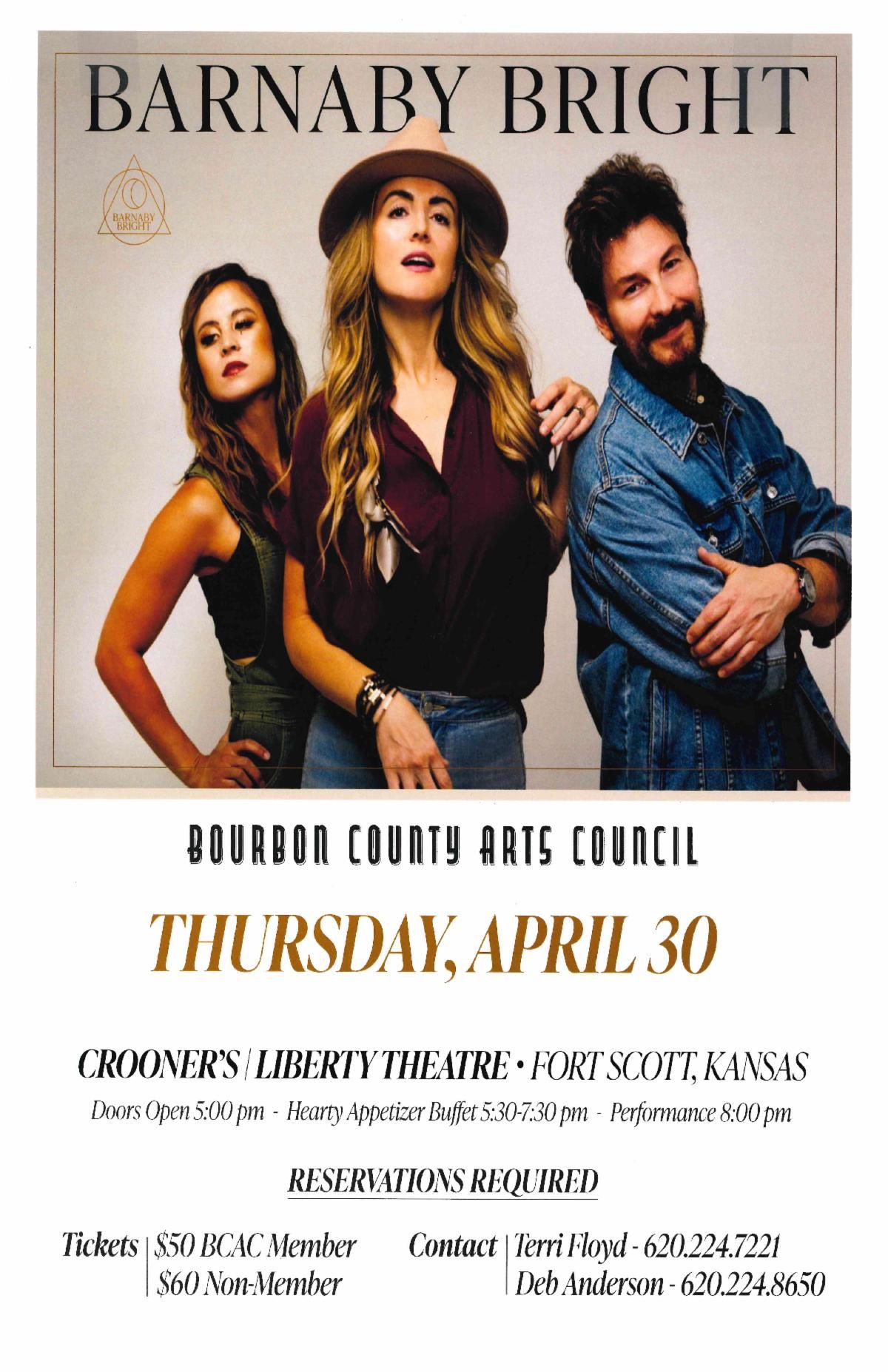
Bourbon County Arts Council Presents Barnaby Bright on April 30th
Sending on behalf of Chamber Member
Bourbon County Arts Council
Bourbon County Arts Council Presents
Barnaby Bright
Thursday, April 30th
Doors Open 5:00pm
Hearty Appetizer Buffet 5:30-7:30pm
Performance 8:00pm
Crooner’s / Liberty Theatre
113 S. Main, Fort Scott, KS
Reservations Required
Tickets: $50 BCAC Member / $60 Non-Member
Contact:
Terri Floyd 620-224-7221
Deb Anderson 620-224-8650