
Category Archives: Bourbon County

Bourbon County Commission Meeting Agenda Summary for June 29, 2026

Bourbon County Commission Meeting Agenda Outline

Agenda 06.29.26

  • Meeting Date & Time: June 29, 2026, at 5:30 PM (Page 1)

  • Location: 210 S National Avenue, Fort Scott, KS 66701 (Page 1)

Agenda Items

  1. Call Meeting to Order (Page 1)

  2. Pledge of Allegiance (Page 1)

  3. Prayer – Commissioner Motley (Page 1)

  4. Introductions (Page 1)

  5. Approval of Agenda (Page 1)

  6. Approval of Minutes (Page 1)

    • a. June 15, 2026 (Page 1)

    • b. May 11, 2026 (Revised) (Page 1)

    • c. April 13, 2026 (Revised) (Page 1)

  7. Approval of Accounts Payable (06/18/26): $83,374.82 (Page 1)

  8. Approval of Accounts Payable (06/26/26): $453,809.91 (Page 1)

  9. Approval of May 2026 Financials (Page 1)

  10. Special Appearances (Page 1)

  11. Public Comments (Page 1)

  12. Department Updates (Page 1)

  13. Old Business (Page 1)

    • a. Jarred Gilmore Phillips 2026 Audit Engagement (Page 1)

    • b. SEK Juvenile Detention Center Discussion (Page 1)

    • c. American Flag Purchase (Page 1)

    • d. Procedures for Adopting Resolutions (Page 1)

  14. New Business (Page 1)

    • a. Statement/Discussion – Commissioner Allen (Page 1)

    • b. Fund Resolution – Commissioner Milburn (Page 1)

    • c. Resolution 25-26: Cancellation of Warrant Checks – Walker (Page 1)

    • d. Heartland Business Licenses Annual Billing (Page 1)

  15. Future Agenda Topics (Page 1)

  16. Commission Comments (Page 1)

  17. Adjournment (Page 1)

Note: A public works budget work session will take place immediately following the commission meeting. (Page 1)

Detailed Summary of Information Packet

1. Past Meeting Minutes Summaries

June 15, 2026 Meeting Minutes

  • Attendance & Logistics: Chaired by Samuel Tran. Commissioners David Beerbower, Joe Allen, Gregg Motley, and Mike Milburn-Kee were present alongside County Clerk Susan Walker. (Page 1)

  • Agenda Modifications: The agenda was rearranged to address time-sensitive items, adding KDWP to Special Appearances, a Hidden Valley Road item, and removing an MOU Grant discussion. (Page 1-2)

  • Accounts Payable & Payroll: Approved batches for June 5 ($184,461.59, withholding two disputed vendor checks) and June 12 ($833,269.76). Supplemental payrolls were also approved to correct a supervisor hours-entry error. (Page 2, 4)

  • Hidden Valley Road Resolution: Public Works Director Kenny Allen and County Counsel verified that the Hidden Valley subdivision roadways are private infrastructure, do not meet county safety or engineering standards, and have never been formally accepted by the county. Resolution 23-26 was passed to formally decline taking over road network maintenance, capping substantial liability concerns. (Page 2-3)

  • Public Comments: INA Alert presented a security and facial-recognition camera system breakdown with free site evaluations. Local resident Mark Warren raised localized standing water and missing side ditch drainage issues near Uniontown and Redfield. (Page 3-4)

  • Minutes Formatting Debate: Chair Tran critiqued current AI-generated minutes for subjective language (e.g., “push back gently”). Clerk Walker defended that she runs raw long-form formats to meet detail requests without adding editorial slant. (Page 4)

  • Elm Creek Lake Grant: The commission passed a motion to formally terminate a stagnant five-year-old Elm Creek Lake renovation grant. Biologist Don George (KDWP) noted the original $121,000 cost estimate to repair the dam hole inflated massively, requiring an engineer re-evaluation before a target May 2027 grant cycle. (Page 4-5)

  • Comprehensive Plan: Following competitive interviews, the Planning Commission recommended hiring Confluence for a total of $152,000 ($105,500 for the Plan; $46,500 for Zoning Code regulations). The motion passed 4-0 (Motley abstained). (Page 5-6)

  • Election Request Dispute: A motion by Commissioner Milburn-Kee to deny the Clerk’s use of the Commission Room for 2026 election cycles failed (3-2). A subsequent motion to approve the space use and transit support passed 3-2. (Page 6)

  • Moratorium Resolution: The board passed Resolution 24-26 (3-0, Allen and Motley abstained) enacting a 365-day freeze on utility-scale power setups, crypto mining, data centers, and waste sites, grandfathering three previously exempted solar facilities. (Page 7-8)

May 11, 2026 Meeting Minutes

  • Public Comments (Meals on Wheels): Michael Hoyt warned that federal defunding hit regional aging agencies hard, freezing new enrollments for standard mobile meal deliveries. He urged local budget steps to preserve safety checks for senior populations. (Page 10)

  • Check-Signing Authority Clash: County Attorney James Crux publicly cited late employee pay cycles caused by a communication breakdown over unsigned checks. Seeking rules accuracy, Chair Tran shifted checking signatures to Commissioner Allen moving forward. (Page 10-11)

  • Clerk Software Lockout: An internal dispute arose after Clerk Walker had her “SecureView” payroll report access revoked due to administrative over-exposure concerns. Intermediary data sharing was labeled inefficient by dissenters, and a motion to restore direct read-only access failed 3-2. (Page 11-12)

April 13, 2026 Meeting Minutes

  • Economic Development: Fort Scott City Manager updated the board on manufacturing building sales projected to create hundreds of jobs starting in early 2027. (Page 13)

  • Employee Rights Outcry: Nearly half the county workforce attended to protest retroactive adjustments to tenure dates and altered leave records after a December 2025 platform shift. Employees described losing up to 16 years of recognized service credit. In response, the commission ordered immediate employee system visibility features to restore transparency. (Page 14-15)

2. Financial Documents & Open Invoice Summaries

Accounts Payable Ledger – Due June 18, 2026

A grand total of $83,374.82 across 70 invoices was processed for this cycle. Significant breakdowns by department include:

  • District Court (Dept. 10): $17,054.00, anchored by a 40% initial deposit ($15,324.00) to McClelland Inc. for a Courtroom A audio infrastructure upgrade. (Page 8)

  • Courthouse General (Dept. 43): $13,379.74, including building utility bills from Evergy and a $7,503.36 regular elevator service fee to Kone Inc. (Page 12)

  • Road & Bridge Sales Tax Fund (Fund 222): $12,455.80, heavily driven by an $11,257.15 charge from Kunshek Chat and Coal Co. for sand hauling. (Page 3)

  • Juvenile Detention (Dept. 18): $11,347.00, matching fixed monthly detention system expenses paid out to the SEK Regional Center. (Page 10)

  • Landfill (Fund 108): $10,652.41, paid entirely to Allen County Public Works for regional waste operations. (Page 2)

Accounts Payable Ledger – Due June 26, 2026

This batch notes a larger volume of operational entries, totaling $453,809.91, primarily tracking payroll runs, clearing accounts, and equipment support:

  • Employee Benefits (Fund 064): $35,424.17 allocated across employee social security withholdings ($14,685.08) and comprehensive KPERS retirement pools ($19,375.17). (Page 4)

  • County Sheriff & Correctional (Fund 120): $81,313.55, tracking department base wages alongside distinct items like building contract needs, Vertiv system components ($6,581.12), and regional inmate health expenses ($7,966.27). (Page 6-7)

  • Mental Disability Support (Fund 116): A $13,750.00 regular quarterly funding appropriation assigned to the Tri-Valley Developmental Center. (Page 6)

  • Road and Bridge Machinery (Fund 220): Detailed hardware invoices from Murphy Tractor & Equipment Co. covering heavy motor, hydraulic drives, and custom equipment maintenance. (Page 7-8)
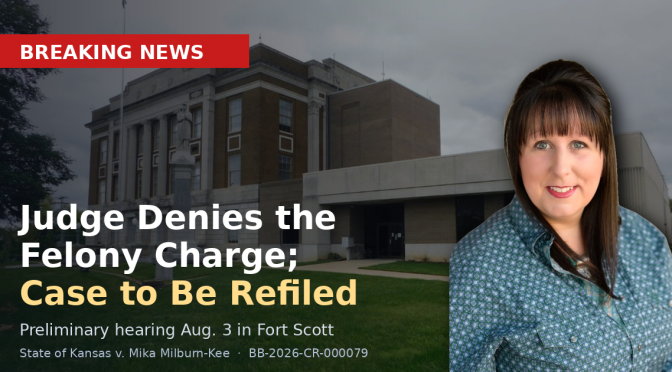
Judge Rejects Late Felony Charge Against Commissioner Milburn-Kee; State Will Refile All Counts

A judge has rejected the Kansas Attorney General’s bid to add a felony charge against Bourbon County Commissioner Mika Milburn-Kee on the eve of her trial, and the State responded by dismissing the case so it can refile all of the charges together.

At a June 26 pretrial conference, Senior Judge Merlin G. Wheeler denied the State’s motion to amend the complaint to add a third count, Intimidation of Voters, a severity level 7 nonperson felony. The State had filed that motion, with several others, the afternoon before the hearing. Milburn-Kee has faced only two misdemeanors since March. FortScott.biz reported the felony motion when it was filed June 25.

Assistant Attorney General Olivia Higdon said the State has evidence beyond a reasonable doubt to support the felony, and that the person it alleges was intimidated is,a witness (who is already on the witness list), Brandi Ross. The State said the charge rests on the original probable-cause affidavit filed when the case began, which already referenced voter intimidation. All of the counts stem from an Oct. 25, 2025 incident at the county commission room while it was being used as an early-voting polling place.

Milburn-Kee’s attorneys, Tricia and Thomas Bath, objected that the motion arrived too late to answer, that a substantive charge should be argued in person rather than over Zoom, and that adding a felony now would prejudice her rights. They cast the move as pressure tied to her decision to demand a jury trial.

Wheeler said this was not the first time the Attorney General’s office had brought last-minute charges in his courtroom, and he made clear he did not blame Higdon personally but the principals in her office. Because a felony would entitle the defense to a preliminary hearing that could not be held before the scheduled July trial, he denied the amendment.

Rather than go to trial on the misdemeanors alone, the State moved to dismiss the case and refile all three counts together, which Wheeler allowed. The July 6 through 8 jury trial is off. The case will restart under a new case number, and a first appearance and preliminary examination is set for Aug. 3 at 1 p.m. in Fort Scott, where the State must show probable cause for each count.

Speedy-trial clock

Wheeler was careful to lock in one point. Dismissing and refiling does not buy the State a fresh clock. Under Kansas’s speedy-trial law, K.S.A. 22-3402, a defendant who is out on bond must be brought to trial within 180 days of arraignment, not counting delays the defense causes. Wheeler ordered that the time already elapsed, which he dated to April 15, keeps running in the refiled case rather than starting over at zero. By that measure the State has until roughly mid-October to bring Milburn-Kee to trial.

Why no plea deal has materialized.

The Attorney General’s office does not make the first plea offer, so it would be up to Milburn-Kee’s lawyers to approach the State with a proposed plea or to apply for diversion, a stance Judge Wheeler called consistent with the standards for prosecutors. The Attorney General stated that the defense had not pursued any type of plea deal or diversion and indicated that, since it looked like the case was going to go to a jury trial, the state wanted to bring all the charges it believes it has enough evidence to convict on, including the felony it hadn’t filed previously.

Higdon cast the timing as an effort to give Milburn-Kee a way to resolve the case without losing her position. The State, she said, had hoped Milburn-Kee’s defense would bring a plea that would let her keep her seat rather than take the case to a jury.

“Our intention with the filing was hopefully to be able to give her a plea offer where she would not have to leave office, with the Class A misdemeanor moving forward and dismissing the Class B,” Higdon said. “However, if this case was going to receive a trial, we wanted to be able to try the whole thing.”

Judge Wheeler also noted that the courthouse elevator is broken and not expected to be fixed in time, that he had been arranging an accessible location, and that he expected a large turnout given the political tension between the county commission and the county clerk.

A charge is an accusation, not a finding of guilt, and Milburn-Kee is presumed innocent unless and until a jury decides otherwise. FortScott.biz will report on the Aug. 3 hearing.

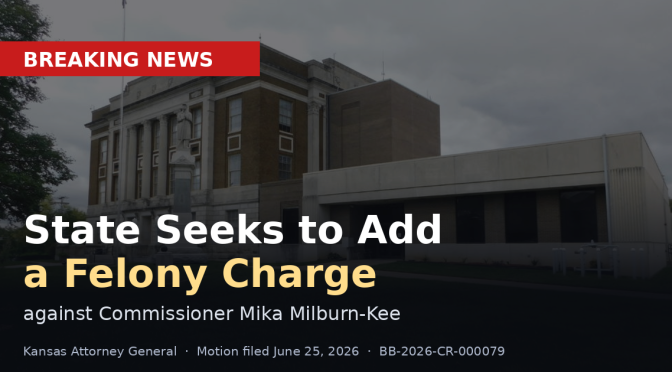
Breaking: Kansas AG Moves to Add a Felony Charge Against Commissioner Milburn-Kee

The Kansas Attorney General’s office has asked Senior Judge Merlin G. Wheeler (the senior judge assigned to the case by the Kansas Supreme Court) for permission to add a felony charge against County Commissioner Mika Milburn-Kee, days before her jury trial is set to begin.

In a motion filed June 25, Assistant Attorney General Olivia R. Higdon asked to add a third count, Intimidation of Voters, a severity level 7 nonperson felony under K.S.A. 25-2415. Milburn-Kee has until now faced only two misdemeanors, both stemming from an Oct. 25, 2025 incident captured on video, when the county commission room was being used as an early-voting polling place.

The stakes rise sharply if the felony is added. A severity level 7 felony can carry a prison term of roughly 11 to 34 months, depending on criminal history, plus a fine of up to $100,000. By comparison, the Class A misdemeanor carries up to one year in county jail and a $2,500 fine, and the Class B misdemeanor up to six months and a $1,000 fine.

The State argues no new facts are alleged, noting that its original probable-cause affidavit already referenced voter intimidation and that it told the defense during plea talks it was weighing the charge. The motion was one of several filings the State made June 25 ahead of the pretrial hearing on June 26, and the judge has not ruled.

If the amendment is granted, what has been a two-misdemeanor case headed to a jury becomes a felony prosecution. A three-day jury trial is set for July 6 through 8. Milburn-Kee is presumed innocent unless and until a jury decides otherwise.

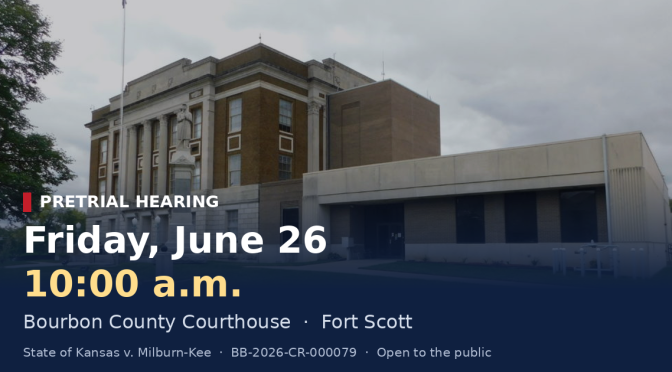
Pretrial hearing Friday in the case against Commissioner Milburn-Kee

The criminal case against Bourbon County Commissioner Mika Milburn-Kee returns to court on Friday, June 26, for a pretrial hearing at 10 a.m. at the Bourbon County Courthouse in Fort Scott. Residents who want to follow the case can attend in person.

Milburn-Kee faces two misdemeanor charges filed by the Kansas Attorney General’s office in March. The first, interference with the conduct of public business in a public building, is a Class A nonperson misdemeanor. The second, disorderly election conduct, comes from the state’s polling-place “three-foot rule.” A conviction on the election-conduct count would carry forfeiture of office under Kansas law.

The charges stem from Oct. 25, 2025, when the county commission room was being used as an early-voting polling place, an encounter that was captured on video. Milburn-Kee has pleaded not guilty and has demanded a jury trial.

A pretrial hearing is a working session before the trial begins. The judge and the attorneys use it to narrow the issues, settle which witnesses and exhibits will be allowed, resolve any outstanding motions, and confirm the schedule. No verdict is reached. It sets the stage for a jury to hear the case.

A three-day jury trial is scheduled for July 6 through 8 in Courtroom A at the Bourbon County Courthouse, starting at 9 a.m. each day. A jury of six, plus one alternate, would decide the case. The Attorney General’s office is prosecuting, and Milburn-Kee is represented by private counsel. FortScott.biz has also looked at how similar Kansas election cases have been resolved.

A charge is an accusation, not a finding of guilt, and Milburn-Kee is presumed innocent unless and until a jury decides otherwise.


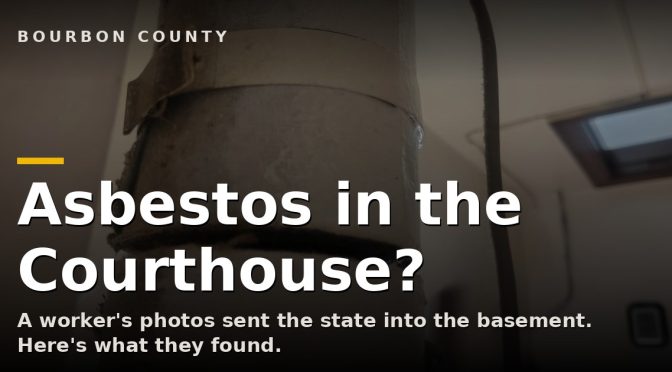
State walkthrough finds no immediate asbestos hazard at Bourbon County Courthouse

A former maintenance worker’s photos of crumbling pipe insulation prompted a Kansas environmental official to walk the building. The early word, relayed by the county’s emergency manager, was that nothing looked like an immediate hazard as long as the material stays undisturbed. No samples have been taken, and the state is still reviewing.

Questions about asbestos in the Bourbon County Courthouse, raised publicly this week by a former maintenance worker who photographed deteriorating pipe insulation in the basement, led to a visit from a representative from the Kansas Department of Health and Environment (KDHE) to the nearly century-old building. According to the county’s emergency manager, the representative said during the walkthrough that he did not see anything hazardous that had to be addressed right now, as long as the material is not disturbed. The representative is conferring with others at the agency and will get back to the county with more detail about what actions or precautions should be taken.

Deteriorating pipe insulation in the courthouse basement, photographed by former maintenance director William Jackson.

The courthouse was built in the 1930s, and asbestos is common in buildings of its era. None of the officials contacted for this story disputed that it is likely present. The question residents have been asking is a different one. Is it dangerous, and is anything being done about it?

Asbestos is generally most dangerous when it is crumbling or broken up and its fibers become airborne, where they can be breathed in. Whether the courthouse material is in fact asbestos, and whether it is releasing any fibers, has not been determined, because no samples have been collected and tested. A visual walkthrough cannot answer that on its own.

How the concern surfaced

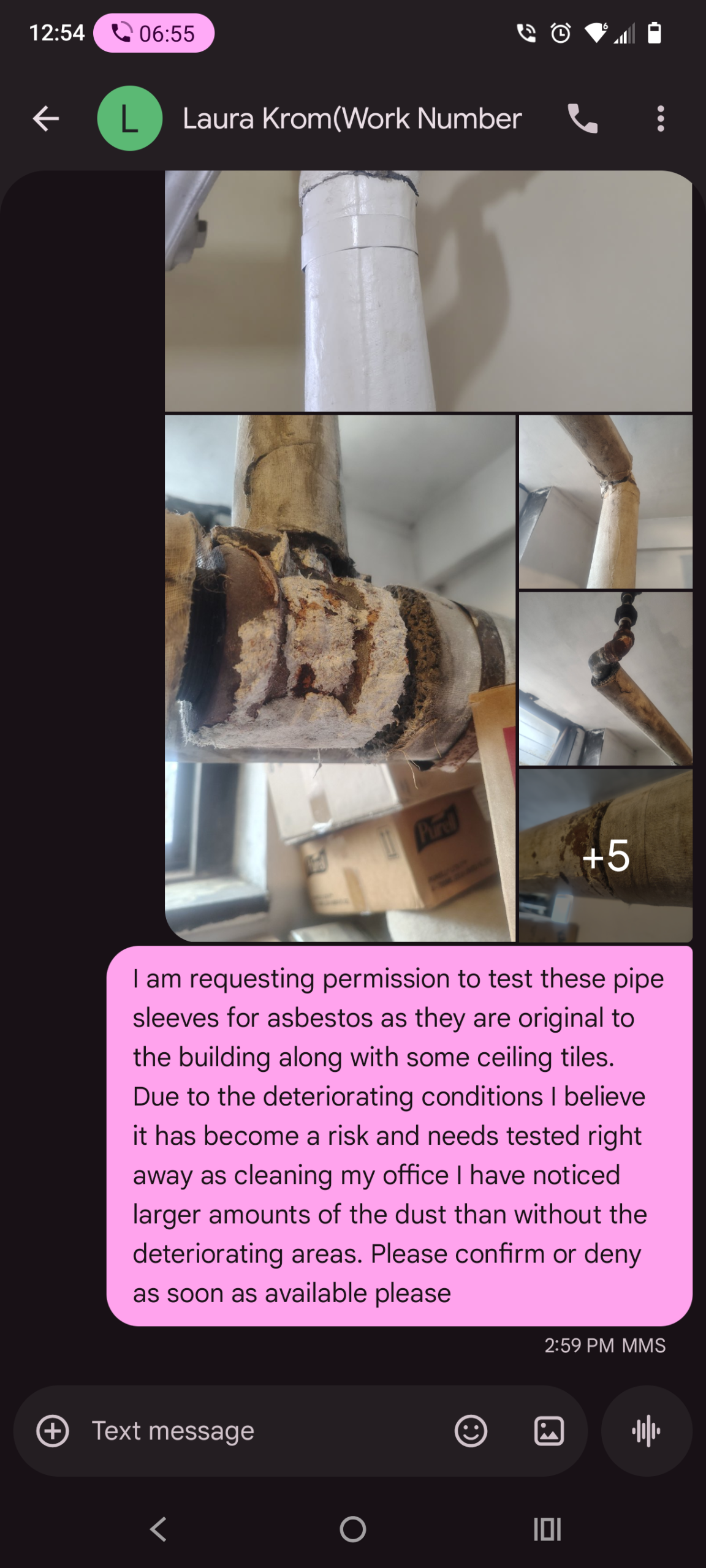
The issue was raised by William Jackson, who worked in the courthouse maintenance this spring. He said he found insulation and ceiling tiles he believed were asbestos deteriorating in the basement, with dust collecting on supplies and on workers’ desks, and that he could not find any asbestos records in the county’s maintenance files. He sent his supervisor a written request for permission to have the material tested.

The message Jackson sent his supervisor, Laura Krom, asking to test the insulation.

Jackson said he sent the request Friday and was fired Saturday morning. He believes the two were connected and that he was let go for raising the concern. County officials declined to comment on his departure.

What the state found

After Jackson’s photos circulated, Bourbon County Emergency Manager Lou Howard walked the building with a KDHE representative, who also had the photos that had been sent to the agency.

“He stated that at the time he looked, he did not see anything that was concerning,” Howard said. “They did not see anything that was hazardous right now that had to be addressed.”

“He did say that if there was active construction going on at the time, then it would be a concern. But nothing is being disturbed. Everything is as it should be.”

Lou Howard, Bourbon County Emergency Manager

Howard said she offered to walk the representative through the rest of the courthouse and that he said he did not need to, based on what he had already seen. She said in the past an area basement had been used as the county’s emergency operations center until other space became available. The review is not finished. The representative was passing the information and photos to a supervisor, and the county is waiting to hear what action it should take, which could include further testing.

More photos from the basement

Insulation at a pipe joint in the basement.
A close-up of the fraying, fibrous wrap.
Original insulated piping in the basement.
A larger insulated pipe with deteriorating wrap.
An opening near the ceiling above the basement drop ceiling.
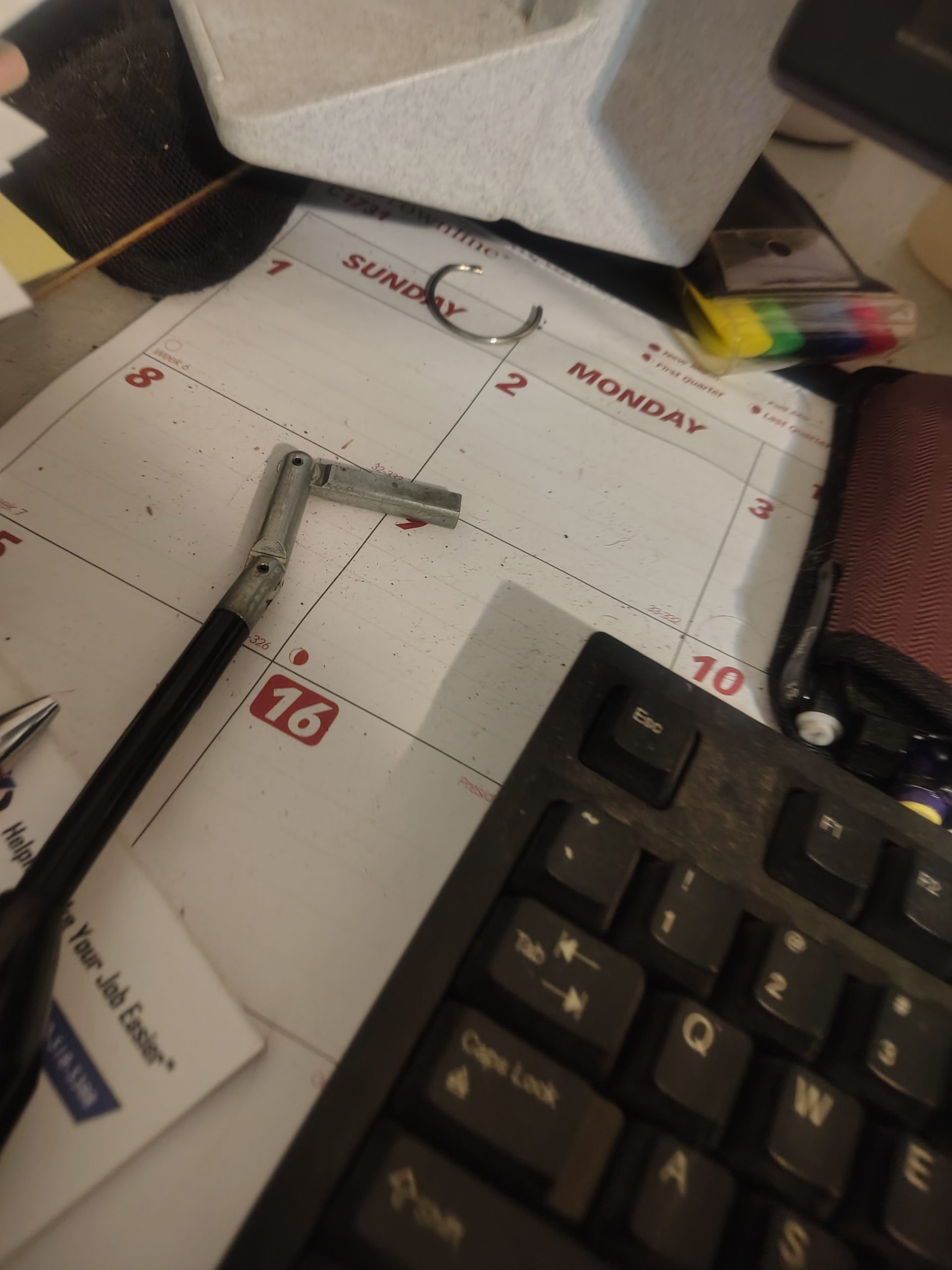
Dust that Jackson said was collecting on desks in the basement work area, which he raised as a concern.

What this does and doesn’t settle

Howard’s account is the most direct word so far on the courthouse. However, it was a visual walkthrough, not laboratory sampling. No material was collected and tested, and the representative did not view the entire building. Some residents have worried that deteriorating material in the basement could send fibers into the building’s heating and cooling system and on to other floors. The walkthrough did not include air sampling or an evaluation of that system, and the state’s guidance to the county is still pending.

The caution about disturbed material is also the heart of the original complaint. Jackson’s concern was that the insulation is already breaking down. Confirming whether that is releasing any asbestos fibers would require testing.

For now, the practical takeaway for residents and courthouse employees is limited but real. The early, visual look reported by the county found nothing requiring immediate action, the chief risk would come from disturbing the material, and a final determination from the state is still to come.

FortScott.biz will update this story when KDHE provides further guidance.

County’s Answer in Shane Walker Lawsuit: Agreement on the Timeline, a Dispute Over Motive and Immunity

Bourbon County and four individuals have filed their formal response to former county IT director Shane Walker’s federal lawsuit, and the answer narrows what the case is actually about. On the basic sequence of events, the two sides now largely agree. What remains in dispute is why Shane Walker lost his county job — and whether the officials can be held legally responsible for it.

The defendants (the Board of County Commissioners plus Commissioners Sam Tran, Mika Milburn-Kee and David Beerbower, and contractor Dr. Steve Cohen) filed their answer June 23 in U.S. District Court for the District of Kansas (Document 13), represented by Andrew D. Holder of Fisher, Patterson, Sayler & Smith. They answered the complaint rather than moving to dismiss it, on a deadline the clerk had extended to that date. For the claims Shane Walker raised, see our earlier report: Federal Lawsuit Alleging Retaliation, Discrimination, and FMLA Violations.

Where the parties now agree

The answer admits key dates and events in the timeline Walker laid out, even as it denies the bulk of his broader allegations. The county admits that he worked for the county from about December 15, 2005 until he left the payroll on or around July 9, 2025; that the commission’s vote to eliminate his position was unanimous and that the county outsourced the IT department; and that the elected Register of Deeds rehired him around November 17, 2025. It admits that Walker is married to Susan Walker, the current County Clerk and former CFO, and that he filed discrimination complaints with the Kansas Human Rights Commission in September 2024 and September 2025. It also admits the episode in which Commissioner Milburn-Kee asked for passwords, Walker and a coworker refused, and the coworker called police and was later fired.

Where they diverge

The agreement stops at motive. Walker’s complaint casts the elimination of his job as retaliation for those discrimination complaints and for taking medical leave. The county’s answer reframes the same event as a layoff. The county repeatedly “denies that Plaintiff was ‘terminated,’” admitting only that he was “laid off,” and it states that any action it took “was not retaliatory, and would have occurred based on legitimate, lawful, and independent reasons regardless of Plaintiff’s protected conduct, if any.” The county also denies Walker’s allegations about how he was treated after he was rehired.

The word choice carries legal weight. Walker pairs the retaliation claims with a breach-of-contract count and a Kansas Wage Payment Act claim; by calling the move a layoff and arguing it “substantially performed” and later “modified” his employment agreement, the county contests whether any contract was broken or wages withheld.

Beyond the facts, the county’s answer also raises legal defenses that, if accepted, could dispose of parts of the case before a jury weighs the question of motive. The individual defendants assert qualified immunity against the federal civil-rights (Section 1983) claims. The county claims governmental immunity under the Kansas Tort Claims Act. And the answer asserts that punitive damages cannot be recovered against a municipality. On Shane Walker’s free-speech claims, the county invokes Garcetti v. Ceballos, arguing his speech was made as part of his official duties and is therefore not protected. In all, the answer lists 23 defenses and asks that the defendants be dismissed from the case.

Walker, represented by Wichita attorney Gaye B. Tibbets, has demanded a jury trial. The case is Walker v. Board of County Commissioners of Bourbon County, Kansas, et al., No. 6:26-cv-01057, before U.S. District Judge Daniel D. Crabtree. An answer is one side’s response; the complaint’s allegations and the county’s denials and defenses have not been tested in court. The county’s full answer is posted here.

Bourbon County Sheriff’s Office Daily Reports June 22

Bourbon County Sheriff’s Office Daily Report – June 22, 2026

Arrested

Lee, Nicole Marie (Age 43) — Arrested 6/18/2026 3:18 PM by Bourbon County Sheriff’s Office. Charge: Warrant Bourbon County (Failure to Appear), Warrant Bourbon County (Probation Violation) x2. Bond: $2,000.00 Cash/Surety.

Eisenbrandt, Jonah (Age 46) — Arrested 6/19/2026 6:00 PM by Bourbon County Sheriff’s Office. Charge: Sanction. Bond: $0.00 No Bond. Released 6/21/2026 6:00 PM via Time Served.

Altic, Karrie S (Age 39) — Arrested 6/19/2026 5:37 PM by Fort Scott Police Department. Charge: DUI; Misdemeanor. Bond: $1,500.00 Cash/Surety.

Leslie, Alyssa Faith (Age 27) — Arrested 6/20/2026 10:13 AM by Fort Scott Police Department. Charge: Criminal Damage to Property; Misdemeanor. Bond: $1,500.00 Cash/Surety.

Released

Allen, Judy Marie — Released 6/18/2026 12:15 PM via Surety Bond (A+ Bail Bonds).

Eisenbrandt, Jonah — Released 6/21/2026 6:00 PM via Time Served (Self).

Fasanella, Angelina M — Released 6/18/2026 8:40 AM via Time Served (Self).

Griffith, Joshua David — Released 6/18/2026 3:10 PM via Own Recognizance (Self).

Hawn, Ryan S — Released 6/20/2026 3:39 PM via Surety Bond (Larry Lamb).

Mason, Gina Fay — Released 6/18/2026 8:36 AM via Transferred Out (KDOC).

McDaniel, Nicolle Selene — Released 6/20/2026 11:58 AM via Surety Bond (Larry Lamb).

Reed, Wesley Alan — Released 6/18/2026 12:03 PM via Surety Bond (A+ Bail Bonds).

Ross, Gavin Lee — Released 6/18/2026 8:16 AM via Surety Bond (A+ Bail Bonds).

Total Inmates Released: 9

Documents:

Bourbon County Commission Agenda Summary for June 22 Meeting

Bourbon County Commission Meeting Agenda 06.22.26

Bourbon County Commission Meeting Agenda Outline

Meeting Date & Time: June 22, 2026, 5:30 PM

Location: 210 S National Avenue, Fort Scott, KS 66701

  • 1. Call Meeting to Order

  • 2. Pledge of Allegiance

  • 3. Prayer – Led by Commissioner Motley

  • 4. Introductions

  • 5. Approval of Agenda

  • 6. Approval of Minutes

    • a. June 15, 2026

    • b. May 11, 2026 (Revised)

    • c. April 13, 2026 (Revised)

  • 7. Approval of Accounts Payable – June 18, 2026 ($83,374.82)

  • 8. Approval of May 2026 Financials

  • 9. Special Appearances

  • 10. Public Comments

  • 11. Department Updates

    • a. Landfill – Blake Hurd

  • 12. Old Business

    • a. Jarred Gilmore Phillips 2026 Audit Engagement

    • b. SEK Juvenile Detention Center Discussion

    • c. American Flag Purchase

    • d. Procedures for Adopting Resolutions

  • 13. New Business

    • a. Statement/Discussion – Commissioner Allen

    • b. Fund Resolution – Commissioner Milburn

    • c. Resolution 25-26: Cancellation of Warrant Checks – County Clerk Walker

    • d. Heartland Business Licenses Annual Billing

  • 14. Future Agenda Topics

    • a. Public Works Budget Work Session (Scheduled for June 29, 2026)

  • 15. Commission Comments

  • 16. Adjournment

(Cross-reference: Complete Agenda Layout found on PDF Page 1)

Detailed Packet Summaries & Historical Minutes

I. Draft Minutes Summary: June 15, 2026

  • Call to Order & Attendance: Chair Samuel Tran called the meeting to order at 5:30 PM. Present were Commissioners Samuel Tran, David Beerbower, Joe Allen, Gregg Motley, Mike Milburn-Kee, and County Clerk Susan Walker. Multiple local citizens, media members, and department reps were noted in attendance. (PDF Page 1)

  • Agenda & Accounts Payable Amendments: The agenda was rearranged to move public comments up and insert a pressing Public Works item. In reviewing accounts payable batches, Commissioner Milburn-Kee flagged duplicate vendor invoices from Murphy for rock crusher training totaling $7,849. The board approved the June 5 batch ($184,461.59) while withholding the disputed checks, and passed the June 12 batch ($833,269.76) cleanly. (PDF Page 1)

  • Hidden Valley Road Jurisdiction: Public Works Director Kenny Allen delivered a definitive review regarding resident requests for county road maintenance in Hidden Valley. Legal and infrastructure checks confirmed that a 2017 resolution was meant strictly for law enforcement patrol access and did not establish public easements. The current road system fails county infrastructure metrics (lacking proper bases and engineered drainage) and would strain the county budget. The board unanimously adopted Resolution 23-26, formally declining the roads into the public network and reinforcing private HOA maintenance obligations. (PDF Page 1–2)

  • Public Safety Systems & Water Drainage: Representatives from INA Alert pitched security system upgrades, offering a complimentary engineering valuation for county facilities. Local landowner Mark Warren presented severe field flooding concerns near Uniontown, Redfield, and Paint Creek, requesting updated culverts and proper side-ditching. Commissioner Milburn-Kee requested his media evidence to launch a site investigation. (PDF Page 2)

  • Clerk Records, Formatting, & Elections: Commissioner Milburn-Kee brought forward corrections for the April 13 minutes, noting a previous revision had been omitted from the record. Chair Tran voiced strong concerns about the style of AI-generated minutes (referencing May 11), noting subjective phrases like “push back gently” and “echoed forcefully” painted commissioners in a non-neutral light. Clerk Walker clarified that she utilizes standard settings without injecting editorial context. Additionally, a motion by Milburn-Kee to deny the Clerk’s use of the Commission Room for upcoming 2026 elections failed 2-3; a subsequent motion to approve the full spatial request passed 3-2. (PDF Page 2–3)

  • Comprehensive Plan & Moratoriums: The board accepted a Planning Commission recommendation to hire Confluence to orchestrate the county’s Comprehensive Plan and Zoning Code for $152,000, praised as a long-term “blueprint” for entrepreneurs. Due to the expiration of previous protective measures, the board approved Resolution 24-26, instating a 365-day moratorium on utility-scale power generation, data centers, crypto-mining, and waste operations (exempting established solar entities). (PDF Page 3)

  • Baker Tilly System Access: To eliminate friction in generating general ledger records, the commission voted unanimously to grant financial consulting group Baker Tilly read-only remote access to the CIC accounting platform using standalone login credentials. (PDF Page 3)

II. Historical Minutes Summary: May 11, 2026

  • Public Meals-on-Wheels Crisis: During public comments, Michael Hoyt warned that federal funding rollbacks had severely defunded regional agencies on aging, restricting home meal delivery eligibility for local seniors. He implored the county to build provisions into upcoming budget cycles. (PDF Page 4)

  • County Communication & Check-Signing Authority: County Attorney James Crux formally admonished the commission for a stark “lack of communication,” revealing that unannounced policy deviations had caused late employee payrolls for two consecutive months. To clear logistical hurdles, the board passed a motion authorizing Commissioner Allen to sign accounts payable checks, superseding previous procedural standoffs regarding statutory requirements. (PDF Page 4–5)

  • SecureView Payroll Access Standoff: Commissioner Motley moved to restore read-only pay entry reporting access to the County Clerk to expedite general ledger balancing, noting intermediary data formats provided by administrative staff lacked cost-center mapping. Commissioner Milburn-Kee countered that the system configuration was all-or-nothing, raising data privacy exposures. The motion failed 2-3, and the matter was tabled to invite a systems representative to a future work session. (PDF Page 5)

III. Historical Minutes Summary: April 13, 2026

  • Economic Development Wins: Fort Scott City Manager Brad Matkin announced major property acquisitions: the Value Merchandisers building and the Timken manufacturing plant were successfully sold to new operators, collectively projected to introduce up to 550 local jobs over three years and trigger massive facility expansions. (PDF Page 5)

  • Employee Outcry Over Altered Benefit Records: A major labor dispute erupted when County Clerk Walker and approximately 40 county employees confronted the board over unannounced adjustments to their benefit tracking. Documentation showed 21 employees had their original hire dates modified in the software between November 2025 and March 2026, threatening KPERS retirement tiers and erasing decades of longevity credits. Following intense public cross-examination and heated executive recesses, the board voted to restore open time-entry visibility to all workers and authorized structural corrections. (PDF Page 6)

  • Juvenile Justice Regulatory Shift: Michael Walden, Executive Director of the SEK Regional Juvenile Detention Center, requested the county preserve its board membership. He warned that newly passed House Bill 2329 overrides previous vetoes to extend juvenile detention lengths of stay from 45 to 90 days, an overhaul expected to saturate facility bed capacities across Kansas. (PDF Page 6)

Financial Packet Breakdown

I. Accounts Payable Batch Summary (June 18, 2026)

The upcoming accounts payable batch totals $83,374.82 across 70 total departmental invoices. Key operations pulling from county resources include:

  • District Court (Dept 10): $17,054.00 total. Features a heavy capital deployment of $15,324.00 paid to McClelland Inc. as a 40% deposit for an audio system upgrade in Courtroom A, alongside legal conflict attorney fees. (PDF Page 8)

  • Courthouse General (Dept 43): $13,379.74 total. Includes localized utility overhead with Evergy facilities, commercial maintenance services with Cintas, and an elevator maintenance contract payout to Kone Inc. totaling $7,503.36. (PDF Page 10)

  • Road and Bridge Sales Tax Fund (Fund 222): $12,455.80 total. Driven primarily by a material and logistical invoice of $11,257.15 paid to Kunshek Chat and Coal Co. for sand and hauling operations supplying 284.99 tons of material. (PDF Page 3)

  • Juvenile Detention (Dept 18): $11,347.00 total. Encompasses the primary monthly regional detention fee of $11,194.00 alongside inmate medical costs. (PDF Page 9)

  • Landfill (Fund 108): $10,652.41 total. Designated entirely for regional municipal solid waste (MSW) processing agreements with Allen County Public Works. (PDF Page 2)

  • County Sheriff & Correctional (Fund 120): $6,810.57 total. Distributed across needs assessments, facility sprinkler inspections, plumbing repair labor ($1,440.00), and vehicle fleet equipment. (PDF Page 2)

II. Bank Reconciliation & Cash Balance (As of May 31, 2026)

The county records a unified cash balance across all liquid profiles of $15,781,466.81 with zero variance reported by the Clerk’s review. (PDF Page 11)

  • *Treasurer General Account (Landmark 3049): Main bank balance of $13,805,425.64. Adjusted down by $68,436.38 in outstanding checks and $931,493.16 in outstanding wires, balanced against $710,976.27 in transit deposits and minor adjustments for an ending book value of $13,621,735.67.

  • *Clerk’s Payables Account (Landmark 3064): Main statement balance of $457,742.07. Adjusted against $344,337.25 in outstanding checks, $95,945.93 in outstanding wires, and $922,985.86 in transits for an ending value of $608,031.14.

  • Certificates of Deposit (CDs): The county maintains a total CD investment portfolio of $1,550,000.00 structured across Union State Bank, Landmark Bank, and City State Bank.

III. Key Fund Balances (May Period 5 Close)

The formal Fund Status Report outlines major operational accounts tracking into the mid-year boundary:

  • 001 – General Fund: Opened the period at $821,487.83, logging $83,469.32 in monthly receipts against $305,900.27 in active disbursements, closing with an ending cash balance of $599,056.88. (PDF Page 11)

  • 064 – Employee Benefit Fund: Holds a substantial reserve tracking at $1,087,833.14 after drawing down $121,982.84 in monthly expenses. (PDF Page 11)

  • 120 – County Sheriff/Correctional: Closed period 5 with $330,789.46 in cash reserves following $277,052.64 in operational monthly expenditures. (PDF Page 11)

  • 220 – Road and Bridge Fund: Tracks at a tight ending balance of $54,140.92, significantly insulated by the parallel 222 – Road & Bridge Sales Tax Fund which maintains $779,851.14 in reserve capital. (PDF Page 11)

  • 224 – Road & Bridge Special Improvement: Retains an independent cash structure of $624,755.21. (PDF Page 12)

  • 108 – Landfill Fund: Concluded the processing month with an active operational balance of $289,843.67. (PDF Page 12)

Opinion: Upcoming Trial Over Last Election

This is an opinion column. It is one person’s read of a pending criminal case, not legal advice or a prediction of any outcome. Mika Milburn-Kee is presumed innocent and has the right to contest the charges in court.

The jury trial for Bourbon County Commissioner Mika Milburn-Kee is scheduled to begin July 6, 2026 and to last three days, with a pre-trial conference set for June 26. She is being prosecuted not by the local county attorney but by the Kansas Attorney General’s office, on two misdemeanor counts stemming from an October 25, 2025 incident in the commission meeting room while it was in use as an early-voting site:

  • Count 1 — Interference with the Conduct of Public Business in a Public Building, K.S.A. 21-5922(a)(5). A Class A nonperson misdemeanor carrying up to 12 months in jail and a $2,500 fine.
  • Count 2 — Disorderly Election Conduct, K.S.A. 25-2413(c) — the polling-place “three-foot rule,” which makes it an offense to come within three feet of an election-board table without authority. A Class B nonperson misdemeanor carrying up to 6 months and a $1,000 fine. Under K.S.A. 25-2432, a conviction on this count would force her to forfeit her office.

For background on the charges and the security-camera footage at the center of the case, see our earlier reporting on the jury-trial schedule, the video of the incident, and a step-by-step walkthrough of how the county runs an election.

What makes this trial so unusual

The fascinating thing about this case is how hard it is to find an example that tells you how it might go. In nearly every comparable situation, the accused takes a deal of some kind. By the time the Attorney General is confident enough in an election case to bring charges, I can’t find a single Kansas example of someone who decided that fighting it in front of a jury was worth the risk of losing and possibly going to jail. As FortScott.biz has documented in a review of similar prosecutions, every comparable case that could be found ended in a plea or a diversion. None went to a jury verdict. That makes Milburn-Kee’s decision to demand a jury trial genuinely unusual.

The diversion that probably isn’t coming

The best possible outcome for Commissioner Milburn-Kee would likely have been a diversion — the kind offered to Meghan Blubaugh in her 2024 Sedgwick County case, where she refused to turn a campaign T-shirt inside out while voting. Blubaugh’s deal required about $160 in court costs and completion of a county election-worker training. A diversion is a deferred-prosecution agreement that ends in dismissal rather than a conviction if it’s completed successfully. It would not have triggered the forfeiture-of-office statute. In other words, a diversion might have let Milburn-Kee keep her commission seat.

The catch is timing. Diversions are typically offered early. In the Blubaugh case, the diversion order was filed the day after her arraignment. We are well past that point in Milburn-Kee’s case, which makes a diversion now highly unlikely. A plea deal, on the other hand, often comes together late in the process, so that option may genuinely still be on the table.

What a plea might actually look like

Because no comparable Kansas case has gone all the way to a verdict, it’s hard to say what sentence the Attorney General would push for if Milburn-Kee lost at trial. As a rule, prosecutors ask for harsher penalties when a defendant forces a full trial, while the penalties attached to negotiated pleas tend to be relatively light.

The most useful data point is the recent case of Joe Ceballos-Armendariz, the former mayor of Coldwater, who in April 2026 pled guilty to three counts of the very same statute charged in Milburn-Kee’s Count 2 — K.S.A. 25-2413. In exchange, the state dismissed six felony counts. His sentence: a $2,000 fine plus costs, six months in jail per count (suspended), and a year of probation. His case is not a clean parallel — he was negotiating down from felonies, and non-citizen-voting issues raised stakes that don’t apply here — but it is the clearest recent example of how this particular election statute gets resolved in practice: with a plea, and with jail time suspended.

Why going to trial looks risky

Having watched the actual video evidence in this case, taking it all the way to a jury without some kind of deal looks like an extraordinarily risky move. Unless Milburn-Kee’s attorneys (the Leawood criminal-defense firm of Bath & Edmonds) see a nuance in the election law they believe will virtually guarantee a not-guilty verdict, it is hard to imagine a plea isn’t high on the list of options they are weighing with her.

My best guess is that the defense is using the cost and uncertainty of a three-day jury trial as leverage to negotiate the most favorable plea possible. But that theory weakens the closer we get to July 6. Plea agreements let the state conserve resources — accepting a lighter sentence from someone who admits guilt so prosecutors can spend their effort on the defendants who insist they did nothing wrong that the Attorney General wants to make an example out of. The closer a case gets to trial, the more work the Attorney General has already sunk into it, and the smaller the resource-saving benefit of offering a lenient deal becomes. At some point the calculation stops being about conserving effort and comes down to one question: how confident is the state that it can win in front of a jury?

What the record shows right now

Jury trials are unpredictable, but they still turn on the facts and the law. The defense requested and received the state’s roughly 161-page discovery file on May 28, and the original complaint listed 15 witnesses for the prosecution. Requesting that discovery triggers a limited reciprocal obligation: the defense must let the state inspect any documents or objects it intends to introduce as evidence at trial. So far, nothing of that sort has appeared on the public docket.

For readers who want the commissioner’s own perspective, FortScott.biz has published her letter to the editor. The election-room dispute also resurfaced at the June 15 commission meeting.

The bottom line

If other similar cases are any guide, this case will be settled with some sort of plea deal before the jury, but anything is possible. Milburn-Kee may become the rare Kansas defendant who bets on a jury in an election case.

Being charged with a crime is not the same as being found guilty. The defendant is presumed innocent unless and until proven otherwise.

FortScott.biz publishes opinion pieces with a wide variety of different views. Letters can be submitted to news@fortscott.biz for potential publication.

Clerk’s Election-Room Request Causes A Heated Exchange

County Clerk Susan Walker’s routine June 15 request to use the commission room for early voting, election nights and election school touched off a heated exchange over a room that is at the center of a criminal case.

The commission room has doubled as election space for years: voting booths line the courthouse hallway while the room itself is used to check in voters and handle provisional ballots. It was that arrangement, on October 25, 2025, that put Commissioner Mika Milburn-Kee in legal jeopardy. Security-camera footage reviewed by FortScott.biz showed Milburn-Kee seated at the commission table, beside a stack of what the clerk said were unverified provisional ballots, reading a newspaper and waving to a voter while early voting was underway. Walker twice told her election law barred her from the polling area; Milburn-Kee objected that it was her office before moving out about twelve minutes later. In March 2026 the Kansas Attorney General charged her with two misdemeanors, including the polling-place “three-foot rule,” a count that would force her from office if she is convicted. Her jury trial is set to begin July 6, 2026, with a pre-trial conference June 26.

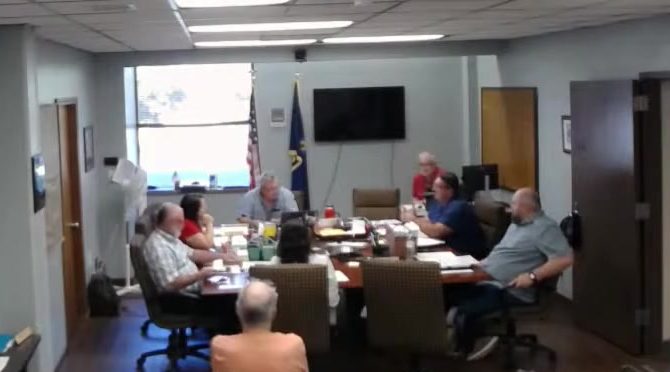
Against that backdrop, Milburn-Kee moved June 15 to deny Walker’s request to use the room, citing its many uses and noting it is the only workspace she has. Walker pushed back saying she has nowhere else, no budget to rent space, and the room is her most secure option. Chairman Samuel Tran disputed that it is “secure,” and the two talked over each other until Walker asked Tran “please don’t be disrespectful to me” and he replied that she was “coming to the table asking for a favor,” and finally telling her to “do what you have to do, madam.” Tran alluded to a past “issue” he didn’t want to “resurface.” Milburn-Kee’s motion failed. Milburn-Kee and Tran were the only ones who voted for it with the rest of the commission against. Commissioner Gregg Motley’s motion to grant Walker’s full request passed with Tran and Milburn-Kee voting against.

The dispute turned on whether the clerk had a workable alternative. Tran proposed moving early voting to the courthouse’s main atrium and using County Appraiser Matt Quick’s office and conference room. Walker rejected that as neither secure nor convenient for her election judges, calling the commission room “the securest” space available; she said she has no other location and no budget to rent one. Milburn-Kee argued the room is needed for its “multi-use purpose,” she said it is her only workspace and that she comes in early and on weekends to set it up, and noted her motion would still lend Walker the county’s Public Works and maintenance crews to move and set up election equipment. Commissioner David Beerbower was skeptical, noting the county would not ask the appraiser or other courthouse officeholders to give up their offices: “I’m baffled.” Commissioner Joe Allen framed the conflict as narrow, “four Mondays, four meetings,” the handful of Monday commission meetings that fall within the voting window, which Walker said she had already worked around so the board could still meet.

The exchange begins around 1:20:43 in the June 15 meeting video.