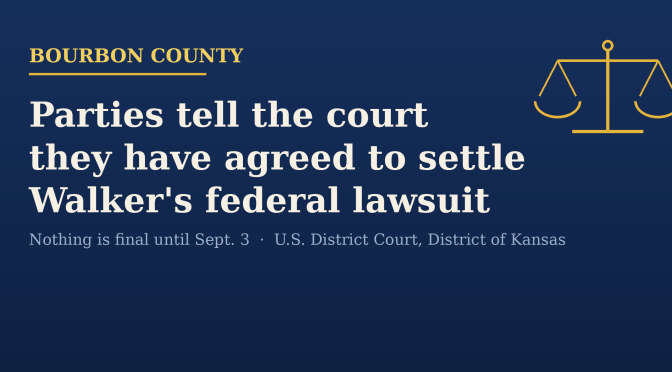
In today’s hearing of BB-2024-CV-000075, Jennifer Hill was allowed to withdraw from her role on the case defending the Bourbon County Commission which consists of Beerbower, Kruger, and Wisenhunt.
Patrick Hughes representing the Plaintiffs (which include all three county commissioners) objected to the reason for her withdrawal stating that there is no conflict of interest according to rule 1.7. He stated there were no objections to her withdrawing other than an objection to the reasoning that there was a conflict of interest.
Judge Richard Fisher asked if there were any objections to the withdrawal and none one objected so he allowed her to withdraw without making any mention of whether their was a conflict or not.
Seth Curtis Wright, defense for Tennyson Creek Solar I & II, pointed out that any conflict in Jennifer Hill representing the Beerbower, Kruger, & Wisenhunt as commissioners would also apply to Mr. Hughes representing all three of them as individuals. Further, he pointed out, that anyone replacing Jennifer Hill will have the same conflict of interest since all three of the commissioners are defendants in a suit filed with the three of them as plaintiffs.
He said he wasn’t presenting that today but would file a motion. Hill said that the county commissioners were working to secure the services of a lawyer, but there were some things that needed to resolve before it could be done. It wasn’t clear what lawyer was being referenced.
The case will be revisited once the conflict of interest motions are filed and the county commissioners obtain someone to represent them in their capacity as commissioners.
Lynn County News is reporting that USD 346 was informed that the board of Southeastern Technical Academy for Rural Students has voted to seek separation from Fort Scott Community College for the upcoming school year. They plan to ask the Kansas Board of Regents to provide mediation in the efforts to separate from FSCC.
FortScott.biz reached out to the STARS, but the employees had been instructed not to communicate with the paper.
According to the FSCC website and USD346’s website, South Eastern Technical Academy for Rural Students offers high school students dual credit college-level courses through FSCC in the following programs from the location in Pleasanton:
Certified Nurse Aide
Emergency Medical Technician
Criminal Justice
Construction Trades
Welding
Heavy Equipment
HVAC
STARS 2024 Graduates in front of 1701 Laurel St. Pleasanton, KS. Photo from FSCC promotional literature. Photo credit Kristie Kern
The program was announced in 2021 and began in the fall semester of 2022 with programs offered through the Kansas Board of Regents for Excel in CTE funding, which meant students could complete technical college courses without being charged tuition and most fees.
The three individual county commissioners and six other individuals who are suing the county commissioners and four solar companies claim that there is no conflict of interest for Lawyer Jennifer Hill to represent the county commissioners as an entity.
Jennifer Hill of McDonald Tinker PA in Wichita, KS
On January 30th, Jennifer Hill filed a motion to withdraw from the lawsuit. She was defending the county commission, which now consists of David Beerbower, Leroy Kruger, and Brandon Whisenhunt. Since those three individuals are all plaintiffs in the lawsuit suing the county commissioners, Hill said that trying to represent them would violate KRPC 1.7, which says that a lawyer can’t represent one client if doing so would be directly adverse to another client. An example might be: It would be impossible for Hill to have any private communication with the county commissioners without that communication being known by at least three of the plaintiffs since they are the same people. If disclosing to the plaintiffs conversations that were intended for the defendants could be adverse to the defense, then there would be a conflict.
The plaintiffs (Beerbower, Kruger, Whisenhunt, and the other individuals who are suing the county commissioners) have responded through their lawyer, saying that while the idea of a conflict has some “facial appeal” there is actually no conflict involved.
The motion to withdraw alleges, in effect, that the plaintiffs who are now members of the Board of County Commissioners are the same party as the defendant Board of County Commissioners Ms. Hill represents and, therefore, her continued representation of the Board of County Commissioners would also be a representation of the board members who are plaintiffs. An attorney has a conflict under Rule 1.7(a)(1) when “the representation of one client will be directly adverse to another client.” That analysis may have some facial appeal, but it is incorrect.
Comment 2 to Rule 1.7 teaches that assessing whether there is a conflict begins with clearly identifying the clients or clients. The Board of County Commissioners of Bourbon County is Ms. Hill’s client. It is a corporate entity and by statute is the properly named defendant in actions against a county. See K.S.A. 19-105. Its legal identity does not change depending on who its current members are. Ms. Hill represented the same entity now that she represented at the beginning of the case.
The objection goes on to state that, since the board members have no individual authority as a commission when it comes to county business, the board has a legal identity separate from that of the individuals. Since Beerbower, Kruger, and Whisenhunt are suing the county commissioners in their capacity as individuals, they claim that action is separate from any action they could bring acting together as the county commission. They claim that since Hill is representing the commissioners but not the individual members of the board, there is no conflict with her continuing to provide legal counsel to the board. There is no mention of how Hill could communicate with Beerbower, Kruger, and Whisenhunt in their role as commissioners without the communication being known by Beerbower, Kruger, and Whisenhunt in their role as plaintiffs who filed the lawsuit.
It might not immediately be apparent why the plaintiffs would care why the defense counsel withdraws, but presumably, if the plaintiffs agree that there is a conflict of interest, that conflict may apply to the defense side of the lawsuit as well since the conflict would come from having the same individuals (though acting in different capacities) both pursuing the lawsuit and defending against it. Further, if there is a conflict for Hill, then any lawyer would have the same conflict. If there is a conflict, the conflict derives from the fact that Beerbower, Kruger, & Wisenhunt are on both sides of the lawsuit regardless of whether they are acting as an individual on one side and the commission on the other. Any attempt to replace a lawyer would not affect a conflict based on an overlap of individuals between the plaintiffs and defendants. If there is a conflict with that as the root, it could only be resolved if the three commissioners were somehow no longer a party to one side of the lawsuit.
The plaintiffs go on to state that they are fine with Ms. Hill withdrawing from the case and posit that she might want to leave because she was hired by an insurance company that has now decided there is no coverage to represent the commissioners in the lawsuit. If Hill is allowed to withdraw, they ask that the proceedings wait until Beerbower, Kruger, & Wisenhunt, in their role as commissioners, retain a lawyer who can help defend against the lawsuit from Beerbower, Kruger, Wisenhunt, et al. in their roles as individuals.
BB-2024-CV-000075 is an ongoing lawsuit by all three members of the Board of Bourbon County Commissioners against the Board of Bourbon County Commissioners. The Commissioners are joined on the plaintiff side by six citizens and on the defendant side by four solar companies.
Jennifer Hill, the lawyer representing the Bourbon County Commissioners on the Defendant side of the lawsuit, filed a motion to withdraw as counsel because “the fact that since the filing of this lawsuit, the Board of County Commissioners of Bourbon County, Kansas is now made up of three individuals who are all also named Plaintiffs in the litigation. Plaintiffs Whisenhunt, Beerbower, and Kruger are the three elected board members of the County commission. Such continued representation violates KRPC 1.7.”
She went on to say that if the County Commission cannot retain counsel, they would need to appear at any future hearings personally. KRPC 1.7 deals with situations where a lawyer discovers that representing a client creates a conflict of interest. For example, any conversation Ms. Hill had with her clients of the County Commission as defendants of the lawsuit would necessarily be shared with three of the people who filed the lawsuit against the County Commission.
Rule 1.7 does allow a lawyer to continue to represent a client even when there is a conflict of interest, but only if:
“the representation does not involve the assertion of a claim by one client against another client represented by the lawyer in the same litigation or other proceeding before a tribunal;”
This conflict of interest would appear to apply to any counsel that the County Commission retained. If that is the case, then the County Commission may be forced to represent itself.
Patrick Hughes of Adams Jones Law Firm in Wichita is representing the Plaintiffs. If Rule 1.7 required Jennifer Hill to withdraw as counsel due to a conflict of interest, it would seem there would be a conflict by the counsel representing the Plaintiffs as well.
On 2/5/2025, three solar companies filed briefs supporting their motion to dismiss. They claim that the plaintiffs appear to be trying to make changes to their petition without following the correct procedures, failing to address the Defendants’ arguments, and having no standing to file the lawsuit in the first place.
The Responses to the Defendants’ Motions to Dismiss only serve to reinforce the notion that the sole basis of Plaintiffs’ claim is that they do not like the Agreements but do not have any actual, legal injury that entitles them to relief. Accordingly, dismissal is required.
A lawsuit was filed in November 2024 seeking to declare Bourbon County Resolution 14-24 unenforceable, which had been approved by the County Commissioners on October 31st, 2024. The resolution revoked an existing moratorium on solar energy developments and “limit the Board of County Commissioner’s exercise of police powers in the future with respect to” the solar companies.
The lawsuit was filed by David Beerbower, Leroy Kruger, Brandon Whisenhunt, Boa Casper, Katie Casper, Timothy Emerson, Samuel Tran, Karen Tran, and Michael Wunderly against The Board of County Commissioners of Bourbon County Kansas, Hinton Creek Solar LLC, Kingbird Solar Energy LLC, Tenneyson Creek Solar LLC, and Tenneyson Creek Solar II LLC.
On January 30th, Jennifer M. Hill, counsel for the Board of County Commissioners of Bourbon County, Kansas, moved to withdraw as counsel. She said three of the people who brought the lawsuit now represent the entirety of the Bourbon County Board of Commissioners, which is being sued in the lawsuit. Thus, a subset of the plaintiffs represents the entirety of one of the defendants. This, she said, violates Kansas Court rule KRPC 1.7 regarding conflict of interest.
In the most recent filing, Jennifer Hill advises the commissioners,
“You are further notified that further proceedings may be held in this matter whether or not you are represented by counsel. “If you do not retain other counsel, you should appear personally at any scheduled hearings. There are no presently scheduled hearings. However, Judge Richard Fischer, JR. will preside over hearings related to various Defendants’ Motion to Dismiss in the upcoming weeks or months.”
The original petition in the lawsuit can be found here.
If you happen to pass near the old Walgreens parking lot, you may be greeted by a voice coming from the sky saying, “You are trespassing! Please leave the area. This area is under video surveillance, and you have been recorded.”
While you look up to identify the celestial speaker in the heavens, you will instead find an aerial bullhorn complete with multiple video cameras and flashing blue lights.
According to the Fort Scott police department, they aren’t owned by law enforcement but are installed by property owners. The devices, made by Live View Technologies, are marketed as a solar-powered way to prevent theft and vandalism.
The devices gained attention in 2023 when they were placed outside an operational Walgreens across the street from a Ronald McDonald house. There, they loudly announced their oration every half hour to the annoyance of families trying to sleep across the street. The innkeeper was unhappy about “Robocop” waking his guests. While those devices seemed to be launching their repetitive discourse on a timer, the LVT website indicates they usually respond to motion.
Walgreens has announced that the Fort Scott store will close on January 22nd. Employees say they weren’t given a reason for the closure other than it was a decision made by corporate.
In October, Walgreens announced they would be closing 1,200 stores without specifying which stores would be affected. The Pittsburg store will remain open.
Downtown Fort Scott, looking north on Main Street, city hall is on the right.
On September 3rd, the Fort Scott City Commission voted to demolish several blighted buildings.
The purpose and goal of the Fort Scott Codes Department is to enforce all codes, ordinances, and regulations adopted by the City of Fort Scott to ensure the safety and aesthetic value of all properties and establish a standard of property maintenance, according to the city’s website.
The city has a process to allow extended time for property owners to repair the buildings.
Properties in a state of deterioration are turned into the city by community members for the most part, said Leroy Kruger, who works in the codes department.
This begins a process that starts with a letter to the property owner asking them to repair the house up to city codes and to give the codes department a phone call, within 30 days of receiving the letter.
“If we haven’t heard from them, we send out a condemnation letter,” Kruger said.
“We give 30 more days, if we haven’t heard from them, we turn it over to the city commissioners, and they vote on it,” he said.
“The next step is to advertise (in the Fort Scott Tribune) that we are going to tear it down. Then we have a public meeting,” Kruger said.
“Homeowners or any interested parties get another letter to come and speak to the commission,” he said.
“If no one shows up, the next step is to tear it down.”
“We try to get three bids submitted to the commission (for demolition) and they decide who gets the bid.” he said.
Once torn down to ground level, if the owners want to sell the property, a special assessment fee is given them to recoup the cost of the demolition.
“There’s quite a few blighted properties in Fort Scott,” Kruger said. “We have to stay in a budget for the year. Usually, there are two to three properties at a time.”
At the September 3 Fort Scott City Commission Meeting six properties were submitted.
“If these six go through, we’ve done 10 or 11 properties this year. I think the six have eaten up our budget,” Kruger said.
The codes department office is located in City Hall at 123 S. Main Street and can by reached by calling 620.223.0550.
Norm Nation is the supervisor and lead codes inspector.
On September 3rd, the Fort Scott City Commission voted to demolish several buildings. Here are the addresses and photos of the buildings taken from Google Street View.
Mercy Hospital Fort Scott signed an agreement with Ascension Via Christi to provide equipment and furnishings for emergency room services in 2019. Ascension Via Christi ceased operating the E.R. in 2023.
The Ascension Via Christi Emergency Department ceased operations in December 2023 in Fort Scott, and since then many in the community have been seeking solutions.
The Bourbon County Commission recently proposed a community vote to see if they will support a one-quarter sales tax to help fund an emergency department. That vote will be on May 14.
On April 11 about 75 people attended the meeting facilitated by a newly formed group called Citizens For An ER. It was held at the Fort Scott Community College Ellis Center.
Members of the group are Jamie Armstrong, Craig Campbell, Lynda Foster, Charles Gentry, Mark McCoy, Randy Nichols, and Doug Ropp.
Dr. Nichols listed some of the reasons the community needs an ER and the importance to the community.
Charles Gentry then explained the ballot proposal, explaining that the additional sales tax would add 25 cents for every $100 spent, so a $10 meal would cost 2.5 cents more. The tax would start on October 1 and run for 5 years. Voters could choose to terminate it before those 5 years are complete, he said.
Approximately 75 people attended the meeting at Fort Scott Community College’s Ellis Center on Thursday night.
Mr. Gentry said there are three ways an emergency department can be set up:
As part of a hospital.
As a remote operation for another hospital that is within 35 miles.
As part of a rural emergency hospital (REH).
Charles Gentry speaks to the audience about the sales tax measure on the ballot. From left are Craig Campbell, Doug Ropp, Randy Nichols, and Gentry. Mark McCoy was the moderator. Armstrong and Foster were absent.
If the county cannot establish an emergency department within those 5 years, the funds could be used for emergency medical services or for property tax reduction, Gentry said.
Mr. Gentry clarified that the group presenting was supporting an emergency room. They weren’t supporting a sales tax other than a means to the end of creating an emergency room. He made it clear that their job was not done once a vote occurred. They intended to monitor, report, and hold the county accountable for spending the money to achieve the goal of an ER.
He said that this sales tax does not guarantee they will be able to bring an E.R. to Fort Scott, but he was confident that without this, Fort Scott would not get an E.R.
Craig Campell spoke about the Rural Emergency Hospital Act, which was passed to help make rural hospitals sustainable. Currently, Fort Scott does not qualify for REH status because the hospital was closed before the cut-off date in the act, but there are some bills to extend the date to make Fort Scott eligible. The REH designation would allow the rural hospital to bill at 105% and would also be subsidized by several hundred thousand dollars per month.
In the first quarter of 2023, there were 128 out-of-town transfers from the Fort Scott Ascension Via Christ Emergency Department E.R. Without a local E.R., the first quarter of 2024 saw 292 transfers by EMS.
Since the only entities that could run an E.R. in Fort Scott are existing hospitals, there is less risk of the money being spent on something like $1,000,000 that was paid to Noble Health.
The donation agreement with Legacy Health Foundation stipulates that maintaining ownership of the hospital building requires maintaining the property, making it available for non-profits, and developing an acute care hospital on that site. If they do not do those things, the building returns to the county. Three years remain on the agreement.
The next community discussion will be at Uniontown on Wednesday, April 24, at 6:30 p.m. in the City Hall Meeting Room.
401 Woodland Hills Blvd. The emergency department is located on the south side of this campus.
The dog park in Gunn Park in Fort Scott, Kansas is very popular with local dog owners. Many canine pet owners meet there regularly to let their four-legged friends get exercise and socialize with other dogs in a safe, enclosed area made especially for them to play and burn energy.
While a dog park meets the needs of many pet owners, local ophidian owners haven’t had a good place to recreate their pets. John Snalt, a senior at Fort Scott High School, is a local pet owner who has personally felt the lack of options. “There just aren’t a lot of places I can take Fred to get exercise,” he said. Fred is John’s 4.5-foot copper-headed water cobra that he got when he was 12. That’s about to change for John, Fred, and other snake owners in the area.
John Snalt with his pet copper-headed water cobra named Fred.
Thanks to a grant from the International Order of Friendly Reptile Keepers (IOFRK), Gunn park will be getting two snake pit exercise areas this coming year.
Located just North of the dog park will be the non-venomous snake pit, and just North of that will be the venomous snake pit. Sue Stalkholm from the IOFRK stressed the importance of having two separate areas for the different types of snakes. “I need to stress the importance of having separate areas for different types of snakes,” she said in her comments to FortScott.biz. “This isn’t just a simple hole in the ground. We’ve designed everything to maximize safety and fun for everyone using the snake pit park,” she said.
Plans call for an emergency telephone and a snake bite kit located between the two pits as well as educational signs to make sure everyone knows that they should always check with the snake’s owner before attempting to pet a snake or play a flute for it. Sue said, “Many people who haven’t been around snakes don’t understand proper snake-handling etiquette so we want to make sure everyone has all the knowledge they need to be comfortable in the snake pit park.”
The grant will cover the construction of the two snake pits as well as ongoing maintenance for the first five years. Ms. Stalkholm said that in most communities, snake pits have become very popular, and local donations can usually fund maintenance after a few years. She stressed the economic value of having snake pit park options for the community and suggested that it might open up opportunities for reptilian pet stores that wouldn’t have been able to stay in business without a local snake pit park.
Several local community members expressed concern about the project. “Is this a good thing to put in Fort Scott before we have an emergency room?” asked John Shnoodle. Mr. Shnoodle doesn’t want anyone to think he is against snakes as pets, but just wasn’t sure if emergency response time should be considered.
Jane Pfeffle also weighed in with strong opinions on the subject. “We shouldn’t build a snake pit until we have a hospital,” she stated emphatically. When told that the funding for this was coming from an outside source and wouldn’t be available to fund a hospital anyway, she responded with, “That doesn’t matter. We need to shut everything down until a hospital opens in Fort Scott again. That includes all of our roads, schools, electricity, water, etc. If it has a budget, power switch, or valve, it all needs to shut down until a hospital reopens.”
According to IOFRK the snake pit park is expected to be completed in exactly 1 year. “We like to see a grand opening that the entire community can participate in.” said Sue. “In other communities, we’ve brought in some snake charmers for the opening day, and that has been a really big hit with local residents,” Sue said. The snake pit park plans to celebrate the opening day on April 1st of 2025. “Plans like this really best when everything related to them happens on April 1st. It really doesn’t work well to have discussions about it on any other day of the year,” said Sue.
FortScott.biz reached out to Fort Scott Mayor Sam Sneedle (who isn’t the normal mayor but is briefly filling the role for the purposes of April 1st) for comment, but he said that current litigation prevented him from making in comment. He went on to say, “They are going to build what in Gunn Park?!”
Fort Scott Community College President Dr. Jason Kegler held another Community Conversation on March 27, from 5:30 to 6:30 p.m. at the college.
These public discourses are to allow the public to have some knowledge of the challenges facing the college.
He referred to a recent FSCC Trustees board meeting where it was announced that the college is in much better shape and no longer at risk of not making payroll through June 30th.
At a recent employee meeting, he used the analogy of “just bobbing with our heads above the water,” Kegler said.
There are still definite challenges, but they can see the surface better than they could in the past, he said.
The audience at the March 27 Community Conversation led by FSCC President Dr. Jason Kegler.
Nursing
A recent update was given to the Kansas Board of Nursing after FSCC voluntarily ceased admitting new nursing students.
Vickie Laderer, Sonia Gugnani, and Darcus Kottwitz requested to the Kansas Board of Nursing that FSCC begin readmitting students for the fall 2024 semester, and was approved.
“This means one of our long-standing programs is no longer on hiatus,” Kegler said. .He said this represents a huge positive direction from being on ‘life support’ and ‘in trouble’ in December.
Dr. Kegler pointed out that FSCC’s nursing program used to be better than Pitt State University, but FSCC has lost the overall standard of excellence. He said there are still pockets of excellence, but the college needs to get back to having excellence across the board.
An audience member asked if the nursing program would be in a new location. Dr. Kegler said they hope to have them back in the lower level of the Hedges administration building. He said if anyone wants to help paint, there will be some opportunity to help.
Anne Dare asked if students had said they wanted to come to nursing but have been put on hold. Dr. Kegler said he wasn’t aware that had happened. He said they are working on a plan to make sure it is communicated to students that they will be accepting nursing students again.
FSCC Is Here To Stay
Dr. Kegler said he doesn’t want the local community wondering if the college is going to be here in the future. “We are going to be here,” he said.
An audience member asked if current students needed to enroll in another college as a backup. The president said he has no reason to believe a student would need to have a backup enrollment. He pointed out that FSCC has gone through one of the toughest times and has done so without laying people off.
“We have a long way to go before we truly need to be concerned about whether our doors are going to be open for students the following semester,” he said.
Dr. Kegler suggested that if people didn’t get a chance to attend the last board meeting, they should go to the YouTube channel and watch the agricultural presentation that highlighted the programs associated with the agricultural department.
FSCC President Jason Kegler speaks to the audience at the Community Conversation on March 27.
Four-day School Week
The college is switching to a four-day school week because students are asking for it. Several high schools are also going to four-day school weeks, and students from those schools are very interested in the flexibility that type of schedule allows. The college will still be open on Fridays, but the majority of courses will be Monday through Thursday.
An audience member said that the 4-day week was important for students because it allows them to take on more work responsibilities to help pay for college.
Softball Question
An audience member asked if softball would still be running this fall and accepting scholarships. He said it should continue to be fully functional in the fall.
FSCC’s Image
Dr. Kegler asked what the community thinks of when they think of the image of FSCC.
Some of the things that were mentioned:
Affordability for large families
A good stepping stone to a 4-year degree.
FSCC used to represent a lot of community involvement
The building we are meeting in used to be a lawn, but it is providing a lot of value to the community now.
Audience members mentioned that they would be very interested in taking some adult education classes and suggestions were made to gather survey information to see what people were interested in.
Jerry Witt mentioned that the community doesn’t know the faculty like they used to and there might be opportunities to “sell the faculty” so the community knows more about them.
Rodeo Team Member in Top Third In the Nation
Dr. Kegler said FSCC has a bronc or bull rider in the top third of the nation. “He was recently injured but his time is good enough that he should qualify for the national finals,” he said.
Future Students and Community Involvement
Aggie Day had 1,250 potential students visiting the college, he said.
Dr. Kegler said that in August the school is hosting a move-in day and asked if the community would come in to help greet the students, hand out water, and make people welcome.
He asked what it would take to get the community involved in the college.
Someone asked about a public relations person to let the alumni know what is happening at the college. Dr. Kegler said there were some other priorities first but that it was a good idea.
Dr. Kegler said the college would need help mowing, cleaning the residence halls, and painting and suggested that people interested in helping should contact the college.
He asked alumni why they attended here. Some of the answers:
Because it was close.
Dual credit when they were in Fort Scott.
They were paying for their own college and it was a good investment.
Their dad made them come because they were going to quit after going to Pitt State.
There was some discussion about how the community could be more informed about what was happening at the college. An audience member suggested that the community could be more active in seeking information about the college. Dr. Kegler said it was a two-way street. The college should try to do a better job of putting information out there, and the community can do a better job of seeking out information about what is happening.
Dr. Kegler said Dick Hedges used to come to work at the college, then run home and put on overalls and go drink coffee with members of the community at the sale barn. Dr. Kegler said he doesn’t drink coffee, but that type of relationship is what the college needs to be building with the community.
He asked if people would like to continue these conversations after the one planned for April. One person suggested continuing and another suggested taking a break.
Members of the Fort Scott community showed up to hear the announcement at the Legacy building (formerly Mercy Hospital).
Kansas Renewal Institute is opening its first location at the Legacy Building (former Mercy Hospital)at 401 Woodland Hills.
Jonathan Gross the CEO of JG Healthcare Solutions spoke for a few minutes about KRI opening their first location in Fort Scott. He said that KRI is a behavioral health company licensed for service to both adults and adolescents, and that they plan to bring a number of jobs to the community.
Fort Scott will be their first location. He said to visit their website for more details and job listing. While it wasn’t mentioned as part of the announcement, people close to the project say that it will be an inpatient clinic taking up a significant portion of the old hospital and is backed by JGHealthcare Solutions.
Below is a recording of the announcement that can also be viewed on Facebook here.
The following is some additional information about the company behind KRI along with links from public sources.
Jonathan Gross is the CEO of JGHealthcare Solutions which is the parent company to Kansas Renewal Institute. According to his LinkedIn profile, Mr. Gross founded his namesake company nine months ago. Before that, he spent nine months as the founder of Revelare Recovery in Atlanta. Prior to founding Revelare, he worked for 4 years as both a director and vice president of Discovery Behavior Health. Discovery is a Behavioral Health business based in California that, according to Linked In, employs over 1,000 people with clinics in 15+ states. They have 21 active job openings according to Linked In.
JG Healthcare Solutions’s Linked In profiles lists them as being located in Golden, Colorado located on the West side of Denver, says they have 5 to 11 employees, and list 3 LinkedIn in profiles that are affiliated with the company. That was not an address on their website, but Bizapedia lists an LLC in Golden by that name. The company was formed April 27th 2023. They are listed as being in good standing with the state of Colorado and show and address of 1015 Golden Park Pl Apt D. The location can be seen from Google Street view as shown.