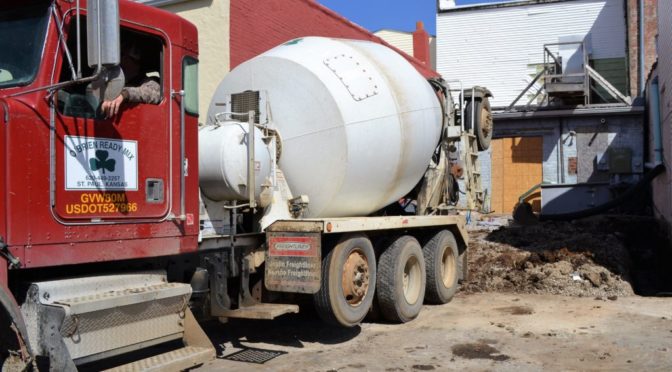
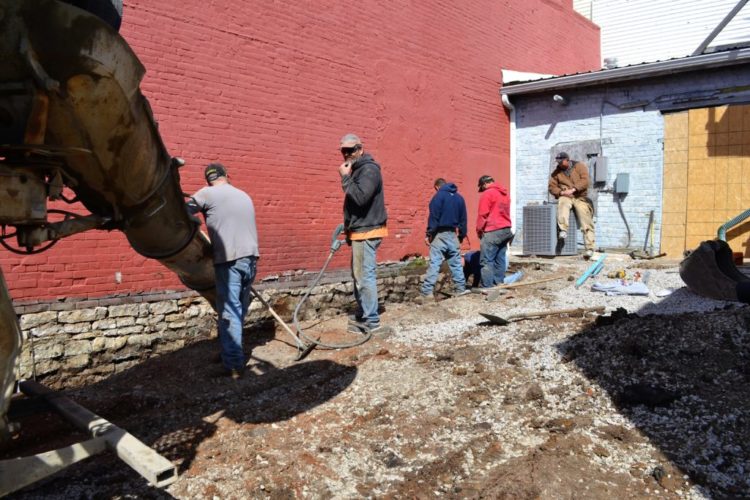
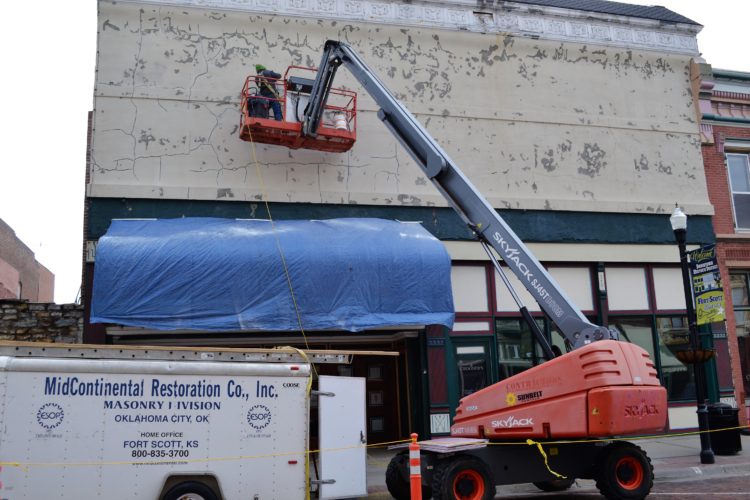
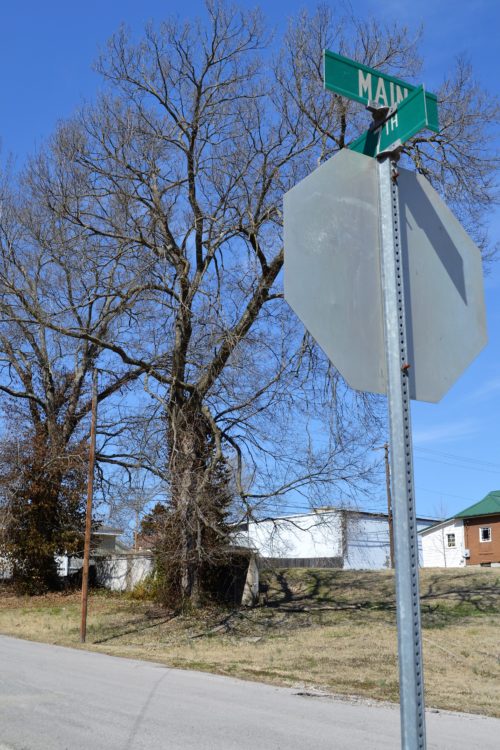
Thomas Concrete Construction workers pour the footings for the Bartelsmeyer loft renovation Wednesday afternoon, in the alley behind the loft on north Main street. They will lay blocks on each side of the footings, then come back to pour the flooring, said foreman Luke Thomas.
Don’t want to wait in line for your custom coffee?
At the Downtown Quarterly Meet and Greet at Common Ground Coffee Co. Tuesday morning, MacKenna Robinson said the coffee shop is beginning to offer online ordering.
“Online ordering is now at Common Grounds and in April, we are giving five-percent off (each order),” Robinson, assistant manager of the shop said.
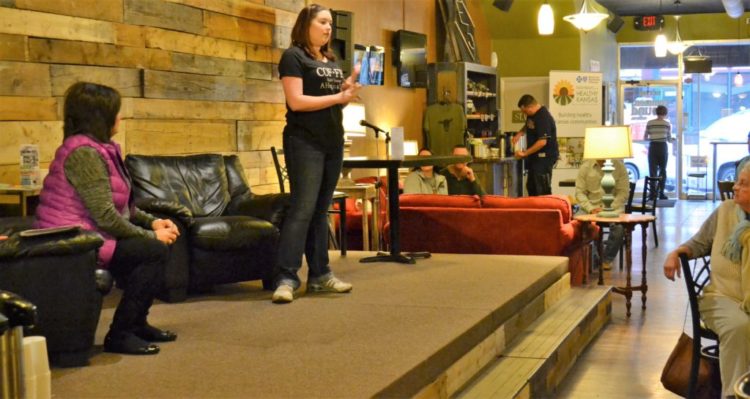
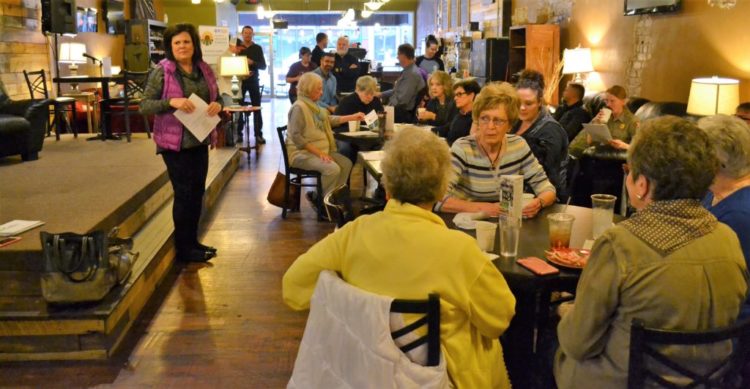
Mackenna Robinson, assistant manager of Common Ground Coffee Co., 116 S. Main, speaks to the Downtown Quarterly Meet and Greet April 3.
Robinson also told the group that the coffee shop has been approved for a Blue Cross Blue Shield of Kansas Pathways to a Healthy Kansas grant, through the Healthy Bourbon County Action Team.
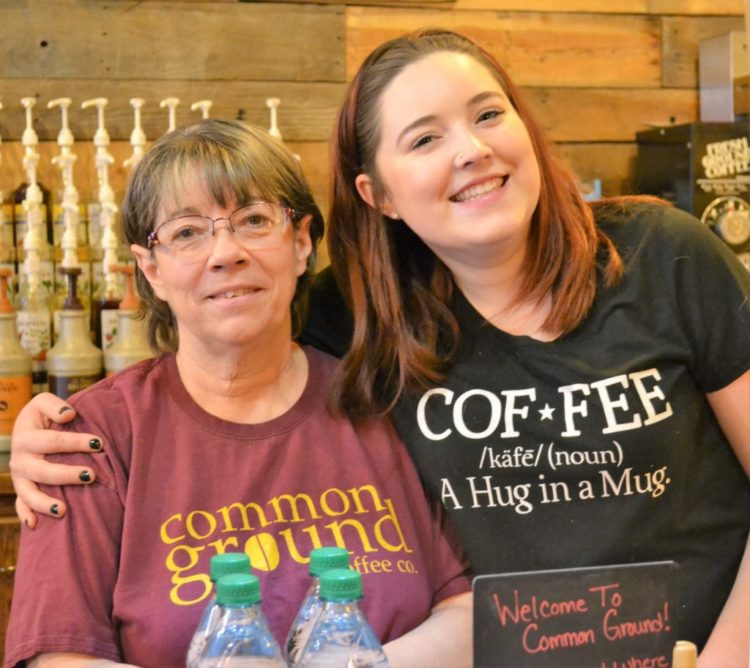
Common Grounds Manager Vicki Waldron and Mackenna Robinson, assistant manager and also Waldron’s grand-daughter.
The grant will allow the coffee shop to purchase more equipment to serve fresh salads, Vicki Waldron, the manager said in a later interview.
Robinson said the coffee shop will also be a part of a meeting to make a directory of food producers and local restaurants. The meeting’s purpose is to form collaborations to get fresh locally produced foods to restaurant tables. The Buy and Eat, Meet and Greet event will start at 5:30 p.m. May 3 at Memorial Hall.
To learn more about the May 3 event see the Healthy Bourbon County Action Team Facebook page.
To learn more about the grantor, BCBSKS, click here:
Other upcoming local events announced at the meeting:
The 2nd Story Festival of Arts and Ideas is scheduled for April 27-29 around venues in Fort Scott. It includes workshops, improv comedy performances and a festival finale event and fundraiser Saturday evening. For more information: https://www.2ndstoryartfestival.com Fort Scott Chamber of Commerce Executive Director Lindsay Madison asked the group to attend the 2- 3:30 p.m. Saturday event titled “Creative Placemaking: Building the Artist Community in Fort Scott” by Marc Wilson at the Empress Event Center, 7 N. Main in downtown Fort Scott.
There will be free outdoor movies offered at a location to be announced by Larry Gazaway, the city’s tourism manager. The movies are The Incredibles, May 25; Cars 3, June 22; Star Wars Night, July 20 and The Princess Bride, August 17.
Art walks by the Bourbon County Arts Council will be from 5-8 p.m. at the Liberty Theater patio, on May 18, June 15, July 27 and Sept. 14.
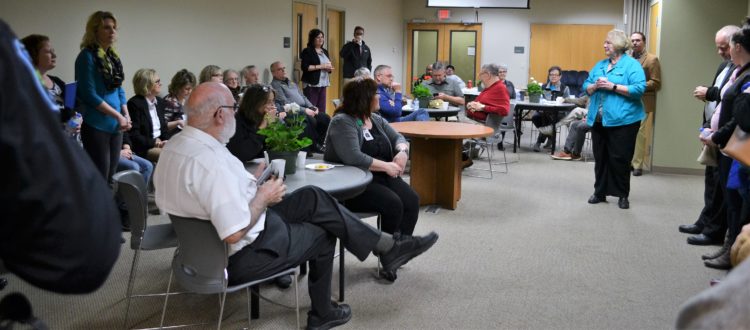
Fort Scott Chamber of Commerce Executive Director Lindsay Madison speaks to attendees at Tuesday morning’s Downtown Quarterly Meet And Greet, hosted by Common Grounds Coffee Co.
Smallville Crossfit is having a “Murph Challenge” on MemorialDay and Fort Games on June 23. See their Facebook page for more information.
The Good Ol Days Festival is May 31 – June 2 this year. The theme is “The Great Outdoors.” The parade is at 6 p.m. June 1 and there will be Friday night shopping again this year downtown.
There is a new website for tourism: www.visitfortscott.com/
Biking Across Kansas, a 559-mile ride will end in Fort Scott on June 16. Expected are about 850 cyclists.
There will be a Veteran’s Weekend Nov. 9-11 in honor of veterans. An 11 am. service at National Cemetery and a parade at 3 p.m. on Nov. 11 are some planned events.
Craw-Kan Telephone Cooperative’s Fiber Optic Internet is progressing to the downtown area this summer and project construction will ramp up in 2019, according to Zach Adams. He said the response was more than expected in the community.
Free tourism trolley tickets are available, businesses are encouraged to add coupons to the ticket envelope to advertise. Contact Gazaway at the tourism office, 231 E. Wall.
The Presbyterian Church will have a Sunday Serve Clean Up/Projects Day April 29 at 8:45 a.m.
The Fort Scott National Historic Site Civil War Encampment is April 21-22.
KOMB is hosting the 7th Annual Home, Sport, Farm, Garden Show at Arnold Arena at Fort Scott Community College April 13-14. There will be 56 inside booths and more outside. Call 620-223-4500 for more information. Children’s activities will also be available.
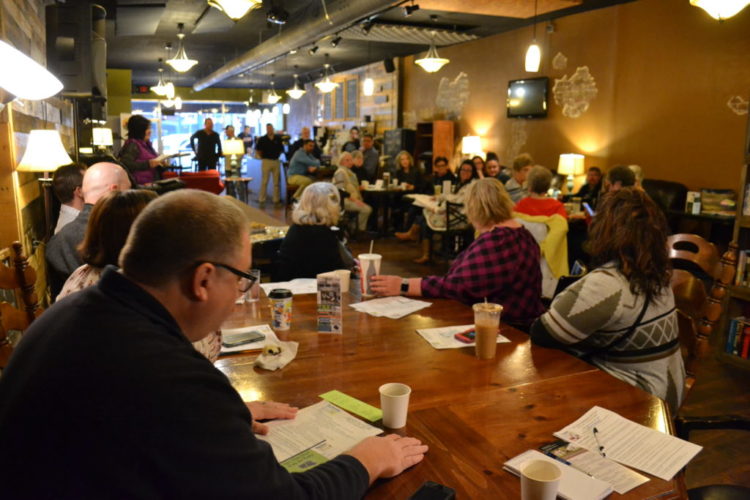
Attendees listen as each tells their name and the business/organization they represent.
The Lowell Milken Center for Unsung Heroes is collaborating with Fort Scott National Historic Site to bring “Mother” Mary Bickerdyke to area fifth-grade students.
There will be a woman’s luncheon April 25 at the Ellis Fine Arts Center at Fort Scott Community College. Vendor booth rental is $6. For more information contact Juley McDaniel at 620-223-2700 Ext. 5201.
An interactive story time at the library will start soon, contact K-State Extension Agent Joy Miller for more information.
Gary Palmer said he will be starting a retail printing business within the next 30 days. He will offer a discount to not-for-profit groups.
The townwide yard sale will be May 11-12.
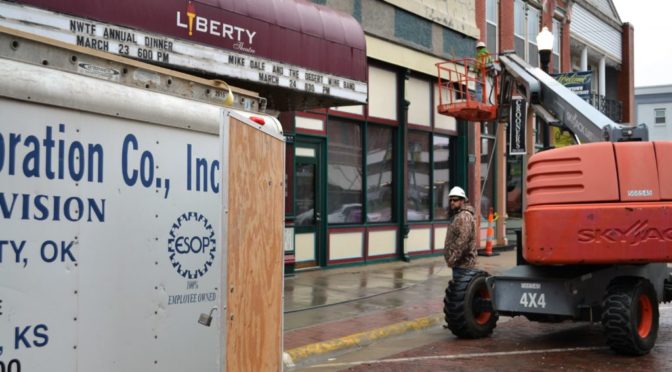
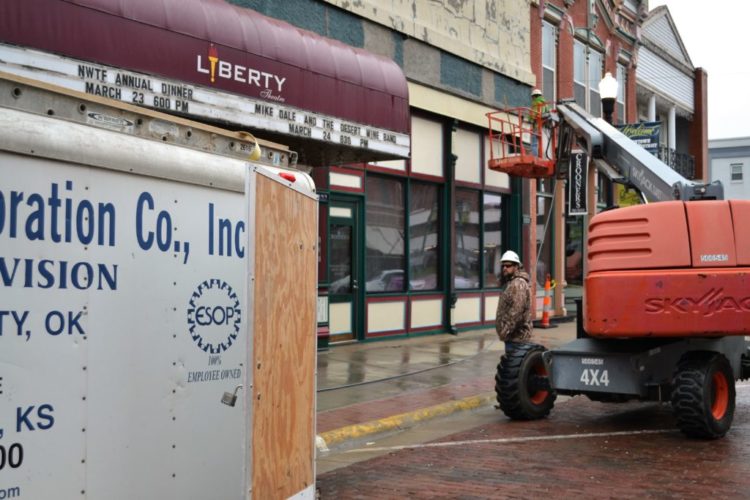
In a recent conversation with Kansas Governor Jeff Colyer, City Manager Dave Martin said Colyer indicated the completion of the Hwy. 69 is a priority project. Martin also mentioned the positive movements in town: the Boiler Room Brewhaus expansion, the Liberty Theater building rehabilitation, the Hole in the Wall Liquor Store project, the Fort Scott Family Dental move to downtown, Bartelsmeyer’s renovating a downtown loft, progress on the old La Hacienda building, Arby’s Restaurant coming to the old Kentucky Fried Chicken facility, and the Fisher Park Project. Martin gave his cell phone number if anyone has questions: 620-644-2498.
The Third Saturday Marketplace in collaboration with Fort Scott Farmer’s Market needs volunteers to oversee the event once a month, said Lindsay Madison.
There will be a meeting at 4 p.m. Thursday, May 3 at the Empress Event Center, downtown, for senior citizens interested in senior housing options. Pat Wood will host the event, which includes drinks and hors d’oeuvres.
The meet and greet is hosted by the Fort Scott Chamber of Commerce the first Tuesday in January, April, July, and October each year.
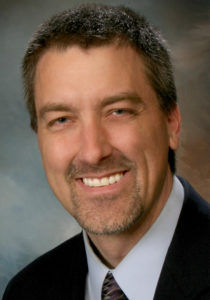
Kansas State University’s 4-H Youth Development Department Head and State Program Leader Wade Weber can be reached at 201 Umberger Hall Manhattan, KS 66506, or phone: 785-532-5800, or wweber@ksu.edu
The Kansas 4-H organization experienced budget cuts in the last few years, according to officials, and began a process to keep the youth organization going and growing.
Kansas 4-H implemented a “4-H Program Fee” effective October 2017. This is new since the 4-H organization has traditionally been free for participants.
“Many states have already implemented this type of fee – including Missouri and Oklahoma,” Carla Nemecek, K-State Southwind District Director and Agent said.
The organization gathered input on how to stabilize funding and grow the 4-H program, according to Wade Weber, Kansas State University’s 4-H Youth Development Department Head and State Program Leader.
“We hosted discussions as well as conducted a survey to gain feedback on program impact within K-State Research and Extension,” Weber said. “A task force of eight extension agents was formed to review all information and develop recommendations on how to move forward.”
The task force worked to provide a means to ensure a steady funding stream to grow the 4-H program, Weber said.
The task force members were Candis Meerpohl from Shawnee County, Monica Thayer from the River Valley District, Michelle Beran from Midway District, Melinda Daily from the Sunflower District, Allen Baker from Wichita County, Nancy Honig from Stevens County, Jodi Besthorn from Sedgwick County
and Brian Swisher from the Wildcat District, according to links provided.
A recommendation from this task force was to implement an annual 4-H program fee of $15 per member, beginning October 2, 2017.
“Funds from the 4-H Program fee are placed in a restricted funds account available for use only by the Kansas 4-H Youth Development Department,” according to Weber.
“Funds generated will strengthen our program priorities of volunteer development, project support, and program enhancement,” Weber said.
“K-State Research and Extension had to face several budget cuts over the past couple of years, and this would seem to be an option to help fund Kansas 4-H on a State level.” Carla Nemecek, Southwind District director, and an agent said. ” The Southwind District will not receive any financial benefit, as 100 percent of the program fee is directed to the State 4-H Program.”
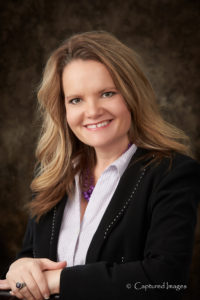
Carla Nemecek is Southwind District Director and agent.
Southwind District encompasses Allen, Bourbon and Neosho Counties.
“Some counties were fortunate to have found donors who are offsetting the cost, but we do not know how long those donations will last,” Nemecek said.
“As a 4-H parent and Director for the Southwind District, I am sympathetic to those who are upset about the fee,” Nemecek said. “Kansas 4-H has always been free for anyone to join, so this is taking us down a path we have never been.”
A provision has been made for those for whom it would be a hardship to pay the $15 per child program fee, she said.
“There is a waiver process for those families or individuals who are not able to pay the fee,” Nemecek said.
Message from Weber on benefits for local 4-H programs:
In January Dr. John Floros, Kansas State’s College of Agriculture Dean presented highlights of 4-H Youth Development efforts in the last 12 months to a joint meeting of state senators and representatives.
Also in January, Dr. Floros, Dr. Greg Hadley, Associate Director of Extension and Applied Research and Weber conducted meetings with local leaders to tell of the progress made.
These findings are what they reported, according to Weber:
“Examples of National and State 4-H Funding Efforts Benefitting Local 4-H Programs:
• Kansas 4-H Foundation Expansion Grant – 2017 marked the conclusion of a five-year effort to expand 4-H youth and volunteer participation in 14 extension units. This effort resulted in an increase of 458 4-H volunteers. Evaluation data has been collected from the units and a framework for growing 4-H will be created based on the learning experiences of those involved and will be shared with local units for implementation.
• National 4-H Council Ag Innovators Experience– 2018 will feature 4-H teen leaders in the Cottonwood District reaching area youth with the “Monarchs on the Move Challenge.”
• National 4-H Council Youth Futures: College Within Reach Grant–The focus of this grant is on providing mentoring partnerships to underserved youth in Seward (2017) and Riley (2018) counties. Program results in reaching new audiences will be shared statewide for local unit implementation.
• National 4-H Council Science Matters Grant – Johnson County (2018) is currently collaborating with Bayer to inspire young people to become tomorrow’s science leaders. Program results will be shared statewide for local unit implementation.
Kansas 4-H Youth Development Program Fee Prioritization Survey
• When: Conducted October 19 – November 15, 2017 by the K-State Office of Planning and Analysis
• Who: 612 Respondents statewide: 67% were volunteers or parents
• What: Received input within the following program priorities:
1) Project support and enhancements (i.e. principles of engaged learning, communicate and connect learning opportunities, updating/refreshing existing project materials)
2) Volunteer Development (training materials and support for volunteers; tools for recruitment, growth, evaluation and accountability)
3) Program enhancements benefiting community clubs (including but not limited to updating and refreshing tools for use with youth and volunteer audiences)
4) Foundational Supports (accessibility to all Kansas youth, campus/community partnerships and improved marketing at statewide events, and promotional materials that can be used by local units)
Fast Enrollment Stats 2016-17
•74,837 Kansas 4-H Youth Impact: This includes all delivery modes and has had duplications removed.
• 17,796 4-H Community based Club Enrollment: This includes Cloverbuds (ages 5-6) who are enrolled through a Community Club.
Dean Floros and Dr. Hadley provided the ability for the 4-H Youth Development program to hire a statewide volunteer development specialist while facing increasing budget challenges. This act affirmed the strategic support from administration to assist the 4-H youth development program in growing and modernizing.
Starting on Feb. 5, Shane Potter, New Volunteer Specialist, is tasked with refining the volunteer development process to ensure safe learning environments for youth and grow local 4-H volunteer capacity beyond the 6,000 existing adult 4-H volunteers statewide.”
Shane Potter is Kansas State University’s Volunteer Development Specialist. He started Feb. 5.
This is a reminder that the Downtown Meet & Greet is TOMORROW, April 3rd from 8:30 to 9:30 am at Common Ground. Come join us for networking and to share ideas related to Downtown. Light refreshments will be served. And, of course, if you want to come a little early you may purchase the specialty drink of your choice. The quarterly event is sponsored by the Fort Scott Chamber of Commerce.
9:00-9:45-Jim Harris-Replacement of tractor and mower
Lawn mower for Elm Creek
9:15-Executive Session-Confidential data relating to financial affairs or trade secrets of a corporation
9:45-10:00-Tim Travis and Lynette Westhoff-Billiard-Hammer
10:15-10:20-Right away for private sign on County property
10:30-10:45-Microbrewery
11:00-Justin Meeks
11:15-Executive Session-Privileged in the attorney-client relationship
11:30-12:00-Landbank and publication of title insurance
12:00-1:00-Commissioners gone to lunch
1:00-1:30-Review of Neighborhood Revitalization program
School Board meetings and FSCC dates and times
1:30-2:00-Clint Anderson/Justin Meeks-Executive Session-Privileged in the attorney-client relationship
2:30-3:00- Review any and all handbook issues/Prep for meeting
Justifications for Executive Session:
Personnel matters of individual non-elected personnel
Consultation with an attorney for the body or agency which would be deemed privileged in the attorney-client relationship
Matters relating to employer-employee negotiations whether or not in consultation with the representative(s) of the body or agency
Confidential data relating to financial affairs or trade secrets of corporations, partnerships, trusts and individual proprietorships
Preliminary discussions relating to the acquisition of real property
Matters relating to the security of a public body or agency, public building or facility or the information system of a public body or agency, if the discussion of such matters at an open meeting would jeopardize the security of such public body, agency, building, facility or information system
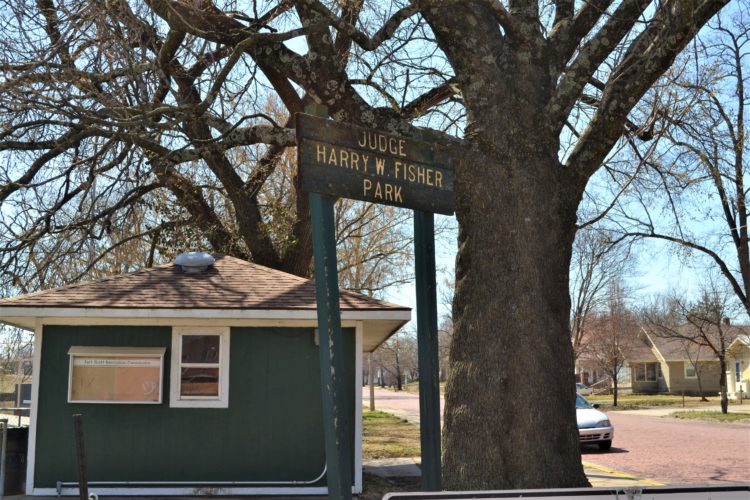
The new Fisher Park parking lot at 7th and Main streets will be located on the northwest corner and will accommodate 25 regular size parking spaces and 1-2 handicapped accessible spaces.
Frank Adamson started seeing the need for improvements of Fisher Park, when his daughter, Hunter, starting playing softball there, three years ago.
Eventually, others joined him in the pursuit to improve the park and today they are awaiting engineering specifications of the first step, making more parking spaces at the park located at 7th and Main.
The Fisher Park Project group received a grant this last month from a local industry, the Timken Company, in the amount of $5,200 for the purpose of helping offset engineering fees
Agricultural Engineering Associates, Uniontown, is currently working on those specifications.
Once received, the specifications will help with the process of getting more grants to fund future park improvement projects, according to Adamson.
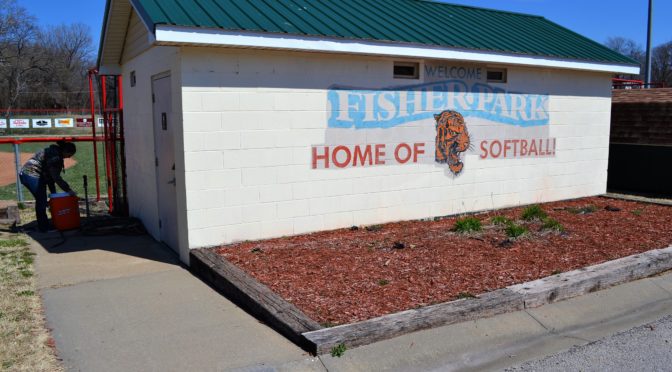
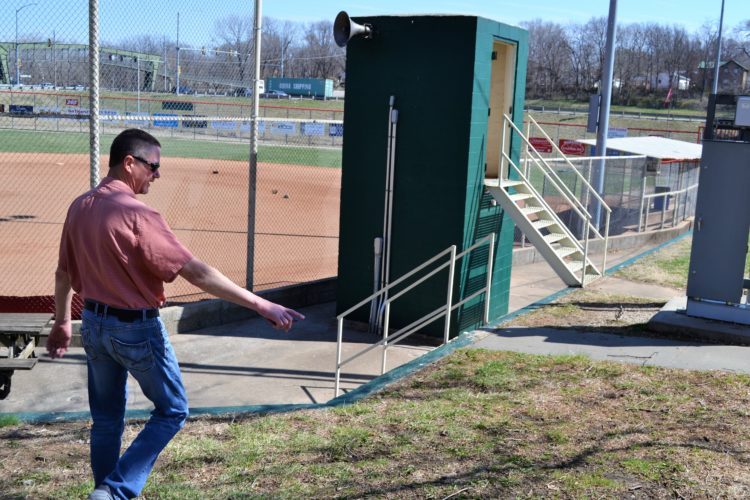
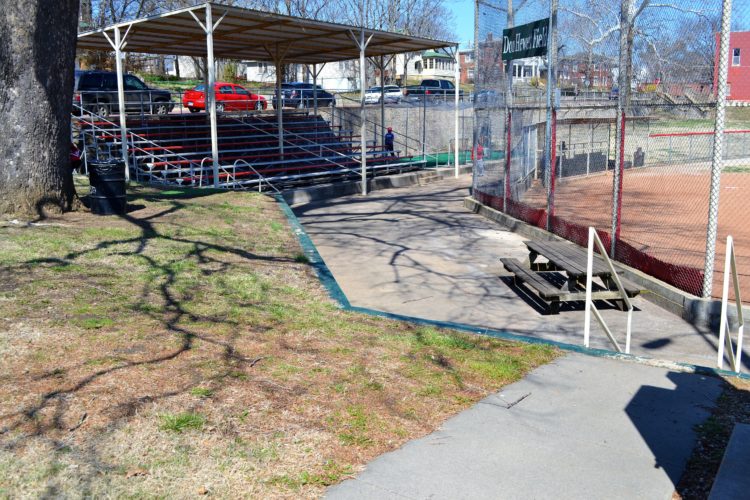
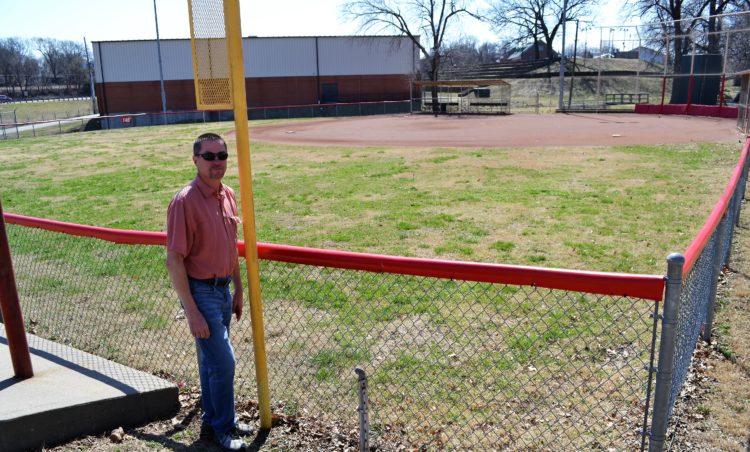
In addition to the parking lot, also envisioned in the project are concrete pads for wheelchair accessibility, more bleachers for viewing games, tearing down an unused tower that obstructs sight for viewers, and reconfiguring of the south ball diamond to make it regulation size.
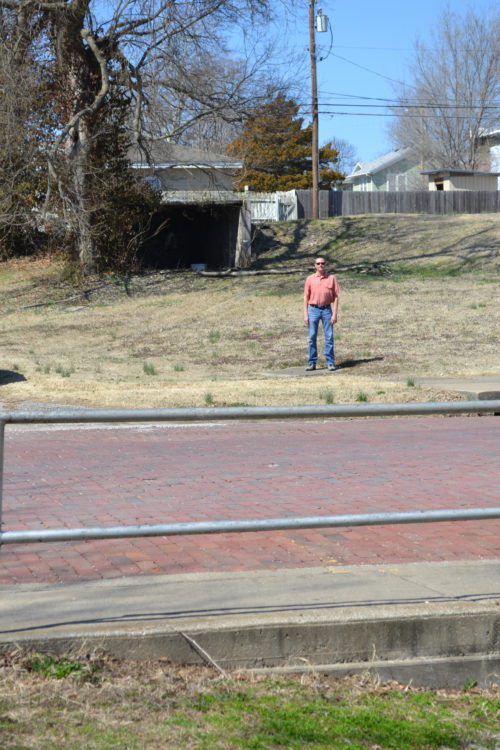
Adamson points to where the concrete pad for wheelchair accessibility is envisioned. In the middle of the picture is the unused green tower which will be demolished. The tower obstructs the view for fans of softball.More bleachers behind home plate are planned in this spot.Adamson stands in the spot that will be the home plate, once the south ballpark is reconfigured to make it regulation size.Adamson stands in the vacant lot at 7th and Main streets across from Fisher Park that will be the new parking lot for 25 vehicles and 1-2 handicapped accessible vehicles.
More parking spaces are first on the list for improvement at Fisher Park.
Twenty-five standard parking spaces and one or two van accessible spaces will be provided in an off-street lot across Main Street from the ballpark.
Those serving on the Fisher Park Project board are Adamson, Josh Jones, Bill Michaud, Tom Robertson and Rhonda Dunn.
For more information, see the Fisher Park Project Facebook page or contact Adamson at the Courtland Hotel & Spa at 620-223-0098
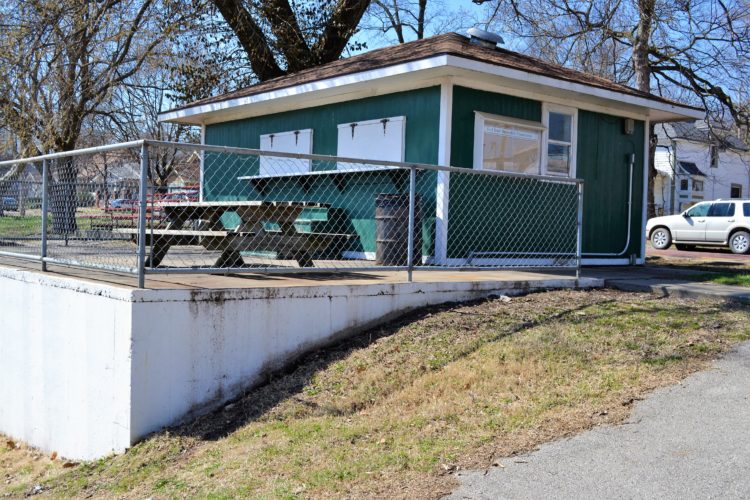
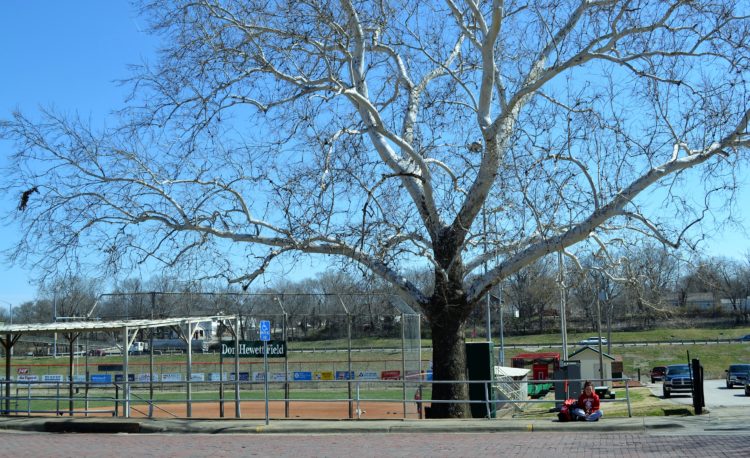
The concession stand currently has wheelchair accessibility and faces the south ballpark.Looking east towards the north ballpark in Fisher Park from the vantage point of the proposed parking lot.
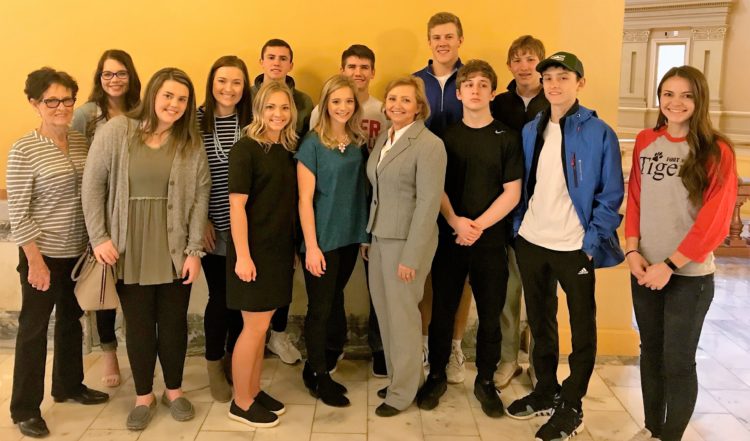
Future Business Leaders of America visited Topeka for the State Leadership Conference on March 27-29.
The conference is a two-day event hosted at the capital each year, according to Morgan Robbins, the Business Teacher and FBLA Sponsor at Fort Scott High School .
“Students from schools all over the state of Kansas compete in various events,” she said. ” All of our students competed in objective tests, in topics including personal finance, business law, hospitality management, health care administration and more. We were so lucky to get to meet with Caryn Tyson and listen to her briefly speak about her work before we left Topeka on Friday.”
Front, from left:
Beth Nuss, chaperone; Lauren Madison; Emma Martin; Morgan Rohr; Senator Caryn Tyson; Daevin Caldwell; Hudson Horn; FBLA Sponsor and FSHS Business Instructor Morgan Robbins.
Back, from left.
Katie Harvey, Sami Rogers, Nick King, Alec Michaud, Matt Campbell, and Carter Goldston
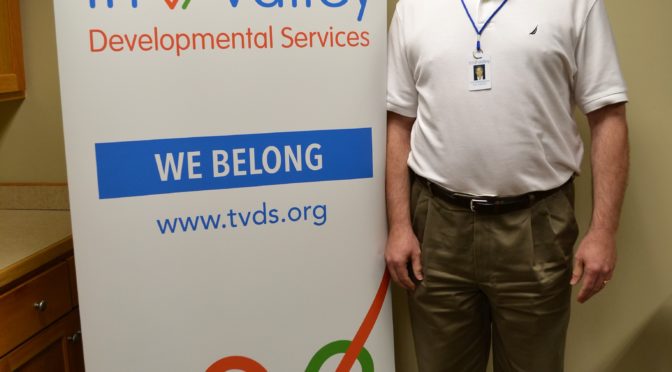
Tri Valley’s Executive Director Tim Cunningham shows off the new logo of the organization at Thursday’s Fort Scott Chamber of Commerce weekly coffee.
Tri-Valley Developmental Services, a local provider of social services to people with intellectual or developmental disabilities, has begun a new marketing plan.
“We don’t tell enough of all the good things we do,” Executive Director Tim Cunningham told the Fort Scott Chamber of Commerce weekly coffee attendees Thursday morning.
“A lot of people don’t know we are a one-stop shop for services they could need,” he continued. ” A lot of people don’t know we strive to make people as independent as possible. A lot of people move people, we keep them in their hometown.”
Cunningham said TVDS started in 1974 and has been in Fort Scott since 1977.
They currently serve 53 individuals at the facility at 4305 Campbell Drive in Fort Scott’s Industrial Park.
Cunningham introduced Barb McCord who is the horticulture therapist at the facility, which houses a greenhouse.
McCord told the attendees there will be no auction fundraiser this year because it happens every other year and this is an off year, but she will be having a one day sale of plants in May.
Additionally, plants raised in the greenhouse were offered as a gift, one per person, when the attendees departed the coffee social.
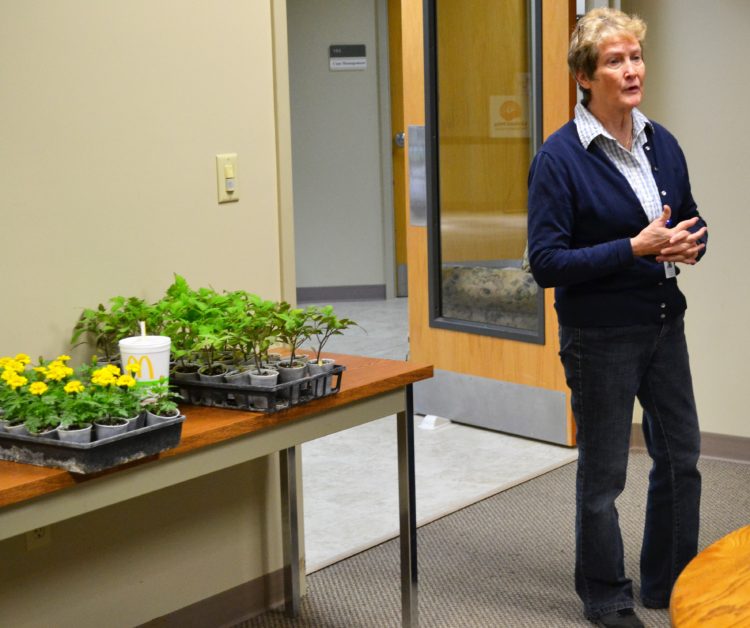
TVDS Horticulture Therapist Barb McCord speaks to the Chamber coffee attendees. Behind her are the give-away plants offered to each person who came to the coffee, either a tomato or a marigold plant. The plants are from the greenhouse at the facility.
Cunningham said the annual Cruise Nite in Chanute has a goal to raise $25,000 this year, to provide homes for people with disabilities.
Deb Needleman, a Chamber member, leads the announcement segment of the weekly coffee.
The Chamber of Commerce Board of Directors are Greg Motley, chairman; Needleman, past chairman; Gina Shelton, finance chair; Geoff Southwell, chairman-elect business, and resource division Chair; Alysia Johnston, workforce development division chair; David Lipe, grassroots division chair.
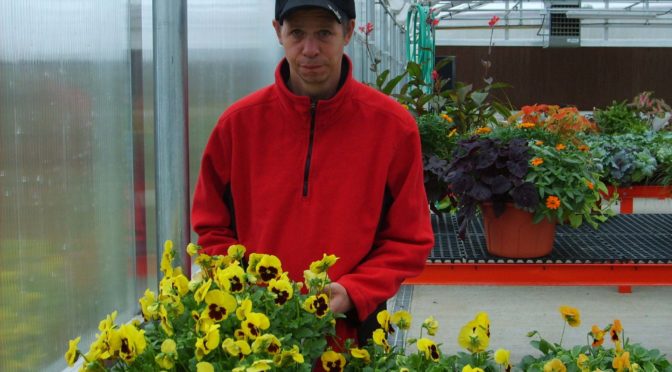
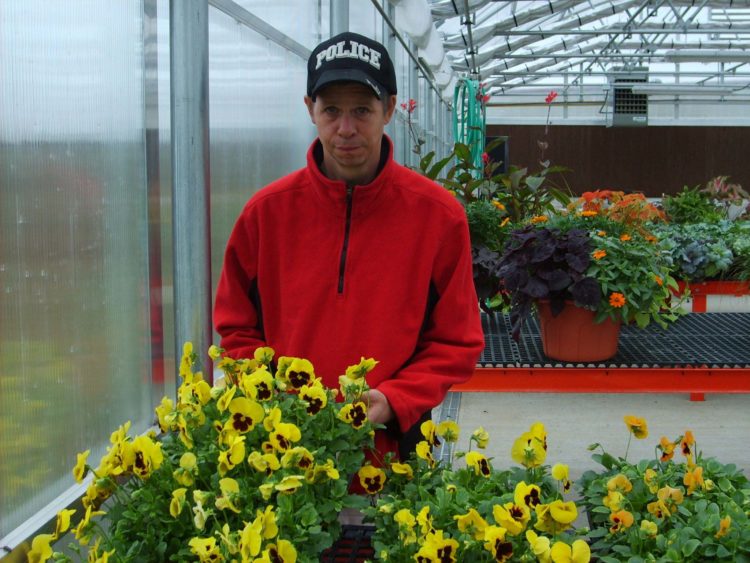
Ritchie Reed, working in Tri-Valley Developmental Services Greenhouse as part of the horticultural program.
Tri-Valley Developmental Services (TVDS) is a United Way of Bourbon County grant recipient.
Fort Scott.Biz is featuring each agency in a series.
The following is an interview with TVDS.
The contact person is Tim Cunningham, whose phone number is 620-223-3990 and whose email address is tcunningham@tvds.org
What service do you provide for our community?
We provide the following services for individuals with intellectual/developmental disabilities: case management, day rehabilitation, residential rehabilitation, employment services, and life enrichment.
TVDS is open Monday – Friday, 8 am to 4:30 pm.
The local address is 4305 Campbell Drive, Fort Scott, KS 66701
What percentage of your budget is the United Way grant?
Twenty-seven percent.
Board members are:
Bourbon County – Ken Anderson, Steve Sewell, Mark Ward; Allen County – John McRae, John Scovill, Susan Jones; Neosho County – Karen Vallier, Margaret Bideau, Mali Ziglari; Woodson County – Leo Gensweider, Peggy Leis, Charles Sheedy.
JOB OF THE DAY- SEASONAL-APRIL – OCTOBER – GOLF COURSE LABORER
The City of Fort Scott is seeking applicants for a Golf Course Laborer to work under direct supervision of the Golf Course Superintendent.
The laborer will be trained in course management including equipment operation, rotary work, trimming, bunker work, sod work, mowing of greens, tees, collars and approaches, watering and clean-up.
Applicant must be able to follow directions, be a motivated self-starter and conduct oneself in a professional manner. Must have a valid drivers license, meet City’s driving history guidelines, pass drug/alcohol screening test and be at least 18 years old.
The season is April – October depending on the weather.