Thyra Babcock won the Best of Show prize for her “Round of Robins” submission, in the amateur division of the Art Is Ageless juried competition at Fort Scott Presbyterian Village. All photos were submitted.
Fort Scott Presbyterian Village, an assisted living facility, recently honored winning artists in the annual Art Is Ageless juried competition, according to a press release.
“We are honored to exhibit artwork by seniors,” Becky Kellum, marketing director at the facility, said. “Our artists prove that art, in any form, is an ageless ambition.”
Winners are as follows:
In the professional division:
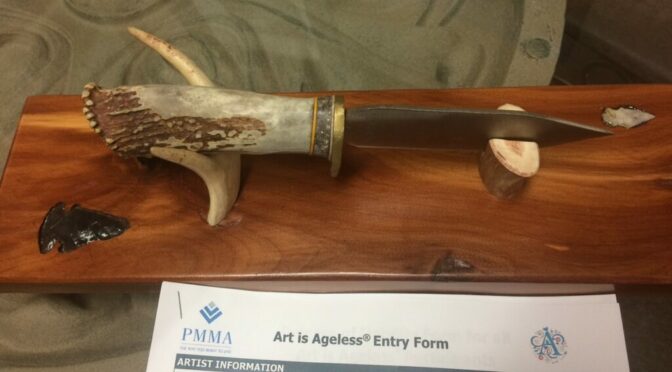
1) The Tony Forelli piece, “Wilderness Knife” won two ribbons 1) Mixed Media /Crafts Professional and 2) People’s Choice Professional.
2) Sculpture 3/D Professional “ Forever” by Bobbie Kemna
3) Quilting Professional “ American Flag” by Carolyn Crystal
4) Photography Professional “ Sunrise at Fort Scott National Cemetery “ by Paul Milks
5) Painting Professional “ Gossip “ by Carolyn Munsell
6) Needlework Professional “ Flower Bag” by Carolyn Crystal
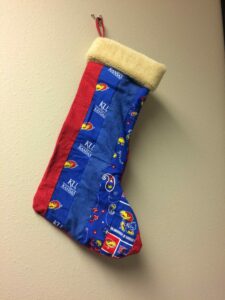
7) Christmas Professional ‘ Christmas Stocking “ by Carolyn Crystal
8) Best of Show Professional “ Druzy Diamonds “ by John Bartlesmeyer
9) Judges Choice Professional “ His Word” by Tony Fornelli
In the amateur division:
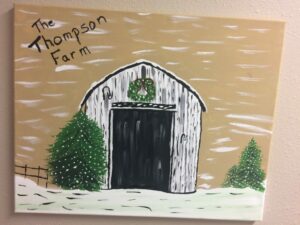
1) Christmas Amateur “Thompson Farm “ by Linda Thompson
2) Needlework Amateur “ Flower Bouquet” by Charlotte Kite
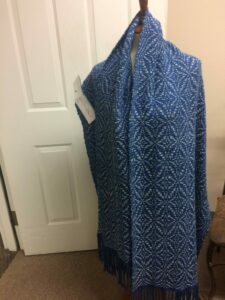
3) Fiber Arts Amateur “ Star of Bethlehem ” by Jean Strader
4) Mixed Media/Crafts Amateur “Joy in Motion”: Barbara Gibson
5) Painting Amateur “ The Cottage “ Glenda Stevicks
Fort Scott High School staff wanted a way to recognize the senior class on the night of their original graduation date, Jeff DeLaTorre, athletics/activities director said.
To honor the FSHSClass of 2020 on that evening, Saturday, May 16, staff members have planned a”Senior Cruise Night”.
Students in vehicles will follow a lead car around the city starting and ending at the high school. Vehicles must be street legal, he said.
Students are invited to wear their cap and gown on the cruise.
” We saw that some other schools around the area were doing something similar to this so we thought it would be a good way to recognize them,” DeLaTorre said.
A parent or family member is encouraged to drive the vehicle on the cruise so their 2020 senior can fully enjoy the event, he said.
Students who have not picked up their cap and gown yet, can still do so, DeLaTorre said.
The car cruise will drive around points in Fort Scott that have been a part of the students’ educational journey.
Senior class members in years past have gone to their former elementary and middle schools for a walk-through the halls which honors them.
So the cruise night route will go to each of the district’s schools, sort of a trip down memory lane.
” We chose this route for a couple of reasons,” DeLaTorre said. “One, we wanted to spread it out so people could be present along the route and still practice social distancing.”
“But the significance of going by Eugene Ware Elementary, Fort Scott Middle School, and Winfield Scott Elementary was to kind of take the place of the traditional ‘Senior Walk-Through’ that the senior class usually gets to do at the end of the year. They usually walk the halls of each of these buildings one more time and the students and teachers congratulate them. The Class of 2020 won’t get to do that so we thought we would include the schools in the Senior Cruise.”
On May 16, the seniors will follow a route that will be led by School Resource Officer Mike Trim.
Senior students are asked to arrive at the high school by 6:45 p.m.
The event will start at 7:00 p.m.
The line up will be starting in the southwest corner of the FSHS front parking lot, and the line will proceed to the east, on the south side of the high school and will weave into the east parking lot.
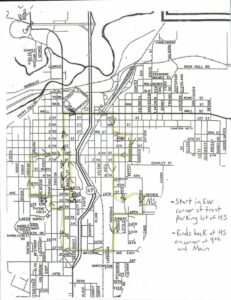
Here is the route:
-Start at the southwest corner of FSHS
-turn north on Main Street and go to 6th Street
-turn west on 6th and go to National Avenue. Turn north on National
-stay on National until Wall, turn east
– stay on Wall until Margrave, turn south
– at 3rd Street turn east (in front of Eugene Ware)
– at Broadway turn south
– at 6th turn west until Margrave, then turn south
– at 10th turn east and head up to middle school
– turn south on Sheppard and then turn west on 12th
– at Margrave turn south until East National
– follow East National until National. Head north and then turn west on 12th
– take 12th to Crawford and turn north, then turn west on 10th
– follow 10th (in front of Winfield Scott) to Horton
– At Horton turn north and go to 6th and continue east on 6th
– At National turn south. At 9th turn east and cruise ends at 9th and Main in front of high school
The route is highlighted in yellow in this map submitted by FSHS Activities Director Jeff DeLaTorre.
“Community members are asked to be present along the route to recognize our senior students,” DeLaTorre said.
Here are some important items to remember for this event:
– All social distancing guidelines must be followed. Seniors will need to stay in their vehicles before, during, and after the event.
– One senior student per vehicle (unless it is siblings).
For the high school senior to be able to enjoy the experience more, it is encouraged that a parent or family member to drive the vehicle for them.
– Community members are asked to be present along the route to recognize the senior students but are asked to stay in their vehicles to practice social distancing.
If you live along the route you are invited to come out on your porch or front yard to show your support.
– This is not a parade!
All traffic rules and laws must be followed, including stop signs, stoplights, etc.
Also, because it is not a parade all vehicles must be street legal.
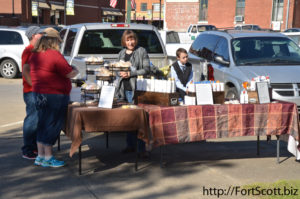
The Fort Scott Farmer’s Market will continue on Saturdays from 8 a.m. to noon and Tuesdays from 4-6 p.m. at Skubitz Plaza, directly in front of the Fort Scott National Historic Site.
This farmer run market provides a friendly, safe, and fair local market of fresh locally produced items for the community, according to its’ Facebook page.
Linda Bower and husband Chet, have been involved in the market for 25 years she said.
Things will be a little different in 2020 with the pandemic in that social distancing will be maintained, Bower said.
“The public health nurse, Becky Johnson, has OK’d the farmer’s market,” she said. “We have to do social distancing. Masks are optional. Hand sanitizers will be available.”
The Bowers will be bringing spring harvested food produce.
“We will be bringing broccoli, onions, lettuce, spinach, and radishes,” she said.
The Fort Scott Garden Club will have their annual plant sale this Saturday, May 9.
Other vendors are:
R and B Produce, owners Ronnie and Beverly Brown, will be selling nuts and nut bread: (pumpkin, banana, poppy seed, apple nut), caramel rolls, jelly, and salsa.
Locust Hill Lamanchas, owner Sue Reinecke and family, will be selling goat’s milk products: soap, lotion, body cream, all-natural deodorant, and candles.
Sue Reinecke sells goats milk products at the Fort Scott Farmer’s Market.
Micki Kraft will be bringing fabric facemasks in three sizes-$3 each. and also aprons (kids and adults), kitchen towels, hot pads, dish rags, and microwave potato bags.
Leta Herboldsherimer will be selling baked goods, pot holders, and dish rags.
Some Amish families will be selling plants and a new vendor will be selling glassware yard decor, Bower said.
Bourbon County businesses with under 50 employees may soon apply for grant funds because of the financial effects of the pandemic.
These grants will be on a first-come, first-served basis.
Rural small businesses should contact the county economic development director, who will apply for the grant.
“We are exploring business needs, outside of Fort Scott City limits, for the CDBG-CV grant opportunity, Hoenor said. “The goal of the grant is job retention. We are looking for all business in the county, outside of Fort Scott city limits, with 1 to 50 employees who have been impacted by the Coronavirus pandemic. Funding can be used for inventory or working capital needed to reopen or help keep a business operating. “
“The City of Fort Scott will have the opportunity to apply for funding if they have used all their current funding,” she said.
Under the Corona Virus Aid and Economic Security Act (CARES), Kansas will receive an additional $9 million in Community Development Block Grant funds to be used exclusively to support projects related to combating the impact of COVID-19, according to a press release from Hoenor.
Hoenor received notice of a public hearing yesterday and attended online.
The following is an email interview with Hoenor regarding the grants for small businesses in the county.
Who is the target for the grant?
There are four proposed activities with this specific grant. At this point, we are focusing on businesses with fewer than 50 employees.
What benefits will the grant give the applicant?
Applicants can use the grant funding for inventory or working capital needs.
What is the application process?
The county will apply for grant funds, identifying a general number of businesses we intend to help in our grant application.
Grant means no payback, right?
We have not seen the specific requirements but grants typically mean they do not have to pay it back unless the recipient does not fulfill the obligations the grant was intended for.
What is the timeline?
We were told the applications process will be online and hope to have available next week. It will be first come first serve.
Jody Hoenor, Bourbon County Economic Development Director. Submitted photo.
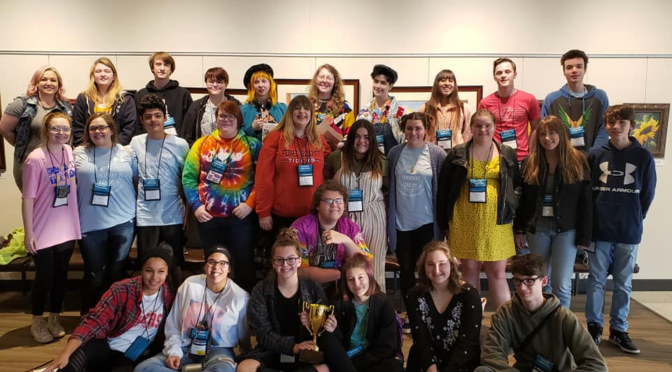
FSHS Thespian Troupe members attending the 2020 KS State Thespian Festival. Left to right, top row – Angie Bin, Tailynn Harding, Jacob Ham, Italeigh Harding, Sierra Long, Amber Russo, Wendy Monahan, Christina King, Levi Bin, Daniel Watson. Second row – Carlee Studyvin, Alexis Williams, Israel Carreno, Kaitlyn Leavell, Olivia Wilterding, Tina Ramirez, Montana Laroche, Mackenzie Peoples, Avery Dorsey, and Justin Stevens. Bottom row (Thespian Officers) – Ashanti Green, Zaria Byrd, Alexa Bukowski, Dominic Cannon, Mesa Jones, and Sage Hill. Submitted photo.
The Fort Scott High School Thespian Troupe #7365 held it’s 3rd Annual Golden Thespie Awards Banquet on May 4.
This year’s banquet was quite different, as it was held over a virtual Zoom call. Current Thespian Officers and Thespian Director Angie Bin made the presentations. Officers include Vice President Sage Hill, Historian Alexa Bukowski, Publicity Chair Zaria Byrd, and State Representatives Jenna Stockstill and Ashanti Green.
The troupe recognized Thespians who performed at the KS State Thespian Festival in January including Mackenzie Peoples – Musical Solo, Amber Russo & Wendy Monahan – Duet Acting, Tina Ramirez – Musical Solo, and Dominic Cannon and Sage Hill – Duet Acting. Special recognition went to the following students who received Superior Ratings at State and will perform in the Virtual International Thespian Festival in June: Ashanti Green – Monologue, Mesa Jones – Musical Solo and Jenna Stockstill – Musical Solo. The troupe was also recognized for receiving the highest state honor a troupe can receive, the Gold Honor Troupe Award given for performance, public service, community involvement, and troupe organization. This is the fourth year in a row that Fort Scott has received the Gold Honor.
The FSHS Thespian Improv Troupe was recognized for participating in Operation Show this year at the Westport Coffee House Theatre in Kansas City, MO under the direction of Mark Bergmann. These students studied improvisational comedy with professional actors and performed for a public audience along with other students from around the KC area. They include Daniel Watson, Kaitlyn Leavell, Justin Stevens, Lola Umarova, Jo Goodbody, Dominic Cannon, Wendy Monahan, Tina Ramirez, Sierra Long, Anthony Russo, and Improv Troupe Captain Amber Russo.
To letter in Theatre, students must participate in both main stage productions (cast or crew), participate in 6 theatre-related fundraisers, activities, or community service projects, and be in good academic standing. First year letters went to Israel Carreno, Kinsley Davis, Bareigh Farrell, Ashanti Green, Jacob Ham, Christina King, Luke Majors, Khris Patel, and Olivia Wilterding. Second year bars were awarded to Alexa Bukowski, Zaria Byrd, Avery Dorsey, Gabriel Graham, Tailynn Harding, Sage Hill, Mesa Jones, Wendy Monahan, Amber Russo, Jenna Stockstill, Carlee Studyvin, and Alexis Williams.
The highlight of the banquet is the awarding of the Golden Thespies. These are awards voted on by the troupe members. Honors went to the following: Most Involved – Alexa Bukowski, Drama Mama (someone who helps out everyone else) – Zaria Byrd, Drama Papa – Jacob Ham, Newcomer of the Year – Kinsley Davis, Designer of the Year – Amber Russo for lighting design, Techie of the Year – Jacob Ham for Stage Management, Dancer of the Year – Addy Labbe, Singer of the Year – Mesa Jones, Actor of the Year – Sage Hill, Actress of the Year – Ashanti Green, and Triple Threat (best overall singer, dancer, and actor) – Mesa Jones.
The troupe also recognized graduating seniors and ended the banquet with a slideshow of pictures from throughout the year. New officers will be elected when the new school year starts.
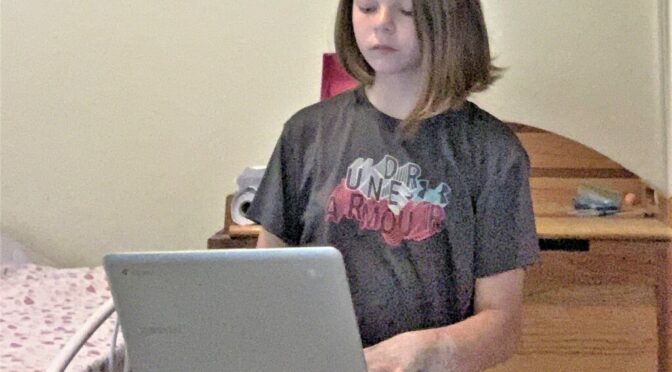
Alexis Tourtillott at home doing online school work. Submitted photo.
Alexis Tourtillott, age 11, attended Fort Scott Middle School until the COVID 19 Pandemic, closed down classes nationwide in March 2020.
Tourtillott started about a month ago to do lessons with teachers on the internet as a part of USD 234 Continuous Learning Plan.
“I started four weeks ago and I am doing online school for about five classes,” Tourtillott said via an email interview.
“A typical school day is waking up, doing a zoom class, then work,” she said. “I probably spend about one-and-one-half hours on it daily.”
She has faced some challenges, she said.
Submitted photo.
“Doing my work at home is kind of hard because there are so many distractions,” Tourtillott said. “My greatest challenge is pushing myself to do the work even though I don’t want to.”
“I think the new learning plan is going well, especially for the amount of time the teachers had to plan for it,” Alexis mother, Amy Wiltse said. “I cannot imagine the stress that this causes for them.”
Payments Have Started for Producers Impacted by Drought, Excess Moisture
WASHINGTON, May 1, 2020 – The U.S. Department of Agriculture (USDA) has started making payments through the Wildfire and Hurricane Indemnity Program – Plus (WHIP+) to agricultural producers who suffered eligible losses because of drought or excess moisture in 2018 and 2019. Signup for these causes of loss opened March 23, and producers who suffered losses from drought (in counties designated D3 or above), excess moisture, hurricanes, floods, tornadoes, typhoons, volcanic activity, snowstorms or wildfires can still apply for assistance through WHIP+.
“To date, FSA has received more than 33,000 WHIP+ applications,” said Richard Fordyce, Administrator of USDA’s Farm Service Agency (FSA).“We want to remind producers that we are still accepting applications for WHIP+, and we encourage producers to call our offices for next steps on how to apply.”
To be eligible for WHIP+, producers must have suffered losses of certain crops, trees, bushes or vines in counties with a Presidential Emergency Disaster Declaration or a Secretarial Disaster Designation (primary counties only) for qualifying natural disaster events that occurred in calendar years 2018 or 2019. Also, losses located in a county not designated by the Secretary as a primary county may be eligible if a producer provides documentation showing that the loss was due to a qualifying natural disaster event.
For losses due to drought, a producer is eligible if any area of the county in which the loss occurred was rated D3, or extreme drought, or higher on the U.S. Drought Monitor during calendar years 2018 or 2019. Producers who suffered losses should contact their FSA county office.
In addition to the recently added eligible losses of drought and excess moisture, FSA will implement a WHIP+ provision for crop quality loss that resulted in price deductions or penalties when marketing crops damaged by eligible disaster events. To ensure an effective program for all impacted farmers, the Agency is currently gathering information on the extent of quality loss from producers and stakeholder organizations.
USDA Service Centers, including FSA county offices, are open for business by phone only, and field work will continue with appropriate social distancing. While program delivery staff will continue to come into the office, they will be working with producers by phone and using online tools whenever possible. All Service Center visitors wishing to conduct business with the FSA, Natural Resources Conservation Service or any other Service Center agency are required to call their Service Center to schedule a phone appointment. More information on Service Centers can be found at farmers.gov/coronavirus, and more information on WHIP+ can be found at farmers.gov/whip-plus.
#
USDA is an equal opportunity provider, employer, and lender.
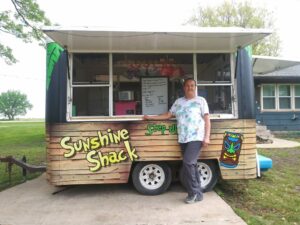
Shayla Knight, the owner of the Sunshine Shack, makes a soft pretzel for a customer on Saturday.
Shayla Knight is a mother of six children and has a food trailer business that she started last year.
She has reopened her business, Sunshine Shack LLC in her driveway at 606 Sherman in Uniontown.
“It’s convenient with the kids,” Knight said. “They can be with mom while I’m working.
She also has the help of husband Kyle Knight, she said. “This is our home base address.”
Kyle works for the City of Fort Scott during the day.
“I have been in the food industry for 10 plus years,” Shayla said. “Ranging from fast food, fine dining, and schools. I enjoy serving the community and customer service is a high priority for me! I love to chit chat! “
She started her business in April 2019.
“My food trailer has the ability to move wherever I would need to be such as fairs, festivals, and other community events,” she said.
Shayla Knight, owner of the Sunshine Shack, a food trailer in Uniontown. Submitted photos.
Sunshine Shack is currently open from 11 a.m.-8 p.m. Monday through Saturday and closed on Sundays,” she said. This is… subject to change as we hope to attend some events throughout the season.”
“We are currently looking at the possibility of catering our fun stuff like cotton candy and snow cones for birthday parties,” she said.
When social distancing is over the Knights will provide a few picnic tables for people to sit and enjoy their food on the property, but not currently, she said.
A happy customer of the Sunshine Shack on Saturday.
The business Facebook page is Sunshine Shack LLC, or call 620-224-8493.
Fort Scott Community College novel coronavirus, COVID-19 update
We are beginning to phase in our new normal at FSCC and I want to say thank you to our students, faculty, staff, and stakeholders for your efforts, expertise, patience, and dedication transitioning to online learning and remote work. I truly appreciate all you have done to meet our FSCC mission that provides affordable, academic, technical, and occupational programs.
Regardless of what our new normal looks like, I am confident we will continue to meet student needs with high-quality educational programs, as well as robust athletic and co-curricular programs. The good news is we have become better at delivering education in an online format and have developed critical policies and protocols on how to help keep our college and community members safe and healthy.
The June 2020 summer school session will change from face-to-face classes to an online format, with the exception of our John Deere Technician Training program. The determination to move classes beginning in the July 2020 summer session from face-to-face to online will be made in the next couple of weeks. We will update you as soon as we have more information. If you have questions concerning summer school, your schedule, or would like to schedule an appointment to enroll please contact advising@fortscott.edu
Fort Scott Community College students who are currently enrolled for the Spring 2020 semester may qualify for COVID-19 emergency relief funds. The Federal CARES Act may provide students with emergency financial aid grants to help cover expenses related to the disruption of campus operations and ensure students are able to continue their education. To apply for FSCC Emergency Relief funds please submit the application at FSCC COVID-19 Student Emergency Relief Grant Application
If you have any questions regarding the FSCC COVID-19 Student Emergency Relief Grant, please contact us at studentcares@fortscott.edu.
Updated information:
Continue remote work through May 17th.
Begin our summer work schedule (minimal staffing on Fridays). Our first Friday of summer hours will be May 22.
Allow student tours by appointment only on June 1.
Our goal as of today is to have face-to-face courses, and also have students in the dorms when the fall semester begins. However, we continue to evaluate both fall and July courses to determine the appropriate modality.
June summer school classes will be moved from face-to-face to an online format (with the exception of John Deere Technician Training)
The last day for withdrawals has moved from May 1 to May 8.
Enrollment is open. Please encourage students to contact advising to schedule an appointment to enroll advising@fortscott.edu
Online tutoring will be available for students via Zoom or email. Please contact Susan Benson at susanb@fortscott.edu for any tutoring needs.
Students desiring to setup a payment plan for an outstanding balance, need to access their Gizmo account and click the link located in the “Account Balance Information” section.
We are developing a plan to recognize graduates from this spring at a special fall commencement ceremony. More information regarding this will be released at a later date.
Craw-Kan is providing free wi-fi to locations in our region. Here is a link to the map https://ckt.net/hotspots/
Internet
For students without readily available internet access, please contact your local area internet service and cellular service providers. Many companies are working with students during this time to ensure access to internet services. If this is unsuccessful, please contact Janet Fancher (janetf@fortscott.edu) or Adam Borth (adamb@fortscott.edu).
Updated Closures
The Bookstore, Library, Computer Labs, and Student Success Center will be closed until at least May 18.
Advising and Enrollment:
Fall enrollment is open and advising will be assisting students via phone appointments and email. To schedule an appointment please contact via email:
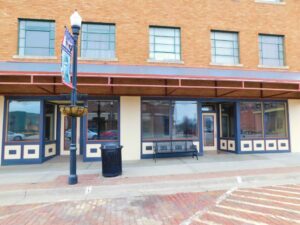
Sunshine Boutique has added space to their shop at 18 E. Wall and now has a storefront at 2 S. Main that is connected to it.
It is a small, family-run business with a wide variety of goods and services.
Sunshine Boutique has more space to shop in. Submitted photo.
“We do fresh and silk flowers for all occasions, tuxedo rentals, decor, gourmet foods and coffees, clothing, jewelry, candles, and more,” Rillie Creollo, store manager, said.
Creollo is the grand-daughter of Georgia Brown, the store owner of the long-time boutique in downtown Fort Scott.
Submitted photo.
“We offer our community a friendly and personable place to hang out and shop,” Creollo said.
“2 S Main is the new addition and we are having a soft opening on Monday (today),” she said. “To keep ourselves and our customers safe we will be practicing social distancing and scheduling times to sanitize throughout the day.”
“We expanded to introduce some new inventory and give us and our customers a little more breathing room while shopping,” Creollo said.
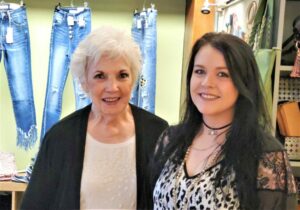
Georgia Brown, left, is the owner of Sunshine Boutique. The store manager is Rillie Creollo, right. Submitted photo.
The store manager has added new items during the expansion.
“A whole new line of clothing including Kancan jeans, crystals, plants, candles, sage, hand-blown crystal orbs, and Doterra essential oils,” Creollo said.
Submitted photo.
Operating hours will be Monday through Friday from 10 a.m. to 5 p.m.
Before and after hour appointments are available upon request.
Approval of minutes of the regular meeting of April 21st, 2020.
Approval of Appropriation Ordinance 1262-A totaling $615,308.86.
Request to Pay #4 – Schneider Electric – $216,807.84 – Energy Service Project
Approval to Pay #5 – Strukel Electric – Electric Vault Project – $5,130.00
Approval to Pay – Olsson – Electric Vault Project Engineering – $5,193.01
VII. APPEARANCE/COMMENTS/PUBLIC HEARING:
APPEARANCE: None
B. CITIZEN COMMENTS (Concerning Items Not on Agenda – 5 minute limit per citizen) Comments will not be taken during this meeting. If you have a topic to discuss not listed on the agenda, please contact a City Commissioner or send a written request to dclay@fscity.org.
C. PUBLIC HEARINGS/COMMENTS: None
VIII. CONSIDERATION:
Request to Pay – Skitch’s Hauling & Excavation, Inc. – February – $1,185.00 – Porta Pottie Services
Approval to publish 2020 Budget Amendment and to hold a public hearing on May 19th, 2020 at 6:00 p.m.
Consideration to repeal Ordinance No. 3556 and approve Ordinance No. 3562 establishing a Street Advisory Board
Consideration of appointments to Street Advisory Board (Six (6) City residents – One (1) County resident within 3-mile limit)
Consideration of appointments to Design Review Board
Consideration of appointments to Planning Commission
Approval of Hay Bid – Airport
Discussion of Pool Opening
Discussion of Fuel Bid
IX. COMMENTS:
Director Updates:
Travis Shelton – Margrave Street School zone discussion
Robert Uhler – Shiney Studio roof update – Certificate of Appropriateness
Commission:
City Manager:
EXECUTIVE SESSION:
I MOVE THAT THE CITY COMMISSION RECESS INTO EXECUTIVE
SESSION FOR ________________________________ IN ORDER TO
(see below justification)
DISCUSS ______________________________________. THE
EXECUTIVE SESSION WILL BE ___________ MINUTES AND THE OPEN
MEETING TO RESUME AT ________________.
Justifications for Executive Sessions:
Personnel matters of non-elected personnel
Consultation with an attorney for the body or agency which would be deemed privileged in the attorney-client relationship
Matters relating to employer-employee negotiations whether or not in consultation with the representative or representatives of the body or agency
Confidential data relating to financial affairs or trade secrets of corporations, partnerships, trusts and individual proprietorships
Preliminary discussions relating to the acquisition of real property