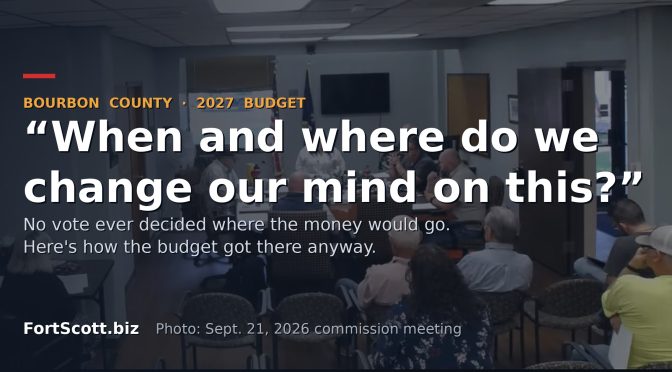
FORT SCOTT — Bourbon County commissioners spent part of their Sept. 21 meeting trying to work out when they had agreed to shift money between funds in the 2027 budget. They never voted on it, and they did not agree about what their earlier discussions had settled. Meeting video and the county’s own minutes show how the idea moved forward over four meetings without a vote.
Aug. 24: a stated goal, no vote
Commissioner Mika Milburn-Kee described what she wanted from the budget: “keep everybody exactly where they’re at, revenue neutral, but us take the assessed valuation increase of that two mil and put it in the reserves in the general fund” (video, 52:45). She put that growth at “approximately $300,000, a little bit less.” The only vote on the 2027 budget that night authorized publishing the hearing notice. The minutes, approved Sept. 9, record the idea as “the Commission’s overall objective.”
Aug. 31: a new recommendation, with Tran absent
A week later, budget consultant Matt Lawn of Baker Tilly recommended “lowering that mill levy” for Road and Bridge “by about four mills and then essentially pushing those mills back into general fund and the employee benefit fund,” using one-time FEMA reimbursement money in the road fund (video, 23:20). He said the plan was based on “some requests that I’ve got from you guys.”
Commissioner Samuel Tran was absent. The commission took no vote on the recommendation. County Treasurer Jennifer Hawkins cautioned that part of the road fund’s balance predates the FEMA reimbursements and that some is needed to match bridge grants. The minutes say the commission directed that her reconciliation of those funds “be completed before any mill reallocation is finalized.”
Sept. 14: the shift shows up in the numbers
After the revenue-neutral rate hearing, Lawn walked through how mills had been moved between funds while the total levy stayed flat: up 2.313 mills in the employee benefit fund and down 1.134 mills in Road and Bridge, among other changes. He said the Road and Bridge cut was smaller than first proposed because some of the FEMA money was “already spoken for” and some had to stay in its special project fund, and that the changes were made “based on council priorities.” The commission voted 5-0 to exceed the revenue-neutral rate but did not adopt the budget. Later that night, all five commissioners, Tran among them, voted to approve the Aug. 31 minutes describing Lawn’s recommendation.
Sept. 21: “When and where do we change our mind?”
When Lawn described moving Road and Bridge money into the employee benefit fund, Tran objected. “That’s the last thing I remember the five of us talking about,” he said of the general fund plan. “We agreed to that, all of us, unanimously” (video, 12:26). “I just want to know when and where do we change our mind on this.”
Milburn-Kee said she was “fine with general.” Lawn said he was “merely saying what Commissioner [Milburn-Kee] asked me to consider” and was open to whatever the board wanted. Tran asked who had directed the change. “Projections. Nobody directed,” Milburn-Kee said, explaining that Lawn had projected what Road and Bridge would overspend in 2026 and carried that forward (video, 13:20).
About 25 minutes later, Commissioner David Beerbower said he did not remember that discussion at the table. “Did we vote?” he asked. “No,” Tran said. “We never voted because we weren’t voting at the time. It was just a consensus like, hey, that’s a good idea” (video, 37:42). He said two commissioners had liked the idea, “so I kept it in the back of my head.”
“To be fair for Matt, we’re throwing him all over the place because we haven’t voted on a single thing,” Milburn-Kee said.
Tran then told Lawn that direction should come only from the full board. “Any marching orders that you get should come from the table,” he said. “It should always come from the table where there’s a consensus. … We rule as a body, not as a single person” (video, 38:35).
“To be fair to him again, we haven’t made any motion here,” Milburn-Kee said of Lawn. “He’s just listened to all the conversations and tried to build something.”
What’s next
The allocation also bears on raises: the draft includes a 5% wage increase across departments, and Milburn-Kee pressed Lawn on whether it rests on one-time money. Lawn agreed to bring about four versions of the budget. The budget must be adopted by Sept. 30, and the commission’s next regular meeting is Sept. 28. Full coverage of the Sept. 21 meeting is also available.