Fort Scott’s budget consultant told commissioners at last week’s work session that the city’s golf course does not cover its own costs, and questioned whether the way the city runs it now is sustainable.
“The revenues that we’re generating is not going to cover the expenses,” Baker Tilly financial advisor Ben Hart told commissioners on July 27, suggesting Woodland Hills might belong back inside the general fund. (watch)
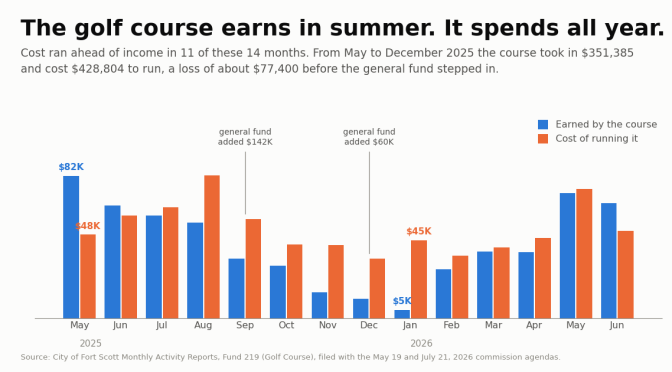
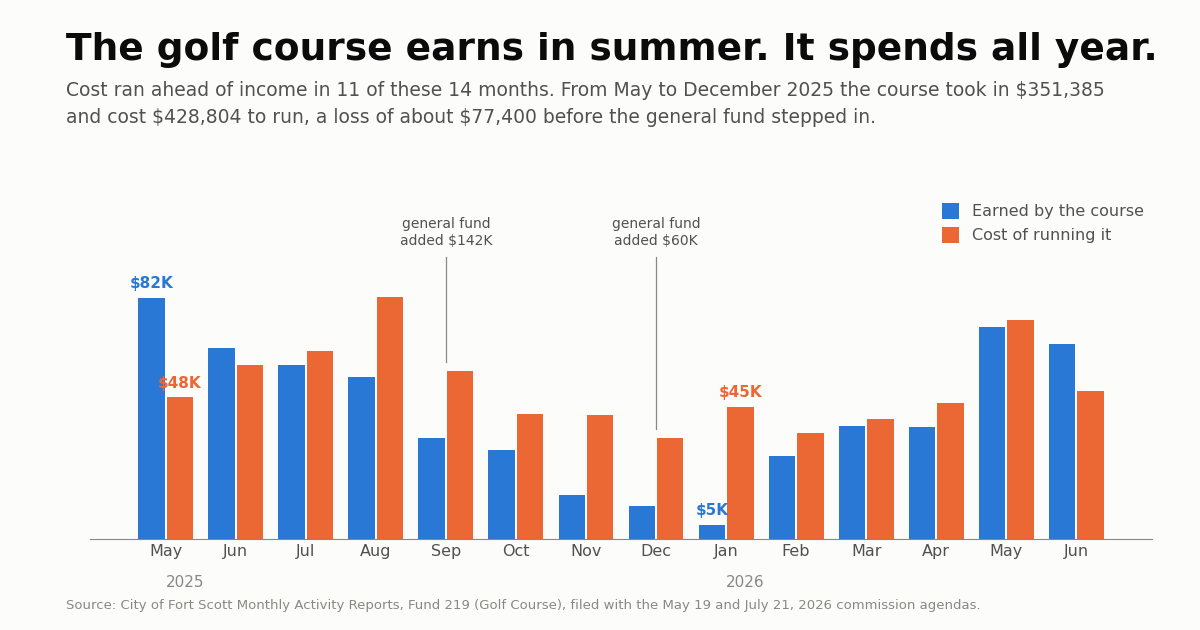
The city’s own monthly reports put numbers to it. Twice last year the general fund transferred money into the golf fund to cover its losses: $142,135.64 in September 2025 and $59,630.23 in December, $201,765.87 together. Strip those transfers out and Woodland Hills ran roughly $77,400 in the red over the eight months from May through December 2025. Through June 2026, the latest month the city has reported, the fund is down about another $44,100, with no transfer so far this year. June was its best month in a year, a $16,299 surplus.
In April, Hart told commissioners the general fund ran a deficit of roughly $987,000 in 2025, driven largely by about $476,000 in transfers out to the golf course, economic development, and parks and recreation. Of those three, the golf course took the most. Over the same eight months the city’s reports show $201,766 going to golf, $147,179 to economic development and $35,566 to recreation.
How Fort Scott ended up owning a golf course
The city didn’t set out to be in the golf business.
When Dave Martin became city manager in 2010, people started telling him the city should buy the course before it fell apart. Others told him to stay well clear of it. The owners could no longer keep it up, and nobody else stepped forward.
Martin’s answer was to put it to the town: if residents thought the city should own it, residents should help pay for it. They did. The community raised about $350,000 toward buying and fixing up the course.
“This is what a community can do when they set their sights to work together to make something nice and better in Fort Scott,” Martin said in 2016.
The years that followed brought steady investment. The city hired PGA professional Shannon O’Neil as clubhouse manager and a superintendent, Jon Kindlesparger, to rebuild grounds Martin admitted were “in disrepair.” A new clubhouse opened in February 2016. A $65,000 cart barn went up in 2018, again paid for largely by donations. In 2019 the city’s community development director, Robert Uhler, told a chamber coffee that a bestthingsks.com list had put Woodland Hills among the top ten public golf courses in Kansas.
The course became more than a place to golf. Fort Scott High School, Uniontown High School and Fort Scott Community College teams all played there, and in FSCC’s first year with a golf program two players qualified for nationals. By 2018 the course carried 127 memberships, hosted 25 tournaments a year and logged 9,100 rounds. In 2024 the clubhouse was renamed “The Clubhouse” by public vote, got new carts and furniture, and the city floated a Fort Scott-themed miniature golf course to pull families in.
So does it make money?
Two of the city’s own officials say they had heard for years that it did. That assumption is exactly what the city set out to test, by pulling the course out of the general fund and into a fund of its own, so its revenue and costs could be seen on their own.
Mayor Kathryn Salsbury told the July 27 work session she wants it kept that way. She said she had always heard the “golf course is the only place where we make money. And then we pulled out and found out that’s not true. So I’d kind of like to keep watching it.” (watch)
City Manager Brad Matkin backed her up, saying the old claim never had evidence behind it: “when I first started, it was like we made money. And that was a statement. You didn’t have any, there’s no proof to that.” (watch) Breaking it out, he said, was the only way to find out: “because other than that, you’re just saying things.”
Commissioner Julie Buchta raised a complication worth remembering: when the course did appear to turn a profit, it may have been because maintenance was being deferred. “Didn’t we show a profit, but it’s because basically they were cutting all the fertilizer and everything out?” (watch) A golf course that stops buying fertilizer looks cheaper for a season and worse for years, which is roughly the condition the city bought it in.
The shape of the problem
The chart above shows why this is hard to fix. Woodland Hills earns real money, about $351,000 from May to December 2025, but it earns almost all of it in five months: May alone brought in $82,000 and January brought in $4,748. The cost of running the course does not follow that curve. It ran between $34,000 and $82,000 every single month, summer and winter alike, and over those same eight months the city’s own reports put the cost of running the course at $428,804 against $351,385 of income. The fund’s expense lines run from salaries, health insurance and KPERS through electricity, equipment and irrigation maintenance to fertilizer, chemicals, sand and gravel. The 2026 budget had to add money for fertilizer and chemicals as prices rose.
The city has kept putting money in, and has looked for more out. In February commissioners raised what tournaments pay. Groups booking an event are charged per player, and the city caps what any single event pays for the day: the per-player fee went from $30 to $35, and the cap on one day’s tournament from $4,500 to $7,000. Those terms sit on the city’s golf event application rather than the published green-fee rates, so most golfers never see them; the change falls on the large charity and fundraiser tournaments the course hosts; as of 2018 it held about 25 a year. On July 21 they took $31,000 out of general fund reserves for a used 2021 Ventrac mower, after the 2012 machine failed and its parts were discontinued.
And the 2027 budget now in front of the commission sets aside nothing to cover golf course losses — only the annual golf cart lease. “There’s nothing budgeted here to transfer over for any kind of losses in the golf course,” Hart said. (watch)
Which leaves an unanswered question on the table as budget hearings approach: if the course again spends more than it takes in during 2027, where does that money come from? Hart said he and a Baker Tilly colleague would start producing a running profit-and-loss statement for the course so commissioners can follow it line by line.
The next budget work session is August 18. The public hearing and adoption are set for September 15.
Reporting from the city’s published recordings of its July 21 and July 27, 2026 commission meetings, the 2027 budget presentation filed with the July 27 agenda, the city’s Monthly Activity Reports for Fund 219 filed with the May 19 and July 21, 2026 agendas, and fortscott.biz coverage from 2016 to 2024.
How much property tax could be recovered each year by the County if the property were developed for residential homes? Most of the course itself is in the county not the city limits.