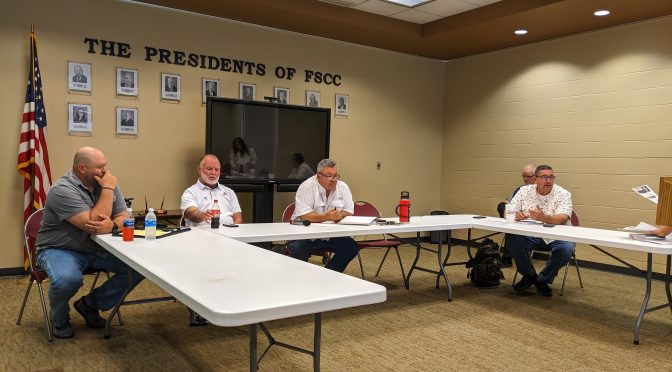
All five Bourbon County commissioners spent two and a half hours at Fort Scott Community College on Wednesday, July 22, taking open-floor questions on the 2027 budget, the county counselor’s contract, the comprehensive plan, outsourcing, staffing and property taxes. The town hall was the most detailed public back and forth with constituents and highlighted the challenges facing Bourbon County.
District 1 Commissioner Samuel Tran, who chairs the board, opened with what he called rules of engagement. “Rule number one, very paramount, is be civil,” Tran said. “Be passionate. But please be civil.” He was joined by David Beerbower (District 2), Joe Allen (District 3), Gregg Motley (District 4) and Mika Milburn Kee (District 5).
Who did the talking
Billed as a chance for residents to be heard, the evening spent about 42% of the time hearing from the audience with commissioners holding the floor approximately 58% of the time. Tran spoke the most, at approximately 29% of the total, followed by Milburn Kee at approximately 11%, Beerbower at approximately 9%, Motley at approximately 8% and Allen at approximately 2%.
Tran argues growth is driving up taxes
A point of numerical and tax distribution disagreement surfaced early: whether Bourbon County is growing at all and whether more homes would raise or lower taxes.
Defending zoning and the comprehensive plan as protective tools, Tran argued the county needs rules in place before development arrives. “People are moving here. People are moving out of the city.” The county doesn’t track how much is being built, he said: “I drive up and down some of these roads and I’m like, wow, that’s a really nice mansion.”
Asked directly whether the county’s population has been growing, Tran conceded, “Right now, I don’t think it’s growing,” arguing instead that rising property values in Miami and Linn counties signal a wave moving toward Bourbon County, and that people who balk at a 30-minute commute today will eventually drive two hours. Pressed that he seemed to be describing the growth of inflation rather than population growth, Tran answered, “It’s both.” He returned to the tax consequence: “Now, can you imagine 500, 600 people moved into Fort Scott and start building these big homes? You don’t think that those taxes, your taxes are going to go up?”
Motley cut in before the topic moved on, with numbers. “Between the 2010 and the 2020 census, Bourbon County lost 810 people, about 81 people per year,” he said. “That rate of decline has slowed down a little bit.” He added that the total mill levy in the county runs about 168 mills, and county government accounts for only about 30% of it — the rest set by schools, cities, townships, fire districts and cemeteries.
Motley’s prescription: bring the work home & fix pay
Asked near the end of the night what he would do with the 2027 budget to move the county toward fiscal stability and a reserve fund, Motley, a retired banker, made three points.
First, stop outsourcing. Motley noted there were 15,300 banks in the United States when he started in 1979 and fewer than 4,000 when he retired in 2024, with survivors buying scale to escape the outsourcing trap. “It’s 20% more expensive in the long term to outsource functions, especially when we have qualified people within the county,” he said.
Second, the hidden cost of sending money out of town. “Every county has a measured statistic they call pull factor. What percentage of money earned by Bourbon County citizens are spent in Bourbon County? And our pull factor is about 77%,” Motley said. Paying vendors outside the county — or outside the state — drives that number down. “Money spent in the county is spent over and over and over again until it exits somehow. So that’s a hidden cost to us that we don’t see.”
Third, change how the county pays people. Bourbon County has leaned on benefits rather than salary to attract employees, Motley said, and benefits are the part the county cannot control. At Landmark, “we paid in the top one-third of salaries for our employees … but our benefits were in the lower range. And we did that intentionally because we can control this number, but … we can’t control that benefits number. And those benefits are accelerating dramatically.” He had hoped for a salary survey this year and did not get one, and warned against an abrupt switch: “These are human beings … we can’t just pull the rug out from underneath them.”
A $625,000 dispute
Michael Hoyt argued in a prepared analysis that the current commission spends roughly $625,303 more than the last one, about $344,000 of it recurring — citing a county counselor at about $96,000 against a predecessor at $58,000, $114,200 in outside legal fees and outsourced human resources at $56,000. Former commissioners Clifton Beth, Jim Harris and Brandon Whisenhunt may be owed an apology, Hoyt said, arguing they were criticized as irresponsible with money but managed the county’s core functions for less.
Commissioners Milburn disputed the numbers saying the counselor’s salary is about $2,000 more, closer to $98,000, but he takes neither insurance nor KPERS. The commissioners said that much of the outside legal spending defended the county against inherited litigation, and that all three outsourced contractors submitted flat budgets for next year. Mike Wunderly noted that $116,500 of Hoyt’s total is the comprehensive plan, which Beerbower had already moved on Monday, July 20, to freeze this year, “so that changes that number considerably.” Hoyt later said that his overall numbers did not include the comprehensive plan cost.
What residents asked for
Heather Etheridge, president of the West Plains and Centerville cemeteries, described driving to Linn County to get help creating her cemetery budget. Told an increase amounted to pennies, she pushed back: “How much is it going to cost my people? Because these are my people.”
Jackie Brown, a lifelong resident, said the county is “taxing people out of their homes,” called for a forensic audit, and asked commissioners to end the public bickering among elected officials. “We have to stop voting popularity contests. We have to start voting in people who are capable of doing the job.” Anne Dare backed an audit too — “if you’re going to audit one, you need to audit all” — and called for a return to basics: law enforcement, ambulance service and roads, questioning whether the sheriff’s request of up to $2 million for radios and towers qualifies. Clint Walker said the county leaves FEMA and grant money on the table and has no maintenance program: “We don’t hire diesel mechanics. We farm it all out.”
Beerbower mentioned the theme he says he has pressed all year. “Doing the same thing over and over again, expecting different results is just insane,” he said. “Reset. We need to reset.”
ABSOLUTELY Fantastic analysis of the Town Hall meeting!!!