Writer’s Note: I know what you’re thinking – “Nick, don’t you have your own website now?” Yes, yes I do, (check out bourboncountymonitor.com). However, the seed that grew into the Monitor started right here at fortscott.biz, with an article I wrote two years ago about…the hospital. More importantly, this is something I believe every Bourbon County citizen should be aware of, so as far as I’m concerned, the more eyeballs, the better.
This is the first in a two-part series that will be published on both sites.
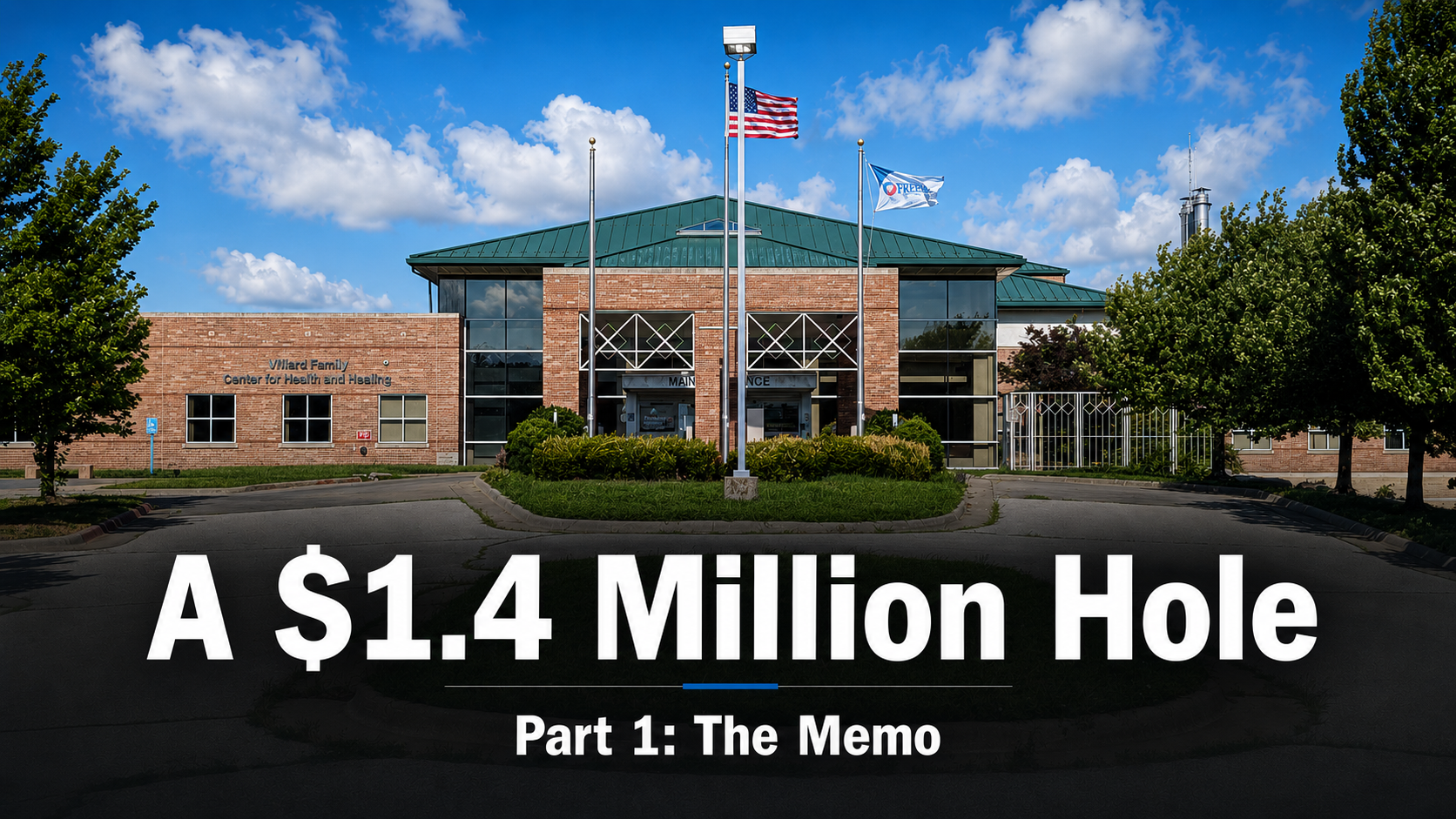
FORT SCOTT, Kan. — An internal memo posted in a local Facebook group last week confirmed weeks of rumors that Bourbon County commissioners are considering legal action to reclaim the former Mercy Hospital building. Until now, commissioners have discussed the matter almost exclusively in executive session.
The memo, authored by Commissioner Gregg Motley, details financial difficulties for building owner Kansas Renewal Institute (KRI) and its primary tenant, Freeman Fort Scott Hospital. It warns that Freeman’s Fort Scott operations are under significant financial strain and face unsustainable losses unless the county implements a plan that involves taking legal action to reclaim the building from owners KRI and Legacy Health.
An Early Warning Sign
Several of the memo’s claims were corroborated by KRI CEO T.J. Denning at a “Capital Update Over Coffee” event hosted by the Fort Scott Chamber of Commerce in late February, weeks before Motley wrote the memo.
Denning told attendees the state had cut KRI’s daily Medicaid reimbursement rate “from about $815 a day to $572,” leaving the organization “losing about $104,000 a month.”
“That’s a big shock to an organization,” he said.
Denning also described KRI’s difficulties getting a 10-bed license from the Kansas Department of Aging and Disability Services (KDADS), saying KRI had tried without success for a year and a half. At the time, he expressed hope of receiving the license within 90 days.
He also spoke about the building’s long history of maintenance issues, saying KRI had bought “a building that had lots of maintenance issues over the years” and was still contending with failing systems.
“We have boiler issues each and every day,” Denning said. “We have chillers that are falling apart with all these things that we put the money back into because I care about the community.”
The Origin of the Memo
In an interview with the Bourbon County Monitor, Motley expanded on the financial issues facing both KRI and Freeman, and why he believes legal action is the commission’s best hope of keeping ER and hospital services in Bourbon County.
Motley said he first learned of KRI’s financial problems at a Feb. 12 meeting of local leaders convened by KRI management to discuss recent difficulties and layoffs.
“(In) February, KRI called prominent citizens of Fort Scott, assembled a group, and assembled the key staff members of KRI,” Motley said. “The topic was KRI needs your help because we are having trouble with the state getting fully licensed…”
KRI management also outlined financial problems Denning would discuss publicly later that month, Motley said.
“They said, ‘We need you to get in touch with anybody you have contacts with and contact the state,’” Motley said.
In response, Motley contacted state Sen. Tim Shallenburger, a longtime friend. He said Shallenburger called back a few days later and told him, “You got problems there. I’m not sure that KRI will ever get fully licensed for the 10 beds.”
“$1.4 Million Is a Big Hole”
Motley said KRI’s inability to license the 10 beds has left both KRI and Freeman in an unsustainable position. He said KRI’s lease with Freeman called for KRI to pay Freeman about $120,000 a month — roughly $1.4 million a year — to manage the beds.
“You do an intake, and generally that’s precipitated by a crisis,” Motley said. “A lot of times, it’s a medical crisis. And so they had an arrangement, an agreement with Freeman to manage those 10 beds for them at a cost to KRI of $1.4 million a year.”
After consulting state agencies, Motley said, both Shallenburger and state Rep. Rick James believe KRI has “no chance” of getting the license, though they have not disclosed why. Without that revenue stream, Motley says Freeman Fort Scott’s chances of achieving financial sustainability are poor. Motley said Shallenburger’s assessment, combined with his own understanding of Freeman’s finances from his time as vice chairman of the hospital’s board, prompted him to ask how to keep Freeman in Fort Scott long term.
“$1.4 million is a big hole,” Motley said. “Having been on the board previously and knowing the numbers, it was, ‘Oh boy, this is bad.’ And then he looped me in with Freeman’s attorney.”
“You Can’t Have a Roof Leak in a Hospital”
That attorney was Pamela Lanier, Freeman Health System’s Director of Government Relations. Motley said he learned from Lanier and other Freeman staff that the hospital had been dealing with roof leaks, HVAC failures and other maintenance problems disrupting operations.
“You can’t have a roof leak in a hospital,” Motley said. “The state will shut you down.”
Motley believes KRI’s difficulty maintaining the building is tied directly to their financial struggles, struggles that have been exacerbated by a large, high-interest mortgage on the building.
A Seven-Figure Mortgage at 13% Interest
Motley’s concerns prompted him to pull all public records on the building’s sale at the Bourbon County Register of Deeds office. There, he found not one but two mortgage agreements.
The first, dated Dec. 20, 2024, was a mortgage for Lots 1 and 2 of the former Mercy Hospital property between Kansas RE Investment Group, representing KRI, and California-based Legacy Health LLC, which shares leadership with the Legacy Healthcare Foundation.
The entire former Mercy Hospital property, along with $2 million in American Rescue Plan Act funds, was donated to Legacy Healthcare Foundation on Nov. 17, 2022, by then-county commissioners Clifton Beth, Jim Harris and Nelson Blythe.
The second agreement, dated Dec. 27, 2024, shows Legacy Health LLC then “flipped” the $2.5 million mortgage with KRI to a California-based company called Pasadena Private Lending.
“Legacy immediately turned around and I would say monetized it. They sold that mortgage, that two and a half million dollar mortgage to Pasadena Private Lending, which is a private equity firm out of California,” Motley said.
In the financial industry, such transactions are often done for cash, Motley said, with the buyer accepting a smaller principal in exchange for a higher interest rate.
“Oftentimes those mortgages are sold at a discount,” he said. “Let’s say the mortgage is $2.5 million and the rate was 5%. They’ll discount it to $2 million and you make the same payments, so the yield goes to 13%.”
After reviewing the documents, Motley said he met with Denning, who told him KRI was making payments on the Pasadena mortgage at a 13% interest rate and had paid Legacy $8.5 million in total for the building — though he did not account for the additional $6 million.
No public records account for the additional $6 million, but Legacy Health Foundation’s 2024 IRS filing reports the building was transferred for $7.5 million — leaving a $1 million gap between the purported purchase price and what was reported to the IRS.
The Memo Is Sent, And The Leaks Begin
What he did not anticipate was that the memo’s contents would be shared with private citizens — including a former elected official with public ties to Legacy Health — before the March 9 meeting even began.
Part 2 will be published on Monday on the Bourbon County Monitor, and Tuesday on FortScott.biz
KRI management was contacted for comment on this series, but did not respond before publication.
Legacy Health management and legal counsel was contacted for comment on this series, but did not respond before publication.
Freeman Health Systems was contacted for this series, and sent a statement that will be included in Part 2.
Public Documents
The public documents referenced in this article are linked below.
- Commissioner Gregg Motley’s hospital memo — the email distributing the memo to commissioners (marked “Attorney-Client Privilege item for distribution”).
- Mortgage — Kansas RE Investment Group (KRI) to Legacy Health LLC — $2.5 million, recorded Dec. 20, 2024 (Bourbon County Register of Deeds, Book 514, Pages 370–380).
- Mortgage assignment — Legacy Health LLC to Pasadena Private Lending — dated Dec. 27, 2024.
- Legacy Health Foundation — 2024 IRS Form 990.
Good article and I’m glad it was posted, but I have a concern with the article, and it is not what it says, but what it doesn’t say. e.g. the 2.5 million dollar grant Freeman was just awarded and for the Fort Scott location not even a 30 days ago.
You can look it up to fact check me.
It’s in 4 states homepage. May 30th, 2026.
ALSO, the article does not say how much revenue KRI takes in per year. That is important too so we can understand what the total picture and problems are. e.g. losing 100,000 a month may not be so catastrophic if they are taking in 1.5 million dollars a month, or 15 million dollars a year.
The math, KRI is losing 243 dollars per day, (as per this article) and that totals to $104,000 per month !!! That is a lot of 243 dollars a day ! See what I mean? I also wonder what Freemans revenues are. I hope part 2 discusses some of this.
Personally, I’d like to see KRI and Freeman Hospital come out winners on this, because we need jobs for our community AND a hospital.
> The math, KRI is losing 243 dollars per day, (as per this article) and that totals to $104,000 per month !!! That is a lot of 243 dollars a day !
I understood that amount to be the amount per patient. $243 x 30 days would be $7,290. So if they were able to break even with 14 kids at the old rate, they would be losing about the stated ~$100,000 per month at the new rate.
It is so sad that this building is in the shape it is I know in the mental health side they have trash cans to catch the rain drops this beautiful building needed to be fixed a long time ago and not let it be let go I agree 100 percent with Gregg Monley we need a hospital and we need the other place for our children and we need mental health this is part of our community please fix the building and get all the problems worked out both me and my husband has used Freeman and I use mental health we need all three of these programs. Thank you
Who actually is the owner of the building now? It seems it’s changed hands so many times!!
It’s owned by KRI, but at least $2.5 million of the mortgage is through Legacy by way of a private equity firm in California.
Based on the public documents available, I believe if KRI defaulted on the mortgage, the building would go back to Legacy and the private equity firm.