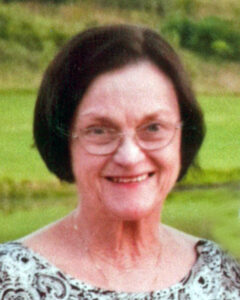
Margaret “Peg” Thorpe, age 73, a resident of Ft. Scott, Kansas, passed away Thursday, February 25, 2021, at the Girard Medical Center in Girard, Kansas. She was born November 7, 1947, in Chicago, Illinois, the daughter of John Howard Raftery and Margaret Montgomery Raftery. Following high school, Peg attended Moser Secretarial School in Chicago. From 1967 to 1969, she served an internship at WGN Radio Station in Chicago. She later served as executive secretary for Midwest Contractor Assoc. in Geneva, Illinois. In 1980, Peg moved to Ft. Scott where she was part owner of the McDonald’s restaurant until 1989. Peg married Wayne Thrope on November 12, 1993, in Ft. Scott. She was a member of the Beta Sigma Phi Sorority, the Red Hat Society and the American Legion Auxiliary. She and her husband, Wayne, also volunteered their time at the Presbyterian Village. Peg enjoyed knitting and reading.
Survivors include her husband, Wayne, of the home; her daughter, Jennifer, Peters, of Leawood, Kansas and three granddaughters, Lydia, Ella and Madeline Anstoetter, all of Leawood. She was preceded in death by her parents, a sister, Kate Rosenthal and a brother, John Raftery.
Rev. Reed Hartford will conduct graveside services at 11:30 A.M. Wednesday, March 3rd at the Evergreen Cemetery. The family will receive friends on Wednesday from 10:30 A.M. until leaving for the cemetery at 11:15 A.M. at the Cheney Witt Chapel. Memorials are suggested to the Shriners Transportation Fund and may be left in care of the Cheney Witt Chapel, 201 S. Main, P.O. Box 347, Ft. Scott KS 66701. Words of remembrance may be submitted to the online guestbook at cheneywitt.com.
TOPEKA – The Kansas Department of Health and Environment (KDHE) has amended its travel quarantine list to include several countries – Mayotte, Czechia, San Marino, Montenegro and Seychelles. The last changes to the travel quarantine list occurred Nov. 17. Kansas has continued to review state and country rates every two weeks; however, no locations have met the threshold for being added to the list until today. The five countries were added to the list due to the countries all having COVID-19 case rates three times Kansas’ numbers.
A comprehensive list of those individuals needing to quarantine includes visitors and Kansans who have:
Traveled on or after Feb. 26 to the countries of Mayotte, Czechia, San Marino, Montenegro or Seychelles.
Attendance at any out-of-state mass gatherings of 500 or more where individuals do not socially distance (6 feet) and wear a mask.
Been on a cruise ship or river cruise on or after March 15, 2020.
The travel quarantine period is seven days with a negative test result or 10 days without testing, with release from quarantine on Day 8 and Day 11, respectively. Further information on quarantine periods can be found on KDHE’s website.
For those traveling internationally, the Centers for Disease Control and Prevention (CDC) is requiring testing within three days of flights into the U.S. For further information on this and other requirements, visit their web page.
“Kansas has seen lower case rates, which has prompted the addition of these five countries that have been experiencing higher case rates,” Dr. Lee Norman, KDHE Secretary, said. “As we start moving into spring, we continue to urge people to avoid travel. And, if you do travel, please take appropriate precautions such as mask wearing, social distancing and practicing good hygiene.”
Health Advisory, Safety Tips Issued During Flint Hills Burning Season
Smoke Modeling Tool to be activated on March 1
TOPEKA – The Kansas Department of Health and Environment (KDHE) reminds Kansans that March and April are a time when large areas of the state’s Flint Hills rangeland are burned. These burns help preserve the tallgrass prairie, control invasive species such as Eastern Red Cedar and Sumac and provide better forage for cattle. Prescribed burning minimizes risk of wildfires and is effective in managing rangeland resources. Smoke from the burns can influence the air quality of downwind areas. The use of smoke management techniques is vital to reduce impacts.
KDHE will activate the Kansas smoke modeling tool on March 1, prior to widespread burning in the Flint Hills. The computer models use fire data and current weather conditions to predict the potential contribution of smoke to downwind air quality problems. There are approximately 2.1 million acres burned on average in the Flint Hills of Kansas and Oklahoma each year.
“We encourage ranchers and land managers to take advantage of this smoke modeling resource to spread out their burns more effectively and mitigate potential air quality impacts,” said Douglas Watson, meteorologist at the KDHE Bureau of Air. “For burns to be safe and effective, weather and rangeland conditions must be ideal. Many landowners will burn at the same time when such conditions are met. Air pollutants from the burns can affect persons in the Flint Hills and can be carried long distances to more populated areas.”
Prescribed burns release large amounts of particulate matter and substances that can form ozone. Particulate matter and ozone can cause health problems, even in healthy individuals. Common health problems include burning eyes, runny nose, coughing and illnesses such as bronchitis. Individuals with respiratory issues, pre-existing heart or lung diseases, children and elderly may experience worse symptoms.
Steps to protect your health on days when smoke is present in your community include:
• Healthy people should limit or avoid strenuous outdoor exercise.
• People with respiratory or heart-related illnesses should remain indoors.
• Help keep indoor air clean by closing doors and windows and running air conditioners with air filters.
• Keep hydrated by drinking lots of water.
• Contact your doctor if you have symptoms such as chest pain, chest tightness, shortness of breath or severe fatigue.
For more information about the burning in the Flint Hills, the Flint Hills Smoke Management Plan, the April burn restrictions and the smoke modeling tool, please visit www.ksfire.org.
The is an image of the proposed micro-meat processing plant. Submitted.
The Fort Scott Planning Commission is meeting at 4 p.m. March 1 at city hall, 123 S. Main, to consider a conditional use permit for property south of the town for a micro-meat processing plant.
The property being considered is south of the Kansas Department of Transportation property, according to the press release from the City of Fort Scott. The K.D.O.T property is south of the LaRoche Baseball Park.
Jody Hoenor, Bourbon County Economic Development Director. Submitted photo.
The Bourbon County Economic Director Jody Hoenor sent the following information on the proposed plant.
“Billy Madison, the owner of W Diamond M Meats, will be seeking the approval of a conditional use permit from City of Fort Scott Commission,” Hoenor said. “He plans to return to his hometown and build a $2.7million micro meat processing plant located approximately two miles outside the city limits of Fort Scott and south of the Fort Scott Industrial Park.”
“The processing plant will add to our efforts in building resilient and self-sustaining food systems,” Hoenor said. “The COVID-19 pandemic highlighted the need for these smaller-scale processing plants, and we are very fortunate to be considered for this expansion. This proposal has potential to help farmers and ranchers with extra supplemental income act as a stimulus for other sectors such as retail trade and services.”
“The site is currently zoned correctly as heavy industrial for use,” she said. “The City of Fort Scott codes requires an additional conditional use permit approval for a meat processing plant to be built.”
The City of Fort Scott Water Department and Codes Enforcment were consulted on sewer and wastewater issues, she said.
“The codes department let us know we would need a conditional use permit to build on the selected site,” Hoener said.
Since July 2020, Madison has been working with Hoener and Bourbon County Economic Development Council Chairs, Steve Buerge (previous), and more recently Gregg Motley, she said.
“It is Madison’s goal is to be a good neighbor, bring above-average wage jobs, and provide value in under-developed land,” Hoenor said. “Financing of the project and acquisition of land is pending approval of the conditional use permit.”
“All impacts on social, economic, and environmental conditions were investigated thoroughly including air and water quality, crime rate, property valuation, wage growth, employment growth, occupational health, and odor,” she said.
“State of the art wastewater system is used to remove suspended matter such as oils and solids,” Hoenor said. “This is measured through biochemical oxygen demand (BOD). The equipment skims any leftover matter and is sold. Bacteria growth is what creates an offensive odor,” she said.”The requirements in cleaning are incredibly stringent and does not allow time for bacteria to grow. As a result, there is no offensive odor in the processing plant.”
“This is a highly regulated industry with a USDA inspector office on sight,” she said. ” It is a requirement in building plans that the USDA inspector has a separate office with his/her own shower. This inspector is on-site at all times while in operation. There are 3-4 additional inspections per month, in order to keep our food safe to consume.”
“There will be no outdoor pens or holding areas for animals, mitigating smell downwind or in the vicinity,” Hoenor said. “Animals are delivered in the very early morning hours and several hours later slaughtered and processed.”
“Letters of support from residential houses in Johnson County and commercial businesses have confirmed the business is a conscientious neighbor,” she said.
In addition, the product can be sold in other states and will bring new jobs.
“W Diamond M Meats is FSIS approved, allowing the meat to be sold across state lines, injecting capital into our economy,” Hoenor said. “This business will bring 30 full-time jobs that pay higher than Bourbon County average. The new construction increases overall county valuation in property and affords the opportunity to reduce the overall tax burden.”
“God will never give us more than we can handle.” It’s a standard answer to anyone in so far over their head that drowning seems inevitable. We share that Bible verse with loved ones in an attempt to let them know that God is in charge, watching patiently, and He will call a time-out when enough is enough. It’s a promise of fairness, and we all like things to be fair, right? (Plus, we feel so spiritually superior when we can spout Scripture.)
The problem is, that phrase does not appear in Scripture. I wish it did. I mean, it sounds helpful, and it certainly offers hope, but it just isn’t something Jesus–or God or the prophets or the disciples–ever said.
The Bible does say that God’s grace is sufficient for us. That we should rejoice during trials. That God comforts us. That we are to be content. The verse that probably comes closest is this one: No temptation has overtaken you that is not common to man. God is faithful, and he will not let you be tempted beyond your ability, but with the temptation he will also provide the way of escape, that you may be able to endure it.
Of course, this really isn’t close. This passage deals with temptations (as in, sins), not trials. Big difference.
The fact is, there is no maximum height of trials over which we are guaranteed we won’t have to jump. So, folks, keep your track shoes laced. I have a few Christian friends whose lives consist of hurdles of Olympic proportions. Physical. Emotional. Mental. Spiritual. They just get a handle on one thing and kapow! Some other bar, higher than the last, appears.
Take, for example, Edith who lives in Salt Lake City. Her first husband died. Together they raised five children: two turned to drugs; one slipped and fell in the hot springs near his home and had third-degree burns from his neck down; one died from complications due to an overuse of meds; and one is normal. Three years ago, Edith met “Ted,” the man of her dreams. They married, and he convinced her to give up her lucrative real estate business so they could travel the world.
A few months ago, Ted kissed his wife good-bye, reminded her not to forget her protein shake when she went to the gym where they both had a membership, and never came home from work. Texts weren’t answered. Nor were phone calls. As it turned out, Ted had “had enough” and split. No reasons given. Edith went into a dark depression from which she just now is recovering.
So, what’s the answer when the news goes from bad to worse to worser? (And yes, I know that’s not a word.) Well, it certainly isn’t to keep our focus on what is going wrong. Let’s refer to Paul who wrote his second letter to the Corinthians with a list of what he had endured: five times whipped with 39 strokes; three times beaten with rods and shipwrecked; pelted with stones; weathered cold, starvation, sleeplessness and nakedness; and lived in constant danger. Yet he’s the one who preached for us to always be content, never complain and trust God.
So, there’s the answer. We need to cling to the only One who can sustain us. The One who will carry us over the hurdles. The One who wants us to be an example of faithfulness to everyone we meet. The One who asks us to count our blessings. The One who promises that one day, this earth will pass away and everything will be glorious.
I kind of like that answer. It sure beats the alternative, don’t you think?
The Kansas Department of Transportation (KDOT) plans on Monday, March 1, to start a resurfacing project on U.S. 69 in Bourbon County. The project begins 2.1 miles north of the Bourbon-Crawford county line and continues north for 3.8 miles.
Project activity includes concrete patching, placement of a one-inch reflective crack interlayer, and a three-inch asphalt overlay. KDOT awarded the construction contract of $3.5 million to Bettis Asphalt & Construction, Inc., of Topeka.
Traffic will be reduced to one lane at the work zone. Work on the project should be completed by mid-August, weather permitting. KDOT reminds drivers to obey the signs and traffic control devices, and to slow down. Persons with questions may contact Public Affairs Manager Priscilla Petersen, (620) 902-6433.
Fort Scott Community College announces the fall 2020 honor roll! Fall 2020 came with some challenges with new COVID regulations and format changes to the learning process, but our Hounds rose above and made it happen. We have 224 students on the honor roll for fall 2020.
“We are very proud of the academic success of all our students. Many students overcome great hurdles to make us proud by demonstrating success both inside and outside of the classroom“, says Adam Borth, Vice President of Academic Affairs.
Great job Greyhounds!
The honor roll system has three main levels:
Honor Roll (3.5-3.74) 71 students
Vice President’s Honor Roll (3.75-3.99) 63 students
Larry Wayne Porter, 78, of Fort Scott, passed away Tuesday evening, February 23, 2021, at the Horton House in Fort Scott, Kansas. He was born June 14, 1942, in Hastings, Nebraska the son of Harry Edward and Thelma (Chenoweth) Porter. He married Georgia Paulette Kersbergen September 7, 1963, and she preceded him in death September 6, 2000. He married Susan Marie Daly February 5, 2002, and she survives of the home.
Larry served in the US Army for six years with three years in Germany as a Radio Teletype Operator. He worked in management and sales in the auto industry. Larry was a member of Grace Baptist Tabernacle. He loved his family, and he loved bowling and golf.
In addition to his wife Susan, Larry is also survived by his daughter Holly Fisher and husband Roger, of Wichita, Kansas; his stepchildren, Lynna and Larry Myer of Lancaster, Kansas, Troy and Rebecca Landers, and Jeff and Julie Daly, all of Fort Scott; a step-daughter-in-law, Jackie Hereford; a grandchild, Josh Fischer of Wichita, Kansas; nine step-grandchildren, Dalton Landers, Jake and Cindy Hereford, Emma Daly, all of Fort Scott, Noah Daly of Pittsburg, Kansas, Jacob and Baylee Graham of Pleasanton, Kansas, Hunter Landers, Hayden Landers, both of Lansing, Kansas, Ashton and Kierstin DeNoon of Olathe, Kansas, and Lisa and Shawn Rice of Kansas City, Missouri; and six great-grandchildren.
He was preceded in death by his parents, all of his brothers and sisters, a stepson, Danny Hereford, and his first wife, Georgia.
Following cremation, the family will hold private services at a later date under the direction of the Konantz-Cheney Funeral Home. Condolences may be submitted to the online guestbook at konantz-cheney.com.
Lots of furniture will be for sale at the Presbyterian Village auction on Feb. 27 Submitted photos.
The COVID-19 Pandemic has set individuals and groups rethinking fundraising ideas.
This is true for Fort Scott Presbyterian Village, which will have its’ annual fundraising auction this Saturday, Feb. 27 at the former Gordman’s store, 2400 S. Main. The auction begins at 10 a.m.
Hand-made quilts will be auctioned at the sale. Submitted photos.
“Traditionally, the auction is known for a great crowd, good food, and lots of good deals,” said Executive Director Ginger Nance. “This year, the need remains for financial support for the Good Samaritan Program and other resident-centered programs. However, the auction looks different this year. We will not provide food or raffles or any of the usual festivities.”
Cast iron and other pans will be offered at auction. Submitted photos.
The auction helps fund programs to benefit the elderly residents who live at the assisted living facility.
Crystal and other glassware will be offered at auction. Submitted photos.
“The 2021 auction benefits resident programs at Fort Scott Presbyterian Village,” Nance said. “Our mission is to provide quality senior services guided by Christian values. Sincethe beginning of the pandemic, we have had to pivot and rethink the way we serve the mission and how the community can interact with our mission.”
Dining tables will be auctioned. Submitted photos.
“Due to the pandemic, our campus has really limited the public’s access and even at times restricted the access of visitors and guests,” she said. “We have to be incredibly careful in keeping our residents and staff safe. So, the auction items moved out of our storage and to a place where folks can go.”
The auction has been moved to the former Gordman’s building on South Main Street, in between Hibbits and Tractor Supply stores.
Beds, dressers, chests of drawers, nightstands will be offered at auction. Submitted photos.
The auction is usually in May, but this year will be February 27.
“Everyone’s lives have changed because of the pandemic and so have schedules,” Nance said. “The collection of items has been growing since late 2019 in preparation for the 2020 event. Imagine our collection now…almost a year and a half later. We are busting at the seams. By moving the auction site, it allows allof the stored items to be removed so access to resident vehicles is easy. As they say, the show must go on. So February is as good of a time as any. We just hope the weather is good and people are understanding.”
Crockery and other kitchen items will be for sale. Submitted photos.
The Village received grant funds to help with COVID-19 issues.
The facility received Strengthening People and Revitalizing Kansas grant money in the fall of 2020 in the amount of $84.000
“With the help of leadership at our home office, Fort Scott Presbyterian Village submitted an application in August of 2020 for Personal Protection Equipment, technology enhancement for screening and resident communication, staffing, and testing expenses,” Nance said. “We were also able to use the funds to facilitate safe visiting for family members, four stations have been established inside doorways of the community and set up with coffee machines, rolling carts, trash cans, and tables for visitation. There are also enhancements for the life enrichment team to have a rolling station of activities for residents.”
“The staffing dollars allocated helped us with payroll for employees that traditionally work in one department but are needed in other areas to assist,” she said. “It also helped with payroll for employees that were exposed to COVID while working. The SPARK money has been a blessing beyond measure! It has allowed for PPE, testing, monitoring, infection control, and reopening supplies to be purchased and available at all times for staff and residents use to keep everyone safe to the best of our ability.”
“We are grateful to have the assistance of the PMMA organization to secure grants and other stimulus money that has helped us during such a challenging time in health care,” she said.
“It is important to recognize the amazing support from donors, volunteers, and families who have given donations to the Presbyterian Village and our system and I cannot thank those donors enough! It truly takes a ‘village’ of people to pull together during challenging times.”
“We have a great community of people who have given crafts, books, hobby items and financial donations to help keep our residents engaged during what seemed like a very long year of social distancing,” she said.
“Our team’s energy and focus is committed to serving our seniors in the best possible way and without God and the assistance of our supportive community we couldn’t be successful,” Nance said.
Kansas Corporation Commission directs Evergy to put distributed generation customers back on a two-part residential electric rate
TOPEKA — This morning, the Kansas Corporation Commission (KCC) issued an Order directing Evergy to put its residential distributed generation (DG) customers back on a two-part standard residential rate design eliminating a controversial demand charge. DG customers produce their own energy, primarily using solar panels, and connect to Evergy’s grid for additional power if needed.
The Commission originally approved the current three-part rate design for residential DG customers in September 2018 as part of a Westar (now Evergy) rate case. The Sierra Club and Vote Solar, who were parties to the docket, filed an appeal. In April of last year, the Kansas Supreme Court reversed the judgment of the Court of Appeals and the Commission, calling the three-part design price discriminatory and sending the matter back to the KCC for further proceedings.
In issuing today’s Order, the Commission rejected two alternate proposals from Evergy to recoup DG customer costs that the Company claims are not captured in the standard residential rate. The first proposal called for the implementation of a grid access fee of $3.00 per kW of installed DG capacity. The alternative called for a $35 minimum monthly bill for all residential customers. As a result of today’s Commission action, rates for standard residential and DG residential customers will be identical, at least until Evergy’s next scheduled rate case in 2023.
“Many states, including Kansas, are struggling to appropriately value residential DG resources, while ensuring those customers pay their fair share to support the grid. Evergy’s proposals weren’t the right way to address these concerns under current law, but the issue won’t go away. We need to look for new solutions,” said KCC Chairperson Andrew French.
The Commission encouraged Evergy to explore modern rate designs that address the DG subsidization issue in future rate cases. The Commission also encouraged all stakeholders that participated in the proceeding to explore legislative changes to modernize Kansas’ net metering laws and other statutes.
USDA Offers Disaster Assistance to Farmers and Livestock Producers in
Kansas Impacted by Recent Winter Storms
Manhattan, Kansas, Feb.25, 2021 – The U.S. Department of Agriculture (USDA) provides technical and financial assistance to help Kansas farmers and livestock producers recover from damages brought on by winter storms Uri and Viola. Agricultural producers are encouraged to contact their local USDA Service Center to learn about the programs available to help them recover from crop, land, infrastructure, and livestock losses.
“These recent winter storms have taken their toll on farmers and ranchers in Kansas,” said Charles Pettijohn, acting state executive director for USDA’s Farm Service Agency (FSA) in Kansas. “We stand with our producers who have worked tirelessly in these severe conditions to keep livestock fed and to protect crops from Mother Nature’s wrath. We know these storms have left damage in their wake, and I’m glad that USDA offers as strong portfolio of disaster assistance programs available to help.”
Disaster Assistance
USDA encourages farmers and ranchers to contact the FSA county office at the local USDA Service Center to apply for eligible programs and to learn which documents, such as farm records, herd inventory, receipts and pictures of damages or losses should be provided to help expedite assistance.
Producers who experience livestock deaths due to the winter storms may be eligible for the Livestock Indemnity Program. Meanwhile, the Emergency Assistance for Livestock, Honeybees, and Farm-Raised Fish Programprovides eligible producers with compensation for feed and grazing losses. For LIP and ELAP, producers will need to file a notice of loss for livestock and grazing or feed losses within 30 days and honeybee losses within 15 days.
Additionally, eligible orchardists and nursery tree growers may be eligible for cost-share assistance through the Tree Assistance Program (TAP) to replant or rehabilitate eligible trees, bushes or vines lost during the winter storms. This complements Noninsured Crop Disaster Assistance Program (NAP) or crop insurance coverage, which covers the crop but not the plants or trees in all cases. For TAP, a program application must be filed within 90 days.
FSA also offers a variety of direct and guaranteed loans, including operating and emergency loans, to producers unable to secure commercial financing. Producers in counties with a primary or contiguous disaster designation may be eligible for low-interest emergency loansto help them recover from production and physical losses. Loans can help producers replace essential property, purchase inputs like livestock, equipment, feed and seed, cover family living expenses or refinance farm-related debts and other needs.
Risk Management
Producers who have risk protection through Federal Crop Insurance or FSA’s NAP should report crop damage to their crop insurance agent or FSA office. If they have crop insurance, producers should report crop damage to their agent within 72 hours of damage discovery and follow up in writing within 15 days. For NAP covered crops, a Notice of Loss (CCC-576) must be filed within 15 days of the loss becoming apparent, except for hand-harvested crops, which should be reported within 72 hours.
“Crop insurance and other USDA risk management options are there to help producers manage risk because we never know what nature has in store for the future,” said Collin Olsen, director of RMA’s Regional Office that covers Kansas. “The Approved Insurance Providers, loss adjusters and agents are experienced and well trained in handling these types of events.”
USDA’s Natural Resources Conservation Service (NRCS) also offers programs to help in the recovery process. The Environmental Quality Incentives Program (EQIP) can help producers plan and implement conservation practices on farms, ranches and working forests impacted by natural disasters.
All USDA Service Centers are open for business, including those that restrict in-person visits or require appointments. All Service Center visitors wishing to conduct business with NRCS, FSA, or any other Service Center agency should call ahead and schedule an appointment. Service Centers that are open for appointments will pre-screen visitors based on health concerns or recent travel, and visitors must adhere to social distancing guidelines. Visitors are also required to wear a face covering during their appointment. Our program delivery staff will continue to work with our producers by phone, email, and using online tools. More information can be found at farmers.gov/coronavirus.
#
USDA is an equal opportunity provider, employer, and lender.